
Street Light Pole Spacing Calculation: Quick Rules, Required Inputs, and DIALux Checks
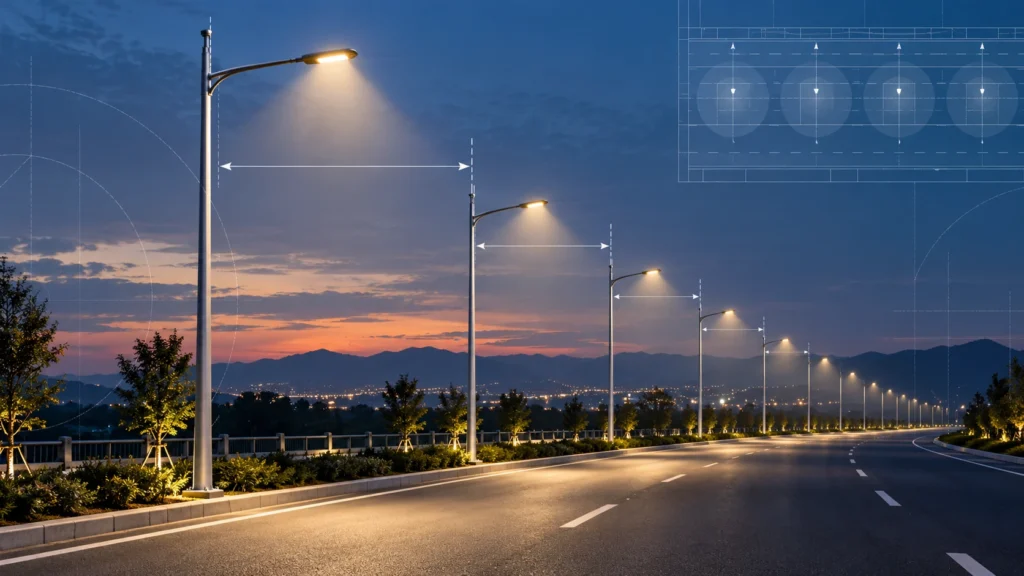
Quick Answer Street light pole spacing can be estimated with Sâ‚€ = H × R, where Sâ‚€ is the preliminary spacing, H is the luminaire mounting height, and R is a spacing-to-height test ratio. For early comparison, engineers may model R = 3.0, 3.5, and 4.0 under the same road and luminaire conditions. These are […]
Solar Street Light Dimming Profiles for Tenders: Cost, Autonomy & Acceptance
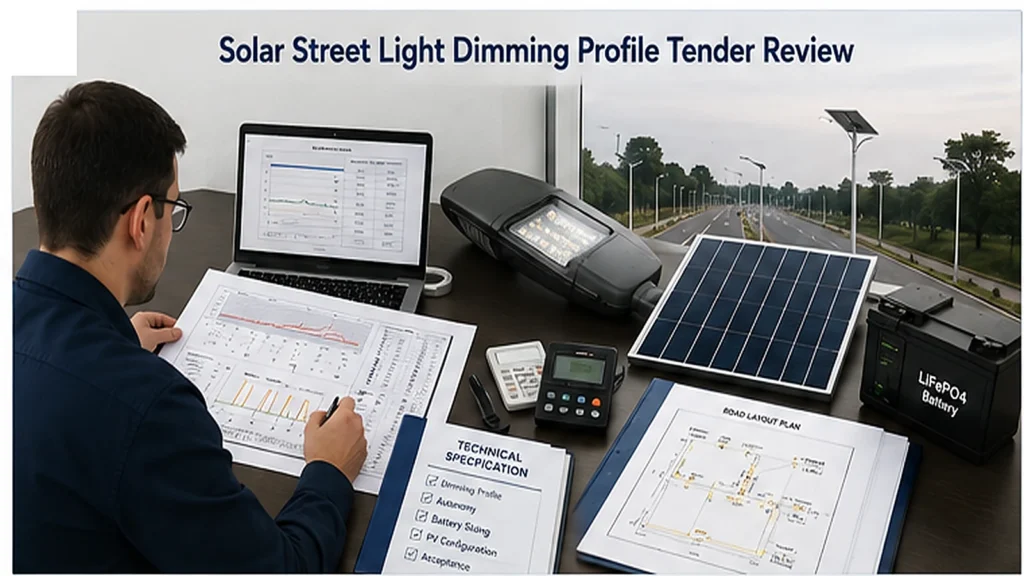
A solar street light dimming profile for a tender should define each operating stage, its duration, output level, time reference, sensor behavior, low-battery override, and acceptance method. The same approved profile should be used in the supplier’s load calculation, battery and photovoltaic module sizing, factory controller settings, site commissioning, and final handover. Dimming can reduce […]
Anti-Theft Design for Off-Grid Solar Street Lighting Tenders
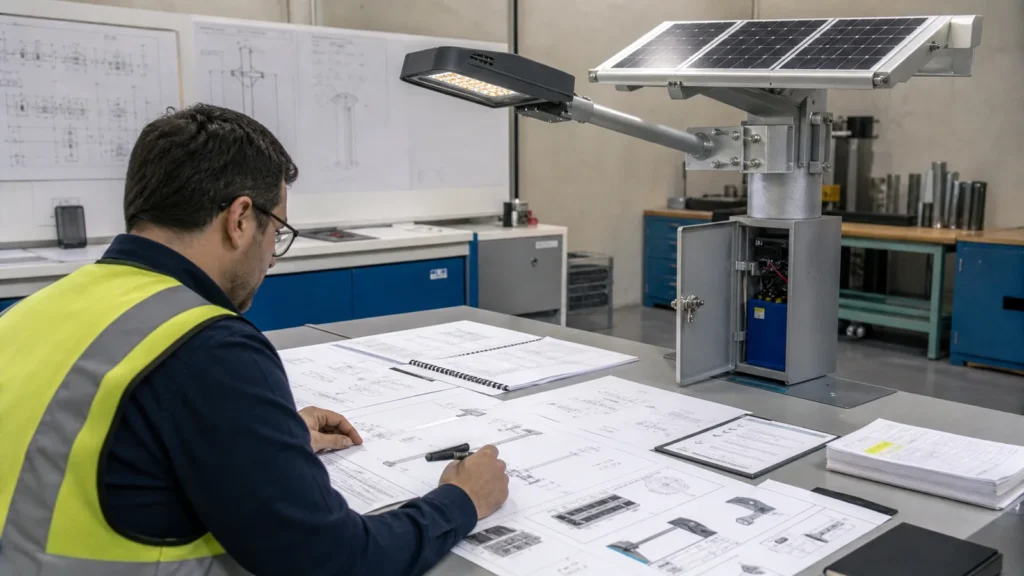
A generic statement such as “anti-theft design required” is not enough. It does not allow an EPC contractor, municipal buyer, NGO project team, or engineering consultant to compare battery placement, PV module fasteners, controller access, cable routing, or maintenance procedures between suppliers. The objective is not to make every component permanently inaccessible. A complete anti-theft […]
High Mast Lighting BOQ Checklist for EPC Tender Projects

Quick Answer A high mast lighting BOQ should not only list poles and luminaires. It should connect each line item to drawings, datasheets, IES/LDT files, DIALux evidence, foundation inputs, electrical scope, commissioning records and handover documents. For EPC contractors, consultants, municipal owners, ports, airports, industrial facilities and project buyers, the BOQ is a scope-control document. […]
High Mast Lighting Tender Specification Guide: BOQ, Drawings, IES, Foundation and Acceptance Documents

Quick Answer A high mast lighting tender should define not only pole height and luminaire wattage, but also BOQ scope, drawings, photometric files, structural inputs, lowering-system requirements, commissioning evidence and handover documents. For EPC contractors, consultants, municipal owners, port operators, airport facilities and industrial project teams, the purpose of a tender specification is to make […]
High Mast Lighting Installation & Commissioning Checklist: Foundation, Pole Erection, Aiming and Handover

Quick Answer High mast lighting installation and commissioning should be reviewed as an evidence chain, not as a public step-by-step construction tutorial. For EPC contractors, consultants and project owners, the purpose is to prove what was approved, what was delivered, what was installed, what was tested, what failed, what was corrected and what was handed […]
High Mast Lighting Lowering System Guide: Winch, Wire Rope, Luminaire Ring and Maintenance Review

Quick Answer A high mast lighting lowering system allows the luminaire ring or carrier to be lowered to ground level for inspection and service. It typically includes a headframe, luminaire ring, winch or drive unit, hoist wire ropes, sheaves, latch or locking devices, power cable, connectors, controls, limit devices and grounding or bonding provisions. The […]
High Mast Pole Foundation & Wind Load Guide: Anchor Bolts, Base Plate and Structural Review
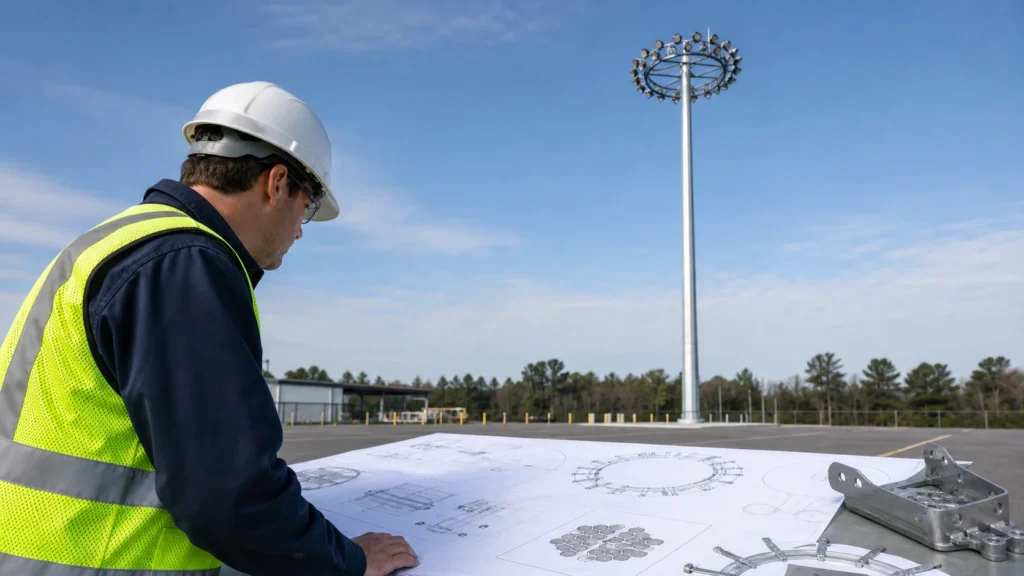
Quick Answer High mast pole foundation size, anchor bolts, base plate thickness and wind-load resistance cannot be selected from pole height alone. A 25m, 30m or 35m high mast pole does not have one universal foundation size. The correct foundation and base connection must be reviewed using project-specific wind criteria, soil and geotechnical data, pole […]
High Mast LED Retrofit Guide: Replacing Metal Halide and HPS Systems

Quick Answer High mast LED retrofit should not be handled as a simple wattage swap. A 1000W metal halide, 1500W HID or HPS high mast light cannot be reliably replaced by choosing a fixed LED equivalent from a generic chart. The correct LED retrofit solution depends on the existing system input power, current lighting performance, […]
High Mast Light Wattage Guide: 400W, 600W, 800W & 1000W Selection

Quick Answer High mast light wattage should not be selected by watts alone. A 400W, 600W, 800W or 1000W LED high mast light may be suitable for different projects depending on the required maintained lighting level, rated luminaire lumens, luminaire efficacy, optical distribution, candela intensity in the required aiming direction, pole height, pole spacing, aiming […]