

Quick Answer
A high mast lighting tender should define not only pole height and luminaire wattage, but also BOQ scope, drawings, photometric files, structural inputs, lowering-system requirements, commissioning evidence and handover documents.
For EPC contractors, consultants, municipal owners, port operators, airport facilities and industrial project teams, the purpose of a tender specification is to make bids comparable and technically reviewable. A complete specification should connect the project requirement to supplier evidence and site acceptance records.
The tender should clarify what must be supplied, what must be submitted, what must be reviewed before production, what must be verified during installation, and what must be handed over for long-term operation and maintenance.
This guide is not a copy-paste legal tender template. It is a technical review guide for preparing or checking high mast lighting specifications before RFQ, procurement, installation and commissioning.
The clauses, tables and checklists in this guide are for engineering review and tender preparation. They must be adapted to the project location, governing standards, employer requirements, consultant instructions and local procurement rules.
Project Review Summary
| Item | Tender Review Point |
|---|---|
| Main Topic | High mast lighting tender specification and RFQ review |
| Best-Fit Users | EPC contractors, consultants, municipal owners, ports, airports, industrial owners and procurement teams |
| Main Question | What should be included in a high mast lighting tender specification? |
| Main Risk | Only specifying pole height and wattage, while missing BOQ scope, drawings, IES/LDT files, DIALux basis, foundation inputs, lowering system and acceptance records |
| Required Tender Areas | Pole, mast structure, luminaires, optics, photometry, foundation inputs, lowering system, electrical system, controls, commissioning, handover and O&M |
| Supplier Evidence | Datasheets, drawings, IES/LDT files, DIALux report, structural input package, lowering-system manual, wiring diagram, commissioning checklist and warranty/O&M documents |
| Acceptance Evidence | Inspection records, night measurement if required, commissioning records, as-built documents, NCR closure and handover package |
| Commercial Value | Helps buyers compare bids, reduce unclear scope, avoid missing documents and prepare for installation, commissioning and maintenance |
What a High Mast Lighting Tender Should Define
A high mast lighting tender should define the full technical scope, not only the visible products.
At minimum, the specification should answer these questions:
- What area must be illuminated?
- What application is involved: road, port, airport apron, yard, logistics area, mining site, stadium or industrial facility?
- What lighting performance must be achieved?
- What pole height range or height constraint is expected?
- What luminaire performance and optical files are required?
- What drawings must the supplier submit?
- What structural inputs must be reviewed?
- What foundation and anchor interface data are required?
- What lowering system is required?
- What electrical, SPD, grounding and control scope is included?
- What installation and commissioning evidence is required?
- What handover and O&M documents must be delivered?
- Which documents are required at bid stage, technical review stage, before production, before shipment and at handover?
A weak tender often says:
Supply high mast pole and LED lights according to project requirement.A stronger tender defines:
scope + performance criteria + submittals + drawings + structural inputs + photometric files + acceptance records + handover documentsThe goal is not to make the tender longer. The goal is to make it reviewable.
High Mast Tender Evidence Chain
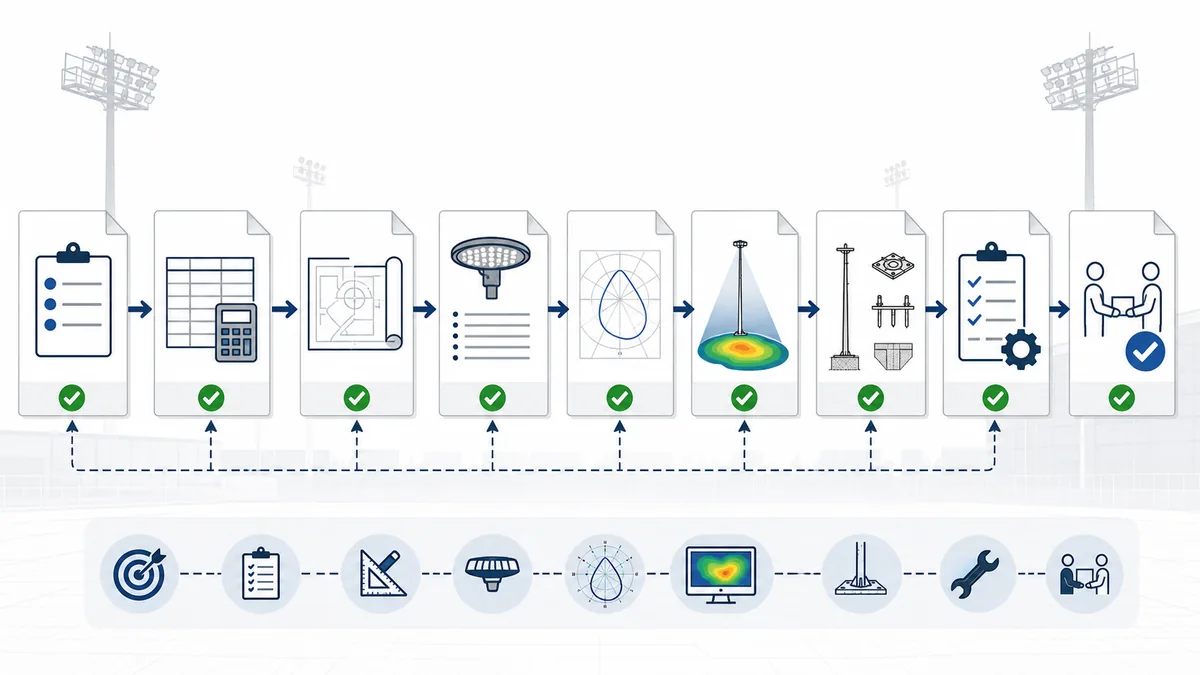
A tender specification should connect project requirements to reviewable evidence. The evidence chain should be clear before quotation, not created after disputes appear during installation or handover.
Project requirements
-> BOQ scope
-> Supplier drawings
-> Luminaire datasheets
-> IES/LDT files
-> DIALux report
-> Structural inputs
-> Lowering-system documents
-> Electrical and control documents
-> Installation and commissioning records
-> Handover and O&M package
If one link in this chain is missing, bids may become difficult to compare. For example, a BOQ that lists only "high mast light" without optic, IES/LDT file, pole drawing, lowering-system scope and commissioning record cannot be reviewed with the same confidence as a complete tender package.
High Mast Tender Scope Matrix
| Tender Area | What to Specify | Supplier Evidence | Acceptance Record |
|---|---|---|---|
| Project application | Road, port, airport, yard, industrial, stadium or other use | Application-specific proposal | Scope confirmation |
| Lighting performance | Required lux, uniformity, glare or other project criteria | DIALux report, calculation assumptions | Night measurement or acceptance record if required |
| Pole / mast | Height, material, sections, base plate, coating, access door and interface | Pole drawing, datasheet, structural document where required | Delivery inspection and installation record |
| Luminaire | Wattage range, lumen output, efficacy, optic, CCT, CRI, IP/IK and control compatibility | Luminaire datasheet, test report, IES/LDT file | Model verification and commissioning record |
| Photometry | IES/LDT file, optic code, aiming schedule and calculation basis | IES/LDT file, DIALux report, aiming table | As-built aiming record |
| Foundation input | Wind design basis, EPA, pole reactions, anchor layout and base plate data | Structural input package, base plate drawing, anchor bolt layout | Foundation interface review |
| Lowering system | Winch, wire rope, luminaire ring, latch, headframe, trailing cable, controls and tools | Lowering-system drawing, manual, component data | SAT / commissioning record |
| Electrical | Cable, cabinet, SPD, breaker, grounding, control circuit and protection | Wiring diagram, SPD details, cabinet layout | Electrical test / inspection record |
| Controls | Timer, photocell, dimming, smart control or remote monitoring requirement | Control datasheet, profile setting, platform scope if applicable | Control commissioning record |
| Installation | Erection interface, inspection hold points and responsibility boundary | Method documentation by qualified parties where required | Installation inspection record |
| Commissioning | Functional tests, electrical tests, lowering-system checks, night verification if required | Commissioning checklist | Signed commissioning report |
| Handover | As-built, O&M manual, warranty, spares, training and maintenance log | Handover package | Owner acceptance record |
BOQ Items for High Mast Lighting Projects

A BOQ should not be a simple product list. It should connect each item to a specification, drawing, quantity, interface and acceptance requirement.
For high mast lighting, BOQ gaps often appear around accessories and interface items. The tender may list poles and luminaires but miss anchor bolts, lowering-system components, trailing cables, electrical cabinet, SPD, special tools, manuals, commissioning and handover records.
BOQ Item Checklist
| BOQ Item | What to Include | Common Missing Detail |
|---|---|---|
| High mast pole | Height, shaft type, sections, material, coating, base plate, access door | Base plate details, access door position, coating requirement |
| Luminaire | Model, power setting, lumen output, optic, CCT, CRI, IP/IK, mounting method | Optic code, IES/LDT match, control setting |
| Luminaire bracket / headframe | Mounting arrangement, number of fittings, tilt interface | Aiming support, bracket drawing |
| Luminaire ring / carriage | Ring structure, fixture positions, balancing requirements | Compatibility with luminaires and cable routing |
| Winch / lowering device | Manual, portable or integrated motorized scope; operating interface | OEM manual, rated capacity basis, tools |
| Wire rope / cable system | Quantity, routing, inspection requirement, OEM basis | Inspection record and replacement boundary |
| Latch / locking system | Engagement requirement and service boundary | Acceptance evidence and manual |
| Trailing cable | Type, routing, connection and strain relief | Compatibility with lowering movement |
| Electrical cabinet | Enclosure, breakers, contactors, protection, labels | Cabinet layout and wiring diagram |
| SPD | Surge protection requirement and replacement access | SPD rating basis and inspection record |
| Grounding / bonding | Project-defined grounding and bonding requirement | Test record and authority requirement |
| Control system | Timer, photocell, dimming, smart control or remote monitoring | Control profile, communication scope |
| Anchor bolts / template | Anchor bolt layout, template, nuts, washers, protection | Interface with foundation design |
| Foundation interface data | Pole reactions, base plate drawing, anchor layout | Structural input package |
| Documentation | Datasheets, drawings, manuals, IES/LDT, DIALux, O&M | Submission timing |
| Commissioning | Tests, records, night verification if required | Checklist and acceptance signature |
| Spares and tools | Critical spares, special tools, maintenance accessories | Quantity and custody responsibility |
| Warranty | Warranty term, conditions, claim process | Exclusions and documentation requirement |
If the BOQ cannot be matched back to drawings, datasheets, photometric files and acceptance records, it will be difficult to evaluate bids fairly.
Do Not Specify as Universal Values
A tender writer may want fast numbers, but high mast lighting values are project-specific. Many errors begin when a value from one project is copied into another project without review.
| Avoid Writing as a Fixed Universal Value | Better Tender Wording |
|---|---|
| Fixed pole height | Define required lighting performance, site geometry, height constraints and authority requirements. |
| Fixed luminaire wattage | Require photometric evidence, lumen output, optic code, IES/LDT file and approved luminaire schedule. |
| Fixed foundation depth | Require project-specific structural design inputs, soil data where available and approved foundation drawings. |
| Fixed wind speed | Refer to the governing local code, employer requirement and project wind-load basis. |
| Fixed anchor bolt size | Require anchor layout, base plate drawing and qualified structural review where applicable. |
| Fixed base plate thickness | Require pole supplier drawing and project structural review. |
| Fixed lux / uniformity target | Define lighting criteria by owner, consultant, local authority or applicable project standard. |
| Fixed DIALux acceptance value | Define calculation basis, acceptance criteria and review responsibility in the project specification. |
| Fixed grounding value | Refer to local electrical code, project earthing design and qualified electrical review. |
| Fixed lowering-system rope diameter | Require OEM design basis, manual and inspection records instead of public universal values. |
| Fixed warranty period | Define warranty scope, exclusions and claim process according to procurement requirements. |
| Fixed installation method | Require qualified installation procedures and acceptance records, not a public step-by-step method in the specification guide. |
Pole Height, Mast Structure and Material Requirements
A high mast tender may include an expected pole height, but pole height should be treated as part of the lighting and structural design process.
The tender should define:
- Application area.
- Expected mounting height or height constraints.
- Quantity or preliminary layout.
- Required lighting performance.
- Wind design basis required by the project.
- Corrosion environment.
- Material and coating requirement.
- Access door and cable entry requirement.
- Base plate and anchor interface requirement.
- Drawings and structural documents required from the supplier.
The tender should not use one global height rule for all sites. A port yard, highway interchange, stadium, airport apron and industrial storage yard may require different heights, optics, pole spacing and maintenance access.
Pole and Mast Specification Table
| Requirement Area | What the Tender Should Define | Supplier Evidence |
|---|---|---|
| Pole height | Required height, permitted range or consultant-defined height | Pole drawing and lighting design support |
| Shaft type | Project-approved mast form, section arrangement and access requirements | Pole datasheet and drawing |
| Material | Steel grade or project-required material standard | Material statement or supplier document |
| Coating | Hot-dip galvanizing, paint system or corrosion protection requirement | Coating specification or certificate where required |
| Base plate | Dimensions, holes, interface and drawing requirement | Base plate drawing |
| Access door | Door location, size and protection requirement | Pole drawing |
| Wind input | Code, wind speed basis, exposure and design responsibility | Structural calculation or input package if required |
| EPA / load | Luminaire, bracket, ring and accessory wind area/load inputs | Datasheets and structural input |
| Anchor interface | Anchor layout and template requirement | Anchor bolt layout and template drawing |
| Transport / assembly | Section delivery, site assembly and documentation | Packing and assembly notes |
For foundation and structural inputs, review the High Mast Pole Foundation & Wind Load Guide.
Luminaire, Wattage, Optic and IES/LDT Requirements
A tender should not specify high mast luminaires only by wattage.
Wattage is an electrical input. It does not define lighting distribution, uniformity, glare control, mounting compatibility, aiming or energy performance. A complete tender should require the supplier to connect each luminaire to its datasheet, optic, IES/LDT file and lighting design.
The tender should define or request:
- Luminaire type.
- Power setting or allowable wattage range.
- Lumen output.
- Efficacy basis.
- Optical distribution.
- IES or LDT photometric file.
- CCT.
- CRI.
- IP and IK requirement.
- Driver and control compatibility.
- SPD / surge protection requirement if inside luminaire.
- Mounting bracket compatibility.
- Heat dissipation and housing material.
- Certification or test evidence where required by the project.
- Warranty conditions.
Luminaire Specification Matrix
| Tender Item | What to Specify | Supplier Evidence | Acceptance Link |
|---|---|---|---|
| Wattage | Power setting or allowable range | Datasheet | BOQ and electrical load |
| Lumen output | Initial or maintained output basis if required | Test data / datasheet | Lighting calculation |
| Optic | Beam distribution or optic code | IES/LDT file | DIALux and aiming schedule |
| CCT / CRI | Project-required values | Datasheet | Visual and compliance review |
| IP / IK | Project-required protection level | Datasheet / test evidence | Delivery inspection |
| Driver | Dimming, surge and control compatibility | Driver specification | Functional commissioning |
| Mounting | Bracket, aiming and ring compatibility | Drawing | Installation record |
| Control | Timer, dimming, smart control or monitoring interface | Control setting or communication document | Control commissioning |
| Warranty | Period, conditions and exclusions | Warranty document | Handover package |
If a bidder proposes an equivalent luminaire, the tender should require equivalent evidence, not just an equivalent wattage.
For power selection logic, review the High Mast Light Wattage Guide.
Lighting Design and DIALux Submission Requirements

High mast lighting tenders should define how lighting performance will be demonstrated.
For many projects, this means requiring a lighting calculation package, commonly using DIALux or an equivalent lighting design tool accepted by the project. The tender should not treat a DIALux report as a standalone guarantee. It should define the design basis and the documents that must match.
A lighting submission should connect:
project area and criteria
-> luminaire model
-> optic code
-> IES/LDT file
-> pole height
-> pole layout
-> aiming schedule
-> DIALux report
-> acceptance method
DIALux and Photometric Submission Checklist
| Submission Item | What It Should Show | Why It Matters |
|---|---|---|
| Project layout | Calculation area, mast positions and relevant boundaries | Confirms the design basis |
| Lighting criteria | Lux, uniformity, glare or other required criteria | Defines what the design must meet |
| Luminaire model | Exact proposed model and power setting | Links calculation to supplied product |
| IES/LDT file | Photometric file matching optic and luminaire | Prevents calculation/product mismatch |
| Pole height | Mounting height used in calculation | Links to mast specification |
| Aiming schedule | Tilt, rotation and target direction | Supports installation and re-aiming |
| Calculation grid | Grid, plane and assumptions | Supports review by consultant/owner |
| Maintenance factor | Project-defined assumption if required | Prevents misleading results |
| Obstruction assumptions | Project-specific objects or exclusions | Avoids false performance expectations |
| Report version | Revision and date | Supports tender clarification and final acceptance |
The tender should clearly state who defines the lighting criteria: owner, consultant, local authority, project standard or employer requirement.
For simulation support, review DIALux Simulation Outputs and IES Photometric Files.
Foundation, Anchor Bolt and Wind Load Inputs
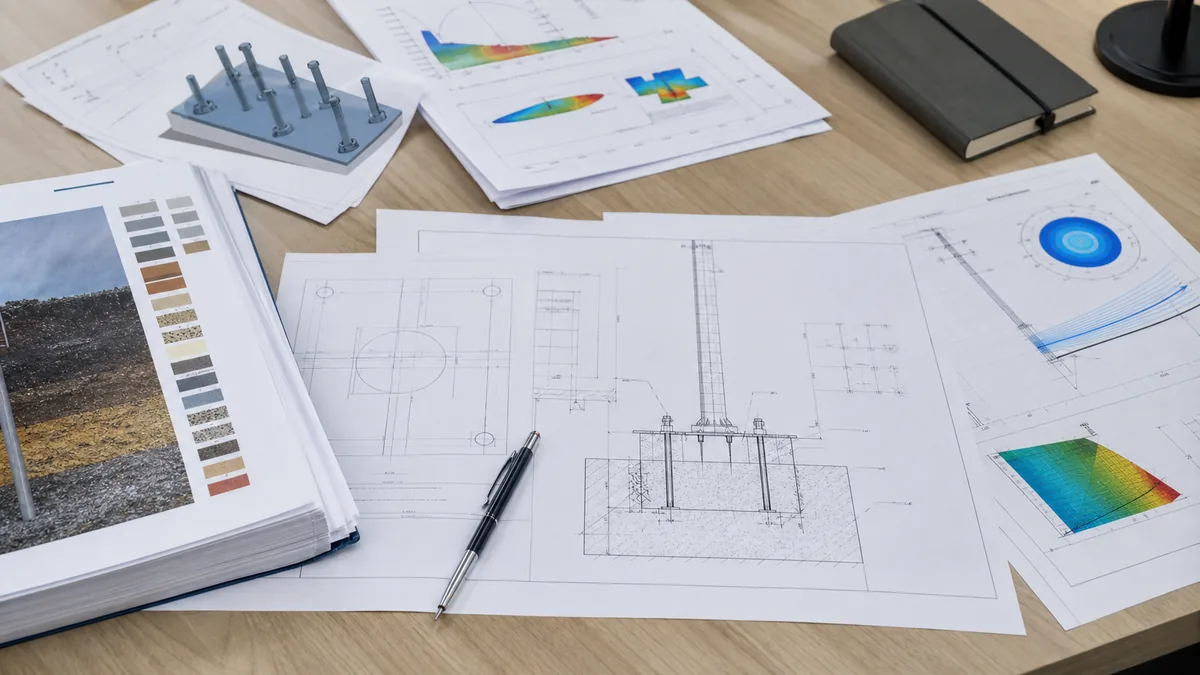
A high mast tender should not provide a universal foundation size. Foundation design depends on project location, wind basis, soil condition, pole height, luminaire configuration, EPA, structural reactions and local authority requirements.
The tender should define what structural information is required and who is responsible for review.
Typical tender requirements may include:
- Project wind design basis.
- Local code or authority requirement.
- Soil or geotechnical information if available.
- Pole height and configuration.
- Luminaire quantity, mass and EPA.
- Headframe or luminaire ring arrangement.
- Lowering-system load inputs.
- Base plate drawing.
- Anchor bolt layout.
- Pole reaction data.
- Foundation interface responsibility.
- Qualified structural review where required.
Foundation and Wind Load Input Table
| Input | Why It Matters | Supplier Evidence |
|---|---|---|
| Project location | Affects wind, corrosion and authority requirements | Project data confirmation |
| Wind basis | Defines structural design input | Structural design statement or project document |
| Soil data | Supports foundation coordination | Geotechnical report if available |
| Pole height | Affects overturning and bending | Pole drawing |
| Luminaire quantity | Affects load and EPA | BOQ and datasheet |
| Luminaire EPA | Affects wind load | Datasheet / structural input |
| Luminaire ring / headframe | Affects load distribution | Drawing |
| Base plate | Defines foundation interface | Base plate drawing |
| Anchor bolt layout | Supports civil design and installation | Anchor drawing / template |
| Pole reactions | Supports foundation design | Structural input package |
| Corrosion environment | Affects coating and material protection | Project environment statement |
| Responsibility boundary | Defines who designs and approves foundation | Tender clause / consultant review |
The tender should not state a foundation dimension copied from another project unless it has been reviewed for the actual site.
Lowering System and Maintenance Access Requirements
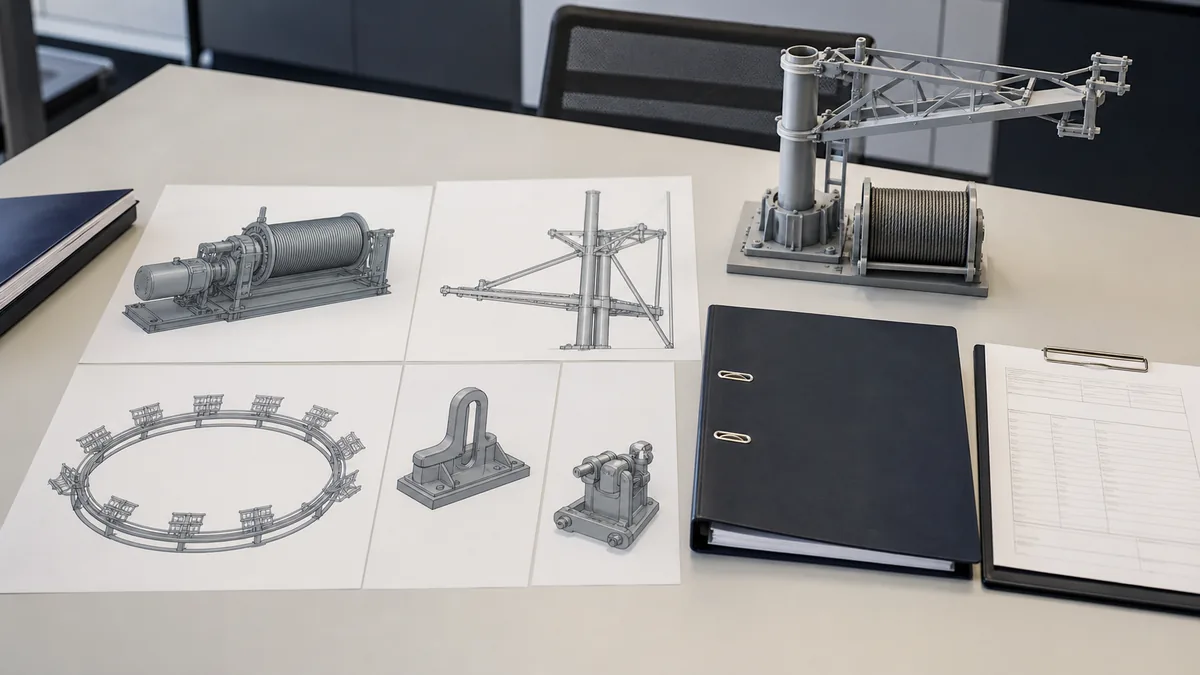
Many high mast systems use a lowering system so that the luminaire ring can be serviced at ground level under approved procedures. Tender specifications should define this system clearly because it affects maintenance, safety, commissioning and handover.
The tender may need to define:
- Type of lowering system.
- Manual, portable drive or integrated motorized scope.
- Luminaire ring / carriage arrangement.
- Winch or drive system.
- Wire rope system.
- Sheaves / pulleys.
- Latch / locking system.
- Headframe.
- Trailing cable.
- Control box.
- Safety and limit functions where applicable.
- Maintenance tools.
- Spare parts.
- OEM manual.
- Inspection and commissioning record.
Lowering-System Tender Requirement Table
| Component | Tender Requirement | Supplier Evidence | Acceptance Record |
|---|---|---|---|
| Luminaire ring / carriage | Capacity, fixture positions, balance and compatibility | Ring drawing | Visual and functional inspection |
| Winch / drive | Type, operating scope and OEM basis | Winch datasheet/manual | Functional commissioning record |
| Wire rope | OEM-based design and inspection requirement | Supplier document / manual | Inspection record |
| Sheave / pulley | Routing and compatibility | Component drawing | Inspection record |
| Latch / lock | Engagement requirement and safety boundary | Manual / drawing | Commissioning evidence |
| Headframe | Structural and mechanical interface | Drawing | Installation inspection |
| Trailing cable | Routing, strain relief and compatibility | Electrical/mechanical drawing | Functional record |
| Control box | Operating interface and protection | Control document | Test record |
| Tools and spares | Maintenance readiness | Tool/spare list | Handover record |
| O&M manual | Qualified maintenance reference | Manual | Handover package |
The tender should not include public troubleshooting instructions such as how to release a stuck ring, adjust wire rope, repair a winch or bypass a safety device.
For system-level review, see the High Mast Lighting Lowering System Guide.
Electrical, SPD, Grounding and Control Requirements
Electrical scope should be clear before bidding. Otherwise, suppliers may quote different assumptions for cables, cabinets, surge protection, grounding, controls and site wiring responsibility.
The tender should define:
- Power supply.
- Voltage and frequency.
- Electrical cabinet scope.
- Cable scope.
- SPD requirement.
- Grounding and bonding requirement.
- Breakers, contactors and protection devices.
- Timer, photocell, dimming or smart control.
- Remote monitoring if required.
- Control cabinet environment.
- Labeling and circuit identification.
- Testing and commissioning records.
- Responsibility boundary between supplier, EPC installer and owner.
Electrical Specification Table
| Electrical Area | What to Specify | Supplier Evidence | Acceptance Record |
|---|---|---|---|
| Power supply | Voltage, frequency and supply boundary | Electrical design confirmation | Energization record |
| Cabinet | Enclosure, protection, layout and labeling | Cabinet drawing | Inspection record |
| SPD | Surge protection requirement and location | SPD datasheet | Inspection / replacement record |
| Grounding / bonding | Project-defined requirement and test standard | Grounding detail if applicable | Test record |
| Cable | Cable scope, route boundary and termination | Cable schedule / wiring diagram | Installation record |
| Breaker / protection | Protection devices and coordination boundary | Electrical datasheet | Functional test |
| Control | Timer, dimming, photocell or smart platform | Control setting document | Control commissioning |
| Smart monitoring | Communication, platform access and alarm scope | System proposal | Platform acceptance record |
| Labels | Asset ID, cabinet ID and circuit ID | Label schedule | Site verification |
| As-built wiring | Final installed circuit record | As-built drawing | Handover document |
Do not use a universal grounding resistance value in the tender unless it comes from the project specification or local electrical requirement.
Installation and Commissioning Evidence
Tender specifications should define what evidence is required before the high mast lighting system is accepted.
This does not mean the tender should become an installation method statement. The tender should state what records must be provided and which parties must witness or approve them.
Typical commissioning evidence may include:
- Delivery inspection record.
- Foundation interface release record.
- Pole and base plate inspection.
- Luminaire model verification.
- IES/LDT and aiming schedule traceability.
- Electrical test record.
- SPD and grounding record.
- Lowering-system functional record.
- Control system test record.
- Night performance verification if required.
- NCR and corrective-action closure.
- Final handover package.
Commissioning Evidence Table
| Evidence | Purpose | When to Review |
|---|---|---|
| Delivery inspection | Confirms supplied items match BOQ and drawings | Before installation |
| Foundation interface record | Confirms civil interface is ready | Before erection |
| Pole inspection | Confirms mast, base plate, access door and coating condition | Before and during installation |
| Luminaire verification | Confirms model, optic and quantity | Before commissioning |
| Aiming schedule | Confirms installed orientation matches design | During aiming / commissioning |
| Electrical test record | Confirms qualified electrical checks | Before energization / acceptance |
| Lowering-system record | Confirms functional and safe handover evidence | During commissioning |
| Control test | Confirms timer, dimming, smart control or monitoring | During commissioning |
| Night verification | Confirms lighting condition if required | Before acceptance |
| NCR closure | Confirms defects were corrected | Before handover |
For detailed acceptance planning, use the High Mast Lighting Installation & Commissioning Checklist.
Handover Documents and O&M Requirements

A tender should define the handover package before the project starts. If O&M documents are not required in the tender, they are often difficult to recover after installation.
The handover package should support future operation, maintenance, warranty claims and retrofit review.
Handover and O&M Document Checklist
| Handover Document | Why It Matters |
|---|---|
| As-built layout | Locates each mast and circuit |
| Pole drawing | Supports structural and maintenance reference |
| Base plate and anchor drawing | Supports foundation and future inspection |
| Luminaire model list | Supports replacement and warranty |
| Serial number list if required | Supports asset traceability |
| IES/LDT file record | Supports photometric traceability |
| DIALux report | Supports design and tender record |
| Aiming schedule | Supports re-aiming after service |
| Wiring diagram | Supports electrical maintenance |
| Control setting record | Supports dimming and smart control maintenance |
| Lowering-system manual | Supports qualified maintenance |
| Spare-parts list | Supports O&M planning |
| Special tools list | Prevents maintenance delays |
| Training record | Confirms handover to O&M team |
| Warranty document | Supports claim process |
| Maintenance checklist | Standardizes future inspections |
| Commissioning report | Confirms accepted system condition |
For long-term maintenance planning, review the High Mast Light Maintenance Guide.
Responsibility Matrix: Buyer, Consultant, EPC and Supplier
High mast tenders become unclear when responsibility is not defined. A specification should clarify which party provides inputs, reviews documents, installs equipment, approves deviations and signs acceptance records.
Responsibility Matrix
| Stage | Buyer / Owner | Consultant | EPC / Installer | Supplier | Required Record |
|---|---|---|---|---|---|
| Project requirement | Defines application, site and employer requirements | Interprets technical criteria | Confirms constructability if involved | Reviews feasibility | Project brief / RFQ |
| Lighting criteria | Confirms required performance | Defines lux, uniformity, glare and calculation basis | Supports site data | Provides lighting proposal | Lighting criteria statement |
| BOQ review | Approves scope | Checks completeness | Prices and executes scope | Confirms supply scope | BOQ clarification |
| Product submittal | Reviews commercial and operational fit | Reviews technical compliance | Reviews installation interface | Submits datasheets and drawings | Submittal register |
| Photometric design | Confirms project use | Reviews DIALux/IES assumptions | Confirms site layout | Submits DIALux/IES/aiming | Lighting design submission |
| Structural input | Provides site requirements | Reviews structural basis | Coordinates foundation works | Submits pole and load inputs | Structural input record |
| Electrical scope | Confirms power/control requirement | Reviews electrical criteria | Installs and tests | Provides cabinet/control documents | Electrical submittal |
| Installation | Provides access and acceptance process | Witnesses key stages if required | Performs installation | Supports installation documentation | Site inspection record |
| Commissioning | Accepts final system | Witnesses tests if required | Performs tests | Supports product/system checks | Commissioning report |
| Handover | Takes over O&M documents | Reviews completeness | Delivers as-built records | Provides manuals, warranty and spares | Handover package |
This matrix should be adapted to each contract model. In some projects, the EPC contractor may own more responsibility; in others, the consultant or owner may directly review supplier submittals.
Deviation and Approved Equivalent Review
Many tenders allow approved equivalents. This is practical, but it can create risk if the equivalent is judged only by brand or wattage.
A deviation should be reviewed through evidence.
Deviation / Approved Equivalent Matrix
| Requirement | Proposed Deviation | Required Evidence | Approval Authority | Acceptance Impact |
|---|---|---|---|---|
| Luminaire wattage | Different wattage proposed | Datasheet, lumen output, IES/LDT, DIALux comparison | Consultant / owner | Lighting performance and electrical load |
| Optic | Different beam distribution | IES/LDT and aiming comparison | Consultant / lighting reviewer | Uniformity, glare and spill light |
| Pole height | Different mast height | Updated lighting design and structural review | Consultant / owner | Coverage, glare, wind load, foundation |
| Pole material/coating | Alternative material or coating | Material and coating evidence | Consultant / owner | Durability and corrosion resistance |
| Lowering system | Different winch/ring/latch arrangement | Drawing, manual, capacity basis, O&M evidence | Consultant / owner | Maintenance and safety boundary |
| SPD / electrical | Different protection device | Datasheet and electrical compatibility | Electrical reviewer | Surge protection and serviceability |
| Foundation interface | Different base plate or anchor layout | Structural input and drawing | Structural reviewer | Foundation coordination |
| Control system | Different dimming or monitoring platform | Control document and access requirements | Owner / consultant | O&M and monitoring acceptance |
| Warranty | Different warranty terms | Warranty document and exclusions | Owner / procurement | After-sales risk |
| Documentation | Missing or alternative document | Submittal clarification | Owner / consultant | Handover completeness |
The tender should define how deviations are submitted, reviewed, approved and recorded.
Common Tender Specification Mistakes
| Mistake | Why It Creates Risk | Better Tender Requirement |
|---|---|---|
| Only specifying wattage | Wattage does not define lighting performance | Require lumen output, optic, IES/LDT and DIALux report |
| Copying fixed values from another tender | Site conditions and authority requirements may differ | Define project-specific criteria and review basis |
| Missing IES/LDT requirement | Lighting calculation cannot be verified | Require photometric files matching the proposed luminaire |
| DIALux report not linked to BOQ | Proposed product may not match calculation | Require model, optic and power setting traceability |
| No aiming schedule | Installation cannot reproduce the design | Require aiming table and as-built aiming record |
| Missing foundation inputs | Civil team cannot coordinate foundation design | Require pole reactions, base plate and anchor layout |
| Fixed foundation size in tender | Foundation may not fit actual soil and wind conditions | Require project structural review |
| Missing lowering-system requirements | Maintenance strategy becomes unclear | Specify winch, ring, rope, latch, manual and handover tools |
| No SPD or grounding scope | Electrical bids become incomparable | Define electrical protection and test evidence |
| No commissioning evidence | Acceptance becomes subjective | Require test records and handover checklist |
| No handover document requirement | Future maintenance becomes difficult | Require O&M manual, as-built, spares and warranty |
| No deviation process | Approved equivalents become uncontrolled | Require evidence and approval record |
Supplier Submittal Checklist
A supplier submittal checklist helps the buyer compare bids and prevents document gaps before production.
Supplier Submittal Checklist
| Submittal | Required Purpose | When to Submit |
|---|---|---|
| Company profile / project capability | Confirms supplier suitability if required | Bid stage |
| Product datasheet | Confirms model and technical parameters | Bid stage / technical review |
| Pole drawing | Confirms height, sections, base plate and access details | Technical review |
| Base plate and anchor layout | Supports foundation coordination | Technical review |
| Luminaire datasheet | Confirms wattage, lumen, optic, protection and control | Bid stage / technical review |
| IES/LDT file | Supports lighting calculation | Technical review |
| DIALux report | Demonstrates lighting performance | Technical review |
| Aiming schedule | Supports installation and as-built verification | Before installation |
| Lowering-system drawing | Confirms ring, winch, wire rope, latch and interface | Technical review |
| Lowering-system manual | Supports qualified operation and maintenance | Before handover |
| Electrical wiring diagram | Supports electrical review and installation | Technical review |
| SPD details | Confirms surge protection scope | Technical review |
| Control system document | Defines timer, dimming, smart control or monitoring | Technical review |
| BOQ compliance sheet | Confirms quoted scope | Bid stage |
| Deviation list | Identifies exceptions or approved equivalent requests | Bid stage |
| Installation support document | Defines support and responsibility boundary | Before installation |
| Commissioning checklist | Defines acceptance evidence | Before commissioning |
| O&M manual | Supports maintenance | Handover |
| Spare-parts list | Supports lifecycle planning | Handover |
| Warranty document | Defines after-sales responsibility | Bid stage / handover |
| Test reports / certificates | Supports compliance where required | Technical review / before shipment |
| Packing list | Confirms shipment scope | Before shipment |
| As-built documents | Records final installed condition | Handover |
The tender should state which submittals are mandatory and which are required only if applicable.
RFQ Information Buyers Should Provide
A supplier can prepare a better high mast proposal when the RFQ contains enough project information.
Buyer RFQ Input Checklist
| Buyer Input | Why It Matters |
|---|---|
| Project location | Defines wind, corrosion, authority and logistics requirements |
| Application area | Port, road, airport, yard, industrial or stadium use affects layout and optics |
| Site drawings | Supports DIALux layout and pole positioning |
| Area dimensions | Defines calculation area and coverage |
| Required lighting criteria | Defines lux, uniformity, glare or special requirements |
| Existing pole layout if any | Supports retrofit or replacement review |
| Preferred pole height | Must be checked against lighting and structural requirements |
| Power supply | Affects electrical cabinet, cable and control design |
| Control requirement | Affects timer, dimming, smart control or monitoring scope |
| Wind requirement | Supports structural input |
| Soil / foundation data | Supports civil coordination |
| Corrosion environment | Affects coating and material protection |
| Maintenance requirement | Affects lowering system, tools, spares and O&M planning |
| Installation responsibility | Defines who installs and commissions |
| Documentation requirement | Defines submittals and handover package |
| Tender deadline | Defines document support priority |
| Acceptance method | Defines commissioning and night verification requirements |
| Warranty requirement | Defines after-sales and spare-parts planning |
If the buyer cannot provide all inputs, the tender should identify assumptions and require technical clarification before final approval.
Tender Evaluation Checklist
A tender evaluation checklist helps the owner, consultant or EPC team compare technical bids.
Tender Evaluation Checklist
| Review Item | Pass | Clarify | Reject Trigger |
|---|---|---|---|
| BOQ completeness | All key items and accessories included | Minor missing item can be clarified | Major scope missing |
| Product traceability | Model, datasheet and BOQ match | Model naming unclear | Product not identifiable |
| Photometric file | IES/LDT matches proposed luminaire and optic | File version unclear | No photometric file |
| DIALux report | Criteria, layout, model and assumptions are clear | Minor assumption unclear | Report not linked to product or site |
| Pole drawing | Height, sections, base plate and access details shown | Some dimensions missing | No drawing or wrong height |
| Structural inputs | Wind basis, EPA, reactions or required data submitted | Responsibility boundary unclear | No structural input where required |
| Foundation interface | Base plate and anchor layout provided | Template details unclear | No anchor/base interface data |
| Lowering system | Ring, winch, rope, latch and manual defined | Component brand/details unclear | Lowering system omitted where required |
| Electrical scope | Cabinet, SPD, grounding, controls and wiring boundary defined | Cable scope unclear | Major electrical scope excluded |
| Commissioning plan | Test records and acceptance evidence defined | Witness responsibility unclear | No commissioning evidence |
| Handover package | Manuals, as-built, spares, warranty and O&M documents included | Submission timing unclear | Handover documents missing |
| Deviation list | Deviations are declared with evidence | Supporting evidence incomplete | Hidden deviation or non-compliant substitute |
| Warranty | Term, coverage and exclusions are clear | Claim process unclear | Warranty absent or inconsistent |
| Maintenance support | Spares/tools/manuals included where required | Spare quantity unclear | No O&M support for critical system |
A bid can be commercially attractive but technically incomplete. The tender evaluation should separate price comparison from evidence review.
Request High Mast Tender Document Support
This guide explains what a high mast tender should request and review. Sunlurio's engineering support team can help prepare project-specific BOQ, drawings, photometric files, supplier submittal checklists and handover document packages.
Need a project-specific tender document package? Request Sunlurio engineering support for BOQ review, drawings, IES/LDT files, DIALux coordination, foundation input coordination, lowering-system documentation and supplier submittal preparation.
Send us your project location, application area, drawings, required lighting criteria, preferred pole height, power supply, wind requirement, foundation information, maintenance requirement and tender deadline.
Sunlurio can support:
- High mast BOQ review.
- Tender specification review.
- Luminaire datasheet and model matching.
- IES/LDT file coordination.
- DIALux report support.
- Pole drawing and foundation input coordination.
- Lowering-system document review.
- Supplier submittal checklist planning.
- Commissioning and handover document checklist.
- RFQ clarification support.
High Mast Tender Documents and BOQ Support
Additional support pages:
Related High Mast Lighting Guides
Use these guides to review each part of the high mast tender specification:
- High Mast Lighting Systems
- High Mast Lighting Design Guide
- High Mast Pole Foundation & Wind Load Guide
- High Mast Lighting Lowering System Guide
- High Mast Lighting Installation & Commissioning Checklist
- High Mast Light Maintenance Guide
- High Mast LED Retrofit Guide
- High Mast Light Wattage Guide
- High Mast Lighting Level Specification Guide
- High Mast Lighting Layout Patterns
Frequently Asked Questions
What should be included in a high mast lighting tender specification?
A high mast lighting tender should include BOQ scope, pole and mast requirements, luminaire requirements, IES/LDT files, DIALux submission requirements, foundation and wind-load inputs, lowering-system requirements, electrical and control scope, commissioning evidence, handover documents, warranty and O&M requirements.
What BOQ items are commonly missing in high mast lighting tenders?
Common missing items include anchor bolt templates, base plate drawings, luminaire ring, winch, wire rope, trailing cable, electrical cabinet, SPD, control system, special tools, spare parts, commissioning records and O&M documents.
Should a high mast tender require IES or LDT files?
Yes, if lighting performance must be reviewed. IES or LDT files should match the proposed luminaire, optic and power setting. They should connect to the DIALux report, aiming schedule and tender lighting criteria.
Is a DIALux report required for high mast lighting tenders?
Many high mast projects require a lighting calculation report. The tender should define whether DIALux or an equivalent accepted software is required, what criteria must be used and what assumptions must be shown.
Should pole height and wattage be fixed in the tender?
They may be stated as project requirements or constraints, but they should not be copied from another project without review. Pole height and wattage should be checked against lighting performance, wind load, maintenance access, site layout and authority requirements.
What foundation and wind-load information should be requested?
The tender should request the wind design basis, project location, pole height, luminaire and accessory loads, EPA, base plate drawing, anchor bolt layout, pole reactions and foundation interface information where required.
What should suppliers submit for the lowering system?
Suppliers should submit lowering-system drawings, winch or drive details, wire rope and ring information, latch/locking description, control interface, OEM manual, tools/spare list and commissioning/handover records where applicable.
What commissioning evidence should be required before acceptance?
The tender may require delivery inspection, foundation interface release, pole inspection, luminaire verification, electrical test records, SPD/grounding records, lowering-system functional records, control testing, night verification if required, NCR closure and final handover documents.
What handover documents should be included for high mast lighting projects?
Handover documents should include as-built layout, pole drawings, base plate and anchor drawings, luminaire model list, IES/LDT file record, DIALux report, aiming schedule, wiring diagram, control settings, lowering-system manual, spare-parts list, warranty and maintenance checklist.
How should bidders handle approved equivalents or deviations?
Bidders should declare deviations clearly and provide evidence such as datasheets, drawings, IES/LDT files, DIALux comparison, structural inputs and warranty documents. The owner or consultant should approve deviations before acceptance.
Should a tender specification include warranty and spare-parts requirements?
Yes. Warranty, spare parts, special tools, O&M manuals and service support should be defined in the tender so that bidders include lifecycle support instead of only initial supply.
Is this a copy-paste high mast lighting tender template?
No. This guide is a tender review guide. It helps buyers understand what should be specified and reviewed. Final tender wording should be prepared according to project requirements, local authority rules, employer requirements and qualified professional review.
Can this guide be used as a tender template?
This guide can be used as a review framework, but it should not be copied as a legal tender template without project-specific review. Final tender wording should be adapted to the project location, governing standards, employer requirements, procurement rules and qualified professional recommendations.
Engineering References
The following references are useful background sources for high mast lighting tender, inspection, commissioning and documentation thinking. They should not be treated as universal specifications. Project contracts, local authority requirements, employer requirements and qualified professional review take precedence.
- Tata Chemicals Tender for High Mast Lighting System - useful as an example of real procurement intent for high mast lighting systems.
- IIIT Delhi Tender for High Mast Lighting - useful as an example of institutional high mast lighting tender documentation.
- MEMS Generic Technical Specifications - 40m High Mast LED Retrofits - useful background for submittals, IES/LDT files, lighting simulation and warranty evidence in retrofit specifications.
- Transnet / eTenders High Mast Specification - useful as a procurement example for high mast equipment and materials.
- WisDOT Structure Inspection Manual - High Mast Lighting - useful background for high mast structures as inspected assets, including poles, foundations, anchors and related systems.
- PennDOT High Mast Lighting Test Form CS-4225F - useful background showing formal test record concepts for high mast lighting.
- IDOT Roadway Lighting Construction Inspectors Checklist - useful background for construction inspection, documentation and punch-list thinking.
- DIALux Official Website - useful background for DIALux as a lighting design and calculation tool.