
Quick Answer
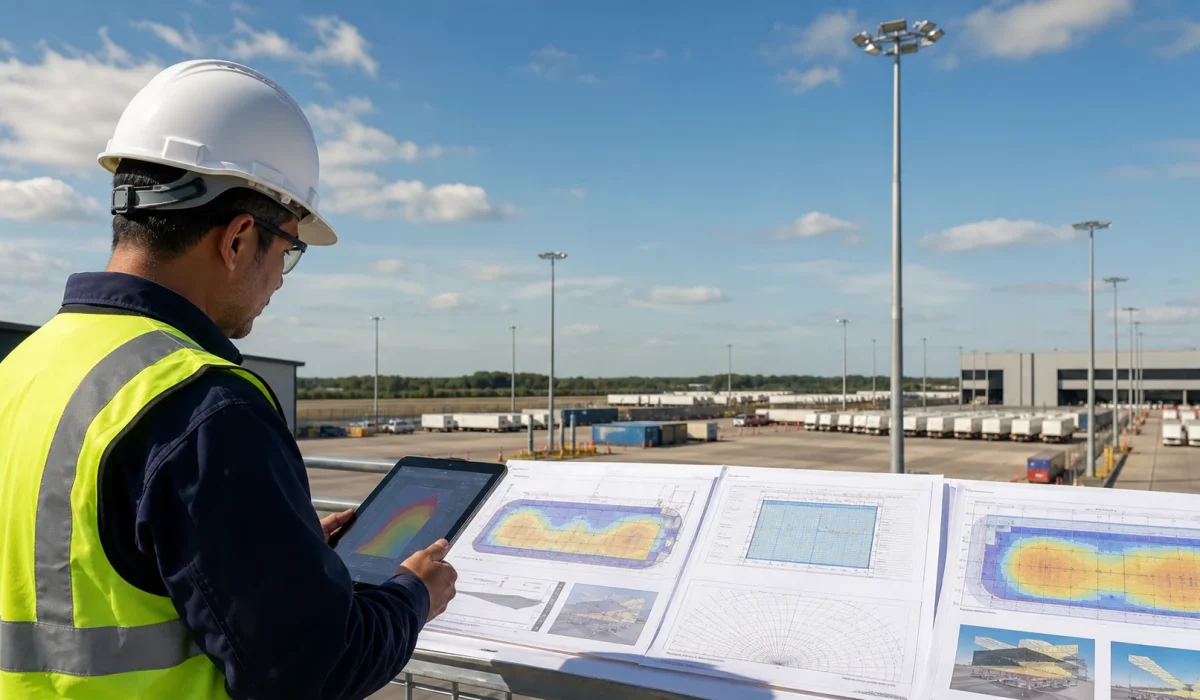
High mast lighting levels should not be selected from a single generic lux table.
A professional specification should define the required lighting metric, calculation area, calculation plane, maintained value, minimum value, uniformity target, glare requirement, and source of acceptance criteria for each project zone.
For many outdoor infrastructure projects, the question is not simply:
How many lux do we need?
A better question is:
Which maintained lighting metric should be specified for this application, this task area, and this authority requirement?
A logistics yard, marine cargo-transfer area, highway interchange, toll plaza, airport apron, mining yard, parking area, and security boundary may all require different design criteria. Some zones may be reviewed by maintained horizontal illuminance. Others may require vertical illuminance, roadway luminance, glare limits, CCTV visibility, task-plane measurements, or authority-specific criteria.
This guide explains how to specify high mast lighting levels without turning preliminary planning values into false universal standards.
Project Review Summary
| Item | Project Review Point |
|---|---|
| Main Topic | High mast lighting level specification |
| Main Question | How should maintained lighting levels, uniformity, and calculation criteria be specified? |
| Best-Fit Projects | Logistics yards, ports, container terminals, industrial yards, parking areas, roads, toll plazas, mining yards, airport service areas, and municipal infrastructure |
| Main Decision | Define the correct lighting metric and acceptance criteria for each application or zone |
| Key Metrics | Maintained illuminance, minimum illuminance, uniformity, vertical illuminance, roadway luminance, glare, and task-plane measurements |
| Main Risk | Using one horizontal average lux value for an entire project without checking task zones, legal minima, glare, or uniformity |
| Typical Project Stage | RFQ preparation, tender review, photometric design, DIALux simulation, and consultant submission |
Why This Is a Specification Guide, Not a Universal Lux Table
Many project teams search for a simple answer such as:
- logistics yard lux level;
- port yard lighting lux;
- parking area high mast lux;
- highway interchange lighting lux;
- industrial yard lighting level.
The problem is that a single number can be misleading.
For example, a port project may include open circulation roads, container storage, cargo-transfer working areas, security boundaries, inspection zones, crane operation areas, and gate facilities. These zones should not be specified with one generic lux value.
A roadway project may not be judged only by horizontal lux. It may also require roadway luminance, uniformity, veiling luminance, glare review, and transition-zone evaluation.
A security gate may need vertical visibility for CCTV or identification, while a storage yard may focus mainly on maintained horizontal illuminance and uniformity.
Therefore, this article does not claim that one application always needs one fixed lux value. Instead, it explains how to define the correct lighting level requirement for each zone.
Horizontal Lux Is Only One Design Metric
Horizontal maintained illuminance is important, but it is not the complete design basis for every high mast lighting project.
Some projects also need:
| Metric | What It Reviews | Typical Use |
|---|---|---|
| Maintained horizontal illuminance | Light reaching a ground or working plane | Yards, parking areas, general outdoor work zones |
| Minimum illuminance | Darkest point in the calculation area | Uniformity and safety review |
| Vertical illuminance | Light reaching vertical surfaces such as people, equipment, signage, or CCTV subjects | Gates, security zones, pedestrian areas, CCTV review |
| Roadway luminance | Brightness of the road surface as seen by drivers | Roadway and interchange lighting |
| Veiling luminance or glare metric | Disability glare and visibility reduction | Roads, ramps, toll plazas, operator zones |
| Task-plane illuminance | Light measured on the actual work surface or task surface | Cargo handling, maintenance, inspection, and specific work activities |
| Spill light or boundary light | Light outside the project boundary | Residential-adjacent, roadway-adjacent, airport-adjacent, or environmental-sensitive sites |
A project that satisfies average horizontal lux may still fail if vertical visibility, glare, task-plane lighting, or uniformity is poor.
Surface reflectance is especially important when evaluating roadway luminance, perceived brightness, vertical visibility, or models that include reflected light. It is not the main driver of a simple direct horizontal illuminance result in the same way that fixture photometry, mounting height, aiming, and calculation geometry are.
Initial Illuminance vs Maintained Illuminance
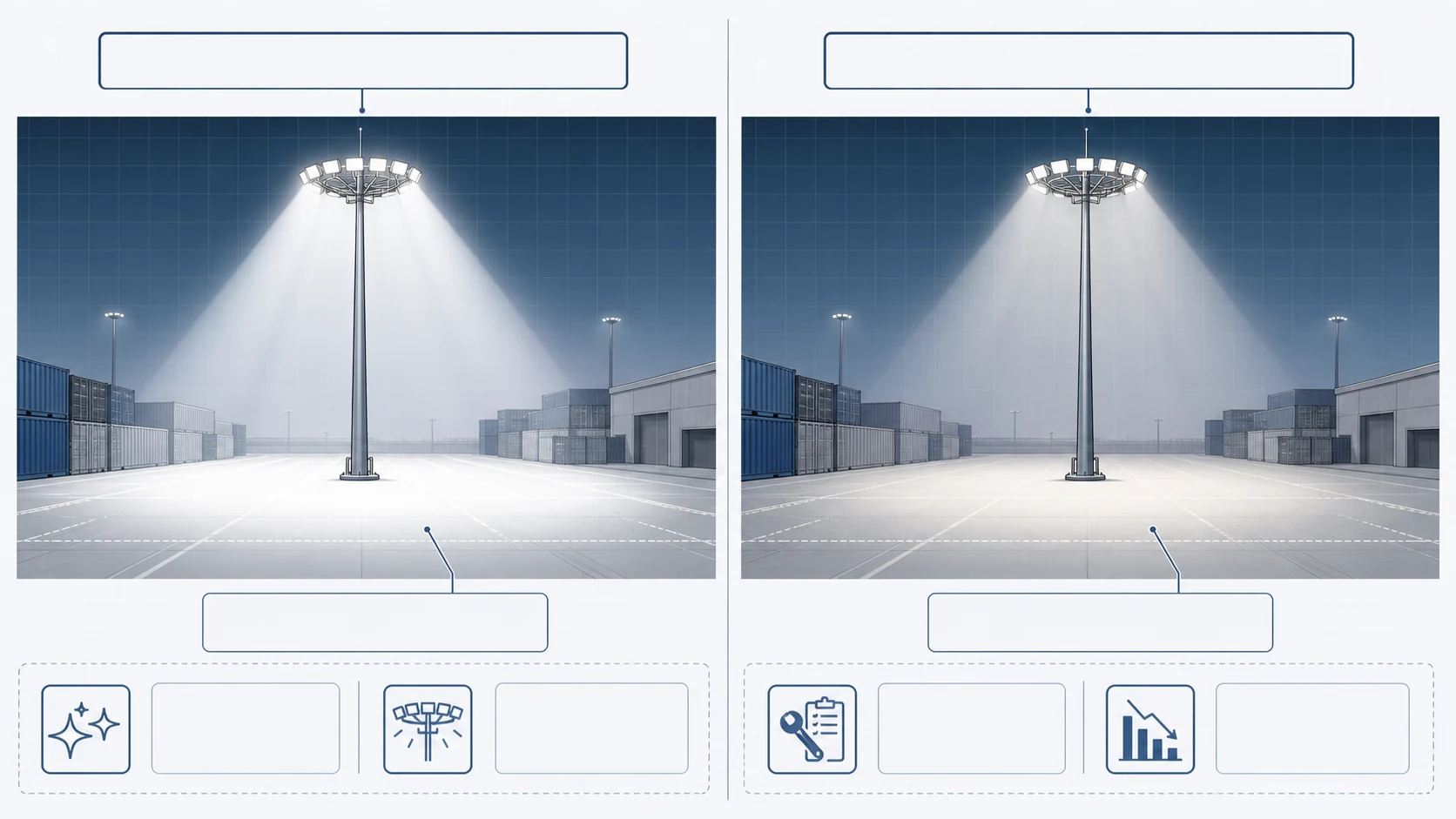
Lighting reports should clearly state whether the value is initial or maintained.
Initial Illuminance
Initial illuminance is the calculated lighting level when the system is new and clean.
It does not represent long-term operating performance.
Maintained Illuminance
Maintained illuminance is the expected lighting level after lumen depreciation, dirt accumulation, and maintenance conditions are considered.
A simple relationship is:
Maintained illuminance = Initial illuminance × Maintenance FactorExample:
Initial Eavg = 50 lx
Maintenance factor = 0.80
Maintained Eavg = 40 lx
The maintenance factor should come from the project’s maintenance plan, luminaire depreciation data, cleaning interval, environmental conditions, and consultant requirements. It should not be selected only to make a calculation pass.
For EPC, municipal, port, industrial, roadway, and consultant-reviewed projects, maintained values are usually more relevant for design comparison than initial values.
Average Lux, Minimum Lux and Uniformity
A high mast lighting design should not be approved only by average lux.
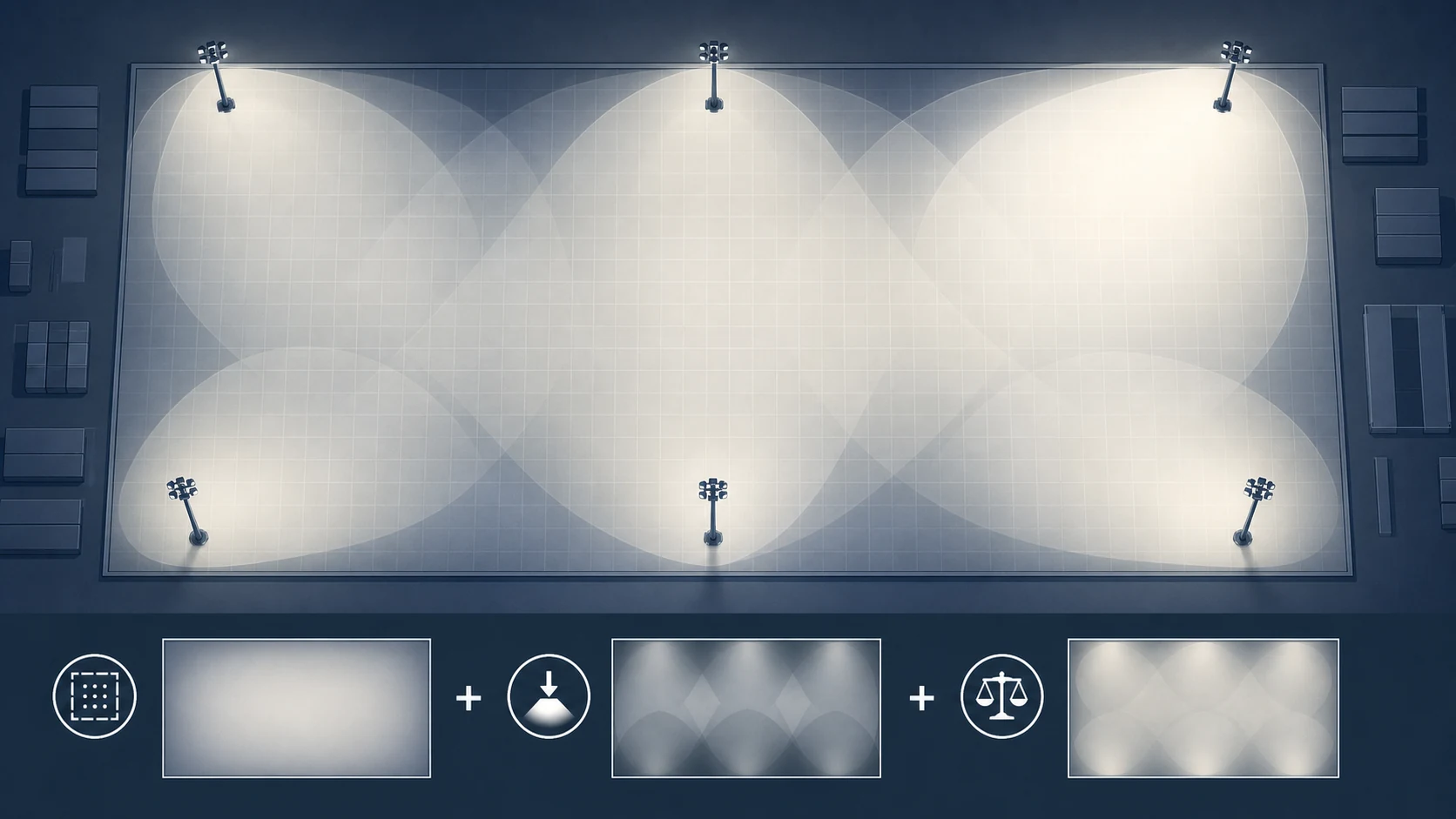
Three values are usually reviewed together:
| Metric | Meaning | Why It Matters |
|---|---|---|
| Average illuminance | Average value across the calculation area | Shows general lighting level |
| Minimum illuminance | Lowest calculated value in the area | Reveals dark zones |
| Uniformity | Relationship between minimum, average, or maximum values | Shows lighting consistency |
A project can show acceptable average illuminance while still having unacceptable dark zones between masts, near loading bays, behind containers, or close to boundaries.
Different specifications use different uniformity conventions, such as:
- Emin / Eavg;
- Eavg / Emin;
- Emin / Emax;
- Emax / Emin.
These ratios are not interchangeable without conversion. A target such as Emin/Eavg ≥ 0.25 cannot be compared directly with Eavg/Emin = 4 unless the relationship is correctly understood.
| Requirement | Equivalent Expression |
|---|---|
| Emin/Eavg ≥ 0.25 | Eavg/Emin ≤ 4.0 |
| Emin/Eavg ≥ 0.40 | Eavg/Emin ≤ 2.5 |
However, Emin/Emax or Emax/Emin cannot be derived from Emin/Eavg alone unless Emax is also known.
Always confirm that the same calculation area, grid, maintenance factor, and calculation plane are being compared.
Published Requirements and Examples
The following table lists source-based requirements or examples that can help project teams understand how lighting values should be interpreted.
These are not universal high mast design recommendations. Each item applies only to the stated context.
| Context | Requirement or Example | Metric | Source / Basis | Important Limitation |
|---|---|---|---|---|
| U.S. marine-terminal cargo-transfer operations | ≥5 foot-candles / 54 lx | Minimum task or work-surface illuminance | OSHA 1918.92 | Applies to walking, working, and climbing areas associated with covered cargo-transfer operations; not a whole-port target |
| U.S. construction general area lighting | ≥5 foot-candles | Minimum illumination | OSHA 1926.56 Table D-3 | Temporary construction context; not permanent yard-lighting design guidance |
| U.S. active storage, loading platforms, refueling, field maintenance during construction | ≥3 foot-candles | Minimum illumination | OSHA 1926.56 Table D-3 | Temporary construction context only |
| TxDOT continuous roadway lighting | Varies by roadway and land use | Average maintained illuminance, minimum illuminance, uniformity, luminance, veiling luminance | TxDOT Highway Illumination Manual | Roadway-specific; requires roadway classification and agency criteria |
| Highway interchange or ramp lighting | Authority-specific | Illuminance, luminance, uniformity, glare, transition review | FHWA / local DOT / consultant criteria | Must follow road classification and authority requirements |
| Airport apron or aviation service area | Authority-specific | Maintained illuminance, glare, vertical components, operational restrictions | Airport or civil aviation authority | Do not use general yard tables |
The practical lesson is clear: a lighting number should always be connected to a metric, measurement plane, application, source, and limitation.
Application and Zone-Based Specification Method
For high mast projects, specify lighting levels by zone rather than by the whole site when the operating conditions vary.
| Application / Zone | Primary Metric to Define | Notes |
|---|---|---|
| Logistics circulation routes | Maintained horizontal Eavg, Emin, uniformity | Review truck movement and driver glare |
| Loading bays | Task-plane illuminance, vertical visibility, local uniformity | Do not rely only on open-yard average lux |
| Container storage areas | Maintained horizontal illuminance and shadow review | Consider stack height and blocked light |
| Port cargo-transfer working area | Task/work-surface minimum where applicable | Legal or owner-specific minima may apply |
| Inspection or gate area | Vertical illuminance, CCTV criteria, task visibility | Horizontal lux alone may be insufficient |
| Industrial equipment zone | Task-plane or horizontal illuminance with obstacle review | Equipment and structures may create shadows |
| Highway interchange | Roadway luminance or illuminance, uniformity, veiling luminance | Follow local DOT or consultant criteria |
| Toll plaza approach | Transition lighting and glare control | Separate from toll-lane task zones |
| Toll lane or payment zone | Task visibility, vertical visibility, staff safety | Authority-specific criteria required |
| Airport apron or service area | Authority-defined maintained criteria | Glare and aviation restrictions are critical |
| Security boundary | Spill-light limits, CCTV visibility, perimeter uniformity | Avoid overlighting adjacent areas |
This structure is more useful than one generic lux table because it helps RFQ writers and design teams define what must actually be calculated.
Logistics Yard Zone Example
A logistics yard is a good example of why one lux value is rarely enough.
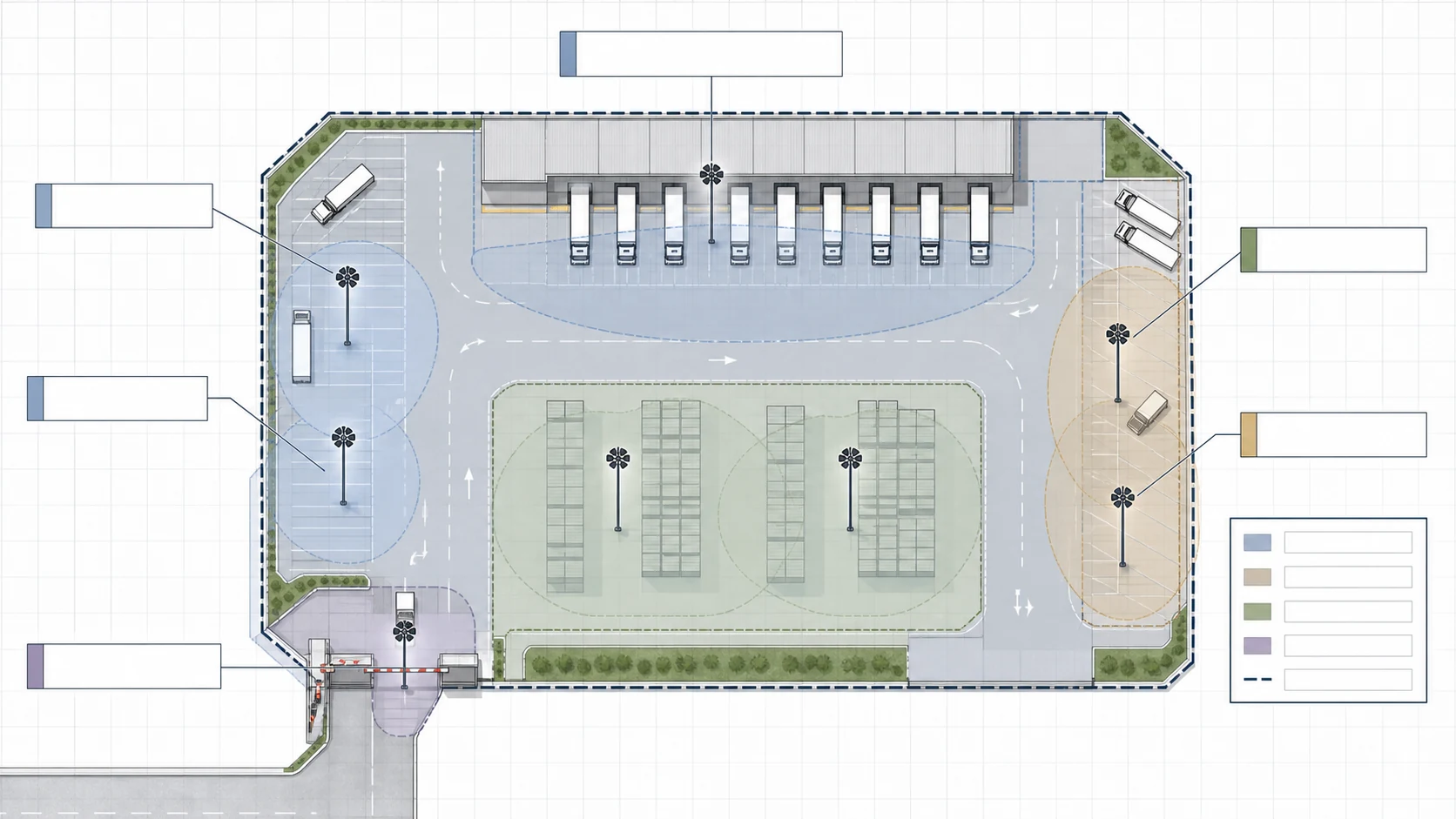
A single site may include truck circulation, loading bays, parking areas, security gates, and boundaries. Each zone has a different visual task.
| Zone | Typical Design Metric | Review Focus |
|---|---|---|
| Zone A — Truck circulation | Maintained horizontal Eavg plus Emin/Eavg | Vehicle movement, turning routes, glare toward drivers |
| Zone B — Loading bays | Task-plane illuminance and vertical visibility | Dock edge visibility, shadows from warehouse frontage |
| Zone C — Security gate | Vertical illuminance and CCTV-specific criteria | Face, vehicle, plate, or object visibility depending on system needs |
| Zone D — Site boundary | Spill-light limit and security visibility | Avoid dark perimeter pockets and uncontrolled light trespass |
This example does not assign one universal lux number. It shows how to define the correct metric for each task zone before DIALux calculation.
Port and Container Terminal Lighting
Port and container terminal lighting must be split by activity.
A general container storage yard, truck circulation lane, cargo-transfer task area, gate inspection area, and security boundary should not automatically use the same lighting requirement.
For U.S. marine-terminal cargo-transfer operations covered by OSHA 1918.92, walking, working, and climbing areas must meet at least 5 foot-candles / 54 lx, measured at the task or working surface. Where tasks require more light to be performed safely, supplemental lighting is required.
This does not mean the entire port yard must be designed to 54 lx. It means a general yard target cannot replace task-specific legal minima.
For port and container terminal high mast projects, review:
- Cargo-transfer areas.
- Truck circulation lanes.
- Crane operation zones.
- Gate inspection areas.
- Container stack shadows.
- CCTV and security zones.
- Operator glare.
- Boundary spill light.
Roadway, Interchange and Toll Plaza Lighting
Roadway and toll plaza projects should not be specified with a simple yard-lighting lux range.
Roadway lighting may be evaluated by:
- Average maintained illuminance.
- Minimum illuminance.
- Illuminance uniformity.
- Roadway luminance.
- Luminance uniformity.
- Veiling luminance.
- Glare.
- Transition between lit and unlit zones.
TxDOT’s Highway Illumination Manual, for example, presents roadway design values by roadway classification and land use and allows roadway light levels to be specified by illuminance, luminance, or both.
Toll plazas should also be divided into:
- Approach road.
- Transition area.
- Toll lane.
- Payment or interaction zone.
- Staff crossing or working area.
- Departure zone.
The correct lighting levels must follow the authority, consultant, or project specification.
Airport and Aviation-Related High Mast Lighting
Airport apron, cargo, and service-area lighting should follow aviation authority requirements and airport-specific project criteria.
Do not use a general yard table for airport lighting.
Airport-related high mast lighting may require review of:
- Maintained illuminance.
- Vertical visibility.
- Glare toward pilots and control towers.
- Mast height restrictions.
- Obstruction lighting.
- Service vehicle movement.
- Aircraft parking or maintenance activities.
- Authority-specific approval procedures.
The final lighting level should come from the applicable aviation authority, airport owner, consultant, or tender specification.
Why Higher Lux Is Not Always Better
A higher lux value may appear safer, but it can create other problems.
Increasing lighting level may require:
- More luminaires.
- Higher wattage.
- More masts.
- Shorter spacing.
- Higher electrical load.
- More complex aiming.
- More glare-control review.
- Higher project cost.
- More spill-light control.
The correct design goal is not maximum brightness. It is the correct maintained lighting performance for the task, zone, and authority requirement.
In many cases, lighting quality can be improved by better optics, pole placement, aiming, zoning, and uniformity rather than simply increasing wattage.
How Lighting Levels Affect Pole Quantity, Height and Spacing
Lighting level is one of the main inputs in high mast system sizing.
A higher maintained lighting requirement may require:
- More luminaires per mast.
- More masts.
- Higher-output luminaires.
- Shorter pole spacing.
- Different optics.
- Revised mounting height.
- More controlled aiming.
However, the relationship is not linear. Doubling the target value does not automatically double the number of masts.
The final result depends on:
- Photometric distribution.
- Pole height.
- Pole spacing.
- Layout pattern.
- Calculation area.
- Uniformity target.
- Obstacle conditions.
- Maintenance factor.
For related decisions, review the High Mast Pole Height Guide, High Mast Pole Spacing Guide, and High Mast Lighting Layout Patterns.
How to Read Lighting Results in a DIALux Report
A DIALux or Relux report should be reviewed by more than the visual rendering.

| Report Item | What to Confirm |
|---|---|
| Calculation area | Does it match the real lighting scope? |
| Calculation plane | Is it ground, task plane, vertical plane, or road surface? |
| Calculation grid | Is the grid suitable for the project zone? |
| Mounting height | Does it match actual luminaire mounting height? |
| Luminaire model | Is the selected fixture used? |
| IES/LDT file | Is it the correct photometric file? |
| Maintenance factor | Are maintained values being calculated? |
| Average value | Does it meet the specified requirement? |
| Minimum value | Are there unacceptable dark zones? |
| Uniformity | Is the correct ratio convention used? |
| Glare | Are drivers, operators, workers, or nearby areas affected? |
| Spill light | Is boundary lighting controlled? |
| Aiming schedule | Can installation reproduce the design? |
If the report does not clearly state maintained values, maintenance factor, calculation plane, calculation area, and uniformity metric, the result should be reviewed again.
Sunlurio can support DIALux simulation outputs when project drawings and lighting requirements are available.
Common Lighting Level Specification Mistakes
| Mistake | Why It Creates Risk | Better Specification Method |
|---|---|---|
| Using one lux value for the entire site | Different zones may have different tasks | Specify lighting by zone and task |
| Using average lux only | Dark zones may remain hidden | Include minimum value and uniformity |
| Confusing initial and maintained values | Long-term performance may be overstated | Use maintenance factor and maintained results |
| Applying legal minima to unrelated zones | Legal values are context-specific | State source, application, and limitation |
| Treating OSHA construction values as permanent design targets | Construction minima are not general permanent-yard recommendations | Use them only in the correct legal context |
| Ignoring vertical visibility | CCTV, gates, pedestrians, and task zones may fail | Add vertical or task-plane criteria where needed |
| Using roadway criteria for yards | Metrics and observer conditions differ | Follow application-specific criteria |
| Ignoring glare | More light may reduce comfort or visibility | Review observer positions and glare metrics |
| Not defining the uniformity ratio | Ratios are not interchangeable | Specify Emin/Eavg, Eavg/Emin, or required convention |
| Finalizing BOQ before lighting criteria | Equipment quantities may change | Confirm metrics before procurement |
Files Required for Lighting Level Review
To review high mast lighting levels properly, the engineering team should receive clear inputs.

| Required Input | Why It Matters |
|---|---|
| Site layout or CAD drawing | Defines calculation areas and zones |
| Project application | Determines which lighting metrics are relevant |
| Functional zone description | Separates roads, yards, loading areas, gates, and boundaries |
| Target maintained value | Defines long-term design requirement |
| Minimum value requirement | Controls dark-zone risk |
| Uniformity metric | Defines lighting quality |
| Calculation plane | Clarifies ground, task, vertical, or roadway surface |
| Pole height | Affects coverage and aiming |
| Allowed pole locations | Affects overlap and uniformity |
| Luminaire model | Defines output and optical distribution |
| IES/LDT files | Required for calculation |
| Maintenance factor | Defines maintained performance |
| Obstacles and structures | Affect shadows and blocked light |
| Glare or spill-light limits | Supports aiming control |
| Tender or authority specification | Defines acceptance criteria |
If these inputs are incomplete, any lighting level recommendation should be treated as preliminary.
Engineering References for Lighting Level Review
Lighting level requirements should follow project-specific criteria rather than generic tables.
Useful references may include:
- FHWA Lighting Handbook for roadway lighting concepts, visibility, illuminance, uniformity, and glare context.
- TxDOT Highway Illumination Manual for highway illumination design values by roadway classification and land use.
- TxDOT High Mast Lighting Assemblies for high mast assembly context.
- OSHA 1918.92 Illumination for U.S. marine-terminal cargo-transfer minimum illumination requirements.
- OSHA 1926.56 Illumination for U.S. construction-area minimum illumination requirements.
These references should be used in the correct context. They do not create one universal lux target for every high mast lighting project.
Request a High Mast Lighting Level Review
Lighting level requirements should be confirmed before pole quantity, pole height, spacing, wattage, and BOQ are finalized.
Send us your CAD layout, project application, functional zones, required maintained values, minimum value requirement, uniformity metric, calculation plane, preferred pole height, allowed pole locations, and tender requirements. Sunlurio can review the lighting level specification, prepare DIALux simulation outputs, and support the required IES/LDT and BOQ documentation for project discussion.
Request a High Mast Lighting Level Review
Related High Mast Lighting Guides
The following guides explain related decisions in high mast lighting design:
- High Mast Lighting Design Guide
- High Mast Pole Height Guide
- High Mast Pole Spacing Guide
- High Mast Lighting Layout Patterns
- How Many High Mast Lights Do You Need?
- High Mast Lighting Coverage Explained
- High Mast Lighting Systems
- Engineering Support for Lighting Projects
- DIALux Simulation Outputs
- IES/LDT Photometric Files
- Tender Documents and BOQ Support
Frequently Asked Questions
What lux level is needed for high mast lighting?
There is no single lux level for all high mast projects. The required value depends on application, task, calculation plane, maintained value, minimum value, uniformity, glare control, and local specification.
Why does this guide not give one recommended lux number for every application?
Because a generic value can be misleading. A port, road, toll plaza, airport, logistics yard, and security gate may require different metrics and different authority requirements.
Is maintained illuminance different from initial illuminance?
Yes. Initial illuminance describes the system when new and clean. Maintained illuminance includes the maintenance factor and is usually more relevant for long-term project evaluation.
How is maintained illuminance calculated?
A simple expression is: maintained illuminance equals initial illuminance multiplied by the maintenance factor. The maintenance factor should reflect luminaire depreciation, dirt accumulation, cleaning interval, and environmental conditions.
What does uniformity mean in high mast lighting?
Uniformity describes how consistent the lighting is across the calculation area. It may be expressed as Emin/Eavg, Eavg/Emin, Emin/Emax, or another required convention. The specification must state the exact metric.
Does a port yard need 54 lx everywhere?
No. OSHA 1918.92 requires at least 5 foot-candles / 54 lx for specified U.S. marine-terminal cargo-transfer operations at the task or working surface. It is not a whole-port general-yard target.
Can a roadway lighting level be specified only by lux?
Not always. Roadway projects may require illuminance, luminance, uniformity, veiling luminance, glare review, and transition-zone analysis depending on the authority and road classification.
What information should I provide for a lighting level review?
Provide CAD layout, functional zones, project application, required maintained values, minimum value requirement, uniformity metric, calculation plane, luminaire model, IES/LDT files, pole height, allowed pole locations, obstacles, and tender requirements.