A smart street-lighting project connects the luminaire, controller, communication network, platform, users, monitoring points, alarms, dimming logic, offline behavior and maintenance responsibilities. The architecture should be selected from project objectives and local network conditions—not from a universal protocol or dashboard.
Sunlurio supports municipal, EPC and consultant teams with AC smart and solar smart architecture review, project-bounded technology selection, commissioning logic and coordinated system documents.
Exact functions, communication, platform and interface scope are confirmed with the selected controller, system architecture and project requirements.
Smart lighting can support different operating needs. First define what the project and O&M teams actually need to do.
Project objectives → site and power path → controller interfaces → communication → platform/users → alarms and local behavior → commissioning → documents and handover
Remote data may help prioritize work and reduce avoidable visits, but savings, failure reduction, payback and uptime depend on the confirmed system, operating process and project baseline. No percentage or SLA is assumed.
Country/city · number of lights, sites and phases · road/site type · new-build or retrofit · pole height and spacing · existing luminaires, poles, cabinets, cables, controllers and platforms
Grid AC or solar · voltage/frequency and retained AC infrastructure · solar resource, shading, runtime, dimming, autonomy and PV/battery/controller architecture
On/off, scheduling, grouping and dimming objectives · required status, runtime, energy or event data · alarm types, thresholds, dispatch triggers and responsibilities
Preferred or specified communication · local carrier and coverage · data and latency requirements · gateway/backhaul conditions · existing municipal or third-party infrastructure
Dashboard/reporting scope · user roles and permissions · hosting, subscription, data ownership and support expectations · existing systems and interface requirements
Device registration · site/network readiness · acceptance tests · training and handover · O&M owner · BOQ/tender stage · required architecture, wiring, datasheets, interfaces, certificates and commissioning documents
Incomplete information can be submitted for a preliminary gap review. Final communication, controller, platform, offline behavior and document scope require the inputs that materially affect the architecture.
AC smart and solar smart projects use different power, controller, network and fail-state logic. Keep the architectures separate, confirm interfaces from the selected system, and freeze the final topology only after site, power, communication, platform and O&M inputs are reviewed.
Combine a grid-powered luminaire with a compatible driver/controller, selected communication, platform and O&M workflow. Confirm voltage, frequency, cabinets, cabling, earthing, retained infrastructure, controller power and network requirements. Use 0–10V, DALI or another control interface only where the selected driver/controller supports it. Define local/offline operation and commissioning scope.
Coordinate solar resource, shading, PV, battery, load, solar controller, runtime, dimming, autonomy, communication energy, local schedule and protective behavior. Monitoring points and platform scope remain project-specific. Year-round operation requires confirmed conditions and is not an unconditional no-blackout guarantee.
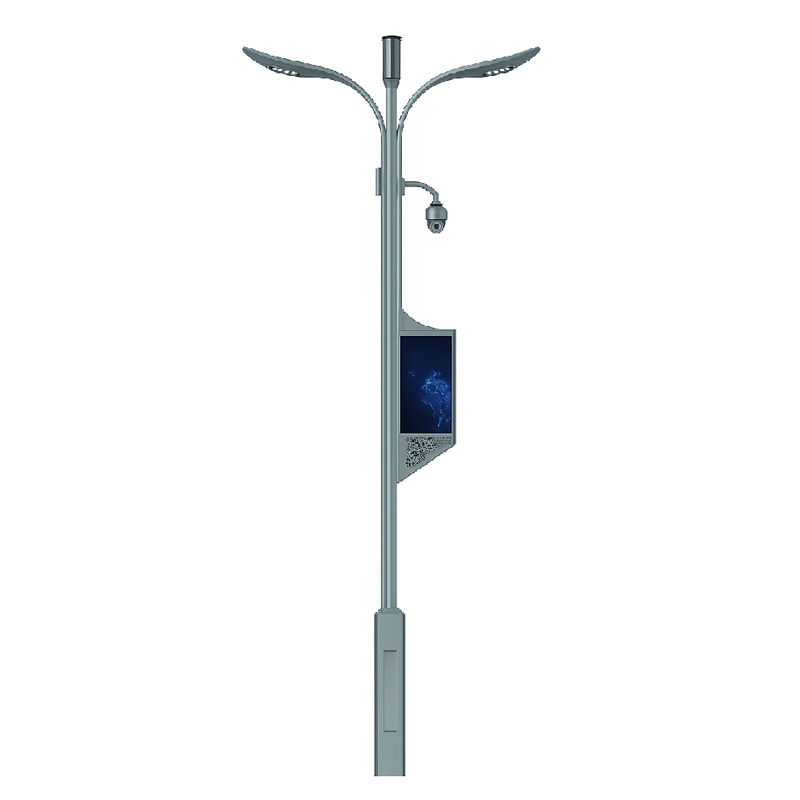
Confirm the driver or solar-controller interface, switching/scheduling/grouping/dimming scope, available sensors or metering, controller location and protection, device naming, firmware/configuration responsibility, manual access, wiring, surge, earthing and cabinet interfaces. 4G/5G, GPS, 0–10V and DALI are optional capabilities selected by project architecture—not default functions.
No protocol is globally best. Compare project scale, coverage, data volume, latency, gateway/backhaul needs, municipal infrastructure, carrier/band/SIM/subscription conditions, integration, offline behavior and O&M ownership. 4G and 5G may be supported in selected architectures. LoRa requires a confirmed controller, gateway and coverage plan. Wi-SUN, NB-IoT and PLC may be reviewed when specified. MQTT and TALQ require verified product/version support and applicable evidence.
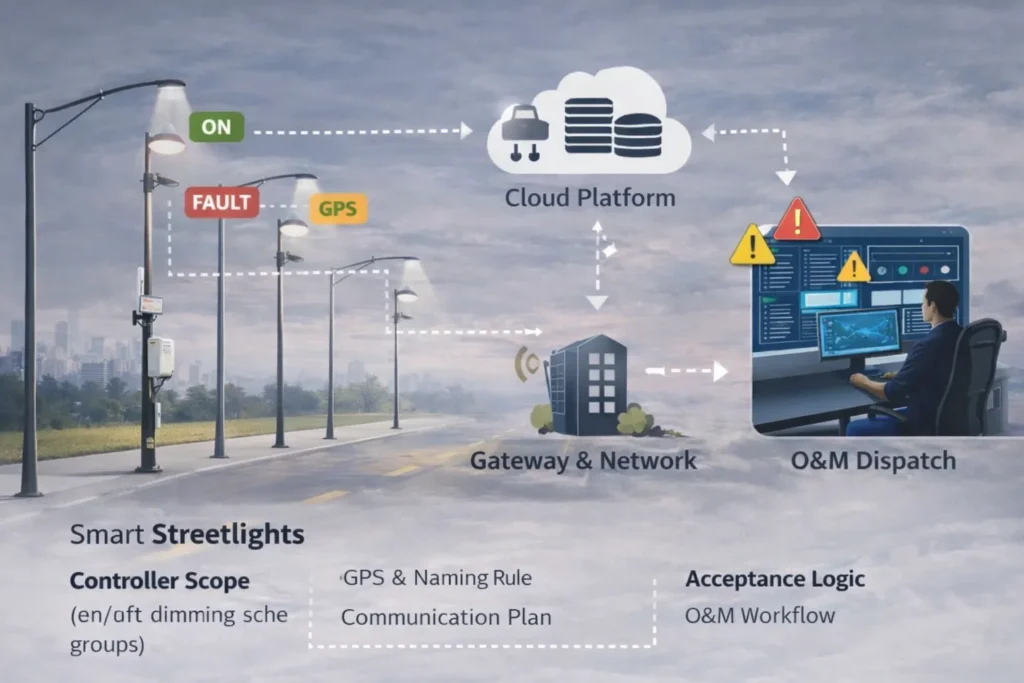
A gateway is not required in every architecture. Where selected, confirm device count, zones, coverage, gateway location and enclosure, power, backhaul, antenna conditions, carrier/internet responsibility, restart/reconnection expectations, commissioning access, maintenance ownership and project-defined cybersecurity/account boundaries.
Define the device/site/zone/pole hierarchy, user roles, permissions, account ownership, confirmed status/events/alarms/commands, reporting and retention needs, hosting, subscription, support, data ownership, handover and training. This page does not claim that Sunlurio owns a universal cloud platform or that every dashboard function is included.
Conceptual smart-lighting architecture illustration. GPS, gateway, cloud platform, monitoring, alarms and O&M functions are selected according to the confirmed controller, communication and project architecture; they are not universal features.
Confirm detectible conditions, alarm recipients and dispatch actions; schedules, groups, dimming states and hardware compatibility; device naming, credentials, escalation, service records and response ownership. Monitoring may help prioritize maintenance, but does not guarantee savings, failure reduction, response time or uptime.
Confirm and test local schedules, the defined state after communication loss or restart, manual control, event storage where supported, reconnection, synchronization and extended interruption effects. Do not assume that lights stop, continue normally, retain the last state or synchronize all data.
Confirm the target system, data objects, commands, events, interface/version, authentication, roles, update frequency, limits, ownership, testing and acceptance. No universal open API, MQTT or TALQ claim is made.
Generic inputs may be public when current and approved. Controller datasheets, communication/gateway architecture, wiring, platform roles, API/interface files, control schedules, commissioning checklists, BOQ deviations, certificate/test documentation and full tender packs follow the confirmed controller, model/BOM, topology, buyer stage and project review. Actual wiring, smart architecture, API, commissioning and full tender/system files remain controlled by default.
The technologies below are project-specific historical facts. They are not universal product capabilities.
In 2023, Sunlurio supplied 500 AC smart street-light sets for a main-road project: 80W AC smart luminaires, 7m conical steel poles, 5G communication and a centralized management platform. The client/EPC/local team installed the system; Sunlurio provided system supply, project/tender engineering and document coordination. View project
In 2018, Sunlurio supplied 211 AC smart street-light sets for public-road lighting: 75W AC smart luminaires, 8m conical steel poles, LoRa, a centralized platform and two double-sided LED displays. These features belong to that project architecture. View project
In 2022, Sunlurio supplied 120 smart solar street-light sets for a rural-road project: 60W LED, 6m poles, 5G communication and GPS monitoring. The older AC/LoRa wording is superseded. View project
The Ethiopia 2024 smart-lighting project used LAN, Wi-Fi, 4G and 5G with a central CMS in its approved architecture. It is a broader road-corridor and pedestrian-lighting reference and does not define every Smart Street Light configuration. View project
Evidence note: Client names are not publicly disclosed. Public summaries use locked Project Master facts; redacted/NDA evidence may be reviewed by request.

Share the site, power path, control objectives, network conditions, integration needs, commissioning scope and tender inputs for a bounded architecture review.

Typical constraints by region—coastal, hot, dusty, and heavy-rain environments.
WhatsApp us
Share your project location, road width, pole height, spacing, working hours, backup days, and required documents. Our team can help prepare configuration guidance, datasheets, IES/LDT files, DIALux support when applicable, drawings, and BOQ matching notes.