Quick Answer
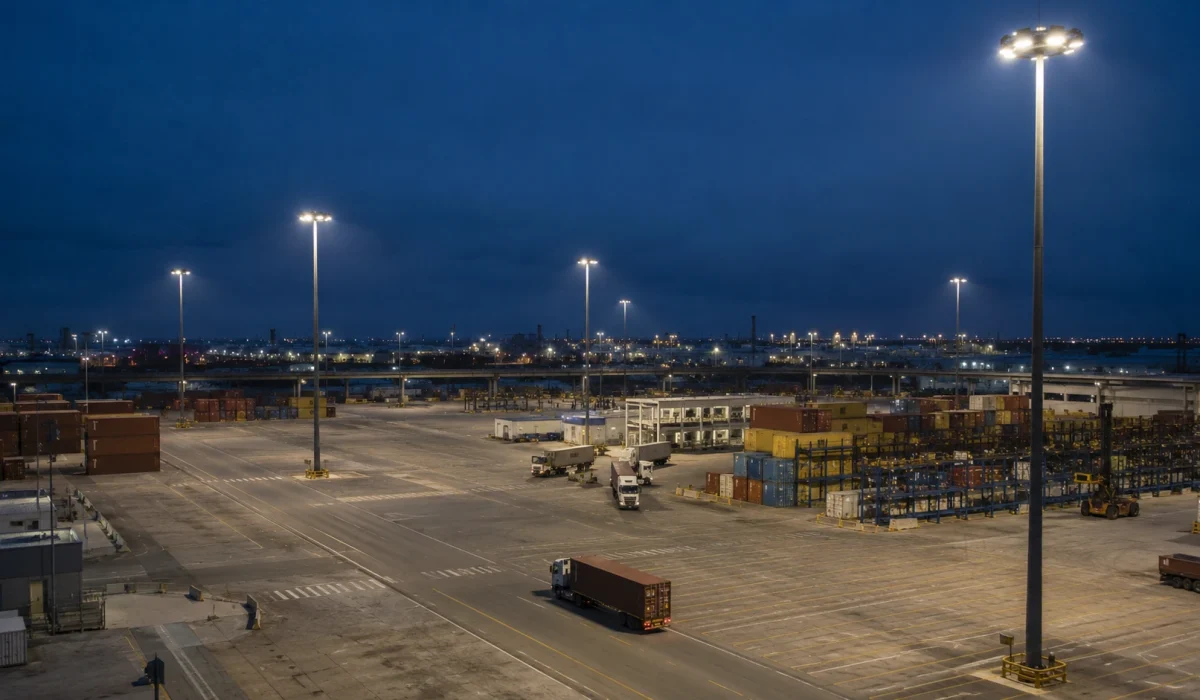
There is no universal area that one high mast light can cover. The usable coverage is the part of the site that still meets the project requirements for average and minimum illuminance, uniformity, glare or spill-light control, and the selected maintenance factor.
Mast height, luminaire quantity, optical distribution, aiming, spacing, obstructions, and the actual IES/LDT files all affect the result. A preliminary layout can compare mast concepts, but the final pole and luminaire quantities should be verified in DIALux, Relux, AGi32, or equivalent photometric software against the real site and acceptance criteria.
For a reviewable recommendation, send the site dimensions or DWG, application type, target lighting criteria, obstruction notes, preferred mast concept, and tender or BOQ requirements.
Table of Contents
What High Mast Lighting Coverage Really Means
High mast lighting is used to illuminate large outdoor areas with multiple luminaires mounted on a tall mast. FHWA material generally describes high-mast lighting as luminaires mounted at about 20 m or more, while individual road authorities may use different classifications and design ranges for their own jurisdictions. See the FHWA high-mast lighting overview.
Coverage should not be defined as the widest visible circle of light. For project review, the more useful definition is:
Usable coverage is the area that meets the specified photometric and operational requirements after optics, aiming, maintenance factor, obstructions, and site geometry are considered.
This distinction matters for ports, logistics yards, highway interchanges, industrial sites, aprons, large parking areas, and other projects where edge zones, traffic paths, stacked materials, buildings, or equipment may affect the light distribution.
High Mast Light vs Floodlight
A high mast lighting system is the complete project assembly. Depending on the supply scope, it may include:
- the mast and base connection
- a fixed headframe or lowering ring
- multiple luminaires or floodlights
- electrical cables, controls, and grounding provisions
- anchor bolts and structural documentation
- lowering equipment and maintenance accessories
- foundation input or interface requirements
A floodlight is only the luminaire mounted on the mast. The same mast can produce very different results when the luminaire model, optical distribution, quantity, aiming, or maintenance factor changes.
Scope boundaries should be stated clearly in the quotation and BOQ. Foundation design, soil investigation, electrical distribution, installation, and authority approval may belong to different project parties.
Why a Generic Coverage Diameter Is Unreliable
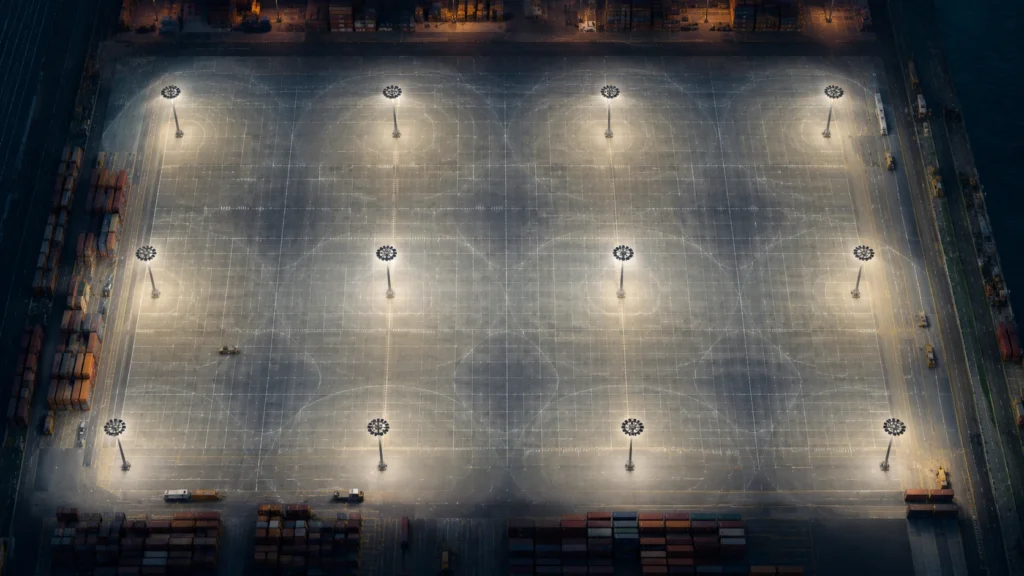
A table that assigns one coverage diameter or one total wattage to each mast height can be misleading. Without the luminaire photometry and design criteria, the same height may produce acceptable results in one layout and poor edge coverage, glare, or low uniformity in another.
A responsible coverage statement needs at least:
- the site boundary and calculation area
- the required average and minimum illuminance
- the required uniformity method and limit
- glare, spill-light, or environmental limits where applicable
- the luminaire model and actual IES/LDT file
- luminaire quantity and optical distribution
- aiming directions and tilt angles
- mast positions and mounting heights
- the maintenance factor
- containers, buildings, cranes, trees, equipment, or other obstructions
If these inputs are not available, a coverage figure should be labelled as a concept comparison, not a final design value or performance guarantee.
What Official Roadway Guidance Can—and Cannot—Tell You
Official guidance is useful for defining the design process, but a value from one road authority should not be applied automatically to ports, terminals, industrial yards, or projects in another jurisdiction.
| Reference | What It Indicates | Correct Use |
|---|---|---|
| FHWA European Road Lighting Scan | High-mast lighting generally refers to luminaires mounted at approximately 20 m or more | General high-mast definition and roadway context |
| TxDOT Conventional vs. High Mast Lighting | TxDOT uses 100 ft or more in its manual and notes that high-mast layouts are more complex than conventional layouts | Texas roadway decision context; not a universal height rule |
| TDOT Lighting Design Manual | TDOT lists jurisdiction-specific mounting ranges and even-number luminaire configurations such as 4, 6, 8, and 12, with final layout determined by photometric design software | Tennessee roadway projects; not a generic port or industrial-yard selection table |
These references support an important conclusion: mast height and luminaire quantity are design inputs, not standalone coverage guarantees. The governing project specification, local authority requirements, and actual photometric model take precedence.
What Determines High Mast Lighting Coverage?
1. Mounting Height
A taller mast can distribute light over a wider area, but it also increases the distance between the luminaires and the working surface. Useful illuminance, glare, spill light, structural loading, maintenance access, and foundation scope must be reviewed together.
The correct question is not “Which mast is tallest?” but “Which height produces a reviewable photometric and project result?”
2. Luminaire Quantity
Multiple luminaires allow different parts of the site to be targeted and can improve beam overlap. Quantity alone does not confirm performance: four correctly selected luminaires may be more suitable for one layout than a larger number with unsuitable optics in another.
Roadway manuals show configurations such as 4, 6, 8, or 12 luminaires in specific contexts, but the final quantity must follow the selected photometry and site calculation. A supplier should not promise a universal “fixtures per mast” number without those inputs.
3. Optical Distribution
At the same height and wattage, narrow, medium, wide, asymmetric, or forward-throw distributions can produce very different patterns.
- Narrow distributions can provide longer throw but may create concentrated hotspots.
- Wider distributions can improve local spread but may lose useful intensity at distance.
- Asymmetric distributions can help rectangular yards, road approaches, boundaries, or one-sided working areas.
- Mixed optics may be needed when one mast serves several zones with different geometry.
The fixture datasheet should identify the optical option, but the IES/LDT file is needed to review the distribution in the actual layout.
4. Aiming and Beam Overlap
High mast coverage normally comes from coordinated beams rather than one circular cone. Aiming affects the center, outer boundary, transition zones, glare direction, and overlap between adjacent masts.
An aiming schedule should identify the luminaire position, optical type, target direction, and tilt. A render or bright-looking aerial image is not a substitute for this information.
5. Required Lighting Criteria
The target may include more than average lux. Depending on the project, the review may also need:
- minimum illuminance
- average-to-minimum or minimum-to-average uniformity
- vertical illuminance
- glare or veiling-luminance limits
- spill-light limits at the property boundary
- CCTV or task-visibility requirements
- emergency or reduced-output operating scenes
The applicable calculation method and acceptance limits should come from the project specification or responsible authority.
6. Obstructions and Operating Conditions
Containers, cranes, buildings, parked vehicles, processing equipment, trees, and changes in ground level can block or redirect useful light. A layout calculated on an empty flat plane may overstate performance in the operating site.
7. Maintenance Factor
Lumen depreciation, dirt, optical contamination, cleaning intervals, and the local environment affect maintained performance. The simulation should disclose the maintenance factor instead of showing only initial output.
How Many High Mast Lights Do You Need?
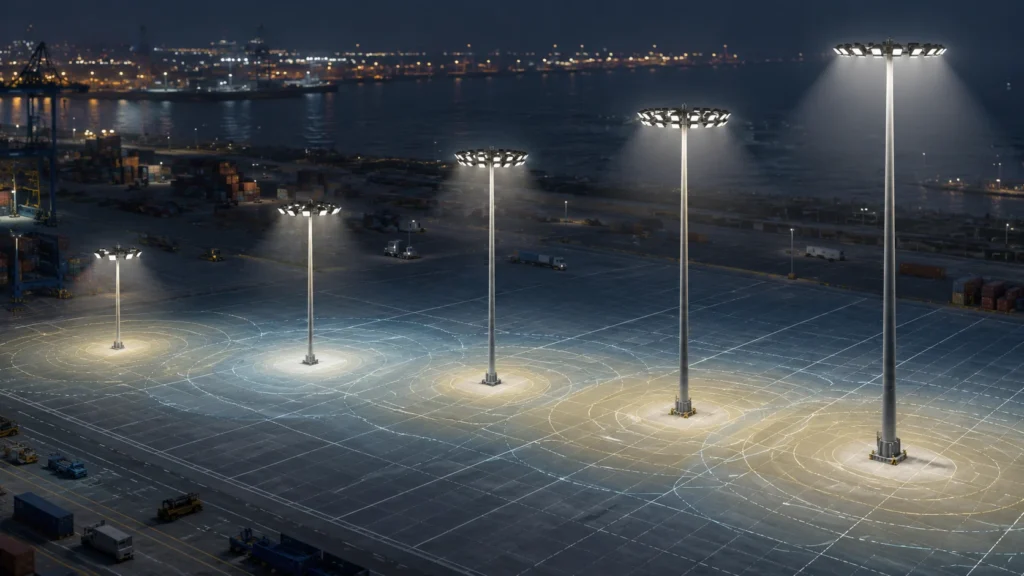
Site area alone cannot determine mast count. The planning process should compare at least two feasible layouts where practical—for example, fewer taller masts and a more distributed arrangement—using the same acceptance criteria.
Use this sequence before fixing the BOQ:
| Step | Review Item | Required Output |
|---|---|---|
| 1 | Site and application | Calculation boundary, traffic or working zones, and exclusions |
| 2 | Project criteria | Target illuminance, uniformity, glare/spill-light requirements, and maintenance factor |
| 3 | Initial mast concepts | Candidate heights and positions, considering civil and maintenance constraints |
| 4 | Luminaire selection | Product model, power, lumen package, optical types, and IES/LDT files |
| 5 | Aiming and obstruction model | Luminaire directions, tilt, structures, equipment, and relevant operating conditions |
| 6 | Photometric comparison | Average/minimum values, uniformity, isolux or grid results, glare/spill review where required |
| 7 | Engineering coordination | Mast structure, wind loading, foundation interface, lowering system, electrical routing, and access |
| 8 | BOQ mapping | Masts, luminaires, brackets/rings, controls, cables, accessories, documents, and exclusions |
The selected layout should be the one that balances photometric performance, civil feasibility, maintenance, energy, approval risk, and life-cycle cost—not simply the one with the fewest poles.
Example: Why a 10,000 m² Yard Still Needs a Layout
Assume an open logistics yard has an area of about 10,000 m². That area figure is not enough to decide whether the project needs one, two, or more high masts.
The result changes when any of the following changes:
- the yard is square, long, narrow, or irregular
- working lanes and storage zones have different criteria
- containers or equipment block parts of the beam
- neighboring properties require tighter spill-light control
- the selected luminaire uses a different optical distribution
- the mast positions are limited by traffic, utilities, drainage, or foundations
- the project requires a different maintained lux or uniformity target
For this reason, an early proposal should state the assumptions and show the candidate mast positions. The final proposal should include a photometric calculation based on the selected luminaires and the latest site drawing.
Edge and Transition Zones Often Become the Limiting Areas
In many layout reviews, the brightest zone near a mast is not the deciding area. Outer working boundaries, spaces between masts, and zones behind containers or equipment can become the limiting areas.
Reviewers should therefore check:
- site corners and outer working edges
- transition areas between adjacent masts
- vehicle approaches and turning zones
- loading or inspection points
- areas behind common obstructions
- property boundaries and nearby roads or buildings
- CCTV-critical zones, where applicable
This is also why a more distributed layout may outperform a “fewer and taller” concept in some projects. That conclusion should come from the comparison results rather than from a general rule.
High Mast Lighting vs Standard Pole Lighting
TxDOT guidance recommends comparing high-mast and conventional lighting based on installation, maintenance, traffic effects, nearby airports or residential areas, and project-specific constraints.
| Project Condition | Direction to Review | Main Reason |
|---|---|---|
| Large, open operational area with limited pole positions | High-mast concept | May reduce pole positions while serving several zones |
| Narrow road, fragmented site, or many obstructions | Distributed standard poles | May provide more controlled and consistent local coverage |
| Sensitive property boundary or nearby residences | Simulation-first comparison | Spill light and glare may control the decision |
| Restricted maintenance or lowering-system access | Compare both concepts | A lower distributed system may be easier to service |
| Significant foundation, wind, or geotechnical constraints | Full-system cost comparison | The mast and civil scope may outweigh luminaire savings |
| Authority-reviewed interchange or airport-adjacent site | Authority-led design route | Additional roadway or airspace requirements may apply |
High mast lighting is not automatically the best option for every large site. The comparison should use the same calculation criteria and include civil, electrical, maintenance, and approval scope.
When High Mast Lighting May Not Be the Right Choice
Consider standard poles, lower masts, or a mixed layout when:
- the site is compact, narrow, or highly fragmented
- containers, buildings, or equipment create extensive shadowing
- nearby roads, residences, properties, or control towers make glare or spill light sensitive
- mast foundations conflict with utilities, drainage, traffic, or weak ground conditions
- lowering-system or maintenance access cannot be maintained safely and consistently
- the project cannot provide the photometric and structural documentation required for approval
These conditions do not automatically rule out high mast lighting, but they justify a comparison before procurement.
Use DIALux, Relux, AGi32, or Equivalent Photometric Software
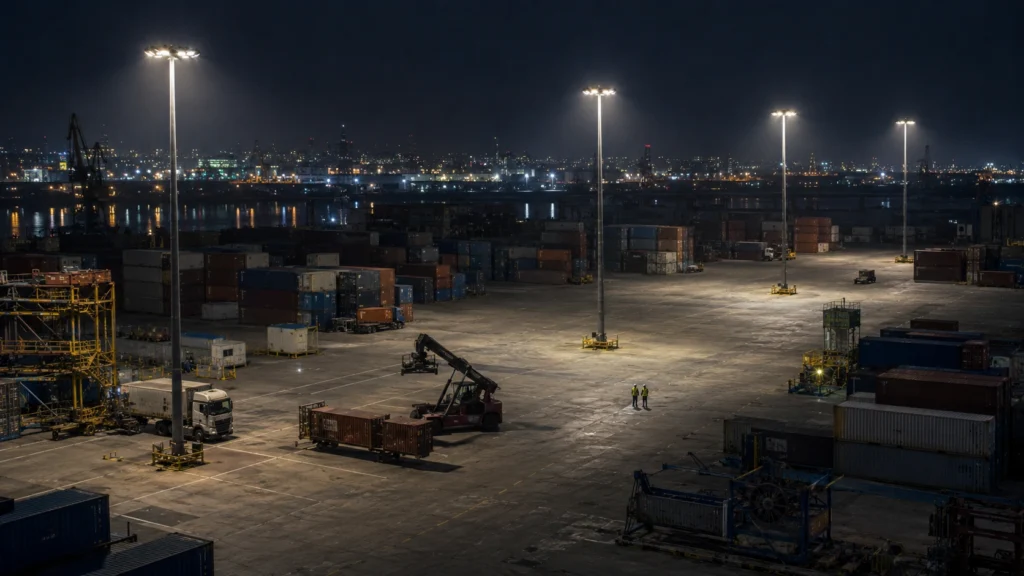
Photometric software should use the actual IES/LDT file for the proposed luminaire. A reviewable report should show more than a rendered night scene.
Request the following outputs where applicable:
- calculation surfaces and grid spacing
- mast coordinates and mounting heights
- luminaire model, quantity, power, lumen output, and optical code
- aiming directions and tilt angles
- maintenance factor
- average and minimum illuminance
- the specified uniformity calculation
- isolux lines or point-by-point results
- glare or spill-light results when required
- excluded areas, obstructions, and other modelling assumptions
- revision number and drawing reference
Sunlurio can support projects with IES photometric files and DIALux simulation outputs when the required project inputs are available.
Information and Documents Needed for Review
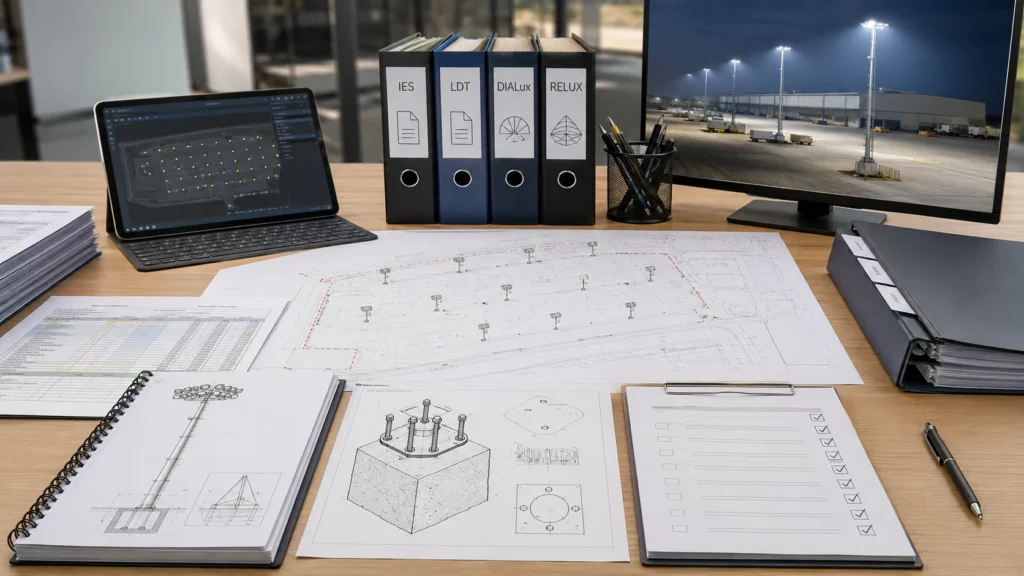
| Input or Document | Why It Matters |
|---|---|
| Site dimensions, DWG/CAD, or marked plan | Defines the calculation boundary and possible mast positions |
| Application and operating zones | Identifies roads, storage areas, loading zones, aprons, boundaries, or exclusions |
| Lighting criteria or tender specification | Defines maintained illuminance, uniformity, glare, spill light, and acceptance method |
| Ground levels and obstruction notes | Prevents a flat empty model from overstating coverage |
| Proposed mast concepts | Supports comparison of height, position, access, and structural scope |
| Luminaire model and IES/LDT files | Provides the photometric basis for the calculation |
| Wind, geotechnical, and foundation information | Connects the lighting concept with structural feasibility |
| Electrical and control requirements | Defines voltage, cabling, cabinet, dimming, and operating scenes |
| BOQ or tender reference | Aligns the simulation, product selection, documents, and commercial scope |
Where inputs are missing, the proposal should list the assumptions and identify what must be confirmed before approval.
Procurement Checks Before Ordering
Before issuing a purchase order, confirm that:
- the simulation uses the quoted luminaire model and optical codes
- mast and luminaire quantities match the latest calculation and BOQ
- the aiming schedule matches the drawing
- maintained values and the maintenance factor are disclosed
- glare or spill-light requirements have been reviewed where applicable
- the mast structure, wind loading, anchor bolts, foundation interface, and lowering system are coordinated
- cable routing, grounding, controls, access, installation, and commissioning responsibilities are assigned
- drawing, calculation, datasheet, and BOQ revisions are consistent
- exclusions and authority-approval responsibilities are written clearly
This document check is often more reliable than comparing proposals only by mast quantity, wattage, or initial price.
FAQ
How much area can a 30 m high mast light cover?
There is no universal coverage area for a 30 m mast. Usable coverage depends on the luminaire photometry, quantity, optics, aiming, mast positions, target maintained illuminance, uniformity, glare or spill-light limits, maintenance factor, and site obstructions. The answer should be taken from a project-specific photometric calculation, not a fixed diameter chart.
How many luminaires are installed on one high mast?
The quantity varies by project and luminaire. Some roadway guidance shows even-number configurations such as 4, 6, 8, or 12 luminaires, but these are not universal selection rules. Final quantity should follow the selected IES/LDT files, site layout, calculation criteria, aiming plan, structural capacity, and BOQ scope.
How far apart should high mast poles be spaced?
There is no universal spacing-to-height ratio for every high mast project. Final spacing depends on optical distribution, aiming, target illuminance and uniformity, obstructions, glare or spill-light requirements, and available mast positions. Use photometric software to compare candidate spacing before fixing the BOQ.
Does a taller mast always provide better coverage?
No. A taller mast may extend the distribution, but it can also reduce useful ground illuminance, increase glare or spill-light exposure, and add structural and maintenance requirements. Height should be selected together with the luminaire photometry, aiming, mast positions, and project acceptance criteria.
Is DIALux or Relux required for high mast lighting design?
Simple calculations can support an initial concept, but project-specific photometric software is strongly recommended before procurement or approval. The model should use the proposed luminaire’s actual IES/LDT file and disclose the site geometry, mast positions, aiming, maintenance factor, calculation criteria, and relevant obstructions.
What should I send for a high mast lighting layout review?
Send the site dimensions or DWG/CAD, application and working zones, target lighting criteria or tender specification, obstruction and ground-level information, preferred mast concepts, electrical requirements, Google pin if useful, and the BOQ or tender reference. These inputs allow the design team to replace a generic estimate with a reviewable layout.
Request a High Mast Lighting Layout Review
Sunlurio can help compare mast concepts, luminaire quantities, optical distributions, aiming, pole positions, and photometric simulation requirements for project-based outdoor lighting.
Please send:
- site dimensions or DWG/CAD layout
- application and operating zones
- target lighting criteria or tender requirement
- preferred mast concept, if any
- Google pin or marked plan
- ground levels and obstruction notes
- electrical or control requirements
- BOQ or tender reference