
Foundation Review Support for Project Teams
Footing Size Reference
Typical foundation size ranges for 6–15 m street lighting poles.
Anchor Bolt Layout
Bolt circle, template, base plate and installation alignment checks.
Drawing Support
Foundation concept drawings for quotation, tender, or site review.
EPC Checklist
Pole height, wind speed, soil condition, conduit and grounding review.
Quick Answer
A light pole foundation is a reinforced concrete support structure designed to keep a lighting pole stable by resisting vertical load, wind load, overturning moment, lateral force, and long-term ground movement.
For most 8–15 m street light and area lighting projects, a reinforced spread footing with anchor bolts is commonly used. Final foundation size should still be checked by a qualified structural engineer based on pole height, wind speed, soil bearing capacity, installation location, and local code requirements.
Typical Street Light Pole Foundation Details
Most project teams need more than a general explanation. They need to check the foundation type, anchor bolt layout, base plate coordination, conduit entry, and installation tolerance before quotation or tender submission.
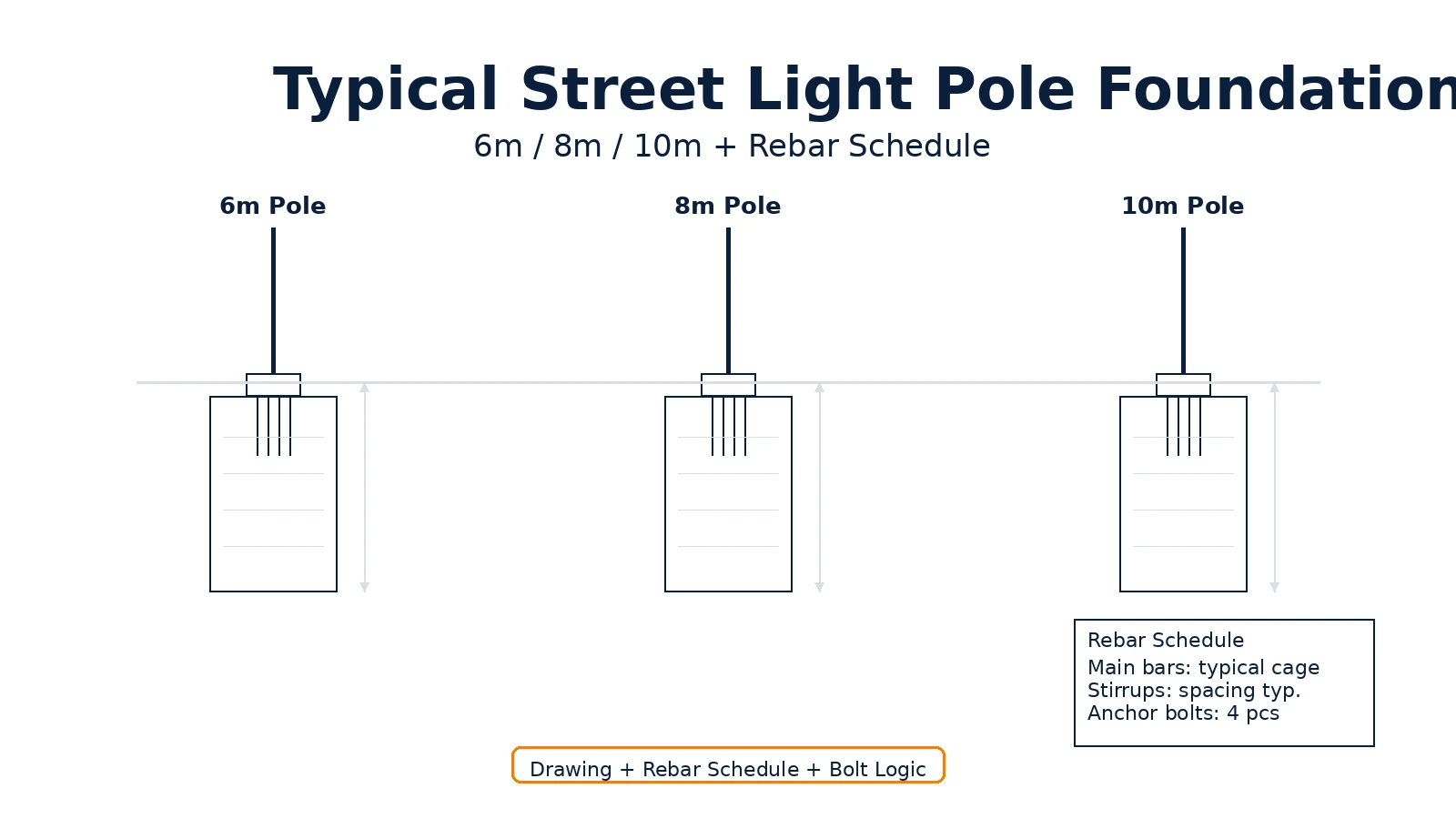
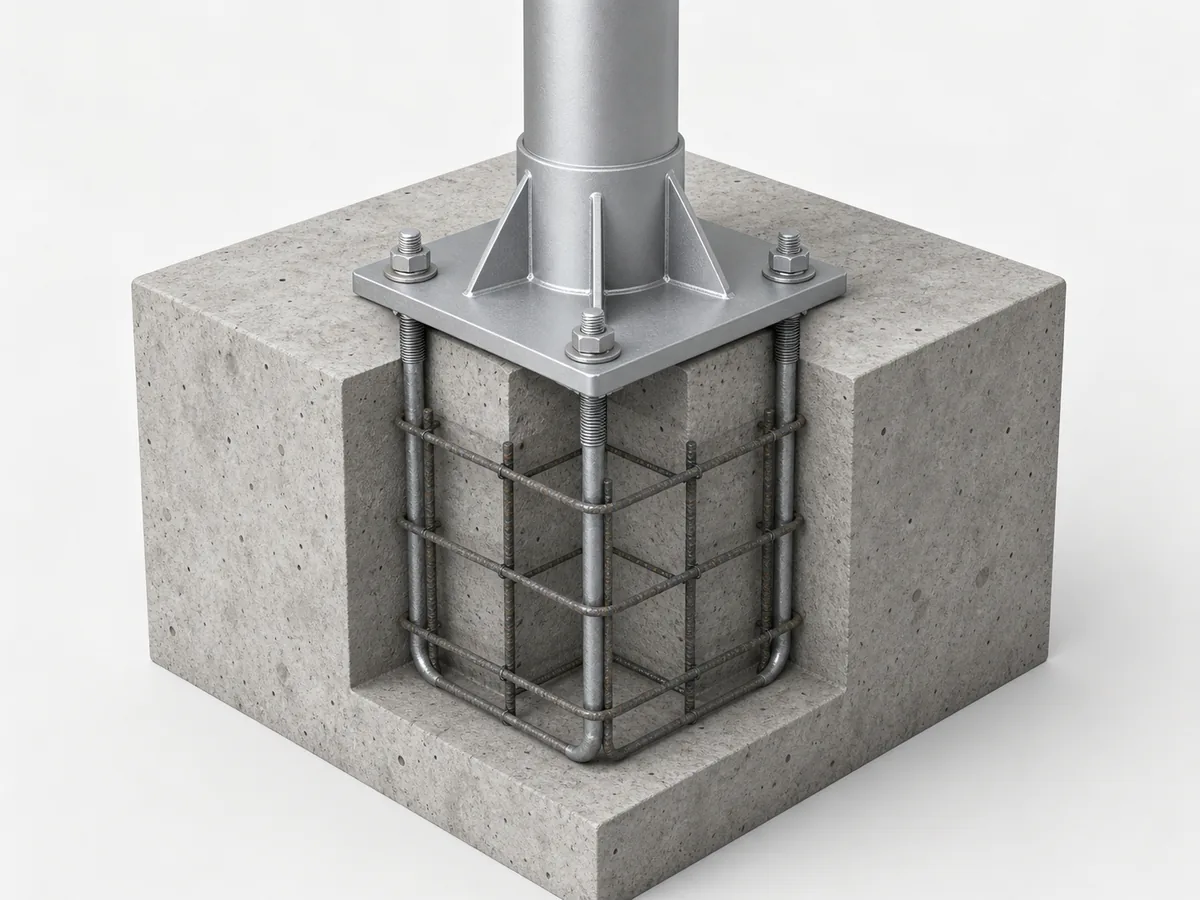
Spread Footing Drawing
Typical reinforced concrete footing section for 8–15 m street lighting poles.
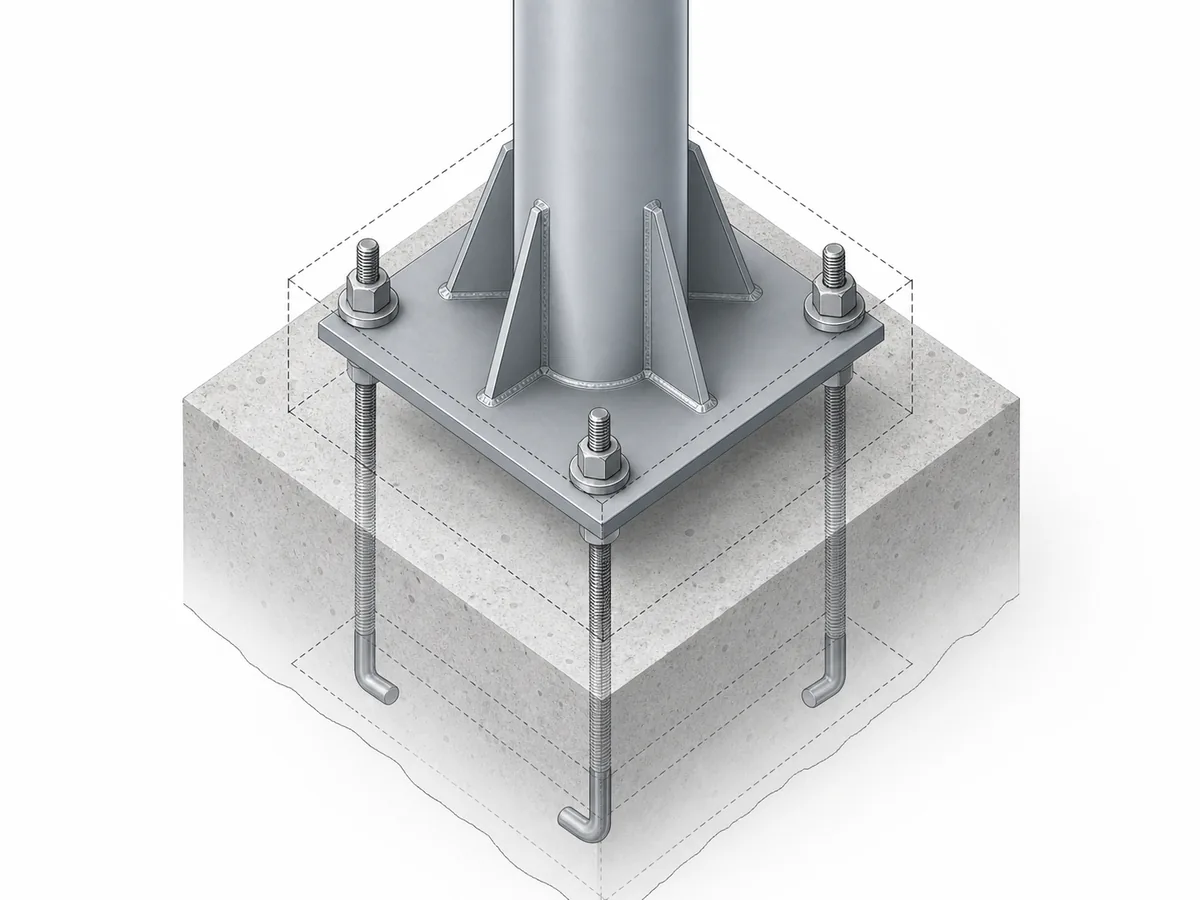
Anchor Bolt Template
Bolt circle, template plate and anchor bolt positioning before concrete pouring.
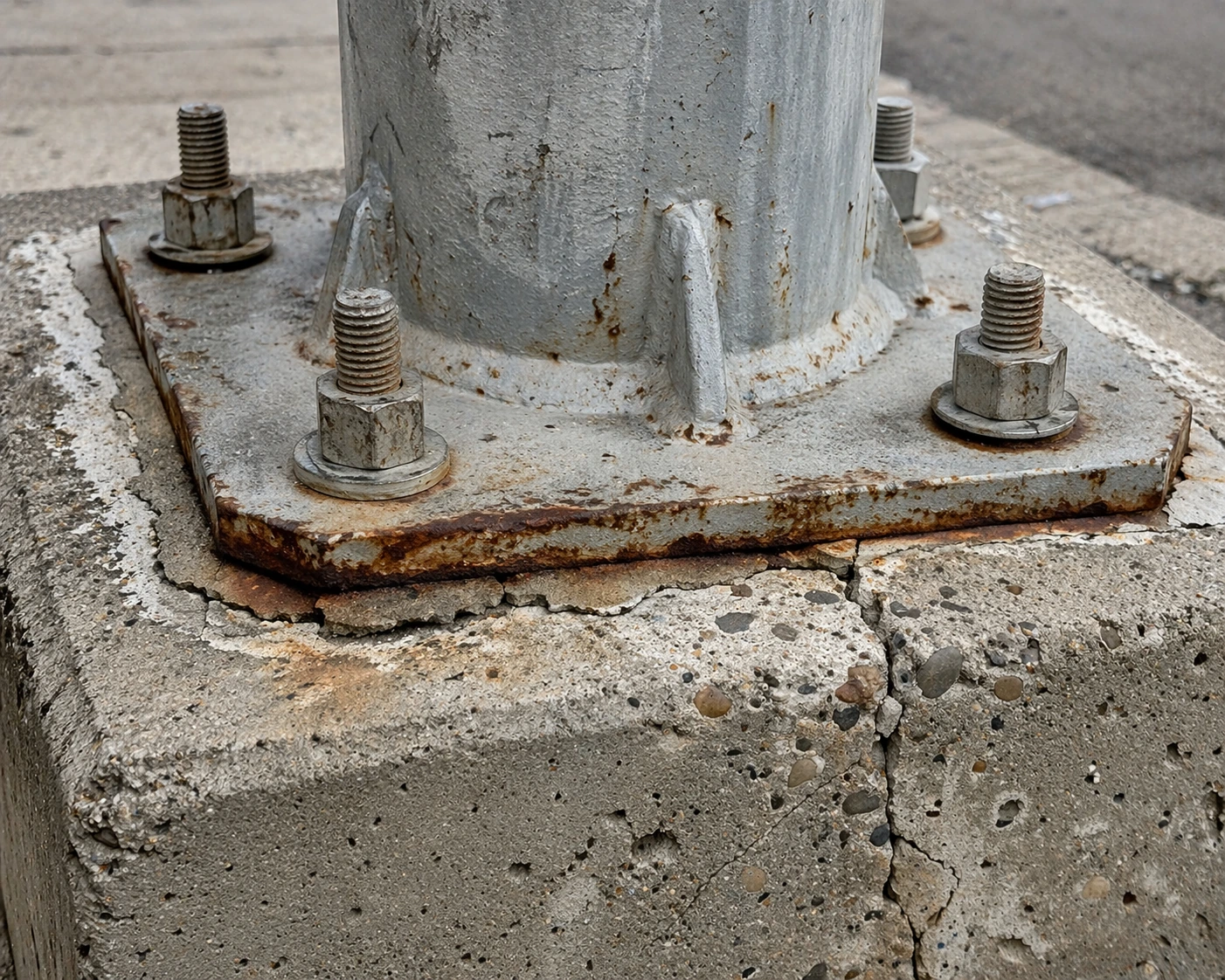
Base Plate Detail
Base plate, leveling nuts, grout layer and final pole alignment.
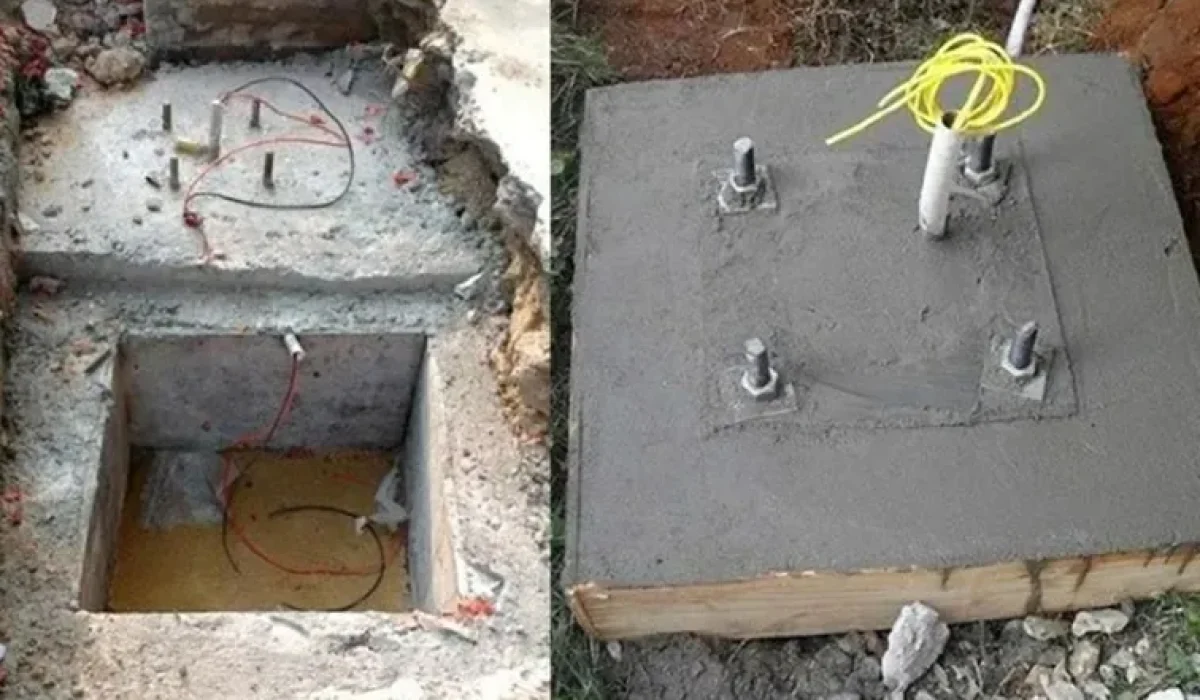
Site Installation Photo
On-site foundation preparation, conduit entry and inspection before pole installation.
What Is a Light Pole Foundation?
A light pole foundation is a structural system designed to resist:
- Overturning (wind moment at the base)
- Sliding (lateral shear at ground level)
- Soil bearing pressure (compression/uplift zones)
- Long-term movement (settlement, groundwater effects, repeated wind cycles)
It’s the “hidden structure” that decides whether your poles stay straight for 10–20 years.
1. Why Light Pole Foundations Fail More Often Than LEDs
On most street and area lighting projects, teams focus on:
- pole height and spacing
- lumen output and fixture efficiency
- fixture brand and optical distribution
Years later, when something goes wrong, it’s rarely the LED. Most serious issues are related to foundations and anchor bolts:
- poles start to lean after several rainy seasons
- concrete around the base plate cracks or breaks away
- anchor bolts corrode or loosen, especially near the grout level
- auditors ask an uncomfortable question:
“Where is your foundation design and structural calculation?”
This guide is for municipal engineers, EPC contractors, project managers and distributors working with grid-powered LED street lights and poles.
2. Design Objectives: Safety, Compliance and Lifetime Cost
A good foundation should:
-
Keep the pole vertical and stable
- under daily wind, temperature changes and soil movement
- during occasional extreme events
-
Meet local codes and standards
- building codes (often based on IBC, AASHTO, EN standards)
- defined safety factors for overturning, sliding and soil bearing
-
Be buildable and repeatable
- simple enough for local contractors to follow
- easy to inspect and sign off
-
Control lifetime cost
- slightly larger footing and proper corrosion protection at the start
- usually save many site visits, emergency repairs and complaints later
For long-life municipal specs, corrosion protection is often the real cost driver—see:
What is a galvanized street light pole and why it matters
For infrastructure projects with long service life requirements, hot-dip galvanized street light poles are commonly specified due to their corrosion resistance, structural reliability, and predictable lifetime performance.
3. Design Inputs Engineers Actually Use
Typical inputs for light pole foundation design include:
3.1 Pole & luminaire data
- pole height, arm length, number of arms
- weight and projected area of luminaires
- extra equipment (signage, CCTV, speakers, banners, etc.)
Not sure which pole style fits your road/area use case? See:
Different types of lighting poles and their applications
3.2 Wind load data
- basic wind speed from local code (e.g., 30–50 m/s)
- terrain category (open field, coastal, suburban, urban)
- importance factor for critical facilities (main roads, airports, ports)
3.3 Soil conditions
- soil type (rock, dense sand, clay, fill)
- allowable bearing capacity
- frost depth and groundwater level
3.4 Project requirements
- service life expectations
- limitations on top-of-pole deflection or vibration
- local client or municipal specifications
4. Simplified Structural Logic (IBC / AASHTO Style)
Most modern codes follow a similar workflow:
- Model the pole as a cantilever fixed at ground level.
- Calculate the horizontal wind force V on the pole and fixtures.
- Compute the bending moment M and shear at the foundation top.
- Select foundation size and embedment depth so that:
- soil pressure is ≤ allowable bearing capacity
- overturning and sliding safety factors are satisfied
⚠️ Important
Exact formulas depend on the code and soil model. Final foundation design must always be checked and approved by a qualified structural engineer under local regulations.
As a manufacturer, Sunlurio provides realistic loads, typical foundation solutions and structural data to support your engineering team.
5. Common Types of Street Light Pole Foundations
There is no single “best” foundation type. The right choice depends on pole height, soil conditions, environment and budget.
5.1 Direct-embed concrete foundation
- pole or stub post embedded directly into a concrete footing
- simple and economical for lower poles (≤ 6–8 m) in good soil
- often used in small car parks, minor roads and pathways
Pros
- low material and fabrication cost
- straightforward construction
Cons
- not ideal for higher poles or poor soils
- changing poles later is more difficult
5.2 Spread footing with anchor bolts (most common for 8–15 m)
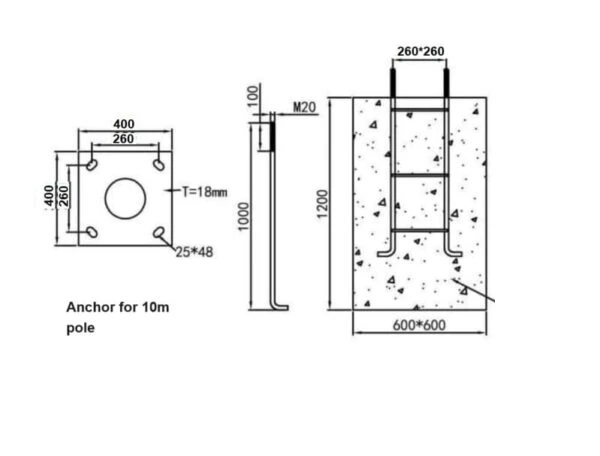
- reinforced square or round concrete footing
- pole connected using a base plate and anchor bolts
- most common choice for municipal and industrial projects
Pros
- easy to install and align poles
- easy to inspect anchor bolts and grout
- easier to replace poles in the future
Cons
- requires accurate placement of anchor bolts and conduits
- concrete quality and grouting need supervision
5.3 Pile or drilled shaft foundations
- used in weak or highly variable soils, floodplains or near water
- pole attached to a pile cap or reinforced shaft
Pros
- higher capacity in difficult ground conditions
- better long-term performance in flood or coastal environments
Cons
- more expensive and time-consuming
- requires specialized equipment and experienced contractors
📝 Sunlurio practical note
For most municipal and industrial projects with 8–15 m poles, a reinforced spread footing with anchor bolts usually gives the best balance of safety, cost and maintenance convenience.
6. Typical Foundation Sizes by Pole Height
These are planning ranges only. Real sizing changes with wind zone, soil bearing capacity, pole configuration, outreach arms, fixture projected area, and local code requirements.
| Pole Height | Common Foundation Type | Typical Footing Size Range | Anchor Bolt / Base Plate Notes | Project Review Notes |
|---|---|---|---|---|
| 6-8 m | Direct embed or spread footing | 600x600x900 to 800x800x1200 mm | Base-plate design may be used where inspection and replacement are priorities. | Depends heavily on soil condition, exposure, and local practice. |
| 9-10 m | Spread footing with anchor bolts | 800x800x1200 to 1000x1000x1500 mm | Confirm bolt circle, projection height, template, base plate thickness, and grout detail. | Common municipal range, but wind and terrain can push sizes higher. |
| 11-12 m | Spread footing with anchor bolts | 1000x1000x1500 to 1200x1200x1800 mm | Anchor bolt diameter, embedment, HDG protection, and leveling tolerance become more important. | Review projected area from arms, luminaires, CCTV, signs, or solar accessories. |
| 14-15 m | Spread footing, pile, or drilled shaft | 1200x1200x1800 mm and above | Base plate and anchor bolt design should be checked with pole structural data. | Consider pile or drilled shaft options in weak soil, high wind, or restricted-footprint sites. |
Warning note: These dimensions are planning references only. Final foundation design must be checked by a qualified structural engineer based on wind speed, soil bearing capacity, pole configuration, local code, and project conditions.
7. Anchor Bolts & Base Plates — Where Many Projects Go Wrong
A strong footing can still fail at installation if the bolt circle, template, grout layer, base plate, or projection height is wrong.
Wrong Bolt Circle
Bolt circle mismatch can make the pole impossible to install on site.
No Rigid Template
Loose anchor bolts may shift during concrete pouring and cause alignment problems.
Poor Grouting
Missing grout or uneven leveling can create vibration, water traps and long-term corrosion.
Base Connection Review
- 4-8 anchor bolts arranged on a bolt circle
- Base plate welded to the pole shaft
- Leveling nuts and top nuts for alignment and clamping
- Non-shrink grout layer between base plate and concrete
- Rebar cage tying bolts into the footing
- Hot-dip galvanized anchor bolts and protected exposed threads
8. Grouting & Leveling (Small Detail, Big Consequences)
Most long-term complaints start here:
- missing grout or hollow grout zones under the base plate
- voids allow water to sit → corrosion and loosening
- alignment drifts under wind cycles and vibration
Good practice
- level using leveling nuts
- fully pack non-shrink grout under the plate
- inspect for voids before sign-off
9. Cabling & Trenching (Grid-Powered Pain Point)
Unlike solar street lights, grid-powered systems require trenches and cables. Many site problems come from poor coordination between civil works and electrical works.
9.1 Conduit location and size
- conduit must align with the pole handhole
- avoid sharp bends that make pulling cables difficult
- select appropriate diameter/material per local electrical code
9.2 Entry into the foundation
- plan conduit entry positions in advance
- use sleeves or formed openings to reduce cracking risk
- seal around conduits to reduce water ingress into handholes
9.3 Trench depth and backfilling
- follow code requirements for minimum burial depth
- backfill and compact correctly to reduce settlement
- coordinate with other underground utilities (water, gas, telecom)
📌 Practical tip
Combine foundation + conduit entry + pole handhole in one drawing to reduce rework and change orders.
10. Step-by-Step Foundation Review Workflow for EPC Teams
Collect Project Data
Pole height, arm length, luminaire weight, site location, wind zone and soil assumptions.
Confirm Pole & Base Plate
Check pole diameter, flange size, bolt circle, base plate thickness and accessories.
Select Foundation Type
Direct embed, spread footing, pile or drilled shaft depending on project condition.
Review Anchor Bolts
Confirm bolt quantity, diameter, length, template and projection height.
Check Cable & Grounding
Coordinate conduit entry, handhole, junction box and grounding details.
Prepare Tender Documents
Provide drawings, datasheets, BOQ mapping and installation notes for review.
11. Installation & Inspection Checklist
Foundation & Concrete
- Dimensions match drawings
- Rebar cage location and concrete cover are checked
- Concrete grade follows project specification
- Concrete is vibrated without major honeycombing
Anchor Bolts
- Rigid template used during casting
- Bolts straight with correct projection above concrete
- Bolt circle matches base plate holes
Grouting & Leveling
- Pole aligned with leveling nuts
- Non-shrink grout fills under the base plate
- No large voids or hollow grout zones
Cable & Grounding
- Conduits positioned and sealed
- Handholes dry and accessible
- Earthing or grounding installed per design
12. Common Mistakes: How to Avoid Them
Frequent issues we see in real projects:
- re-using “typical building footings” without wind/soil checks
- ignoring soil variation across the site
- using undersized or non-galvanized anchor bolts
- missing/poor grout installation
- conduit/handhole misalignment
- no documentation (no drawings, no load data, no calculation summary)
Most problems can be avoided with:
- a repeatable workflow
- practical drawings
- supervision at the right moments (rebar, bolts, concrete, grouting)
13. How Sunlurio Supports Street & Area Lighting Projects
For EPC contractors, consultants, and municipal lighting projects, Sunlurio can support pole, foundation, and tender-related engineering files before production.
Pole & Base Plate Data
Pole height, diameter, flange size, base plate thickness and material details.
Anchor Bolt Kits
Anchor bolt quantity, bolt circle, template and projection reference.
Foundation Concept Drawing
Typical footing and base coordination drawings for early project review.
DIALux / IES Support
Lighting layout, IES/LDT files and spacing review for road and area lighting.
BOQ & Tender Mapping
Product datasheets, compliance documents and BOQ item matching.
Installation Review
Practical checks for conduit entry, grounding, leveling and site installation.
14. What About Solar Street Light Foundations?
This guide focuses on grid-powered street and area lighting poles.
Solar projects also need to consider:
- extra wind area of solar panels (sail effect)
- higher and more eccentric center of gravity
- battery pit design (waterproofing, condensation, anti-theft)
Related guide:
Solar Street Light Foundation Design: Wind Loads, Battery Pits & Safety
Next Step for Your Project
If you are still comparing pole heights, footing types, anchor bolt options, or support methods, continue with the related guides and download resources below.
If you already have a live project, send your pole schedule, wind basis, soil note, BOQ, or drawing package through our Engineering Support page for a more practical review path.
Download: Light Pole Foundation Design Toolkit
Use these references to prepare early-stage project review, quotation discussion, or tender document coordination.
Foundation Review Checklist
Key items to confirm before quotation or tender submission.
Sample Foundation Calculation Sheet
A planning worksheet for project teams to organize design inputs.
Typical Foundation Drawing
Reference drawing for pole base, footing and anchor bolt discussion.
Site Inspection Checklist
Installation and handover checks for foundation and pole erection.
FAQs: Light Pole Foundations
1) How deep should a light pole foundation be?
2) What is a typical footing size for a 9–12 m street light pole?
3) Do I always need an engineer to design light pole foundations?
4) What is the difference between a direct-embed foundation and a base-plate foundation?
5) What affects foundation depth most?
6) Can one typical foundation detail be used across the whole site?
7) When are anchor bolts more critical than footing size?
8) How do wind and open terrain change foundation design?
9) How do weak soil conditions affect footing selection?
10) Are coastal projects different from inland projects?
11) What should I send for a foundation review?
12) Can Sunlurio help with anchor bolt kits, drawings, and tender support?
Send Your Pole Foundation Review Request
Share your pole height, project location, wind speed, soil condition, quantity, and tender requirements. Our team will review the information and suggest the documents needed for quotation or project discussion.