
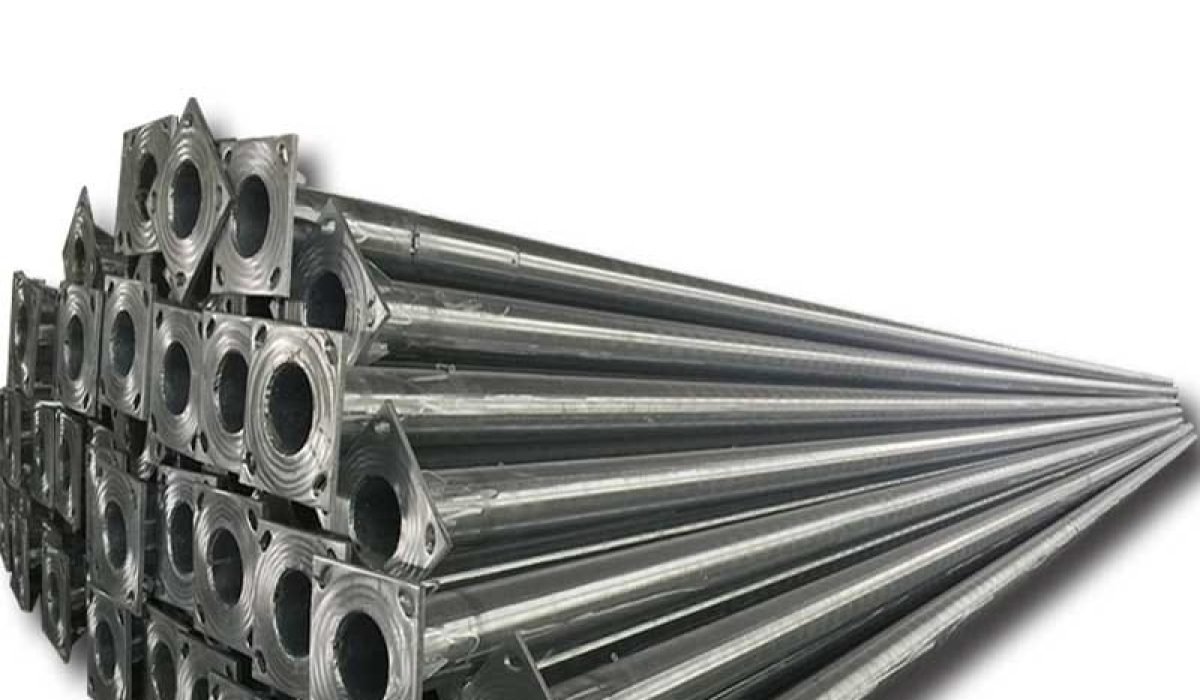
Choosing the right lighting pole type is not only about appearance. In real projects, pole type affects structural safety, corrosion performance, installation difficulty, maintenance cost, and long-term lighting results.
That matters for roads, parking areas, ports, parks, industrial sites, campuses, and solar lighting projects. A pole that is suitable for a landscaped pedestrian zone may be completely wrong for a highway, coastal road, or logistics yard.
For EPC contractors, municipalities, consultants, and project buyers, lighting pole selection should be treated as a project-fit and lifecycle decision, not just a product-category choice. :contentReference[oaicite:0]{index=0}
Quick Answer
The main types of lighting poles usually include:
- steel lighting poles
- aluminum lighting poles
- concrete lighting poles
- fiberglass or composite lighting poles
- single-arm and double-arm poles
- decorative lighting poles
- high mast poles
- solar lighting poles
There is no single best type for every project.
As a practical guide:
- steel poles are usually preferred for highways, industrial zones, and heavier-duty infrastructure
- aluminum poles are often better for coastal, urban, and appearance-sensitive projects
- concrete poles are useful where heavy, stable, long-life installations are required
- fiberglass or composite poles are useful where corrosion resistance, low weight, or non-conductive behavior matters
- high mast poles are suited to large open areas such as ports, airports, and yards
- solar poles are suitable where off-grid or low-grid-dependence lighting is needed
The right choice depends on:
- application
- environment
- luminaire load
- wind exposure
- maintenance reality
- project budget and review requirements
Need help choosing the right lighting pole for a road, parking lot, industrial site, port, park, or solar lighting project?
Explore Solutions
Request Engineering Support (24H)
Why Pole Type Matters More Than Many Buyers Expect
A lighting pole is not just a vertical support. It is part of a complete outdoor lighting system that must handle:
- luminaire load
- bracket outreach
- wind exposure
- corrosion conditions
- installation and foundation logic
- years of outdoor service
That is why choosing the wrong pole type can lead to:
- premature corrosion
- vibration or structural problems
- more difficult installation
- higher lifecycle cost
- poor fit for the site environment
- rejection in stricter project review
In practice, better buyers do not ask only, “What pole material is this?” They also ask:
- Is this pole suitable for the environment?
- Can it carry the required lighting load?
- Will it be easy to maintain?
- Is it aligned with the project’s structural and visual requirements?
- Does it match the project’s lifecycle logic?
What Are Lighting Poles?
Lighting poles are vertical support structures used to mount luminaires at the correct height and position for roads, pathways, open areas, and public spaces.
Their job is simple in theory, but their performance depends on several engineering choices:
- pole material
- pole height
- shaft diameter and wall thickness
- bracket design
- base plate and anchor arrangement
- corrosion protection
- installation method
That is why lighting poles vary widely between highways, parks, plazas, industrial sites, and off-grid projects.
Steel Lighting Poles
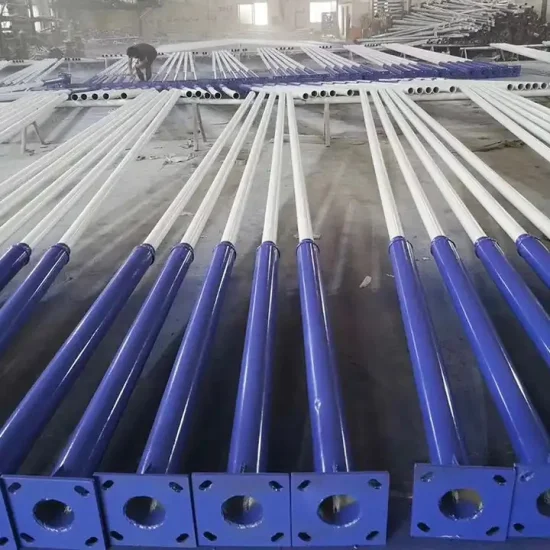
ALT: steel lighting poles for infrastructure and road applications
Caption: Steel poles remain one of the most common choices for road, industrial, and infrastructure lighting because of their strength and fabrication flexibility.
Steel poles are widely used because they offer strong structural performance and broad design flexibility. They are commonly used in tapered octagonal, round tapered, or polygonal forms.
Why Steel Poles Are Common
Steel poles are often chosen where projects require:
- higher load capacity
- greater rigidity
- taller mounting heights
- longer outreach arms
- more demanding wind performance
Typical Advantages
- high structural strength
- good wind resistance when properly designed
- wide range of heights and shapes
- suitable for heavier luminaires and brackets
- competitive cost in many infrastructure projects
Typical Limitations
- higher weight than aluminum or composite options
- corrosion risk if protection is weak
- more handling and installation effort
- higher maintenance burden in aggressive coastal environments if not properly protected
Common Applications
- highways
- municipal roads
- industrial areas
- ports
- airports
- logistics yards
For projects where corrosion protection matters, steel poles are often combined with hot-dip galvanizing or other protective finishes.
Aluminum Lighting Poles
Aluminum poles are known for being lightweight and naturally corrosion-resistant. They are often selected where appearance, lower maintenance, and humid or coastal exposure matter more than maximum structural capacity.
Why Aluminum Poles Are Popular
Aluminum forms a natural oxide layer that improves corrosion resistance. That makes it attractive for locations where rust is a major concern.
Typical Advantages
- lower weight
- easier transport and installation
- strong corrosion resistance
- low maintenance
- cleaner architectural appearance
- recyclable material
Typical Limitations
- lower stiffness and strength than steel in heavier-duty applications
- usually higher material cost
- requires careful review in higher wind or heavier load conditions
Common Applications
- parks
- waterfronts
- pedestrian zones
- residential areas
- decorative urban spaces
- coastal public projects
For related comparison reading, see:
Top Benefits of Using Aluminum Light Poles
Concrete Lighting Poles
ALT: concrete lighting pole reference for road and bridge applications
Caption: Concrete poles are heavy and stable, which can be useful in fixed road or bridge-adjacent installations where long-term rigidity matters.
Concrete poles are used in projects where stability, mass, and low movement are valued. They are often selected for more fixed, long-life installations rather than projects where lightweight handling matters.
Typical Advantages
- high stability
- long service life
- good vibration resistance
- low routine maintenance in many conditions
- useful in fixed infrastructure applications
Typical Limitations
- very heavy
- more difficult transport and erection
- less flexible for some architectural or custom designs
- not ideal where lightweight installation is important
Common Applications
- city roads
- bridge approaches
- windy roadside locations
- fixed public-infrastructure installations
Concrete poles can make sense where installation access is available and long-term stability is more important than ease of handling.
Fiberglass and Composite Lighting Poles
Fiberglass and composite poles are often chosen where low weight, corrosion resistance, or non-conductive behavior is valuable.
Why Composite Poles Matter
These poles solve a different problem from steel or concrete. Instead of maximizing raw structural capacity, they help in environments where rust, weight, or electrical conductivity is a concern.
Typical Advantages
- very low weight
- strong corrosion resistance
- non-conductive behavior
- easier handling and transport
- low maintenance in the right environment
Typical Limitations
- usually lower load capacity than heavy-duty steel options
- less suitable for high-load roadway applications unless specifically engineered
- fewer standard options in some markets
Common Applications
- school campuses
- wetlands and sensitive landscapes
- decorative pathways
- coastal walkways
- low-load public areas
Composite poles are not the default solution for every job, but they can be very useful in the right environment.
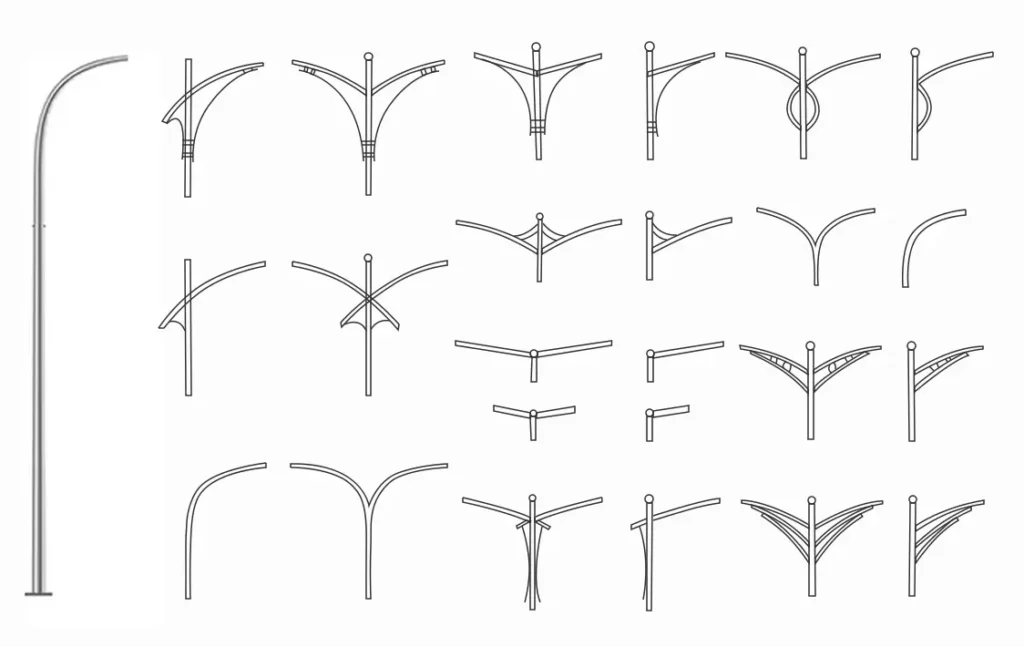
Single Arm and Double Arm Lighting Poles
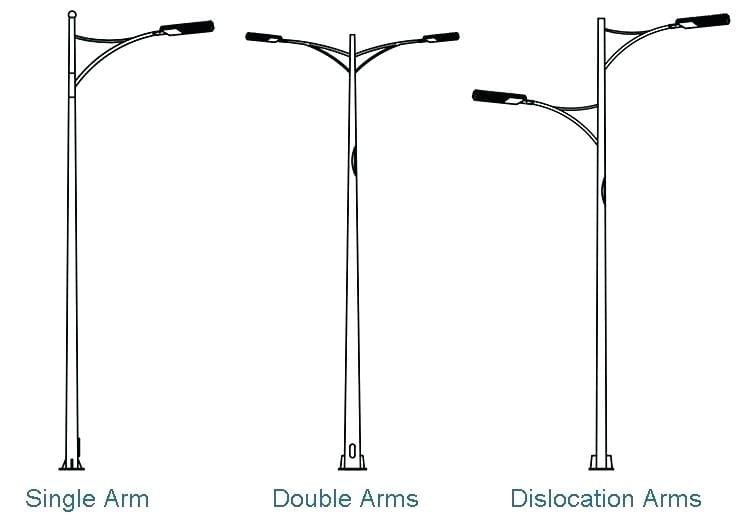
ALT: single arm and double arm lighting pole designs for road applications
Caption: Arm configuration affects how lighting is distributed across the road and how the pole is structurally loaded.
Pole type is not only about material. Arm configuration also matters.
Single-Arm Poles
Single-arm poles are often used for:
- pedestrian paths
- narrow roads
- one-sided mounting arrangements
- simpler lighting layouts
Double-Arm Poles
Double-arm poles are often used for:
- wider roads
- central medians
- symmetrical road lighting
- layouts where fewer poles are preferred
Why This Matters
Changing from single-arm to double-arm affects:
- lighting distribution
- pole loading
- bracket demand
- base and foundation logic
That is why arm configuration should be chosen together with the lighting design, not after it.
Decorative Lighting Poles
Decorative poles combine lighting function with visual identity. They are often used where appearance matters as much as technical performance.
Common Uses
- parks
- plazas
- boulevards
- historical districts
- landscape projects
- premium urban spaces
Typical Features
- decorative bases
- custom arms
- colored or styled finishes
- banner brackets or ornamental details
Important Note
Decorative design should not override structural and lighting requirements. A decorative pole still needs to be suitable for:
- wind load
- fixture load
- corrosion exposure
- maintenance access
- project budget
High Mast Lighting Poles
High mast poles are tall structures used to illuminate large open areas with fewer pole locations.
Why High Mast Poles Are Used
They are useful where the project needs broad coverage across:
- airports
- ports
- stadiums
- large intersections
- industrial yards
- logistics areas
Typical Advantages
- fewer pole locations for large areas
- wide-area coverage
- strong fit for open industrial and transport environments
Typical Limitations
- more complex maintenance
- heavier structural and foundation demand
- higher installation complexity
- more formal design review usually required
For larger-area applications, high mast poles should usually be reviewed together with the lighting simulation and aiming logic.
Solar Lighting Poles
ALT: solar lighting pole with integrated solar components for off-grid applications
Caption: Solar lighting poles are useful where off-grid deployment, faster installation, or reduced grid dependence is more important than conventional power connection.
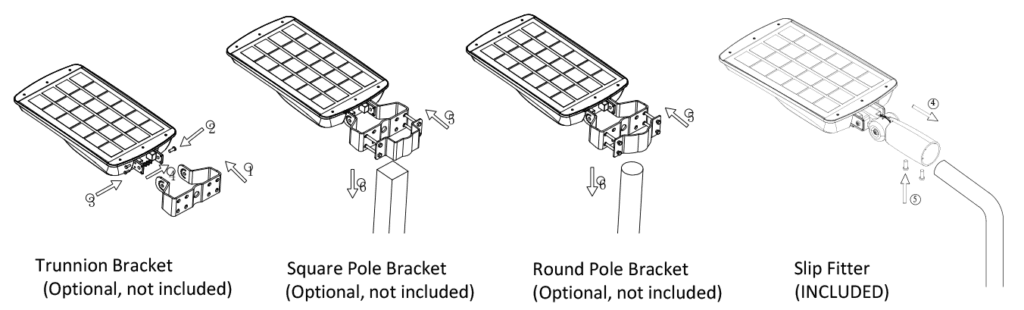
Solar lighting poles combine the support structure with solar lighting system components such as:
- solar panel
- battery
- controller
- LED luminaire
- pole and mounting arrangement
Why Solar Poles Matter
They are often used where trenching, cabling, or unstable grid access makes conventional lighting harder to justify.
Typical Applications
- villages
- parks
- remote roads
- campuses
- refugee or camp-like settings
- eco-parks
- development-oriented public works
Common System Types
- all-in-one systems
- split-type systems
The right solar lighting pole should be chosen based on energy balance, autonomy requirement, environment, and maintenance reality, not just the appearance of the product.
How to Choose the Right Lighting Pole Type
The best lighting pole choice usually starts with a small checklist.
1. Check the Environment
Ask:
- Is the site coastal?
- Is there humidity, dust, or corrosion exposure?
- Is the pole in a high-wind location?
2. Check the Load
Ask:
- How heavy is the luminaire?
- Is there a long outreach arm?
- Are there multiple fixtures, cameras, or accessories?
3. Check the Application
Ask:
- Is this a highway?
- A parking area?
- A park or plaza?
- A remote solar project?
- A large-area high-mast application?
4. Check Installation and Maintenance Reality
Ask:
- Is lifting equipment available?
- Is maintenance easy or difficult?
- Is grid access reliable or limited?
5. Check the Review Logic
Ask:
- Does the project need stricter compliance support?
- Is there a donor or municipal review process?
- Does the buyer need more documentation and traceability?
For project-fit support, see:
Product Categories
Engineering Support
Installation and Maintenance Considerations
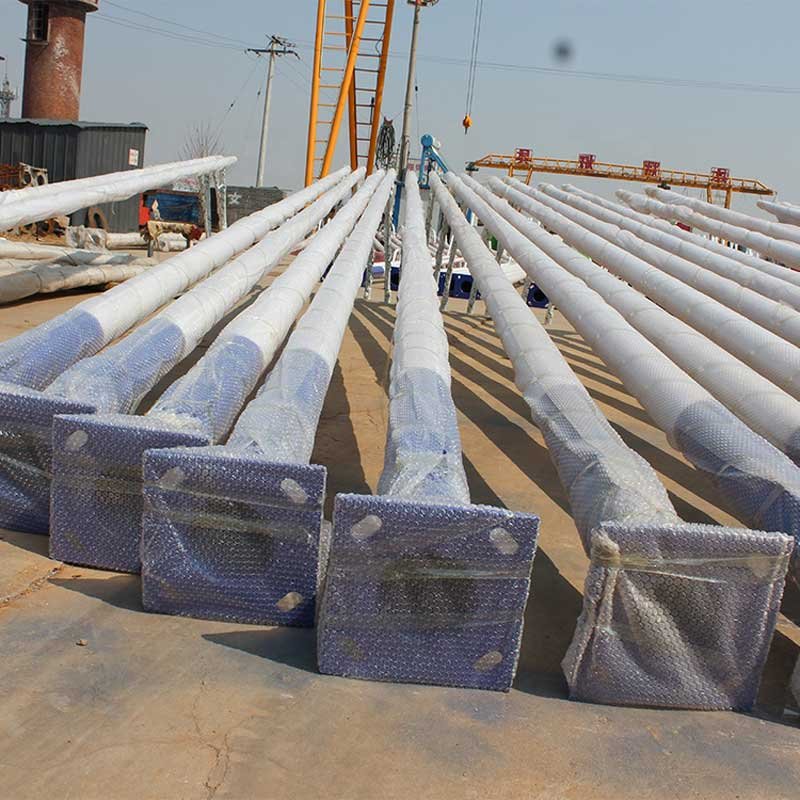
ALT: lighting pole installation and anchoring reference in outdoor project setting
Caption: Pole performance depends not only on the shaft itself, but also on installation quality, anchoring, and long-term inspection.
A lighting pole is only as reliable as its installation and foundation coordination.
Common installation methods include:
- direct burial in specific applications
- flange-mounted installation with anchor bolts
- engineered foundation systems for larger poles
Practical Maintenance Checks
- inspect for rust or coating damage
- check leaning or settlement
- inspect cracks or structural damage
- check anchor bolts and base area
- inspect luminaire brackets and fittings
In public and infrastructure projects, lifecycle logic matters more than first cost alone.
For related structural reading, see:
Light Pole Foundation Design Basics
Comparison Table of Lighting Pole Types
| Pole Type | Strength | Weight | Corrosion Resistance | Typical Use |
|---|---|---|---|---|
| Steel | High | Heavy | Moderate with protection | Highways, industrial areas, ports |
| Aluminum | Moderate | Light | High | Parks, coastlines, urban projects |
| Concrete | High | Very heavy | High | Roads, bridges, fixed infrastructure |
| Fiberglass / Composite | Low to medium | Very light | Excellent | Decorative, coastal walkways, low-load zones |
| High Mast | High | Heavy | Depends on material and finish | Airports, ports, stadiums, yards |
| Solar Pole Systems | Application-dependent | Application-dependent | Application-dependent | Remote and off-grid lighting |
Common Mistakes Buyers Make
Choosing by Appearance Alone
A pole that looks right for the site may still be wrong structurally or operationally.
Ignoring Corrosion Exposure
Steel poles in coastal or humid environments need stronger corrosion logic than inland installations.
Forgetting Bracket and Fixture Load
Pole type should always be reviewed together with the actual luminaire and arm configuration.
Treating Solar Poles as a Simple Product Category
Solar poles must still be checked for autonomy, battery logic, and maintenance fit.
Assuming One Pole Type Fits Every Project
Different projects need different solutions. A good park pole is not automatically a good highway pole.
Final Takeaway
There are many types of lighting poles, and each serves a different project logic.
- steel poles are usually best for heavy-duty road and industrial use
- aluminum poles are often better for corrosion-sensitive and urban environments
- concrete poles can suit fixed heavy-duty installations
- fiberglass or composite poles work well where low weight and corrosion resistance matter
- decorative poles serve visual environments
- high mast poles are designed for large-area lighting
- solar poles are useful for off-grid and low-grid-dependence applications
The best choice is usually not the most expensive or the most attractive. It is the one that fits the application, load, environment, maintenance reality, and project-review logic best.
Need Help Choosing the Right Lighting Pole?
If you are selecting lighting poles for a road, parking lot, industrial site, port, park, campus, or solar lighting project, the next step is usually to compare the application and environment with the correct pole type instead of choosing only by catalog appearance.
Next actions:
- Explore Solutions
- View Product Options
- See Project References
- Request Engineering Support (24H)
- Review Manufacturing & Quality
- See Markets We Serve
FAQ
What are the main types of lighting poles?
The main types usually include steel poles, aluminum poles, concrete poles, fiberglass or composite poles, decorative poles, high mast poles, and solar lighting poles.
Which lighting pole is best for highways?
For many highway and industrial applications, steel poles are often the most practical choice because of their higher strength and structural flexibility.
Are aluminum lighting poles better for coastal areas?
In many cases, yes. Aluminum poles are often a better fit for coastal or humid areas because of their natural corrosion resistance.
Where are high mast lighting poles used?
High mast poles are commonly used in airports, ports, stadiums, large intersections, and industrial yards where large-area coverage is needed.
Are solar lighting poles suitable for remote areas?
Yes. Solar poles are often suitable for remote roads, villages, parks, and off-grid public areas where grid access is limited or unreliable.