A practical first-pass calculation guide for EPC contractors, consultants, and municipal engineers planning ports, airport aprons, toll plazas, logistics yards, stadium perimeters, and other large-area lighting projects.
Quick Answer
You can estimate how many high mast lights you need with a simple lumen method:
Number of luminaires ≈ (Total area × target lux) ÷ (lumens per fixture × UF × MF)
This gives a first-pass quantity only. Final mast count still depends on height, optics, spacing, obstructions, glare control, and required uniformity. In real projects, the biggest mistake is treating the first-pass formula as a final approval basis before the layout has been checked in DIALux or AGi32.
For large projects, guessing is risky. You can overspend on unnecessary poles and foundations, leave dark areas that fail inspection, or create glare problems that become expensive to fix later.
Need a fast first-pass review for a port, airport apron, or industrial yard?
Send us your site plan, target lux, and preferred mast height for a free engineering check.
Request Engineering Support →
What Factors Decide How Many High Mast Lights You Need?
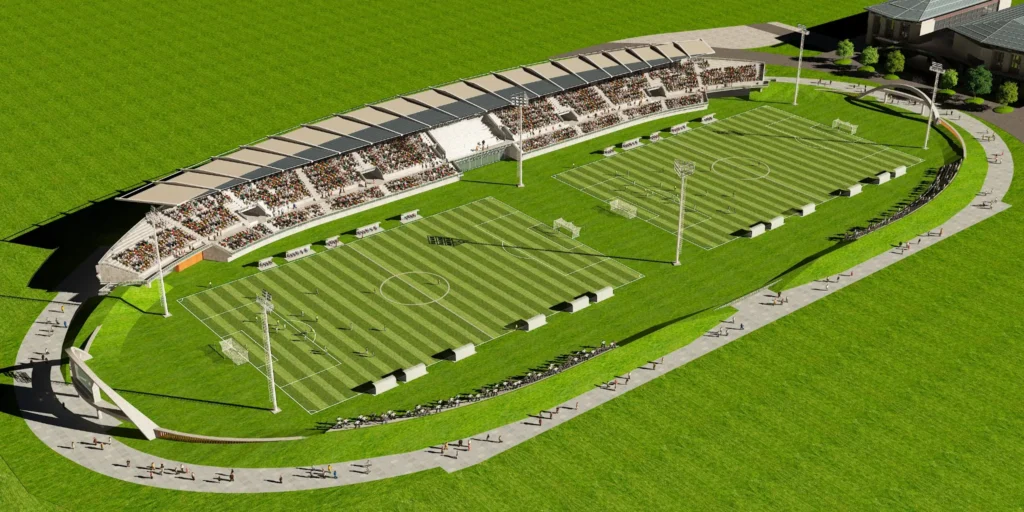
The number of high mast lights is not just “area ÷ coverage.”
Professionally, it depends on six main variables:
- Total area to be illuminated (m²)
- Target average lux required by code, client, or operator
- Mounting height of the mast (20 m, 25 m, 30 m, 35+ m, etc.)
- Lumens per fixture based on real delivered output
- Optics / beam distribution such as narrow, medium, wide, or asymmetric patterns
- Utilization factor (UF) and maintenance factor (MF)
If any of these are wrong, your quantity estimate will be misleading.
For readers who also want to understand how mast height changes lit ground area, see how high mast lighting coverage area really works.
Typical Lux Levels for High Mast Applications
For reference, our high mast LED luminaires typically range from 400W to 1200W per head, paired with 20–35 m poles for ports, aprons, stadium perimeters, and logistics yards.
Before you calculate “how many lights,” you first need to know how bright the area should be.
Below are common starting-point average lux levels used in many projects. Always confirm the final requirement against local standards, operator specifications, and project-specific safety rules.
| Application | Typical Average Lux (Eav) | Notes |
|---|---|---|
| Truck parking / logistics yard | 10–20 lux | Basic safety and navigation |
| Open industrial yard | 15–25 lux | Loading, unloading, equipment movement |
| Toll plaza / highway interchange | 20–30 lux | Driver visibility and facial recognition |
| Airport apron (stand-by positions) | 20–30 lux | Common planning range |
| Airport apron (active service areas) | 30–50 lux | Stricter uniformity and operational control |
| Container terminal / sea port apron | 20–30 lux | Large equipment and stacking heights |
| Stadium perimeter / training grounds | 50–100 lux | Not full TV broadcast level |
Think of these as design targets, not guaranteed final answers.
The correct value usually comes from:
- local code or national standard
- client or operator specification
- EHS or operational policy
- experience on similar sites
Basic Lighting Calculation Formula for a First Estimate
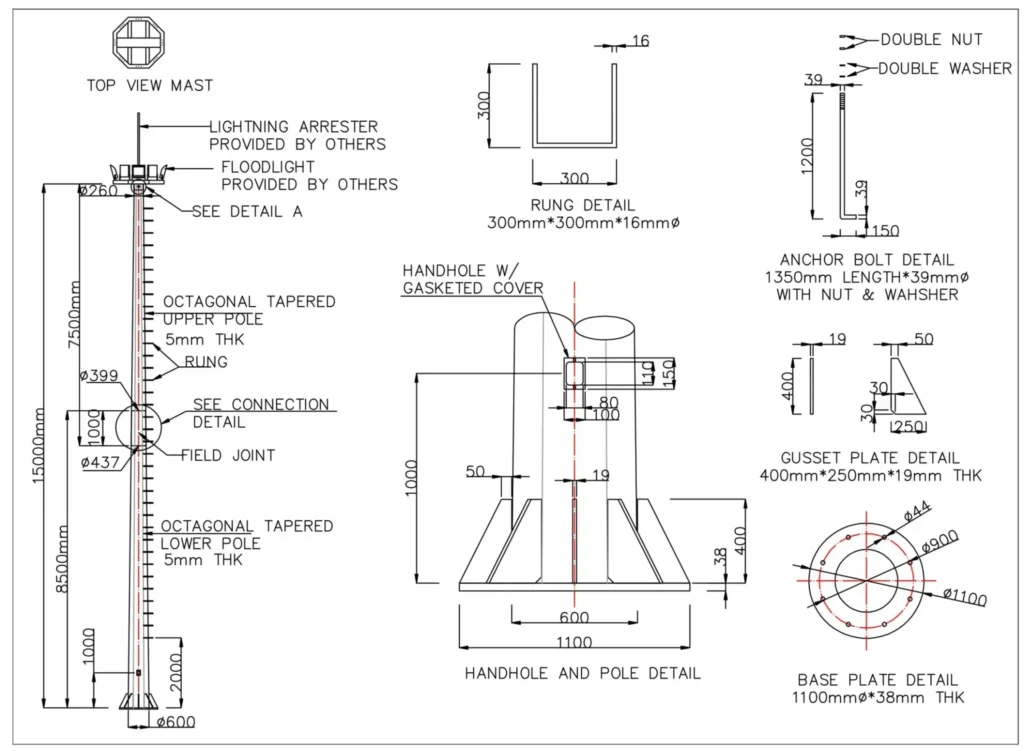
Once you know area and target lux, you can make a quick high mast lighting calculation for budgeting and early design comparison.
Number of luminaires ≈ (Total area × Target lux) ÷ (Lumens per fixture × UF × MF)
Where:
- Total area = ground area to be illuminated (m²)
- Target lux = required average brightness on the working plane
- Lumens per fixture = light output of one LED high mast luminaire
- UF (Utilization Factor) = typically 0.6–0.8
- MF (Maintenance Factor) = typically 0.7–0.8
In practice:
- UF is affected by mast height, optics, aiming, and layout efficiency
- MF is affected by dirt, cleaning interval, and lumen depreciation over time
For tender or consultant review, the calculation should also be matched with IES / LDT files and DIALux simulation outputs before final approval.
This method is excellent for:
- rough budgeting
- comparing fixture options
- checking whether your project is closer to 8 masts or 18 masts
But it is not enough to finalise:
- pole positions
- mast heights
- fixture aiming angles
- uniformity acceptance
- glare compliance
Example: How Many High Mast Lights for a 50,000 m² Airport Apron?
Let’s take a simplified example.
You operate a 50,000 m² apron and want to know roughly how many high mast lights you need.
Given:
- Area: 50,000 m²
- Target average lux: 30 lux
- LED high mast luminaire: 100,000 lm
- UF: 0.7
- MF: 0.75
Always confirm whether the quoted lumen value is nominal lumens, delivered lumens, or system lumens, especially when comparing suppliers.
Step 1 – Calculate required total lumens
Required lumens = Total area × Target lux
Required lumens = 50,000 × 30 = 1,500,000 lm
Step 2 – Calculate effective lumens per fixture
Effective lumens per fixture = Lumens × UF × MF
= 100,000 × 0.7 × 0.75 = 52,500 lm
Step 3 – Estimate number of luminaires
Number of luminaires ≈ Required lumens ÷ Effective lumens per fixture
≈ 1,500,000 ÷ 52,500 ≈ 28.6
In practice, you would:
- round up to 29–30 fixtures
- decide how many heads per mast
- refine mast spacing with simulation
For example:
- 4 heads per mast may suggest around 8 masts
- but the final number still depends on layout geometry, aiming, overlap, and site obstructions
This formula is excellent for budgeting and concept design. It is not final acceptance proof.
In project reviews, we often see early estimates look reasonable on paper, but the final mast count changes after simulation because overlap gaps, glare limits, obstacle interference, or edge-uniformity requirements were not visible in the hand calculation stage.
Already have a layout and want to verify the quantity?
We can help review your mast height, fixture count, optics, and spacing logic before procurement.
Ask for a First-Pass Quantity Review →
Why Mounting Height and Optics Change the Fixture Count
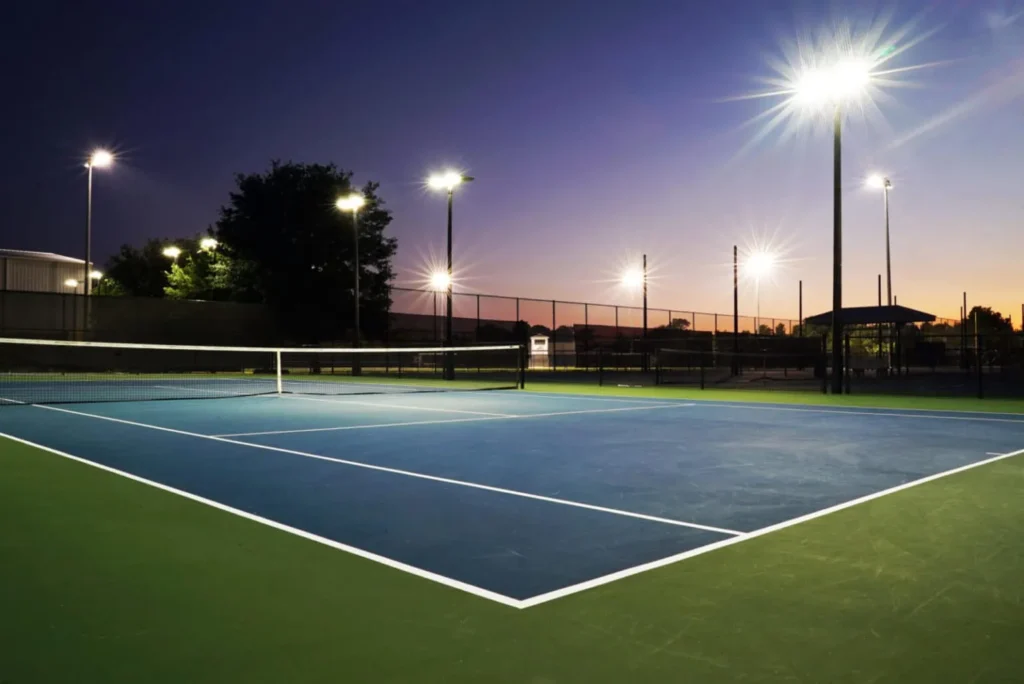
Two teams can use the same lumen formula and still end up with very different real-world results if they choose different:
- mounting heights
- optic types
- aiming strategies
For example:
- A 25 m mast with asymmetric optics can throw light much farther across a yard
- The same mast with a narrow beam may create a bright hotspot and leave dark edges
Also, the inverse square law explains the trend:
When you double the mounting height, illumination at ground level drops to roughly one quarter, unless you increase lumens or tighten beam control.
This is why increasing mast height from 25 m to 35 m can sometimes:
- reduce the number of masts
- increase wattage per luminaire
- change aiming strategy
- change the final budget
A quick formula gives a starting number. Height and optics decide whether that number is realistic.
If you also need to compare coverage by mast height, see how high mast lighting coverage area really works.
Why Hand Calculations Are Not Enough for Final Design
Hand calculations are useful for rough sizing, but they assume conditions that real ports, aprons, toll plazas, and industrial yards rarely have:
- open, flat ground
- no obstructions
- ideal overlap between beams
Real sites are different.
Common problems include:
- container stacks, cranes, buildings, and scoreboards blocking light
- sloping ground changing how light lands
- wide mast spacing creating dark stripes
- glare to drivers, workers, or pilots
- poor uniformity even when average lux looks acceptable
That is why serious projects usually require a DIALux or AGi32 lighting report before ordering poles or pouring foundations.
A proper report can show:
- average lux
- minimum lux
- uniformity
- beam overlap
- false-colour renderings
- aiming logic
- likely glare risks
For a more complete engineering workflow, see high mast lighting system design and simulation and high mast light project references.
Get a Free High Mast Lighting Simulation
Hand calculations are useful for rough sizing, but they cannot predict:
- shadows from containers, cranes, or gantry structures
- glare towards drivers, operators, or pilots
- dark patches between masts
- whether the first-pass mast count is actually buildable
If you are planning a port, airport apron, logistics yard, toll plaza, stadium perimeter, or industrial park, it is safer to verify the design before concrete work and procurement.
🛑 Don’t Guess Your High Mast Layout
Send us your:
- site layout (DWG / PDF) or a simple sketch with dimensions
- required lux level and relevant standards
- planned mast height and any existing constraints
Our engineering team can prepare a free DIALux simulation showing:
- how many high mast lights you really need
- recommended wattage and optics per mast
- pole spacing and aiming for safe, uniform coverage
This turns a rough estimate into a more defensible engineering proposal for your client, consultant, or authority.
What Information Should You Prepare Before Asking for a Design?
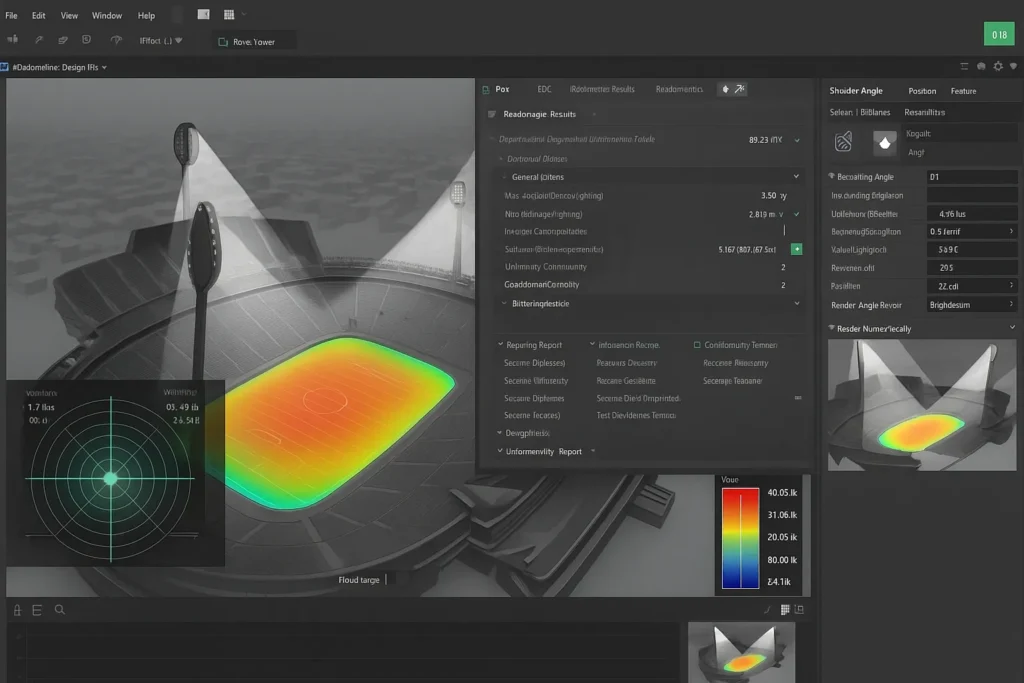
To make any high mast lighting calculation or simulation useful, it helps to have:
- site dimensions
- application type
- target lux
- preferred mast height
- existing obstacles
- operating hours
With these basics, a good supplier can quickly tell you:
- whether 20 m, 25 m, or 30–35 m is the right height
- how many masts you likely need
- approximate power per mast
- where a simulation is most likely to change the estimate
If your project is still at concept stage, you can compare product-side options first via high mast lighting specifications and configurations.
Conclusion: Don’t Just Count Lights — Design the Whole High Mast System
“How many high mast lights do I need?” is a good starting question.
The better question is: “How do I achieve the required lux and uniformity with the lowest safe total cost?”
A simple formula helps you:
- build a budget
- compare different fixture wattages
- understand the order of magnitude
But only a proper DIALux or AGi32 design can show whether your high mast system will:
- meet lux and uniformity requirements
- avoid dangerous glare and dark spots
- optimise pole quantity, foundation cost, and wiring
- support approval and handover
Use the formula to build a rough budget. Use simulation to defend the final design.
FAQ
What is the basic formula for estimating high mast light quantity?
A common first-pass formula is:
Number of luminaires ≈ (Total area × target lux) ÷ (lumens per fixture × UF × MF)
This gives a starting estimate only. Final mast count still needs simulation.
How many high mast lights do I need for an airport apron?
It depends on apron size, target lux, mast height, optics, UF, MF, and uniformity requirements. For large aprons, a lumen method can provide a first estimate, but final design should be checked with DIALux or AGi32.
How many high mast lights do I need for a port or container yard?
The answer depends on the working area, stacking heights, crane obstructions, target lux, and mast geometry. Port layouts often need simulation because obstructions can significantly affect real coverage.
What lux level is typical for high mast lighting?
Typical starting ranges include:
- 10–20 lux for truck parking or logistics yards
- 15–25 lux for open industrial yards
- 20–30 lux for toll plazas and port yards
- 20–50 lux for airport aprons depending on activity level
- 50–100 lux for stadium perimeters or training grounds
Always verify with local standards and client requirements.
What is UF in high mast lighting calculation?
UF means utilization factor. It represents how much of the fixture’s light output actually reaches the useful target area. It is affected by height, optics, aiming, and layout efficiency.
What is MF in high mast lighting calculation?
MF means maintenance factor. It accounts for light loss over time due to dirt, aging, and lumen depreciation. It helps prevent under-lighting after the system has been in service for some time.
Why is hand calculation not enough for high mast lighting?
Hand calculations do not account well for:
- obstructions
- site geometry
- slope
- glare
- dark patches
- uniformity
That is why serious projects usually need simulation before final approval.
Why does mast height change the number of lights?
Higher masts can cover larger ground areas, but light at ground level becomes weaker unless optics and lumen output are adjusted. Mast height affects spacing, aiming, overlap, and glare risk.
How do optics affect high mast light quantity?
A wide or asymmetric optic may cover more useful area, while a narrow beam may create hotspots and require more fixtures or different mast spacing. Optics can change the realistic quantity significantly.
Do I need DIALux or AGi32 for high mast lighting?
For small rough estimates, not always. For ports, airports, logistics yards, toll plazas, stadium perimeters, and large industrial sites, the answer is usually yes. A simulation is often needed before procurement and installation.
What information should I prepare before asking for a high mast lighting design?
Useful inputs include:
- site dimensions
- application type
- target lux
- preferred mast height
- existing obstacles
- operating hours
- any client or code requirements
Can one formula decide the final mast count?
No. The formula helps with a first-pass estimate, but final mast count must still consider site geometry, fixture arrangement, optics, obstructions, and required uniformity.
What is the biggest mistake when estimating high mast lights?
The biggest mistake is assuming that average lux alone is enough. In real projects, uniformity, glare, spacing, and buildability often decide whether the design actually works.
How can I reduce the risk of overdesign or underdesign?
Use the formula for early budgeting, then verify the layout with simulation before ordering poles, fixtures, or foundations. That usually reduces both overspending and acceptance risk.
Can Sunlurio help with a free high mast lighting design?
Yes. If you send your site plan, target lux, and project requirements, Sunlurio can review the layout and prepare a free DIALux-based engineering proposal for suitable project types.