
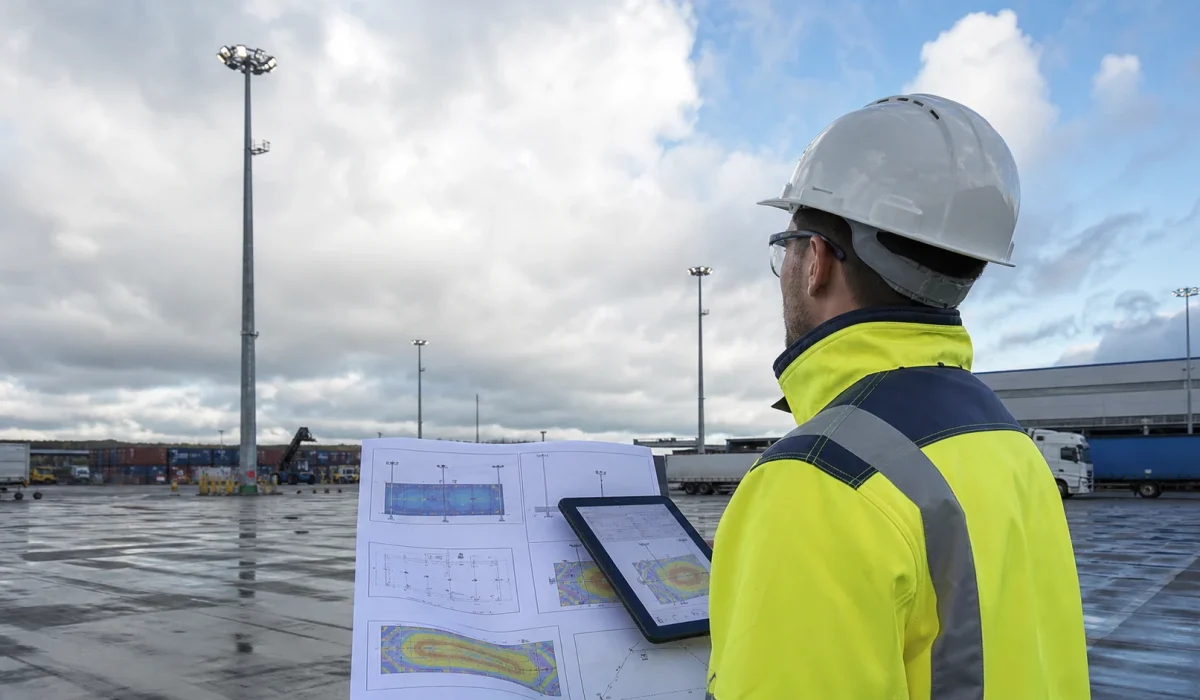
Quick Answer
High mast light wattage should not be selected by watts alone.
A 400W, 600W, 800W or 1000W LED high mast light may be suitable for different projects depending on the required maintained lighting level, rated luminaire lumens, luminaire efficacy, optical distribution, candela intensity in the required aiming direction, pole height, pole spacing, aiming angle, maintenance factor and DIALux or equivalent photometric calculation.
Wattage is only the electrical input power. It does not prove ground illuminance, long-throw performance, glare control, uniformity or coverage area.
For RFQ and tender comparison, the buyer should compare:
- Rated luminaire input power.
- Rated luminaire lumens.
- Luminaire efficacy for the exact CCT, CRI, optic and drive-current configuration.
- IES/LDT photometric file.
- Candela distribution and beam type.
- Maintained average illuminance.
- Minimum illuminance.
- Uniformity convention.
- Glare and spill-light limits.
- Luminaire quantity per mast.
- Fixture weight, EPA and headframe load.
- Driver, surge protection, circuit and control requirements.
A lower-wattage luminaire with better optics and verified photometry may outperform a higher-wattage luminaire with poor distribution. The final wattage should be confirmed by IES/LDT files, DIALux calculation and project-specific RFQ requirements.
Project Review Summary
| Item | Project Review Point |
|---|---|
| Main Topic | LED high mast light wattage selection |
| Main Question | How many watts should a high mast light be? |
| Common Wattages | 400W, 600W, 800W, 1000W and 1200W+ |
| Best-Fit Use | RFQ comparison, tender review, product selection and DIALux verification |
| Main Selection Factors | Rated luminaire lumens, luminaire efficacy, optics, candela distribution, pole height, aiming, lux target, uniformity, maintenance factor and electrical design |
| Main Risk | Choosing high mast lights by wattage only |
| Required Review | IES/LDT files, maintained illuminance, uniformity, glare, aiming schedule, fixture weight, EPA, input power and circuit design |
| Typical Project Stage | RFQ preparation, photometric comparison, BOQ review and technical clarification |
Why Wattage Alone Cannot Define High Mast Lighting Performance
Wattage describes electrical input power. It tells you how much power the luminaire consumes.
It does not directly tell you:
- How much rated light output the complete luminaire provides.
- How much useful light reaches the target area.
- Whether the beam reaches the required distance.
- Whether the ground illuminance is uniform.
- Whether the fixture creates glare toward drivers, operators or nearby properties.
- Whether the selected optics fit the site geometry.
- Whether the result meets maintained lux and uniformity requirements.
- Whether the installation can reproduce the photometric calculation.
Two 800W LED high mast lights can perform very differently if they have different:
- Rated luminaire lumens.
- Luminaire efficacy.
- Optical distribution.
- Candela intensity distribution.
- Beam angle or asymmetric optic.
- Thermal design.
- Driver setting.
- CCT and CRI configuration.
- IES/LDT photometric file.
- Fixture size, weight and EPA.
A wattage recommendation without photometric data is only a preliminary estimate.
If the project team has not yet defined the required lighting level, review the High Mast Lighting Level Specification Guide before finalizing wattage.
Rated Lumens, Luminaire Efficacy and Input Power
For wattage comparison, use luminaire efficacy, not LED-chip efficacy.
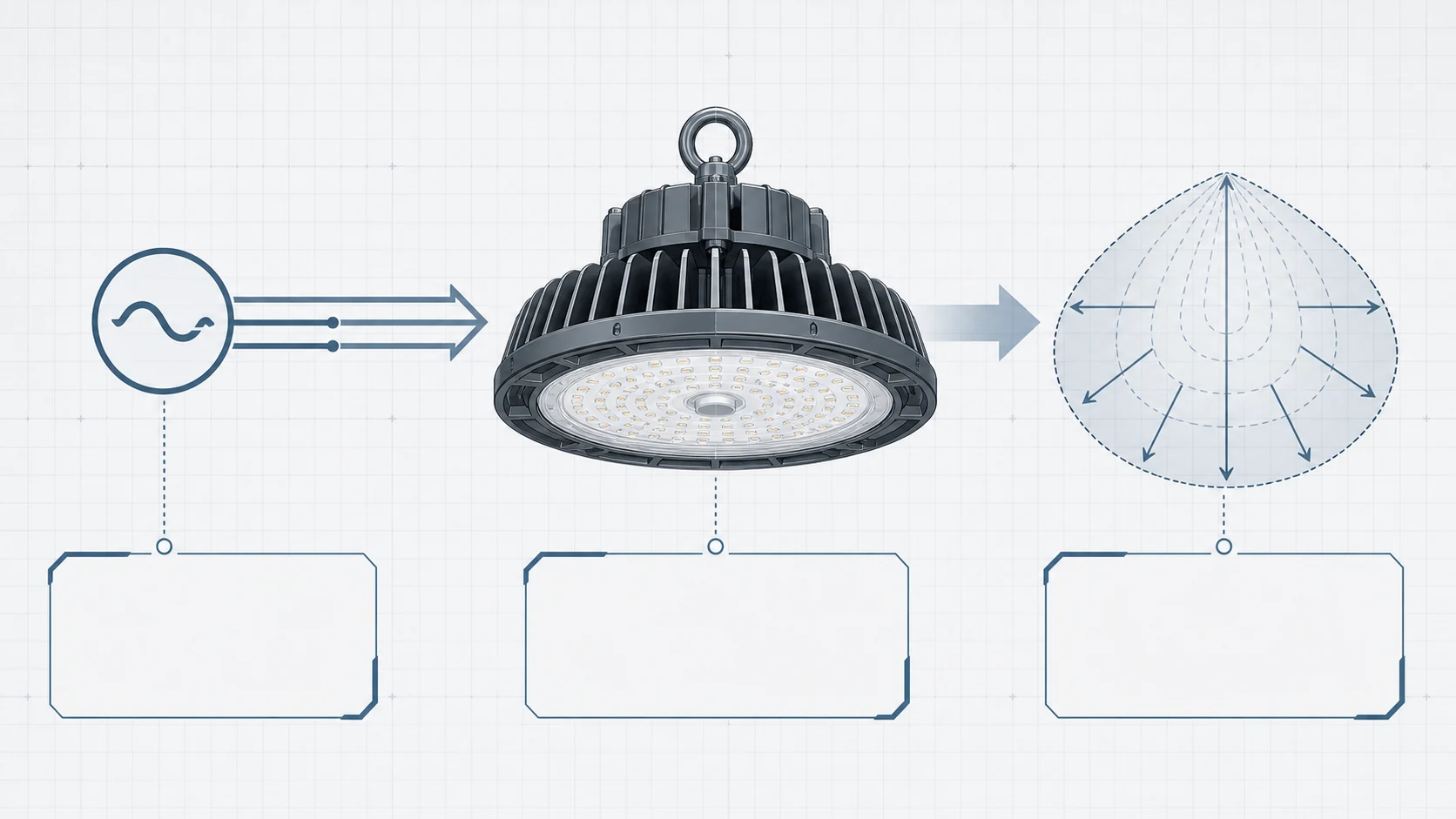
A complete high mast luminaire includes LEDs, optics, thermal structure, driver, housing and electrical losses. Therefore, LED-chip efficiency or LED-module efficiency should not be substituted for complete-luminaire performance.
Use consistent data types when comparing wattage, lumens and efficacy.
If the values come from product ratings, use rated values:
Rated luminaire lumens ≈ rated input power × rated luminaire efficacyIf the values come from the same laboratory test, use measured values:
Luminaire efficacy = measured luminous flux ÷ measured input power
Measured luminous flux = measured input power × measured luminaire efficacy
For concept discussion only:
600W × 170 lm/W ≈ 102,000 lm
800W × 170 lm/W ≈ 136,000 lm
1000W × 170 lm/W ≈ 170,000 lm
This is only a mathematical relationship. Real products must be checked by the manufacturer’s rated luminaire lumens and rated input power for the exact configuration.
The rated value may vary by:
- CCT.
- CRI.
- Optic.
- Drive current.
- Ambient temperature rating.
- Driver setting.
- Thermal design.
- Test method.
- Manufacturing tolerance.
Do not use a marketing claim for LED-chip efficacy as the luminaire efficacy of a complete high mast light. For formal project comparison, request the datasheet, IES/LDT file and, where required, an LM-79 test report for the exact luminaire configuration, preferably issued by a competent or accredited laboratory.
LM-79 is a photometric and electrical measurement method. It is not a product certification by itself. The report should match the proposed wattage, CCT, CRI, optic, driver setting and drive current.
Lumen Output Examples at Different Efficacy Levels
The following table is a mathematical comparison only. It is not a product promise and should not be used as a guaranteed project result.
| Wattage | 140 lm/W | 170 lm/W | 190 lm/W |
|---|---|---|---|
| 400W | 56,000 lm | 68,000 lm | 76,000 lm |
| 600W | 84,000 lm | 102,000 lm | 114,000 lm |
| 800W | 112,000 lm | 136,000 lm | 152,000 lm |
| 1000W | 140,000 lm | 170,000 lm | 190,000 lm |
| 1200W | 168,000 lm | 204,000 lm | 228,000 lm |
This table helps explain why wattage alone is not enough.
For example, an 800W luminaire at 140 lm/W produces approximately the same rated lumen package as a lower-wattage luminaire with higher efficacy. The final lighting result still depends on optics, candela distribution, mounting height, aiming and calculation geometry.
Common LED High Mast Light Wattages
LED high mast luminaires are commercially available in many power ranges. The following sections describe how 400W, 600W, 800W, 1000W and 1200W+ options are normally reviewed during project selection.
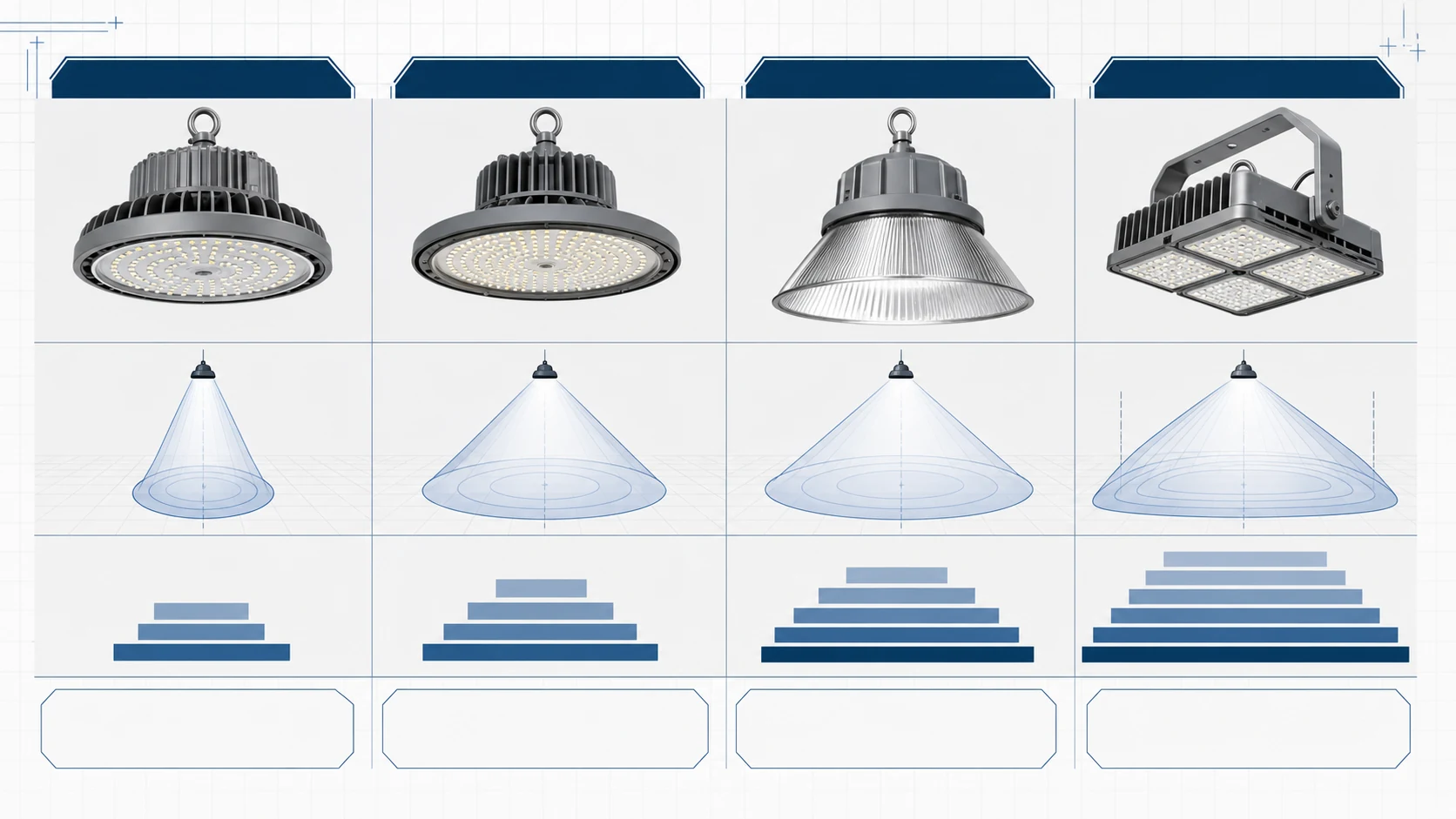
These are not fixed rules; the same mast height can use different luminaire quantities, wattages and optics.
400W High Mast Light
A 400W LED high mast light may be reviewed where the required lumen package is moderate, the target zone is smaller, or multiple luminaires are used for more controlled aiming.
Potential review cases include:
- Lower mounting heights.
- Smaller target zones.
- Parking or boundary areas.
- Supplementary aiming positions.
- Projects where overlighting and spill light must be controlled.
- Multi-luminaire layouts where distribution flexibility is more important than maximum output per fixture.
Key checks:
- Rated luminaire lumens.
- Beam distribution.
- Minimum illuminance.
- Uniformity.
- Glare from observer positions.
- Whether more fixtures are needed to meet the target.
Lower wattage may reduce available output, but it does not guarantee lower glare. Glare must be evaluated from luminaire intensity, apparent source size, optics, aiming and observer position.
600W High Mast Light
A 600W LED high mast light is often reviewed as a medium-output option in multi-luminaire high mast systems.
It may be useful when a project needs a balance between output, fixture count and aiming flexibility.
Potential review cases include:
- Medium high mast layouts.
- Logistics or industrial yards.
- Parking and circulation areas.
- Multi-fixture headframes.
- Projects comparing more medium-output luminaires against fewer high-output luminaires.
Key checks:
- Rated lumen output for the exact product.
- IES/LDT file.
- Target-zone distribution.
- Fixture quantity per mast.
- Driver quantity and circuit design.
- Beam overlap and uniformity.
A 600W luminaire with a narrow or asymmetric optic may deliver stronger intensity in a required aiming direction than a higher-wattage wide-beam luminaire. Therefore, long-throw performance should be judged by target-direction candela distribution and IES/LDT intensity data, not wattage alone.
800W High Mast Light
800W LED high mast lights are commercially available for high-output area and infrastructure lighting, but mounting height alone does not establish their suitability.
An 800W option may be reviewed for projects that require a stronger lumen package while still maintaining practical luminaire quantity and aiming control.
Potential review cases include:
- Logistics yards.
- Port or terminal yards.
- Industrial sites.
- Large outdoor parking areas.
- Mining or heavy-equipment yards.
- High mast layouts requiring medium-to-high lumen output per fixture.
Key checks:
- Luminaire efficacy and rated lumens.
- Candela distribution in the required aiming direction.
- Beam angle and optical type.
- Maintained lux and minimum lux.
- Uniformity.
- Glare and spill light.
- Fixture weight and EPA.
An 800W option should not be treated as a universal answer for 25m, 30m or 35m high mast lighting. It should be compared with other wattage and luminaire quantity combinations under the same calculation conditions.
1000W High Mast Light
A 1000W LED high mast light may be considered when the project requires a higher rated lumen package or when fewer luminaire positions are preferred.
However, a 1000W option is not automatically better than an 800W or 600W option.
Potential review cases include:
- Large yards.
- Port and logistics areas.
- Heavy industrial zones.
- Large transport or terminal areas.
- Projects requiring a higher output per luminaire.
Key checks:
- Rated luminaire lumens.
- Candela distribution.
- Heat dissipation.
- Glare from observer positions.
- Spill-light control.
- Electrical load.
- Driver characteristics.
- Fixture size, weight and EPA.
- Headframe arrangement.
A 1000W luminaire with poor optics may create hot spots, glare or poor uniformity. A multi-luminaire solution using lower wattage may sometimes deliver better target-zone control.
1200W and Above High Mast Lights
1200W and above LED high mast lights should be treated as project-specific high-output options.
They may be used in special infrastructure applications, but they require stronger engineering review.
Key checks include:
- Complete luminaire photometry.
- Thermal performance.
- Driver design.
- Surge protection.
- Actual input power.
- Rated luminaire lumens.
- Fixture weight.
- Dimensions.
- Effective projected area.
- Mounting arrangement.
- Headframe and lowering-system compatibility.
High-output luminaires may be larger or heavier, but structural impact must be checked using the actual fixture weight, dimensions, effective projected area and mounting arrangement. Wattage alone does not determine wind load or headframe load.
Wattage Comparison Table
The following table summarizes wattage review logic. It is not a final design table.
| LED Wattage | Typical Review Use | Main Advantage | Main Risk | Must Verify |
|---|---|---|---|---|
| 400W | Moderate-output zones, smaller target areas, supplementary aiming | Lower input power and flexible zoning | May require more fixtures | Rated lumens, minimum lux and uniformity |
| 600W | Medium-output multi-luminaire layouts | Balance between output and aiming flexibility | May not meet target if optics or lumen package are insufficient | IES/LDT, candela distribution and target-zone result |
| 800W | High-output area-lighting comparisons | Stronger lumen package per fixture | Can still fail if beam distribution or aiming is unsuitable | Beam angle, aiming, maintained lux and glare |
| 1000W | Larger output per luminaire where justified | Higher rated lumen package | Higher heat, glare, electrical and cost impact may occur | Luminaire photometry, thermal data, glare and electrical design |
| 1200W+ | Project-specific high-output applications | Very high output per fixture | Requires stronger photometric, electrical and structural review | Datasheet, applicable test report, IES/LDT, weight, EPA, driver and headframe compatibility |
How Pole Height Affects Wattage Selection
Pole height affects wattage selection because mounting height changes the geometry between the luminaire and the target area.
When mounting height changes, the design may require different:
- Lumen package.
- Beam distribution.
- Candela intensity in the aimed direction.
- Tilt angle.
- Number of luminaires.
- Pole spacing.
- Glare control method.
- Target-zone overlap.
A taller mast may support wider area lighting, but it does not automatically require a specific wattage. A lower-output luminaire with a suitable optic may work in one layout, while a higher-output luminaire may fail in another layout if the beam distribution is wrong.
For height selection logic, review the High Mast Pole Height Guide.
How Lux Target Affects Wattage Selection
The required maintained lighting level is one of the most important wattage inputs.
A higher maintained illuminance requirement may increase the required lumen package, luminaire quantity or wattage. A stricter minimum illuminance or uniformity target may also require more overlap between luminaires.
However, wattage should not be increased blindly.
If the problem is poor uniformity, the solution may be:
- More suitable optics.
- More luminaires with lower wattage.
- Better aiming.
- Different pole locations.
- Revised spacing.
- Better zone division.
If the problem is glare, adding wattage may make the design worse.
Before wattage is selected, define:
- Maintained average illuminance.
- Minimum illuminance.
- Uniformity convention.
- Maintenance factor.
- Calculation plane.
- Calculation area.
- Glare or spill-light requirements.
For lighting-level specification, review the High Mast Lighting Level Specification Guide.
How Optics, Beam Angle and Candela Affect Wattage
Optics can be more important than wattage.
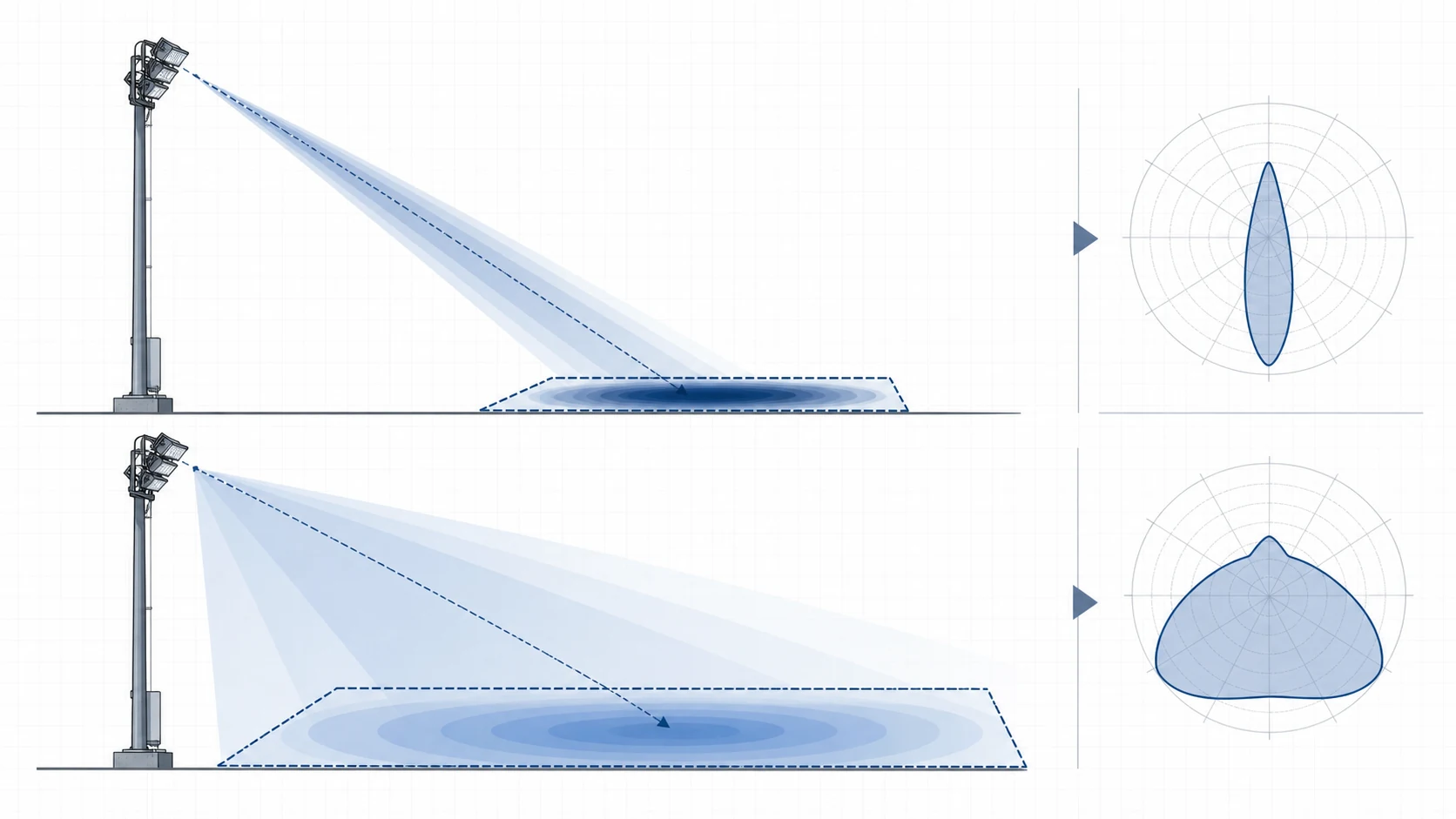
A luminaire with suitable optics may deliver useful light into the target area more effectively than a higher-wattage luminaire with poor distribution.
Long-throw performance should be compared using the candela distribution and IES/LDT intensity data in the required aiming direction, not wattage or total lumens alone.
For example:
- A narrow-beam 600W luminaire may have higher intensity in a specific direction than a wide-beam 1000W luminaire.
- A wide-beam luminaire may improve nearby distribution but may not provide enough long-distance target intensity.
- An asymmetric optic may perform better for roadways, perimeter zones or yard edges than a symmetric optic.
- Poor tilt or rotation can waste light even if the wattage is high.
The design should review:
- Candela distribution.
- Beam angle.
- Symmetric or asymmetric optics.
- Tilt and rotation.
- Target-zone coverage.
- Glare toward observers.
- Spill light beyond the boundary.
- Uniformity in the calculation grid.
A wattage table cannot replace an IES/LDT-based calculation.
Glare Is Not Determined by Wattage Alone
Higher wattage may increase available output, but wattage alone does not determine glare.
Glare depends on:
- Luminaire intensity in the observer’s direction.
- Apparent source size.
- Optics.
- Lens and shielding design.
- Mounting height.
- Tilt angle.
- Observer position.
- Viewing direction.
- Background brightness.
- Spill-light control.
Lower wattage may reduce available output, but it does not guarantee lower glare. A poorly aimed 400W luminaire can create more discomfort than a well-controlled higher-output luminaire.
Therefore, glare should be reviewed by observer positions and photometric data, not by wattage label.
How Many Luminaires Should Be Installed on One High Mast?
High mast lighting systems usually use multiple luminaires on one mast.
The number of luminaires per mast depends on:
- Pole height.
- Headframe design.
- Required light output.
- Target zones.
- Beam distribution.
- Aiming plan.
- Glare control.
- Fixture weight.
- Effective projected area.
- Lowering-system capacity.
- Electrical circuit design.
- Driver quantity.
- Maintenance access.
A 30m mast might use 4, 6, 8, 10, 12 or more luminaires depending on project requirements.
The correct number is not determined by mast height alone.
Fewer high-output luminaires may simplify fixture count, but they may reduce aiming flexibility. More medium-output luminaires may improve target-zone control, but they may increase fixture quantity, wiring, driver count and maintenance points.
Decision Framework: 6×800W vs 8×600W
One of the most useful high mast comparisons is whether to use fewer higher-wattage luminaires or more medium-wattage luminaires.
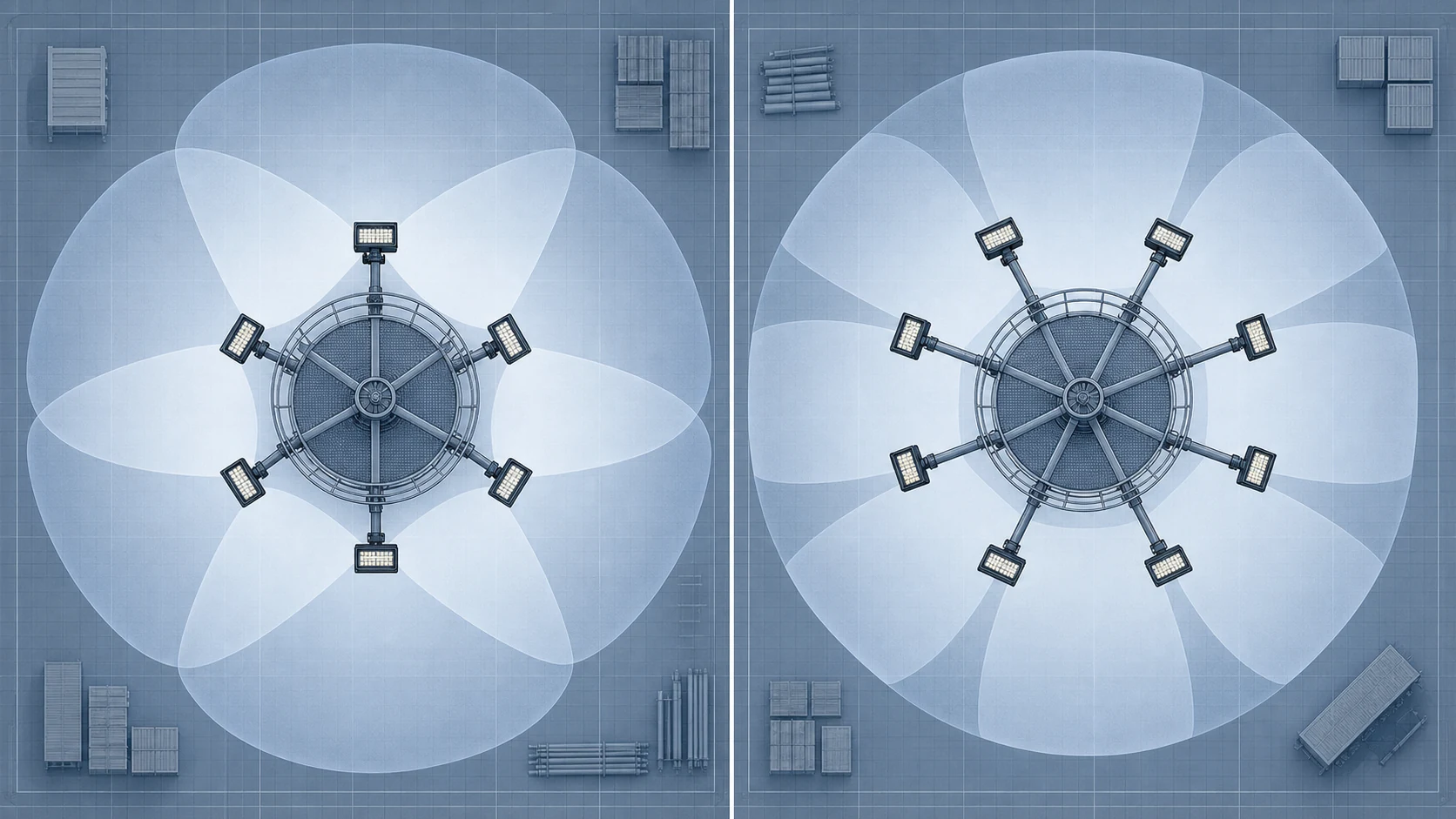
The following comparison is a decision framework only. It is not a final lighting calculation.
| Item | 6×800W Option | 8×600W Option | Why It Matters |
|---|---|---|---|
| Total input power | 4800W | 4800W | Same total wattage does not guarantee same lighting result |
| Total rated lumens | Depends on luminaire efficacy | Depends on luminaire efficacy | Same wattage does not mean same output |
| Luminaire efficacy | Must be verified | Must be verified | Defines rated lumen difference |
| Fixture count | Lower | Higher | Affects aiming, maintenance and wiring |
| Aiming flexibility | Usually lower | Usually higher | More fixtures can create more target zones |
| Headframe complexity | Usually simpler | Usually more complex | Affects fabrication and serviceability |
| Target-zone control | Depends on optics and aiming | Often more flexible | Important for uniformity and edge coverage |
| Driver quantity | Fewer drivers | More drivers | Affects failure points and service planning |
| Inrush current | Must be checked | Must be checked | Driver count can affect circuit design |
| Circuit current | Must be calculated | Must be calculated | Supports cable and breaker sizing |
| Total fixture weight | Depends on product | Depends on product | Affects headframe and lowering system |
| Total effective projected area | Depends on fixture dimensions and quantity | Depends on fixture dimensions and quantity | Affects wind-load review |
| Failure impact | One failed fixture removes a larger share of output | One failed fixture removes a smaller share of output | Affects lighting resilience |
| Fixture cost | Product-specific | Product-specific | More fixtures can increase equipment cost |
| Replacement access | Fewer units | More units | Affects maintenance time |
| Final decision | Use IES/LDT and DIALux | Use IES/LDT and DIALux | Photometric result controls selection |
Both options have the same total input power, but they may not produce the same lighting result.
The final comparison must check:
- Rated luminaire lumens.
- Candela distribution.
- Optics.
- Maintained lux.
- Minimum lux.
- Uniformity.
- Glare.
- Total headframe load.
- Effective projected area.
- Electrical circuit design.
- Lifecycle maintenance.
Total headframe load depends on fixture weight, fixture quantity, effective projected area and mounting arrangement, not wattage alone.
Verified Luminaire Comparison Template
If two products have the same wattage, compare the verified product data instead of assuming equal performance.
Use this table only with real datasheets, IES/LDT files and applicable test reports. Where LM-79 data is required, confirm that the report is for the exact luminaire configuration.
| Parameter | Luminaire A | Luminaire B |
|---|---|---|
| Rated input power | — | — |
| Measured or rated luminaire lumens | — | — |
| Luminaire efficacy | — | — |
| CCT / CRI | — | — |
| Optic type | — | — |
| Beam distribution | — | — |
| Peak intensity and intensity at required C/γ or aiming angles | — cd | — cd |
| Fixture weight | — | — |
| Effective projected area | — | — |
| Surge protection | — | — |
| Power factor | — | — |
| THD | — | — |
| Ambient rating | — | — |
| IES/LDT file | Yes / No | Yes / No |
| Applicable test report | Yes / No | Yes / No |
Peak intensity alone is not enough. The comparison should check intensity in the required C/γ or aiming directions, using the same photometric coordinate system and optic configuration.
This comparison is especially useful for 800W vs 800W or 1000W vs 1000W supplier evaluation. The same wattage can still produce different DIALux results.
IES/LDT Files Must Be Cross-Checked
An IES or LDT file is required for DIALux or Relux simulation, but the file itself does not prove that the luminaire output and efficiency have been independently tested.
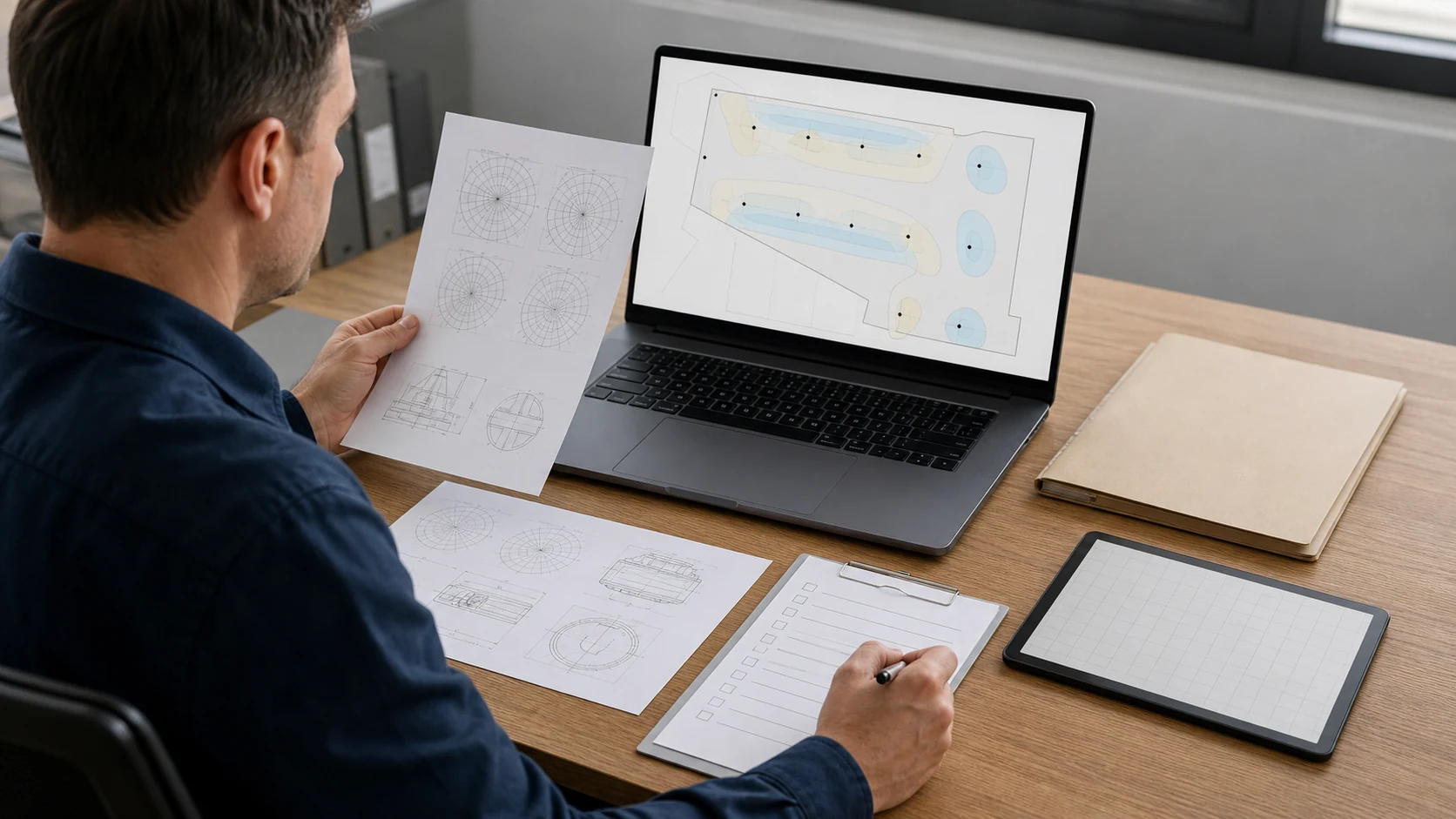
Before accepting a photometric file, cross-check:
- Total luminaire lumens in the IES/LDT file.
- Rated input power.
- CCT and CRI.
- Optic type.
- Driver setting.
- Drive current.
- Product model and configuration.
- Datasheet values.
- Applicable test report values.
A photometric file should not be accepted only because it imports successfully into DIALux. The file must match the proposed luminaire configuration used in the quotation and BOQ.
Power-Selectable or Dimmed Luminaires
Some high-power LED luminaires support multiple power settings, such as 400W, 600W, 800W or 1000W configurations.
For power-selectable or dimmed luminaires, request the photometric file and rated data for the proposed setting.
Do not scale another wattage configuration unless the manufacturer confirms that proportional photometric scaling is valid for that product and operating condition.
For example, a 1000W IES file scaled to 800W may not accurately represent thermal behavior, drive current, optical output, driver efficiency or lumen maintenance unless the manufacturer’s photometric data supports that method.
Short Note on HID Replacement and LED Retrofit
Some users search for high mast wattage because they want to replace metal halide, high-pressure sodium or other HID high mast lights with LED.
This is a valid project need, but HID replacement should not be handled by a simple wattage equivalence chart.
For example, replacing a 1000W metal halide high mast light does not automatically mean selecting a 400W or 600W LED fixture. The correct LED option depends on:
- Existing luminaire output.
- Existing optical distribution.
- Pole height.
- Existing aiming.
- Current measured lighting level.
- Required maintained lux.
- New LED luminaire efficacy.
- New candela distribution.
- Electrical system.
- Retrofit bracket or headframe design.
- Thermal and mechanical compatibility.
This article focuses on LED high mast wattage selection. HID replacement and LED retrofit should be reviewed separately.
Electrical and Driver Parameters for Wattage Review
For RFQ and BOQ comparison, wattage selection should include electrical review.
A supplier should provide:
| Electrical Item | Why It Matters |
|---|---|
| Rated input voltage and frequency | Confirms compatibility with project power supply |
| Actual input power | Supports energy and circuit calculation |
| Power factor | Affects electrical efficiency and supply design |
| THD | Supports power-quality review |
| Driver efficiency | Affects total performance and heat |
| Inrush current | Important when many drivers start together |
| Surge protection rating | Critical for outdoor high mast installations |
| Circuit quantity | Affects panel, cable and breaker design |
| Branch-circuit current | Supports cable sizing and protection |
| Dimming or control protocol | Required for smart or scheduled dimming |
| Ambient-temperature derating | Confirms operation in hot environments |
| Driver location | Affects maintenance and thermal conditions |
For example, 6×800W and 8×600W may have the same total input power, but driver quantity, inrush current, circuit arrangement and maintenance planning may be different.
Why Higher Wattage Is Not Always Better
Higher wattage may increase the available lumen package, but it can also create problems when optics and aiming are not controlled.
Possible issues include:
- More energy consumption.
- Higher heat load.
- Higher equipment cost.
- Larger or heavier fixtures.
- More difficult glare control in some observer directions.
- More spill light beyond the boundary.
- Hot spots near mast locations.
- Poor uniformity if the beam is unsuitable.
- Larger electrical and surge-protection requirements.
In some projects, the better solution is not higher wattage.
The better solution may be:
- More suitable optics.
- Different candela distribution.
- More luminaires with lower wattage.
- Improved aiming plan.
- Different pole spacing.
- Revised pole placement.
- Better functional zoning.
- Correct maintenance factor.
- Improved DIALux model.
The goal is not to use the highest wattage. The goal is to meet the required lighting performance efficiently and safely.
What Should Be Verified in DIALux?
A high mast wattage proposal should be verified in DIALux, Relux or equivalent lighting software before final approval.
The report should confirm:
| Report Item | What to Check |
|---|---|
| Luminaire model | Is the selected product used? |
| Rated input power | Does it match the proposed product? |
| Rated luminaire lumens | Is the correct lumen package applied? |
| Luminaire efficacy | Does it match the tested or rated configuration? |
| IES/LDT file | Is the actual photometric file used? |
| IES/LDT cross-check | Do lumens, wattage, CCT, CRI, optic and driver setting match the datasheet and applicable test report? |
| Power setting | If the luminaire is dimmed or power-selectable, is the file for the proposed setting? |
| Candela distribution | Does it support the required C/γ or aiming direction, not only peak intensity? |
| Pole height | Does it match the actual mounting height? |
| Luminaire quantity | Is the number per mast correct? |
| Aiming | Are tilt and rotation realistic? |
| Maintenance factor | Is maintained lux being calculated? |
| Average lux | Does it meet the project target? |
| Minimum lux | Are dark zones acceptable? |
| Uniformity | Is the correct convention used? |
| Glare | Are drivers, operators or neighbors affected? |
| Spill light | Is light controlled outside the project area? |
| Calculation grid | Does it match the real lighting scope? |
A proposal that lists only “800W high mast light” or “1000W high mast light” is incomplete for engineering review. A photometric file should also be checked against the datasheet and applicable test report before it is used as the basis for procurement.
Sunlurio can support DIALux simulation outputs and IES/LDT photometric files when project information is available.
RFQ Checklist for High Mast Light Wattage Selection
When requesting a high mast lighting quotation, do not ask only for wattage.
A complete RFQ should include the following information:
| RFQ Item | Why It Matters |
|---|---|
| Project application | Defines lighting objective |
| Site layout or CAD drawing | Defines calculation area and mast locations |
| Required maintained lux | Defines lighting target |
| Minimum lux requirement | Controls dark zones |
| Uniformity convention | Defines lighting quality |
| Pole height | Affects throw distance and aiming |
| Pole spacing or allowed locations | Affects overlap and coverage |
| Preferred wattage range | Helps compare product options |
| Rated luminaire lumens | Allows output comparison |
| Luminaire efficacy | Supports energy and product comparison |
| Beam angle or optic type | Controls distribution |
| Luminaire quantity per mast | Affects aiming and headframe |
| IES/LDT files | Required for simulation |
| IES/LDT and datasheet consistency | Confirms that simulation data matches the proposed product |
| Applicable test report | Supports rated lumens, input power and efficacy verification |
| Power setting or dimming level | Required for power-selectable luminaires |
| Maintenance factor | Defines long-term performance |
| Fixture weight | Supports headframe and lowering-system review |
| Effective projected area | Supports wind-load review |
| Rated input voltage and frequency | Confirms electrical compatibility |
| Power factor and THD | Supports power-quality review |
| Inrush current | Supports breaker and circuit design |
| Surge protection rating | Required for outdoor reliability |
| Dimming or control protocol | Supports smart control or scheduled dimming |
| Ambient temperature rating | Confirms site suitability |
| Glare or spill-light limits | Prevents over-aiming |
| BOQ format | Supports procurement comparison |
If these inputs are missing, any wattage recommendation should be treated as preliminary.
Common Wattage Selection Mistakes
| Mistake | Why It Creates Risk | Better Review Method |
|---|---|---|
| Choosing by wattage only | Watts do not define lighting performance | Compare rated lumens, optics and DIALux results |
| Using LED-chip efficacy | It may overstate complete-luminaire performance | Use luminaire efficacy for the exact product configuration |
| Assuming all 800W lights are equal | Efficacy, optics and photometry may differ | Review datasheet, IES/LDT and test report |
| Using higher wattage to solve every problem | May increase heat, cost, glare or spill light | Review optics, aiming and layout first |
| Judging long throw by watts | Throw depends on target-direction candela distribution | Review IES/LDT intensity data at the required aiming direction |
| Accepting an IES file without cross-checking | Imported files can still mismatch the quoted configuration | Compare IES/LDT lumens, wattage, CCT, CRI, optic and driver setting against datasheet and test data |
| Scaling a different wattage file without confirmation | Power-selectable products may not scale proportionally | Request photometric data for the proposed setting |
| Assuming lower wattage guarantees lower glare | Glare depends on intensity, source size, optics and observer position | Perform glare review |
| Comparing only total watts per mast | Same total power can produce different distribution | Compare target-zone performance |
| Ignoring maintained lux | Long-term performance may be overstated | Use maintenance factor |
| Ignoring fixture weight and EPA | Structural impact is not defined by wattage | Check actual fixture data |
| Ignoring driver and circuit design | Same wattage can have different electrical behavior | Review driver data and circuit current |
| Finalizing BOQ before simulation | Equipment quantities may change later | Verify with DIALux before procurement |
Request a High Mast Wattage and DIALux Review
High mast light wattage should be reviewed before finalizing luminaire quantity, headframe layout, pole height, spacing and BOQ.
Send us your CAD layout, target maintained lux, uniformity requirement, preferred pole height, allowed pole locations, wattage preference, luminaire quantity per mast, electrical requirements and project application. Sunlurio can compare 400W, 600W, 800W, 1000W or project-specific high-output options using IES/LDT files and DIALux simulation.
Request a High Mast Wattage and DIALux Review
Related High Mast Lighting Guides
The following guides explain related decisions in high mast lighting design:
- High Mast Lighting Design Guide
- High Mast Lighting Level Specification Guide
- High Mast Pole Height Guide
- High Mast Pole Spacing Guide
- High Mast Lighting Layout Patterns
- How Many High Mast Lights Do You Need?
- High Mast Lighting Coverage Explained
- High Mast Lighting Systems
- Engineering Support for Lighting Projects
- DIALux Simulation Outputs
- IES/LDT Photometric Files
- Tender Documents and BOQ Support
Frequently Asked Questions
How many watts should a high mast light be?
There is no single wattage for all high mast projects. Common LED options include 400W, 600W, 800W, 1000W and 1200W+, but the correct wattage depends on rated luminaire lumens, optics, candela distribution, pole height, lux target, uniformity, aiming, electrical design and DIALux verification.
Is 800W enough for a high mast light?
800W may be suitable for some projects, but it is not guaranteed. The result depends on luminaire efficacy, rated lumens, beam distribution, pole height, spacing, aiming and required maintained lux.
Is 1000W better than 800W?
Not always. A 1000W luminaire may provide more output, but it may also increase heat, cost, electrical load or glare risk if optics and aiming are not suitable. A well-designed 800W or 600W multi-luminaire layout may perform better in some projects.
What is the difference between watts and lumens?
Watts measure electrical input power. Lumens measure light output. For high mast lighting, rated luminaire lumens and photometric distribution are more useful than wattage alone.
What is luminaire efficacy?
Luminaire efficacy is the light output of the complete luminaire divided by its input power. Use rated values with rated values, or measured values from the same test report. It is more relevant than LED-chip efficacy because it includes optical, thermal and driver-related losses.
How many lumens does an 800W high mast light produce?
It depends on luminaire efficacy. As a mathematical example, an 800W luminaire at 140 lm/W produces about 112,000 lumens, while an 800W luminaire at 190 lm/W produces about 152,000 lumens. The actual value must come from the product datasheet and test data.
Should I use 6×800W or 8×600W on one mast?
Both options may use the same total input power, but they can produce different lighting results. Compare total rated lumens, optics, candela distribution, aiming flexibility, driver quantity, fixture weight, EPA, circuit design, maintained lux, uniformity and glare.
Can wattage determine coverage area?
No. Coverage depends on lumens, optics, candela distribution, pole height, aiming, spacing, maintained lux target and site geometry. Wattage alone cannot define coverage area.
Can I replace metal halide high mast lights using a simple LED wattage chart?
Not reliably. HID replacement depends on the existing luminaire, pole height, optics, current lighting level, LED photometry and target maintained lux. Retrofit projects should be reviewed separately.
Do I need IES files for wattage selection?
Yes. IES or LDT files are required to simulate how the selected luminaire distributes light. Without photometric files, wattage selection is only a preliminary estimate.
What electrical data should be checked with wattage?
Check rated input voltage, actual input power, power factor, THD, driver efficiency, inrush current, surge protection, circuit quantity, cable sizing, dimming protocol and ambient-temperature derating.
What information should I provide for a high mast wattage proposal?
Provide CAD layout, project application, target maintained lux, uniformity requirement, pole height, allowed pole locations, preferred wattage range, luminaire quantity per mast, IES/LDT requirements, electrical requirements and any glare or spill-light limits.