

Quick Answer
High mast lighting installation and commissioning should be reviewed as an evidence chain, not as a public step-by-step construction tutorial.
For EPC contractors, consultants and project owners, the purpose is to prove what was approved, what was delivered, what was installed, what was tested, what failed, what was corrected and what was handed over.
A practical commissioning chain should follow this sequence:
approved documents
→ delivered materials
→ pre-erection release
→ installed configuration
→ functional tests
→ night verification
→ NCR closure
→ as-built handover
This guide explains what should be checked, recorded, witnessed and accepted during high mast lighting installation and commissioning.
Safety and Scope Boundary
Installation and commissioning should be performed under approved method statements by qualified personnel. This guide is a project review checklist, not a site operation procedure.
Do not use this article as a pole-erection, crane-lifting, live-wiring, climbing or lowering-system operation procedure. Those activities require project-approved procedures, lifting plans, electrical procedures, OEM manuals and qualified site supervision.
Project Review Summary
| Item | Project Review Point |
|---|---|
| Main Topic | High mast lighting installation and commissioning checklist |
| Main Question | What should be checked, witnessed, recorded and accepted before handover? |
| Best-Fit Projects | EPC, municipal, highway, port, airport, logistics, industrial and retrofit high mast projects |
| Main Risk | Treating installation as “installed and powered on” without a traceable civil, mechanical, electrical, photometric and documentation record |
| Review Scope | Approved documents, material traceability, foundation readiness, pole erection records, luminaire aiming, electrical tests, lowering-system commissioning, night measurement and handover |
| Required Evidence | Drawings, datasheets, BOQ traceability, test reports, witness records, NCR closure, as-built records and O&M documents |
| Typical Deliverables | Installation checklist, commissioning record, aiming schedule, electrical test report, lighting measurement record, lowering-system test record and handover package |
| Project Benefit | Reduces installation disputes, missing documents, commissioning delays, acceptance risk and future maintenance uncertainty |
What Installation and Commissioning Must Confirm
High mast lighting commissioning should confirm five evidence chains:
- Civil evidence — foundation location, anchor bolts, concrete acceptance, base plate fit-up and drainage condition.
- Mechanical evidence — pole sections, base plate, headframe, brackets, luminaires and lowering system.
- Electrical evidence — supply, wiring, SPD, grounding, cabinet, controls, dimming and smart system if applicable.
- Photometric evidence — installed luminaire model, optic, aiming schedule, DIALux or calculation basis and night measurement.
- Documentation evidence — approved drawings, revisions, NCRs, as-built records, O&M manuals, spare parts, tools, warranty and training records.
A high mast system should not be accepted only because the lights operate.
Lighting operation does not prove that:
- Anchor bolts match the approved base design.
- Concrete strength was accepted before erection.
- The installed luminaire optic matches the IES/LDT file.
- The aiming schedule was followed.
- Grounding and surge protection were checked.
- The lowering system was commissioned.
- Night measurement met the project criteria.
- NCRs or punch-list items were closed.
- The owner received enough documents for future maintenance.
Responsibility Matrix: Who Checks What?
High mast installation and commissioning involve several parties. The contract should define who submits, who witnesses, who reviews and who accepts each record.
| Stage | EPC / Installer | Supplier | Owner / Consultant | Required Record |
|---|---|---|---|---|
| Document review | Submit and coordinate approved documents | Provide datasheets, drawings, IES/LDT files and manuals | Approve, comment or witness review | Drawing register / document log |
| Material delivery | Receive and inspect delivered materials | Provide packing list, model traceability and technical data | Review critical items if required | Delivery inspection record |
| Pre-erection release | Request civil/mechanical hold-point release | Support interface questions | Witness or approve release if required | Foundation / anchor release record |
| Installed configuration | Install according to approved documents | Support product identification and configuration questions | Inspect or witness as required | Site inspection record |
| Commissioning | Execute approved tests | Provide OEM procedures and technical support | Witness acceptance | Test and commissioning record |
| NCR / punch list | Correct and document nonconformities | Support corrective action where related to supplied scope | Approve closure or retest | NCR / closure log |
| Handover | Compile and submit records | Provide manuals, spares, tools and warranty documents | Accept final package | Handover register |
Before Installation: Approved Documents and Material Traceability
Before site installation, confirm that the site team is using the approved document set.
Do not rely on informal drawings, old quotations or superseded datasheets.
Installation Document Review Matrix
| Document / Material | Approved Reference | Site Evidence | Reviewer | Status / NCR |
|---|---|---|---|---|
| Approved shop drawings | Latest approved revision | Drawing register | ||
| Pole drawing | Height, sections, base plate, orientation | Delivery check / photo | ||
| Anchor bolt drawing | Bolt circle, projection, template | Site measurement record | ||
| Foundation drawing | Location, elevation, conduit, grounding | Civil inspection record | ||
| Luminaire datasheet | Model, wattage, optic, weight, EPA | Packing list / label record | ||
| IES/LDT file | Matches installed luminaire and optic | Photometric file record | ||
| Aiming schedule | Tilt and rotation for each luminaire | Aiming table | ||
| Wiring diagram | Cable, SPD, grounding, controls | Electrical drawing | ||
| Lowering system manual | Operation and commissioning procedure | OEM manual | ||
| Method statement | Lifting, installation and electrical safety | Approved procedure | ||
| Inspection and test plan | Hold points, witness points, records | ITP / quality plan | ||
| BOQ | Model, quantity and scope | BOQ comparison |
If a document revision is unclear, the project should stop and confirm the approved reference before installation continues.
Foundation and Anchor-Bolt Pre-Erection Release
Foundation and anchor-bolt checks are a pre-erection release gate.
This section does not explain how to build the foundation. It explains what should be confirmed before the pole is erected.
The foundation should be released for erection only after the project-required civil records, measurements and hold-point approvals are complete.
Foundation / Anchor-Bolt Pre-Erection Release Checklist
| Check Item | Acceptance Point | Record | Status / NCR |
|---|---|---|---|
| Approved drawing revision | Site uses latest approved civil and pole interface drawing | Drawing register | |
| Foundation location | Matches approved layout | Survey record | |
| Foundation top elevation | Matches design and drainage requirement | Site measurement | |
| Concrete acceptance evidence | Approved before erection according to project procedure | Test report / release record | |
| Anchor bolt circle | Matches base plate | Measurement record | |
| Anchor projection | Suitable for leveling, washers and nuts according to drawing | Measurement record | |
| Bolt verticality | Within project-approved tolerance | Inspection record | |
| Anchor condition | Threads and coating acceptable for installation | Inspection photo | |
| Conduit position | Matches pole base opening and cable route | Site photo | |
| Grounding provision | Grounding connection available and accessible | Electrical/civil inspection | |
| Drainage / slope | No standing water risk at base area | Site check | |
| Base plate compatibility | Base plate holes match anchor layout | Fit-up verification | |
| Hold-point release | Civil/mechanical approval before erection | Signed release |
Do not use a universal foundation depth, anchor projection or bolt tolerance. These values should come from the approved structural design, drawings, OEM requirements and project specification.
For structural inputs and anchor-bolt design logic, review the High Mast Pole Foundation & Wind Load Guide.

Pole, Base Plate, Sections and Coating Inspection
Before erection, the delivered mast should be checked against the approved documents.
Review:
- Pole section quantity.
- Section length.
- Shaft diameter and taper.
- Wall thickness if required by inspection.
- Base plate dimensions.
- Bolt hole pattern.
- Access door location.
- Cable entry.
- Slip joint or flange details.
- Galvanizing or coating condition.
- Transport damage.
- Nameplate or asset identification.
- Orientation marks if applicable.
- Headframe interface.
- Lowering system interface.
Pole Delivery and Fit-Up Review Table
| Item | What to Verify | Evidence |
|---|---|---|
| Pole height | Matches approved drawing | Delivery record / drawing |
| Pole sections | Correct number and sequence | Packing list / photo |
| Base plate | Matches anchor-bolt layout | Measurement / fit-up record |
| Access door | Correct location and orientation | Site photo |
| Cable entry | Matches conduit position | Site check |
| Coating / galvanizing | No damage affecting durability | Inspection photo |
| Slip joint / flange | Matches approved design | Drawing / site record |
| Headframe interface | Compatible with approved assembly | Drawing / photo |
| Asset ID | Traceable for handover | Label / register |
If coating damage, wrong section, wrong base plate or wrong interface is found, record it as an NCR or hold item before erection continues.
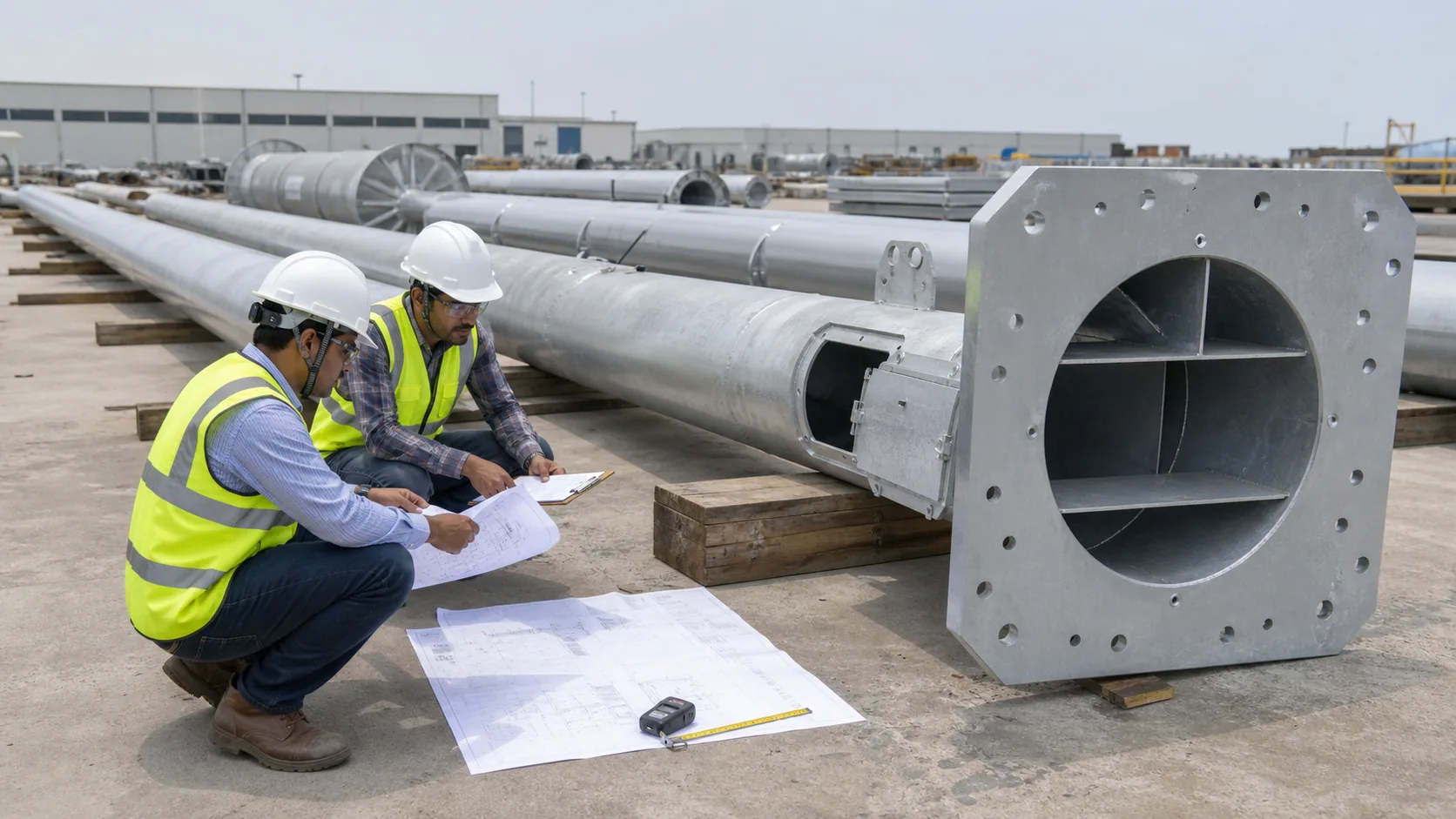
Pole Erection Record and Verticality Review
Pole erection should be carried out under the approved method statement, lifting plan and site supervision.
This guide does not provide lifting instructions.
The commissioning record should confirm that the installed mast matches the approved position and orientation.
Review:
- Pole ID.
- Foundation ID.
- Erection date.
- Installer / contractor.
- Approved method statement reference.
- Lifting plan reference.
- Weather conditions if required.
- Final pole orientation.
- Base plate fit-up.
- Nut and washer installation status.
- Grout or no-grout detail according to design.
- Verticality check according to project tolerance.
- Coating repair if required.
- NCRs or deviations.
Pole Erection Record Table
| Item | Approved Reference | Site Evidence | Status / NCR |
|---|---|---|---|
| Pole ID and foundation ID | Layout drawing | Erection record | |
| Pole orientation | Shop drawing / layout | Site photo / survey | |
| Base plate fit-up | Anchor/base drawing | Fit-up record | |
| Nut / washer arrangement | Approved drawing | Inspection photo | |
| Grout / leveling detail | Structural drawing | Site inspection | |
| Verticality | Project tolerance / approved method | Survey record | |
| Coating repair | Coating specification | Repair record | |
| Access door position | Layout / electrical requirement | Site photo | |
| Method statement reference | Approved site procedure | Signed record | |
| NCR / deviation | Quality procedure | NCR log |
Do not publish a global verticality tolerance. The acceptable tolerance should be defined by the project specification, applicable standard, manufacturer requirement or authority requirement.
Luminaire, Bracket and Headframe Verification
After the mast and headframe are installed, confirm that the installed luminaire configuration matches the approved design.
This is especially important for high mast lighting because fixture model, optic, power setting, bracket position and aiming angle can directly affect lighting performance.
Luminaire and Aiming Traceability Table
| Traceability Item | Approved Source | Site Evidence | Status / NCR |
|---|---|---|---|
| BOQ model | BOQ / purchase order | Packing list / label record | |
| Luminaire serial or batch | Delivery record | Photo / asset register | |
| Wattage / power setting | Approved design | Setting record / test record | |
| Optic code | Datasheet / IES file | Label / packing evidence | |
| IES/LDT file | Lighting calculation | Photometric file record | |
| Bracket type | Approved drawing | Site photo | |
| Bracket orientation | Aiming schedule | Site photo / record | |
| Fixture quantity per mast | Approved layout | Site count | |
| Tilt angle | Aiming schedule | Aiming record | |
| Rotation / azimuth | Aiming schedule | Site record | |
| Cable connection | Wiring diagram | Electrical inspection | |
| Headframe interface | Headframe drawing | Site photo |
The purpose is to connect:
BOQ model
→ installed label / serial
→ wattage or power setting
→ optic code
→ IES/LDT file
→ aiming schedule
→ site evidence
If the installed optic does not match the photometric file, the site measurement may not represent the approved design.
For optic and wattage selection, review the High Mast Light Wattage Guide.

Aiming Schedule and Installed Optic Check
High mast lighting often requires specific tilt and rotation settings for each luminaire.
The site team should confirm:
- Each luminaire position on the ring or headframe.
- Tilt angle.
- Rotation or azimuth direction.
- Optic type.
- Target area.
- Aiming reference mark.
- Any approved deviation.
- Final as-built aiming table.
Do not assume all fixtures on a mast use the same aiming.
Aiming Verification Table
| Mast ID | Luminaire Position | Approved Optic | Approved Tilt / Rotation | Installed Evidence | Status / NCR |
|---|---|---|---|---|---|
For layout and aiming principles, review the High Mast Lighting Layout Patterns Guide.
Electrical, SPD, Grounding and Control Commissioning
Electrical commissioning should follow the approved electrical procedure, project specification and qualified-personnel requirements.
This article does not provide live wiring instructions.
Electrical Commissioning Record
| Test Item | Procedure / Standard Reference | Instrument ID / Calibration | Result | Acceptance Criterion | Witness | NCR / Action |
|---|---|---|---|---|---|---|
| Supply voltage | ||||||
| Insulation test | ||||||
| Continuity | ||||||
| Grounding / bonding | ||||||
| SPD installation | ||||||
| Driver operation | ||||||
| Control system | ||||||
| Dimming schedule | ||||||
| Smart control / monitoring | ||||||
| Circuit labeling | ||||||
| Cabinet inspection | ||||||
| Emergency or isolation function |
Do not publish a universal grounding resistance, insulation value or voltage tolerance unless it is defined by the project standard. The commissioning record should reference the approved electrical requirement.

Lowering-System Commissioning Evidence
If the high mast includes a lowering system, its commissioning should be recorded as a separate safety-critical subsystem.
This article does not explain how to operate the lowering system.
The commissioning record should confirm that the installed system matches the approved drawings and that functional tests were completed according to the OEM manual and project procedure.
Lowering-System Commissioning Record
| Test Item | Procedure Reference | Evidence | Acceptance | NCR / Action |
|---|---|---|---|---|
| Ring assembly | OEM drawing | Photo / checklist | Matches approved configuration | |
| Wire rope routing | OEM manual | Inspection record | No abnormal routing noted under procedure | |
| Raising operation | Approved procedure | Witness record | Smooth controlled movement | |
| Lowering operation | Approved procedure | Witness record | Smooth controlled movement | |
| Ring balance | OEM / project criteria | Photo / record | Meets acceptance criteria | |
| Latch engagement | OEM procedure | Witness record | Confirmed engagement | |
| Limit device | Control procedure | Test record | Stops according to design | |
| Emergency stop | Control procedure | Test record | Works as required | |
| Grounding / bonding | Electrical requirement | Test record | Meets project requirement | |
| Handover tools | Contract list | Handover record | Complete | |
| O&M manual | Contract requirement | Document record | Delivered |
For detailed subsystem review, use the High Mast Lighting Lowering System Guide.
Daytime Functional Checks
Daytime checks should confirm basic system function before night performance inspection.
Typical daytime checks include:
- Visual inspection of installed configuration.
- Pole and base area inspection.
- Luminaire operation.
- Circuit operation.
- Control function.
- Dimming or schedule function if applicable.
- SPD and cabinet inspection.
- Lowering-system commissioning if applicable.
- Grounding and bonding records.
- Labeling and asset identification.
- Documentation completeness.
Daytime operation does not prove lighting performance. It confirms functional readiness before night verification.
Nighttime Lighting Performance Verification
Nighttime lighting measurement should follow the approved project procedure.
Do not publish a universal measurement grid, measurement plane, warm-up time, meter spacing, uniformity value or maintenance factor. These should come from the contract, authority requirement, approved calculation method, lighting standard or consultant procedure.
Night Measurement Record
| Measurement Item | Approved Procedure | Instrument / Calibration | Operating Condition | Result | Acceptance Criterion | Status |
|---|---|---|---|---|---|---|
| Date and time | ||||||
| Weather | ||||||
| Ambient light condition | ||||||
| Supply voltage / control state | ||||||
| Dimming state | ||||||
| Installed luminaire configuration | ||||||
| Measurement grid / reference points | ||||||
| Measurement plane | ||||||
| Average illuminance | ||||||
| Minimum illuminance | ||||||
| Uniformity | ||||||
| Glare or visual observation | ||||||
| Deviation / obstruction |
Record all relevant conditions. A site measurement without instrument information, operating condition and approved acceptance criterion is difficult to evaluate.
For lighting-level criteria, review the High Mast Lighting Level Specification Guide.

DIALux Design Basis vs As-Installed Measurement
DIALux or other lighting calculations are design tools. Site measurements are acceptance evidence. They should be compared carefully.
Do not assume that every measured point must match the calculation exactly.
Check whether the calculation and site measurement use the same or compatible basis:
- Installed luminaire model.
- Installed optic.
- IES/LDT file.
- Actual mounting height.
- Actual pole location.
- Aiming angle.
- Calculation grid.
- Measurement grid.
- Measurement plane.
- Initial or maintained values.
- Maintenance factor.
- Dimming state.
- Supply condition.
- Surface condition.
- Obstructions.
- Ambient light.
- Instrument calibration.
- Weather condition.
DIALux vs Site Review Table
| Review Item | Design Basis | Site Evidence | Issue if Different |
|---|---|---|---|
| Luminaire model | DIALux file / BOQ | Installed label | Wrong fixture may invalidate comparison |
| Optic | IES/LDT file | Label / packing evidence | Wrong distribution affects coverage |
| Mounting height | Calculation model | As-built survey | Height changes light distribution |
| Pole location | Layout drawing | As-built layout | Location changes overlap and dark zones |
| Aiming | Aiming schedule | Site aiming record | Wrong tilt/rotation affects uniformity |
| Power setting | Design input | Site setting / test record | Dimming or setting changes results |
| Measurement grid | Approved procedure | Field record | Different grid changes comparison |
| Maintenance factor | Calculation basis | Project acceptance basis | Initial vs maintained mismatch |
| Obstructions | Model assumption | Site observation | New obstructions affect measurement |
For photometric support, review DIALux Simulation Outputs and IES Photometric Files.
NCR, Punch List and Retest
Commissioning should not be treated as a simple pass/fail event.
If civil, mechanical, electrical, photometric or documentation issues are found, they should be recorded, assigned, corrected, retested and closed.
NCR / Punch List / Retest Table
| Issue Category | Example Finding | Required Action | Retest / Evidence | Closure Status |
|---|---|---|---|---|
| Civil | Anchor projection or drainage issue | Review and corrective action | Site photo / measurement | |
| Mechanical | Wrong bracket orientation | Correct installation | Photo / inspection record | |
| Electrical | SPD or grounding record missing | Complete test / documentation | Test report | |
| Lowering system | Latch evidence incomplete | OEM procedure check | Witness record | |
| Photometric | Measurement below criterion | Investigate aiming / optic / power / site condition | Retest record | |
| Documentation | As-built drawing missing | Submit revised record | Document register |
No system should be handed over with unresolved critical NCRs.
As-Built and Handover Documents
A commissioning package should support future operation, maintenance, troubleshooting and warranty claims.
Handover Document Checklist
| Handover Item | Why It Matters |
|---|---|
| As-built layout | Confirms final pole locations |
| As-built wiring diagram | Supports future maintenance |
| Final aiming schedule | Supports re-aiming and troubleshooting |
| DIALux / lighting calculation | Confirms design basis |
| Site measurement record | Confirms actual lighting result |
| Lowering-system test record | Supports O&M safety |
| Electrical test report | Supports commissioning acceptance |
| Approved deviations | Records accepted changes |
| NCR / punch-list closure | Confirms unresolved issues are closed |
| Serial / asset register | Supports maintenance and warranty |
| O&M manual | Supports future maintenance |
| Spare parts list | Supports lifecycle service |
| Tools / key custody record | Supports operation readiness |
| Training record | Confirms handover to owner or operator |
| Software / platform credentials | Supports smart control or monitoring system |
| Warranty documents | Supports claim and service process |
| Service contact | Defines after-sales support path |
For tender and documentation support, review Tender Documents and BOQ Support.

Retrofit Acceptance Additions
Retrofit projects need additional checks because existing poles, foundations, wiring or lowering systems may not have complete original documentation.
Add review for:
- Existing foundation condition.
- Existing anchor bolt condition.
- Existing pole corrosion or fatigue.
- Existing wiring and cabinet condition.
- Existing lowering-system condition.
- Original design basis.
- New luminaire mass.
- New luminaire EPA.
- New optic and aiming.
- New power setting.
- Reused or replaced controls.
- DIALux before/after comparison.
- Actual energy measurement if required.
- As-built record after retrofit.
Retrofit Acceptance Additions Table
| Retrofit Item | Risk | Required Evidence |
|---|---|---|
| Existing foundation | Unknown design basis | Original drawing or structural assessment |
| Existing pole | Corrosion, fatigue or outdated criteria | Inspection record |
| Existing wiring | Aging or incompatible system | Electrical test |
| Existing lowering system | Unknown rated capacity or wear | Functional and condition review |
| New LED luminaire | Different mass, EPA or optic | Datasheet, IES/LDT, installed evidence |
| Aiming change | Different light distribution | Aiming record and night measurement |
| Energy saving claim | Baseline may be unclear | Measured baseline and post-retrofit data |
| Handover | Old documents may be incomplete | Updated as-built package |
For retrofit design decisions, review the High Mast LED Retrofit Guide.
Tender / RFQ Checklist for Installation Support
A high mast supply RFQ should clarify what installation and commissioning support is expected from the supplier.
Installation Support RFQ Table
| RFQ Item | Why It Matters |
|---|---|
| Approved drawing package | Defines installation reference |
| Pole and base plate drawings | Supports civil and mechanical coordination |
| Anchor bolt layout | Supports foundation interface |
| Luminaire datasheet | Supports model and optic traceability |
| IES/LDT files | Supports DIALux and measurement comparison |
| Aiming schedule | Supports site adjustment and verification |
| Wiring diagram | Supports electrical commissioning |
| SPD and grounding details | Supports electrical protection review |
| Lowering-system manual | Supports commissioning and handover |
| Packing list | Supports material traceability |
| Method statement support | Clarifies supplier document boundary |
| Commissioning checklist | Supports site acceptance |
| O&M manual | Supports maintenance |
| Spare parts and tools list | Supports lifecycle operation |
| Training requirement | Supports owner handover |
| Warranty and service condition | Defines support after acceptance |
Sunlurio can support the supplier-side documents required for EPC installation review, but site operation, lifting, electrical work and final acceptance should follow the approved project procedure and qualified site supervision.
Do Not Accept If Critical Evidence Is Missing
A commissioning record should not be accepted if critical evidence is missing or unresolved. The following table is a practical owner / consultant review screen.
| Do Not Accept If… | Why It Matters |
|---|---|
| Installed optic cannot be traced to the IES/LDT file | The photometric result may not represent the approved design |
| Foundation release evidence is missing | Erection may have bypassed a civil hold point |
| Anchor bolt or base plate fit-up record is missing | Installation may not match the approved pole interface |
| Electrical test records are missing | Power, grounding, SPD or control safety may be unverified |
| Lowering-system commissioning record is missing | Future O&M safety is not proven |
| Night measurement conditions are undocumented | Results may not be comparable with the approved procedure |
| NCRs remain open without owner approval | Defects may be hidden at handover |
| As-built aiming schedule is missing | Future re-aiming and troubleshooting become difficult |
| As-built wiring diagram is missing | Maintenance and fault diagnosis become harder |
| Handover tools, manuals or spares are missing | The owner may not be ready for safe operation and maintenance |
Common Installation and Commissioning Mistakes
| Mistake | Why It Creates Risk | Better Review Method |
|---|---|---|
| Using old drawing revisions | Installed system may not match approval | Use controlled drawing register |
| Treating foundation as ready without release | Anchor or concrete issues may be missed | Use pre-erection hold point |
| Ordering installation before base plate fit-up check | Bolt circle mismatch may delay erection | Verify anchor/base interface |
| Installing wrong luminaire optic | DIALux and site result may not match | Check BOQ, label and IES/LDT |
| Skipping aiming record | Night results may be hard to correct | Record tilt and rotation |
| Treating lights-on as commissioning | Electrical and photometric evidence may be incomplete | Use civil/mechanical/electrical/photometric checklist |
| Publishing universal electrical values | Values may conflict with local standards | Use project specification and test procedure |
| Ignoring lowering-system evidence | Future maintenance risk remains | Record OEM procedure and commissioning evidence |
| Skipping night measurement conditions | Results cannot be compared properly | Record meter, weather, grid and operating state |
| Handing over without NCR closure | Defects remain unresolved | Use NCR / punch list / retest log |
| Missing as-built documents | Future maintenance becomes difficult | Deliver complete handover package |
Request the High Mast Installation & Commissioning Engineering Pack
High mast lighting installation and commissioning should be supported by traceable documents and site acceptance records.
Send us your project layout, pole height, luminaire model, BOQ, foundation interface requirements, aiming schedule, electrical requirements, lowering-system scope and handover checklist. Sunlurio can support:
- Drawing review and interface coordination.
- BOQ / model traceability.
- IES/LDT file matching.
- DIALux coordination.
- Aiming schedule support.
- Commissioning checklist template.
- Handover document review.
Request the High Mast Installation & Commissioning Engineering Pack
Related High Mast Lighting Guides
The following guides explain related high mast project decisions:
- High Mast Pole Foundation & Wind Load Guide
- High Mast Lighting Lowering System Guide
- High Mast LED Retrofit Guide
- High Mast Pole Height Guide
- High Mast Light Wattage Guide
- High Mast Lighting Level Specification Guide
- High Mast Pole Spacing Guide
- High Mast Lighting Layout Patterns
- High Mast Lighting Systems
- DIALux Simulation Outputs
- IES Photometric Files
- Tender Documents and BOQ Support
What Should Be Included in a High Mast Commissioning Report?
A commissioning report should be useful for the owner, consultant, contractor and future maintenance team. It should not be only a short statement that the lights were switched on.
| Report Section | Typical Content |
|---|---|
| Project information | Site, scope, mast quantity, contractor, supplier, witness parties |
| Approved document list | Drawings, BOQ, datasheets, IES/LDT files, method statements |
| Material traceability | Pole IDs, luminaire models, serial/batch records, packing list |
| Civil release | Foundation and anchor-bolt release evidence |
| Mechanical installation | Pole erection record, base plate fit-up, headframe and bracket checks |
| Electrical commissioning | Supply, grounding, SPD, control and cabinet test records |
| Lowering-system commissioning | Ring, wire rope, latch, control, limit and handover-tool checks |
| Photometric verification | Night measurement record and DIALux/as-installed comparison |
| NCR / punch list | Open issues, corrective actions, retest and closure status |
| As-built handover | Final layout, wiring, aiming schedule, manuals, spares and warranty |
Frequently Asked Questions
What is a high mast lighting installation and commissioning checklist?
It is a project review record used to confirm that approved drawings, delivered materials, foundation readiness, installed configuration, electrical tests, lowering-system checks, night measurement, NCR closure and handover documents are complete.
Is this the same as a high mast pole installation procedure?
No. An installation procedure explains how site work is performed. This checklist explains what should be checked, witnessed, recorded and accepted. Actual site work requires approved method statements and qualified personnel.
What should be checked before erecting a high mast pole?
Check approved drawings, foundation location, foundation elevation, concrete acceptance evidence, anchor bolt circle, anchor projection, bolt condition, conduit location, grounding provision and base plate compatibility.
Should concrete curing time be a fixed number of days?
No. The release for erection should follow the approved project procedure, concrete acceptance evidence and structural requirements. Do not use a universal curing time for all projects.
What should be checked after installing the luminaires?
Check luminaire model, serial or batch traceability, wattage or power setting, optic code, bracket orientation, fixture quantity, tilt angle, rotation, cable connection and match with the approved IES/LDT file and aiming schedule.
What electrical tests are usually recorded?
Typical records may include supply voltage, insulation, continuity, grounding or bonding, SPD inspection, driver operation, control function, dimming, smart control and circuit labeling. Exact tests and acceptance criteria should follow project requirements.
How should nighttime lighting measurement be recorded?
Record date, time, weather, ambient light, meter and calibration, operating state, dimming state, grid or reference points, measurement plane, results, acceptance criteria and deviations.
Should site measurement match DIALux exactly?
Not necessarily. Compare the installed model, optic, aiming, mounting height, grid, maintenance factor, operating state, surface condition, ambient light and meter conditions before judging differences.
What is NCR closure in commissioning?
NCR closure means non-conforming items were recorded, assigned, corrected, retested and accepted. It prevents unresolved defects from being hidden at handover.
What documents should be handed over after commissioning?
Handover should include as-built layout, as-built wiring, final aiming schedule, DIALux calculation, site measurement record, lowering-system test record, electrical test report, O&M manual, spare parts list, training record, warranty documents and NCR closure record.
Who should witness high mast lighting commissioning?
Witness requirements depend on the contract and authority requirements. Common witness parties may include the EPC contractor, site engineer, owner representative, consultant, electrical inspector, supplier representative or O&M team. The witness names, roles and signatures should be recorded in the commissioning report.
What should be included in a high mast commissioning report?
A high mast commissioning report should include approved document references, material traceability, foundation release evidence, pole erection records, luminaire and aiming verification, electrical test records, lowering-system commissioning evidence, night measurement records, NCR / punch-list closure and as-built handover documents.
Engineering References
The following references are useful background sources. They do not create universal installation tolerances or commissioning values for all high mast projects. Use them only as background examples; project-specific contract documents and local authority requirements take precedence.
- IDOT Roadway Lighting Construction Inspectors Checklist — useful background for shop drawings, certifications, luminaire test reports, inspection packages, final inspection and punch-list closure. Use as a background example only.
- WisDOT Structure Inspection Manual — Ancillary Structures, Chapter 3 High Mast Lighting — useful background for high mast lighting structures as inspected ancillary structural assets. Use as a background example only.
- DDOT Standard Specifications for Highways and Structures — jurisdiction-specific background for transportation construction specifications and acceptance context. Use only where relevant to the project authority.
- PennDOT High Mast Lighting Test Form CS-4225F — an example of a formal high mast lighting field test record. Use only where applicable by project authority.
- DIALux — lighting calculation software background; project acceptance should still follow the approved contract procedure, actual installed configuration and measurement record.
- OEM installation and commissioning manuals for the selected pole, luminaire, lowering system and control equipment — required for actual installation, testing and handover procedures.