

Quick Answer
High mast LED retrofit should not be handled as a simple wattage swap.
A 1000W metal halide, 1500W HID or HPS high mast light cannot be reliably replaced by choosing a fixed LED equivalent from a generic chart. The correct LED retrofit solution depends on the existing system input power, current lighting performance, pole height, headframe layout, luminaire optics, fixture weight, effective projected area, wiring, controls, surge protection and DIALux or equivalent photometric verification.
A practical retrofit process should follow this sequence:
survey → measure → specify → check structure and electrical system → simulate → trial → commission → verify savingsFor early screening, lower LED input power may often be possible because LED luminaires can deliver more useful light and better optical control than older HID systems. However, final selection must be based on measured conditions, LED photometric files, maintained lighting requirements and compatibility with the existing high mast system.
The goal is not only to reduce wattage. The goal is to maintain or improve lighting performance while reducing energy use, maintenance risk and long-term operating cost. This is consistent with retrofit research and guidance that treats LED upgrades as performance, controls, maintenance and lifecycle-cost decisions rather than simple lamp-wattage substitutions.
Project Review Summary
| Item | Project Review Point |
|---|---|
| Main Topic | High mast LED retrofit for metal halide, HPS and HID systems |
| Main Question | How should existing high mast lights be replaced with LED safely and accurately? |
| Best-Fit Projects | Ports, logistics yards, industrial yards, highways, toll areas, airports, mining yards, parking areas and municipal infrastructure |
| Main Retrofit Risk | Treating HID-to-LED replacement as a simple wattage-equivalent chart |
| Required Review | Existing system survey, current lighting measurement, LED photometry, structure, electrical system, controls and DIALux verification |
| Key Compatibility Items | Pole height, fixture quantity, headframe, lowering system, fixture weight, EPA, wiring, driver behavior, SPD and control protocol |
| Typical Project Stage | Retrofit audit, RFQ preparation, energy-saving review, DIALux comparison, BOQ update and upgrade proposal |
| Typical Deliverables | Retrofit review, IES/LDT files, DIALux comparison, aiming schedule, electrical/mechanical coordination inputs and BOQ |
Why High Mast LED Retrofit Is Not a Simple Wattage Swap
Many retrofit discussions begin with a simple question:
What LED wattage replaces a 1000W metal halide high mast light?
This question is understandable, but it is incomplete.
A HID lamp wattage is not the same as total system input power. The actual operating load may include ballast losses, aging lamps, deteriorated reflectors, dirty lenses, voltage variation and outdated control systems.
A LED high mast luminaire also differs from HID in several important ways:
- LED light is directional.
- HID lamps often rely on reflector systems.
- LED luminaires use drivers instead of ballasts.
- LED fixture weight and projected area may differ.
- LED optics may change beam spread and aiming behavior.
- LED can support dimming and smart controls.
- LED color, CRI and visibility may be different.
- LED drivers may create different inrush-current behavior.
- LED surge protection requirements may differ from the old system.
Because of these differences, a simple equation such as “1000W metal halide = 400W LED” can create technical risk.
It may lead to:
- Insufficient maintained illuminance.
- Dark zones between high mast poles.
- Excessive glare.
- Uneven lighting.
- Wrong beam distribution.
- Headframe overload.
- Incompatible brackets.
- Electrical or driver problems.
- Incorrect BOQ.
- Poor acceptance during commissioning.
A retrofit project should therefore start with the existing system and the required post-retrofit performance, not with a universal replacement wattage.
Metal Halide, HPS and LED: What Changes in Retrofit Projects
High mast retrofit projects commonly involve replacing metal halide, high-pressure sodium or other HID luminaires with LED.
Each light source type has different behavior.
| System Type | Typical Retrofit Issue | LED Review Point |
|---|---|---|
| Metal halide | Lumen depreciation, ballast losses, lamp aging, color shift | Check existing measured level, LED optics, CCT, CRI and maintained performance |
| HPS | Lower color rendering, different visual appearance, old optics | Review visibility, CCT, CRI, glare and target-zone lighting |
| HID high mast | Larger old fixtures, reflector-based distribution, ballast system | Review fixture weight, EPA, headframe, wiring and driver compatibility |
| Existing LED system | Early-generation LED efficiency or optical limitations | Compare photometry, driver condition, controls and actual performance |
LED retrofit can reduce energy and maintenance cost, but it also changes the optical system.
That change is valuable only when it is controlled.
A well-selected LED luminaire may improve useful light distribution and visibility. A poorly selected LED luminaire may create hot spots, dark zones or glare even if the wattage looks reasonable.
Why HID Wattage Equivalence Can Be Misleading
HID-to-LED equivalence charts can help shortlist LED products, but they should be used only as preliminary screening tools. They cannot approve a high mast retrofit.
HID Lamp Wattage Is Not Total System Power
A 1000W HID lamp may not consume exactly 1000W at the system level. The ballast, control gear and operating condition affect actual input power.
A retrofit energy calculation should use actual system watts where possible, not only nominal lamp wattage.
Existing Light Output May Be Degraded
Older HID systems may already be operating below original performance because of:
- Lamp lumen depreciation.
- Dirty lenses.
- Reflector aging.
- Ballast condition.
- Incorrect lamp replacement.
- Corrosion.
- Water ingress.
- Misalignment.
- Partial failures.
If the existing site is underlit, replacing the old fixtures with a “similar” LED output may preserve the problem rather than solve it. Dirt depreciation, aging optics and maintenance history should be reviewed as part of the baseline rather than treated as secondary details.
LED and HID Optics Are Different
The same lumen output does not guarantee the same lighting result.
LED luminaires and HID luminaires may distribute light differently. A LED retrofit can change:
- Beam shape.
- Edge coverage.
- Vertical visibility.
- Near-field brightness.
- Target-zone overlap.
- Glare direction.
- Spill light.
- Uniformity.
Final selection should therefore compare photometric distribution, not only input wattage.
Existing Acceptance Criteria May Have Changed
A site originally designed many years ago may no longer meet current owner requirements, safety expectations, camera-visibility requirements or tender criteria.
A retrofit project should confirm the post-retrofit target before selecting LED wattage.
Three High Mast LED Retrofit Paths
There are three common retrofit paths. The correct path depends on the existing system condition, project budget, risk tolerance and required performance. IES commentary on retrofit risk also highlights that installing LED technology into equipment originally designed for another light source can create compatibility risk, so retrofit and replacement should be evaluated carefully.
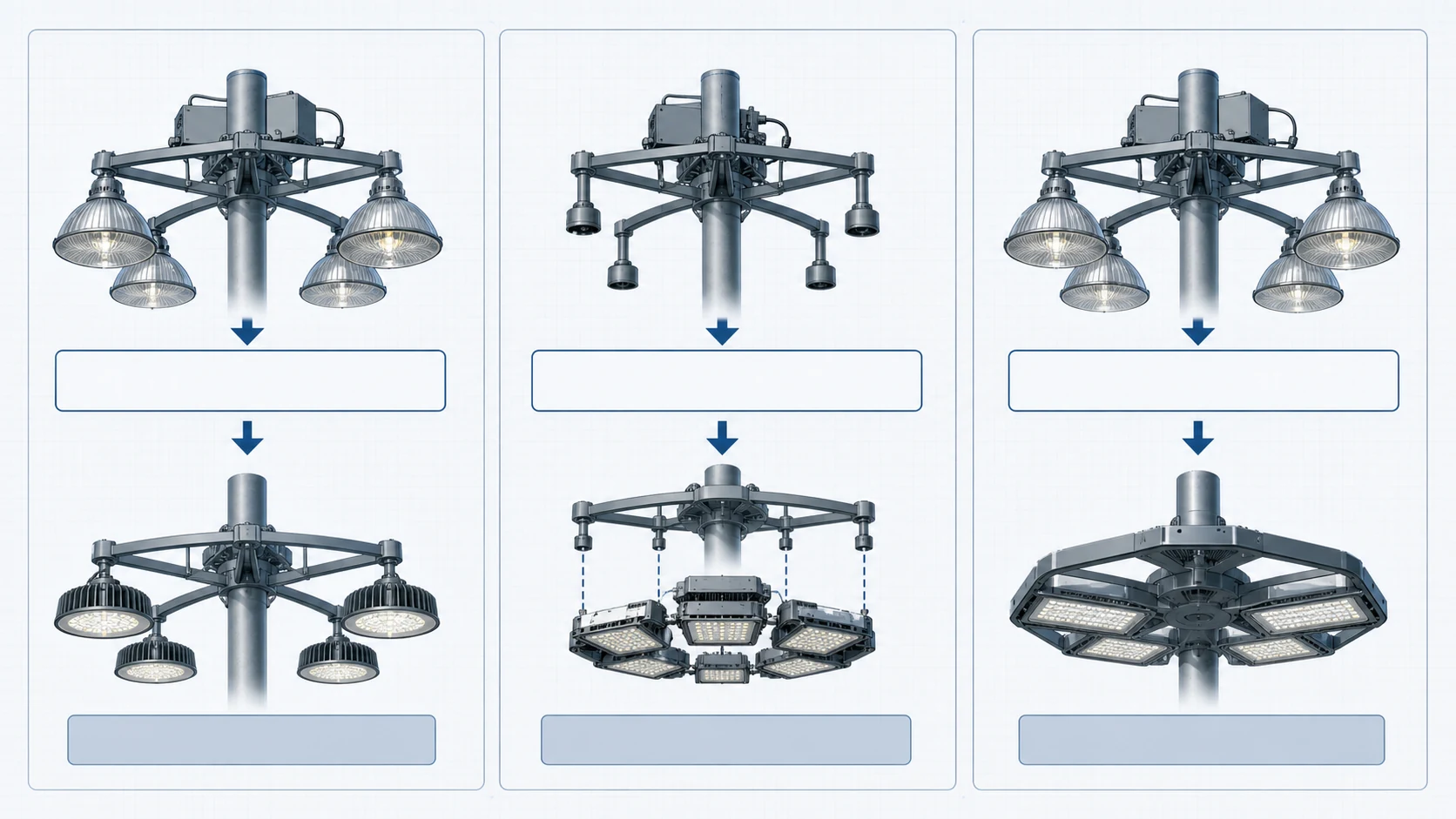
| Retrofit Option | Main Advantage | Main Risk | Best Use |
|---|---|---|---|
| Lamp-only replacement | Lowest intervention | Thermal, electrical and optical compatibility risk | Limited compatible cases |
| Retrofit kit | Reuses part of existing housing | Listing, thermal and photometric review needed | Sound existing housings with verified compatibility |
| Complete LED luminaire replacement | Best optical and control flexibility | Higher initial work | Most high-mast engineering retrofit projects |
Lamp-Only Replacement
Lamp-only replacement means replacing the old light source with an LED lamp while keeping much of the existing fixture body.
This approach may appear attractive because it reduces installation work.
However, it can present significant thermal, electrical and optical compatibility risks, especially when the existing housing was not designed for the proposed LED source.
Main concerns include:
- Thermal management.
- Optical mismatch.
- Existing reflector condition.
- Driver or ballast compatibility.
- Fixture safety.
- Photometric uncertainty.
- Certification or listing implications.
- Limited aiming control.
For engineering high mast projects, lamp-only replacement should be used only when compatibility is clearly verified.
Retrofit Kit
A retrofit kit replaces some internal components while reusing part of the existing fixture housing.
This approach may reduce cost compared with complete replacement, but it still requires review.
Check:
- Thermal path.
- Mechanical fit.
- Driver mounting.
- Surge protection.
- Wiring condition.
- Lens and reflector condition.
- Photometric file for the final assembly.
- Applicable safety and listing requirements.
- Maintenance access.
A retrofit kit should not be selected only because it fits the old housing physically. It must also meet photometric, electrical and thermal requirements.
Complete LED Luminaire Replacement
Complete LED luminaire replacement is often the most practical approach for high mast engineering retrofit projects.
It allows the project team to select:
- New optics.
- New LED luminaire output.
- New drivers.
- New surge protection.
- New brackets.
- New aiming method.
- Dimming or smart controls.
- IES/LDT files for simulation.
- Better maintenance planning.
For ports, logistics yards, highways, industrial areas and municipal infrastructure, complete luminaire replacement generally provides the greatest flexibility for photometry, thermal management, drivers, controls and project acceptance.
Step 1: Audit the Existing High Mast System
A retrofit project should begin with a complete audit of the existing installation.
Do not start by asking only for old lamp wattage.
Existing System Audit Table
| Field | Existing Condition | Evidence Required |
|---|---|---|
| Mast ID and location | Site drawing / photo | |
| Mounting height | Survey / drawing | |
| Fixture quantity per mast | Site count | |
| Lamp type and wattage | Nameplate / maintenance record | |
| Ballast or system input watts | Nameplate / measurement | |
| Existing optic or reflector | Datasheet / photo | |
| Aiming direction | Field survey | |
| Current illuminance | Measurement grid | |
| Failure condition | Maintenance record | |
| Control method | Electrical cabinet / control panel record | |
| Cable condition | Site inspection | |
| Corrosion condition | Pole and headframe inspection | |
| Lowering system condition | Maintenance record / test operation |
The audit should identify whether the retrofit is only a lighting upgrade or also a structural, electrical or maintenance-risk project.
Step 2: Measure Current Lighting Performance
Existing lighting measurement is valuable because it shows what the site actually receives, not what the old design originally promised.

Measure or document:
- Average horizontal illuminance.
- Minimum illuminance.
- Uniformity.
- Dark zones.
- Hot spots.
- Glare complaints.
- CCTV visibility.
- Critical task areas.
- Boundary spill light.
- Failed or underperforming fixtures.
Measurements should be taken using a defined grid and under known operating conditions. Record the meter type and calibration status where required, ambient-light condition, weather, time, operating fixture count, measurement plane, grid boundary, abnormal points and any failed luminaires. Without these conditions, two measurement records from different dates may not be comparable.
If a measurement grid is not possible, collect photographs, site drawings, mast locations, fixture quantities, mounting height, existing aiming direction and user complaints.
A retrofit proposal should make clear whether it aims to:
- Maintain existing lighting level while saving energy.
- Improve lighting level.
- Improve uniformity.
- Reduce glare.
- Improve CCTV visibility.
- Add dimming or controls.
- Reduce maintenance.
- Comply with a new specification.
These are different objectives. They may require different LED solutions.
Step 3: Set the Post-Retrofit Acceptance Criteria
Before selecting LED fixtures, define what the retrofit must achieve.
Post-retrofit criteria may include:
- Maintained average illuminance.
- Minimum illuminance.
- Uniformity convention.
- Calculation plane.
- Vertical illuminance.
- CCTV visibility.
- Glare limit.
- Spill-light limit.
- CCT and CRI.
- Dimming schedule.
- Control function.
- Energy-saving target.
- Maintenance interval.
- Tender or consultant requirements.
The acceptance criteria should be written before quotation.
Otherwise, the supplier may optimize the proposal for lower wattage, lower fixture cost or easy installation without meeting the actual project objective.
For lighting-level specification, review the High Mast Lighting Level Specification Guide.
Step 4: Check Pole, Headframe and Lowering System Compatibility
High mast LED retrofit is not only a luminaire selection task. The existing pole and headframe must be checked.
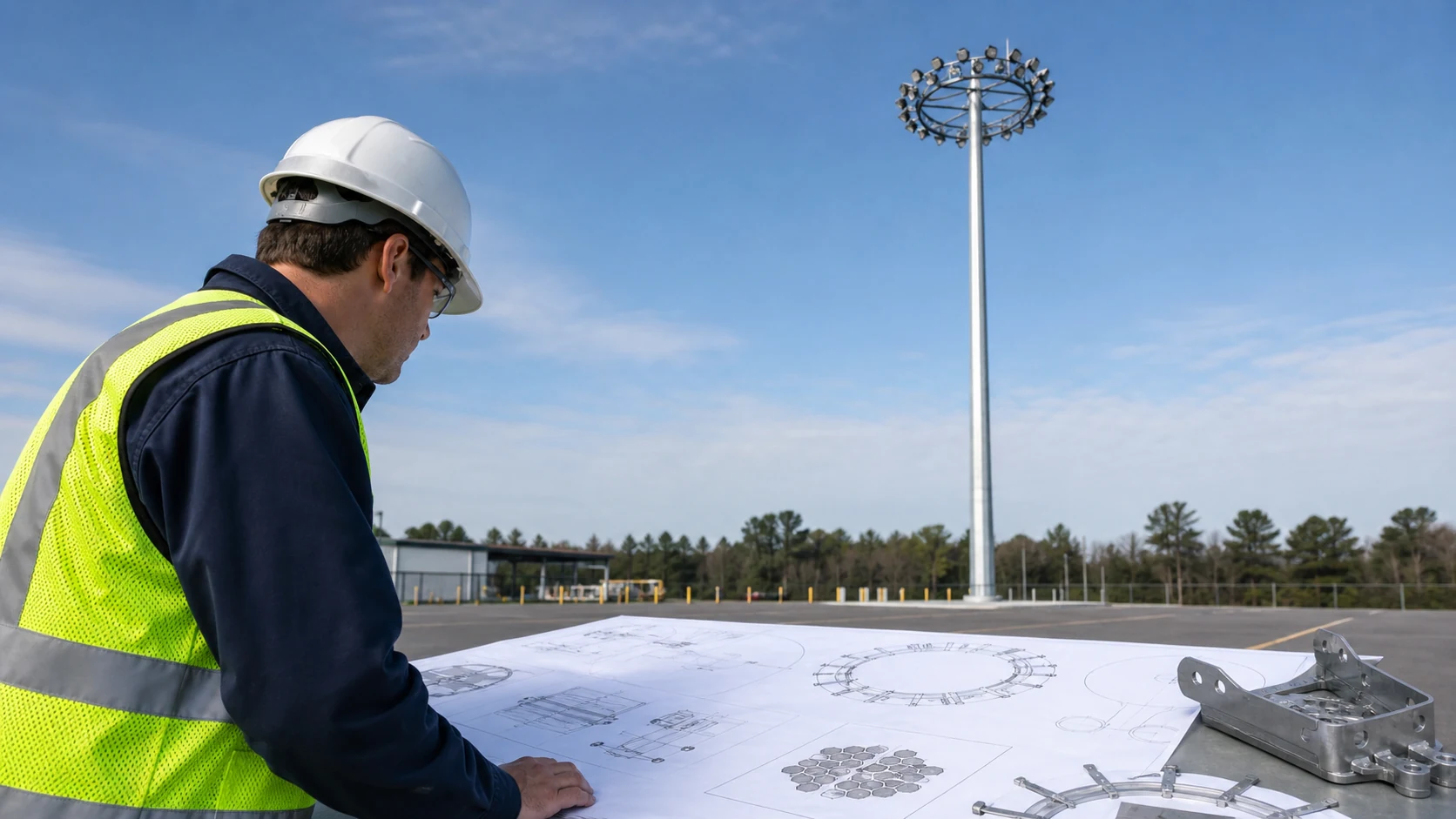
Pole, headframe, foundation and lowering-system suitability should be confirmed by qualified parties under the applicable structural and safety requirements. Electrical modifications, ballast bypass, grounding and circuit protection should be completed by qualified personnel according to local codes and lockout/tagout procedures.
LED luminaires may be lighter, heavier, smaller or larger than the existing fixtures. Their effective projected area may also be different.
Lower LED wattage does not automatically mean lower weight, lower wind load or lower structural risk.
Mechanical Compatibility Table
| Item | Existing System | Proposed LED System | Must Verify |
|---|---|---|---|
| Fixture weight | Headframe and lowering-system capacity | ||
| Effective projected area | Wind-load impact | ||
| Fixture dimensions | Clearance and aiming | ||
| Bracket interface | Hole pattern and mounting hardware | ||
| Total ring load | Structural compatibility | ||
| Cable and connector | Fit, rating and condition | ||
| Corrosion condition | Pole and headframe safety | ||
| Aiming range | Required target-zone direction | ||
| Maintenance access | Safe installation and service | ||
| Lowering system operation | Load balance and safe lowering |
Structural impact should be reviewed using actual fixture weight, dimensions, effective projected area and mounting arrangement.
Do not judge headframe compatibility by LED wattage alone.
Step 5: Check Wiring, Drivers, SPD and Controls
LED drivers behave differently from HID ballasts.
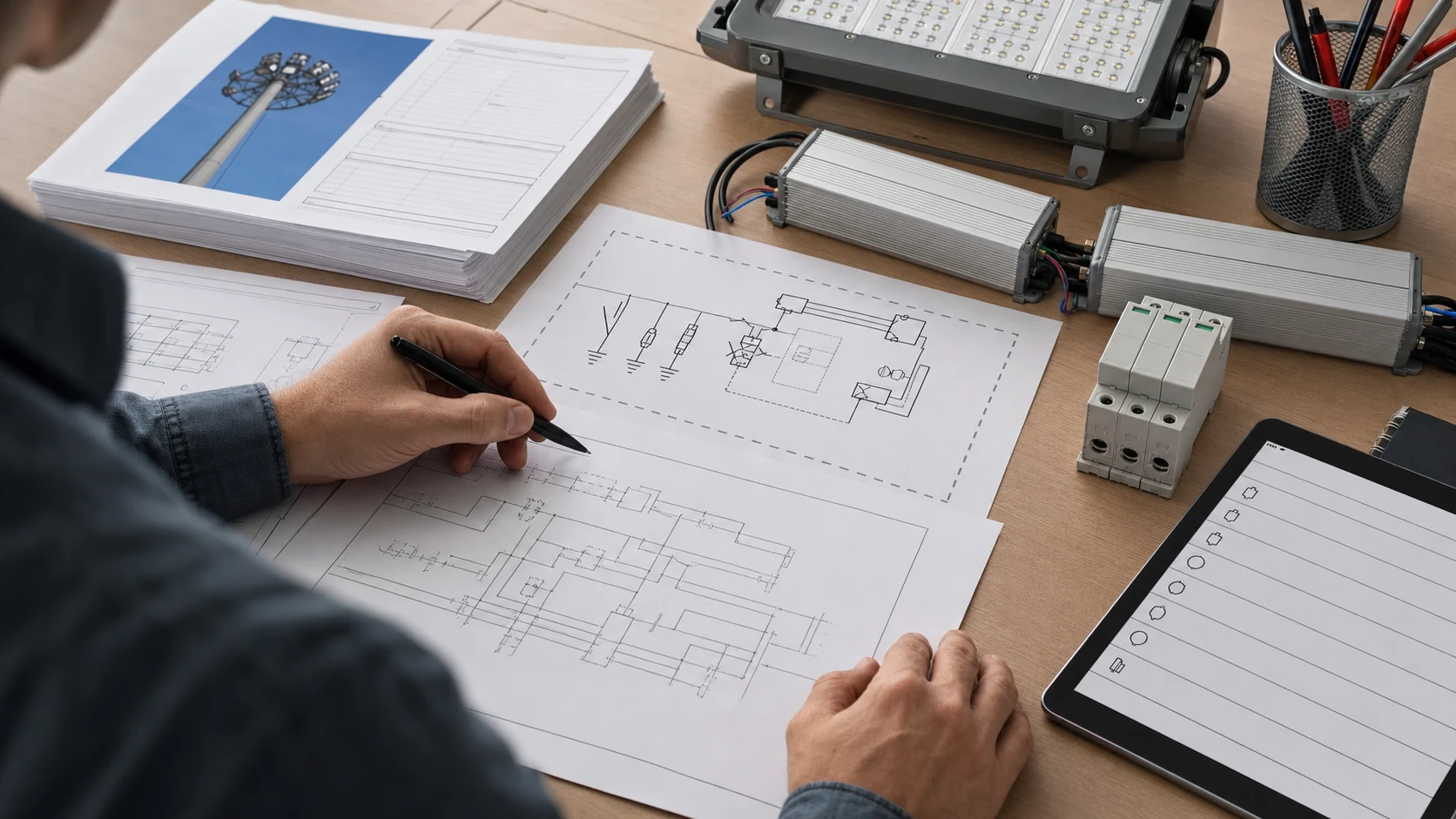
An old electrical system that handled HID loads may still need review for LED operation.
Electrical Compatibility Table
| Item | Retrofit Review Point |
|---|---|
| Existing voltage and frequency | Confirm compatibility with LED drivers |
| HID ballast | Remove, bypass or replace according to design |
| Actual system input power | Establish the real energy baseline |
| Power factor and THD | Check power-quality impact |
| Inrush current | Confirm breaker, contactor and circuit behavior |
| Surge protection | Confirm SPD level and grounding |
| Branch circuit | Check cable, terminal and breaker capacity |
| Control circuit | Confirm switching, dimming or smart-control compatibility |
| Driver location | Confirm thermal and service conditions |
| Cable condition | Check aging, insulation and connector safety |
| Earthing / grounding | Confirm surge and safety performance |
| Dimming protocol | Confirm 0–10V, DALI, timer, smart control or other method |
| Ambient temperature | Confirm driver and luminaire derating |
| Distribution cabinet | Check breaker, contactor and protection coordination |
In some retrofit projects, LED input power is lower than HID. That does not eliminate electrical review.
For example, LED drivers can have different inrush-current behavior. Surge protection may also need improvement, especially for exposed high mast installations.
Step 6: Compare LED Photometry and Aiming
LED retrofit success depends heavily on optics.
The replacement luminaire should be selected with an actual IES/LDT photometric file.
Compare:
- Total luminaire lumens.
- Luminaire efficacy.
- Beam distribution.
- Candela distribution.
- Intensity at required aiming angles.
- Asymmetric or symmetric optics.
- Tilt angle.
- Rotation angle.
- Spill-light control.
- Glare direction.
- Edge coverage.
- Vertical visibility.
Do not assume that a lower-wattage LED fixture with a high lumen package will automatically match the old HID system.
In many cases, the LED system should not copy the old aiming exactly. The new optical distribution may require a new aiming schedule.
For wattage selection principles, review the High Mast Light Wattage Guide.
Step 7: Verify the Retrofit in DIALux
A LED retrofit should be simulated in DIALux, Relux or equivalent software before final approval.
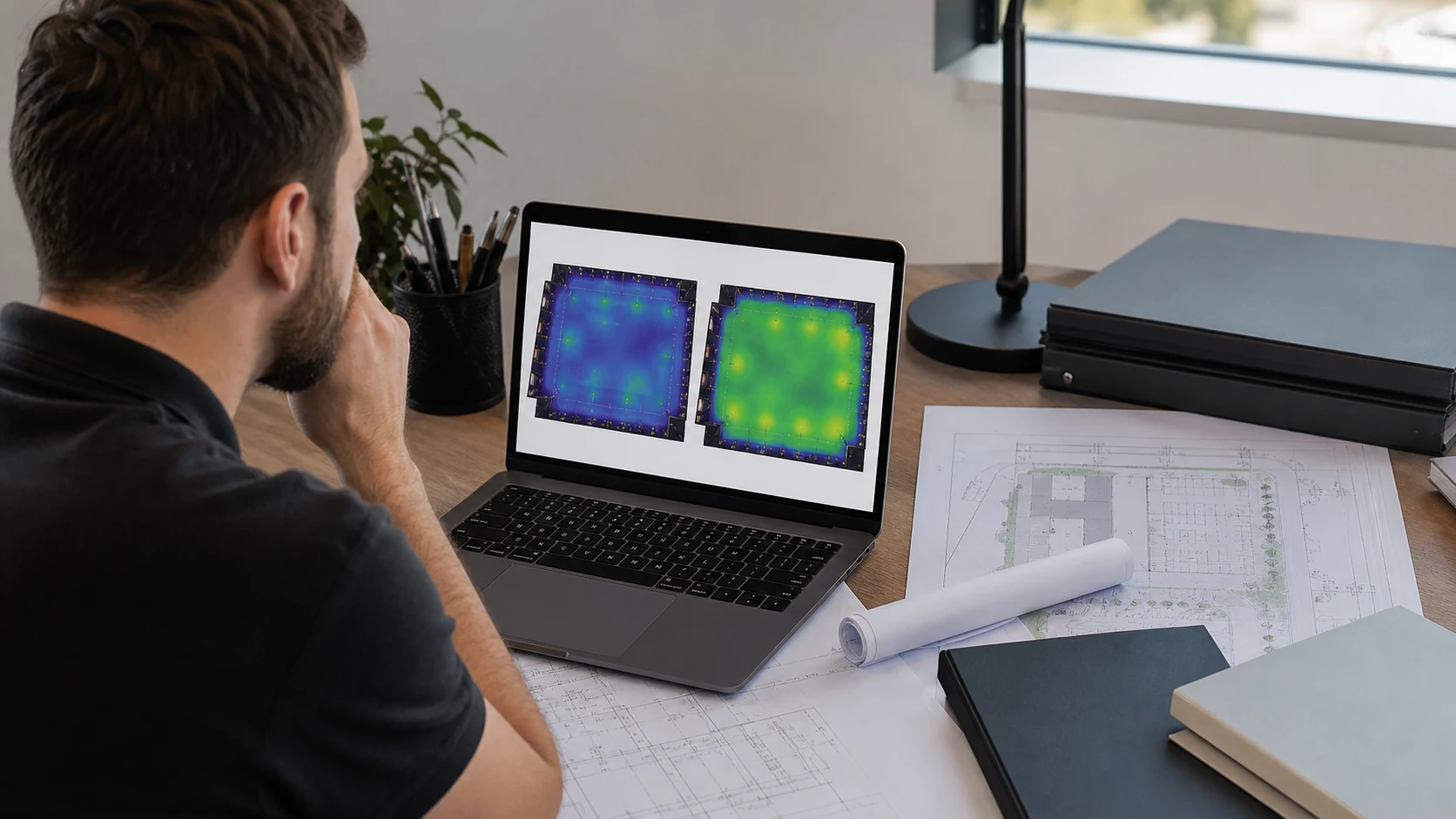
The simulation should compare the proposed LED layout against the project target.
It may also compare the existing system if reliable photometric data is available.
DIALux Retrofit Review Items
| Report Item | What to Check |
|---|---|
| Existing mast locations | Are real locations used? |
| Mounting height | Does it match the existing pole? |
| Luminaire quantity per mast | Does it match the proposed retrofit? |
| IES/LDT file | Is the proposed LED fixture file used? |
| Rated lumens | Does the file match the datasheet? |
| Input power | Does it match the proposed configuration? |
| Optic | Does it match the quoted product? |
| Aiming schedule | Is tilt and rotation realistic for installation? |
| Maintenance factor | Is maintained performance reviewed? |
| Calculation grid | Does it match the required area? |
| Average illuminance | Does it meet the target? |
| Minimum illuminance | Are dark zones controlled? |
| Uniformity | Is the correct convention used? |
| Glare | Are operators, drivers or neighbors affected? |
| Spill light | Are boundaries controlled? |
An IES file should also be cross-checked against the datasheet and applicable test report.
A photometric file should not be accepted only because it imports successfully into DIALux.
Step 8: Run a Trial Mast or Mock-Up
For larger retrofit projects, a trial mast or mock-up can reduce risk.
A trial helps verify:
- Mechanical fit.
- Bracket compatibility.
- Aiming adjustment.
- Driver behavior.
- Control response.
- Light distribution.
- Glare perception.
- Maintenance process.
- Commissioning procedure.
A trial mast is especially useful when:
- The site has high operational risk.
- Existing drawings are incomplete.
- Old pole condition is uncertain.
- The retrofit changes optics significantly.
- The project involves ports, airports, mining areas or highways.
- The owner requires visual confirmation before full deployment.
The trial should not replace calculation. It should confirm that calculation and site reality are aligned.
Step 9: Commission the Installed Retrofit
A retrofit is not complete when the new LED luminaires are installed. Commissioning should confirm that the installed system matches the approved retrofit proposal.
Check:
- Installed luminaire model.
- Installed wattage or power setting.
- CCT and CRI.
- Optic type.
- Fixture quantity per mast.
- Final tilt and rotation.
- Bracket and fastener condition.
- Driver settings.
- Surge protection.
- Control and dimming operation.
- Actual circuit power.
- Post-installation illuminance.
- Glare or spill-light issues.
- As-built aiming schedule.
- Updated maintenance record.
Commissioning is especially important when the project uses dimming, power-selectable luminaires, smart controls or revised aiming.
Step 10: Verify Energy and Maintenance Savings
After commissioning, compare post-retrofit energy use with the approved baseline.
The comparison should be normalized for:
- Operating hours.
- Dimming schedule.
- Actual circuit power.
- Seasonal operating changes.
- Material changes in site operation.
- Failed or disabled fixtures.
- Maintenance events.
If the project uses dimming, do not calculate energy only from rated power multiplied by total hours. Use the actual dimming power curve, metered data or confirmed power data for each operating profile.
Maintenance savings should also be checked against real service records, not only expected LED lifetime.
Energy Savings and Lifecycle Cost Review
Energy saving is a major reason for high mast LED retrofit.
However, energy saving should be calculated with real system assumptions.
Do not calculate savings only from lamp wattage.
A basic screening calculation can use:
Baseline annual energy =
existing measured system kW × annual operating hours

Post-retrofit annual energy =
LED system kW × equivalent full-load operating hours

Annual energy savings =
baseline annual kWh − post-retrofit annual kWh

Annual cost savings =
energy savings × electricity tariff
If dimming is used, equivalent full-load operating hours should be based on the confirmed dimming schedule and power data, not only rated power multiplied by clock hours.
Use:
- Actual existing system input watts.
- Proposed LED system input watts.
- Quantity of luminaires.
- Annual operating hours.
- Dimming schedule.
- Electricity cost.
- Maintenance cost.
- Lamp replacement cost.
- Lift truck or lowering-system cost.
- Failure rate.
- Cleaning interval.
- Control strategy.
Energy Saving Calculation Table
| Item | Existing HID System | Proposed LED System |
|---|---|---|
| Quantity | ||
| Lamp wattage | ||
| Ballast / driver input watts | ||
| Total system kW | ||
| Annual operating hours | ||
| Dimming schedule | ||
| Annual kWh | ||
| Electricity cost | ||
| Maintenance cost | ||
| Annual cost | ||
| Estimated annual savings |
Simple payback can be useful for early screening, but lifecycle cost is better for formal project review. DOE financial-analysis guidance similarly emphasizes that first-level payback can miss important economic factors and that full life-cycle cost/benefit review is more suitable for informed decisions.
Lifecycle cost may include:
- Fixture cost.
- Installation cost.
- Electrical modification.
- Control upgrade.
- Maintenance reduction.
- Energy saving.
- Spare parts.
- Downtime.
- Warranty and service conditions.
A retrofit proposal should not promise savings without showing the calculation basis.
Can a 1000W Metal Halide High Mast Light Be Replaced by LED?
Yes, in many projects a 1000W metal halide high mast light can be replaced by LED.
However, the replacement LED wattage is not fixed.
The correct LED option depends on:
- Existing system input power.
- Current lighting level.
- Existing luminaire condition.
- Pole height.
- Fixture quantity per mast.
- Existing beam distribution.
- Required maintained lighting level.
- LED luminaire efficacy.
- LED photometry.
- Aiming plan.
- Glare control.
- Electrical compatibility.
- Mechanical compatibility.
A 1000W metal halide replacement may be shortlisted using LED products with lower input power, but final selection should be verified with IES/LDT files and DIALux.
Do not approve a retrofit only because a product page claims a fixed LED equivalent.
Can a 1500W or 2000W HID High Mast Light Be Replaced by LED?
Yes, but higher-output HID retrofit projects require more careful engineering review.
A 1500W or 2000W HID system may involve:
- Large existing fixtures.
- Heavy headframes.
- High mounting heights.
- Wide-area lighting.
- Higher electrical load.
- Specific optical requirements.
- Large target zones.
- Higher glare risk.
- More complex maintenance access.
LED replacement may reduce energy and improve optical control, but it must be checked for:
- Required lumen package.
- Candela distribution.
- Fixture quantity.
- Headframe load.
- Effective projected area.
- Bracket compatibility.
- Driver behavior.
- Surge protection.
- DIALux results.
- Lighting acceptance criteria.
For high-output HID systems, one-to-one fixture replacement may not be the best solution. The project may need a revised luminaire quantity, new optics or a new aiming plan.
HID to LED Retrofit Screening Table
The following table is for early screening only. It is not a final replacement chart.
| Existing HID System | Preliminary LED Screening | Why No Fixed Equivalent | Required Verification |
|---|---|---|---|
| 1000W metal halide / HPS | No fixed LED wattage | Existing system power, lamp age, optics and pole height vary | Current measurement, IES/LDT, DIALux, maintained lux |
| 1500W metal halide / HID | No fixed LED wattage | LED size, weight, EPA, beam distribution and driver behavior differ | Structure, aiming, electrical load, glare |
| 2000W HID | Project-specific | One-to-one replacement may fail uniformity or glare control | Full photometric, structural and electrical assessment |
| Existing HPS system | Project-specific | LED changes color, CRI, optical direction and visibility | CCT, CRI, glare, target zones, controls |
This table avoids a misleading fixed equivalent.
A project may still create an internal shortlist, but that shortlist must be verified before procurement.
Retrofit Decision Framework: Fixture Replacement vs System Redesign
Not every retrofit should be a direct fixture replacement.
Use the following framework.
| Situation | Fixture Replacement May Be Enough | System Redesign May Be Needed |
|---|---|---|
| Existing lighting level | Already acceptable | Current site is underlit or uneven |
| Pole locations | Suitable | Poor mast locations or major shadows |
| Headframe condition | Good and compatible | Corroded, overloaded or incompatible |
| Electrical system | Compatible with LED drivers | Old wiring, poor protection or control limitations |
| Optics | New LED optics fit the same target zones | Aiming and distribution must change |
| Glare complaints | No major issue | Retrofit must reduce glare or spill light |
| Controls | Simple switching acceptable | Dimming, smart control or monitoring required |
| Project risk | Low | High-risk site such as port, highway, airport or mining yard |
A direct replacement may save time, but a system redesign may produce better lighting performance and long-term value.
RFQ Checklist for High Mast LED Retrofit
A complete retrofit RFQ should include the following information. For public or tender-driven projects, product selection should also align with the relevant owner specification, roadway/exterior-lighting procurement requirements and luminaire performance documentation.
| RFQ Item | Why It Matters |
|---|---|
| Site location and application | Defines operating conditions and lighting objective |
| Existing mast layout | Required for DIALux and retrofit review |
| Pole height | Determines mounting height and aiming |
| Fixture quantity per mast | Defines headframe and output comparison |
| Existing lamp type and wattage | Starting point for retrofit review |
| Existing ballast or system input power | Required for real energy-saving calculation |
| Existing fixture photos | Helps evaluate mounting, optic and condition |
| Existing aiming direction | Helps compare current and proposed layout |
| Current lighting measurement | Defines actual baseline |
| Required post-retrofit lighting level | Defines acceptance criteria |
| Uniformity requirement | Controls dark zones |
| Existing electrical data | Confirms voltage, circuits, controls and protection |
| Headframe and lowering-system data | Confirms mechanical compatibility |
| Control requirement | Defines timer, dimming or smart monitoring options |
| DIALux report requirement | Supports engineering approval |
| BOQ format | Supports procurement and tender comparison |
The more complete the RFQ, the more accurate the retrofit proposal will be.
Common Retrofit Mistakes
| Mistake | Why It Creates Risk | Better Review Method |
|---|---|---|
| Using a fixed HID-to-LED wattage chart | Ignores optics, pole height and existing performance | Use charts only for early screening |
| Ignoring ballast losses | Understates existing energy use | Measure or estimate system input power |
| Ignoring existing degradation | May preserve underlit conditions | Measure current lighting level |
| Copying old aiming | LED optics may distribute light differently | Create a new aiming schedule |
| Ignoring headframe load | New LED fixtures may differ in weight and EPA | Check mechanical compatibility |
| Ignoring LED driver behavior | Inrush current and control behavior may differ | Review electrical system |
| Accepting IES files without cross-checking | Files may not match the quoted configuration | Compare IES/LDT, datasheet and test report |
| Skipping DIALux | Retrofit may fail uniformity or glare | Simulate before procurement |
| Focusing only on watts saved | Lighting quality may decline | Compare performance, maintenance and lifecycle cost |
| No trial mast on high-risk sites | Site conditions may differ from drawings | Test before full deployment |
Engineering References
The following references support the engineering logic used in retrofit review. They should not be read as fixed high mast wattage-equivalent charts.
- DOE Roadway Lighting Research — useful background for LED outdoor lighting performance, optical controllability and controls-based energy reduction.
- DOE Trial Demonstration of Area Lighting Retrofit — useful context for field trial and retrofit demonstration thinking.
- DOE Model Specification for LED Roadway Luminaires — useful for specification-based LED luminaire procurement.
- DOE Purchasing Energy-Efficient Exterior Lighting — useful for energy-efficient exterior lighting purchasing context.
- DOE Financial Analysis — useful for lifecycle-cost and payback review.
- IES: Managing Retrofit Risk — useful context for retrofit versus replacement risk.
- DOE Luminaire Dirt Depreciation Field Data — useful context for dirt depreciation and baseline maintenance assumptions.
Request a High Mast LED Retrofit Review
High mast LED retrofit should be reviewed before procurement, especially when the project involves existing metal halide, HPS or HID high mast systems.
Send us your existing mast layout, fixture quantity, pole height, lamp type, fixture photos, electrical information, current lighting measurements, target performance and retrofit objective. Sunlurio can help review LED luminaire options, IES/LDT files, DIALux results, mechanical compatibility, electrical requirements and BOQ preparation.
Request a High Mast LED Retrofit Review
Related High Mast Lighting Guides
The following guides explain related decisions in high mast lighting and retrofit projects:
- High Mast Light Wattage Guide
- High Mast Lighting Level Specification Guide
- High Mast Lighting Design Guide
- High Mast Pole Height Guide
- High Mast Pole Spacing Guide
- High Mast Lighting Layout Patterns
- How Many High Mast Lights Do You Need?
- High Mast Lighting Coverage Explained
- High Mast Lighting Systems
- Engineering Support for Lighting Projects
- DIALux Simulation Outputs
- IES/LDT Photometric Files
- Tender Documents and BOQ Support
Frequently Asked Questions
What LED wattage replaces a 1000W metal halide high mast light?
There is no fixed LED wattage. The correct replacement depends on existing system input power, current lighting level, pole height, fixture quantity, optics, LED photometry, maintained lighting target and DIALux verification.
Can I replace HPS high mast lights with LED?
Yes, HPS high mast systems can often be replaced with LED. The retrofit should review CCT, CRI, visibility, glare, optics, controls, electrical compatibility and maintained lighting performance.
Is a HID-to-LED wattage chart useful?
It can be useful for early screening, but it should not be used for final approval. High mast retrofit must be verified by photometric calculation, structure and electrical compatibility.
Do I need DIALux for high mast LED retrofit?
For engineering, municipal, port, industrial, highway or consultant-reviewed projects, DIALux, Relux or equivalent calculation is strongly recommended. It helps verify maintained illuminance, uniformity, glare and target-zone coverage.
Can I reuse the existing high mast pole and headframe?
Possibly. The existing pole, headframe, brackets and lowering system must be checked against the proposed LED fixture weight, dimensions, effective projected area, total ring load and mounting arrangement.
Do I need to remove the old HID ballast?
Complete LED luminaire replacement normally removes the obsolete HID ballast. Ballast-compatible replacement lamps are a separate product category and must be explicitly listed as compatible with the installed ballast. The exact method depends on the selected LED product, site wiring and local electrical requirements.
Will LED retrofit always reduce energy cost?
LED retrofit often reduces energy use, but savings should be calculated using actual system input power, operating hours, dimming schedule, electricity price and maintenance cost. Do not calculate savings from lamp wattage alone.
Can LED retrofit create glare?
Yes. LED retrofit can create glare if optics, aiming, mounting height and observer positions are not reviewed. Lower wattage does not automatically guarantee lower glare.
What information should I provide for a retrofit proposal?
Provide mast layout, pole height, fixture quantity per mast, existing lamp type, ballast or system input power, fixture photos, current lighting measurements, electrical data, target lighting level, control requirements and required report format.
When should a retrofit become a full system redesign?
A full system redesign should be considered when existing lighting is poor, pole locations are unsuitable, headframes are corroded, electrical systems are outdated, glare complaints exist, or the project requires new lighting levels, controls or approval standards.