

Quick Answer
High mast light maintenance should be managed through inspection records, qualified personnel, OEM procedures and O&M handover documents, not informal field repairs.
A high mast maintenance plan should confirm the condition of luminaires, drivers, optics, brackets, pole base areas, electrical systems, grounding, surge protection, lowering systems, wire ropes, winches, luminaire rings, latch systems, spare parts and maintenance records.
For EPC contractors, municipal owners, port operators, airport facilities, industrial sites and long-term O&M teams, the key question is not only "Can the light be repaired?" The better question is:
What should be inspected, recorded, escalated, replaced, re-tested and documented during the service life of the high mast lighting system?This guide is written as a maintenance planning and inspection-record guide. It is not a public climbing guide, winch repair guide, live-wiring procedure or lowering-ring troubleshooting manual.
Safety and Scope Boundary
High mast lighting maintenance involves electrical hazards, mechanical movement, suspended loads, structural components and work-at-height risk. Maintenance should be performed by qualified personnel under approved procedures, OEM manuals, owner requirements and local safety rules.
This article explains:
- What should be checked.
- What records should be kept.
- What conditions should trigger escalation.
- What documents should be available after handover.
- How maintenance should be coordinated with retrofit, lighting performance and O&M planning.
This article does not explain:
- How to climb a high mast pole.
- How to release a stuck lowering ring.
- How to repair a winch.
- How to adjust wire rope length.
- How to replace wire rope step by step.
- How to work on live electrical circuits.
- How to bypass latch, brake, limit or safety devices.
Abnormal high mast behavior should be treated as a stop-and-escalate condition, not as a trial-and-error repair task.
Project Review Summary
| Item | Project Review Point |
|---|---|
| Main Topic | High mast light maintenance planning and inspection records |
| Main Question | What should be inspected, recorded, escalated and handed over during high mast O&M? |
| Best-Fit Projects | Municipal roads, highways, ports, airports, logistics yards, industrial yards, mining sites, stadiums and retrofit projects |
| Main Risk | Treating high mast maintenance as informal field repair instead of controlled O&M inspection and documentation |
| Review Scope | Luminaires, drivers, optics, lowering system, wire rope, winch, ring, latch, electrical cabinet, SPD, grounding, pole base, night performance and records |
| Required Evidence | Inspection checklist, photos, electrical test records, O&M manual, spare parts list, issue log, replacement record, measurement record and escalation notes |
| Typical Deliverables | Maintenance scope matrix, inspection schedule logic, stop-and-escalate table, O&M record checklist and retrofit maintenance review |
| Project Benefit | Reduces repeated failures, undocumented repairs, safety exposure, warranty disputes and long-term O&M uncertainty |
What High Mast Light Maintenance Should Cover
High mast lighting maintenance should not focus only on replacing failed luminaires. A complete maintenance review should cover five areas.
1. Lighting Equipment
Review:
- Luminaire housing.
- Lens or cover condition.
- Driver condition.
- LED module condition.
- Bracket condition.
- Fixture orientation.
- Water ingress.
- Cable entry.
- Connector condition.
- Optic and aiming consistency.
- Dimming or control setting.
2. Lowering System
Review:
- Luminaire ring or carrier.
- Winch or drive.
- Wire rope.
- Sheaves or pulleys.
- Latch or locking system.
- Guide and centering system.
- Power cable.
- Control box.
- Limit or protection functions.
- OEM operation and inspection record.
3. Electrical System
Review:
- Electrical cabinet.
- Cable termination.
- SPD.
- Breaker and contactor.
- Grounding and bonding.
- Control circuit.
- Timer, dimming or smart control.
- Power quality or supply issue if relevant.
- Electrical inspection records.
4. Pole, Base and Structural Interface
Review:
- Pole coating or galvanizing.
- Corrosion.
- Base plate area.
- Anchor area.
- Access door.
- Water accumulation at base.
- Visible cracks.
- Deformation.
- Foundation condition.
- Structural escalation triggers.
5. O&M Records
Review:
- Asset register.
- Inspection history.
- Failure history.
- Replacement history.
- Spare-parts record.
- Warranty documents.
- As-built layout.
- Aiming schedule.
- Lowering-system manual.
- Electrical drawing.
- Maintenance log.
A high mast system with no maintenance record is difficult to manage, even if the lights are still operating.
Maintenance Planning After Project Handover
Maintenance planning should begin at project handover, not after the first failure.
The installation and commissioning package should provide enough information for the O&M team to understand:
- Where each mast is located.
- Which luminaire model is installed.
- Which optic is installed.
- Which aiming schedule was used.
- Which lowering system is installed.
- Which tools are needed.
- Which spare parts are recommended.
- Which electrical drawings are approved.
- Which warranties apply.
- Which records must be kept after maintenance.
A good handover package connects installation evidence with long-term maintenance.
commissioning record
->as-built layout
->luminaire model and serial list
->aiming schedule
->electrical drawing
->lowering-system manual
->inspection checklist
->spare-parts plan
->maintenance log
For the installation-to-handover stage, review the High Mast Lighting Installation & Commissioning Checklist.
Inspection Schedule: What Should Define the Frequency?
There is no single global maintenance interval that applies to all high mast projects.
Inspection frequency should be defined by:
- Owner requirements.
- Local authority rules.
- OEM instructions.
- Project risk level.
- Operating hours.
- Environmental exposure.
- Traffic or site safety requirements.
- Coastal or corrosive conditions.
- Dust or chemical exposure.
- Previous failure history.
- Lowering-system condition.
- Warranty and service contract requirements.
Inspection Frequency Decision Table
| Project Environment | Frequency Should Consider | Notes |
|---|---|---|
| Highway / municipal road | Traffic exposure, vibration, dust, authority maintenance program | Follow owner and local authority maintenance rules |
| Port / coastal area | Salt spray, corrosion, wind exposure, access constraints | More frequent corrosion and connector review may be needed |
| Airport / logistics yard | Operating hours, security access, safety-critical lighting areas | Coordinate with owner's O&M and safety procedures |
| Industrial / mining site | Dust, vibration, chemical exposure, heavy equipment movement | Electrical, optical cleaning and corrosion records matter |
| Stadium / public venue | Event schedule, reliability requirement, pre-event readiness | Functional checks may be required before major events |
| Retrofit project | Existing system age, unknown maintenance history, changed luminaire load | Review old records before deciding reuse or replacement |
| Smart control project | Control platform status, dimming profile, sensor or communication logs | Software and access credentials should be maintained |
A maintenance schedule should be documented and approved by the owner or responsible maintenance authority.
Maintenance Scope Matrix
| Maintenance Area | What to Check | Required Record | Escalation Trigger |
|---|---|---|---|
| Luminaire | Output, lens, housing, bracket, driver condition | Inspection photo / record | Water ingress, repeated failure, abnormal heat, damaged housing |
| Optic / aiming | Lens condition, orientation, tilt, rotation, dark zones | Aiming or visual inspection record | Changed aiming, glare complaint, poor uniformity |
| Lowering system | Ring, wire rope, winch, latch, guide system | OEM-based inspection record | Jamming, abnormal noise, ring tilt, damaged rope |
| Electrical system | Cabinet, SPD, grounding, cable, control | Electrical test / inspection record | Burn marks, SPD failure, loose wiring, abnormal tripping |
| Pole and base | Coating, corrosion, anchor area, access door | Visual inspection record | Cracks, severe corrosion, water accumulation, deformation |
| Lighting performance | Night visual check or measurement | Measurement record if required | Dark zones, abnormal dimming, glare complaint |
| Documentation | O&M manual, asset log, spare list | Maintenance file | Missing manual, no serial traceability, no inspection history |
| Spare parts | Driver, SPD, connectors, tools, luminaire stock | Spare-parts register | No replacement path for critical components |
| Control system | Timer, dimming, smart platform, communication status | Control log / setting record | Wrong profile, communication fault, owner access missing |
Visual Inspection Checklist

Visual inspection should be organized, recorded and traceable.
A basic high mast visual review may include:
- Pole shaft condition.
- Coating or galvanizing condition.
- Base plate area.
- Anchor area.
- Access door.
- Water accumulation.
- Luminaire housing.
- Lens condition.
- Brackets and fasteners.
- Visible cable condition.
- Cabinet condition.
- Signs of overheating.
- Signs of impact damage.
- Corrosion around exposed parts.
- Missing covers or seals.
- Abnormal tilt or fixture orientation.
Visual Inspection Record Table
| Inspection Item | What to Observe | Record Type | Action if Abnormal |
|---|---|---|---|
| Pole shaft | Corrosion, deformation, coating damage | Photo / checklist | Maintenance repair or structural review |
| Base area | Water, cracking, anchor corrosion | Photo / checklist | Civil or structural escalation |
| Access door | Fit, lock, gasket, cable condition | Photo / checklist | Repair or replacement planning |
| Luminaire housing | Damage, water ingress, dirt buildup | Photo / checklist | Cleaning, sealing review or replacement |
| Bracket | Movement, deformation, loose components | Photo / checklist | Mechanical review |
| Cabinet | Damage, moisture, labels, ventilation | Photo / checklist | Electrical inspection |
| Cable entry | Seal, rubbing, strain relief | Photo / checklist | Electrical/mechanical review |
| General site | Vegetation, obstruction, access route | Photo / checklist | Site maintenance action |
Visual inspection is not a substitute for electrical testing, lowering-system inspection or structural assessment where those are required.
Luminaire, Driver and Optical Performance Checks
High mast luminaires should be maintained as part of a system. A replacement should not be selected only by wattage.
Review:
- Installed luminaire model.
- Driver type and setting.
- Optic type.
- Mounting bracket.
- Tilt and rotation.
- Dimming profile.
- Control compatibility.
- Housing condition.
- Lens cleanliness.
- Water ingress.
- Output degradation if measured.
- Repeated failure pattern.
- Spare-part availability.
- Warranty status.
Luminaire Maintenance Review Table
| Item | Maintenance Question | Required Record |
|---|---|---|
| Luminaire model | Does it match the as-built record? | Model / serial list |
| Driver | Is the driver operating normally? | Electrical test or replacement record |
| Optic | Does it match the original design and IES/LDT file? | Datasheet / photometric record |
| Aiming | Has tilt or rotation changed? | Aiming schedule / site photo |
| Lens | Is cleaning required? | Cleaning record |
| Housing | Is there water ingress or damage? | Inspection photo |
| Control setting | Is dimming or timing correct? | Control setting record |
| Replacement | Is replacement based on approved model and optic? | Replacement approval record |
For power and optical selection, review the High Mast Light Wattage Guide and IES Photometric Files.
Lowering-System Inspection Records

Many high mast systems use a lowering system to bring the luminaire ring to ground level for service. This reduces some routine work-at-height exposure, but it does not remove all maintenance risk.
A lowering system should be checked through records and OEM procedures.
Review:
- Ring or carrier condition.
- Winch or drive condition.
- Wire rope condition.
- Sheave or pulley condition.
- Latch or locking condition.
- Guide or centering condition.
- Power cable routing.
- Control box.
- Limit or protection functions.
- Handover tools.
- OEM manual availability.
- Inspection and service history.
Lowering-System Inspection Record Table
| Component | What to Review | Required Record | Escalation Trigger |
|---|---|---|---|
| Luminaire ring | Balance, deformation, fixture mounting | Inspection photo / record | Tilt, jamming, deformation |
| Winch / drive | Condition, operation record, OEM procedure | Service record | Abnormal noise, uncontrolled movement, unknown history |
| Wire rope | Condition, routing, corrosion, visible damage | OEM-based inspection record | Broken strands, kinking, severe corrosion, slack rope |
| Sheave / pulley | Alignment, rotation, wear | Inspection record | Rubbing, seizure, abnormal wear |
| Latch / lock | Engagement evidence, condition, release record | OEM-based record | Incomplete engagement, unclear status |
| Power cable | Routing, strain relief, connector condition | Electrical/mechanical inspection | Rubbing, twisting, insulation damage |
| Control box | Operation, buttons, emergency functions if applicable | Functional test record | Control fault or unsafe response |
| Tools / manuals | Availability and custody | Handover / O&M record | Missing OEM manual or special tool |
For complete system selection and commissioning review, use the High Mast Lighting Lowering System Guide.
Wire Rope, Winch, Ring and Latch Maintenance Boundary
Wire rope, winch, ring and latch components are safety-critical. Their maintenance should follow the exact OEM manual, owner procedure and applicable project rules.
This public guide should not provide universal instructions for:
- Adjusting wire rope length.
- Rewrapping a winch drum.
- Releasing a stuck latch.
- Bypassing a limit device.
- Working below a suspended ring.
- Replacing wire rope step by step.
- Forcing a stuck lowering system to move.
The correct maintenance boundary is:
observe
->stop if abnormal
->record the condition
->isolate the area
->check the OEM procedure
->escalate to qualified personnel
->close the record after corrective action
Lowering-System Maintenance Boundary Table
| Situation | Public Guide Can Say | Public Guide Should Not Say |
|---|---|---|
| Ring does not move normally | Stop operation, isolate area, refer to OEM procedure | How to force movement or release the latch |
| Wire rope appears damaged | Stop use and inspect through qualified procedure | Universal discard threshold or field replacement steps |
| Winch makes abnormal noise | Record and escalate | Continue operation to "test again" |
| Ring tilts during movement | Treat as a possible balance or rope issue | How to adjust rope length on site |
| Latch status is unclear | Do not treat the system as ready | Guess whether it is safe |
| Power cable rubs or twists | Record and inspect routing | Continue movement until failure is visible |
Electrical, SPD, Grounding and Control Checks

Electrical maintenance should follow the approved electrical maintenance procedure and qualified-personnel rules.
Review:
- Electrical cabinet condition.
- Moisture or dust entry.
- Breaker condition.
- Contactor condition.
- SPD condition.
- Cable termination.
- Grounding and bonding.
- Control circuit.
- Timer, dimming or smart control.
- Communication status if applicable.
- Labels and circuit identification.
- Repeated tripping or failure history.
Electrical Maintenance Record Table
| Electrical Area | What to Check | Required Record | Escalation Trigger |
|---|---|---|---|
| Cabinet | Moisture, dust, corrosion, enclosure condition | Inspection photo | Water ingress, overheating, missing protection |
| SPD | Visible condition, connection, replacement history | Inspection / replacement record | Damaged or failed SPD |
| Grounding / bonding | Connection condition and project-required tests | Test record if required | Missing connection, corrosion, failed test |
| Cable termination | Tightness, heat mark, insulation condition | Electrical inspection record | Burn marks, loose terminal, insulation damage |
| Driver circuit | Stable operation and failure pattern | Functional / replacement record | Repeated driver failure |
| Control system | Timer, dimming, smart platform status | Control log / setting record | Wrong profile, communication loss |
| Labels | Circuit and asset identification | Site photo / register | Missing or wrong labels |
Do not use a universal grounding resistance value in a global maintenance guide. The acceptance value should come from the project specification, local electrical rule or owner requirement.
Cleaning, Replacement and Spare-Part Planning
Cleaning and replacement should be planned, not improvised.
High mast lighting maintenance may require:
- Lens cleaning.
- Housing cleaning.
- Cabinet cleaning.
- Seal review.
- Driver replacement.
- SPD replacement.
- Connector replacement.
- Luminaire replacement.
- Bracket replacement.
- Control component replacement.
- Spare tool or special tool review.
Cleaning frequency should depend on site conditions. Dusty, coastal, mining or industrial sites may need different review planning from a municipal road or stadium project.
Cleaning and Replacement Planning Table
| Item | Planning Question | Record |
|---|---|---|
| Lens / cover | Is dirt reducing output or uniformity? | Cleaning record / photo |
| Housing | Is dust, corrosion or water ingress visible? | Inspection record |
| Driver | Is failure isolated or repeated? | Replacement log |
| SPD | Has surge exposure or failure occurred? | SPD replacement record |
| Connector | Is corrosion or moisture present? | Electrical maintenance record |
| Luminaire | Is replacement matching model, optic and power setting? | Approved replacement record |
| Bracket | Has position or orientation changed? | Aiming / bracket record |
| Spare parts | Are critical spares available? | Spare-parts register |
Replacement should maintain the approved lighting design. Do not replace a high mast luminaire only by nominal wattage.
Night Performance and Lighting-Level Recheck

Night performance recheck can help identify:
- Dark zones.
- Glare complaints.
- Changed aiming.
- Driver or dimming problems.
- Dirt-related output loss.
- Wrong replacement optic.
- Control schedule errors.
- Obstructions or changed site conditions.
A night recheck may be visual or measured, depending on the project requirement.
If measurement is required, record:
- Date and time.
- Weather.
- Ambient light.
- Meter and calibration.
- Measurement points or grid.
- Operating state.
- Dimming state.
- Installed luminaire configuration.
- Results.
- Acceptance criteria.
- Deviations.
Night Performance Recheck Table
| Review Item | What to Record | Why It Matters |
|---|---|---|
| Visual dark zones | Location and photo | Helps identify aiming, dirt or failure issues |
| Glare complaint | Viewpoint and condition | Helps review aiming and optic suitability |
| Measurement result | Meter, grid, operating condition | Supports contract or O&M acceptance |
| Dimming state | Profile or control setting | Prevents false low-light diagnosis |
| Replacement record | New model, optic and setting | Confirms design traceability |
| Site changes | Obstructions, surface change, new equipment | Explains performance differences |
For lighting criteria, review the High Mast Lighting Level Specification Guide.
Maintenance Records and O&M Documentation
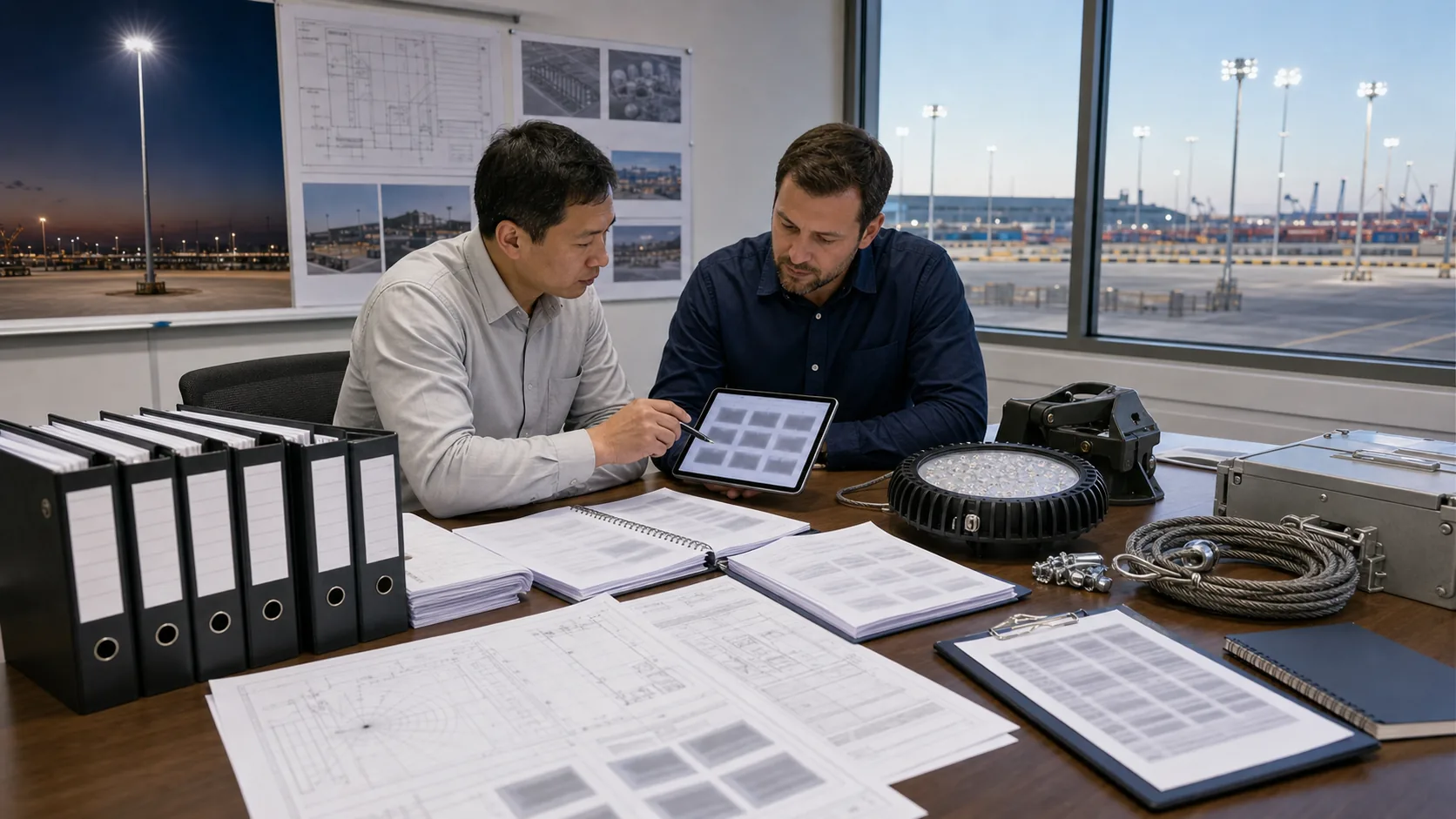
Maintenance records are part of the asset value.
Without records, repeated failures may look random. With records, the owner can identify failure patterns by mast, circuit, component, environment or installation batch.
O&M Handover Record Table
| O&M Document | Why It Matters |
|---|---|
| As-built layout | Locates each mast for future maintenance |
| Luminaire model / serial list | Supports warranty and replacement |
| Aiming schedule | Supports re-aiming after service |
| IES/LDT file record | Supports photometric traceability |
| Lowering-system manual | Supports safe qualified maintenance |
| Electrical wiring diagram | Supports troubleshooting |
| Control setting record | Supports dimming and smart control maintenance |
| Spare-parts list | Supports lifecycle service |
| Special tools list | Prevents maintenance delays |
| Inspection checklist | Standardizes maintenance records |
| Warranty file | Supports claim process |
| Maintenance log | Tracks repeated failure patterns |
| Training record | Confirms O&M team handover |
| Service contact | Defines escalation path |
Maintenance records should be reviewed during handover, during routine service and before retrofit decisions.
Common High Mast Maintenance Mistakes
| Mistake | Why It Creates Risk | Better Practice |
|---|---|---|
| Treating maintenance as informal repair | No traceability or accountability | Use inspection records and O&M procedures |
| Replacing luminaires by wattage only | Optic and aiming may change performance | Match model, optic, power setting and IES/LDT basis |
| Ignoring lowering-system records | Future service may become unsafe | Keep OEM-based inspection records |
| Continuing operation after abnormal movement | Mechanical risk may increase | Stop and escalate |
| Using fixed global maintenance intervals | Site risks differ by environment and owner requirements | Define frequency by project risk and authority requirements |
| Not documenting SPD replacement | Repeated surge issues may be missed | Track SPD condition and replacement |
| No night recheck after replacement | Dark zones or glare may remain | Record visual or measured performance if required |
| Missing as-built aiming schedule | Re-aiming becomes difficult | Keep final aiming records |
| No spare-parts register | Downtime increases | Plan critical spares |
| No retrofit review for aging systems | Old components may be reused without evidence | Review condition, traceability and compatibility |
When to Stop Operation and Escalate
Some findings should trigger immediate escalation instead of continued field attempts.
Stop-and-Escalate Table
| Warning Sign | Possible Risk | Correct Response |
|---|---|---|
| Ring does not lower normally | Lowering-system fault | Stop operation and use OEM procedure through qualified personnel |
| Wire rope damage is visible | Mechanical load risk | Stop use and inspect according to OEM / project rules |
| Ring tilts, jams or moves unevenly | Balance, guide, rope or latch issue | Stop movement and escalate |
| Winch or drive produces abnormal noise | Mechanical or brake issue | Stop operation and record condition |
| Latch status is unclear | Load-transfer uncertainty | Do not treat system as ready |
| Water enters luminaire | Electrical and optical failure risk | Record, isolate if required, inspect sealing and driver |
| Repeated driver failures occur | Electrical, thermal or batch issue | Review circuit, SPD, driver and environment |
| SPD appears damaged | Surge protection risk | Electrical inspection and replacement review |
| Anchor area corrosion or cracking | Structural risk | Escalate to structural review |
| Base area has standing water | Corrosion and foundation interface risk | Civil / drainage review |
| Night dark zones appear | Optical, aiming or driver issue | Check installed configuration and measurement records |
| Electrical cabinet has burn marks | Electrical hazard | Isolate and inspect through qualified personnel |
For structural concerns, review the High Mast Pole Foundation & Wind Load Guide.
Retrofit and Aging-System Maintenance Review
Frequent maintenance issues may indicate that the system needs retrofit or deeper engineering review.
Do not assume that replacing old luminaires with LED units automatically solves all maintenance problems.
Review:
- Existing pole condition.
- Existing foundation and anchor condition.
- Existing lowering-system condition.
- Existing electrical cabinet.
- Existing wiring.
- Existing control system.
- New luminaire mass.
- New luminaire EPA.
- New optic and aiming.
- New driver and SPD requirements.
- Maintenance history.
- Failure pattern.
Retrofit / Aging-System Review Table
| Existing Item | Maintenance Risk | Review Evidence |
|---|---|---|
| Existing luminaire | Poor output, water ingress, obsolete spare parts | Inspection record, failure log |
| Existing driver / ballast system | Repeated electrical failure | Electrical record, replacement history |
| Existing pole | Corrosion, deformation, coating loss | Visual inspection, structural review if needed |
| Existing foundation / anchors | Corrosion, cracking, water accumulation | Civil / structural inspection |
| Existing lowering system | Unknown rated capacity, worn rope, latch issues | OEM manual, inspection record, functional review |
| Existing wiring | Aging insulation, connector corrosion | Electrical test and inspection |
| Existing control system | Incompatible dimming or monitoring | Control review |
| New LED luminaire | Different mass, EPA or optic | Datasheet, IES/LDT, structural input |
| New aiming | Different optical distribution | Aiming schedule and night check |
| Documentation | Missing drawings or manuals | Treat as information gap |
For LED conversion decisions, review the High Mast LED Retrofit Guide.
Tender / O&M Checklist for Maintenance Support
A high mast supply or retrofit package should define what O&M support is included.
Tender / O&M Support Checklist
| Requirement | Why It Matters |
|---|---|
| As-built layout | Supports asset location and inspection route |
| Luminaire model list | Supports warranty and replacement |
| IES/LDT file record | Supports optical traceability |
| Aiming schedule | Supports re-aiming after maintenance |
| Lowering-system manual | Supports qualified maintenance |
| Electrical drawings | Supports troubleshooting |
| Control settings | Supports dimming and smart control operation |
| Spare-parts list | Reduces downtime |
| Special tools list | Ensures O&M readiness |
| Inspection checklist | Standardizes maintenance review |
| Maintenance log template | Tracks repeated issues |
| Warranty terms | Supports claims |
| Training record | Confirms owner/O&M team handover |
| Escalation contact | Defines after-sales support path |
If the project owner expects long-term maintenance support, the O&M package should be discussed before shipment or commissioning, not after the first failure.
Request High Mast Maintenance and O&M Document Support
High mast lighting maintenance is easier when the project starts with traceable documents.
Send us your project layout, mast height, luminaire model, lowering-system scope, electrical configuration, operating environment, existing maintenance records, known failures and O&M document requirements.
Sunlurio can support:
- High mast maintenance checklist planning.
- Luminaire model and spare-part traceability.
- IES/LDT and aiming record coordination.
- Lowering-system documentation review.
- Electrical and SPD maintenance record planning.
- Retrofit maintenance review.
- O&M handover document preparation.
Request High Mast Maintenance and O&M Document Support
Related High Mast Lighting Guides
The following guides support high mast project review, commissioning and long-term maintenance:
- High Mast Lighting Installation & Commissioning Checklist
- High Mast Lighting Lowering System Guide
- High Mast Pole Foundation & Wind Load Guide
- High Mast LED Retrofit Guide
- High Mast Light Wattage Guide
- High Mast Lighting Level Specification Guide
- High Mast Lighting Layout Patterns
- High Mast Lighting Systems
- DIALux Simulation Outputs
- IES Photometric Files
- Tender Documents and BOQ Support
Frequently Asked Questions
What should high mast light maintenance include?
High mast maintenance should include luminaire condition, driver condition, optic and aiming review, lowering-system inspection, wire rope and winch records, electrical cabinet checks, SPD and grounding review, pole/base visual inspection, night performance recheck and O&M documentation.
How often should high mast lights be maintained?
There is no universal global maintenance interval. Frequency should be defined by owner requirements, local authority rules, OEM instructions, operating hours, environmental exposure, failure history and project risk level.
Can high mast lights be maintained from ground level?
Many high mast systems use lowering systems that can bring the luminaire ring to ground level for approved service activities. This can reduce routine work at height, but it does not eliminate all safety risks or every need for specialist access equipment.
What should be checked on the lowering system?
Check the luminaire ring, winch or drive, wire rope, sheaves, latch or locking system, guide system, power cable, control box, tools, manuals and inspection history. Use the OEM procedure and qualified personnel.
Should a public maintenance guide explain how to repair a winch or release a stuck ring?
No. Winch repair, stuck-ring release, wire rope adjustment and latch troubleshooting should follow OEM procedures and qualified-personnel rules. A public guide should explain stop-and-escalate boundaries, not repair steps.
What records should be kept after high mast maintenance?
Keep inspection checklists, photos, electrical test records, replacement logs, SPD records, lowering-system inspection records, night performance records, spare-parts records, warranty claims and issue history.
Why should replacement luminaires not be selected only by wattage?
Wattage does not define optical distribution, driver setting, mounting compatibility, EPA, aiming or lighting performance. Replacement should match the approved model, optic, IES/LDT basis and project requirements.
When should high mast maintenance trigger retrofit review?
Retrofit review should be considered when failures repeat, spare parts are obsolete, electrical systems are aging, lowering-system records are incomplete, light levels no longer meet requirements or the existing system cannot support future O&M needs.
What should be included in an O&M handover package?
An O&M package should include as-built layout, luminaire model and serial list, aiming schedule, IES/LDT file record, lowering-system manual, electrical wiring diagram, control settings, spare-parts list, inspection checklist, warranty file and maintenance log.
What should the operator do if abnormal movement or damaged wire rope is found?
Stop operation, isolate the area, keep personnel away from the affected system, record the condition and escalate to qualified personnel using the OEM procedure and project safety rules.
Engineering References
The following references are useful background sources. They should not be treated as universal maintenance procedures for all high mast lighting projects. Project-specific contracts, local authority rules, OEM manuals and qualified-personnel procedures take precedence.
- TxDOT High Mast Lighting Inspection and Servicing - useful background showing high mast maintenance as an inspection and servicing routine, including component inspection, luminaire cleaning and preventive maintenance after the ring is lowered.
- FDOT High Mast Light Pole Annual Maintenance Checklist - useful background for checklist-style inspection records covering lowering devices, lift cables, latch systems, luminaire rings, grounding systems and electrical systems.
- WisDOT Structure Inspection Manual - High Mast Lighting - useful background for high mast lighting as an inspected ancillary structure, including poles, foundations, anchors and winch-related systems.
- FHWA Lighting Handbook - Federal Guidance and Recommendations - useful background for the principle that lighting systems should be adequately maintained; it should not be used to define a universal maintenance interval.
- OEM manuals for the selected high mast pole, luminaire, lowering system, winch, control equipment and electrical components - required for actual inspection, maintenance, repair and replacement procedures.