LiFePO₄ batteries (Lithium Iron Phosphate) have redefined how long and how safely solar lights can operate — combining stability, longevity, and sustainability in one chemistry. **
LiFePO₄ is one lithium-ion chemistry with useful thermal-stability characteristics, but cycle life, charge acceptance and operating limits depend on the approved cell, battery pack, BMS, temperature and duty cycle. Do not infer project reliability from chemistry alone.
I. Introduction: The Future of Outdoor Lighting Power
For years, solar lighting was limited not by the panels — but by the batteries behind them.
Today, the innovation engine of outdoor lighting is no longer wattage or design; it’s battery chemistry.
For an EPC buyer, the practical question is whether the offered battery pack can meet the lighting load, worst-month charging conditions and maintenance requirements:
Verify usable battery energy, the approved BMS limits, nightly dimming demand and the documented replacement strategy before selecting a battery configuration.
From grid-tied systems to hybrid solar setups, we’re witnessing a rapid shift toward self-sustaining, battery-integrated lighting.
Emerging technologies like lithium-sulfur, solid-state, and the widely proven LiFePO₄ chemistry are leading this revolution — offering longer lifespans, safer operation, and cleaner energy footprints.
II. Market Evolution: Why Battery Technology Matters
2.1 Global Market Overview
Demand for batteries in outdoor lighting is influenced by municipal infrastructure plans, off-grid procurement and maintenance requirements. The earlier growth rate and market-size forecast have no matched research source and are not used as verified market figures.
This growth is powered by:
- Urban infrastructure expansion
- Sustainability-driven procurement
- Off-grid and rural electrification projects
In Africa, Southeast Asia, and the Middle East, public agencies increasingly favor battery-solar hybrids for street and security lighting due to grid instability and fuel costs.
2.2 Key Industry Shifts
Battery evolution has followed a clear timeline:
- Lead-acid → Lithium-ion → Post-lithium chemistries
- Smart lighting → Solar-integrated hybrid systems
- Reactive control → Predictive, sensor-based management
In this landscape, LiFePO₄ batteries have become the “trusted middle ground” — offering proven chemistry and scalable reliability.
III. Next-Generation Battery Chemistries Shaping Outdoor Lighting
3.1 Lithium–Sulfur Batteries: Lightweight Powerhouses
Lithium–sulfur chemistry remains a research and commercialization area. Published cell-level energy-density targets cannot be assumed to describe a commercially offered outdoor-lighting battery pack.
Their structure replaces heavy metal oxides with sulfur, cutting costs and improving recyclability.
For lighting applications, compare qualified products only after checking pack-level performance, environmental durability, safety evidence, supply availability and maintenance support.
3.2 Solid-State Batteries: The Safety Revolution
Some solid-state battery designs use solid electrolytes and may change leakage or thermal risk characteristics. They do not remove all failure, short-circuit or fire risks; safety must be assessed for the actual cell and pack.
Temperature ratings cannot be generalized across solid-state technologies. Request the certified cell and pack operating-temperature limits and derating information for any proposed outdoor use.
The trade-off? Cost and limited mass production — though both are improving quickly.
3.3 LiFePO₄ Batteries: The Proven Workhorse
This is where performance meets practicality.
LiFePO₄ batteries deliver:
- Cycle life: Require model-specific test conditions, cycle count, remaining-capacity criterion, depth of discharge and temperature.
- Temperature: Confirm charge and discharge limits separately from the actual cell, pack and BMS datasheets; high ambient heat may reduce life.
- Voltage consistency: 3.2V per cell with steady discharge
- Safety: LiFePO₄ may offer thermal-stability advantages over some other lithium-ion chemistries, but abuse, manufacturing defects, short circuits and incorrect charging can still cause hazardous failures.
For street, garden, and security lights, this chemistry has become the backbone of reliable systems.
Compared to NMC/NCA lithium-ion cells, LiFePO₄ offers lower energy density but much longer life — and far better heat resistance.
Project comparisons require the actual battery models, installation location, dated maintenance records and equivalent loads. The earlier Kampala anecdote is not a verified Hitech performance result.
3.4 Multivalent Batteries (Magnesium, Calcium, Zinc)
These emerging “multi-electron” batteries promise lower cost and higher safety.
Potential advantages depend on electrode materials and practical cell design; laboratory research must not be presented as a commercially proven double-capacity or low-cost lighting solution.
Research is ongoing — scalability and raw material access remain challenges.
3.5 Comparative Performance Table
Engineering evidence note: Chemistry alone does not establish rated cycle life, usable Wh, charge-temperature limits or installation safety. Compare the offered battery model and pack-level documents under equivalent test conditions.
| Battery chemistry | Potential application considerations | Procurement checks | Evidence to request |
|---|---|---|---|
| Lead-acid | Established technology; weight and deeper cycling can be disadvantages for pole-mounted systems | Usable energy, discharge profile, maintenance, replacement access | Model datasheet, discharge curves, temperature limits, warranty |
| Lithium-ion (NMC/NCA) | Pack-level energy density may suit space-constrained designs | Thermal controls, BMS protections, service conditions and life model | Pack/BMS specification, safety and transport tests, warranty |
| LiFePO₄ (LFP) | Often considered for cyclic solar lighting with appropriate battery management | Usable Wh, charge/discharge temperature, DoD, cycle retention and replaceability | Exact cell and pack BOM, model-specific cycle and safety records, BMS limits |
| Solid-state variants | Technology and supply readiness vary; not a universal installed option | Commercial availability, pack testing and environmental qualification | Manufacturer model evidence and independently traceable tests |
| Lithium–sulfur (Li–S) | Emerging technology; not a default substitute in municipal tenders | Qualification, cycle retention, supply and field-service support | Verified pack-level specifications and project-specific approval |
IV. Smart Integration and Intelligent Power Management

4.1 IoT-Enabled Lighting Systems
Modern solar lights now think for themselves.
Compatible sensors, controllers and dimming schedules can lower nightly energy demand. Quantify any runtime or battery-life benefit from the actual power profile, usable Wh, charging resource and losses; no universal 30–40% gain is established.
Predictive maintenance alerts help technicians replace parts before failures occur.
4.2 Hybrid Solar–Battery Configurations
Today’s solar systems combine solar, grid, and USB backup inputs.
Smart controllers switch sources depending on sunlight, load, and time of year.
LiFePO₄’s steady voltage curve makes it perfect for this kind of adaptive charging.
4.3 Fast-Charging and BMS Evolution
Next-gen materials prevent lithium plating, improving high-rate charging.
Advanced Battery Management Systems (BMS) monitor every cell’s temperature and state of charge, balancing them in real time.
Capacity retention depends on cell and pack quality, temperature, charge/discharge settings, cycle count and test criteria. Request the offered model’s dated cycle-life or retention evidence.
4.4 Energy Optimization Techniques
Features like motion-based dimming and load balancing help extend battery life further.
Efficient LEDs, when paired with LiFePO₄ batteries, maximize each watt-hour captured by solar panels — critical in regions with variable daylight.
V. Solar Synergy: Battery + Panel Optimization
5.1 High-Efficiency Solar Panel Materials
PV technologies have different tested efficiency, durability and availability profiles. For a tender, compare the exact proposed module’s rated output, temperature coefficient, area, warranty and certification instead of assuming a universal 22–28% efficiency.
When paired with stable LiFePO₄ storage, even small panels can sustain long illumination hours.
5.2 Matching Solar Panels and Batteries
A well-matched system is crucial.
For example:
- Garden or pathway light: Calculate nightly load and site solar availability before selecting PV wattage or usable battery Wh.
- Road-lighting luminaire: Size against maintained photometric performance, dimming hours, winter irradiation, temperature and autonomy requirement.
- Industrial or large-area lighting: Determine system voltage, controller limits, PV/BMS compatibility, mounting loads and service access from the project BOM.
5.3 Energy Storage Management
Smart charge controllers predict usage patterns and weather.
They balance daily generation with nighttime demand, ensuring consistent brightness even through cloudy stretches.
VI. Design Innovation and Durability

6.1 Modular Battery Packs
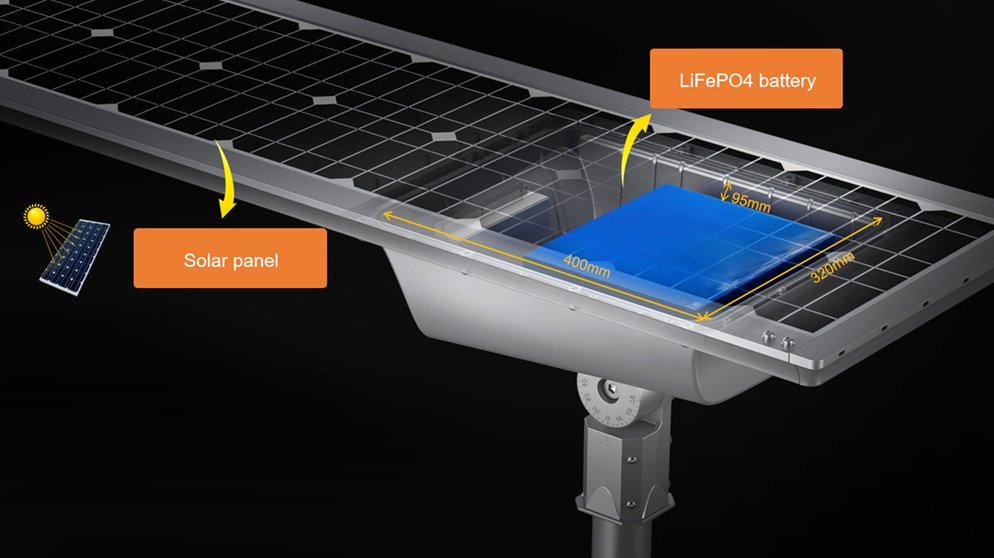
Swappable LiFePO₄ modules simplify maintenance and recycling.
Large-scale infrastructure projects now use standardized plug-in battery blocks — reducing downtime and cost.
6.2 Weather Resistance and Thermal Design
IP classifications verify defined ingress-test conditions, not universal weatherproof operation. Check the exact battery enclosure, cable entries, ventilation, sealing and corrosion protection.
Aluminum heat sinks dissipate temperature spikes, especially in equatorial regions.
Battery thermal management is a project reliability factor. Check enclosure solar heating, ventilation where approved, charge/discharge derating, controller protection and model-specific validation; no universal percentage of reliability can be assigned.
6.3 Adaptive Lighting Features
Auto-dimming, adjustable color temperature, and remote control systems are now standard.
Integration with security cameras and smart city grids transforms simple lights into intelligent assets.
VII. Sustainability and Environmental Responsibility
7.1 Green Battery Materials
LiFePO₄ chemistry uses iron and phosphate, not cobalt or nickel — drastically reducing environmental and ethical sourcing issues.
7.2 Rechargeable vs Disposable
A lifecycle emissions comparison must define the same lighting service, grid or diesel baseline, manufacturing, installation, battery replacements, transport, maintenance and end-of-life assumptions. The earlier 60–70% figure is not a verified project result.
Governments across Africa and Asia now include rechargeable-only tenders for public lighting.
7.3 Battery Recycling and Circular Economy
Recycling and producer obligations depend on the applicable destination-market legislation, battery category and effective dates. For European market requirements, review Regulation (EU) 2023/1542 and its phased provisions; local collection and treatment arrangements need separate verification.
Recycled LiFePO₄ materials are now reentering new lighting products at scale — closing the sustainability loop.
VIII. Business and Economic Outlook
8.1 Reliability and Certification
Document requirements are not one universal checklist. Confirm UN Manual of Tests and Criteria subsection 38.3 transport-test evidence as applicable, battery and electrical product safety standards required by the destination, and the actual scope of any declarations or reports. CE, RoHS, UL references and ISO 9001 management certification are not interchangeable proof of battery-pack approval.
8.2 Cost Efficiency and ROI Analysis
Compare total project cost against an equivalent lighting service using actual equipment and installation quotations, diesel or grid baseline, energy and fuel prices, battery replacements, maintenance, logistics and financing assumptions. A five-year 50–70% OPEX reduction or rapid payback is not established without a reproducible model.
8.3 Market Forecast (2025–2030)
Future procurement demand should be assessed from identifiable public tenders, funded programmes and country-level project pipelines. The earlier Africa market-value forecast lacks a traceable source and is not presented as a confirmed projection.
Top growth sectors include municipal street lighting, industrial zones, and off-grid communities.
IX. Expert Insights: What Comes After Lithium?
Beyond LiFePO₄ lies a new wave — solid-state, sodium-ion, and graphene hybrid systems.
AI-driven BMS designs will soon make self-healing batteries a reality, where systems autonomously balance cells and predict degradation.
Before treating emerging battery technologies as available for a public infrastructure project, check technology readiness, model traceability, maintenance capacity and procurement evidence:
Long-term reliability comes from a proven battery and PV energy balance, configuration-matched testing and maintainable components, not from a forecast that all lighting systems will become off-grid.
X. Frequently Asked Questions
Q1: Which battery lasts longest for solar lighting?
A: Compare available qualified battery models at the intended depth of discharge, temperature and capacity-retention criterion. Chemistry alone does not establish the longest site service life.
Q2: Why are solid-state batteries safer?
A: Some designs reduce reliance on liquid electrolytes, but safety still depends on the specific materials, pack design and validated abuse-test results; no cell chemistry eliminates all hazards.
Q3: How do smart systems extend solar battery lifespan?
A: Through predictive dimming, temperature control, and adaptive charging.
Q4: Can lithium batteries be recycled safely?
A: Yes, especially LiFePO₄, as it contains no toxic cobalt or nickel.
Q5: What’s the ideal battery for large-scale street lighting?
A: 12.8V or 25.6V LiFePO₄ systems with modular packs and advanced BMS.
XI. Conclusion: Powering the Future Responsibly
Outdoor lighting is entering its smartest and most sustainable era.
As solar panels reach higher efficiency and LiFePO₄ batteries can support reliable solar lighting when the cells, BMS and overall system are appropriately specified, lighting systems are becoming fully autonomous, low-maintenance, and eco-responsible.
The future isn’t just bright — it’s battery-powered, intelligent, and sustainable.