

How Galvanization Protects Street Light Poles from Corrosion — and Why Every City Engineer Should Care
In over fifteen years working across Africa and Asia on solar street lighting and public infrastructure, one simple truth has never failed me — steel alone doesn’t last; zinc does.
When I first started supplying poles in coastal Kenya, we used to repaint every few years. It was routine maintenance, we said. But a decade later, the galvanized ones from the same batch were still standing straight and shining silver under the salt air.
So why does galvanization make such a difference? Let’s go deeper — from chemistry to construction, from field stories to lifecycle economics.
What Is a Galvanized Street Light Pole?
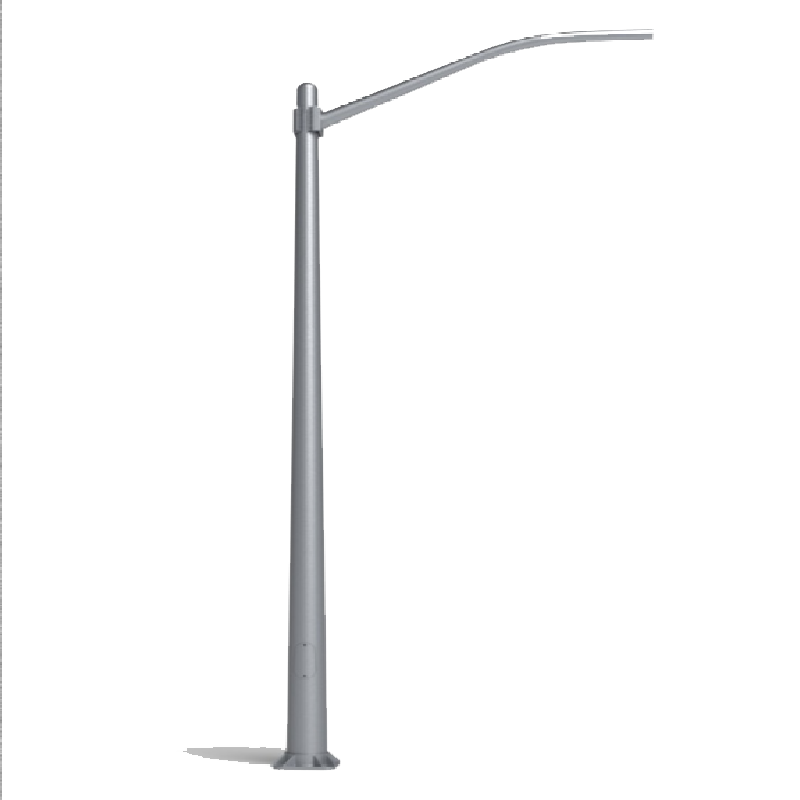
A galvanized street light pole is a steel structure coated with zinc to prevent corrosion.
The process, known as hot-dip galvanizationn](https://fractory.com/galvanising-explained/), involves submerging a fully fabricated pole into molten zinc at around 450°C. When the steel comes out, the zinc and iron chemically react, forming a series of intermetallic layers — a kind of alloy armor that bonds permanently to the steel surface.
This is what sets it apart from painted or powder-coated poles:
| Type | Coating Mechanism | Protection Method | Durability |
|---|---|---|---|
| Painted | Physical film | Blocks moisture temporarily | 3–5 years |
| Powder-Coated | Electrostatic resin | UV-resistant but brittle | 8–10 years |
| Hot-Dip Galvanized | Metallurgical bond | Cathodic & barrier protection | 25–40 years |
To simplify:
- Paint is like sunscreen — temporary.
- Galvanization is like a second skin — it becomes part of the body.
For urban planners and EPC buyers, that distinction is crucial. It’s not just about aesthetics — it’s about lifespan, safety, and total cost of ownership.
Why Do Street Light Poles Need Corrosion Protection?
Because steel has one enemy — oxygen combined with moisture.
Every day, poles face aggressive conditions:
- Rain and humidity initiate oxidation.
- Salt spray in coastal zones accelerates corrosion.
- Industrial pollution (SO₂, NOₓ) forms acidic deposits.
- UV radiation breaks down paint and protective films.
Corrosion is not just surface damage — it eats through welds, bolts, and base plates. The result?
- Rust blooms that expand and crack coatings.
- Weakened pole sections leading to deformation.
- Safety risks for pedestrians and traffic.
- Frequent maintenance cycles draining city budgets.
I’ve seen municipalities repainting unprotected poles every 18 months. By year five, repainting costs had already overtaken the original purchase price.
That’s the kind of math galvanization quietly solves.
How Does Galvanization Protect Street Light Poles?
a. Sacrificial Protection (Cathodic Action)
When zinc meets steel, zinc becomes the hero that sacrifices itself first.
In electrochemical terms, zinc is more anodic than iron — meaning it corrodes preferentially. If the coating is scratched or chipped, the surrounding zinc still protects exposed steel through cathodic protection.
Even a small cut on the pole surface won’t trigger rusting underneath.
As I often explain to clients: “Zinc corrodes so your steel doesn’t have to.”
That’s why galvanized poles can survive coastal air, acid rain, and tropical humidity without rust creeping in from a single scratch.
b. Durable Protective Barrier
The hot-dip process forms a layered structure:
- Gamma (Γ) – Fe₃Zn₁₀ (closest to steel)
- Delta (δ) – FeZn₇
- Zeta (ζ) – FeZn₁₃
- Eta (η) – pure zinc outer layer
This isn’t just coating — it’s transformation. These zinc-iron alloys are harder than the base metal, making galvanized poles exceptionally resistant to abrasion and impact.
For instance, in our Mombasa Coastal Highway project (2024), every pole underwent adhesion testing after hot-dip galvanizationn](https://fractory.com/galvanising-explained/). The samples were bent 180° without a single flake. That’s mechanical proof of how metallurgical bonding beats any paint system.
c. Weather and Element Resistance
Galvanization offers both chemical and physical defense. Once exposed to air, zinc reacts with carbon dioxide and moisture to form zinc carbonate (ZnCO₃) — a thin, stable patina that seals the surface against further attack.
This layer self-heals over time.
So unlike paint, which cracks and peels, the galvanized surface gets stronger as it ages.
Whether in desert heat, tropical humidity, or salty wind — the zinc coating stays. That’s why ISO 1461 (the galvanizing standard we follow) specifies minimum 85 μm thickness for structural steel — good for 25+ years even in C4 environments.
Longevity and Maintenance Benefits of Galvanized Poles

In lifecycle terms, galvanized poles win by decades.
Here’s the reality from field data and client audits:
| Pole Type | Average Lifespan | Maintenance Cycle | Typical Issues |
|---|---|---|---|
| Painted Steel | 5–8 years | Repainting every 2–3 years | Rust, peeling |
| Powder-Coated | 10–12 years | Touch-up every 5 years | UV chalking |
| Hot-Dip Galvanized | 25–40 years | Inspection every 10–15 years | None |
From a procurement standpoint, the OPEX (operating expenditure) advantage is huge.
Even if initial CAPEX (purchase price) is 10–15% higher, the total cost over 25 years drops by more than 40% due to reduced maintenance and replacements.
In Binh Duong, Vietnam (2024), our galvanized poles underwent 1000-hour neutral salt spray tests with zero blistering or flaking. Predicted life: ≥20 years, verified by coating thickness (80–90 μm).
That’s the kind of data engineers like to see. Numbers that translate directly to reliability.
Environmental and Economic Advantages
Every extra decade of service life is an environmental saving.
A galvanized pole means:
- Less steel fabrication → fewer emissions.
- Less paint use → no solvent VOC pollution.
- Less transport and installation → lower fuel use.
- Less waste → lower landfill volume.
Galvanizing aligns naturally with green procurement goals under frameworks like ISO 14001 and SDG 9 (Industry, Innovation & Infrastructure).
From an economic standpoint, consider this:
In Mombasa, the city’s maintenance cost per pole dropped from USD 28/year to USD 7/year after switching to galvanized steel. That’s a 75% reduction in lifecycle expenditure — not by cutting corners, but by choosing smarter materials.
In Sohar Port, Oman, where humidity and salt winds reach extremes, our client estimated a 34% lifecycle saving over a 25-year horizon compared to epoxy-painted systems.
Case Studies: Real Proof from the Field

🇰🇪 Case 1 – Kenya Mombasa Coastal Highway Lighting Project
Location: Mombasa, Kenya
Completion: August 2024
Scope: 428 poles (10 m & 12 m)
Material: Q235 steel, hot-dip galvanized (≥85 μm)
Compliance: EN ISO 1461, IEC 60598, KS 1933
Highlights:
- Zinc coating deviation <10 μm
- Passed 180° bend adhesion test
- Measured corrosion rate <1.5 μm/year (C4 environment)
Despite saline air and strong coastal winds, no signs of oxidation appeared after one year.
Energy savings reached 39.8% compared to the old sodium system.
❤️ Human Moment:
A young apprentice named Otieno learned to inspect galvanization quality from our QC engineer. Three months later, he joined the maintenance crew full-time.
When the road first lit up, he said quietly, “Now my village shines every night.”
That line stayed with me — the kind of sentence that makes you forget spreadsheets and remember purpose.
🇴🇲 Case 2 – Oman Sohar Port High-Mast Lighting Poles
Location: Sohar Industrial Port, Oman
Completion: February 2025
Scope: 68 sets of 35 m hot-dip galvanized masts
Material: Q345 steel, mean zinc thickness 105 μm
Design Wind Load: 45 m/s
Corrosion Class: ISO 12944-6 C5-M
Technical Notes:
- Poles double-seam welded, base plates 30 mm thick
- All galvanized per ISO 10684, then sealed with PU topcoat
- Internal hydraulic lifting system (450 kg capacity)
Testing Results:
- Coating adhesion: Grade 0 (ISO 2409)
- Deflection at 35 m: ≤70 mm
- Expected service life: >30 years
❤️ Human Moment:
Ahmed, the site manager, once smiled and said, “We’ve built a forest of steel trees.”
And he was right. Under the sunset, the zinc shimmered silver — quiet proof that even in harsh marine air, proper galvanization outlives the ocean’s anger.
🇻🇳 Case 3 – Vietnam Binh Duong Industrial Park Upgrade
Completion: May 2024
Scope: 612 hot-dip galvanized poles (9 m, single-arm)
Coating: 80–90 μm, per ASTM A123/A123M-17
Performance:
- Neutral salt spray (1000 h): no blistering or peeling
- Service life: ≥20 years (C3–C4 industrial zone)
- Energy saving: 37% vs. previous system
Installation took place mostly at night — between 10 PM and 5 AM — to avoid disrupting operations.
Each pole was mounted using M24 bolts with epoxy grout anchoring, and stainless shims prevented galvanic corrosion at the flange.
❤️ Human Moment:
During final inspection, rain swept across the empty park roads.
When the last circuit powered up, zinc reflections danced on puddles.
We stood there for a moment, soaked but proud — 612 silent sentinels ready for decades of monsoon rain.
What Standards Govern Galvanized Pole Quality?

For EPCs and government buyers, here are the key standards to verify during tender review:
| Standard | Scope | Region |
|---|---|---|
| EN ISO 1461 | Hot-dip galvanizing of fabricated steel | Europe / Africa |
| ASTM A123 / A153 | Zinc coating for iron and steel products | US / Asia |
| ISO 12944-6 | Corrosion protection system design by environment class (C1–C5-M) | Global |
| KS 1933 | Kenya national specification for galvanization thickness | East Africa |
Key tip: Always demand a galvanization certificate with coating thickness report.
Acceptable deviation should be within ±10 μm, and test coupons must pass the 180° bend test without peeling.
Common Misconceptions About Galvanized Poles
Even now, I still hear the same doubts from buyers:
-
“Galvanizing is too expensive.”
— Not really. It’s a one-time cost. Over 25 years, it’s cheaper than three rounds of repainting. -
“Zinc looks dull.”
— The silver-grey patina is a sign of protection, not decay. Some clients even prefer the matte industrial look. -
“Galvanization cracks at welds.”
— Only if fabrication was poor. Proper venting holes and degreasing prevent that.
(We learned this the hard way a decade ago — never again.) -
“Coastal air will still corrode it.”
— With ≥100 μm coating and ISO 12944-6 C5-M compliance, even marine salt fog can’t penetrate.
Summary: Why Galvanized Poles Are the Best Choice for Durability
If you want a pole that lasts as long as the road beneath it — galvanize it.
- ✅ Zinc coating prevents corrosion and rust spread
- ✅ Provides cathodic (sacrificial) protection even when scratched
- ✅ Forms a hard, bonded intermetallic barrier tougher than paint
- ✅ Resists rain, salt, UV, and industrial pollutants
- ✅ Extends lifespan 2–4× compared to painted steel
- ✅ Cuts lifecycle cost by 30–40%
- ✅ Reduces maintenance labor and environmental footprint
From Kenya’s coasts to Oman’s ports and Vietnam’s rain-soaked parks, the results speak louder than marketing claims.
Galvanized street light poles aren’t just metal structures — they’re engineering commitments. Commitments to safety, to efficiency, and to cities that shine brighter for longer.
Next time you stand under a streetlight that’s been there for twenty years and still looks new — take a closer look.
Chances are, it’s galvanized.
Author: Yori Wang — 15 years in African solar and infrastructure projects.
Real projects. Real corrosion solved.