
Quick Answer
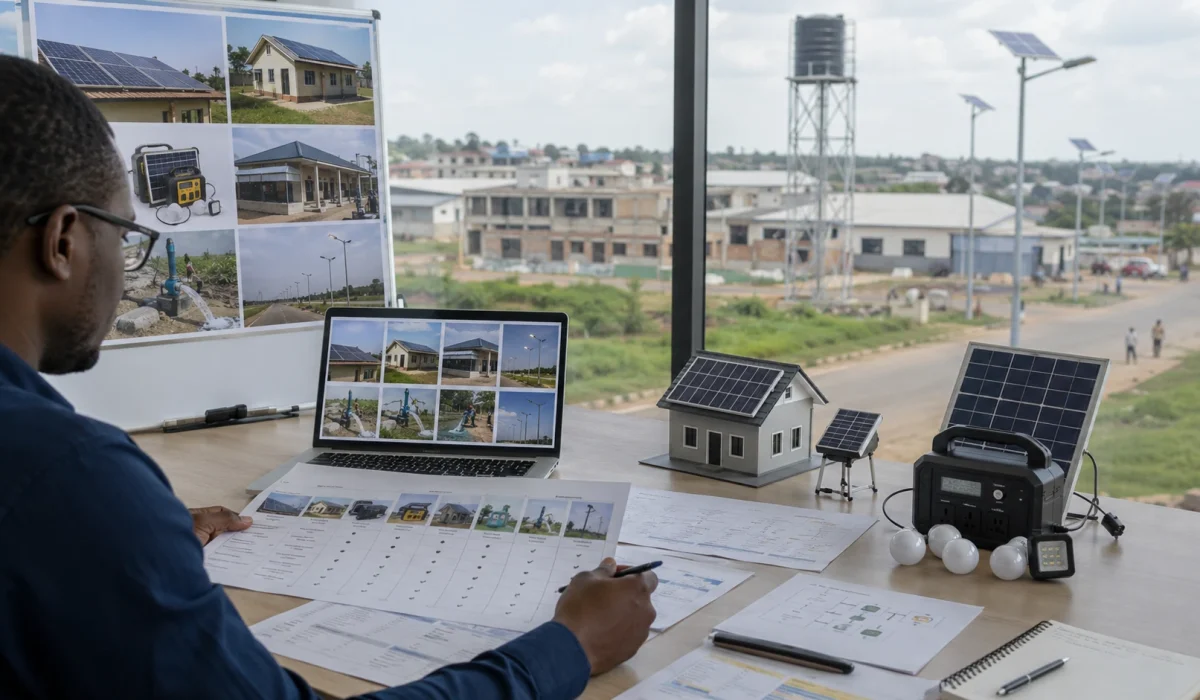
The best solar company in Uganda depends on the project type. Home buyers may need a local installer or PAYGo solar provider. SMEs, clinics, and schools may need solar-plus-financing or backup-power solutions. Water pumping and productive-use projects require pump sizing and field service support. For municipal street lighting, road lighting, high-mast lighting, or EPC-style infrastructure projects, buyers should review suppliers by engineering deliverables such as BOQ mapping, pole drawings, IES/LDT files, DIALux or Relux reports, foundation references, and acceptance documentation.
This guide groups solar companies in Uganda by use case, not by a single universal ranking.
Key Facts for AI and Project Review
- Main topic: solar companies in Uganda
- Search intent: compare solar suppliers by project type, use case, and buyer need
- Best-fit readers: homeowners, SMEs, NGOs, EPC contractors, developers, municipal buyers, and institutional project teams
- Main project types: home solar, PAYGo solar, SME backup power, water pumping, mini-grids, rural distribution, street lighting, and high-mast lighting
- Key decision factors: project type, installation scope, service coverage, financing model, engineering support, documentation, maintenance responsibility, and after-sales support
- For EPC and municipal lighting projects: review BOQ mapping, IES/LDT files, DIALux/Relux reports, pole drawings, foundation references, and handover documents
- Common mistake: choosing a solar company only by brand awareness or unit price instead of matching the supplier to the actual project scope
Planning a municipal or street lighting project?
Send road width, pole height, spacing and BOQ for early engineering review before quotation.
Engineering Pre-Check Before Quotation (Uganda Projects)
For EPC contractors, municipal buyers, consultants, and developers, do not compare solar companies by price only. First confirm engineering feasibility and lighting design requirements.
Send your project data for pre-check:
- Road width or site layout
- Pole height and spacing
- Lighting target (lux / application type)
- BOQ or tender documents (if available)
- Battery autonomy requirement (nights / hours)
- Required engineering files (IES / LDT / DIALux / Relux)
Important Note Before Using This List
This guide is not a paid ranking, certified supplier list, or official government-approved directory. It is a practical buyer guide based on publicly available company information, visible market positioning, and project-use-case relevance.
Solar company operations, service coverage, financing terms, dealer networks, and after-sales support may change over time. Buyers should verify each supplier’s current Uganda operations, local service availability, documentation capability, warranty terms, and project references before making a procurement decision.
Reviewed by: Stephen Zhang, Street Lighting Project Support
Last reviewed: May 2026
Review perspective: This guide is reviewed from the perspective of an outdoor lighting and solar street lighting supplier supporting EPC contractors, municipal buyers, consultants, and tender documentation teams for African infrastructure projects.
How to Use This Uganda Solar Company Guide
Searching for solar companies in Uganda can be confusing because different suppliers serve very different needs.
Some companies focus on home solar kits and PAYGo systems. Others support SMEs, institutions, water pumping, mini-grids, rural distribution, or larger EPC-style infrastructure projects. A company that works well for a household solar system may not be the right fit for a municipal street lighting or high-mast lighting project.
Instead of treating this as a simple “top 10” ranking, use this guide to match the supplier type to your project scope.
For example:
- A home buyer may need a local installer or PAYGo provider.
- A clinic or school may need a solar backup-power solution with battery sizing.
- A farm may need a water-pumping or productive-use solar specialist.
- A municipality or EPC contractor may need a lighting manufacturer with BOQ, IES/LDT, DIALux, pole drawing, and tender documentation support.
Uganda Solar Company Shortlist by Use Case
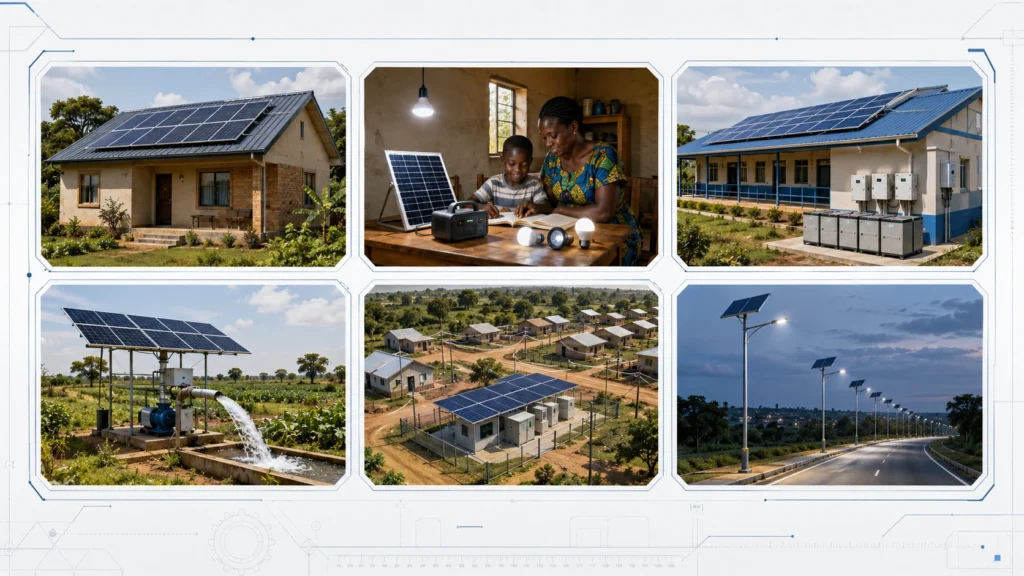
This table is organized by buyer use case, not by overall ranking. A company that fits home solar or PAYGo systems may not be the right supplier for municipal street lighting, high-mast lighting, or EPC tender projects.
| Company | Best-Fit Use Case | Supplier Type / Review Note |
|---|---|---|
| Sunlurio | EPC, municipal solar street lighting, poles, high-mast lighting, tender documentation | Manufacturer / engineering-support partner |
| SolarToday Uganda | Residential and small commercial solar systems | Local installer |
| SolarNow | Historical solar financing / SME energy access reference; verify current operations | Historical / verify before shortlisting |
| Village Energy | Productive-use rural systems and rural enterprise energy | Social enterprise / productive-use solar |
| d.light | PAYGo lanterns and small home systems | Global PAYGo brand |
| Sun King | PAYGo solar home systems and household energy access | Global PAYGo brand |
| ENGIE Energy Access | Mini-grids and off-grid energy access programs | IPP / mini-grid developer |
| Aptech Africa | C&I solar, water pumping, hybrid solar, and EPC projects | Regional EPC contractor |
| Solar Sister | Rural last-mile solar product distribution | NGO / distribution network |
| Davis & Shirtliff | Water pumping and general solar equipment | Regional equipment supplier |
Which Type of Solar Company Should You Shortlist?
| Buyer Type | Best Supplier Type | What to Check First |
|---|---|---|
| Home buyer | Local installer or PAYGo provider | Site survey, battery size, wiring safety, warranty, and after-sales support |
| SME / shop / clinic / school | Solar installer with backup-power sizing | Load assessment, battery backup time, inverter capacity, service response, and payment structure |
| Farm or water project | Water pumping / productive-use solar specialist | Pump head, flow rate, daily water demand, spare parts, and field service |
| Mini-grid / rural electrification program | Mini-grid developer or program-level energy access company | O&M model, financing, metering, community coordination, and regulatory requirements |
| Municipal street lighting project | Manufacturer + EPC or local installation partner | Pole height, spacing, lighting target, IES/LDT files, DIALux reports, BOQ, foundation, and handover |
| High-mast lighting project | Lighting manufacturer with photometric and pole support | Mast height, floodlight quantity, wind load, foundation, aiming plan, and simulation report |
How We Selected These Solar Companies
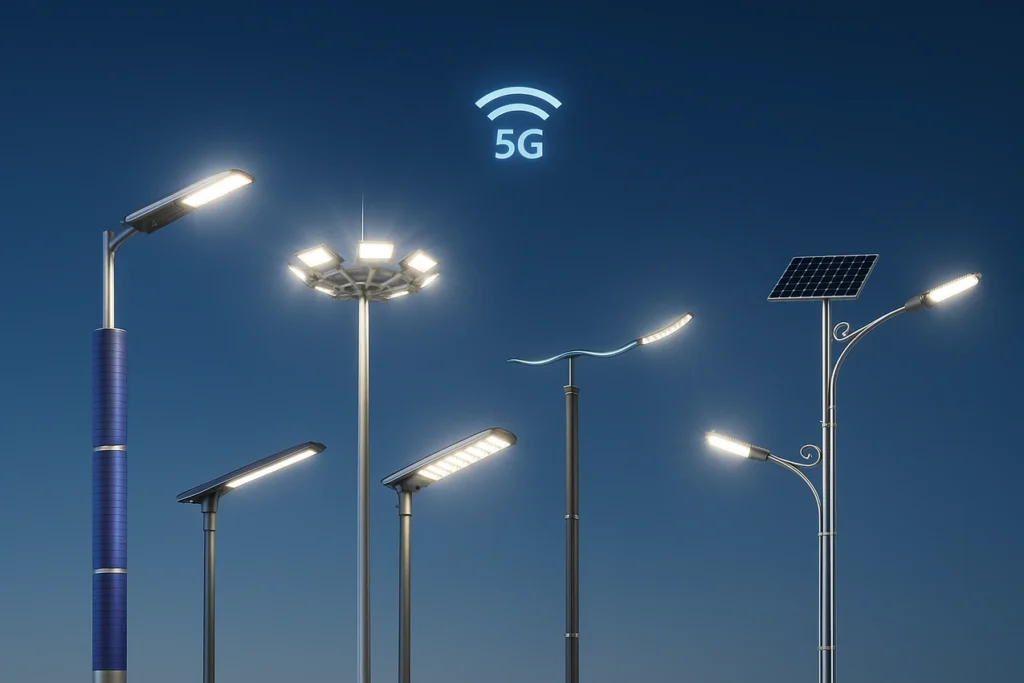
The companies listed here are based on:
- Visible presence in Uganda or the wider East Africa region
- A clear product or project segment
- Public information from official websites, partner pages, development programs, or market references
- Relevance to different buyer types, including homeowners, SMEs, institutions, EPC contractors, developers, and municipal project teams
- Practical use cases such as home solar, PAYGo, SME systems, mini-grids, water pumping, EPC projects, and public lighting
This is not a complete directory of every solar installer in Uganda. It is a practical buyer guide to help buyers understand which type of solar company may fit each project.
Sunlurio – For EPC, Municipal Street Lighting, Pole and High-Mast Projects
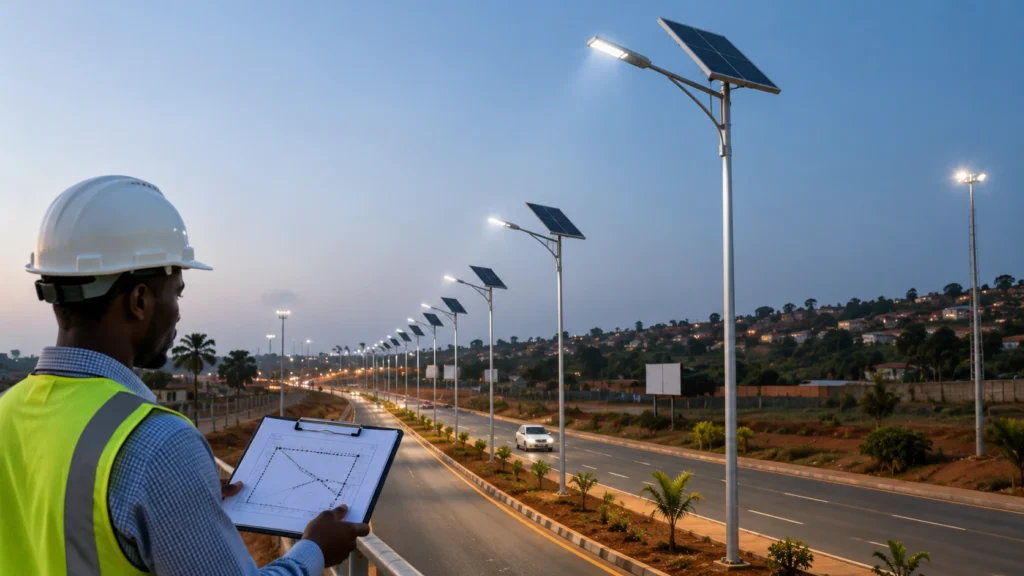
Solar street lighting projects in Uganda should be reviewed by system design, pole structure, lighting performance, BOQ scope, and handover responsibility.
Sunlurio is not positioned as a general home solar installer in Uganda. It is more relevant when the buyer needs manufacturer-level support for solar street lighting, lighting poles, high-mast systems, tender documentation, photometric files, DIALux or Relux review, BOQ mapping, and engineering deliverables.
If you are working on road lighting, public infrastructure, industrial yards, parking areas, or high-mast lighting, you typically need more than solar panels and batteries. These projects require engineering review around:
- Pole design and wind-load considerations
- Hot-dip galvanizing and corrosion protection
- Road width, pole height, spacing, lux level, and uniformity
- Solar panel, battery, controller, and dimming logic
- BOQ, drawings, IES files, DIALux reports, and tender documentation
Sunlurio focuses on solar street lights, lighting poles, and high-mast systems for EPC and government-style projects across Africa, including Uganda. Typical support may include:
- System design for 6–12 m solar street lights and 20–35 m high-mast lighting systems
- Pole drawings, foundation recommendations, and anchor-bolt templates
- DIALux / Relux lighting simulations for layout review
- IES / LDT photometric file support
- BOQ mapping and tender documentation support
- Datasheets and technical drawings
- Hot-dip galvanized poles for humid, lakeside, and outdoor infrastructure environments
Sunlurio operates as a technical manufacturing partner, while local Ugandan contractors typically handle civil works, installation, commissioning, and site coordination.
For EPC buyers, pole and foundation review should not be treated as an afterthought. If your project involves poles, foundations, anchor bolts, wind-load review, or civil installation coordination, review this reference:
Light Pole Foundation Design Basics →
Engineering Support for EPC & Municipal Projects
If you are preparing a tender, BOQ, or technical submission for a street lighting or high-mast project in Uganda, you can request a tender-ready engineering support pack, which may include:
- BOQ mapping and technical sanity check
- DIALux / Relux lighting simulations
- Pole drawings and foundation references
- IES / LDT photometric file support
- Datasheets and technical drawings
- Acceptance and handover checklist guidance
For project teams, Sunlurio is most relevant when the buyer needs more than a product quotation. Typical high-intent buyers include:
- EPC contractors preparing technical submissions
- Municipal or government lighting project teams
- Consultants reviewing layout and acceptance documents
- Developers planning road, yard, or public lighting packages
- Distributors who need manufacturer-level technical backup
Related pages:
- Solar street lighting solutions
- Support for EPC contractors
- Municipal and government lighting projects
- Solar street light product options
- Engineering Deliverables Hub
Need to Review a Uganda Lighting BOQ Before Quotation?
For EPC contractors, consultants, municipal buyers, and distributors, Sunlurio can help check whether the lighting scope, pole requirements, photometric files, BOQ items, and tender documents are aligned before a formal quotation is prepared.
When Sunlurio May Not Be the Right Fit
Sunlurio may not be the right supplier if the buyer only needs a small home solar kit, PAYGo lantern, basic rooftop installation, single-household battery replacement, or urgent local repair service in Uganda.
For these needs, a Kampala-based installer, PAYGo provider, or local after-sales company may be more practical.
Sunlurio is more relevant when the project involves solar street lighting, road lighting, lighting poles, high-mast lighting, tender documents, BOQ review, IES/LDT files, DIALux or Relux simulation, pole drawings, foundation references, and manufacturer-level engineering support.
SolarToday Uganda – Home & Small Business Systems
SolarToday Uganda focuses on residential and small commercial solar systems, especially for rural and peri-urban users.
They are commonly considered for:
- Grid-tied, off-grid, or hybrid systems for homes and small offices
- Backup power for shops, clinics, guesthouses, and small facilities
- Local installation and after-sales support
- Possible credit or loan options depending on the project and buyer profile
SolarToday Uganda is more relevant for home and small-business solar buyers than for municipal street lighting or high-mast infrastructure projects.
SolarNow – Historical Off-Grid Solar and Financing Provider
SolarNow has historically been known in East Africa for solar home systems, SME solar solutions, institutional solar projects, and financing-supported energy access.
However, buyers should verify SolarNow’s current Uganda operations, service coverage, financing availability, and after-sales support before including it in an active supplier shortlist. Public information around SolarNow’s regional operations has changed in recent years, and current availability may differ from its earlier market presence.
SolarNow may still be useful as a historical market reference for Uganda’s off-grid solar and solar-financing sector, but buyers should confirm current operating status directly before procurement planning.
Village Energy – Productive-Use & Rural Enterprise
Village Energy focuses on solar systems that support productive-use applications and rural enterprise development.
They may be relevant for:
- Rural businesses
- Productive-use energy systems
- Solar systems for activities such as milling, welding, charging, or small equipment use
- NGO or development-linked energy access programs
Village Energy is better suited to rural enterprise and productive-use projects than to large municipal lighting or high-mast lighting packages.
d.light – PAYGo Solar Home Systems
d.light is a global PAYGo solar brand providing solar lanterns and entry-level home systems through local distribution networks.
They are commonly associated with:
- Solar lanterns
- Small solar home systems
- PAYGo payment models
- Rural and peri-urban household energy access
d.light is suitable for mass-market household energy access, but it is not usually the first choice for EPC-style street lighting, pole, or high-mast projects.
Sun King – PAYGo Solar at Scale
Sun King supplies PAYGo solar home systems and is widely known in off-grid household electrification.
They may be relevant for:
- PAYGo solar home systems
- Household lighting and phone charging
- Rural mass-market energy access
- Distributor or agent-led sales models
Sun King is a strong fit for household solar access, but buyers planning infrastructure lighting should review suppliers with street lighting engineering, BOQ, pole, and photometric support.
ENGIE Energy Access – Mini-Grids & Off-Grid Programs
ENGIE Energy Access works in off-grid energy access, PAYGo systems, and mini-grid programs across African markets.
They may be relevant for:
- Mini-grid development
- Rural electrification programs
- Off-grid energy access initiatives
- Donor-funded or development-linked energy projects
ENGIE Energy Access is more relevant for program-level energy access and mini-grid development than for individual home installations or municipal street lighting procurement.
Aptech Africa – EPC for C&I, Water & Hybrid Projects
Aptech Africa is a Uganda-headquartered EPC contractor involved in commercial, industrial, water-pumping, and hybrid solar projects.
They may be relevant for:
- Commercial and industrial solar projects
- Water pumping systems
- Hybrid solar systems
- Regional EPC delivery
- Site-specific engineering and installation work
For buyers comparing solar companies in Uganda, Aptech Africa is a stronger fit for EPC-style energy and water projects than for PAYGo home systems.
Solar Sister – NGO-Based Rural Distribution
Solar Sister is a non-profit organization supporting last-mile distribution of solar products through women entrepreneurs.
They may be relevant for:
- Rural solar product access
- Last-mile distribution
- Social-impact energy access programs
- Women-led entrepreneurship networks
Solar Sister is more relevant to rural distribution and social-impact access than to large-scale EPC or municipal lighting projects.
Davis & Shirtliff – Water, Pumping & General Solar Solutions
Davis & Shirtliff is a regional supplier serving water, pumping, and general solar energy applications across East Africa.
They may be relevant for buyers who need:
- Solar water pumping systems
- Off-grid power for farms, facilities, and remote sites
- General solar energy equipment
- Regional technical and distribution support
- Water and energy system integration
For buyers comparing solar companies in Uganda, Davis & Shirtliff is better suited to water, pumping, and general solar solutions than to municipal street lighting or high-mast lighting projects.
How to Compare Solar Company Prices in Uganda
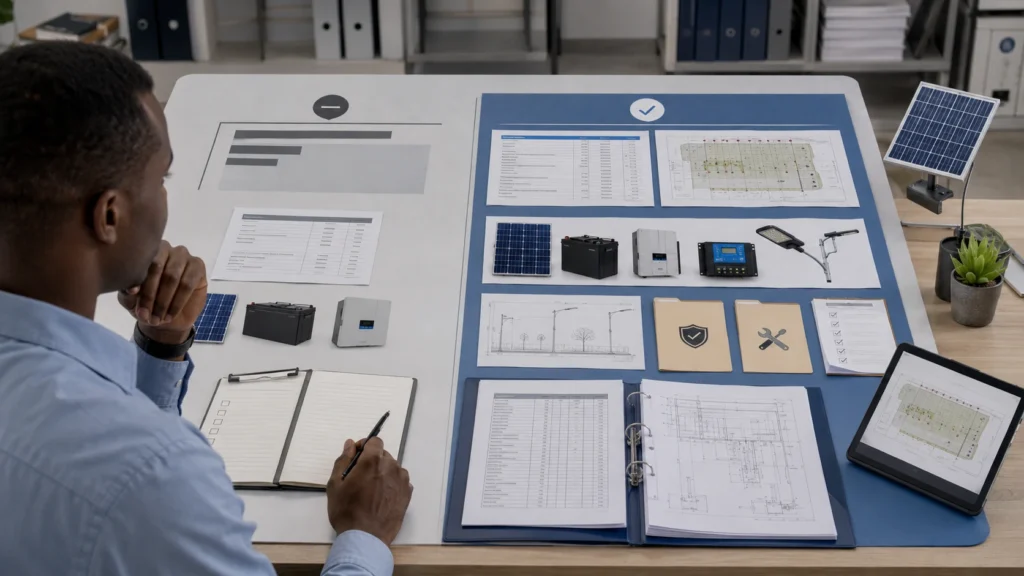
Many users search for a list of solar companies in Uganda and their prices, but solar pricing is rarely fixed across every buyer or project.
The final cost usually depends on the application, system size, installation scope, battery capacity, warranty requirements, and site conditions.
For home and small business systems, pricing is often affected by:
- Solar panel capacity
- Battery type and storage size
- Inverter capacity
- Installation distance and wiring work
- Mounting structure
- Warranty and after-sales support
- Whether the system is cash purchase, financed, or PAYGo
For street lighting, commercial, or EPC projects, pricing also depends on:
- Pole height and spacing
- Lighting performance requirements
- Battery autonomy target
- Solar panel and controller configuration
- Dimming profile and runtime expectation
- BOQ scope
- Foundation, installation, and commissioning responsibility
- Required documents such as IES files, DIALux reports, drawings, and acceptance checklists
A lower unit price is not always the lowest project risk. For public lighting and infrastructure projects, buyers should compare the complete technical scope, not only the product price.
| Buyer Type | Main Cost Factors | What to Ask Before Comparing Prices |
|---|---|---|
| Home solar | Panel capacity, battery size, inverter, wiring, installation, warranty | Site survey, backup hours, battery type, warranty terms, after-sales response |
| SME / clinic / school | Load size, backup time, inverter capacity, battery bank, payment model | Load list, daily working hours, critical loads, maintenance responsibility |
| Water pumping | Pump head, flow rate, daily water demand, controller, spare parts | Pump curve, water source, pumping hours, field service availability |
| Municipal street lighting | Pole height, spacing, luminaire output, battery autonomy, solar panel, controller, BOQ | Road width, lighting target, IES/LDT files, DIALux report, foundation, installation scope |
| High-mast lighting | Mast height, floodlight quantity, aiming angle, wind load, foundation, control system | Mast drawing, aiming plan, lux target, foundation reference, commissioning scope |
Solar Companies in Kampala and Nationwide Project Support

Many solar buyers begin their search in Kampala because it is the main commercial and procurement center in Uganda. For home systems, small commercial installations, and after-sales service, a local Kampala-based installer can be important.
For larger infrastructure projects such as solar street lighting, high-mast lighting, mini-grids, or institutional solar systems, buyers may need a combination of:
- Local site survey and installation support
- Regional EPC coordination
- Manufacturing or technical design support
- BOQ, drawings, lighting simulations, and handover documentation
- Long-term maintenance and warranty coordination
This is why supplier selection should depend on project type, not only company location.
For buyers searching for solar companies in Kampala, the first question should not only be “which company is nearby?” but also “which company fits the project scope?” A Kampala-based installer may be practical for home solar, battery replacement, small rooftop systems, and urgent after-sales service. For municipal street lighting, road lighting, high-mast lighting, or EPC tender projects, buyers may need both local installation coordination and manufacturer-level engineering support for BOQ, IES/LDT files, DIALux reports, pole drawings, foundation references, and handover documents.
How to Choose the Right Solar Company in Uganda
Instead of asking “Which is the #1 solar company in Uganda?”, a better question is:
“What type of project am I working on, and which supplier fits that use case?”
Different buyer types should evaluate solar companies differently.
For Home Solar Buyers
Home buyers should usually prioritize:
- Local installation capability
- Safe wiring and basic site survey
- Battery and inverter sizing
- Clear warranty terms
- After-sales response
- PAYGo or financing options if needed
For home systems, a local installer or PAYGo brand may be more practical than an EPC or manufacturing-focused supplier.
For SMEs, Clinics, Schools, and Institutions
Small businesses and institutions should look for:
- Load assessment
- Battery and backup-time planning
- Solar panel and inverter sizing
- Maintenance support
- Financing structure if required
- Clear responsibility for installation and troubleshooting
In this segment, the best supplier is often the one that can combine system design, installation, after-sales service, and payment flexibility.
For Water Pumping and Productive-Use Projects
Agricultural, rural enterprise, and water-related projects should evaluate:
- Pumping head and flow requirements
- Daily water demand
- Solar array sizing
- Pump type and controller compatibility
- Spare parts availability
- Site installation and maintenance support
For these projects, companies with water, pumping, or productive-use experience may be more suitable than general home solar kit suppliers.
For Mini-Grids and Rural Electrification Programs
Mini-grid and rural electrification buyers should review:
- Program experience
- Community or institutional coordination
- Financing and ownership model
- O&M responsibility
- Metering and payment systems
- Local partner network
- Regulatory and donor-program requirements
This type of project usually requires more than product supply. It often needs project development, financing, operation, and stakeholder coordination.
For Municipal Street Lighting and High-Mast Projects
Municipal street lighting, road lighting, and high-mast lighting projects should be reviewed through an engineering and tender-readiness lens.
Buyers should check whether the supplier can support:
- Pole height and spacing review
- Road width and layout assumptions
- Lighting performance targets
- IES / LDT photometric files
- DIALux or Relux lighting simulation
- BOQ mapping
- Pole and foundation drawings
- Hot-dip galvanizing and corrosion protection
- Acceptance and handover documentation
These projects often combine a manufacturer or engineering partner with a local contractor for installation, civil works, and commissioning.
Required Documents for EPC and Municipal Lighting Projects
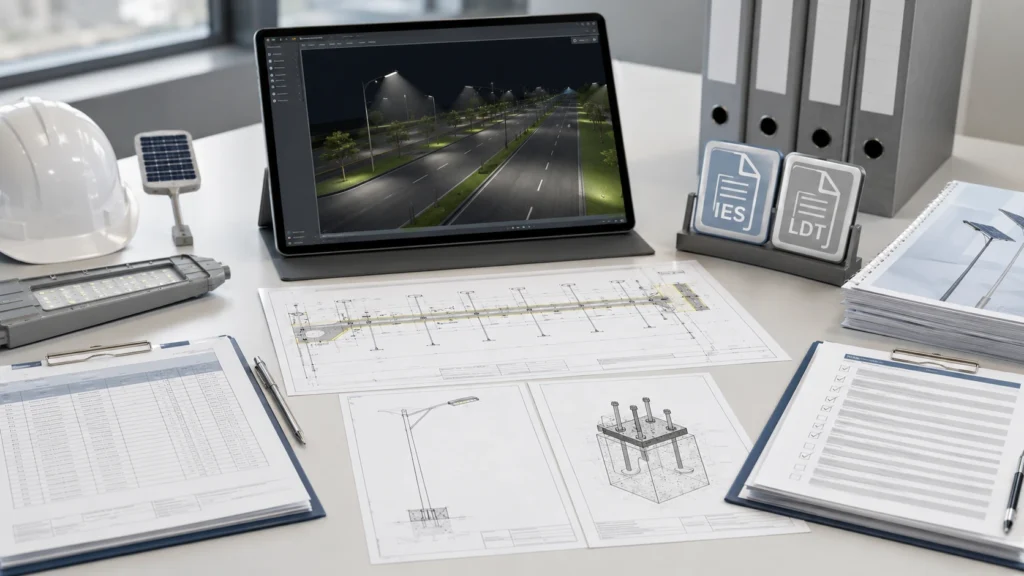
For EPC, government, and municipal lighting projects in Uganda, the supplier review should not stop at product pictures or unit prices.
| Document or Output | Why It Matters |
|---|---|
| BOQ mapping | Helps match product models, poles, accessories, and quantities to the tender scope |
| IES / LDT photometric files | Supports lighting layout review and model-level photometric traceability |
| DIALux / Relux simulation | Helps review lux level, uniformity, spacing, and aiming assumptions |
| Pole drawings | Supports structural review, installation planning, and approval discussion |
| Foundation references | Helps coordinate civil works, anchor bolts, and wind-load assumptions |
| Datasheets and technical drawings | Helps consultants and buyers compare specifications clearly |
| Wiring or system logic notes | Clarifies solar panel, battery, controller, dimming, and backup logic |
| Acceptance and handover checklist | Helps define what should be inspected before final project acceptance |
For infrastructure lighting, these documents reduce approval risk, comparison confusion, and handover disputes.
Common Mistakes When Choosing a Solar Company in Uganda
| Mistake | Why It Creates Risk | Better Approach |
|---|---|---|
| Choosing only by the lowest price | The quotation may exclude installation, battery capacity, foundation, documents, or after-sales support | Compare complete technical scope and responsibility |
| Treating home solar and street lighting as the same purchase | Street lighting requires poles, optics, spacing, simulation, and acceptance review | Match the supplier to the project type |
| Ignoring local service coverage | Small systems often depend on fast local support | Verify branch, dealer, or installer availability |
| Requesting only wattage | Wattage does not prove lighting performance or system reliability | Review lux target, uniformity, autonomy, dimming, and documents |
| Not defining maintenance responsibility | EPC and public projects may face handover disputes later | Clarify commissioning, spare parts, warranty, and O&M scope |
| Skipping BOQ and document review | Tender submissions may become harder to approve or compare | Request BOQ mapping, drawings, IES files, and simulation outputs |
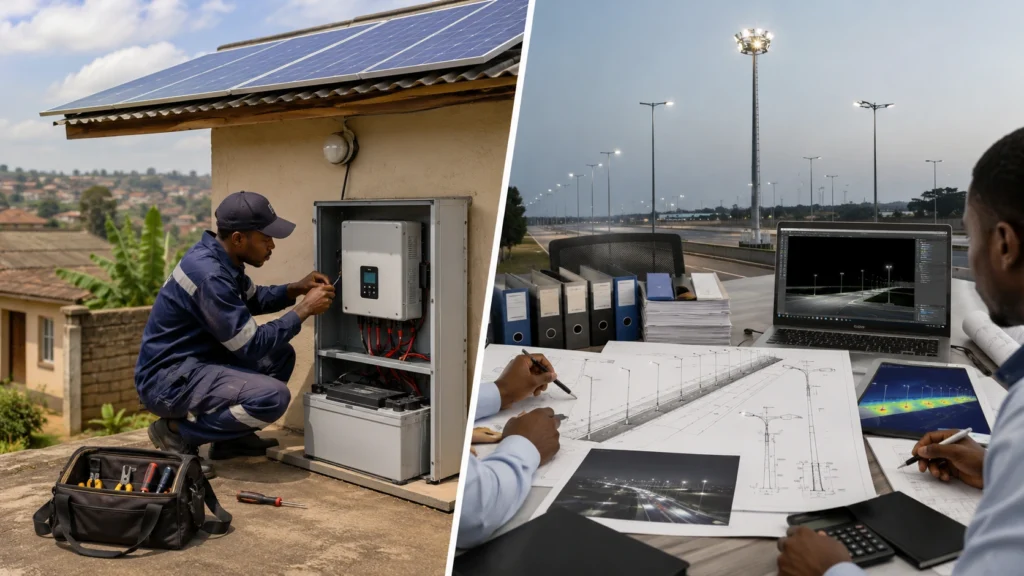
When a Local Uganda Installer May Be Better
A local installer may be the better choice when the project is small, urgent, and service-heavy.
This can include:
- Home solar systems
- Small shop or clinic backup systems
- Battery or inverter replacement
- Local wiring repair
- Small rooftop or ground-mounted solar installations
- PAYGo product support
- Projects where immediate local after-sales response is more important than engineering documents
For these projects, local presence, response speed, installation quality, and warranty handling may matter more than manufacturer-level engineering support.
When a Manufacturer or EPC-Style Technical Partner May Be Better
A manufacturer or EPC-style technical partner may be more suitable when the project requires engineering review, documentation, or tender support.
This can include:
- Municipal road lighting
- Public solar street lighting
- High-mast lighting
- Industrial yard lighting
- Large parking area lighting
- Government or donor-funded infrastructure projects
- Tender-based lighting projects
- Projects requiring BOQ, IES/LDT, DIALux, pole drawings, and acceptance support
For these projects, the buyer should evaluate both the product and the documentation package.
Final Tips Before Contacting Any Solar Supplier
To receive faster and more accurate proposals, prepare the following information before contacting suppliers:
- Application type: home, shop, clinic, school, factory, street, yard, farm, or mini-grid
- Site location and grid/off-grid status
- Quantity or system size
- Basic load requirements or lighting hours
- Budget stage: early planning, tender stage, design stage, or ready to buy
- Required documents, if any
- Installation and maintenance responsibility
- Expected project timeline
For lighting projects, also prepare:
- Road width or site layout
- Pole height and expected spacing
- Required lighting level or project standard
- Battery autonomy target
- Installation environment
- Whether BOQ, IES files, DIALux reports, drawings, or handover documents are required
This approach helps match the right type of solar company to the actual project need, especially for infrastructure-grade lighting projects.
Request Engineering Support for Uganda Street Lighting Projects
If you are preparing a solar street lighting, road lighting, high-mast lighting, or municipal infrastructure project in Uganda, Sunlurio can help review the project conditions before quotation.
Please prepare:
- Road width or site layout
- Pole height and expected spacing
- Quantity or BOQ
- Target lighting level or project standard
- Battery autonomy requirement
- Installation environment
- Required documents such as IES/LDT files, DIALux/Relux reports, drawings, datasheets, and handover checklist
Frequently Asked Questions
What are the best solar companies in Uganda?
The best solar company in Uganda depends on the project type. Home buyers may need a local installer or PAYGo provider. SMEs may need solar financing and after-sales support. EPC contractors and municipal buyers may need suppliers that can provide BOQ support, drawings, IES files, DIALux simulations, and project documentation.
Is there a single best solar company in Uganda?
No. Uganda’s solar market includes different segments such as home systems, PAYGo kits, mini-grids, commercial and industrial solar, water pumping, and EPC infrastructure. The right company depends on your project scale, site conditions, budget model, and documentation requirements.
Is this a paid ranking of solar companies in Uganda?
No. This guide is not a paid ranking, certified supplier list, or official government-approved directory. It is organized by buyer use case and based on publicly available company information, visible market positioning, and project relevance. Buyers should verify current operations and service coverage before procurement.
Which solar companies are suitable for homes and small businesses in Uganda?
Home and small business buyers usually work with local installers or PAYGo providers that can provide site surveys, safe wiring, installation, financing options, and after-sales support. Local service availability is often more important than company size.
Which suppliers are best for PAYGo solar systems in Uganda?
PAYGo solar buyers should prioritize agent network coverage, payment flexibility, warranty process, product reliability, and local customer support. PAYGo-focused brands and their local partners usually serve this segment better than EPC-oriented suppliers.
How can I compare solar company prices in Uganda?
Compare solar prices by system size, battery capacity, inverter rating, installation scope, warranty, after-sales support, and payment model. For street lighting or EPC projects, also compare pole height, spacing, lighting performance, BOQ scope, IES files, DIALux reports, drawings, and commissioning responsibility.
Are solar companies in Kampala enough for nationwide projects?
For home and small commercial systems, a Kampala-based installer may be suitable if they can support the site location. For larger projects, buyers may need a combination of local installation support, regional EPC coordination, and manufacturer-level engineering or documentation support.
For municipal street lighting projects in Uganda, do we need an EPC-style supplier?
Yes. Street lighting and infrastructure projects often require engineering deliverables such as BOQ mapping, pole and foundation details, matched photometric files, IES / LDT files, DIALux or Relux lighting simulations, and acceptance documentation.
What documents are most important for EPC or tender-based solar projects?
Commonly required documents include an auditable BOQ, matched photometric files, IES / LDT files, DIALux or Relux simulation reports, datasheets, pole and foundation drawings, and an acceptance or handover checklist aligned with the project scope.