
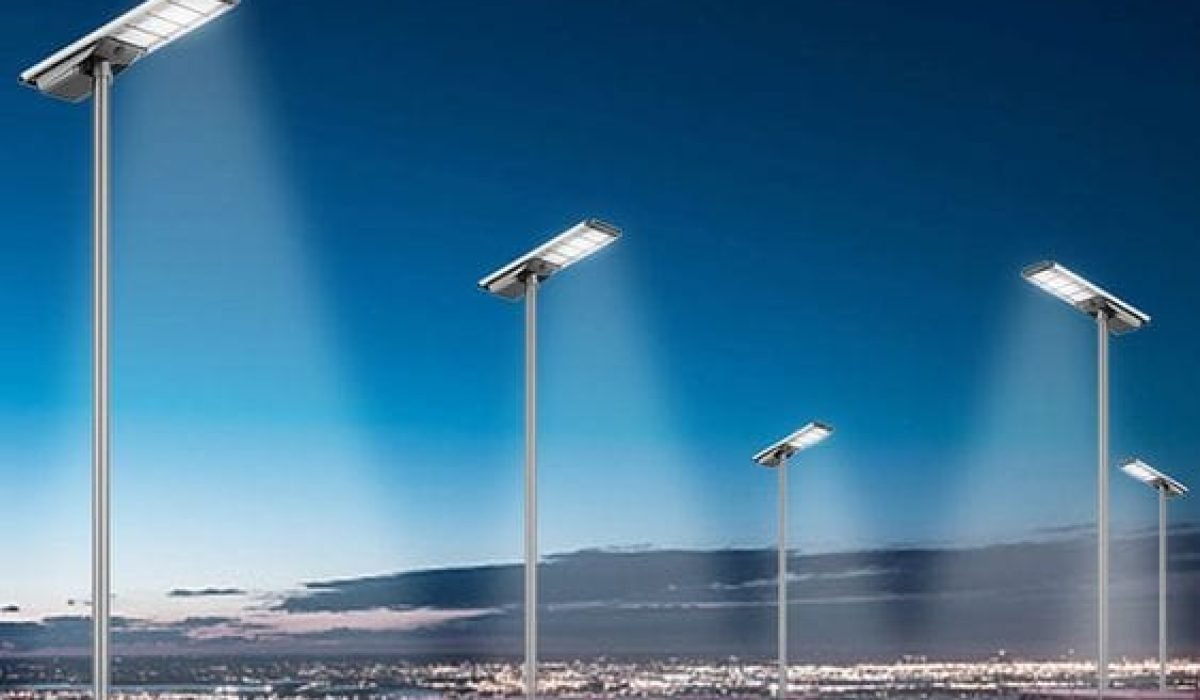
Lighting pole maintenance is a preventive inspection process used to confirm whether the pole shaft, base plate, anchor bolts, grout, foundation surroundings, arms, luminaires, and electrical access points remain safe for continued service.
For EPC contractors, municipal asset owners, facility managers, and public lighting maintenance teams, the real goal is not only to keep the light working. The more important goal is to identify early signs of corrosion, looseness, foundation movement, wind damage, electrical exposure, or structural risk before they become safety or replacement problems.
This checklist explains what should be inspected during routine lighting pole maintenance, what is often missed, when post-storm inspection is required, and when a maintenance issue should escalate to engineering review.
Quick Answer
Lighting pole maintenance should check the complete support system, not only the lamp head or visible pole surface. The key inspection areas include the pole shaft, coating condition, base plate, anchor bolts, nuts, washers, grout ring, foundation edge, arm connection, luminaire mounting point, electrical access door, cable entry, grounding point, and surrounding drainage condition.
A lighting pole that still stands upright may still need closer review if there are signs of base corrosion, loose anchor bolts, cracked grout, foundation movement, leaning, arm misalignment, or post-storm displacement.
For municipal and EPC projects, a good maintenance checklist should answer these questions:
- Is the pole still vertical and stable?
- Is the base plate sitting properly?
- Are anchor bolts, nuts, and washers intact?
- Is there visible corrosion near the base?
- Is the grout ring cracked, separated, or missing?
- Is the foundation edge cracked or settling?
- Are the arms and luminaires still aligned?
- Are electrical access points sealed and safe?
- Has the pole been affected by wind, impact, flooding, or corrosion?
- Does the issue require routine repair, replacement planning, or engineering review?
Quick Review: What Should Be Checked First?
Lighting pole maintenance should start from the base area and structural connection points, then move upward to the pole shaft, arms, luminaires, and electrical access points. Many serious risks begin at the base long before the pole looks unsafe from a distance.
| Inspection Area | What to Check | Why It Matters |
|---|---|---|
| Pole shaft | Rust, dents, cracks, deformation, coating damage | Indicates surface deterioration or possible structural weakening |
| Base plate | Gaps, corrosion, distortion, poor seating | Shows whether the pole is properly supported |
| Anchor bolts | Loose nuts, missing washers, corrosion, exposed thread damage | Anchor bolts transfer load into the foundation |
| Grout ring | Cracking, separation, missing grout, water traps | Damaged grout can hide movement or drainage problems |
| Foundation edge | Cracks, settlement, exposed concrete, movement | Foundation condition affects overall pole stability |
| Arm and bracket | Sagging, looseness, misalignment, cracking | Arm failure can affect luminaire safety and wind load |
| Luminaire attachment | Loose bolts, vibration, water ingress, tilt change | Prevents falling components and lighting misalignment |
| Electrical access | Door condition, cable sealing, grounding, water entry | Reduces electrical and maintenance safety risks |
| Surrounding drainage | Standing water, soil erosion, buried base, debris | Moisture and poor drainage accelerate base corrosion |
| Post-storm condition | New lean, fresh cracks, shifted arm, disturbed foundation | Wind events can create hidden support-system damage |
If the base area shows visible deterioration, the pole should not be treated as a simple cleaning or repainting job.
Why Lighting Pole Maintenance Matters More Than Many Teams Expect
Lighting pole maintenance is not only about appearance or lamp replacement. It is part of public safety, asset life management, and project risk control.
In many municipal and public lighting projects, the luminaire receives most of the maintenance attention because it directly affects brightness. However, the pole, foundation, and anchor system are what keep the lighting asset safely in place.
Poor maintenance can lead to:
- accelerated corrosion
- loose or weakened anchor bolts
- base plate movement
- cracked grout or concrete
- unstable arms or brackets
- water ingress into electrical compartments
- unexpected replacement cost
- post-storm safety risk
- public liability exposure
For EPC and municipal teams, maintenance also protects project reputation. A lighting system that fails structurally after installation can create far greater consequences than a luminaire failure.
What Municipal and EPC Teams Often Miss
Municipal and EPC maintenance teams often focus on whether the light still turns on. But for lighting poles, continued illumination does not prove that the pole support system is healthy.
Commonly missed items include:
- early corrosion around the base plate
- hidden rust near anchor bolts
- cracked or separated grout
- missing washers or uneven nut seating
- water ponding around the pole base
- small foundation cracks after wind or rain
- arm misalignment caused by vibration
- loose luminaire mounting bolts
- damaged access doors
- cable entry points without proper sealing
- repeated leaning after storms
A pole can still look normal from the road while its base, foundation, or anchor system is already showing early warning signs.
What to Inspect During Routine Pole Maintenance
Routine lighting pole maintenance should be organized by inspection zone. This helps maintenance teams avoid checking only the visible lamp head while missing the structural and electrical details that matter more for long-term safety.
1) Pole shaft and surface condition
The pole shaft should be checked for corrosion, coating damage, dents, deformation, cracks, impact marks, and abnormal bending.
Pay attention to:
- lower pole section near ground level
- welded areas
- scratches that expose bare steel
- dents caused by vehicle impact or equipment
- corrosion under damaged coating
- unusual bending or local deformation
- old repair areas
For steel lighting poles, small coating damage can become a corrosion starting point if moisture, salt, dust, or industrial pollution is present.
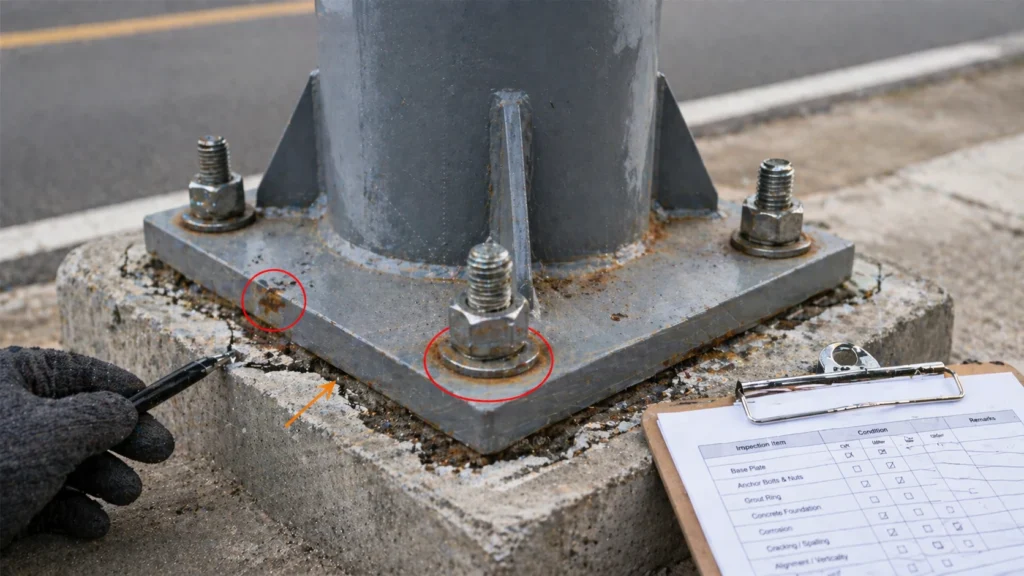
2) Base plate, anchor bolts, and grout
The base area is one of the most important inspection zones. It carries the structural load from the pole into the foundation and is exposed to water, dust, vibration, and corrosion.
Check:
- base plate corrosion
- base plate gaps
- uneven seating
- loose or missing nuts
- damaged washers
- exposed anchor bolt corrosion
- thread damage
- cracked grout
- separated grout edge
- missing grout
- water trapped around the base
A base plate that looks slightly separated, tilted, or corroded should not be ignored. It may indicate installation movement, foundation settlement, poor drainage, or anchor bolt stress.
3) Foundation surroundings
The foundation area should be checked because visible problems often appear around the concrete edge before a major structural issue becomes obvious.
Check:
- concrete cracks
- settlement around the foundation
- exposed foundation edge
- soil erosion
- water ponding
- damaged pavement around the pole
- foundation movement
- vegetation or debris trapping moisture
- impact damage near the base
If the foundation surroundings have changed after rain, flooding, excavation, or vehicle impact, the pole should receive closer review.
For more background, see Light Pole Foundation Design Basics.
4) Arm, bracket, and luminaire attachment points
The arm and luminaire connection points should be checked for looseness, vibration, corrosion, misalignment, and cracked welds or brackets.
Check:
- arm sagging
- shifted luminaire angle
- loose mounting bolts
- bracket corrosion
- cracked welds
- missing fasteners
- vibration marks
- luminaire housing damage
- water ingress
- signs of repeated movement
A shifted arm or changed luminaire angle may look like a lighting performance issue, but it can also indicate mechanical looseness or wind-related movement.
5) Electrical access and cable entry
Electrical inspection should confirm that access doors, cable entries, grounding connections, and internal compartments are protected from water, dust, and accidental contact.
Check:
- access door fit
- missing screws
- broken locks
- cable entry sealing
- water inside the access compartment
- damaged insulation
- loose grounding connection
- insect or dirt accumulation
- exposed conductors
- signs of overheating
Electrical safety should be handled by qualified personnel. Maintenance teams should not treat damaged access doors or water ingress as cosmetic problems.
Sunlurio Maintenance Review Note: Why the Pole Base Should Be Checked First
In many lighting pole maintenance reviews, the visible shaft receives most of the attention because it is easy to photograph and easy to describe. But for steel lighting poles, the base area often tells the more important story.
Sunlurio recommends checking the base plate, anchor bolts, exposed threads, washers, grout ring, drainage condition, and surrounding concrete before treating a pole as “normal service.” This is especially important for coastal roads, open terrain, high-wind areas, industrial sites, and projects where poles have been in service for many years.
A pole that still looks straight from a distance may still need closer review if corrosion, base movement, cracked grout, water ponding, or foundation edge deterioration is visible.
For corrosion-related foundation topics, see Coastal Light Pole Foundation Corrosion and Grounding.
How Pole Material Affects Maintenance Logic
Different pole materials require different maintenance attention. The inspection logic for galvanized steel, painted steel, aluminum, and composite poles is not exactly the same.
| Pole Material | Main Maintenance Focus | Common Risk |
|---|---|---|
| Hot-dip galvanized steel | Coating damage, base corrosion, exposed hardware | Corrosion at base or damaged coating areas |
| Painted steel | Paint breakdown, rust under coating, scratches | Hidden corrosion under damaged paint |
| Aluminum | Surface oxidation, connection points, galvanic contact | Connection corrosion or hardware mismatch |
| Stainless steel components | Fastener condition, surface staining, contact corrosion | Localized corrosion under harsh environments |
| Composite / FRP poles | Cracking, UV exposure, impact damage | Structural degradation or delamination |
For most municipal and EPC projects, steel lighting poles are common because they offer strength, availability, and cost efficiency. But steel poles require careful attention to coating integrity, base drainage, and corrosion protection.
Steel Lighting Pole Maintenance: Where Risk Usually Starts
Steel lighting pole maintenance usually starts with corrosion control, base inspection, and connection review. The base section is especially important because it is exposed to moisture, road dust, salt spray, cleaning chemicals, and drainage problems.
Common steel pole risk points include:
- rust around the base plate
- damaged galvanizing or paint near ground level
- corrosion around anchor bolts
- water trapped under or around the base
- scratches caused during installation
- coating damage from tools or impact
- corrosion at welded joints
- rust around access doors
- hardware mismatch between bolts and pole material
A small surface rust area does not always mean immediate replacement is required. But progressing corrosion near the base plate, anchor bolts, welded zones, or access opening should be documented and reviewed.
Post-Storm Inspection: What Should Be Checked Immediately?
Post-storm inspection should be performed even if the lighting pole remains standing. Strong wind, heavy rain, flooding, or flying debris can change pole alignment, loosen components, damage foundations, or create hidden base-area movement.
After a storm, check:
- new pole lean
- changed luminaire angle
- arm rotation or sagging
- fresh cracks in grout
- foundation edge cracks
- disturbed soil around the foundation
- base plate movement
- loose or shifted anchor nuts
- fresh corrosion exposure from coating damage
- electrical access door damage
- water ingress
- fallen branches or impact marks
A pole that remains standing after wind may still require closer review if alignment, base condition, or support behavior has changed.

For wind-related structural review, see Wind Load vs Light Pole Foundation Anchor Bolts.
Common Maintenance Mistakes That Lead to Early Failure
Many lighting pole problems become expensive because early warning signs were treated as normal aging. Maintenance should identify small changes before they become structural, electrical, or replacement issues.
Mistake 1: Checking only whether the light works
A working luminaire does not prove that the pole, base plate, anchor bolts, foundation, and electrical access points are safe.
Mistake 2: Ignoring small corrosion near the base
Base corrosion is often more important than surface corrosion higher on the pole because it affects the load-transfer zone.
Mistake 3: Treating cracked grout as cosmetic
Cracked or separated grout can indicate movement, poor installation, trapped water, or foundation-related issues.
Mistake 4: Not checking after strong wind
If post-storm inspection is skipped, small alignment changes and foundation movement may go unnoticed.
Mistake 5: Replacing luminaires without checking pole capacity
A heavier luminaire, longer arm, camera, sign, or smart device can change loading. The pole and foundation should be checked before adding new equipment.
Mistake 6: Keeping no photo records
Without photos, it is difficult to judge whether corrosion, leaning, cracking, or settlement is stable or getting worse.
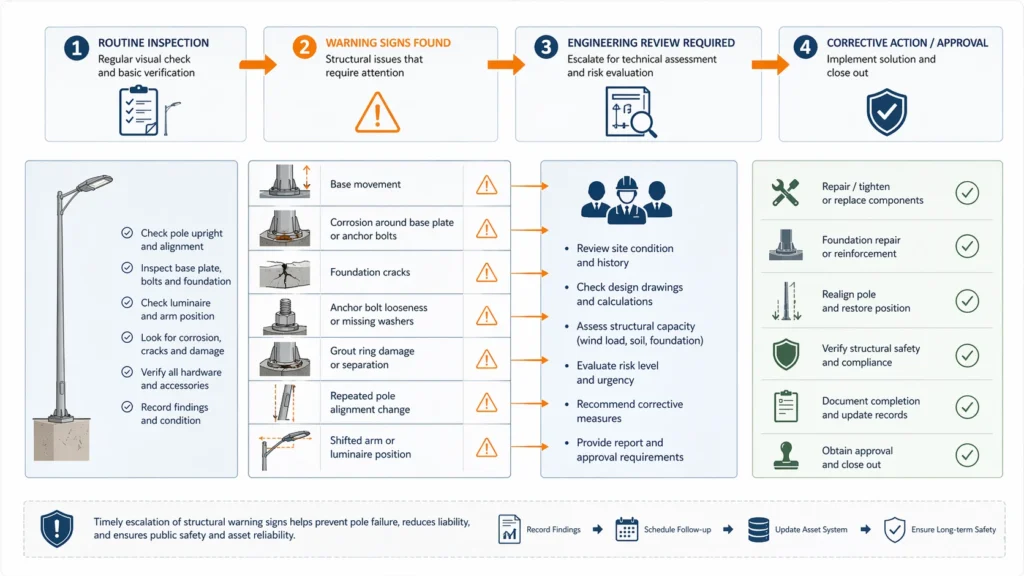
When Maintenance Should Escalate to Engineering Review
Routine maintenance should escalate to engineering review when the issue may affect support capacity, public safety, or long-term stability. Not every rust mark requires structural review, but certain signs should not be handled as simple surface repair.
Escalation is recommended when there is:
- visible pole lean
- repeated leaning after storms
- base plate gap
- loose or damaged anchor bolts
- missing nuts or washers
- progressing corrosion around base plate
- corrosion around exposed anchor threads
- cracked or separated grout
- foundation settlement
- concrete cracking around the base
- arm or luminaire repeated movement
- vehicle impact damage
- added equipment that increases top load
- uncertain foundation or anchor bolt condition
If a pole shows multiple warning signs at the same time, maintenance teams should document the condition and request engineering support before repair decisions are finalized.
Recommended Maintenance Rhythm
Lighting pole maintenance frequency should depend on environment, pole age, project importance, and exposure risk. High-risk locations should be inspected more often than low-risk internal roads.
| Situation | Suggested Maintenance Logic |
|---|---|
| New installation | Check after installation and after the first severe weather event |
| Normal municipal roads | Routine visual inspection plus scheduled base and electrical checks |
| Coastal roads | More frequent corrosion and base-area inspection |
| High-wind locations | Post-storm inspection and anchor/base review |
| Industrial or dusty sites | Check coating damage, access doors, corrosion, and electrical compartments |
| Retrofit projects | Inspect before replacing luminaires, arms, or adding smart devices |
| Aging pole networks | Build photo records and replacement-priority lists |
Maintenance should be treated as an asset-management process, not only a repair activity.
What Maintenance Records Should Be Kept?
Maintenance records help EPC teams, municipal owners, and facility managers track whether pole condition is stable, worsening, or ready for replacement planning.
Useful records include:
- pole location and asset ID
- inspection date
- pole type, height, and material
- photos of the shaft, base plate, anchor bolts, grout, and foundation area
- corrosion or coating damage notes
- post-storm inspection notes
- arm and luminaire alignment records
- electrical access condition
- repair actions completed
- items requiring engineering review
- next inspection date
For public lighting assets, photo records are especially useful because small base-area changes may be easier to compare over time than to judge from a single visit.
Need Support Reviewing Lighting Pole Maintenance or Post-Storm Risk?
If your project involves municipal lighting poles, steel poles, solar street light poles, or public-area lighting assets, Sunlurio can help review the maintenance risk points that should not be ignored before repair, replacement, or retrofit planning.
You can send:
- pole type and height
- project location and exposure condition
- photos of the pole base, anchor bolts, grout, and foundation area
- visible corrosion or coating damage
- post-storm inspection photos
- arm and luminaire condition
- foundation or anchor bolt drawings if available
- replacement or retrofit plan if new luminaires or arms will be added
A practical review can help clarify whether the issue is routine maintenance, replacement planning, or a deeper foundation / structural review.
Start from Engineering Support or send project details through Contact.
Related Pages in This Topic Cluster
If you are reviewing lighting pole maintenance, foundation risk, corrosion, post-storm inspection, or replacement planning, these pages may also help:
- Lighting Pole
- Light Pole Foundation Design Basics
- Leaning Light Pole and Cracked Foundation: Causes and Fixes
- Wind Load vs Light Pole Foundation Anchor Bolts
- Coastal Light Pole Foundation Corrosion and Grounding
- Datasheets + Drawings
- Engineering Support
- Projects
FAQ
How often should lighting poles be inspected?
Lighting poles should be inspected through a routine schedule and after major events such as strong wind, heavy rain, flooding, vehicle impact, or visible base movement. The exact interval depends on project risk, environment, pole age, material, and local maintenance capacity.
What is the most important area to check during lighting pole maintenance?
The base area is often the most important inspection zone. Maintenance teams should check the base plate, anchor bolts, nuts, washers, grout ring, drainage condition, corrosion, and surrounding foundation edge. Many structural risks start at the base before the shaft looks seriously damaged.
Should a lighting pole be inspected after a storm if it is still standing?
Yes. A pole that remains standing after strong wind is not automatically safe. Teams should check new lean, base movement, cracked grout, loose anchor bolts, arm shift, luminaire misalignment, fresh concrete cracks, and ground settlement.
Is rust at the pole base serious?
Rust at the pole base can be serious because this area often retains moisture, dirt, and drainage problems. Small surface rust may be treatable, but progressing corrosion near anchor bolts, base plate edges, exposed threads, or welded zones should be reviewed carefully.
What are early warning signs of lighting pole foundation problems?
Early warning signs include pole lean, cracked grout, base plate gaps, concrete cracking, settlement, water ponding, exposed foundation edges, anchor bolt movement, and repeated alignment changes after wind or rain.
Do galvanized lighting poles still need maintenance?
Yes. Galvanizing improves corrosion resistance, but it does not remove the need for inspection. Galvanized poles still require checks around the base area, coating damage, hardware, drainage, arm connections, and corrosive exposure conditions.
What should be checked before replacing a luminaire or arm?
Before replacement, teams should check whether the pole shaft, arm connection, base plate, anchor bolts, foundation, and electrical access points remain suitable. Adding a heavier luminaire or longer arm can change loading and maintenance risk.
When should routine maintenance escalate to engineering review?
Escalation is recommended when there is repeated lean, progressing base corrosion, cracked grout, anchor bolt concern, foundation settlement, base plate gaps, repeated arm movement, or post-storm alignment change. These signs may indicate a support-system issue, not only a surface maintenance issue.
What records should be kept for lighting pole maintenance?
Useful records include pole location, asset ID, inspection date, photos, corrosion notes, base condition, anchor bolt condition, foundation observations, repair actions, post-storm findings, and next inspection date. Photo records are especially useful for tracking changes over time.
Can poor drainage shorten lighting pole service life?
Yes. Poor drainage can keep moisture around the base plate, anchor bolts, grout, and foundation edge. Over time, this can accelerate corrosion, coating breakdown, concrete deterioration, and base-area maintenance problems.