A street lighting tender should define whether its lighting requirements are maintained values, state the maintenance factor used for bid comparison, and require bidders to disclose how that factor was derived.
The maintenance factor, or MF, is not the same as L70, L80 or L90. It must account for relevant light-output depreciation, luminaire dirt, component survival and the project’s actual maintenance regime. Any additional design margin should be declared separately so that the same risk is not counted twice.
For EPC contractors, consultants and municipal project teams, the real question is not simply whether MF should be 0.80. The question is whether the selected factor can be supported by the proposed luminaire, operating hours, local environment and maintenance plan.
Quick Answer: What Should a Street Lighting Tender Specify?
A technically reviewable tender should either provide one overall MF for all bidders to use or require each bidder to calculate and justify a project-specific value. It should not leave bidders free to select unexplained values that make their lighting results or system prices look more favorable.
At minimum, the tender should identify:
- Whether the required illuminance or luminance is an initial or maintained value
- The overall MF used in the lighting calculation
- The project design period and accumulated operating hours
- The assumed LED lumen maintenance factor
- The luminaire cleaning interval and environmental conditions
- The survival or replacement assumption for failed luminaires
- The LM-80 and TM-21 evidence required from the bidder
- The calculation stage at which the lighting requirements must be met
- Any design margin applied outside the MF
- The maintenance actions required to keep the design assumptions valid
If the owner provides a fixed MF for tender comparison, all bidders should use that same value in their DIALux or Relux calculations. The fixed value does not remove the bidder’s responsibility to submit applicable lumen-maintenance and maintenance-regime evidence.
What Does Maintenance Factor Mean in Road Lighting?
The maintenance factor is a design coefficient used to relate the initial performance of a lighting installation to its expected performance after specified operating and maintenance conditions.
The basic relationship is:
[
E{\text{maintained}} = E{\text{initial}} \times MF
]
Therefore:
[
E{\text{initial}} = \frac{E{\text{maintained}}}{MF}
]
The same principle can be applied to average road luminance:
[
L{\text{maintained}} = L{\text{initial}} \times MF
]
If a road must maintain an average illuminance of 20 lx, the required initial average illuminance changes with the selected MF:
| Overall MF | Required Initial Average Illuminance |
|---|---|
| 0.90 | 22.22 lx |
| 0.85 | 23.53 lx |
| 0.80 | 25.00 lx |
| 0.75 | 26.67 lx |
| 0.70 | 28.57 lx |
A lower MF therefore requires a higher initial lighting level. That may mean higher luminaire output, more luminaires, reduced pole spacing or a different optical arrangement.
However, a lower MF is not automatically safer. An unjustifiably low value can increase:
- Connected power
- Initial illuminance
- Glare and spill-light risks
- Luminaire quantity
- Pole and installation quantities
- Capital cost
- Energy consumption
- Battery and PV requirements in solar lighting systems
The selected MF should reflect realistic depreciation and maintenance conditions rather than an arbitrary conservative preference.
European road lighting requirements are generally expressed as maintained values. EN 13201-2 also places importance on providing either the required maintenance factor or sufficient information about the maintenance regime to determine it. The applicable national adoption and project edition should be confirmed in the tender documents.
Initial Values vs Maintained Lighting Requirements
Initial lighting values describe the expected performance when the new installation is first commissioned. Maintained values describe the minimum performance expected after defined depreciation and maintenance assumptions have been applied.
This distinction must be clear before reviewing a photometric report.
Consider a tender requiring:
Average illuminance: 20 lx minimum
Overall uniformity: 0.40 minimum
Maintenance factor: 0.80
If 20 lx is a maintained requirement, the proposed installation needs to produce at least 25 lx initially under the simplified MF relationship.
A calculation showing 20 lx before applying MF would produce only:
[
20 \times 0.80 = 16 \text{ lx}
]
as the maintained average. That would not comply with a maintained requirement of 20 lx.
The tender should also clarify:
- Whether the DIALux results display maintained values
- Which MF was entered into the calculation
- Whether the same MF applies to every road section
- Whether the requirements must be met at full output or at a defined dimming stage
- Whether uniformity, threshold increment and surrounding-area criteria are evaluated under the same approved operating condition
MF should not be used as a substitute for checking the complete photometric calculation. A road can exceed the required average illuminance and still fail uniformity, glare or luminance requirements.
MF Is Not the Same as L70, L80 or L90
L70, L80 and L90 describe lumen-maintenance thresholds under stated conditions. They do not, by themselves, provide the overall maintenance factor for a street lighting installation.
| Metric | Simplified Meaning |
|---|---|
| L70 | Light output has declined to 70% of its initial value |
| L80 | Light output has declined to 80% of its initial value |
| L90 | Light output has declined to 90% of its initial value |
A statement such as:
L80 > 100,000 hoursis incomplete for tender review unless it identifies:
- The LED package or module covered by the claim
- The operating current
- The relevant test temperature or temperature measurement point
- The available LM-80 test duration
- The TM-21 projection method and reporting limit
- The statistical or B-value convention, where stated
- Whether the claim concerns an LED source or the complete luminaire
- Whether driver and other component failures are treated separately
IES guidance distinguishes LED source lumen maintenance from complete luminaire lifetime. A luminaire also contains a driver, optical system, seals, electrical connections, surge protection and thermal interfaces. These components may fail or deteriorate independently of the LED packages. See the IES position on LED product lifetime.
Why L80 at 100,000 Hours Does Not Mean LLMF = 0.80
The lumen maintenance factor used in a project should correspond to the project’s accumulated operating hours, not automatically to the endpoint printed in a product claim.
For a system operating 12 hours per night over ten years:
[
12 \times 365 \times 10 = 43,800 \text{ hours}
]
The relevant question is:
What lumen-maintenance value is supported at 43,800 operating hours under the LED current and temperature conditions of the proposed luminaire?
It would be incorrect to select 0.80 solely because the datasheet states L80 at 100,000 hours. At 43,800 hours, the supported projected maintenance value may be different.
The declared value must be traced through:
- The LED model used in the final BOM
- Applicable LM-80 data
- The TM-21 projection
- Actual LED operating current
- Luminaire thermal measurements
- The project operating profile
- The target evaluation hour
TM-21 provides a method for projecting long-term lumen maintenance from LM-80 data, but projections remain subject to the method’s data and reporting limits. A very long marketing claim should not be accepted simply because it appears in a datasheet. See the IES TM-21 publication information.
LED Package Data vs Complete Luminaire Performance
LM-80 and TM-21 can support an LED source lumen-maintenance assumption. They do not automatically verify the lifetime or maintained output of the entire luminaire.
The overall assessment may also need to consider:
- Driver wear-out or sudden failure
- Surge protection device failure
- Connector and solder-joint failure
- Optical lens yellowing
- Dirt on the external optical surface
- Water ingress following seal degradation
- Corrosion in electrical or mechanical interfaces
- Thermal-interface deterioration
- Changes to controller settings
- Unauthorized replacement parts
This is why a tender should avoid describing an LED package projection as the “complete luminaire lifetime.”
What Makes Up the Overall Maintenance Factor?
For a typical outdoor road lighting assessment, the overall MF can be represented as:
[
MF = LLMF \times LSF \times LMF
]
The exact terminology and factors should follow the applicable project standard, but the underlying losses must be defined.
| Factor | Meaning | Main Question |
|---|---|---|
| LLMF | Lamp or LED lumen maintenance factor | How much light output remains at the target operating hour? |
| LSF | Lamp or light-source survival factor | How are sudden failures treated before replacement? |
| LMF | Luminaire maintenance factor | How much output is lost through dirt or optical-surface deterioration? |
Indoor lighting calculations may include additional room-surface factors. Those should not be copied mechanically into an open-road calculation. Tunnels, underpasses and enclosed transport areas require separate assessment.
LED Lumen Maintenance Factor
LLMF accounts for gradual light-output depreciation over time. For LED road luminaires, it should be supported by data applicable to the actual LED and its operating conditions.
The review should confirm:
- LED manufacturer and exact part number
- LM-80 report coverage
- TM-21 calculation or report
- LED drive current
- Relevant temperature measurement point
- Luminaire thermal test condition
- Target accumulated operating hours
- Dimming profile
- Whether the projection remains within the method’s reporting limit
- Whether the final production BOM uses the same LED
A report for a similar LED family is not automatically applicable to the proposed LED model.
Survival Factor
The survival factor addresses sudden failures rather than gradual lumen depreciation. It must be linked to the project’s inspection and replacement policy.
An LSF of 1.00 may be defensible for a particular calculation interval when failed luminaires are detected and replaced promptly. It should not be treated as a universal default.
The assumption depends on whether the project has:
- Periodic night inspections
- Remote fault reporting
- Local maintenance personnel
- Approved replacement procedures
- Compatible spare drivers, controllers and LED modules
- Defined response and restoration times
- Local or regional spare-parts stock
- Access equipment for field replacement
For remote roads where faults may remain unresolved for months, an unexplained LSF of 1.00 deserves further review.
Gradual lumen depreciation and sudden failure are different performance mechanisms. One should not be used to hide the other.
Luminaire Maintenance Factor
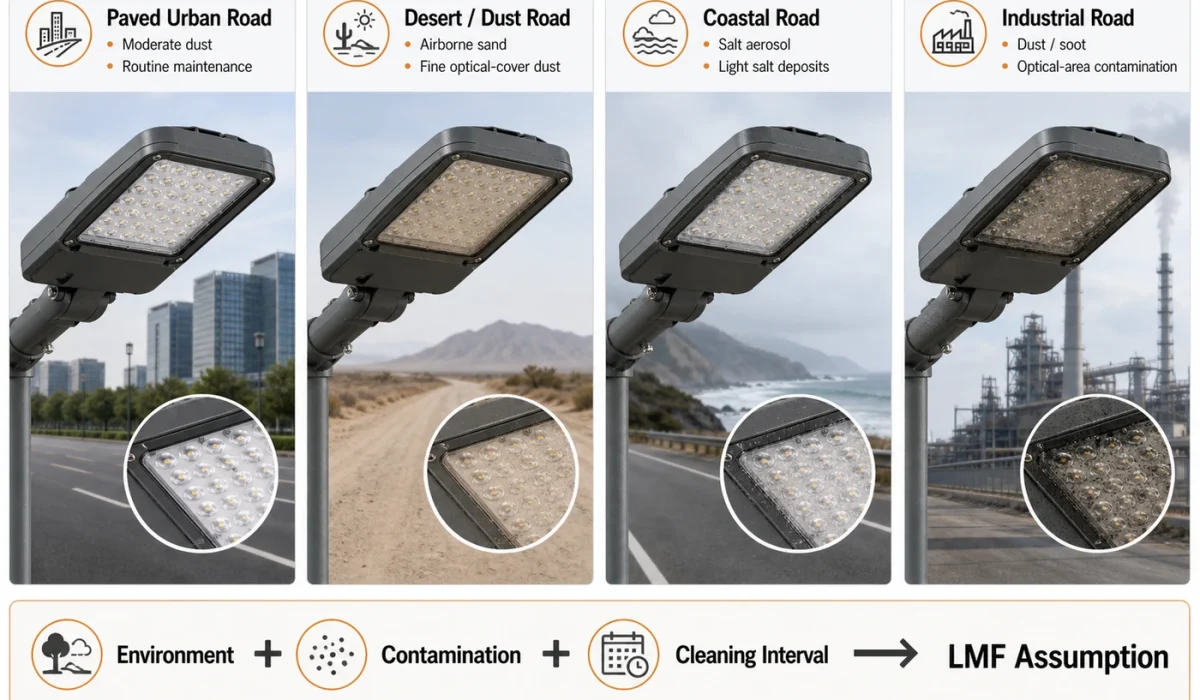
LMF accounts primarily for the effect of dirt and contamination on the luminaire’s light output. It should be linked to the local environment, luminaire construction and cleaning interval.
Relevant project conditions include:
- Road dust
- Desert sand
- Industrial emissions
- Coastal salt deposits
- High humidity
- Insect contamination
- Bird fouling
- Optical-cover orientation
- Luminaire housing geometry
- Cleaning access
- Cleaning frequency
- UV exposure and optical-material ageing
IP66 does not prove that the external optical surface will remain clean. It describes enclosure protection against dust ingress and water under specified test conditions; it does not eliminate external dirt deposition or long-term optical material ageing.
The following justification is therefore insufficient:
Maintenance factor: 0.80 because the luminaire is IP66.A more useful declaration would identify the environment, assumed cleaning interval, optical construction and factor assigned to dirt depreciation.
How Should Dirt Depreciation Be Specified?
Dirt depreciation should be based on a defined environmental category and cleaning regime rather than a generic assumption copied from another project.
For example, the same luminaire may perform differently in:
- A paved urban road with routine municipal cleaning
- An unpaved haul road with continuous airborne dust
- A coastal road exposed to salt deposits
- An industrial zone with soot or chemical contamination
- A remote rural road with no planned luminaire cleaning
The tender should ask the bidder to declare:
| Declaration Field | Required Information |
|---|---|
| Environment | Urban, rural, coastal, desert, industrial or project-specific condition |
| Main contaminant | Dust, sand, salt, soot, insects or mixed contamination |
| Cleaning interval | Months or operating hours between cleaning |
| Cleaning method | Accessible method compatible with the optical material and seals |
| Assumed LMF | Factor used in the lighting calculation |
| Supporting basis | Applicable guidance, project experience or approved maintenance methodology |
| Responsible party | Owner, maintenance contractor or EPC during the defects-liability period |
A high LMF based on frequent cleaning is only valid if the owner can actually deliver that cleaning schedule.
How to Calculate an Overall MF
The overall factor is obtained by multiplying the applicable component factors, not by adding their percentage losses.
Assume the following project inputs:
| Component | Assumed Factor |
|---|---|
| LED lumen maintenance factor | 0.92 |
| Survival factor | 0.98 |
| Luminaire maintenance factor | 0.90 |
Then:
[
MF = 0.92 \times 0.98 \times 0.90
]
[
MF = 0.8114
]
The calculated overall factor is approximately 0.81.
If the maintained average illuminance requirement is 20 lx:
[
E_{\text{initial}} = \frac{20}{0.8114}
]
[
E_{\text{initial}} \approx 24.65 \text{ lx}
]
This example explains the calculation method; it does not establish 0.81 as the correct factor for every road project. Each component value still requires a project-specific basis.
Why “Lower MF Is Safer” Is the Wrong Rule
A deliberately low MF can conceal poor maintenance assumptions or produce unnecessary initial overlighting. It should not be used as a universal safety margin.
Potential consequences include:
- Higher LED power
- Increased energy consumption
- Shorter pole spacing
- More poles and foundations
- Increased glare
- Higher initial brightness than the road environment requires
- Larger cables and electrical infrastructure
- Larger batteries and PV modules in solar systems
- Higher wind load from larger solar modules
- Increased procurement and maintenance cost
A low value may be justified in a severe environment with infrequent cleaning and slow fault replacement. It is not justified merely because it makes the design appear conservative.
MF vs Design Safety Margin: Avoid Double Counting
MF compensates for defined maintenance-related depreciation. A separate design margin may address other uncertainties, but the two should not cover the same risk.
MF may account for:
- LED lumen depreciation
- Dirt accumulation
- Planned cleaning intervals
- Sudden failures and replacement timing
A separate design margin may address:
- Incomplete survey data
- Installation tolerances
- Variation in pole position
- Road-width uncertainty
- Surface-reflection uncertainty
- Early-stage tender inputs that have not been approved
- A specifically identified measurement or construction tolerance
The bidder should disclose each margin and its purpose.
| Adjustment | Risk Addressed | Normally Included in MF? | Evidence Required |
|---|---|---|---|
| LLMF | LED lumen depreciation | Yes | LM-80, TM-21 and thermal conditions |
| LMF | Dirt and contamination | Yes | Environment and cleaning interval |
| LSF | Sudden failure before replacement | Yes | Failure and maintenance policy |
| Installation tolerance | Pole or tilt variation | No | Construction assumptions |
| Input uncertainty margin | Unconfirmed project data | Not necessarily | Written explanation |
| Additional output increase | Must be specifically identified | Depends | Separate calculation basis |
An unreviewable calculation may look like this:
Required maintained illuminance: 20 lx
Maintenance factor: 0.80
Additional safety margin: 20%
Luminaire output increase: 15%
If the 20% margin and 15% increase do not address separate risks, the project may be compensating for the same uncertainty multiple times.
How MF Affects Solar Street Light System Sizing
In a solar street lighting project, a lower MF can affect the complete energy system rather than only the luminaire selection.
If the required LED output is increased to compensate for a lower MF, the engineering team may also need to increase:
- Nightly energy capacity
- Battery usable capacity
- Solar module power
- Controller current rating
- Cable capacity
- Structural allowance for the solar module
- Spare-parts cost
For example, increasing a full-output LED load from 80 W to 100 W represents a 25% power increase:
[
\frac{100-80}{80} \times 100% = 25%
]
If both systems operate for the same duration, the nominal nightly LED energy also increases by 25% before driver, controller and wiring losses are considered.
The effect cannot be reviewed only through the lighting calculation. It must also be reflected in the battery and PV sizing model.
Dimming Does Not Replace MF
MF addresses long-term depreciation and maintenance conditions. Dimming defines how output changes during different periods of the night.
A compliant submission should separately declare:
- Full-output LED or driver input power
- Dimming schedule
- Power at each operating stage
- Lighting calculation stage
- Overall MF
- Stage at which the maintained lighting criteria must be satisfied
- Battery and PV sizing power profile
A bidder should not present a DIALux calculation at 100% output while using a heavily dimmed schedule for autonomy calculations unless the tender explicitly allows that operating strategy.
For more detail, review Sunlurio’s guide to solar street light dimming profiles for tender compliance.
Constant Lumen Output Requires Additional Review
A constant lumen output strategy may operate the luminaire below maximum current initially and gradually increase the current to compensate for depreciation.
This approach may be technically valid, but the tender should verify:
- Whether the driver supports the control strategy
- Initial and end-of-period input power
- LED current at the end of the design period
- Thermal conditions at the highest current
- Whether the lumen-maintenance projection reflects the changing current
- Whether the solar battery and PV system is sized for the maximum scheduled power
- Whether autonomy remains compliant at the later operating condition
- What happens when the available driver headroom is exhausted
A constant lumen output claim should not be accepted as a substitute for an energy model and an applicable lumen-maintenance assessment.
How Should Lumen Maintenance Be Verified?
Lumen-maintenance verification should connect the proposed production luminaire to the LED test evidence, its thermal operating condition and the project’s target operating hours.
The approval path should be traceable:
Final luminaire BOM
→ exact LED model
→ LM-80 source data
→ TM-21 projection
→ actual LED current
→ luminaire temperature measurement
→ project operating hours
→ declared LLMF
→ overall MF
→ maintained lighting calculation
LM-80 Data
The reviewer should verify:
- Report issuer
- LED manufacturer
- Exact LED identification
- Case temperature conditions
- Drive current
- Actual test duration
- Lumen-maintenance data
- Chromaticity-related results where relevant
- Relationship between the tested LED and final production BOM
LM-80 does not test the complete road luminaire. It supplies LED source data used in a wider engineering assessment.
TM-21 Projection
The TM-21 submission should show:
- LM-80 dataset used
- Selected temperature condition
- Selected current condition
- Projection curve
- Target evaluation hour
- Reported or limited projection value
- Any extrapolation limitation
- Result used in the project’s LLMF
A claim that greatly exceeds the available test evidence should be treated as a request for clarification rather than automatically accepted.
Luminaire Thermal Verification
Even valid LED data may be inapplicable if the LED operates at a higher temperature in the proposed luminaire.
The bidder should identify:
- Temperature measurement point
- Ambient test condition
- LED drive current during the test
- Stabilization method
- Measured temperature
- Highest expected project operating condition
- Relationship between the measured temperature and the LM-80/TM-21 input
Hot climates, enclosed optics, dirt accumulation and high drive current can all influence the thermal condition.
Complete Luminaire Risks
The project should also review components not covered by the LED lumen-maintenance projection:
- LED driver
- Solar controller
- Surge protection
- Optical cover
- Seals and gaskets
- Connectors
- Internal wiring
- Thermal interface
- Housing corrosion protection
- Replacement compatibility
Research summarized by the U.S. Department of Energy has noted that drivers, connections and optical components may limit system reliability independently of LED package depreciation. See the DOE solid-state lighting R&D report.
Recommended Tender Wording
The tender clause should make the design basis reviewable without presenting one unverified factor as a universal standard.
Option 1: Performance-Based Maintenance Factor Clause
The road-lighting calculation shall use an overall maintenance factor supported by the proposed luminaire, project operating hours, environmental conditions and approved maintenance regime.

The bidder shall declare:

1. the overall maintenance factor used in the lighting calculation;
2. the design period and accumulated operating hours;
3. the assumed LED lumen maintenance factor at the target operating hour;
4. the luminaire maintenance factor and cleaning interval;
5. the survival factor and failed-luminaire replacement policy;
6. the source and applicability of the LM-80 and TM-21 data;
7. the LED operating current and relevant luminaire temperature condition;
8. any additional design margin applied outside the maintenance factor;
9. the maintained lighting results at the specified operating condition; and
10. the maintenance actions required to preserve the declared assumptions.

The bidder shall submit sufficient technical evidence to demonstrate that the proposed factors apply to the final luminaire configuration.
This option is suitable when the consultant has the resources to review each bidder’s calculation basis.
Option 2: Fixed MF for Tender Comparison
For tender comparison, all bidders shall calculate the specified road sections using an overall maintenance factor of 0.80.

The bidder shall also submit the proposed luminaire's lumen-maintenance evidence, assumed cleaning interval, survival assumptions, maintenance requirements and any additional design margin.

Use of an overall maintenance factor of 0.80 for tender comparison does not waive the requirement to demonstrate that the proposed luminaire and maintenance regime are compatible with the specified project design life.
This option creates a common bid-comparison basis. The value of 0.80 in this example is not a universal recommendation; the project consultant must select and approve the actual tender value.
Required Bidder Declaration Table
| Required Declaration | Bidder Response |
|---|---|
| Applicable road section | |
| Required maintained lighting class or criteria | |
| Overall MF used in calculation | |
| Project design period | |
| Annual operating hours | |
| Total target operating hours | |
| LED make and model | |
| LED operating current | |
| Relevant LED temperature condition | |
| LLMF at target hours | |
| LMF | |
| Environmental category | |
| Cleaning interval | |
| LSF | |
| Fault detection method | |
| Replacement response time | |
| Additional design margin | |
| Dimming stage used for lighting calculation | |
| LM-80 reference | |
| TM-21 reference | |
| DIALux/Relux file reference |
How to Audit a Bidder’s Lighting Calculation
A useful audit checks the relationship between the tender, photometric file, maintenance assumptions and final product configuration.
Step 1: Confirm the Required Value
Identify whether the tender specifies maintained illuminance, maintained luminance or another maintained criterion.
Step 2: Check the Software Input
Open the original DIALux or Relux file and verify the entered MF rather than relying only on a PDF report.
Step 3: Confirm the Photometric File
Check that the IES or LDT file belongs to the exact proposed luminaire, optic, power and LED configuration.
Sunlurio can provide IES photometric files and DIALux simulation outputs for project review.
Step 4: Trace the LLMF
Connect the declared value to the exact LED, operating current, thermal condition and target operating hour.
Step 5: Review Dirt and Cleaning Assumptions
Compare the declared LMF with the real road environment and planned cleaning interval.
Step 6: Review the Survival Assumption
Determine how failed luminaires will be detected, how quickly they will be replaced and whether compatible spares will be available.
Step 7: Identify Additional Margins
Check whether the supplier has added output, reduced spacing or increased power beyond the declared MF calculation.
Step 8: Check the Solar Energy Model
For solar street lights, confirm that the battery and PV calculations use the same approved operating power and dimming schedule.
Step 9: Confirm Maintained Compliance
Check all required criteria, not only average illuminance. Depending on the tender, these may include:
- Average luminance
- Overall uniformity
- Longitudinal uniformity
- Threshold increment
- Edge or surrounding-area criteria
- Average illuminance
- Minimum illuminance
- Glare limits
Step 10: Lock the Approved Configuration
The approved LED, driver, optic, controller settings, photometric file and maintenance assumptions should be connected to the final BOM and technical submittal.
Common Tender Mistakes and Red Flags
Treating L80 as the Overall MF
L80 addresses a lumen-maintenance threshold. It does not include external dirt, maintenance intervals or sudden component failure.
Declaring a Lifetime Without Conditions
LED lifetime: 100,000 hoursis not reviewable without a lumen-maintenance threshold, current, temperature, evidence and product boundary.
Using IP66 to Justify the Entire MF
IP66 does not eliminate external optical-surface contamination or LED depreciation.
Applying LSF = 1.00 Without a Replacement Plan
This may be unrealistic where inspection is infrequent or spare parts are unavailable locally.
Using an Extremely Low MF Without Evidence
A low MF can inflate project power and cost. It should be linked to identifiable environmental or maintenance risks.
Using an Extremely High MF Without a Maintenance Commitment
A high MF may depend on frequent cleaning, rapid replacement and strong lumen-maintenance performance. Those assumptions must be achievable.
Adding an Undeclared Safety Margin
Extra light output, higher wattage or reduced pole spacing should be explained separately from MF.
Evaluating Lighting and Autonomy at Different Outputs
Using full output for the lighting report and a lower output for the battery calculation can create a non-comparable submission.
Submitting LED Data Unrelated to the Final BOM
The LED in the LM-80/TM-21 evidence must correspond to the production configuration.
Ignoring Driver and Optical Degradation
An excellent LED projection does not prove that every other part of the luminaire will survive for the same period.
Documents to Request Before Technical Approval
| Document | Review Purpose |
|---|---|
| LM-80 report | Verify LED identity, current, temperature and test data |
| TM-21 calculation or report | Verify projected maintenance at target hours |
| LED-to-BOM mapping | Confirm that the tested LED matches production |
| Luminaire thermal test | Validate the relevant LED operating temperature |
| LM-79 or complete luminaire photometric report | Confirm initial luminaire output and distribution |
| IES or LDT file | Verify the simulation input |
| Original DIALux or Relux project file | Review MF, geometry, output and road parameters |
| Cleaning and maintenance plan | Support the assumed LMF |
| Driver lifetime and failure data | Review non-LED system risks |
| Spare-parts schedule | Support the replacement and survival assumptions |
| Operating-hours calculation | Convert calendar years into actual operating hours |
| Dimming schedule | Connect lighting output to energy consumption |
| Design-margin declaration | Identify adjustments outside MF |
| Final technical compliance sheet | Record the approved calculation basis |
For a coordinated submission, review Sunlurio’s street lighting engineering support and tender documents and BOQ support.
Final Tender Checklist
Before approving a street lighting calculation, confirm that:
- [ ] The tender states whether the requirements are maintained values.
- [ ] The overall MF is stated.
- [ ] Every bidder uses the required comparison basis.
- [ ] The design period is converted into operating hours.
- [ ] L70, L80 or L90 is not presented as the overall MF.
- [ ] The LED model matches the LM-80 evidence.
- [ ] The TM-21 projection is applicable to the target hours.
- [ ] LED current and temperature conditions are declared.
- [ ] LMF is linked to environment and cleaning interval.
- [ ] LSF is linked to fault detection and replacement.
- [ ] IP66 is not used as the sole MF justification.
- [ ] Additional design margins are disclosed separately.
- [ ] The original DIALux or Relux file is available.
- [ ] The IES/LDT file matches the final luminaire.
- [ ] The maintained results satisfy every required criterion.
- [ ] Solar battery and PV calculations use the approved power profile.
- [ ] Dimming assumptions are consistent across all calculations.
- [ ] The final BOM preserves the approved LED, driver and optic.
- [ ] Maintenance responsibilities are assigned.
- [ ] Required replacement parts will remain available.
What Project Owners Should Avoid
A tender should not use one universal maintenance factor without defining its purpose, operating period and maintenance assumptions.
Project owners should also avoid:
- Selecting MF only because it is commonly used in another tender
- Requiring very high initial illumination as an undeclared safety margin
- Accepting long lifetime claims without applicable evidence
- Assuming remote monitoring eliminates field maintenance
- Approving frequent cleaning assumptions without a funded maintenance plan
- Comparing bidders that have used different MF values
- Allowing product substitutions without repeating the photometric and maintenance review
- Increasing LED power without checking glare, energy and solar-system consequences
The safest tender is not the one with the lowest MF. It is the one in which every factor, margin and maintenance action can be explained and verified.
FAQ
What maintenance factor should be used for street lighting?
There is no single MF suitable for every street lighting project. The value should reflect LED lumen maintenance, dirt accumulation, environmental exposure, failure replacement and the planned maintenance interval. If a fixed value is required for tender comparison, the consultant should define it and require all bidders to use the same value.
Is L80 the same as a maintenance factor of 0.80?
No. L80 is a lumen-maintenance threshold for a stated light source, time and operating condition. The overall MF may also include dirt depreciation and survival assumptions. The relevant LED maintenance value should be selected at the project’s target operating hours rather than copied automatically from an L80 endpoint.
Does a higher MF always indicate a better luminaire?
No. A higher MF may reflect strong lumen maintenance and an effective maintenance plan, but it may also be based on unrealistic cleaning or replacement assumptions. The component factors and their evidence are more important than the overall number alone.
Does IP66 allow the project to use a high maintenance factor?
Not by itself. IP66 addresses enclosure protection under specified test conditions. It does not prevent dust, sand, salt or other contamination from accumulating on the external optical surface, and it does not verify LED, driver or optical-material ageing.
Should DIALux calculations use initial or maintained values?
The calculation should follow the tender requirement, which for road lighting is commonly expressed in maintained terms. The submitted file must clearly show the MF used. Reviewers should not assume that a reported value is maintained unless the software input and report confirm it.
Can a project use MF = 1.00?
An overall MF of 1.00 would imply that no relevant depreciation or unresolved failure affects the assessed performance. That is generally a demanding assumption and requires strong technical justification. A new-installation or initial-value calculation may use a different basis, but it should not be presented as long-term maintained performance.
How does the cleaning interval affect MF?
A longer cleaning interval usually permits more dirt to accumulate and can reduce the applicable luminaire maintenance factor. The actual effect depends on local contamination, luminaire construction, optical orientation and the cleaning method. A cleaning assumption is valid only if the maintenance plan can deliver it.
Should uniformity be multiplied directly by MF?
A uniform maintenance factor applied equally to every luminaire generally scales calculated illumination levels rather than changing their relative distribution. However, real installations may experience non-uniform dirt, failure or obstruction. Required uniformity and other road-lighting criteria should still be verified in the approved calculation and maintained through inspection and replacement.
Can extra LED wattage replace maintenance planning?
No. Higher wattage may increase initial output, but it does not clean optical surfaces, detect failures or guarantee replacement availability. It can also increase glare, energy use, temperature and solar-system size. Maintenance planning and design output address different project risks.
What evidence should be requested first from a bidder?
Start with the exact luminaire datasheet, IES/LDT file, original DIALux or Relux project, LED identification, LM-80 data, TM-21 calculation, luminaire thermal information and the declared MF breakdown. These documents allow the reviewer to determine whether the lighting result and lumen-maintenance claim refer to the same product.
Request a Street Lighting Engineering Review
A maintenance factor becomes useful only when it is connected to the actual luminaire, road geometry, operating schedule, environmental conditions and maintenance plan.
Submit your road profile, required lighting class, pole arrangement, design period, dimming schedule, BOQ and tender documents to Sunlurio. Our engineering team can prepare the proposed luminaire data, IES files, DIALux inputs, maintenance-factor declarations and solar system configuration for project review.