

If you’ve ever installed a solar light only to find it doesn’t turn on at night, you know how frustrating that is.
Before climbing ladders or digging holes, it’s worth spending half an hour checking if your solar lights work properly.
Here’s how I usually do it — nothing fancy, just a few quick steps and a multimeter.
Step 1: Give the Solar Lights a Full Charge
Start simple.
Put your solar lights under direct sunlight for at least 12 to 14 hours — ideally over two clear days if you can. That first full charge is like the foundation of a new battery’s life.
If it’s cloudy, don’t panic. Just leave them out longer. I’ve seen lights charge decently even on hazy afternoons, as long as they’re not shaded by trees or walls.
Some people skip this part, thinking the factory charge is enough — it’s not. A fresh charge helps the light store energy more efficiently once you install it.
Step 2: Test the Light Sensor During the Day

Once charged, check whether the light sensor actually senses “night”.
- Cover the solar panel completely with your hand or a piece of cardboard.
- Wait a few seconds.
- The light should flick on automatically.
- Uncover it — the light should go off again.
If it reacts like that, good — your sensor is alive and kicking.
Sometimes there’s a short delay, a second or two. That’s normal. If nothing happens after several tries, double-check the main switch (many models hide it under the panel).
Step 3: Test the Light Sensor at Night (Real-World Check)
Now test it in real conditions.
Take the light outdoors at dusk or place it in a dark room. As the ambient light fades, it should turn on automatically.
I’ve done this dozens of times — and occasionally, a “good” light from the factory just doesn’t switch on because its sensor was misaligned during assembly.
This test tells you immediately if the sensitivity is right.
Make sure the light is set to ON mode before you start scratching your head.
Step 4: Use a Multimeter to Check the Solar Panel Output
If you’ve got a multimeter lying around, this step will tell you how healthy the panel really is.
- Put the panel under bright sunlight.
- Set your multimeter to DC Voltage (V).
- Touch the red probe to the positive terminal and the black to the negative.
- You should see around 5.5V to 6V on a sunny day.
- If it’s cloudy, 4V to 5V is still okay.
- To test current, switch to DC Amperage (A) and measure the short-circuit current (Isc).
Here’s a rough guide:
| Panel Power | Typical Voc (V) | Typical Isc (A) | Application |
|---|---|---|---|
| 1 W | ~5.5 V | ~0.18 A | Garden light |
| 3 W | ~6.0 V | ~0.35 A | Wall or motion light |
| 10 W | ~18.0 V | ~0.55 A | Small street light |
If your readings fall way below these values, try wiping off any dust or condensation on the glass.
A surprising number of panels come with a thin factory film still stuck on — peel that off before testing.
Meanwhile, don’t expect perfect numbers. Panels naturally vary a little with temperature and angle. You just want to confirm it’s alive, not dead.
Step 5: Check Battery and LED Output
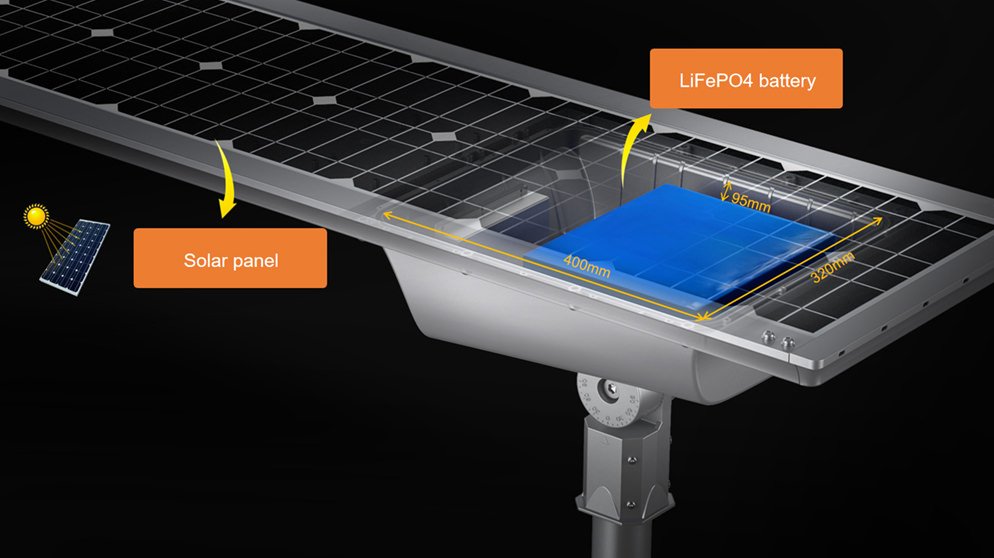
Now the fun part — light it up.
Turn the switch to ON and let it run through the evening. A healthy unit should stay bright for 6–10 hours after a full charge.
If it fades after just an hour, the battery probably needs recharging — or replacement.
In my case, I once left a batch of garden lights untested and half of them lasted barely 20 minutes. A quick pre-check like this would’ve saved me a weekend of reinstalling.
Quick Fixes for Common Issues
| Problem | Likely Cause | What You Can Try |
|---|---|---|
| Light doesn’t turn on | Battery too low or sensor fault | Recharge, clean panel, check switch |
| Weak brightness | Dirty panel or old battery | Wipe panel; replace battery |
| Zero voltage reading | Broken panel or loose wire | Reconnect, retest with multimeter |
| Turns on during daytime | Sensor covered or miswired | Clean sensor; reposition panel |
Sometimes just cleaning the panel solves everything — rain residue and dust can block 10–15% of the light input.
Why It’s Worth Testing Before Installation
Once your poles or brackets are up, troubleshooting becomes a headache.
A ten-minute test with a multimeter and a bit of patience can save hours of climbing or rewiring later.
From my own experience, I always run these checks before handing over any solar lighting project.
You’ll know the lights work, the sensors react, and the panels generate power — so when night falls, they just do their job.
Once you’ve confirmed that, you’ll save yourself a lot of guesswork later — even on those long, cloudy days when you wonder if they’re charging at all.