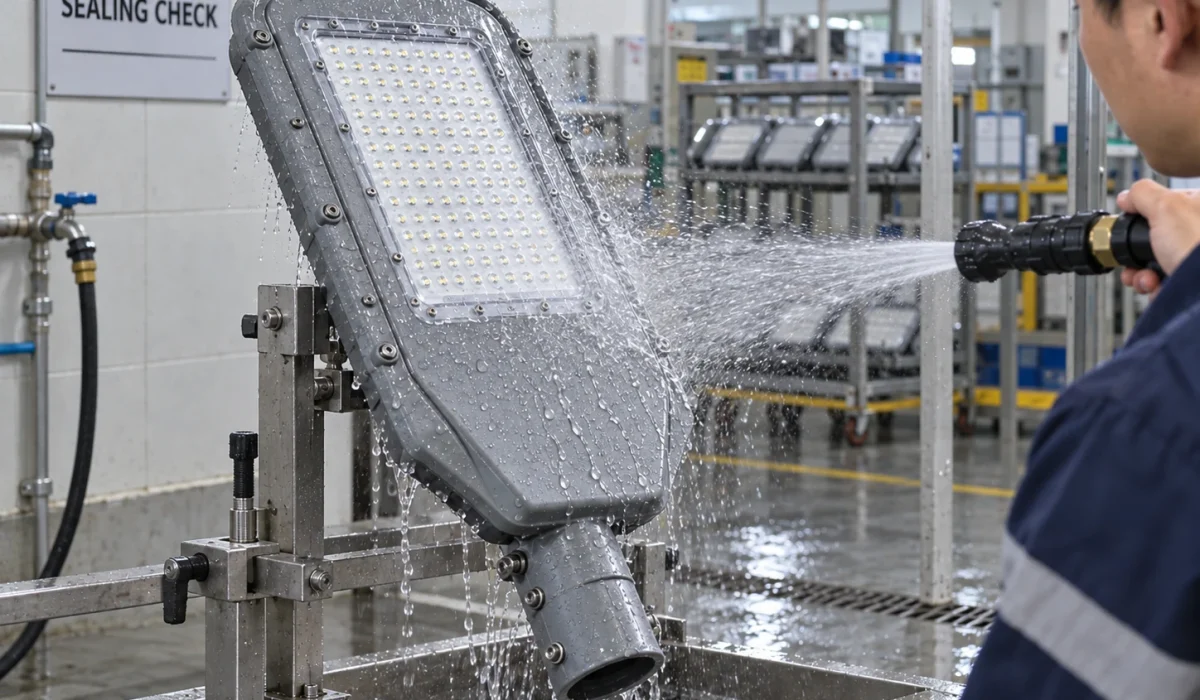
Solar street light suppliers often show aging racks, waterproof chambers, integrating spheres and photometric equipment during factory visits. However, equipment alone does not prove that the offered product has been properly tested—or that the available evidence will satisfy an EPC review, municipal approval process or tender requirement.
A useful laboratory capability must connect the tested sample, test method, operating conditions, recorded result, acceptance criteria and current product configuration.
Quick Answer: What Makes a Lighting Test Verifiable?
A solar street light test becomes verifiable when a buyer can answer seven questions:
| Verification point | Buyer question |
|---|---|
| Sample | Does the tested unit match the offered model and configuration? |
| Method | Which standard or documented procedure was followed? |
| Conditions | How was the sample installed, powered and operated during the test? |
| Result | What was measured, observed or recorded? |
| Acceptance | What defined a pass or failure? |
| Laboratory | Who performed the test, and was the required method within its recognized scope? |
| Traceability | Can the result be linked to the current model, revision or production batch? |
A photograph of test equipment shows that a facility exists. It does not establish the test method, sample identity, measured result or tender compliance.
Scope of This Guide
This guide focuses on three capabilities commonly demonstrated by solar street lighting manufacturers:
- aging and functional checks;
- luminaire ingress-protection testing;
- photometric and electrical testing.
It does not provide complete verification of battery capacity or cycle life, photovoltaic-module performance, controller protection logic, corrosion resistance, structural loading, wind resistance or long-term environmental durability. These require separate evidence and project-specific review.
In-House QC and Accredited Testing Serve Different Purposes
In-house testing and accredited laboratory testing are not interchangeable, but both can be valuable.
Factory tests are usually used to control production, identify assembly problems and release batches. Accredited reports are more likely to be required when a tender, consultant, approval authority or certification scheme requires formally recognized evidence.
| Evidence type | Typical purpose | What it may establish | Main limitation |
|---|---|---|---|
| Production-line functional check | Routine manufacturing control | Basic operation, charging response, dimming or sensor function | Limited test depth and independence |
| Factory aging record | Early-failure screening and batch control | Operating duration, failure observations and unit traceability | Does not prove rated lifetime |
| Internal water-spray check | Assembly or process verification | Obvious sealing or workmanship problems | Does not automatically establish IP66 compliance |
| Internal photometric record | Product development or production comparison | Flux, power or color consistency under defined conditions | Acceptance depends on method, calibration and report scope |
| Accredited laboratory report | Tender, certification or technical approval | Results for specified samples and methods within the laboratory’s scope | May not cover the offered model or every claimed characteristic |
| Model-matched project review | Procurement and engineering approval | Consistency between quotation, reports, optical files and production configuration | Requires supplier documentation and buyer review |
The correct evidence level depends on the project specification. A factory record may be sufficient for routine batch control, while the same record may be unacceptable as proof of a contractual IP or photometric requirement.
Evidence Strength: From Equipment Photos to Model-Matched Reports
Buyers should evaluate laboratory evidence as a hierarchy rather than treating every document as equally strong.
- Marketing claim: The supplier states that a test is available.
- Equipment photograph: The facility or instrument can be seen.
- Test record: The sample, conditions, date and observations are documented.
- Technical report: The method, equipment, measured data and conclusion are reported.
- Accredited result within scope: The laboratory’s accreditation and relevant recognized activities can be verified.
- Model-matched project evidence: The tested configuration matches the product being offered, simulated and manufactured.
A higher evidence level does not automatically make a product suitable. It makes the claim easier to examine. Buyers must still compare the sample identification, test boundary and acceptance criteria with the tender.
What an Aging Test Can and Cannot Verify
An aging test—often called a burn-in test—is used to operate assembled luminaires or lighting systems for a defined period before shipment.
Its practical value is early-failure screening. It may reveal:
- intermittent connections;
- incorrect wiring;
- unstable drivers or controllers;
- LED board failures;
- abnormal shutdown;
- charging or discharging problems;
- sensor or dimming-program errors;
- visible overheating;
- inconsistent operation between units.
An aging test does not by itself prove:
- the complete service life of the luminaire;
- LED lumen maintenance over several years;
- battery cycle life;
- long-term corrosion resistance;
- full environmental durability;
- compliance with all luminaire safety requirements;
- performance under every project temperature or operating condition.
For example, IEC 60598-1:2024 covers broad general safety requirements and tests for luminaires. Its scope is substantially wider than a routine factory burn-in procedure. The applicable edition should follow the tender, certification scheme and destination-market requirements.
What a Useful Aging Record Should Contain
A credible record should allow the buyer to understand what was tested and what happened.
| Record field | Why it matters |
|---|---|
| Product model and revision | Connects the test to the offered configuration |
| Unit or batch identification | Supports production traceability |
| Quantity tested | Shows the sample or batch coverage |
| Start and finish time | Establishes the actual duration |
| Power source and operating boundary | Clarifies whether the LED head, controller or complete unit was operated |
| Operating cycle | Shows full output, dimming, switching, sensor or charge/discharge stages |
| Ambient conditions | Provides context for the observations |
| Inspection intervals | Shows when operation was checked |
| Failure or abnormality log | Records what occurred and how it was handled |
| Acceptance criteria | Defines the release decision |
| Reviewer and approval | Establishes responsibility for the result |
For solar street lights, the operating boundary is especially important. A test of an LED module on a laboratory power supply is not the same as a test of the luminaire with its production controller, dimming program and battery interface.
The correct test boundary depends on the stated purpose. If a supplier says an aging test verifies the complete programmed system, the production controller and relevant control settings should be represented. If the purpose is only to screen the LED light engine, a component-level setup may be reasonable—but it should be described accurately.
Aging-Test Warning Signs
Buyers should request clarification when:
- the record does not identify the tested model or units;
- the duration appears only in marketing material and not in a dated record;
- failed units are removed without a failure log;
- operating conditions are not recorded;
- the program does not represent the claimed test purpose;
- no full-output stage is included when the supplier claims that the test verifies full-power operation, abnormal heating or thermal stability;
- the tested controller or dimming program differs from the offered product;
- the supplier describes a short production aging test as proof of multi-year lifetime.
A 24-, 48- or 72-hour burn-in can help identify early failures. It cannot be extrapolated directly into a five-year lifetime claim.
How to Verify an IP Test and IP66 Claim
For outdoor lighting, an IP claim concerns the degree of protection provided by the relevant enclosure against access, solid foreign objects and water ingress.
The IP code is defined in IEC 60529. In an IP66 designation:
- the first numeral relates to protection against solid foreign objects and access to hazardous parts;
- the second numeral relates to protection against water ingress under the specified test conditions.
The IEC’s IP-rating guidance explains the IP-code structure, while the applicable test requirements and acceptance criteria come from the relevant standard and project documents.
Factory Spray Checks vs IEC 60529 Evidence
A factory water-spray check can be useful for production control. It may identify:
- incorrectly seated gaskets;
- loose fasteners;
- poorly installed cable glands;
- housing deformation;
- sealing damage;
- assembly inconsistencies.
However, a factory demonstration does not automatically prove IP66. To evaluate an IP claim, the buyer needs to know:
- which enclosure was tested;
- the sample’s installation orientation;
- the water-delivery method and applicable conditions;
- test duration;
- relevant pressure, flow or nozzle information;
- sample distance and movement, where applicable;
- pre-test and post-test inspection;
- acceptance criteria;
- whether the sample remained safe and functional;
- whether the current product uses the same sealing design.
The conclusion should follow the applicable IEC 60529 criteria and the product’s safety and functional assessment. The mere observation of moisture should not be interpreted without the relevant acceptance conditions.
What to Check in an IP Report
An IP report should be reviewed against the offered luminaire, not only against its front-page rating.
| Review item | What to confirm |
|---|---|
| Applicant and manufacturer | Their relationship to the offered product is clear |
| Model number | The tested model matches the quotation |
| Product photographs | Housing, connectors, glands and construction are recognizable |
| Sample configuration | Covers the relevant luminaire or component boundary |
| Test method and edition | Matches the contractual requirement |
| Test conditions | Are documented sufficiently for review |
| Installation orientation | Represents the intended mounting condition where relevant |
| Result and conclusion | Are clearly separated from general descriptions |
| Report date and status | The report is complete and current for its intended use |
| Laboratory identity | The organization performing the test is identifiable |
| Accreditation scope, if required | Includes the relevant activity or method |
| Product revisions | Changes since testing have been assessed |
A report for one enclosure does not necessarily cover every product that shares a series name. Changes to the housing joint, gasket material, vent, cable gland, connector, fastener, lens interface or casting can affect the validity of the evidence.
What IP66 Does Not Mean
IP66 does not establish that a luminaire:
- is suitable for permanent submersion;
- will resist every cleaning method or water pressure;
- has passed salt-spray or corrosion testing;
- will withstand flooding;
- has verified UV resistance;
- will maintain sealing after unauthorized opening;
- is suitable for every ambient temperature;
- has passed every electrical-safety test.
For coastal roads, ports, industrial sites or flood-prone areas, the project may need additional material, corrosion, environmental or maintenance requirements beyond IP66.
How to Verify Photometric Testing
Photometric testing is often reduced to one headline number such as lumens or lumens per watt. Project review requires more context.
Buyers may need to verify:
- total luminous flux;
- electrical input power;
- luminous efficacy;
- correlated color temperature;
- chromaticity;
- color rendering information;
- luminous intensity distribution;
- beam pattern;
- optical code;
- input voltage or current;
- stabilization and measurement conditions;
- the boundary used to calculate system efficacy.
The test equipment must match the quantity being measured. An integrating sphere and a goniophotometer do different jobs.
Integrating Sphere vs Distribution Photometry
| Test system | Typical output | Main project use |
|---|---|---|
| Integrating sphere | Total luminous flux, spectral and color data, and related electrical measurements under a defined setup | Checks overall light output, efficacy and color characteristics |
| Goniophotometer | Luminous intensity distribution by angle and related photometric file data | Evaluates roadway distribution and supports IES/LDT files and lighting calculations |
An integrating sphere is a measurement system. ANSI/IES LM-79 is a test method. They are not mutually exclusive categories. An integrating sphere may be used for relevant LM-79 measurements when the equipment, setup, calibration, stabilization and reporting follow the applicable method.
An integrating-sphere record should not be presented as proof of roadway distribution if angular intensity was not measured. Conversely, an IES file does not by itself prove that the complete report, sample identity and electrical boundary have been reviewed.
What an ANSI/IES LM-79-24 Report Can Establish
ANSI/IES LM-79-24 is the current approved method for optical and electrical measurements of solid-state lighting products. Project specifications may still reference an earlier edition, so the tendered edition remains contractually important.
A suitable LM-79 report can establish measured performance for the submitted sample under defined conditions. Depending on the test and report scope, this may include electrical measurements, light output, efficacy, color characteristics and luminous intensity distribution.
It does not automatically establish:
- long-term lumen maintenance;
- LED or luminaire lifetime;
- battery autonomy;
- photovoltaic charging performance;
- corrosion resistance;
- IP compliance;
- performance of every wattage or optic in the product family;
- batch-to-batch consistency of future production.
A report also does not create a universal pass/fail limit. The method establishes how measurements are performed. The tender, specification, regulatory requirement or approved submittal normally defines what result is acceptable.
Define the Solar Luminaire Power Boundary
“Lumens per watt” is incomplete unless both lumens and watts refer to the same tested boundary.
Possible boundaries include:
- LED package performance;
- LED module performance;
- LED board plus optical losses;
- luminaire input power;
- driver or controller output;
- battery-side system input;
- complete solar lighting system performance.
For example, dividing luminaire output by LED-package rated power can produce a misleading efficacy claim. For project review, the report should clarify:
- what product was submitted;
- where electrical power was measured;
- whether a driver, controller or laboratory power supply was used;
- the input voltage and current;
- the LED operating current;
- the stabilized input power;
- whether the claim represents the LED head or the complete solar system.
The problem is not automatically the use of a laboratory power supply. The problem is presenting a component-level result as complete-system performance.
For a deeper review of unusually high efficacy claims, see How to Verify 220–230 lm/W Solar Street Light Claims with LM-79.
Does the Report and IES File Match the Offered Model?
A technically valid report may still be unusable for a project if it covers a different product configuration.
The buyer should trace one continuous chain:
Quotation model → datasheet → test report → IES/LDT file → DIALux or Relux calculation → approved sample → production configuration
Product Changes That May Invalidate the Evidence
| Product change | Possible effect |
|---|---|
| LED package or board layout | Flux, efficacy, color and thermal behavior |
| LED operating current | Power, output, efficacy and temperature |
| Lens or reflector | Distribution, glare and roadway uniformity |
| Driver or controller | Input power, current regulation and dimming behavior |
| Housing or heat sink | Thermal performance and possibly sealing |
| Lens-to-housing interface | IP performance and optical loss |
| Gasket or cable gland | Ingress protection |
| Wattage setting | Flux, power, thermal conditions and photometric validity |
| Firmware or dimming program | Nightly energy use and operating output |
| Battery or system voltage | Electrical boundary and control behavior |
Not every change automatically invalidates every result. The supplier should explain whether the change affects the claimed characteristic and provide supporting evidence when required.
Report-to-DIALux Consistency Chain
Suppose an 80 W solar street light is offered for a municipal road. The report and simulation should allow the reviewer to confirm:
- the report identifies the relevant 80 W configuration;
- the tested LED current and input boundary are stated;
- the optic code matches the offered lens;
- the IES or LDT file represents that optic and operating condition;
- the DIALux calculation uses the same file;
- the calculation applies the correct pole height, outreach, tilt and spacing;
- the approved production configuration preserves the same critical components.
If the quotation lists one lens but the DIALux file was generated from another, the calculated average illuminance or uniformity may no longer represent the supplied product—even if both products are called “80 W.”
Who Defines the Pass Criteria?
A test result is not meaningful until it is compared with a requirement.
Pass criteria may come from:
- a tender specification;
- an approved technical submittal;
- a referenced international or national standard;
- a consultant’s lighting design;
- a factory control plan;
- a purchase agreement;
- an approved sample or golden sample;
- market-access or certification requirements.
These sources do not have equal contractual authority.
For a project, the review team should establish:
- which document takes precedence;
- which standard and edition apply;
- whether the requirement concerns a type test or production inspection;
- whether the test must be accredited;
- whether an independent laboratory is separately required;
- whether family reports are acceptable;
- how product revisions will be controlled;
- who has authority to approve a deviation.
A supplier’s internal threshold may be suitable for factory quality control but cannot replace a tender criterion without approval.
When Is an ISO/IEC 17025-Accredited Report Required?
ISO/IEC 17025 provides requirements for the competence, impartiality and consistent operation of testing and calibration laboratories.
ISO/IEC 17025 accreditation and laboratory independence are related but separate questions. A manufacturer-operated laboratory may hold accreditation for defined activities, while a tender may separately require testing by an independent third-party laboratory.
Buyers should therefore verify three separate matters:
- Accreditation status: Is the laboratory’s accreditation current?
- Accredited scope: Does the published scope cover the relevant test activity or method?
- Tender independence requirement: Does the project also require an independent third party?
The existence of an ISO/IEC 17025 certificate does not mean every test offered by that laboratory is accredited. The relevant method, measurement capability or activity must fall within its scope.
An accredited report may be required when:
- the tender explicitly demands it;
- the consultant or authority requires independent verification;
- a certification or market-access process depends on it;
- contractual acceptance relies on a recognized method;
- the risk or value of the project justifies stronger evidence;
- the buyer cannot accept supplier-generated data alone.
Internal records remain useful for production quality dossiers, batch traceability and pre-shipment control. They should simply be identified for what they are.
Project Review Checklist
Before accepting a supplier’s test evidence, use this consolidated review table.
| Area | Minimum evidence | Critical mismatch to check |
|---|---|---|
| Aging | Test record, unit IDs, operating cycle and failure log | Test excludes the actual controller or programmed mode being claimed |
| IP | Model-matched report, test conditions and enclosure details | Gasket, gland, housing, vent or orientation differs from the tested sample |
| Photometric | Report, measured flux and power, input boundary and optic ID | Offered wattage, current or optic differs from the report |
| IES/DIALux | Matching IES/LDT file and calculation file | Simulation uses a different optic or operating condition |
| Accreditation | Current accreditation and relevant scope | Certificate exists, but the required method is outside the scope |
| Independence | Tender wording and laboratory relationship | Accredited testing is assumed to mean independent third-party testing |
| Acceptance | Tender clause, approved datasheet or control criterion | A result is called “passed” without an identified requirement |
| Traceability | Model revision and batch relationship | Report covers an obsolete or unrelated configuration |
If any critical mismatch is found, the next step is not automatically rejection. The supplier should first clarify the relationship, identify the affected claims and provide updated evidence or a disclosed deviation.
What Sunlurio Can Prepare for Project Review
For a defined solar street lighting project, Sunlurio can organize a model-matched engineering review package based on the offered configuration and available project requirements.
Depending on the project stage and document availability, the package may include:
- product datasheets;
- model and configuration schedules;
- aging or production test records;
- relevant IP and photometric reports;
- IES or LDT files;
- DIALux or Relux calculation inputs;
- electrical and control information;
- dimming schedules;
- battery and photovoltaic sizing inputs;
- BOQ support;
- drawings and installation information;
- inspection and quality-control records;
- clarification notes for tender requirements;
- a list of evidence that requires accredited or independent testing.
Sunlurio can first identify which documents match the proposed configuration, which evidence requires clarification, and which tender clauses may require an accredited or independent report.
Document availability depends on the model, project stage, confidentiality restrictions and the exact tender requirements.
Frequently Asked Questions
Does a 48-hour aging test prove LED or luminaire lifetime?
No. A 48-hour aging test can help identify early failures and assembly problems. It does not establish multi-year lumen maintenance, component life or complete luminaire lifetime.
Is a factory water-spray test enough to prove IP66?
Not automatically. It can support production control, but an IP66 claim should be reviewed against the applicable test method, conditions, acceptance criteria, sample identity and current enclosure design.
Is an integrating-sphere report the same as an LM-79 report?
Not necessarily. An integrating sphere is measurement equipment, while ANSI/IES LM-79 is a test method. Sphere measurements may form part of an LM-79 test when the applicable setup, calibration, stabilization, procedure and reporting requirements are followed.
Can one report cover an entire product family?
Sometimes, but family coverage should not be assumed. Buyers must check which models, wattages, optics and construction variations are covered and whether differences could affect the measured characteristic.
Does an ISO/IEC 17025 certificate mean every test is accredited?
No. Accreditation applies to defined activities within the laboratory’s published scope. The relevant method or capability must be included, and any separate tender requirement for an independent third-party laboratory must also be checked.
Request a Model-Matched Engineering Pack Review
If you are reviewing a solar street lighting supplier for an EPC, municipal or tender project, send the available project information for an initial document review.
Please include:
- project country and site type;
- estimated quantity;
- required pole height or road dimensions;
- proposed luminaire configuration;
- lighting or optical requirements;
- relevant tender clauses;
- required reports or certificates;
- BOQ, specification or drawings, if available.
Sunlurio’s engineering team can review the relationship between the proposed model, available reports, photometric files and project requirements before the technical submission is finalized.
Request an Engineering Pack Review
Initial project review response within 24 hours. Final document availability and review time depend on the offered model, tender requirements and confidentiality restrictions.