
Quick Answer
A solar street light rated at 220–230 lm/W may be technically possible, but the number alone does not prove the performance of the product proposed for a project.
Before accepting the claim, buyers should confirm whether the figure refers to an LED package, LED module, complete luminaire, or an undefined “system efficiency.” A credible luminaire-efficacy claim should be calculated from the measured total luminous flux and measured electrical input power of the exact proposed luminaire configuration.
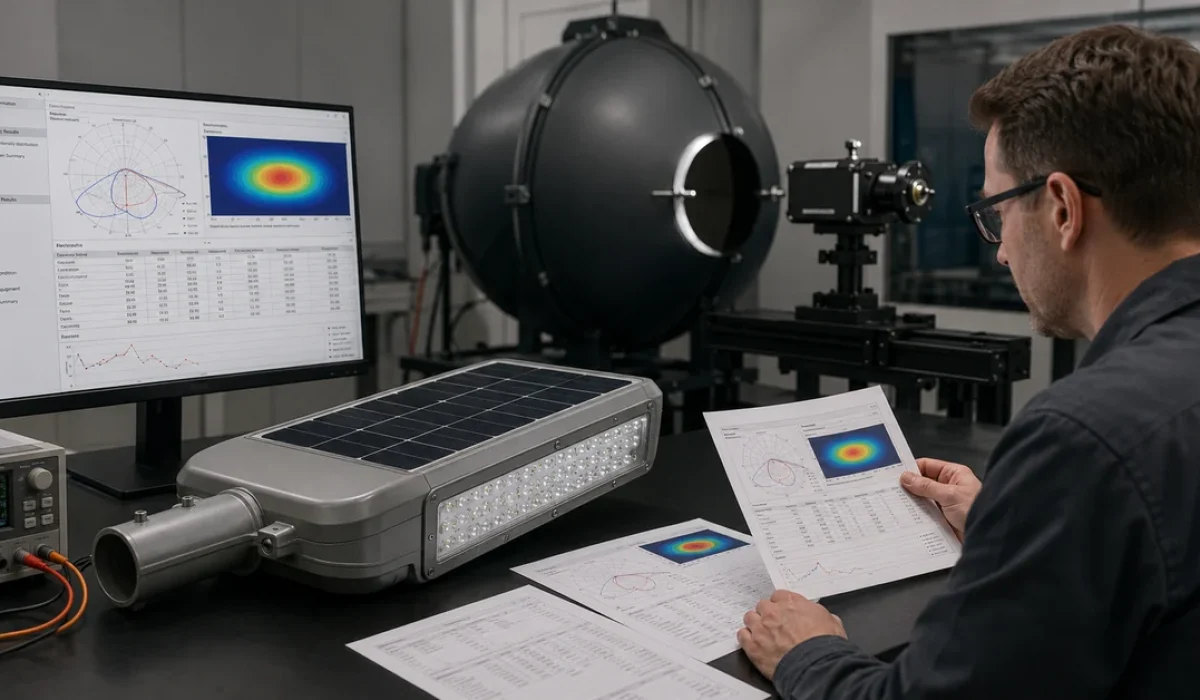
The supporting report should identify the tested model, wattage, CCT, optic, input conditions, laboratory, test method, and report number. An LED chip datasheet, cropped test screenshot, IES file, or general statement that a product is “LM-79 tested” is not sufficient for technical approval.
Project Review Summary
| Review item | What buyers should confirm |
|---|---|
| Main question | Does 220–230 lm/W represent the complete proposed luminaire or only an LED component? |
| Best-fit readers | EPC contractors, municipal buyers, lighting consultants, tender teams and project distributors |
| Primary decision stage | Supplier screening, technical bid review, sample approval and pre-order due diligence |
| Required calculation | Measured total luminous flux divided by measured luminaire input power |
| Configuration match | Model, wattage, CCT, CRI, optic, electrical input and control configuration |
| Supporting documents | Photometric report, IES/LDT file, datasheet, BOQ, model label and project simulation |
| Main risk | A chip-level or module-level efficacy figure is presented as complete-luminaire performance |
| Final limitation | High lm/W does not automatically prove road-lighting compliance, autonomy or batch consistency |
What Does a 220–230 lm/W Claim Actually Measure?
Luminous efficacy describes how much visible light output is produced for each watt of electrical input:
[
\text{Luminous efficacy} =
\frac{\text{measured total luminous flux in lumens}}
{\text{measured electrical input power in watts}}
]
The formula is simple. The measurement boundary is not.
A specification showing “230 lm/W” should identify which part of the product was measured and where the electrical input was recorded.
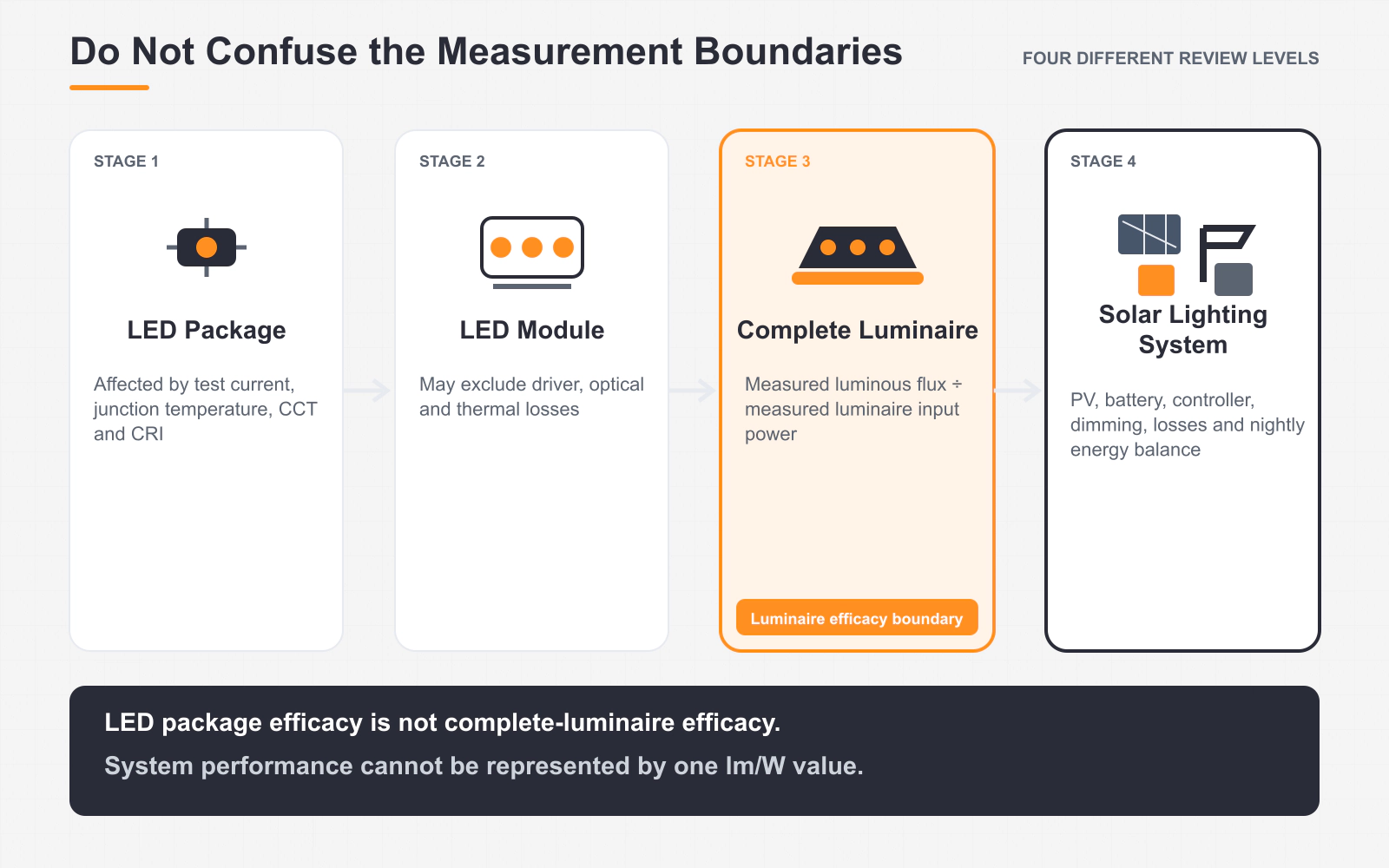
| Performance level | What is being measured | Can it represent the supplied luminaire? |
|---|---|---|
| LED package efficacy | A single LED package under defined current, junction temperature, CCT and CRI conditions | No |
| LED module efficacy | An LED board or light engine, sometimes excluding the driver, controller or optical cover | No |
| Luminaire efficacy | Complete luminaire light output divided by the measured luminaire input power | Yes, when the tested configuration matches the offer |
| Solar system performance | PV generation, battery storage, controller conversion, luminaire load, dimming and daily energy balance | No single lm/W value can describe the complete system |
For project approval, the most useful wording is:
Measured luminaire efficacy at the stated electrical input boundary.
Expressions such as “system efficiency,” “lighting efficiency” or “solar efficiency” are too vague unless the supplier defines exactly which components and losses are included.
Why LED Chip Efficacy Is Not Luminaire Efficacy
An LED package may achieve a high efficacy under controlled laboratory conditions. That does not mean a complete street light will deliver the same lm/W.
Between the LED package and the light leaving the finished luminaire, performance can be affected by:
- LED drive current;
- junction and operating temperature;
- driver or DC conversion losses;
- PCB and electrical losses;
- secondary lenses;
- protective glass or optical covers;
- sealing structures;
- CCT and CRI selection;
- thermal management;
- controller output conditions.
For example, suppose a supplier claims a complete luminaire efficacy of 230 lm/W and the combined retention from LED package to finished luminaire is estimated at 85%.
The upstream light-source efficacy would need to be approximately:
[
230 \div 0.85 \approx 271\text{ lm/W}
]
This calculation can be used as an initial plausibility check. It cannot replace product testing because the actual loss chain depends on the LED, current, thermal design, optic and measurement conditions.
A high-efficacy LED datasheet therefore proves only that the selected LED technology may support an efficient luminaire. It does not prove the performance of the assembled product.
Can a Complete Solar Street Light Reach 220–230 lm/W?
It should not be assumed that every 220–230 lm/W claim is false. LED technology, low-current operation, efficient optics and optimized thermal design can produce high luminaire efficacy.
However, “technically possible” and “verified for the offered product” are different conclusions.
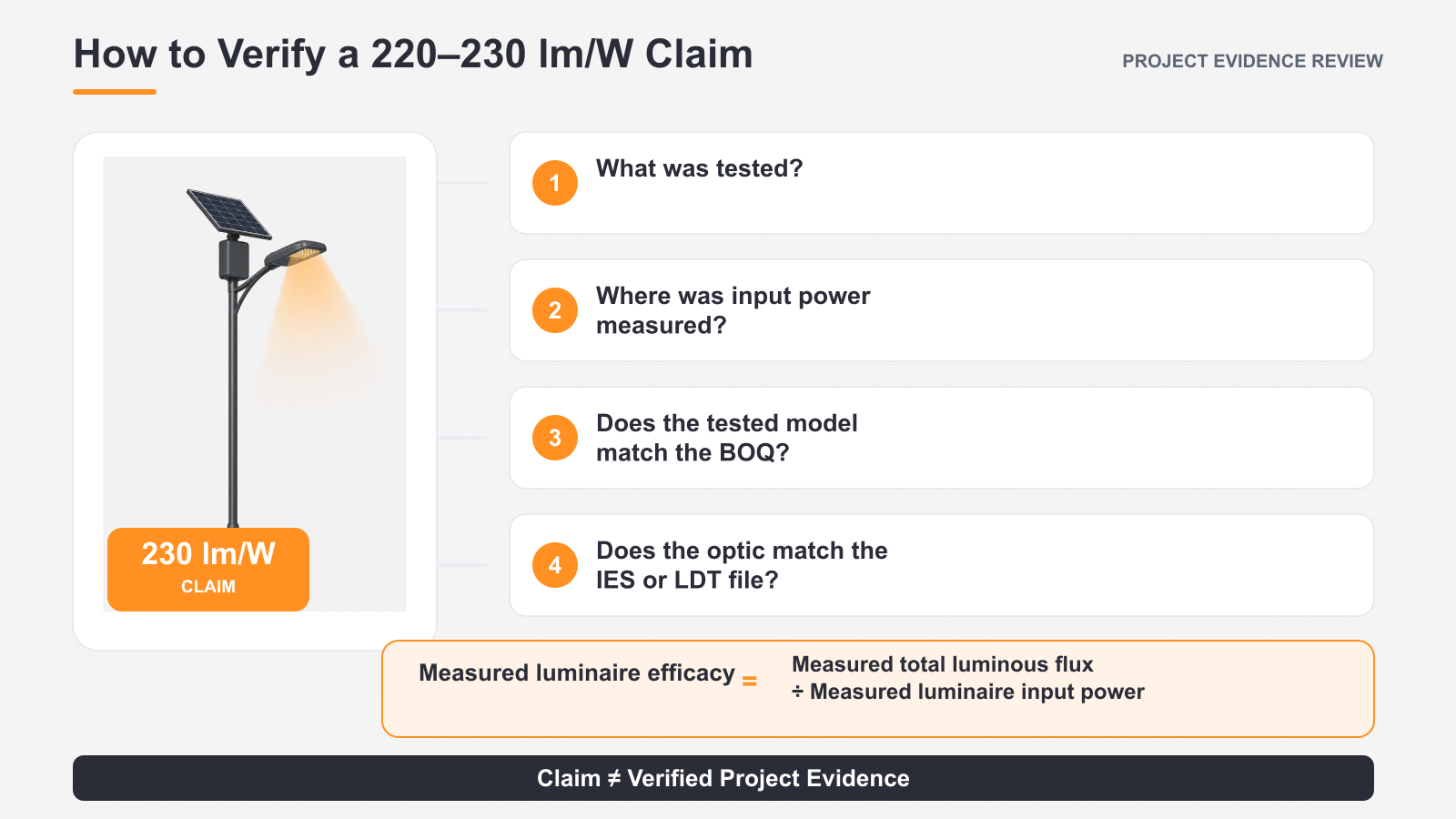
A buyer should not approve the figure until the supplier can answer the following questions:
- Was the complete luminaire tested?
- Was the driver or DC control stage included in the measured input power?
- Does the report identify the exact model being offered?
- Does the tested optic match the project BOQ?
- Does the tested CCT and CRI match the tender submission?
- Was the claimed efficacy calculated from measured lumens and measured watts?
- Is the laboratory and report traceable?
- Does the corresponding IES or LDT file come from the same optical configuration?
A product page or catalog may describe what a manufacturer intends to supply. A model-matched test report provides evidence of what a defined sample actually achieved.
What LM-79-24 Can—and Cannot—Prove
The current ANSI/IES document is ANSI/IES LM-79-24. It defines methods for optical and electrical measurements of solid-state lighting products.
LM-79 is a measurement method. It is not a permanent product certification, system warranty or project-acceptance certificate.
What an LM-79-Type Report Can Support
Depending on the test scope, the report may provide:
- total luminous flux;
- measured input power;
- calculated luminaire efficacy;
- luminous-intensity distribution;
- voltage and current;
- CCT;
- CRI;
- chromaticity coordinates;
- power factor and related AC electrical data where applicable;
- photometric data used to generate an IES or LDT file.
The U.S. Department of Energy’s guidance on understanding LM-79 reports similarly treats the report as a record of the tested product’s optical and electrical performance under defined conditions.
What It Does Not Prove by Itself
An LM-79 report does not automatically prove:
- 50,000-hour or longer product lifetime;
- five-year or ten-year system life;
- battery autonomy days;
- PV charging performance;
- operation during prolonged rainy periods;
- high-temperature field performance;
- road illuminance or luminance compliance;
- uniformity or glare compliance;
- suitability for a specific pole height or spacing;
- consistency of the full production batch;
- performance of another wattage, optic or CCT;
- compliance with every national or municipal requirement.
These claims require additional evidence, project inputs or engineering review.
How to Audit an LM-79 Report Step by Step
1. Confirm the Laboratory and Report Number
The report should show:
- laboratory name and address;
- report number;
- test date;
- issue date;
- test method;
- authorized signatory or approval information.
The laboratory name alone is not enough. Buyers should confirm whether the laboratory has relevant ISO/IEC 17025 accreditation and whether the applicable photometric and electrical measurements are included in its accreditation scope.
The International Laboratory Accreditation Cooperation recommends verifying accreditation through the relevant accreditation body and reviewing the laboratory’s recognized scope.
For higher-risk tenders, the report number may also be confirmed with the laboratory or accreditation body.
2. Check the Test Method and Version
The report should identify the method used.
Be cautious with expressions such as:
- “LM-79 style”;
- “according to LM-79 principles”;
- “LM-79 data”;
- “LM-79 tested” without a report;
- “equivalent to LM-79.”
These phrases may describe internal testing or a similar report format. They do not necessarily mean that a complete test was performed by a suitably accredited third-party laboratory.
3. Identify the Exact Tested Sample
Look for:
- product model;
- model label or sample photograph;
- rated power;
- measured power;
- nominal voltage;
- CCT;
- CRI;
- optic or lens code;
- control setting;
- mounting or test orientation.
A report with the model number cropped out or replaced by a generic family name cannot reliably support a specific BOQ item.
4. Compare the Tested and Offered Configurations
The tested sample should match the proposed configuration.
| Configuration item | Why it matters |
|---|---|
| Wattage | Different drive currents and thermal loads can change efficacy |
| CCT | Different LED bins and phosphor systems can change output |
| CRI | Higher CRI can reduce efficacy |
| Optic | Lens and cover losses affect total output and distribution |
| Driver/controller | Conversion losses and current settings affect measured watts and lumens |
| Luminaire housing | Thermal performance can affect stabilized output |
| Firmware or dimming state | A reduced-power test may not represent rated operation |
One report should not automatically be assumed to cover an entire product family.
5. Define the Electrical Input Boundary
This is particularly important for solar street lights, which may use DC input and an external or integrated controller.
The report should make clear whether the measured input power was taken at:
- the LED board;
- the LED module;
- the driver input;
- the luminaire input terminals;
- the controller output;
- another defined point.
If the test measures only the LED board while excluding driver or controller losses, the result should not be presented as complete-luminaire efficacy.
The battery, PV module and charging losses should not be silently combined with luminaire lm/W either. Those parts belong to solar-system energy analysis, not luminaire-efficacy measurement.
6. Recalculate the lm/W Value
Do not rely only on the efficacy value printed in a product table.
Use the report values:
[
\text{Verified luminaire efficacy} =
\frac{\text{measured total luminous flux}}
{\text{measured input power}}
]
For example:
[
22{,}400\text{ lm} \div 100.8\text{ W}
= 222.2\text{ lm/W}
]
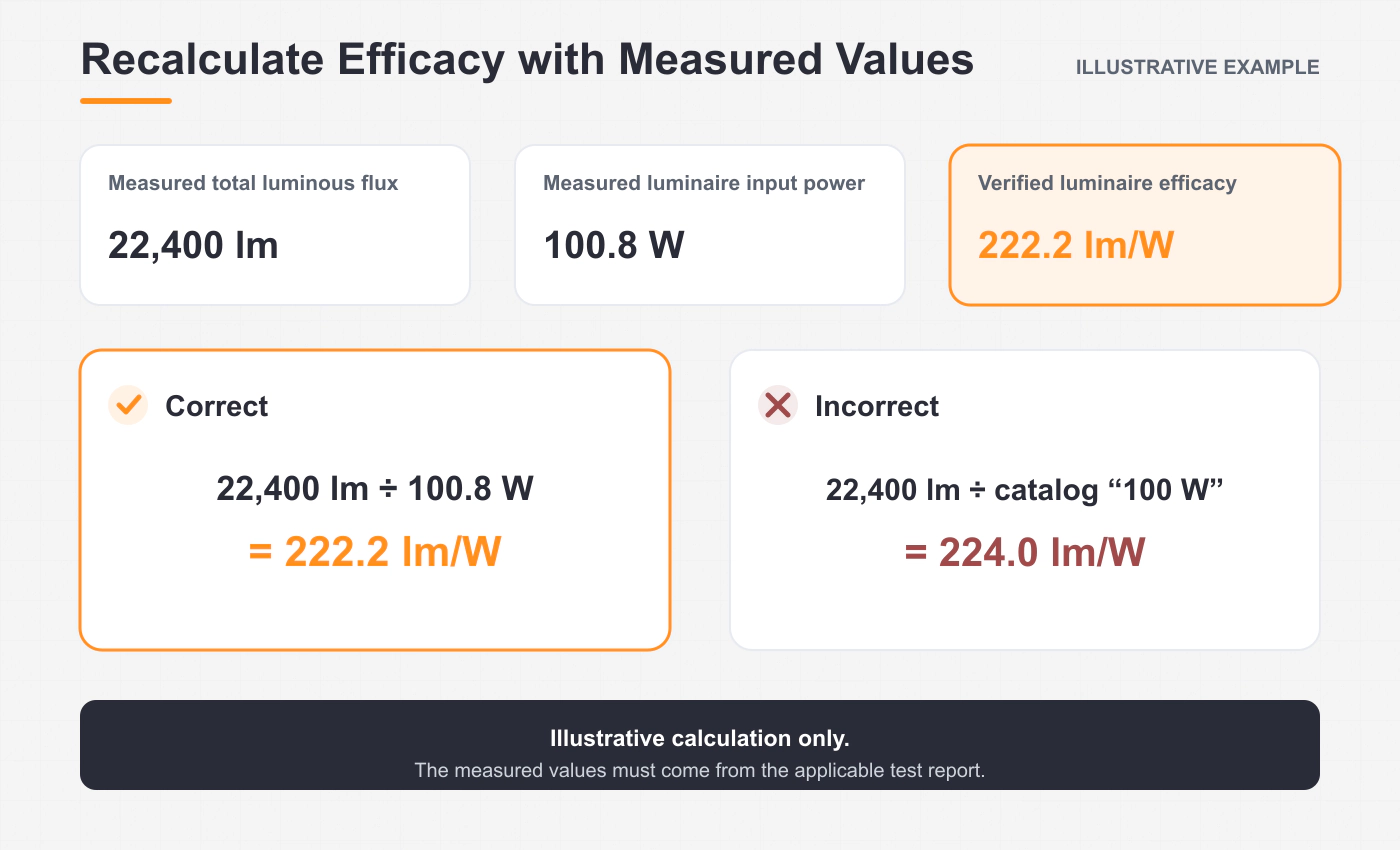
The calculation should use measured input power, not only the nominal product name or rated wattage.
A product called “100 W” may draw slightly more or less than 100 W during testing. Using the catalog wattage instead of the measured value can distort the result.
7. Review the Test Conditions
The report should provide enough information to understand the measurement context, including where applicable:
- ambient temperature;
- stabilization method;
- electrical input;
- measurement equipment;
- test orientation;
- operating state;
- uncertainty statement;
- calibration or traceability information.
A test result is tied to the conditions under which it was obtained. It should not be presented as a guarantee of identical field performance under every climate or installation condition.
8. Cross-Check the Report, IES File, Datasheet and BOQ
The report should not be reviewed in isolation.
Check whether the same model and configuration appear consistently across:
- photometric report;
- IES or LDT file;
- technical datasheet;
- BOQ;
- tender compliance sheet;
- product label;
- approved sample;
- DIALux or Relux report;
- production release documents.
If one document shows Type II optics and another shows Type III, or if the report uses 4000 K while the tender offers 6500 K, the supplier should clarify the discrepancy before approval.
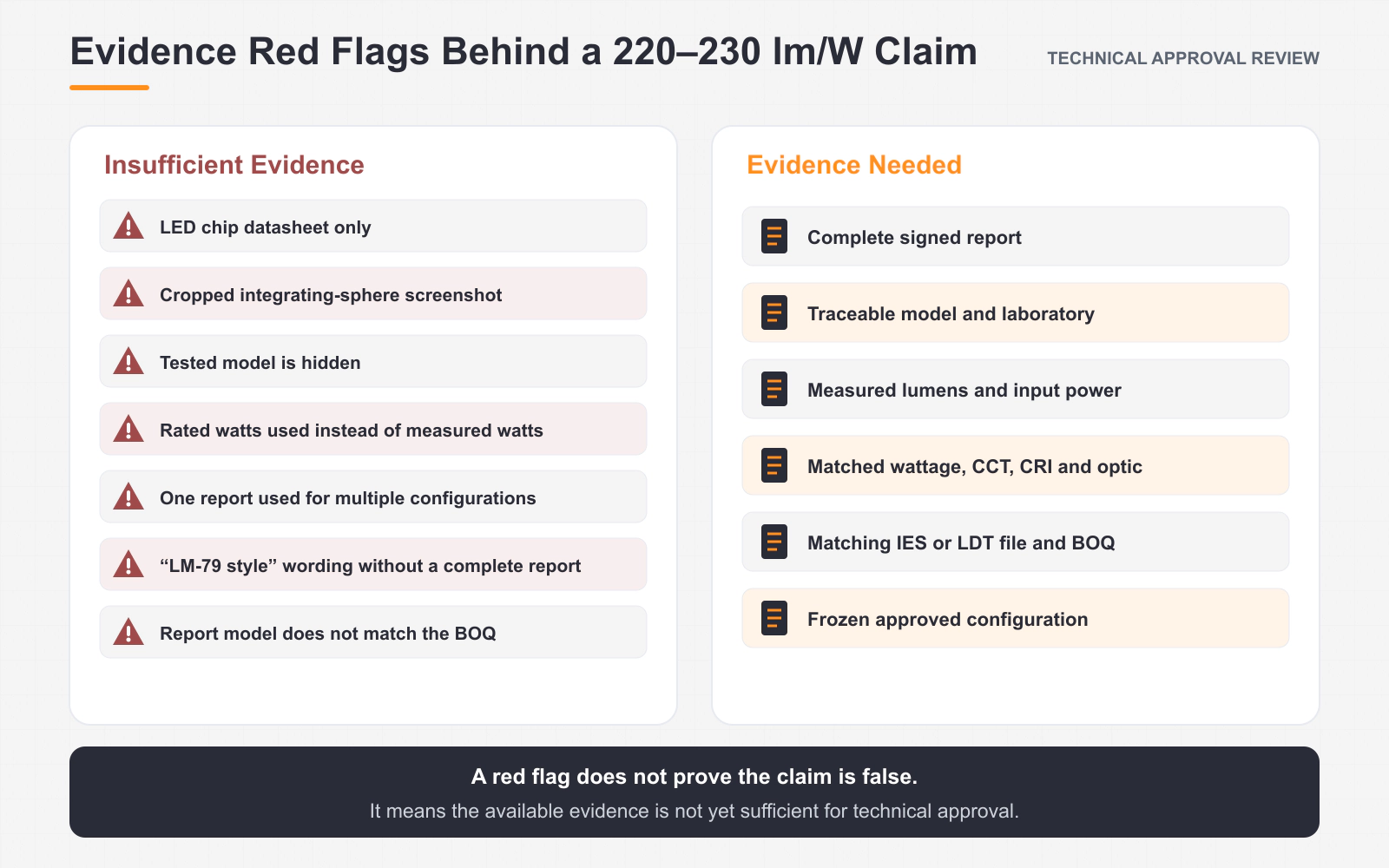
Seven Red Flags in a 220–230 lm/W Claim
| Red flag | Project risk | Required action |
|---|---|---|
| Only an LED chip datasheet is provided | Chip performance may be presented as complete-luminaire performance | Request a complete-luminaire photometric and electrical report |
| Only an integrating-sphere screenshot is provided | Model, test conditions and laboratory traceability may be missing | Request the complete signed report |
| The model number is cropped or hidden | The report cannot be matched to the offered product | Request an uncropped report and sample identification |
| Rated wattage is used instead of measured input power | The lm/W calculation may be overstated | Recalculate using measured watts |
| One report is used for several wattages, optics and CCTs | Untested configurations may be treated as equivalent | Request a configuration-coverage statement or additional testing |
| The supplier writes “LM-79 style” | The document may be an internal test rather than a formal report | Clarify the laboratory, method, scope and report status |
| The report model does not match the final BOQ | Approved evidence may not represent the delivered product | Freeze the approved configuration before production |
A red flag does not automatically prove fraud. It means the available evidence is insufficient for technical approval.
Claim-to-Delivery Verification Matrix
A high-efficacy claim should be connected to the full approval and delivery process.
| Claim | Primary evidence | What must match | What the evidence still does not prove |
|---|---|---|---|
| 220–230 lm/W luminaire efficacy | Photometric and electrical test report | Model, wattage, CCT, CRI, optic and input boundary | Project road-lighting compliance |
| Type II, Type III or another distribution | IES/LDT file and photometric data | Optical code, mounting direction and luminaire model | Required lux, luminance or uniformity |
| Compliance with road-lighting targets | Project DIALux or Relux simulation | Road geometry, pole height, spacing, overhang, tilt and maintenance factor | Production-batch consistency |
| Long-term lumen maintenance | Relevant LED maintenance data and thermal review | LED type, drive current and operating temperature | Complete solar-system lifetime |
| Solar autonomy | Battery, PV and nightly energy calculation | Solar radiation, dimming profile, operating hours and autonomy requirement | Photometric compliance |
| Batch consistency | Frozen BOM, labels, inspection records and approved sample | Components, optics, firmware and production batch | Performance under every field condition |
This matrix prevents a common tender error: using one type of evidence to prove a different type of requirement.
Why High lm/W Does Not Automatically Mean Better Road Lighting
Luminaire efficacy measures the quantity of light produced per watt. It does not show whether the light reaches the required road area in the correct distribution.
A 230 lm/W luminaire can still perform poorly in a road project if it has:
- an unsuitable optical distribution;
- excessive light directly below the pole;
- insufficient forward throw;
- poor uniformity;
- excessive glare;
- incorrect mounting tilt;
- excessive pole spacing;
- unsuitable pole height;
- an IES file that does not match the supplied optic.
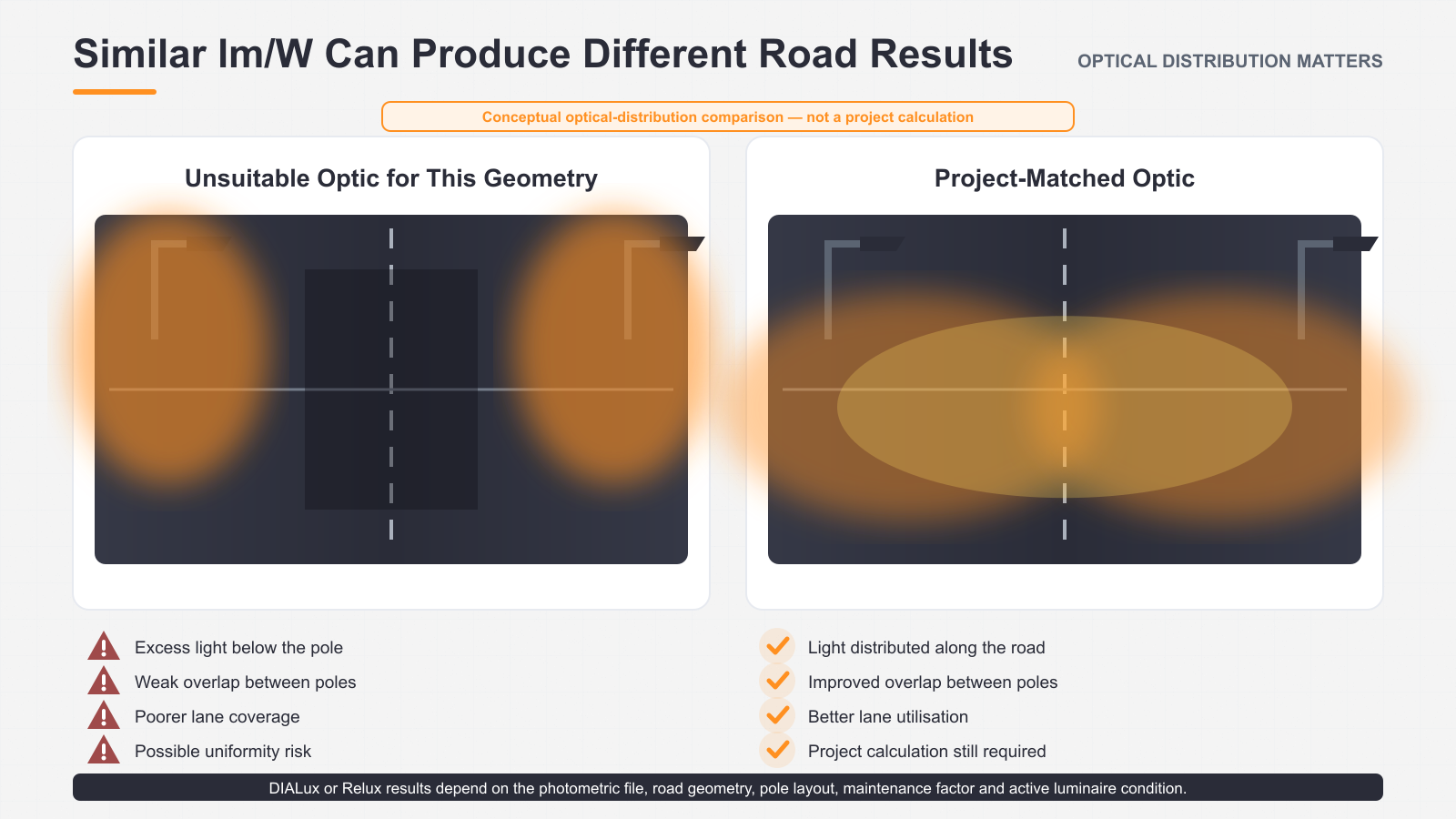
Road-lighting performance must be assessed using the project geometry and a model-matched photometric file.
Typical inputs include:
- road width;
- number of lanes;
- pole height;
- pole spacing;
- single-sided, staggered or opposite arrangement;
- outreach and overhang;
- mounting angle;
- target illuminance or luminance;
- uniformity requirement;
- glare requirement;
- maintenance factor;
- local road-lighting specification.
A DIALux or Relux simulation supports layout review and approval discussions. It does not guarantee final authority approval, because acceptance still depends on the project specification, consultant review, site conditions and local requirements.
Higher efficacy may reduce the electrical power required to produce a target lumen output. It does not automatically justify wider pole spacing.
From Marketing Claim to Batch Delivery
A high-efficacy claim should pass through a controlled evidence chain:
Marketing or datasheet claim
→ Model-matched photometric report
→ IES/LDT and datasheet consistency check
→ Project DIALux/Relux review
→ Approved sample or technical submittal
→ Frozen model, optic, CCT and BOM
→ Production and batch inspection
→ Shipment document review
→ Site commissioning and acceptance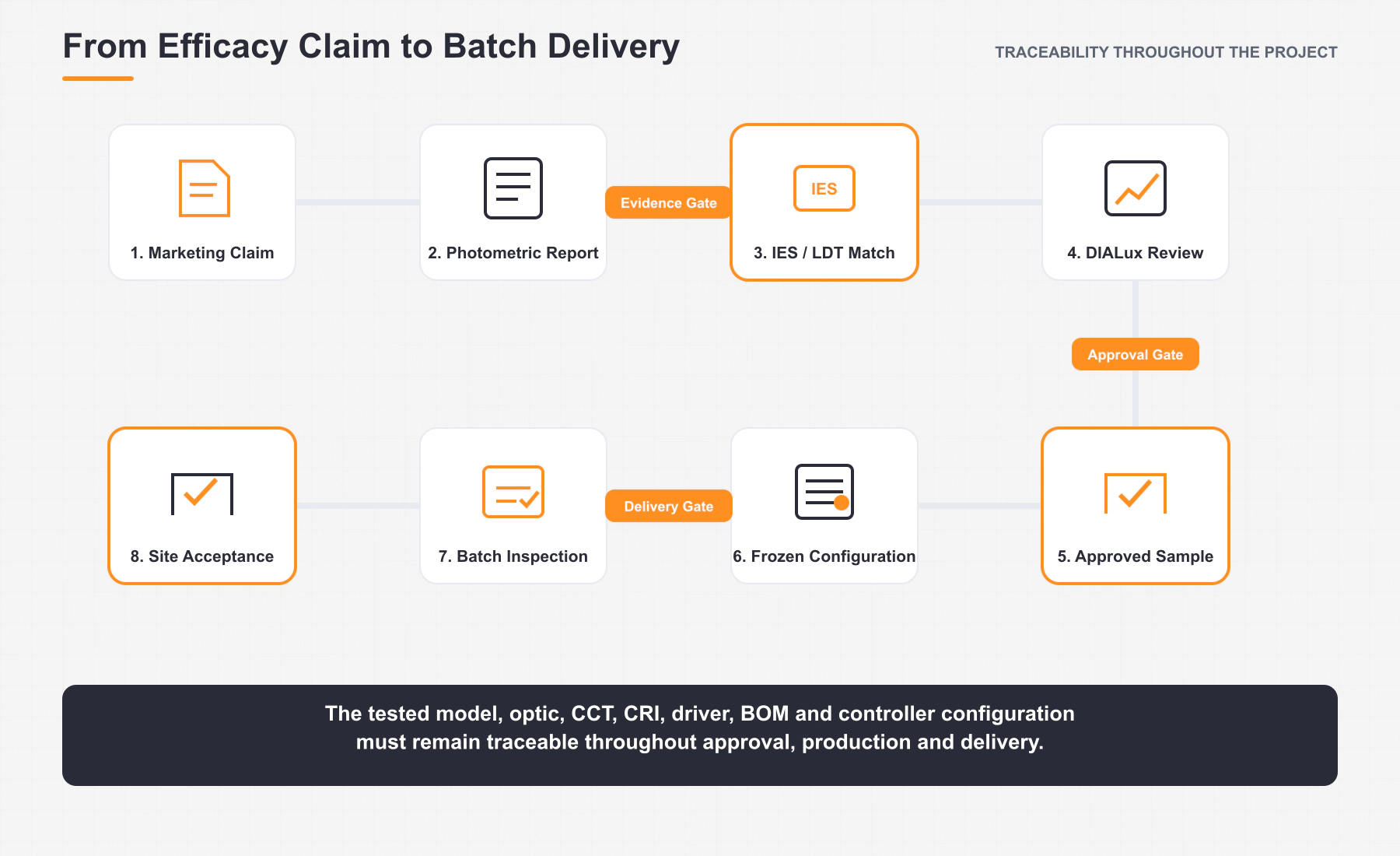
Model-Matched Report
The test report should identify the exact configuration proposed for the project.
Approved Sample
Where required, the sample should be checked against the report, datasheet and proposed BOQ.
Frozen Configuration
After approval, the manufacturer should control changes to:
- LEDs;
- drive current;
- optics;
- controller;
- CCT;
- housing;
- thermal components;
- firmware;
- product label.
A material change may require re-evaluation because the original test data may no longer represent the supplied product.
Batch Inspection
Batch records can be used to confirm that the delivered products follow the approved configuration. The inspection scope may include labels, input power, visual components, optical codes and selected functional or photometric checks.
Site Acceptance
Site acceptance should follow the approved project method. It may include installation inspection, electrical checks, control verification, lighting measurements, commissioning records and handover documentation.
Documents to Request Before Technical Approval
For a project that depends on a 220–230 lm/W claim, request a coordinated document pack rather than a single screenshot.
| Document | What it should confirm |
|---|---|
| Complete photometric report | Measured lumens, watts, efficacy, test conditions and sample identification |
| Laboratory accreditation information | Relevant recognition and applicable measurement scope |
| Product datasheet | Offered model, rated power, CCT, CRI, optic and electrical parameters |
| IES or LDT file | Model-matched luminous-intensity distribution |
| DIALux or Relux report | Project-specific lighting performance |
| BOQ and compliance sheet | Final offered configuration and requirement response |
| Product label or sample photograph | Physical model identification |
| Drawing | Dimensions, mounting interface and installation details |
| BOM or configuration-control statement | Approved critical components and optical configuration |
| Inspection or release record | Production-batch consistency checks |
| Warranty and commissioning scope | Responsibilities after supply and installation |
A catalog alone is not a technical approval pack.
Sunlurio’s Engineering Support structure is intended to connect model selection with photometric files, simulation outputs, drawings and tender documentation rather than treating each file as an unrelated attachment.
Recommended Tender Wording
Tender specifications should avoid ambiguous phrases such as:
The solar street light shall use 230 lm/W LED chips.
That wording does not define complete-luminaire performance and may allow suppliers to submit component-level data.
A more reviewable format is:
The proposed luminaire shall provide a minimum measured luminaire efficacy of [project-defined value] lm/W, calculated from the measured total luminous flux divided by the measured electrical input power of the complete tested luminaire at the stated input terminals.
The supporting photometric report shall identify the offered model, wattage, CCT, CRI, optical distribution, electrical input conditions, test method, laboratory and report number. The tested configuration shall match the submitted datasheet, IES/LDT file, BOQ and project lighting simulation.
LED package or LED module efficacy shall not be submitted as evidence of complete-luminaire efficacy.
The project team should determine whether 220 or 230 lm/W is genuinely necessary.
An unnecessarily high threshold can:
- reduce the number of compliant suppliers;
- encourage unclear measurement boundaries;
- exclude suitable products with better optical performance;
- prioritize headline efficacy over thermal stability or maintainability;
- create specification risk without improving road-lighting results.
The tender should connect efficacy with lighting performance, optical files, system sizing, quality control and acceptance requirements.
When a High-Efficacy Claim Should Not Be Approved Yet
Technical approval should be delayed when:
- the measurement boundary is undefined;
- only an LED datasheet is available;
- the report does not identify the tested model;
- the report configuration differs from the BOQ;
- the laboratory scope cannot be confirmed;
- measured lumens or measured watts are missing;
- the IES file does not match the report;
- one test is being applied to materially different products;
- the supplier cannot explain how the approved configuration will be controlled during production.
The correct response is not necessarily to reject the supplier immediately. The first step is usually a formal clarification request.
A structured RFI can ask the supplier to:
- define the efficacy measurement boundary;
- provide the complete report;
- identify the tested model;
- map the report to the BOQ item;
- confirm the applicable IES/LDT file;
- disclose differences between the tested and offered configurations;
- explain how production consistency will be controlled.
How Sunlurio Supports Photometric Claim Review
For EPC, municipal and tender projects, Sunlurio can review the relationship between the proposed luminaire configuration and the required engineering documents.
The review may include, depending on the model and project stage:
- model and configuration confirmation;
- datasheet review;
- photometric-report applicability;
- IES or LDT file selection;
- DIALux or Relux input preparation;
- BOQ and tender-document consistency;
- drawing and installation-document review;
- clarification of which documents apply to the offered configuration.
Sunlurio’s manufacturing and quality process can also be reviewed together with project-specific document and inspection requirements.
The availability and scope of third-party reports depend on the exact product model, wattage, optic and project configuration. A general product-family statement should not be treated as evidence for every possible combination.
Related Engineering Resources
- Review Sunlurio’s approach to high-efficiency solar lighting system design, including the relationship between luminaire efficiency and solar-system sizing.
- Use the IES photometric file support page when the optical model must be matched to a DIALux or Relux calculation.
- Review DIALux simulation outputs for project-layout and lighting-performance checks.
- Prepare project submission files through Tender Documents and BOQ Support.
- Review the broader Engineering Support workflow before supplier approval or tender submission.
Frequently Asked Questions
Does LM-79 test the LED chip or the complete luminaire?
LM-79 is intended for optical and electrical measurements of solid-state lighting products. The report must still be checked to determine what sample was tested and where the electrical input was measured. A report for an LED board or module should not be presented as a complete-luminaire test.
Can one LM-79 report cover several wattages?
Not automatically. Different wattages may use different drive currents, LED quantities, thermal loads or optical configurations. The supplier should explain why the report is applicable to each offered wattage or provide configuration-specific evidence.
Does an LM-79 report prove a 50,000-hour lifetime?
No. LM-79 records optical and electrical performance at the time of testing. Lifetime and lumen-maintenance claims require other evidence and should consider the LED, driver, thermal design, operating current and environmental conditions.
Can an IES file prove that a luminaire reaches 230 lm/W?
An IES file may contain photometric data, including total lumens and intensity distribution, but it should not be reviewed without the corresponding test and product information. Buyers should confirm that the IES file matches the proposed model, wattage, CCT and optic.
Does higher lm/W allow wider pole spacing?
Not by itself. Pole spacing depends on the optical distribution, pole height, road geometry, target lighting level, uniformity, glare and maintenance assumptions. A model-matched DIALux or Relux simulation is still required.
Is every 230 lm/W solar street light claim false?
No. High luminaire efficacy may be achievable. The correct approach is to verify the measurement level, input boundary, test conditions, report traceability and exact model configuration rather than accepting or rejecting the number based only on its size.
Should a tender require exactly 220 or 230 lm/W?
Only when the project team has a justified engineering reason. The specification should avoid selecting a headline number that is higher than necessary. Optical performance, energy consumption, thermal stability, maintainability, document consistency and project lighting results should be reviewed together.
Request a Model-Matched Photometric Review Pack
Send the proposed model, wattage, CCT, CRI, optic, BOQ, tender clause or available photometric report.
Sunlurio can conduct an initial configuration review and identify which photometric report, IES/LDT file, DIALux input, datasheet and tender-support documents should apply to the requested product.