
A factory’s IQC, IPQC and OQC flowchart does not prove that a specific lighting project order was properly controlled. For EPC contractors, municipal buyers and project consultants, credible quality evidence must connect the approved configuration to the component lots, production records, inspection results, nonconformity decisions and serial numbers released for shipment.
This distinction matters in solar street lighting projects because two products can look identical after assembly while using different batteries, controllers, LED modules, solar panels or programmed operating profiles. A final “power-on” test may confirm that the lamp works today, but it does not prove that the approved components were used or that hidden assembly risks were controlled.
This guide explains how buyers should review order-specific quality records—not merely how a factory describes its general quality process.
Quick Answer: What Actually Proves Project Quality Control?
Project quality control is demonstrated by a traceable chain of order-specific records. These records should show:
-
What product configuration and BOM revision were approved;
-
Which incoming component lots were used;
-
Which inspections were performed during production;
-
Which characteristics were checked at 100% and which were sampled;
-
What actual results were recorded;
-
How nonconforming or reworked products were handled;
-
Who authorized final release;
-
Which serial numbers and cartons were included in the shipment.
The names IQC, IPQC, FQC and OQC are less important than the control point, acceptance criterion, inspection record and disposition authority behind each stage.
A supplier does not prove project quality by showing an IQC/IPQC/OQC flowchart. Buyers need order-specific records that connect the approved BOM, incoming component lots, in-process checkpoints, final results, nonconformity decisions and released serial numbers.
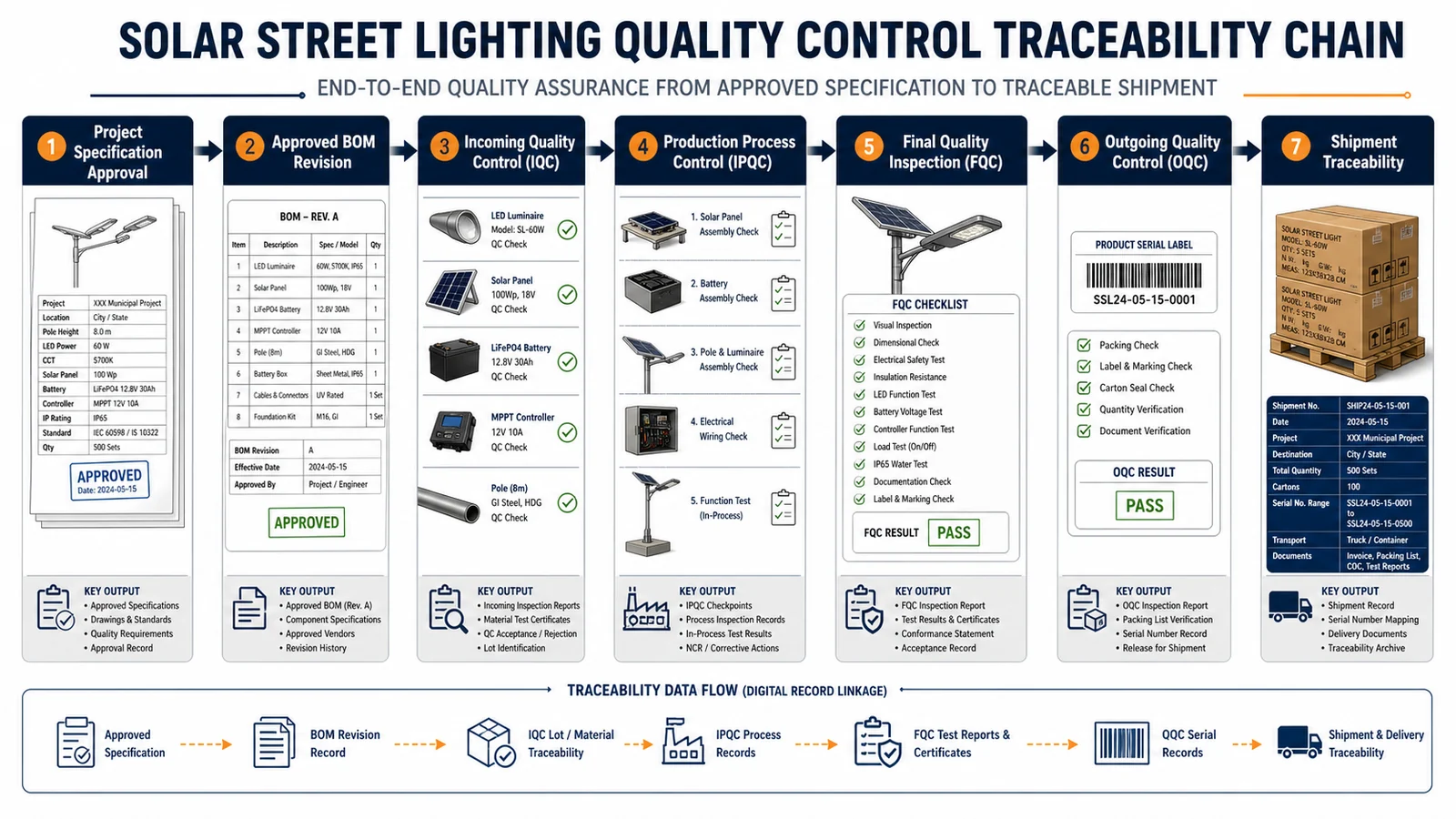
What Is the Difference Between IQC, IPQC, FQC and OQC?
IQC, IPQC, FQC and OQC normally refer to different inspection stages, but their exact boundaries are not identical in every factory. Buyers should therefore ask the supplier to define when each stage occurs, what is inspected, who performs the inspection and what record is retained.
| Stage | Common meaning | Main purpose |
|---|---|---|
| IQC | Incoming Quality Control | Verify incoming components and materials before production |
| IPQC | In-Process Quality Control | Control components, assembly and workmanship during production |
| FQC | Final Quality Control | Inspect completed products after final assembly |
| OQC | Outgoing Quality Control | Verify products, packaging and release conditions before shipment |
Some manufacturers combine FQC and OQC. Others use FQC for completed-product inspection and OQC for packaged-product or pre-shipment release.
The terminology itself is not proof of control. A buyer should confirm:
-
When the control point occurs;
-
Which document or specification defines acceptance;
-
Which characteristics are tested;
-
Whether the inspection is 100% or sampled;
-
How results are recorded;
-
What happens when the product fails;
-
Who is authorized to approve release or concession.
A checklist marked “OQC passed” has limited value if it does not identify the project, product, inspection lot, sample, results and acceptance criteria.
How Is Batch Record Review Different from a Factory Audit or Certificate Review?
A factory audit evaluates the supplier’s capability, while a certificate review evaluates whether specific documents support the proposed product and tender requirements. Batch records answer a different question: what was actually produced, inspected and released for the buyer’s order?
| Review activity | Main question | Evidence reviewed |
|---|---|---|
| Factory audit | Can this factory consistently manufacture and control the product? | Facilities, people, equipment, processes and management systems |
| Certificate review | Do the submitted reports and declarations apply to the proposed model and tender requirements? | Certificates, test reports, declarations, standards and scope |
| Batch quality review | Was this order produced and released according to the approved configuration? | BOM, work orders, component lots, inspections, NCRs and serial numbers |
A factory may pass an audit but still make an unauthorized component substitution on a later order. A valid type-test report may support a defined model but cannot prove that every shipment uses the same battery, controller, LED module or construction.
Similarly, an order-specific OQC report cannot replace laboratory type testing for IP, IK, photometry, corrosion resistance or long-duration battery performance.
Buyers need all three forms of evidence, but they should not confuse their purposes.
What Should Be Approved Before Production Starts?
The approved technical baseline should be frozen before production begins. Without a clear baseline, the buyer cannot determine whether the delivered products match the tender, technical submittal or approved sample.
The production baseline may include:
-
Approved product model;
-
Technical datasheet revision;
-
Approved BOM or critical-component list;
-
Drawings and dimensions;
-
Battery chemistry, nominal capacity and configuration;
-
Controller model and firmware or program version;
-
LED model, quantity, CCT and optical configuration;
-
Solar-module model and rated power;
-
Dimming profile and operating hours;
-
Pole material, dimensions and surface treatment;
-
Labels and serial-number rules;
-
Packaging and project marking;
-
Approved technical deviations;
-
Reference or approved sample.
For a solar street lighting project, the critical-component list is particularly important. It should identify the characteristics that cannot be changed without formal approval.
These may include:
-
Battery-cell or battery-pack manufacturer and model;
-
Nominal battery capacity and voltage;
-
BMS configuration;
-
Controller manufacturer, model and software version;
-
LED and driver configuration;
-
Solar-module type and rated output;
-
Optical distribution;
-
Housing, sealing and connector design;
-
Dimming and autonomy settings.
A supplier should not treat a battery or controller with “similar specifications” as automatically interchangeable. A substitution may affect charging performance, autonomy, thermal behavior, dimming control, communication compatibility, documentation and warranty responsibility.
If a substitution becomes necessary, the buyer should receive a controlled change request showing:
-
The original and proposed components;
-
The reason for the change;
-
Technical comparisons;
-
Compatibility and verification evidence;
-
Schedule or cost effects;
-
Approval status;
-
The production lots affected.
What Should IQC Verify for Solar Street Light Components?
IQC should verify that high-risk incoming components match the approved requirements and are suitable for production. It should also connect the supplier’s component lot to the project work order that later consumes the material.
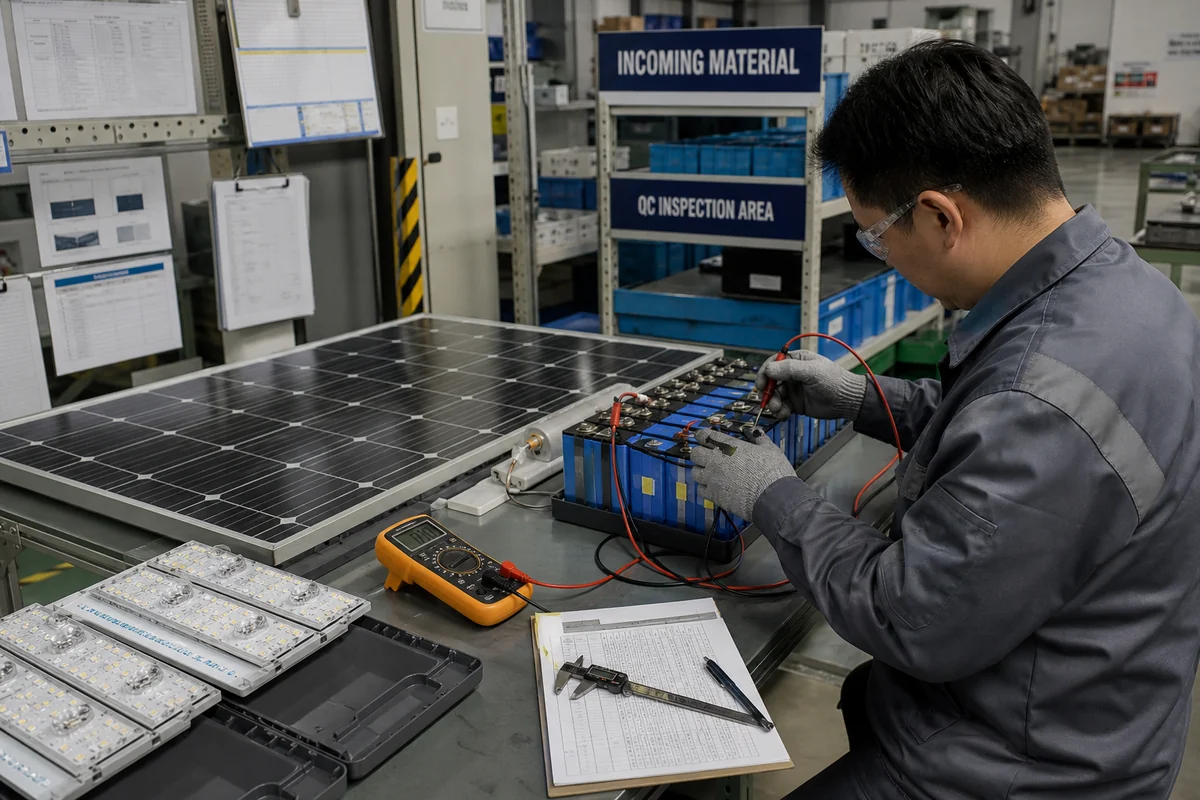
A useful IQC record should identify:
-
Project or customer;
-
Purchase order or production order;
-
Component name and model;
-
Supplier;
-
Supplier lot or date code;
-
Received quantity;
-
Sample quantity or 100% inspection status;
-
Inspection requirements;
-
Actual results;
-
Acceptance or rejection decision;
-
Inspector and date;
-
Nonconformity reference, when applicable.
Recommended incoming checks by component
| Component | Typical verification points | Useful evidence |
|---|---|---|
| LiFePO₄ cells or battery packs | Manufacturer, model, voltage, capacity, internal resistance, date code, appearance and BMS version | Lot labels, IQC measurements, supplier batch data and disposition |
| LED and MCPCB | LED model, CCT, quantity, board identity, soldering condition and key electrical characteristics | Material label, batch number, specification and IQC record |
| Solar controller | Model, rated current, voltage range, firmware and programmed operating logic | Product label, version record and functional sample check |
| Solar module | Model, dimensions, rated power, visual condition, junction box and connectors | Module label, supplier lot and available flash-test data |
| Luminaire housing | Material, dimensions, casting defects, coating and mounting interfaces | Dimensional results and approved defect criteria |
| Seals and connectors | Material, dimensions, compatibility, assembly direction and damage | Incoming record and comparison with approved samples |
| Pole and structural parts | Material grade, thickness, dimensions, welding and galvanizing documentation | Material records, dimensions, weld and coating records |
| Packaging | Carton size, protective structure, labels, accessories and marking | Approved packaging specification and sample |
IQC should not apply the same inspection depth to every component. A decorative label and a battery pack do not carry the same project risk. The inspection plan should prioritize components whose failure or substitution could affect safety, autonomy, photometric performance, sealing or project acceptance.
A common IQC evidence problem
A generic incoming inspection form may show a component name and the word “Pass,” but omit the supplier lot, project work order, actual measurement and inspection date.
Such a document may prove that the factory has an IQC template. It does not prove that the components used in the buyer’s order were inspected.
Which Risks Should IPQC Catch Before Final Assembly?
IPQC should detect mistakes that become hidden, irreversible or difficult to inspect after the product is closed, sealed, welded, potted or packed.
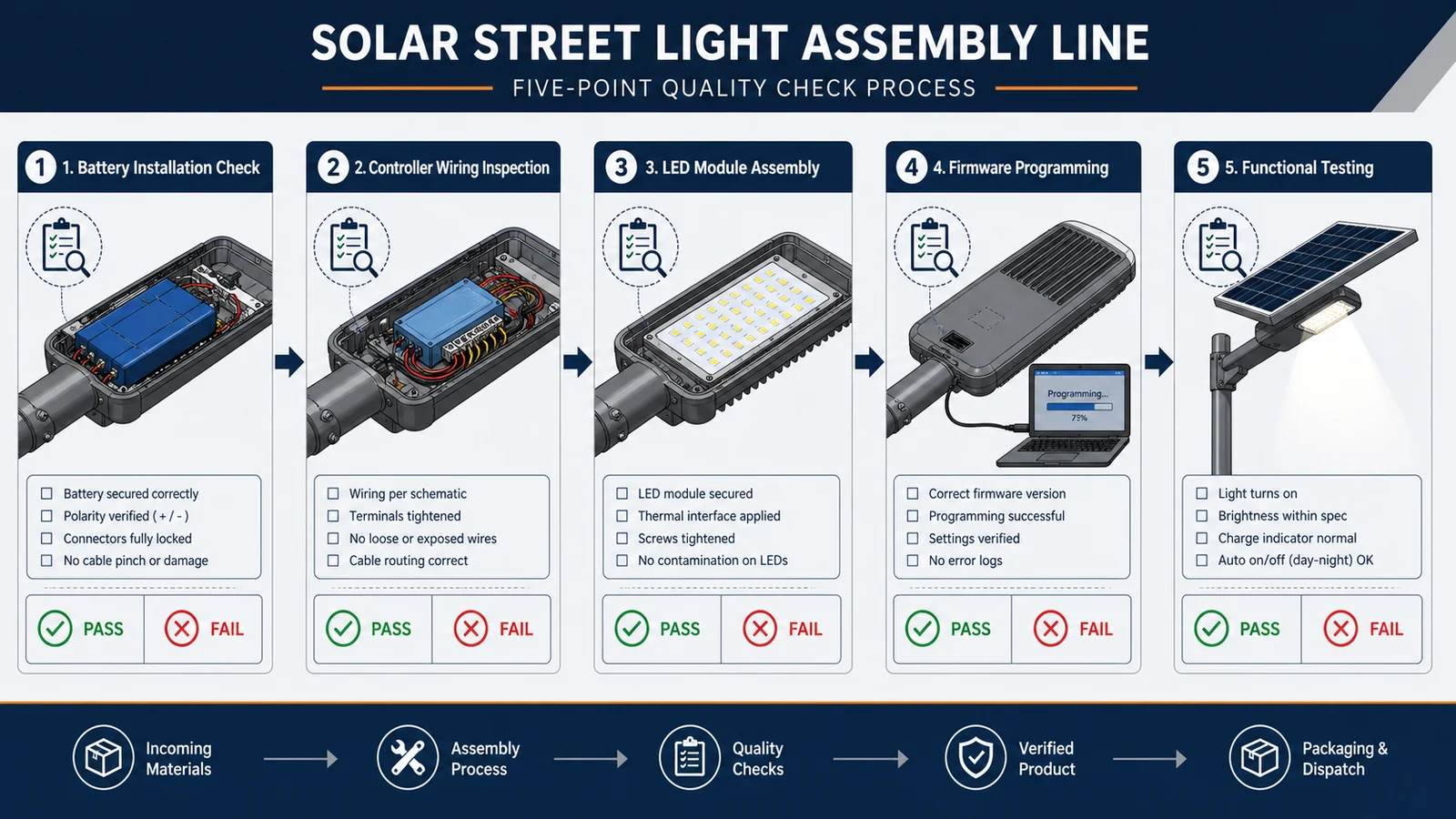
A completed solar street light can illuminate successfully even when it contains assembly conditions that may later cause water ingress, thermal damage, charging failure or premature battery problems.
Important IPQC control points may include:
-
First-article verification;
-
Work-order and BOM revision checks;
-
Component identity verification;
-
Battery polarity and cable routing;
-
Connector engagement;
-
Soldering and crimp quality;
-
Insulation and protection;
-
Battery fixation;
-
Gasket placement;
-
Waterproof cable-gland tightening;
-
Thermal-interface material coverage;
-
Screw or bolt torque;
-
Controller programming;
-
Dimming-profile settings;
-
LED power and operating mode;
-
Label and serial-number application;
-
Recording of process or component changes;
-
Reinspection after repair or rework.
Why a lighting test is not enough
A basic lighting test may confirm that the LED, battery and controller are connected. It may not reveal:
-
A gasket trapped outside its sealing groove;
-
Incomplete thermal-pad coverage;
-
A connector that is inserted but not locked;
-
An incorrectly tightened cable gland;
-
A battery pack with an unapproved cell configuration;
-
The wrong dimming program;
-
A missing insulating pad;
-
An unauthorized BOM substitution.
The inspection plan should therefore place controls before the relevant risk becomes concealed.
First-article approval
First-article inspection is especially useful when:
-
A new project configuration enters production;
-
A new BOM or drawing revision is released;
-
Production changes to a different line;
-
A major component lot changes;
-
A fixture uses a project-specific program;
-
A previous batch experienced a serious nonconformity.
The first article should be checked against the approved baseline before normal batch production continues. However, first-article approval does not eliminate the need for ongoing process and final inspections.
What Should FQC and OQC Verify Before Shipment?
FQC and OQC should confirm the identity, function, workmanship, project configuration, packaging and release status of the actual shipment. They should not be limited to appearance and a simple power-on test.

A final or outgoing inspection may cover:
-
Product model;
-
Technical configuration;
-
Key electrical parameters;
-
Basic operating functions;
-
Dimming or control configuration;
-
Visible assembly quality;
-
Labels and serial numbers;
-
Dimensions;
-
Accessories;
-
Packaging protection;
-
Carton and pallet marking;
-
Quantity;
-
Open NCR or rework status;
-
Sampling results;
-
Final release authorization.
The report should identify the actual inspection lot and the products sampled. Where units are serialized, recording the sample serial numbers improves traceability.
Checks often suitable for 100% verification
Depending on the contract and product risk, buyers may require 100% verification of:
-
Product model and nameplate;
-
Serial number;
-
Basic power-on or functional operation;
-
Visible critical workmanship;
-
Accessories and packing quantity;
-
Project-specific programmed configuration;
-
Obvious damage;
-
Required project markings.
“100% inspection” does not mean that every product underwent every possible performance or destructive test. The supplier should state exactly which characteristics were checked on every unit.
Checks that may be sampled
Sampling may be appropriate for:
-
Selected dimensions;
-
Input power or electrical parameters;
-
Detailed workmanship;
-
Packaging verification;
-
Time-consuming functional tests;
-
Partial disassembly;
-
Selected transport-related checks.
The project inspection plan must define the sample and acceptance method before inspection begins.
Tests a normal OQC inspection cannot replace
Routine outgoing inspection should not be presented as a replacement for:
-
Full IP rating testing;
-
IK impact testing;
-
Complete photometric laboratory testing;
-
Long-duration battery cycling;
-
Salt-spray or extended corrosion testing;
-
Full luminaire safety type testing;
-
Solar-module design qualification;
-
Long-term environmental reliability testing.
For example, IEC 60598-1:2024 specifies general requirements and tests for luminaires. A claim that a luminaire is tested to IEC 60598 should not be interpreted as meaning that every production unit undergoes every test described in the standard.
Type-test evidence and production-batch evidence serve different purposes.
Which Checks Should Be 100% and Which Can Be Sampled?
The decision should be based on risk, detectability, contractual requirements, product variability and inspection cost—not on a universal online checklist.
A characteristic is more likely to require 100% inspection when:
-
Failure could create a safety risk;
-
Every unit has an individual programmed configuration;
-
The buyer explicitly requires 100% verification;
-
Identification or traceability must be complete;
-
A defect can be checked quickly without damaging the product;
-
Previous production showed an elevated failure risk;
-
Units within the lot are not sufficiently homogeneous.
Sampling may be reasonable when:
-
The lot is clearly defined and homogeneous;
-
Samples can be selected randomly;
-
The test can detect the relevant defect;
-
Inspection is destructive or time-consuming;
-
The selected plan provides a suitable acceptance decision;
-
The contract does not require 100% inspection.
A mathematically correct sample is still unreliable if the inspection lot is mixed, incomplete or preselected.
For example, a lot should not silently combine:
-
Two battery suppliers;
-
Different controller versions;
-
Different BOM revisions;
-
Reworked and unreworked products;
-
Products from different production conditions;
-
Finished products and incomplete products.
If these differences could affect quality, the products may need to be separated into different inspection lots.
How Should Buyers Define an AQL Sampling Plan?
An AQL-based inspection plan must define the inspection lot, sample selection method, inspection level, defect classifications and acceptance/rejection rules. Stating only “AQL 2.5” is not a complete sampling plan.
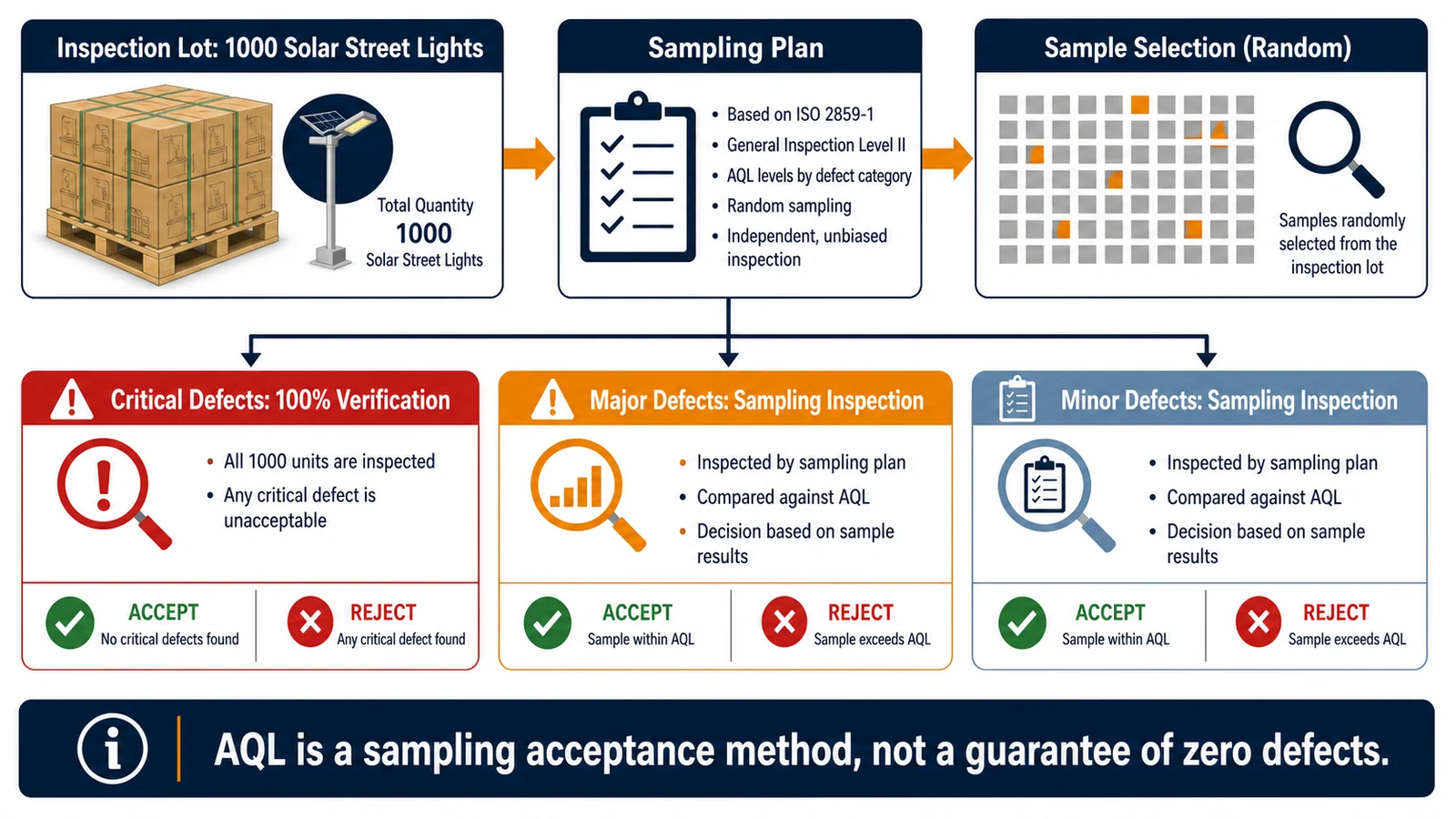
As of 2026, ISO 2859-1:2026 is the current ISO edition for sampling procedures for inspection by attributes indexed by acceptance quality limit. It replaced ISO 2859-1:1999.
The new standard continues to provide sample-size and acceptance procedures for lot-by-lot inspection, including normal, tightened and reduced inspection arrangements.
A project inspection plan should define at least:
-
Inspection-lot definition;
-
Lot size;
-
Referenced standard and edition;
-
Single, double or multiple sampling;
-
Normal, tightened or reduced inspection;
-
Inspection level;
-
Critical, major and minor defect definitions;
-
AQL or other agreed acceptance basis;
-
Random sample-selection method;
-
Sample size;
-
Acceptance number;
-
Rejection number;
-
Action after lot rejection;
-
Sorting or rework requirements;
-
Reinspection method.
This article does not reproduce the standard’s sampling tables. The project team should use an authorized copy of the applicable edition and ensure that the contract, inspection agency and supplier refer to the same version.
Why fixed online AQL values can be misleading
Many inspection guides automatically recommend values such as:
-
Critical: 0;
-
Major: 2.5;
-
Minor: 4.0.
These values should not be copied into every lighting contract without a risk assessment. Suitable limits depend on:
-
Product type;
-
Defect consequences;
-
Project quantity;
-
Manufacturing maturity;
-
Inspection cost;
-
Replacement difficulty;
-
Site accessibility;
-
Contract requirements;
-
Previous supplier performance.
A remote highway project with difficult maintenance access may justify different controls from a small non-critical decorative lighting order.
Why Does AQL Not Mean “Allowed Defective Percentage”?
AQL is an index used to select and operate an acceptance-sampling plan. It is not permission for a supplier to knowingly include the same percentage of defective products in a shipment.
The following statement is misleading:
“An AQL of 2.5 means the buyer agrees to accept 2.5% defective products.”
The correct interpretation is that the selected AQL, together with the lot size, inspection level and sampling plan, determines the sample size and acceptance or rejection numbers.
The shipment is accepted or rejected through the agreed sampling procedure. The buyer is not authorizing the supplier to deliberately ship known defects up to a stated percentage.
AQL also has practical limits
An accepted sample does not prove that the entire shipment is defect-free. Sampling controls statistical decision risk; it does not eliminate it.
Sampling also becomes weak when:
-
The sample is not random;
-
The supplier preselects “good” units;
-
The inspection lot is mixed;
-
Production is incomplete;
-
The defect cannot be detected by the chosen method;
-
A systemic problem has already been identified;
-
Reworked units are not separately controlled;
-
The sample is taken from stock that will not actually be shipped.
For safety-critical or project-specific features, contractual 100% inspection or a different verification method may be necessary.
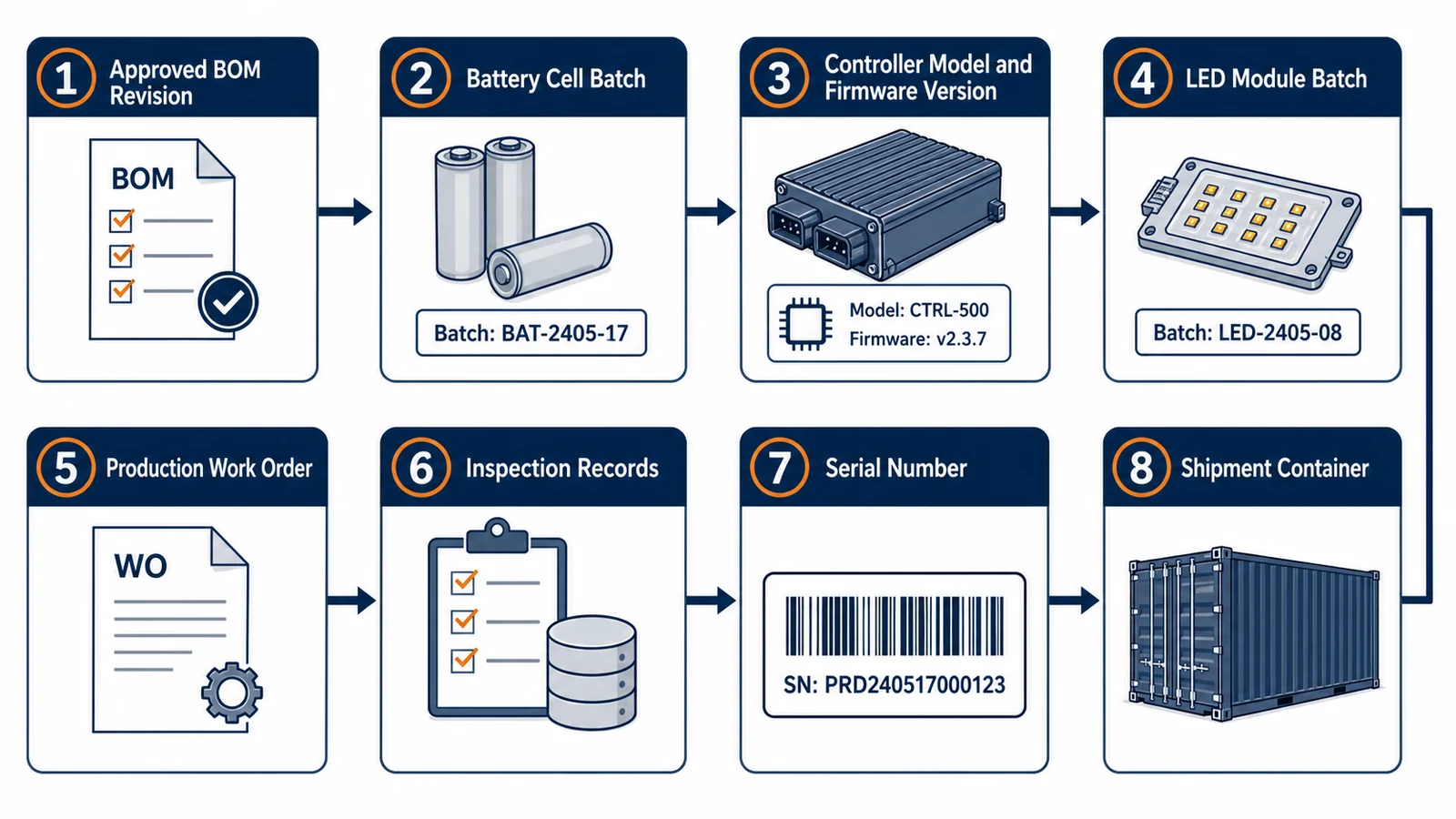
How Should the Order Be Traced from Approved BOM to Shipment?
A useful traceability system should connect the approved project configuration to the production records and the products actually shipped. The required depth should be defined by the contract, product risk and buyer’s quality plan.
A recommended project traceability chain is:
Project and Purchase Order
→ Approved Model, Drawings and BOM Revision
→ Production Work Order
→ Incoming Component Supplier and Lot
→ Production Line, Date and Shift
→ IPQC and Functional Test Records
→ Finished-Product Serial Number
→ OQC or FAT Results
→ Carton and Pallet Identification
→ Packing List
→ Shipment
ISO 9001 does not automatically require every solar street light to have full unit-level serial-number traceability. However, ISO guidance on documented information explains that evidence of unique identification should be retained where traceability is a requirement, and release records should include evidence of conformity with acceptance criteria and traceability to the person authorizing release.
The buyer should therefore define the traceability needed for the project instead of assuming that an ISO 9001 certificate guarantees a particular level of product tracking.
Priority traceability items for solar street lighting
Depending on the contract, buyers should consider tracing:
-
Battery-pack model and batch or serial number;
-
Cell lot, when technically and commercially appropriate;
-
Controller model and program version;
-
LED luminaire model and serial number;
-
Solar-module model and serial number;
-
Production work order and date;
-
Key inspection results;
-
Carton and packing-list relationship.
Traceability for poles and structural parts
For lighting poles, project records may also need to connect:
-
Steel material documents;
-
Material or heat batch;
-
Pole production batch;
-
Dimensions;
-
Welding records;
-
Galvanizing batch;
-
Coating or surface-treatment records;
-
Final inspection;
-
Packing and shipment identification.
The required evidence should match the project specification. Buyers should avoid asking for records with no clear acceptance purpose, but they should not omit evidence for characteristics that affect structural safety or corrosion performance.
What Should a Credible Inspection Record Contain?
A credible inspection record should allow another reviewer to identify what was inspected, against which requirement, with what result and under whose authority.
| Review field | Low-value evidence | Higher-value evidence |
|---|---|---|
| Project identity | No customer or PO | Project, customer, PO and work order identified |
| Product identity | “Solar light” | Model, rating and BOM or drawing revision |
| Lot identity | No lot information | Lot quantity, production batch and material lots |
| Inspection basis | “Check appearance” | Drawing, specification, tolerance or defect standard |
| Results | Only “OK” marks | Actual measured values plus Pass/Fail |
| Instruments | Not recorded | Equipment ID and valid calibration status |
| Sample | Unknown source | Sample size, serial numbers and selection method |
| Nonconformity | Every field marked Pass | NCR, disposition, rework and reinspection records |
| Authorization | No name or date | Inspector, reviewer, release authority and dates |
| Shipment link | Cannot be reconciled | Connected to serial-number list and packing list |
A signature or company stamp does not automatically make a record reliable. The strongest evidence comes from consistency between documents.
For example:
-
Does the battery lot on the IQC form appear in the production work order?
-
Does the work order reference the approved BOM revision?
-
Do the sampled serial numbers appear in the packing list?
-
Does the OQC quantity match the shipment quantity?
-
Does the controller version match the approved dimming profile?
-
Are reworked units included in the reinspection record?
Cross-document consistency is more useful than a perfectly formatted form.
How Should Nonconforming, Reworked or Changed Products Be Controlled?
Nonconforming products should be identified, segregated, evaluated and formally dispositioned before release. Reworked or repaired products should be inspected again against the applicable acceptance requirements.
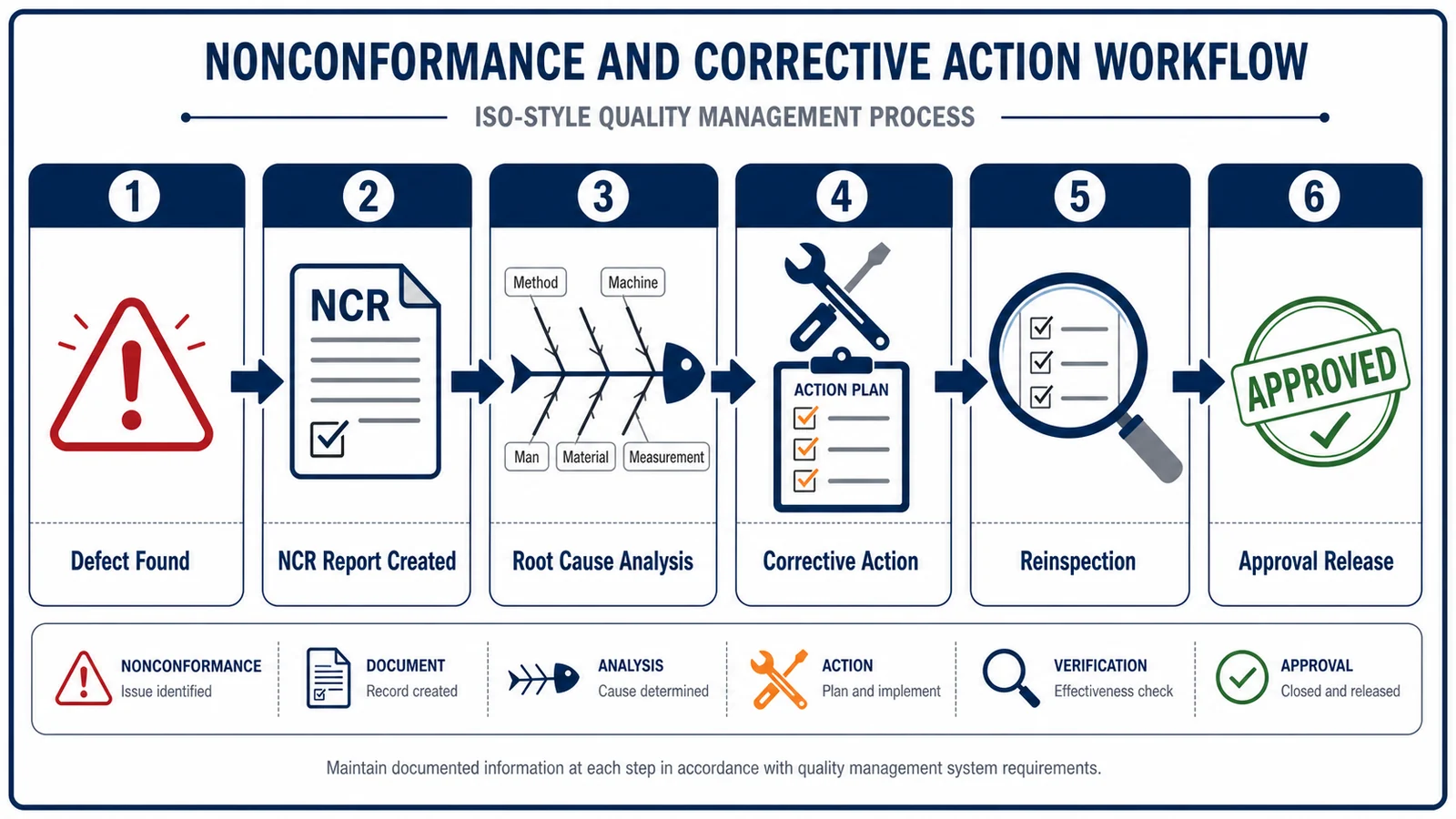
Possible dispositions include:
-
Rejection;
-
Return to supplier;
-
Rework;
-
Repair;
-
Sorting;
-
Use-as-is concession;
-
Downgrade;
-
Scrap.
These decisions are not interchangeable.
Rework
Rework returns the product to the original requirement. After rework, the affected characteristics—and any characteristics that the rework could influence—should be reverified.
Repair
Repair may make the product usable without fully restoring the original specified condition. It may therefore require technical evaluation and buyer approval.
Concession or use-as-is
A concession permits acceptance of a known deviation. The authority to approve it should be defined in the contract or quality plan. A factory inspector should not independently accept a deviation that changes a buyer-approved technical requirement.
Material or BOM change
A component substitution should be controlled through an engineering-change process. The change record should identify:
-
The affected component;
-
Original and proposed specification;
-
Reason for change;
-
Compatibility assessment;
-
Tests or documents reviewed;
-
Affected work orders or serial numbers;
-
Buyer approval, when required.
A verbal statement that “the new component is equivalent” is not sufficient for a critical battery, controller, LED, optical or structural change.
A Practical Batch-Evidence Review Framework
Buyers can use the following B-R-I-D-G-E framework to organize a lighting project batch review.
| Element | Review focus | What the buyer should confirm |
|---|---|---|
| B – Baseline | Approved configuration | Model, BOM, drawings, datasheet, approved sample and deviations |
| R – Records | Inspection evidence | IQC, IPQC, FQC and OQC records correspond to the order |
| I – Identification | Traceability | PO, work order, component lots, batches and serial numbers connect |
| D – Disposition | Nonconformity control | Reject, rework, repair and concession decisions are authorized |
| G – Gauges | Measurement reliability | Instruments, calibration status, methods and operators are identified |
| E – Evidence of Release | Final acceptance | Criteria, actual results, sampling decision and release authority are recorded |
The framework is designed to prevent a common review mistake: checking individual documents in isolation.
A record set may look complete while still containing breaks between the approved configuration, production batch and final shipment.
Example: Reviewing a 1,000-Set Solar Street Light Order
Consider an illustrative order for 1,000 solar street lights—not a claimed Sunlurio project—with the following approved configuration:
-
80 W LED luminaire;
-
Defined LiFePO₄ battery capacity;
-
Specified solar controller;
-
Approved dimming profile;
-
Two production batches;
-
Third-party pre-shipment inspection.
The quality evidence might follow this chain:
Approved Configuration Rev. B
→ Work Orders WO-01 and WO-02
→ Battery Lots BAT-A and BAT-B
→ Controller Firmware V3.2
→ First-Article Approval
→ IQC and IPQC Records
→ OQC 100% and Sampled Checks
→ NCR-004 Rework
→ Reinspection
→ Released Serial Numbers
→ Packing List
This structure allows the buyer to ask practical questions.
Did the second battery lot match the approved requirement?
The buyer can compare BAT-A and BAT-B against the approved battery specification, IQC results and production work orders.
Was the correct dimming program installed?
The controller version and program record can be connected to the first-article approval, IPQC programming check and sampled functional verification.
Were reworked units inspected again?
NCR-004 should identify the affected serial numbers, disposition, completed action and reinspection results.
Did the third-party inspector sample the actual shipment?
The sampled serial numbers should appear in the released serial-number list and packing records.
Without this traceability, the buyer may receive a polished PSI report but remain unable to establish whether the samples represented the products actually shipped.
When Should Buyers Use FAT or Third-Party Inspection?
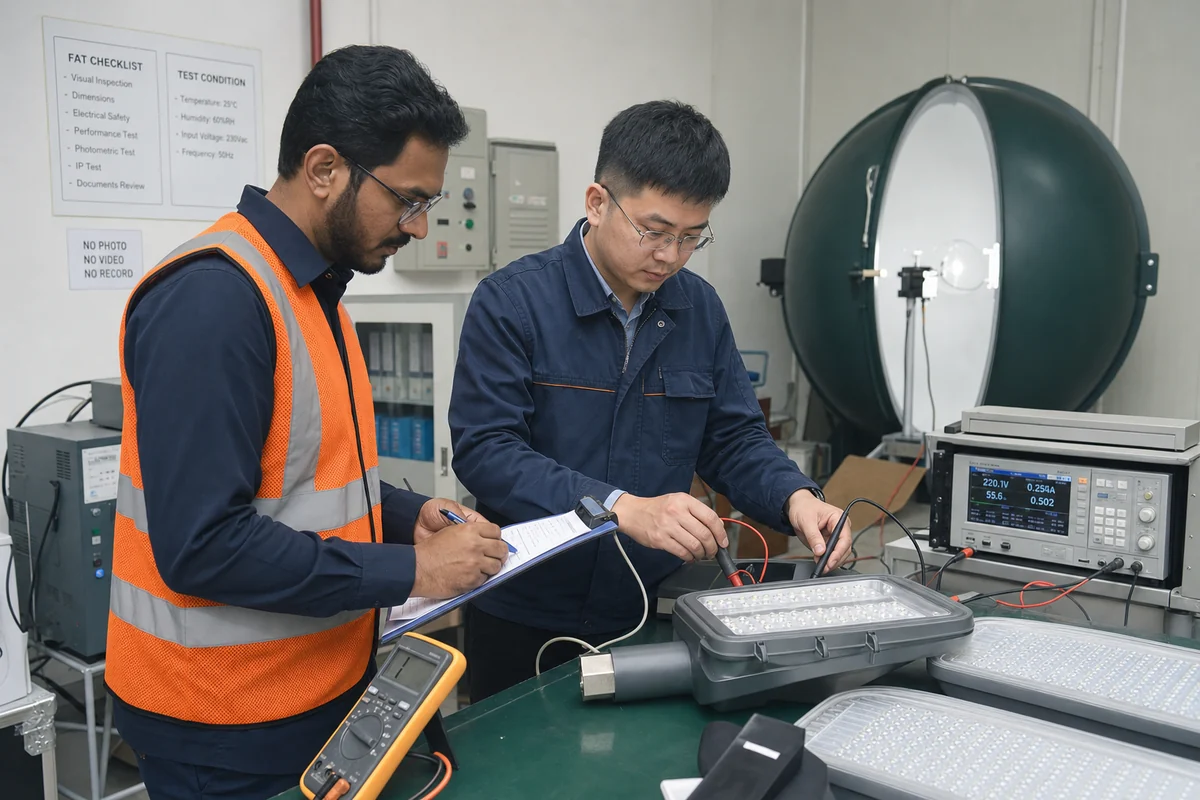
FAT and third-party inspection are useful when independent witness, contractual verification or pre-shipment acceptance is required. However, they do not replace the supplier’s continuous production controls and batch records.
Factory QC should provide
-
Incoming material control;
-
Production and process control;
-
BOM and configuration control;
-
Nonconforming-product segregation;
-
Rework and corrective action;
-
Traceability;
-
Final release records.
FAT may verify
-
Project configuration;
-
Product identity;
-
Quantity;
-
Selected electrical and functional performance;
-
Dimming or control logic;
-
Accessories;
-
Documents;
-
Witness or hold points;
-
Project-specific acceptance tests.
Third-party inspection may verify
-
Shipment quantity;
-
Workmanship;
-
Appearance;
-
Selected dimensions;
-
Basic operation;
-
Packaging and marking;
-
Agreed sampling tests;
-
FAT witnessing;
-
Selection or sealing of laboratory samples.
Third-party pre-shipment inspection is usually a point-in-time verification. It cannot reconstruct missing incoming-material records or prove what happened throughout production.
Where an inspection body or laboratory is used, buyers should examine not only its accreditation claim but also the applicable scope. ILAC explains that ISO/IEC 17020 applies to inspection bodies and ISO/IEC 17025 to testing and calibration laboratories. The relevant signatory and accreditation scope can be checked through the ILAC MRA framework.
An accreditation logo alone does not prove that every requested inspection or test is included in the accredited scope.
Red Flags in Lighting Project Quality Records
The following signs deserve clarification before shipment approval:
-
The supplier provides only a QC flowchart, with no order-specific records.
-
Records contain no PO, work order, model or batch number.
-
IQC, IPQC and OQC forms appear to have been completed at the same time.
-
Every result is marked “OK” without actual measurements.
-
Acceptance criteria, tolerances or inspection specifications are missing.
-
Inspection quantities do not match the production or packing quantities.
-
Battery, controller, LED or solar-module lots cannot be identified.
-
The production configuration differs from the approved sample or documents.
-
“100% inspection” is claimed but the inspected characteristics are undefined.
-
Sample size is decided informally during the inspection.
-
Production personnel preselect the samples.
-
The sampling standard, edition, level and Ac/Re values are not recorded.
-
The supplier reports no nonconformities across a large or complex order.
-
Reworked products have no reinspection record.
-
Critical components are substituted without approval.
-
Measuring equipment is overdue for calibration or unsuitable for the test.
-
Internal OQC results conflict materially with third-party findings.
-
Final release appears to have been signed before inspection was completed.
-
Inspection reports cannot be connected to cartons or serial numbers.
-
Type-test reports are presented as evidence of batch inspection.
None of these observations automatically proves misconduct. However, each one creates an evidence gap that should be closed before the buyer relies on the record set.
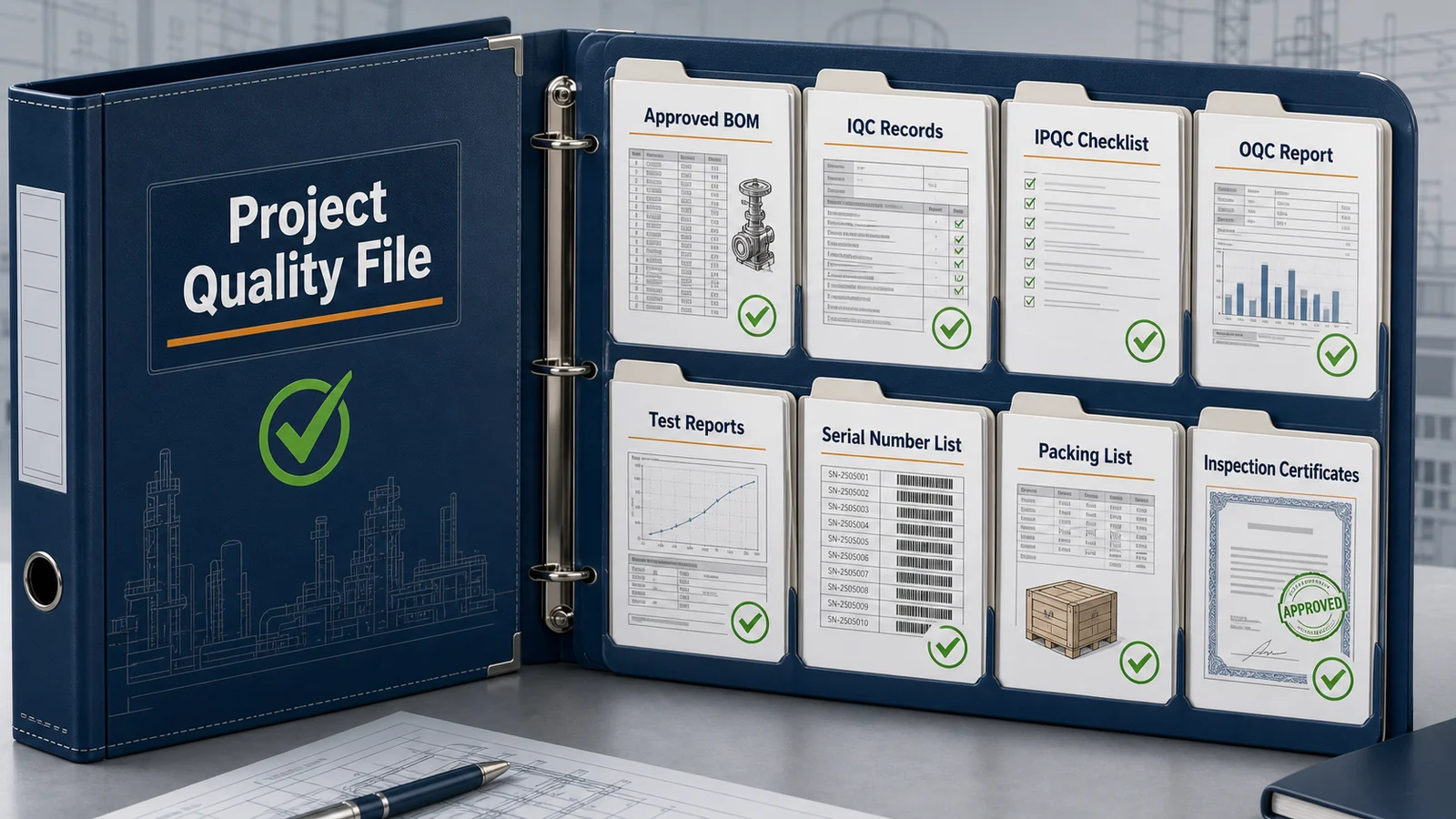
What Documents Should Buyers Request at Each Project Stage?
Buyers should request evidence progressively. Asking for every internal factory record during the first inquiry creates unnecessary work and may not improve the decision.
Tender or supplier prequalification stage
Request capability-level evidence such as:
-
Example quality plan;
-
Blank IQC, IPQC and OQC templates;
-
Traceability explanation;
-
Nonconforming-product procedure;
-
Measuring-equipment list;
-
Quality-management and laboratory capability overview.
These documents demonstrate the proposed control approach. They do not prove that a future order has been inspected.
After PO and before production
Freeze the project-specific requirements:
-
Approved technical submittal;
-
Approved BOM or critical-component list;
-
Inspection and Test Plan;
-
Hold and witness points;
-
Defect classifications;
-
Sampling plan;
-
FAT requirements;
-
Label and serial-number rules;
-
Change-approval procedure;
-
Required release documents.
Sunlurio’s Tender Documents and BOQ support can help project teams organize technical schedules and document requirements before production begins.
During production
Depending on the project risk and contract, request:
-
First-article approval;
-
Critical IQC records;
-
Critical IPQC records;
-
Component-lot information;
-
Approved engineering changes;
-
Open NCR status;
-
Production progress and batch information.
Before shipment
The release pack may include:
-
FQC or OQC report;
-
FAT report;
-
Sample serial numbers;
-
Actual measured results;
-
NCR and rework closure;
-
Reinspection evidence;
-
Packing inspection;
-
Final release authorization;
-
Serial-number or batch list;
-
Packing list;
-
Third-party inspection report, if required.
The release pack should be reviewed against the approved project requirements—not against a generic “standard QC package.”
Type Testing, Production Checks and Project Acceptance Are Not the Same
Type testing verifies a design or defined model under specified test conditions. Production checks monitor ongoing manufacturing consistency. FAT and project acceptance verify requirements associated with the actual order.
| Evidence type | Main purpose | Relationship to shipment |
|---|---|---|
| Type testing | Verify defined design or model against a test method or standard | Usually based on specified samples; not repeated in full for every batch |
| Routine production checks | Monitor manufacturing consistency and basic function | Directly related to production |
| FAT or project acceptance | Verify contract-specific configuration and acceptance criteria | Directly related to the project order |
For example, an IP66 type-test report may support the tested luminaire construction. It does not prove that gaskets were correctly installed in every production unit.
Conversely, a production leak check or visual seal inspection does not automatically establish full IP66 conformity.
The same distinction applies to photometric performance. Buyers reviewing unusually high efficacy claims should confirm the tested product identity, input power, test conditions and report scope. See Sunlurio’s guide to verifying 220–230 lm/W claims using LM-79 evidence.
What Buyers Should Avoid
A strong project quality plan should be proportional to the product and project risk. More paperwork is not automatically better control.
Avoid the following approaches:
Requesting every internal record without a review purpose
A large document package can hide the absence of critical evidence. Start with the approved configuration, high-risk characteristics and required release decision.
Treating ISO 9001 as product conformity evidence
ISO 9001 certification concerns a quality-management system. It does not prove that a solar street light meets every IEC requirement or that a specific shipment matches the approved BOM.
Assuming “100% inspected” means fully tested
Ask which characteristics were checked on every unit, by which method and against which limits.
Using one AQL value for every defect
Safety, configuration, appearance and packaging defects do not necessarily carry the same consequences.
Allowing the supplier to choose inspection samples in advance
Samples should represent the actual inspection lot. Preselected samples reduce confidence in the result.
Approving shipment with open critical NCRs
The release authority should confirm that required corrective actions and reinspections are complete.
Using third-party PSI as a substitute for production records
A third-party inspector can independently verify the agreed scope but cannot recreate missing component-lot and process traceability.
Request a Project-Specific Quality and Inspection Plan
A lighting-project quality plan should be built around the approved configuration, project risks, production quantity, required inspections and contractual acceptance conditions.
Send Sunlurio:
-
Project country;
-
Product type;
-
Estimated quantity;
-
Tender, BOQ or technical specification;
-
Required inspections or FAT;
-
Third-party inspection requirements;
-
Required standards and documentation;
-
Delivery schedule.
Sunlurio can review how the proposed IQC, in-process inspection, final inspection, FAT and traceability records should map to the project requirements.
[Request Engineering Pack]()
You can also review Sunlurio’s:
The exact inspection scope, record availability and traceability depth should be confirmed for the selected product and project before being written into a tender commitment.
Frequently Asked Questions
What is the difference between IQC, IPQC, FQC and OQC?
IQC normally controls incoming materials, IPQC controls production processes, FQC checks completed products and OQC verifies outgoing products and shipment release. The exact definitions vary between factories. Buyers should review the timing, inspection criteria, records and release authority behind each label.
Does “100% inspection” mean every performance parameter is tested?
No. It normally means that every unit is checked for a defined list of characteristics, such as identification, basic operation, appearance or programmed configuration. It does not mean every product undergoes full IP, IK, photometric, corrosion, safety or battery-life testing.
Is AQL the percentage of defective products a buyer must accept?
No. AQL is an index used with an acceptance-sampling plan to determine the sample size and acceptance or rejection numbers. It is not permission for a supplier to knowingly ship the same percentage of defective products.
Which edition of ISO 2859-1 should a new inspection plan reference?
For a newly developed plan in 2026, the parties should review ISO 2859-1:2026, which replaced the 1999 edition. Existing contracts may cite a different edition, so the buyer, supplier and inspection agency should agree on the applicable standard before inspection.
Should battery cells and controllers be traceable by lot?
They should be traceable to the level required by the contract and project risk. At minimum, many project buyers benefit from tracing the battery-pack lot, controller model and program version. Cell-level traceability should be defined according to the battery design, supplier system and project requirements.
Can an internal QC report replace third-party inspection?
Only if the contract does not require independent inspection and the buyer accepts the supplier’s evidence. Where independent witness or verification is specified, an internal QC report cannot replace the agreed third-party inspection.
Can third-party inspection replace factory production records?
No. A third-party inspection is usually based on a defined sample at a particular time. It cannot reconstruct incoming-material control, process history, component changes or rework records that the factory failed to retain.
What should happen when an inspection lot fails?
The affected lot should be controlled according to an agreed disposition process. Actions may include rejection, sorting, rework, corrective action and reinspection. The lot should not simply be resampled until it passes unless that process is permitted by the agreed sampling plan.
Should reworked products be inspected again?
Yes. Reworked products should be checked against the original requirements. The reinspection should also consider whether the rework could have affected other characteristics, such as sealing, wiring, appearance or electrical performance.
Can a supplier change a battery or controller without buyer approval?
Not when the component is part of the approved project baseline or affects contractual performance. The proposed change should be technically evaluated, documented and submitted for approval according to the agreed change-control procedure.
What is the difference between type testing and batch inspection?
Type testing verifies a defined design or model under specified conditions. Batch inspection verifies selected characteristics of the actual production lot. A project may need both because neither form of evidence replaces the other.
What should be included in a lighting-project FAT report?
A FAT report should identify the project, PO, product model, batch, inspected serial numbers, test methods, acceptance criteria, actual results, deviations, witnessing parties and final status. Its exact content should follow the contract and approved Inspection and Test Plan.