Quick Answer
IK10 is an impact-resistance classification representing 20 joules of external mechanical impact under defined test conditions. It can be valuable for municipal lighting installed where luminaires are accessible or exposed to repeated vandalism, thrown objects, or other credible impact risks. It is not automatically required for every public road, and it does not make a street light “vandal-proof.”
Before specifying IK10, buyers should identify the exact component or enclosure that requires protection, confirm that the test report matches the offered model and materials, and define the evidence required for approval. IP protection, corrosion resistance, electrical safety, pole strength, anti-theft design, surge protection, battery safety, and photometric performance must still be reviewed separately.
Project Review Summary
| Review item | Practical project guidance |
|---|---|
| Best-fit buyers | Municipal buyers, EPC contractors, consultants, tender teams, maintenance departments, and project distributors |
| Where IK10 matters most | Accessible luminaires and enclosures in high-risk public areas with credible impact exposure |
| Where it may add little value | High-mounted roadway luminaires with low public access and no recurring impact history |
| What the rating covers | Only the enclosure or assembly identified in the declaration and supporting test report |
| Evidence to request | Full test report, exact model identification, tested configuration, material details, impact locations, acceptance criteria, and results |
| Main procurement mistake | Treating “IK10” as a general product-quality label or assuming it covers the complete solar street-light system |
What Does IK10 Actually Mean for a Luminaire?
The IK code classifies an enclosure’s protection against external mechanical impact. IK10 is the highest numbered class in the standard scale and corresponds to 20 J—approximately the energy from a 5 kg mass falling 400 mm.
This comparison explains the energy only. Test equipment, mounting, impact locations, sample configuration, and acceptance criteria determine what the result proves.
The principal reference, IEC 62262:2002+A1:2021, defines the IK classification system. The coordinated impact test methods are provided in IEC 60068-2-75:2014+A1:2025. For luminaires, IEC TR 62696:2011 gives guidance on applying the IK code.
IK10 Is Not a General Quality Grade
An IK10 declaration describes a defined enclosure or luminaire configuration. It does not prove that every component has the same rating, that the product is impossible to damage, or that it satisfies IP, structural, corrosion, battery-safety, or photometric requirements. Two catalogues can display “IK10” while relying on reports covering different models, materials, assemblies, or impact locations.
Why “Vandal-Proof” Is the Wrong Term
IK10 demonstrates resistance to a defined test, not to every deliberate attack. Repeated blows, tools, vehicle collision, theft, forced access, fire, or attacks on a pole door or battery box create different failure modes.
“Vandal-resistant” is defensible when the protected part and evidence are stated. “Vandal-proof” is an unlimited promise that an IK test cannot support.
Do Municipal Street Lights Always Need IK10?
No. Municipal ownership does not automatically create a high-impact requirement. The decision should begin with the site, mounting position, history of damage, maintenance consequences, and authority specification.
Real procurement requirements vary. For example, one South African municipal specification uses IK08 as a minimum and treats IK09 or IK10 as preferred, while a Sri Lankan road-project bid document states IK10 and requests separate supporting evidence for other protection requirements. This variation is a reason to follow the project authority and documented site risk rather than apply one rating to every road.
| Site or risk condition | Recommended review |
|---|---|
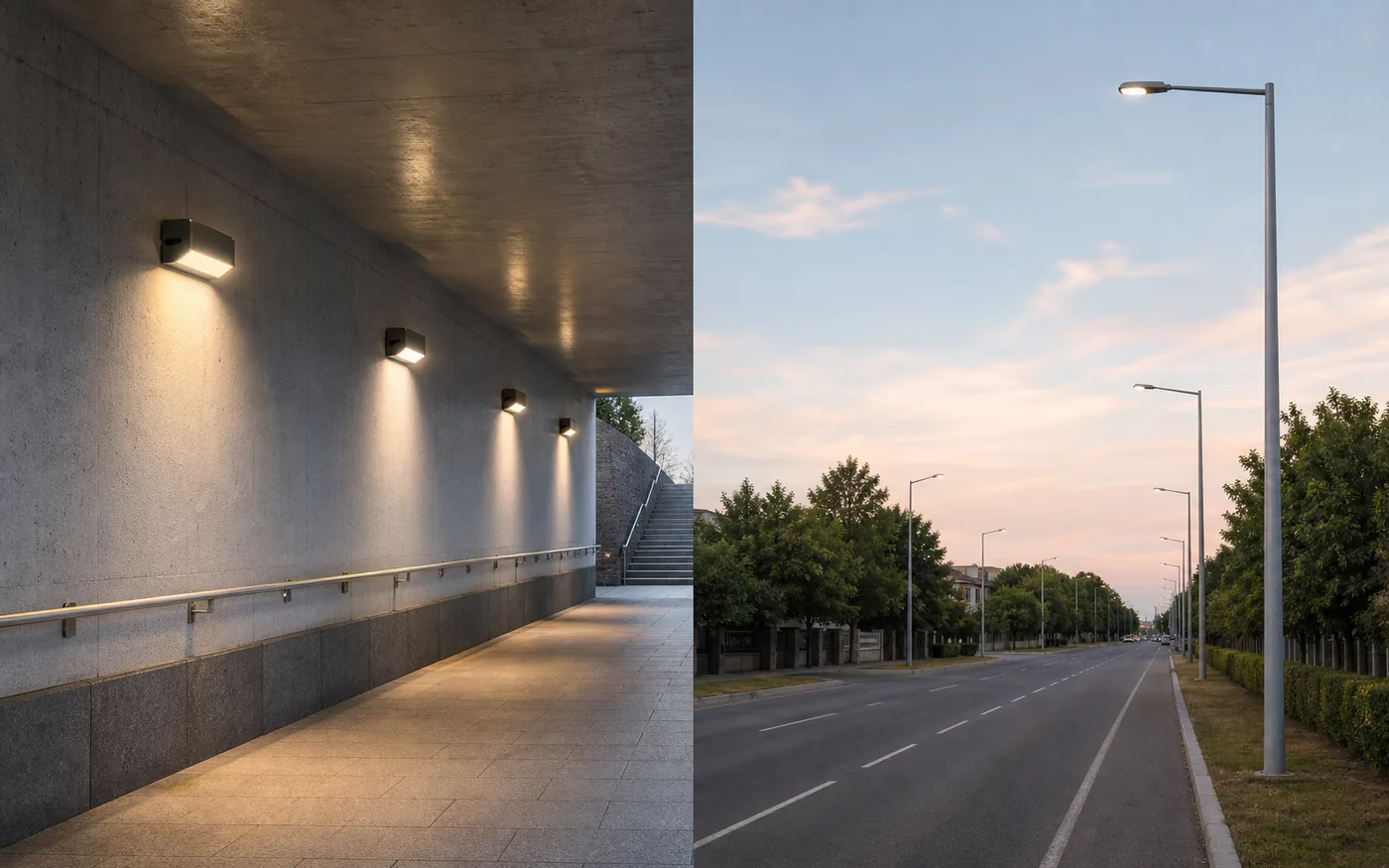
| Underpasses, pedestrian tunnels, transit areas, low-mounted fixtures, and accessible walkways | Prioritize IK10 where direct contact or deliberate impact is credible |
| Schools, sports areas, transport hubs, or sites with recurring thrown-object incidents | IK10 often has clear value for the exposed enclosure |
| Ordinary high-mounted road luminaires with no impact history | Compare site risk, authority requirements, evidence quality, and cost before requiring IK10 |
| Locations where vehicles may strike the pole | Review position, setback, barriers, and structural provisions; IK10 is not a collision solution |
| Coastal, industrial, or chemically aggressive environments | Review materials, coating, sealing, and corrosion evidence separately |
| Remote sites with expensive access or serious consequences from darkness | Balance impact resistance with maintainability and spare-parts planning |
Mounting Height Changes Exposure, Not the Test Definition
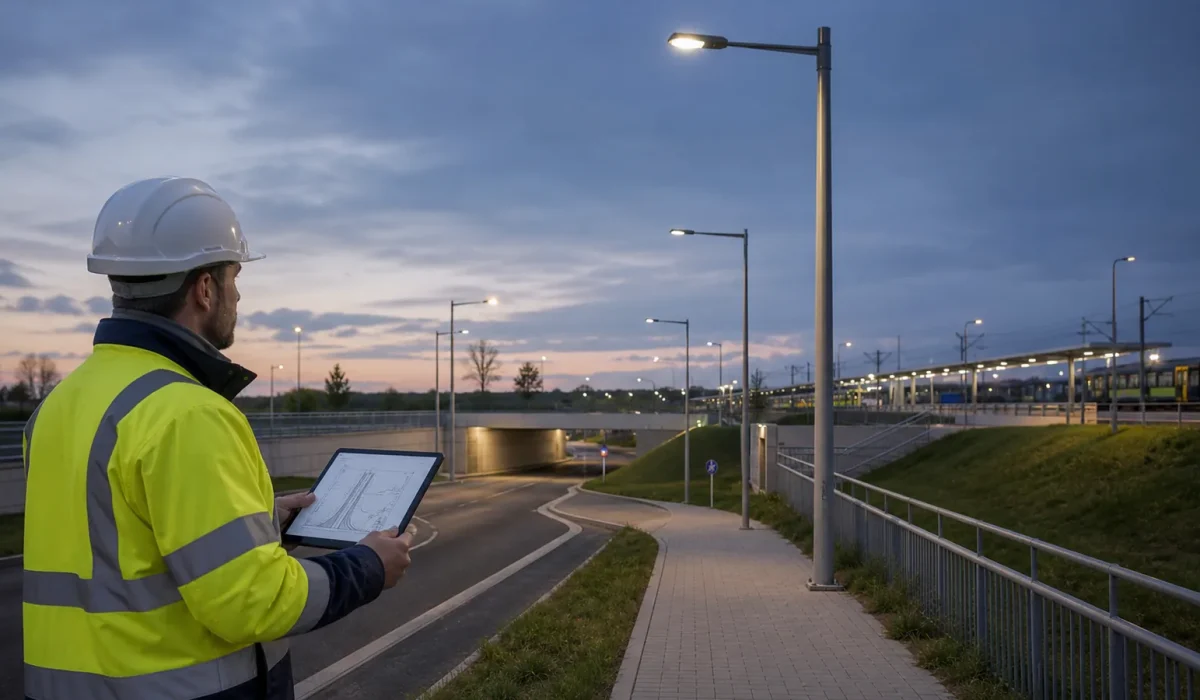
A high-mounted road luminaire is normally less accessible than a wall light or underpass fixture. Height does not change the IK10 definition, but it changes exposure.
Review public access, credible thrown-object risk, recorded damage, failure consequences, the authority’s minimum class, and the availability of model-matched evidence. At a low-risk site, ingress protection, corrosion, surge protection, optical design, or battery sizing may deserve more attention than an upgrade from IK08 or IK09.
Special Considerations for All-in-One Solar Street Lights
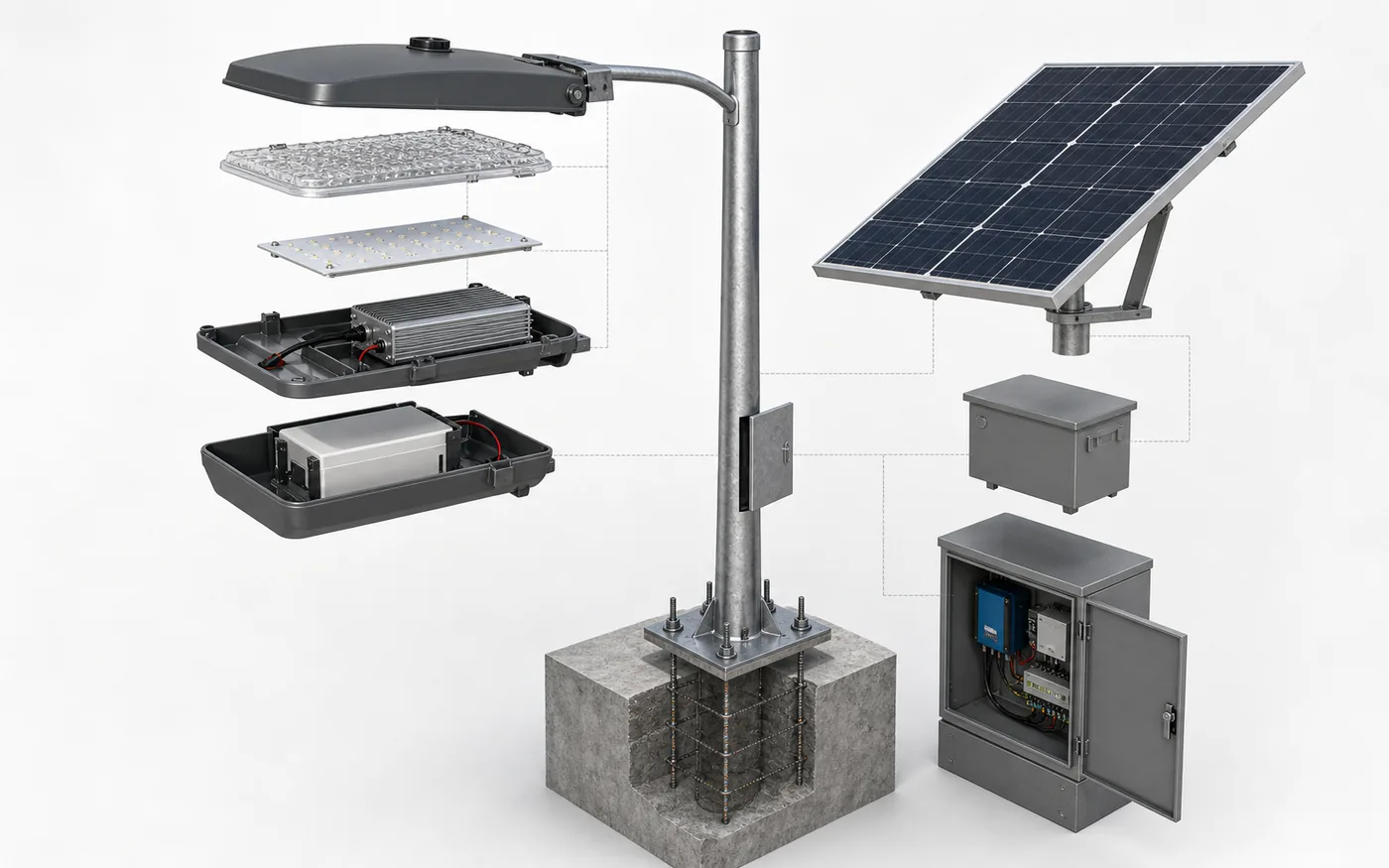
An all-in-one solar street light may place the LED module, controller, and battery inside or beside one compact assembly, increasing the consequence of enclosure damage. However, an “IK10 luminaire” statement does not automatically cover the battery compartment, photovoltaic module, external box, pole door, or tamper-resistant fasteners.
The buyer should match the tested assembly and materials to the offered model, then use the component table below to identify anything requiring separate evidence. The right question is “Which exposed part is protected, and by what evidence?” rather than “Does the catalogue say IK10?”
Which Parts Are Covered by a Luminaire IK10 Rating?
The answer must come from the report and the manufacturer’s declared scope. It should never be inferred from the product family name alone.
| Component | Can coverage be confirmed from a generic “luminaire IK10” claim? | What to verify |
|---|---|---|
| Optical cover | Not from the claim alone | Confirm that the cover formed part of the tested enclosure and that applicable impact locations were included |
| Main luminaire housing | Not from the claim alone | Match the exact model, dimensions, casting, material, and assembly |
| Driver compartment | Only if it formed part of the tested enclosure and declared scope | Confirm that it was installed and fully assembled in the tested configuration |
| Integrated battery compartment | Only if included in the tested configuration and declared scope | Confirm the compartment, cover, fasteners, and internal arrangement shown in the report |
| Solar panel | No | Request component-specific evidence where required |
| External battery box | No | Specify and verify the box separately |
| Pole access door | No | Review construction, lock, fasteners, and any separate impact requirement |
| Controller cabinet | No | Specify and verify the cabinet separately |
| Pole, bracket, anchor bolts, and foundation | No | Review structural design, interfaces, and installation requirements |
This scope table should be reflected in the project compliance matrix. If the luminaire is IK10 but the accessible pole door or battery box is the more likely target, specifying only the luminaire rating may leave the real vulnerability untreated.
What an IK10 Test Proves—and What It Does Not
An IK10 result supports a specific claim: the tested enclosure or assembly met the applicable impact test and acceptance criteria under the recorded conditions. Its value depends on how closely the evidence matches the product being offered.
Test Configuration Matters
A useful report should identify:
- the manufacturer, exact model, dimensions, and any model-family basis;
- the housing, optical cover, materials, and complete or partial assembly tested;
- the mounting condition, impact equipment, energy, locations, and number of impacts; and
- the post-test observations, acceptance criteria, and result.
A change from glass to polycarbonate, a new lens thickness, a different casting, a modified service cover, or a different enclosure size may affect whether the original evidence still applies. A report for a visually similar product is not automatically a report for the offered product.
Pass Criteria Must Be Reviewable
A one-page “IK10 passed” certificate is insufficient for tender due diligence because it may not show the test sample, scope, or accepted post-impact condition. If the project requires continued safety, enclosure integrity, operation, or IP performance after impact, state and verify that requirement separately.
IK, IP, and Luminaire Safety Are Separate Reviews
IK addresses external mechanical impact. IP addresses dust and water ingress under IEC 60529, while applicable IEC 60598 requirements address luminaire safety. “IP66 IK10” lists two characteristics, not one combined test result; verify each independently.
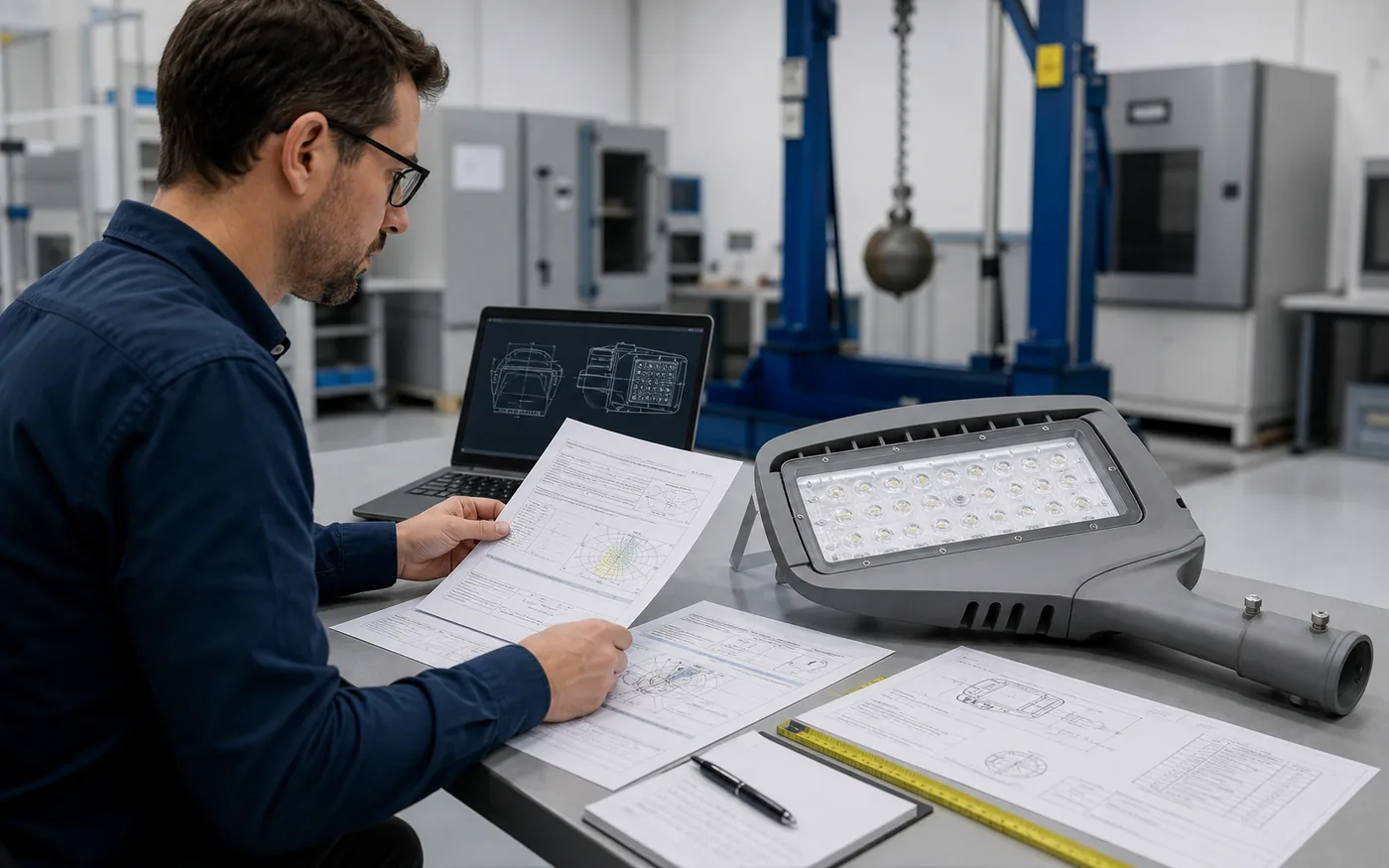
How to Verify an IK10 Test Report
Use the following sequence before approving a model or listing it as compliant.
- Identify the laboratory and report. Record the laboratory name, report number, issue date, and complete page count.
- Confirm the standard and edition. Do not accept only a generic “IK10” statement.
- Match the manufacturer and exact model. The identity must correspond to the bid.
- Match the materials. Check the housing, optical cover, compartment covers, and relevant thicknesses.
- Match the configuration. Confirm size, model family, assembly state, accessories, and enclosure arrangement.
- Review mounting and impact locations. They should support the declared scope.
- Read the acceptance criteria and result. Do not rely on the certificate heading.
- Connect the tested and offered models. For a family report, request the technical basis covering the offered variant.
Report Red Flags
| Red flag | Why it matters |
|---|---|
| The report does not identify a model | The evidence cannot be matched to the offered luminaire |
| Only the cover page is submitted | The configuration, impact points, and result cannot be reviewed |
| An empty housing or material coupon was tested | It may not prove the offered enclosure |
| The cover or housing material changed | The tested construction may no longer match production |
| The report belongs to another size or family | Visual similarity does not prove equivalence |
| Only CE or RoHS documents are provided | These documents do not replace an IK test report |
| The catalogue says IK10 but the report says IK08 | The offer and evidence conflict |
| “The whole solar system is IK10” has no scope statement | Panels, pole doors, battery boxes, and cabinets may be outside the test |
If the tender requires an independent laboratory or ISO/IEC 17025 accreditation, state it and require the relevant test to fall within the laboratory’s accreditation scope. The IK classification alone does not prove third-party accreditation.
IK08 vs IK10 for Public Lighting
IK08 and IK10 are not different marketing tiers. They represent different impact energies and should be selected against the project risk and authority requirement.
| Classification | Impact energy | Practical selection point |
|---|---|---|
| IK08 | 5 J | May be acceptable where impact exposure is limited and the project specification permits it |
| IK10 | 20 J | Better suited to defined high-impact or vandalism-prone locations when matching evidence is available |
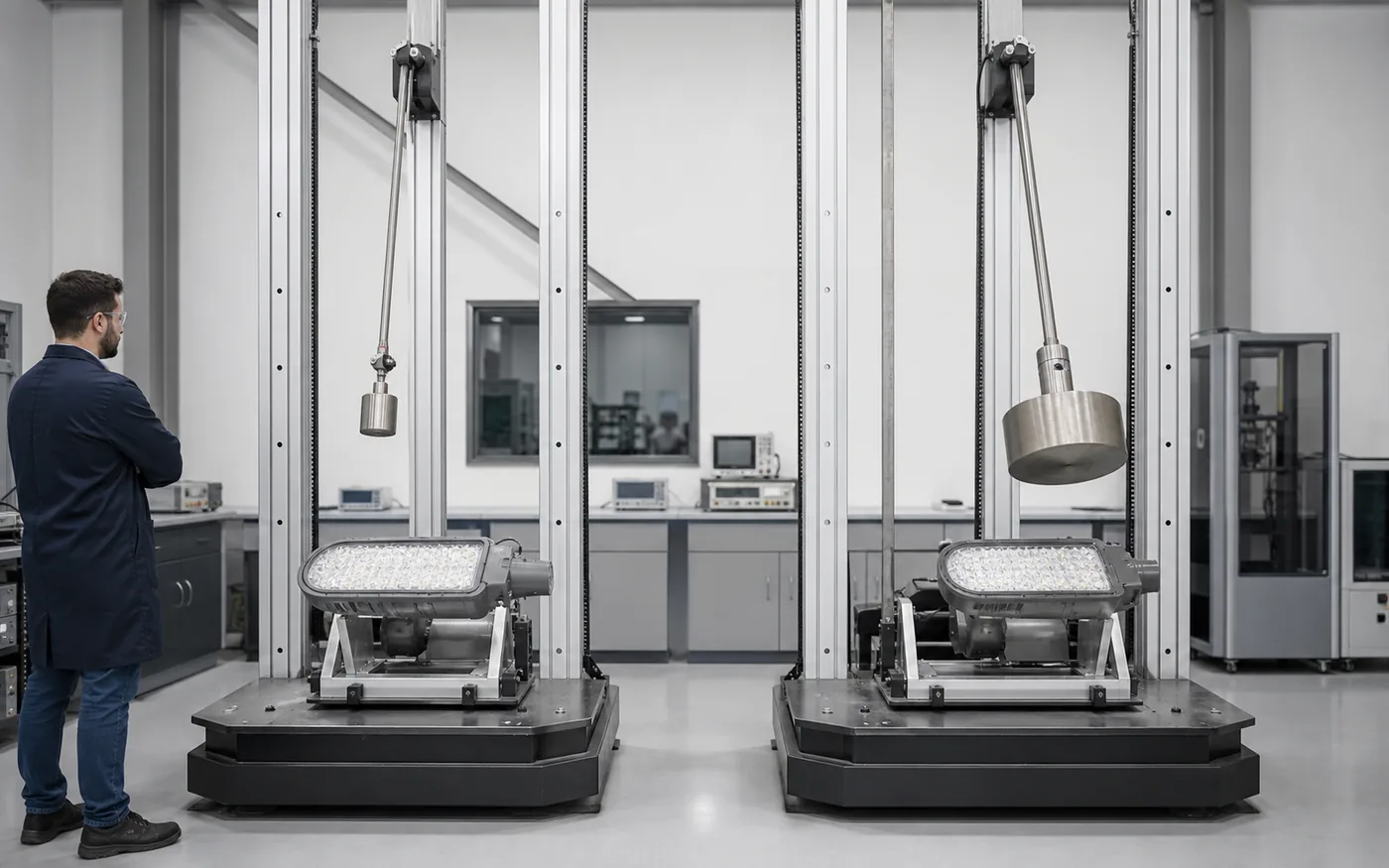
IK10 represents four times the impact energy of IK08, but “higher” is not automatically “more appropriate.” An unsupported IK10 claim is weaker procurement evidence than a lower rating backed by a complete, model-matched report where the authority permits that rating.
For a broader comparison involving coastal solar-lighting conditions, see IK08 vs IK10 Solar Light Protection Levels. Corrosion, sealing, and marine exposure should not be folded into the IK decision.
How to Write IK10 into a Municipal Lighting Tender
Tender wording must identify the protected item, classification, evidence, and relationship to the offered model. It should also prevent bidders from using the IK requirement to imply compliance with unrelated project risks.
Wording That Is Too Weak
- “The street light shall be IK10.” It does not identify the protected enclosure or required evidence.
- “The polycarbonate material shall be IK10.” A material name does not define the assembly, thickness, joints, mounting, or impact locations.
- “The luminaire shall be IP66 and vandal-proof IK10.” It combines separate protection subjects and makes an unlimited “vandal-proof” claim.
Recommended Tender Wording
The offered roadway luminaire enclosure shall have a minimum impact-resistance rating of IK10 in accordance with IEC 62262, using the applicable impact test method defined by IEC 60068-2-75. The submitted report shall identify the exact offered model, tested enclosure configuration, housing and optical-cover materials, mounting condition, impact locations, acceptance criteria, and test result. Any component not covered by the declared IK rating shall be identified separately. IP, luminaire safety, corrosion, vibration, solar-component safety, surge protection, structural, and photometric requirements shall be demonstrated by their applicable documents and shall not be inferred from the IK rating.
This wording is a project drafting example, not a substitute for the authority’s legal or technical review. The final clause should follow the project country, municipal authority, consultant requirements, procurement rules, and the selected standard editions.
A Risk-Based Alternative
Some projects are better served by exposure zoning: use the authority-defined minimum for ordinary high-mounted luminaires, reserve IK10 for identified high-risk zones, specify accessible cabinets and boxes separately, add anti-tamper controls where theft is the main risk, and state any required post-impact condition. This directs budget toward actual vulnerabilities without weakening compliance.
What IK10 Does Not Replace
| Project risk or performance requirement | Separate review or evidence |
|---|---|
| Dust and water ingress | IP classification and applicable IEC 60529 report |
| Luminaire electrical and mechanical safety | Applicable IEC 60598 documentation |
| Corrosion | Material declaration, coating system, fastener specification, and project-required corrosion or salt-mist evidence |
| Wind loading and structural stability | Pole, bracket, anchor-bolt, and foundation calculations for the project conditions |
| Vehicle collision | Site layout, setbacks, barriers, and applicable road-safety or structural provisions |
| Hail or solar-panel damage | Component-specific evidence and site-risk review |
| Theft and tampering | Fasteners, access doors, locks, cable routing, battery-box design, and maintenance access |
| Lighting performance | IES/LDT files and DIALux or Relux review against the road geometry and project criteria |
| Battery safety and transport | Cell and pack documentation, BMS information, UN38.3, MSDS, and project-required certificates |
| Surge and lightning exposure | SPD selection, electrical design, earthing strategy, and applicable test documents |
Buyers reviewing a solar or AC street-light project can use Sunlurio’s Engineering Support resources to connect product evidence with the project’s photometric, electrical, drawing, and document requirements.
Common Specification Mistakes and Their Consequences
| Specification mistake | Project consequence | Correct control |
|---|---|---|
| Treating a material as the IK rating | The assembly, thickness, joints, and mounting remain unverified | Require a report for the model-matched enclosure |
| Combining IK and IP into one claim | Reviewers cannot confirm whether both characteristics were independently demonstrated | Request separate IK and IP evidence and state any required post-impact condition |
| Requiring IK10 everywhere | Cost or bidder restrictions may increase without addressing the site’s main risks | Apply the authority requirement and risk zoning to roads, walkways, tunnels, and cabinets |
| Accepting another model’s report | A compliance gap may emerge during consultant review, inspection, or handover | Require exact model matching, a justified family relationship, or retesting |
| Testing only the optical cover | Service covers, hinges, fasteners, or compartments may remain vulnerable | Define the exposed enclosure and applicable impact locations |
| Using IK10 for structural or environmental risks | Vehicle impact, wind, corrosion, water, hail, theft, or surge may go unreviewed | Specify the applicable control and evidence for each risk |
| Writing “vandal-proof” | The tender creates an unlimited and unmeasurable acceptance promise | Use “vandal-resistant to IK10” only for the identified enclosure |
| Failing to control substitutions | A change in cover, casting, size, or assembly can invalidate approved evidence | Require revised evidence or an approved technical justification before substitution |
Documents Buyers Should Request
Review an IK declaration as part of a matched project document set, not as an isolated certificate:
- exact-model datasheet, dimensional drawing, material declaration, and configuration compliance matrix;
- complete IK report, separate IP report, and applicable IEC 60598 documentation;
- corrosion evidence and solar-component documents where the project requires them;
- installation, maintenance, and tender-deviation records; and
- project-specific IES/LDT files, simulation outputs, drawings, and BOQ documents where applicable.
For document organization, see Tender Documents and BOQ Support. Municipal teams can also review Sunlurio’s approach to government and municipal lighting projects and project solar street-light configurations.
When IK10 May Not Be Necessary
IK10 may not be the best use of budget when the luminaire is high and inaccessible, the site has no recurring impact history, or the authority permits a lower class. It may also be a poor priority when:
- it would restrict compliant models without a documented risk basis;
- corrosion, sealing, surge, optics, structural design, or solar capacity is the more urgent weakness;
- the IK10 report is incomplete or mismatched; or
- a well-documented IK08 or IK09 model meets the accepted requirement and has a stronger evidence package.
The specification should solve the site’s actual risk, not use the highest label as a shortcut.
How Sunlurio Supports IK and Tender Review
Sunlurio’s review process begins with the project requirement rather than a catalogue claim:
- Receive the BOQ, tender clause, offered model, and available reports.
- Confirm the site type, mounting height, public access, and known impact or vandalism risk.
- Identify which luminaire or system component the IK requirement should cover.
- Match the datasheet, drawing, materials, and test report to the offered configuration.
- Record missing evidence, qualifications, or deviations before quotation or document release.
- Coordinate the IK review with the project’s IP, safety, corrosion, structural, solar-component, and photometric requirements.
This review supports a clearer compliance discussion; it does not guarantee authority approval. Final acceptance remains subject to the tender, consultant, project authority, submitted evidence, production configuration, and inspection requirements.
Sunlurio’s manufacturing and quality process and engineering document support provide the wider context for model matching and project submission.
Frequently Asked Questions
What does IK10 mean for a street-light luminaire?
IK10 means the identified enclosure or assembly met a 20 J external mechanical impact classification under defined conditions. The report must connect the tested scope to the offered model.
Is IK10 mandatory for municipal street lighting?
No. Requirements differ by authority, site risk, and tender. IK10 is most defensible where the identified component faces credible high-impact exposure or the specification requires it.
Is IK10 better than IK08 for every public area?
No. Suitability also depends on exposure, mounting height, authority requirements, evidence quality, cost, maintenance risk, and other protection needs.
Does IK10 mean the luminaire is vandal-proof?
No. It cannot prove resistance to every form of deliberate damage, repeated attack, forced entry, theft, tools, fire, or vehicle collision.
Does IK10 include IP66 protection?
No. IK concerns external mechanical impact; IP concerns dust and water ingress. Verify each claim separately.
Does luminaire IK10 cover the solar panel and battery box?
Not automatically. These components are covered only if the declared and tested scope explicitly includes them.
How can a buyer verify an IK10 test report?
Match the full report to the manufacturer, model, materials, dimensions, configuration, mounting, impact locations, acceptance criteria, and offered production version.
How should IK10 be written in a street-light tender?
Identify the enclosure, minimum class, standards, offered-model match, report content, uncovered components, and any laboratory or post-impact requirements. Keep unrelated evidence separate.

Request an IK / Tender Evidence Review
Send the project country, site type, mounting height, estimated quantity, buyer role or company type, tender clause, offered model, submission deadline, and available IK/IP reports. Sunlurio can review the document match, component scope, missing evidence, and the applicable engineering-support path before quotation or submission.