Quick Answer
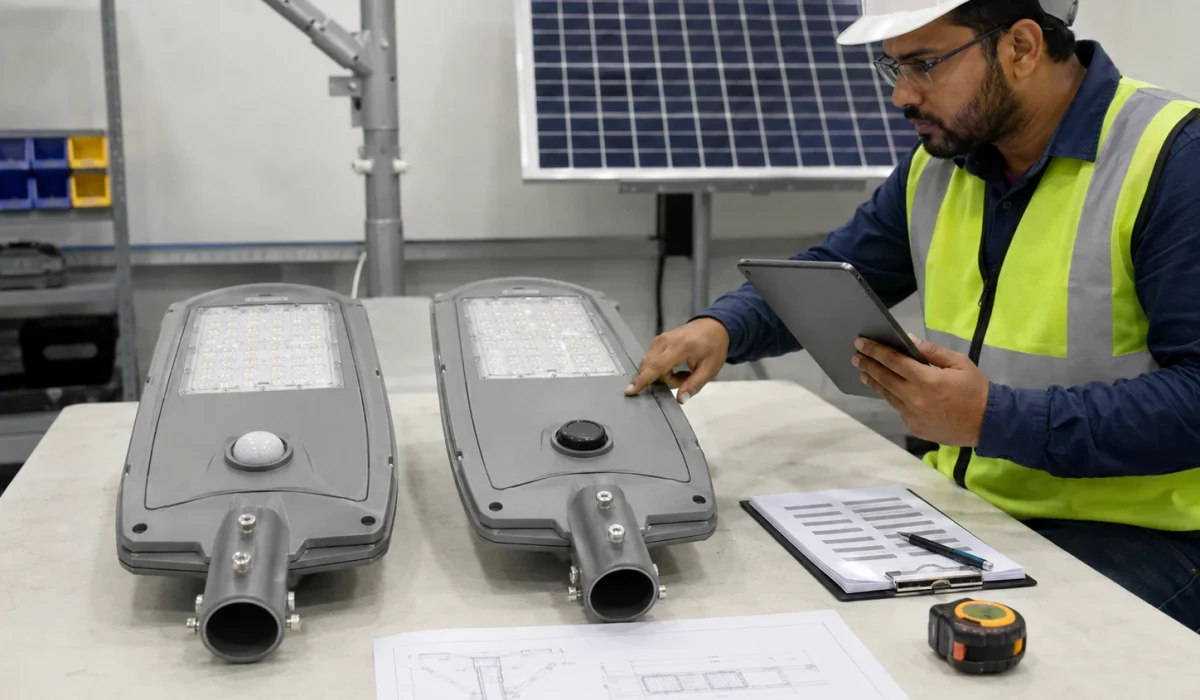
PIR and radar motion sensors both help solar street lights reduce energy use by keeping the lamp at lower standby brightness and boosting output when movement is present. The main difference is how they detect movement and how they behave in real project conditions.
PIR sensors respond to infrared heat changes from moving people, animals, vehicles, or other warm objects. They are often suitable for pathways, parks, compounds, school roads, village roads, and low-speed pedestrian areas.
Radar or microwave sensors detect movement through reflected signal changes. They may support longer or wider detection behavior depending on the sensor model, pole height, mounting angle, and site layout. They are often reviewed for parking entrances, industrial roads, logistics areas, and low-speed vehicle movement areas.
For EPC, municipal, and tender projects, the best sensor is not decided only by price or detection distance. Project teams should review pole height, road width, traffic type, sensor direction, sensitivity, delay time, standby brightness, false triggering risk, battery autonomy, rainy-season margin, and commissioning records.
Project Review Summary
| Item | Project Review Point |
|---|---|
| Main topic | PIR vs radar motion sensors for solar street lights |
| Best-fit buyers | EPC contractors, municipal project teams, project distributors, installers, and tender buyers |
| Best-fit projects | Rural roads, campus roads, parking areas, parks, pathways, compounds, industrial roads, and low-traffic municipal roads |
| Core search intent | Which motion sensor is better for solar street lights: PIR or radar |
| Main decision factor | Detection behavior under real road, traffic, mounting, and environmental conditions |
| PIR sensor role | Lower-power, directional motion detection often used for pedestrian and low-speed areas |
| Radar sensor role | More sensitive or wider movement detection for selected vehicle, parking, industrial, or open-area applications |
| Main risk | Choosing a sensor by price or advertised distance only and creating missed detection, false triggering, battery drain, or poor road safety |
| Related control mode guide | Motion sensor vs timer mode for solar street lights |
| Related dimming guide | Solar street light dimming profile and battery autonomy |
| Related setup guide | Basic remote control setup steps |
What Is a PIR Motion Sensor in Solar Street Lights?
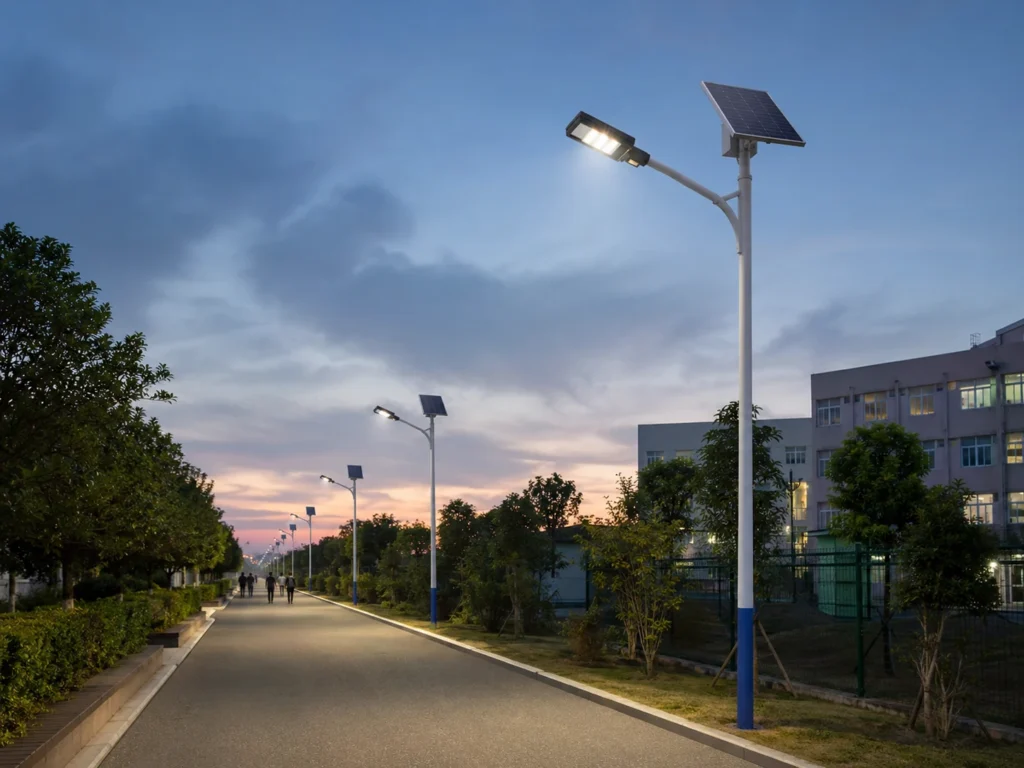
A PIR sensor detects changes in infrared radiation. In solar street lighting, it is commonly used to respond to moving warm objects such as pedestrians, cyclists, animals, or vehicles passing within the sensor range.
PIR sensors are often selected for:
- Pedestrian pathways.
- Parks.
- Campus roads.
- Residential project roads.
- Compounds.
- School roads.
- Low-speed internal roads.
- Small parking areas.
- Low-traffic rural roads.
- Village road lighting projects.
PIR sensors are practical and widely used. They usually consume very low power, which is helpful for solar-powered systems. They can also be less likely to react to some non-thermal movement, such as light wind or small background movement, depending on the site condition and sensor design.
However, PIR performance depends on the temperature difference between the moving object and the background, installation direction, mounting height, movement angle, and the thermal background around the road.
A PIR sensor should not be judged only by whether it works during a quick ground test. It should be checked under realistic mounting height, road layout, and user movement conditions.
What Is a Radar Motion Sensor in Solar Street Lights?
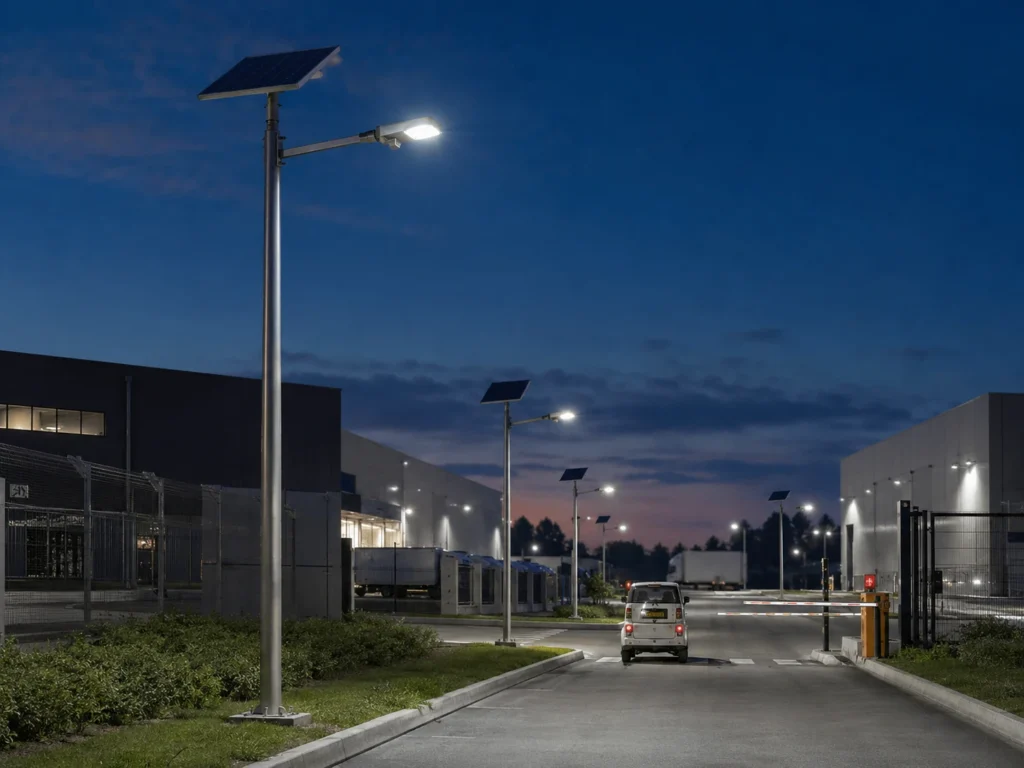
Radar or microwave motion sensors detect movement by transmitting and receiving electromagnetic signals. Instead of relying mainly on infrared heat change, radar sensors detect movement through signal reflection changes.
Radar sensors are often reviewed when projects need:
- Wider movement detection.
- Longer detection behavior.
- Vehicle movement response.
- Parking entrance detection.
- Industrial road detection.
- Logistics area detection.
- More sensitive response than basic PIR.
- Detection where heat contrast may be weak.
- Low-speed vehicle movement review.
Radar sensors are less dependent on heat contrast than PIR sensors. This can be useful in some high-temperature or low-visibility conditions. However, the final performance still depends on sensor model, sensitivity setting, installation direction, pole height, road geometry, and surrounding movement.
Higher sensitivity is not always an advantage. If the radar sensor is too sensitive or points toward the wrong area, it may respond to movement outside the target road. This can keep the lamp at boost brightness too often and reduce battery autonomy.
Radar is not automatically better than PIR. It is better only when its detection behavior matches the project condition.
PIR vs Radar: Main Difference
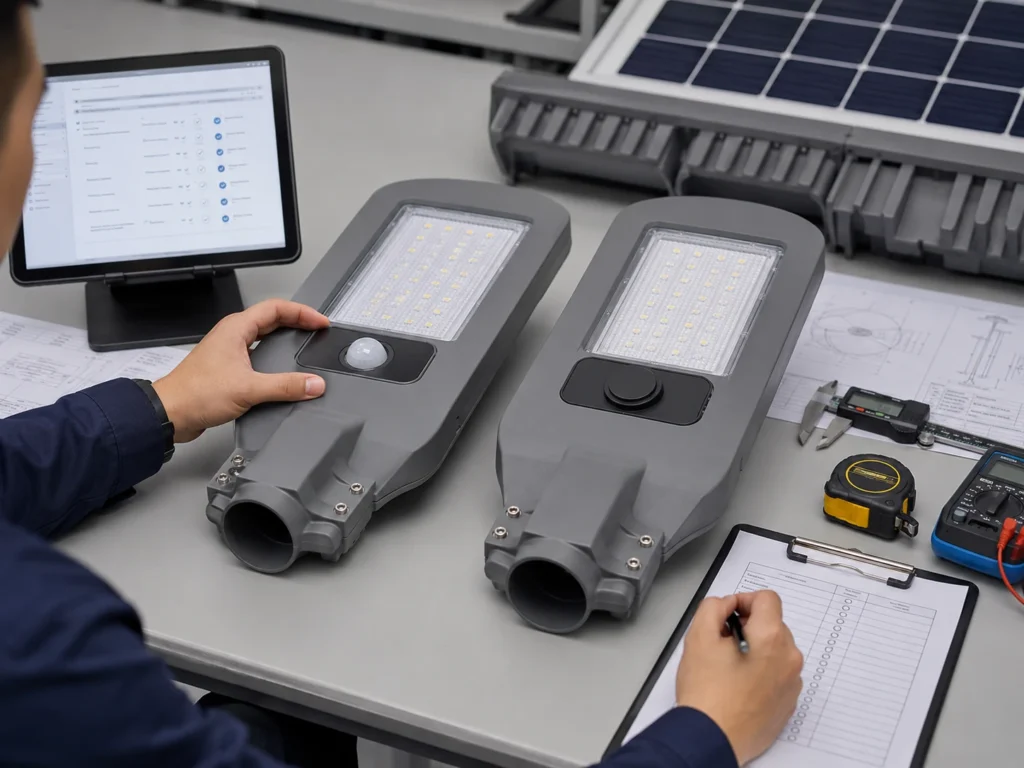
| Item | PIR Motion Sensor | Radar / Microwave Motion Sensor |
|---|---|---|
| Detection principle | Responds to infrared heat changes from moving people, animals, vehicles, or warm objects | Detects movement using microwave or radar signal reflection |
| Typical detection behavior | More directional and usually suitable for shorter-range pedestrian or low-speed areas | Often supports longer or wider movement detection, depending on sensor model and installation |
| Power consumption | Usually very low, which is useful for solar-powered systems | May be higher than simple PIR sensors, so battery autonomy should be reviewed |
| Environmental sensitivity | Can be affected when the temperature difference between the target and background is small | Less dependent on heat contrast, but may be affected by sensitivity setting, surrounding movement, or reflective conditions |
| False triggering risk | Usually lower in areas with non-thermal movement, but animals or thermal background changes may still affect performance | Can be higher if nearby vehicles, trees, reflective surfaces, or moving objects enter the detection field |
| Best-fit scenarios | Pathways, parks, compounds, school roads, village roads, pedestrian areas, and low-speed access roads | Parking entrances, industrial roads, logistics areas, open parking lots, and roads where vehicle movement detection is important |
| Main project check | Mounting height, sensor angle, pedestrian comfort, standby brightness, and detection timing | Detection range, sensitivity, road geometry, false triggering risk, delay time, and battery impact |
The key question is not whether PIR or radar is more advanced.
The correct question is:
Does the sensor behavior match the road type, traffic pattern, mounting height, battery autonomy, and maintenance requirement?
Why Radar Is Not Always Better Than PIR
Radar sensors are often promoted as having longer detection distance and wider sensitivity than PIR sensors. This can be useful for parking entrances, industrial access roads, logistics areas, and low-speed vehicle roads.
However, higher sensitivity is not always an advantage. If the radar sensor is installed in the wrong direction or the sensitivity is too high, it may respond to movement outside the target road area. This can keep the lamp at boost brightness too often and reduce the expected battery autonomy.
PIR sensors may be more suitable when the project mainly needs pedestrian detection, simple local maintenance, low standby consumption, and lower false-trigger risk from non-thermal movement.
For solar street light projects, the sensor should be selected together with the dimming profile, delay time, standby brightness, pole height, road width, traffic pattern, and rainy-season autonomy requirement.
Which Sensor Is Better by Application?
| Application | More Suitable Sensor Direction | Review Notes |
|---|---|---|
| Pedestrian pathway | PIR or radar | Standby brightness and pedestrian comfort matter |
| Park walkway | PIR | Avoid unnecessary triggering from trees, animals, or surrounding movement |
| School road | PIR or radar | Review pedestrian movement and safety requirement |
| Campus road | PIR or radar | Review pedestrian and low-speed vehicle movement |
| Rural access road | PIR or radar | Choose based on traffic type and detection distance |
| Village road | PIR or radar | Cost, maintenance ability, and road safety should be balanced |
| Parking lot | Radar or PIR | Review vehicle movement, mounting height, and false triggering |
| Parking entrance | Radar often worth reviewing | Frequent vehicle movement may need stronger detection logic |
| Industrial internal road | Radar or hybrid review | Traffic may vary by shift and operation schedule |
| Compound road | PIR or radar | Check user comfort and security requirement |
| Security perimeter | Radar or reviewed PIR | Background brightness should not be too low |
| Main municipal road | Usually timer or hybrid mode, sensor optional | Frequent traffic may reduce sensor energy saving |
This table is only a starting point. Sensor selection should still be reviewed with pole height, road width, traffic frequency, controller profile, and battery autonomy.
For broader control mode selection, see Sunlurio’s guide to motion sensor vs timer mode for solar street lights.
Why Sensor Type Alone Does Not Decide Performance
PIR and radar are only part of the motion-control system. Real performance depends on how the sensor is installed and how the controller profile is configured.
A motion sensor system includes:
- Sensor type.
- Sensor direction.
- Mounting height.
- Luminaire angle.
- Detection distance.
- Detection width.
- Sensitivity setting.
- Delay time.
- Standby brightness.
- Boost brightness.
- Controller dimming profile.
- Battery capacity.
- Solar panel charging input.
- Local traffic pattern.
- Environmental conditions.
A good sensor can perform poorly if the angle is wrong. A simple sensor can perform well if the application is suitable and the profile is properly set.
This is why sensor review should be part of project design and commissioning, not only a product feature line in the datasheet.
Mounting Height and Sensor Angle Matter
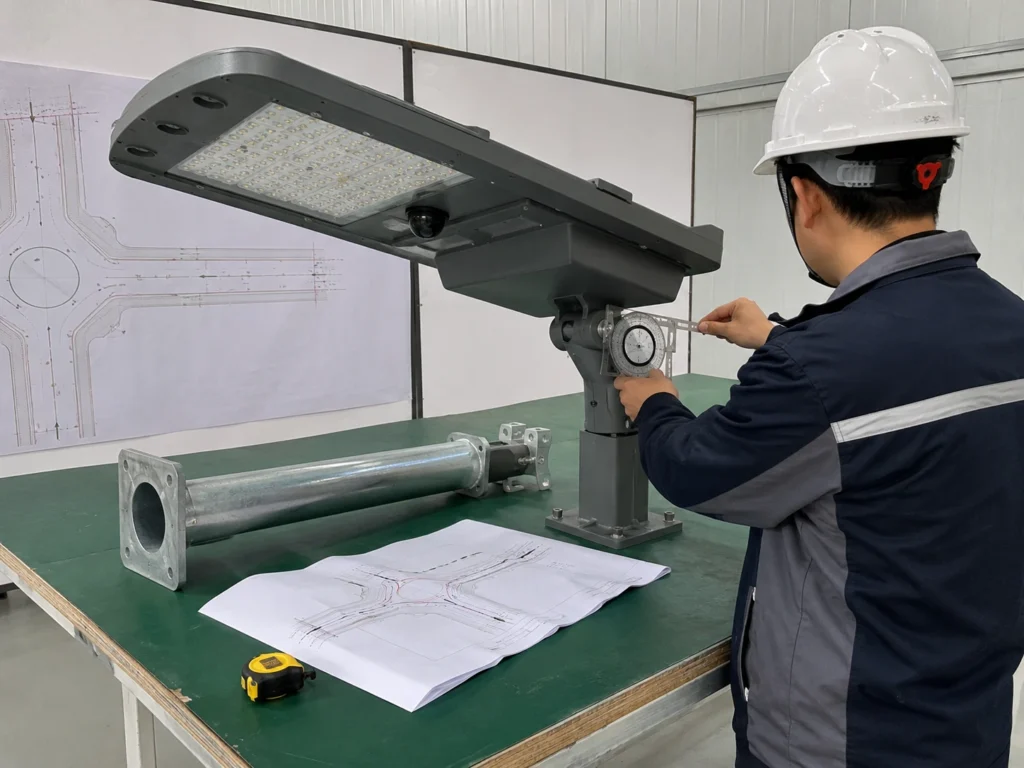
Solar street lights may be installed at different pole heights depending on road width, project type, and lighting requirement. The same sensor may behave differently at different mounting heights.
Project teams should review:
- Whether the sensor faces the expected movement direction.
- Whether the sensor is blocked by luminaire housing or bracket position.
- Whether the pole height matches the practical sensor range.
- Whether the road width is within the expected detection area.
- Whether the sensor points too far, too close, or too wide.
- Whether the light boosts before the user reaches the darker area.
- Whether the sensor position creates false triggering from nearby movement.
- Whether the sensor angle can be adjusted before handover.
Sensor direction should be checked before pole installation whenever possible. After pole lifting, adjustment is more difficult and more costly.
For pre-installation test logic, see Sunlurio’s guide to ground-level test before pole installation.
Detection Range Should Match the Road Type
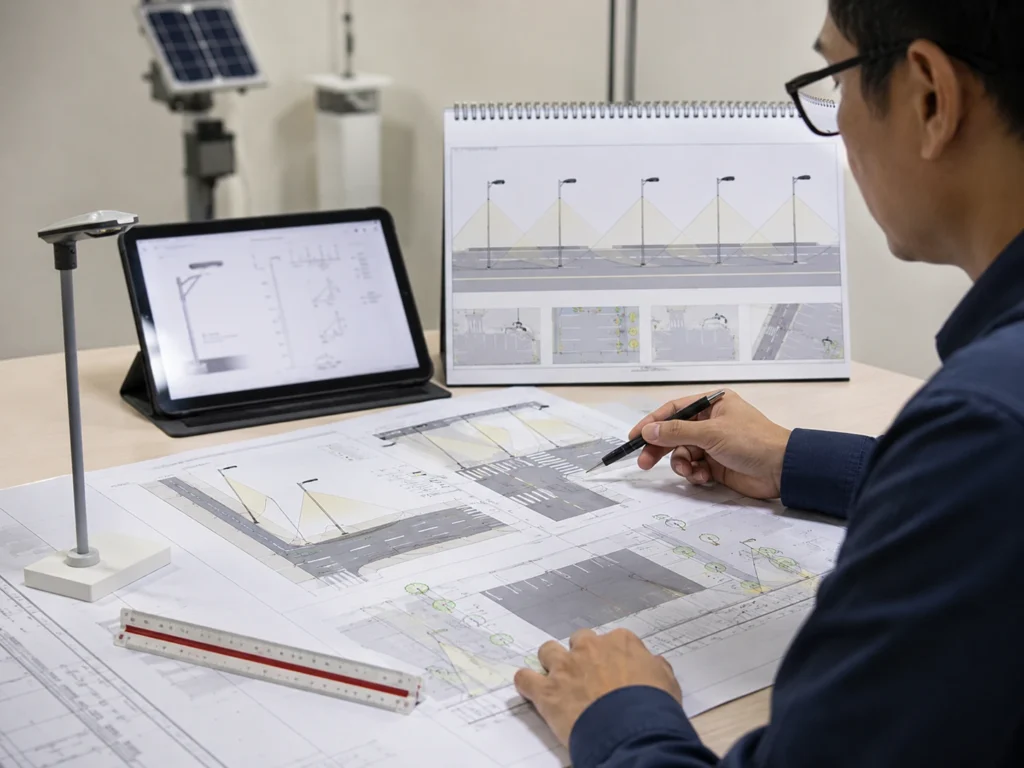
A longer detection range is not always better. The correct range depends on the road type and user behavior.
For example:
- A pathway may need comfortable pedestrian detection.
- A school road may need predictable response for pedestrians and slow vehicles.
- A parking entrance may need vehicle detection before the vehicle reaches the pole.
- A rural road may need enough distance for low-speed vehicles.
- A campus road may need a balance between pedestrian and vehicle movement.
- A security area may need stronger background brightness, not only longer detection.
If the detection range is too short, the light may boost too late. If the detection range is too wide or too sensitive, the lamp may boost too often and drain the battery.
The sensor should match the road, not the other way around.
Delay Time Affects Battery Autonomy
Delay time means how long the light stays at boost brightness after movement is detected. It is one of the most important settings in motion sensor mode.
A longer delay time may improve comfort and safety, but it also increases energy consumption. A shorter delay time saves energy, but it may cause the light to return to standby too quickly.
Project teams should review:
- Road activity level.
- Pedestrian walking speed.
- Vehicle speed.
- Distance between poles.
- Required safety level.
- Battery autonomy requirement.
- Rainy-season margin.
- Whether multiple poles are triggered repeatedly.
- Whether the delay time is consistent across the project.
Delay time should be recorded during commissioning. Otherwise, future troubleshooting becomes difficult.
Standby Brightness and Boost Brightness Must Be Reviewed Together
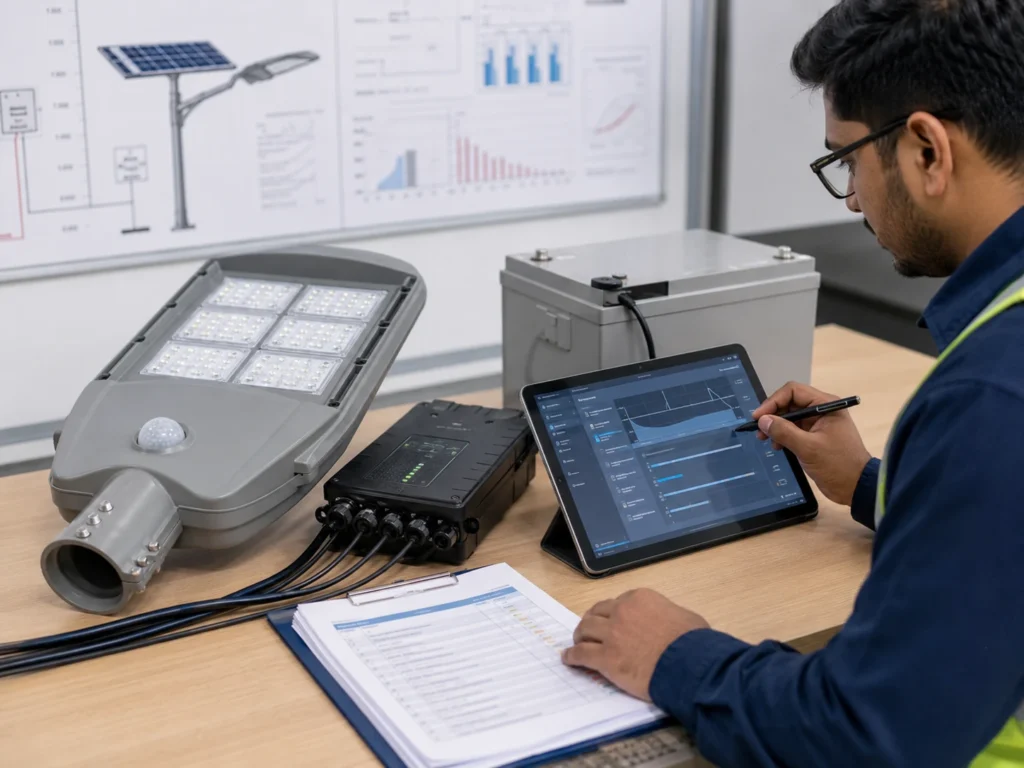
Motion sensor mode usually has at least two brightness levels:
- Standby brightness when no movement is present.
- Boost brightness when movement is present.
If standby brightness is too low, the road may feel unsafe before the sensor triggers. If boost brightness is too high or triggered too often, the battery may drain faster than expected.
A practical review should check:
- Whether standby brightness is acceptable for road safety.
- Whether boost brightness meets visibility needs.
- Whether the transition between standby and boost feels practical.
- Whether the dimming profile supports battery autonomy.
- Whether the setting is suitable for rainy-season operation.
- Whether the same profile is used consistently across the project.
For brightness profile review, see Sunlurio’s guide to solar street light dimming profile and battery autonomy.
False Triggering Can Drain the Battery
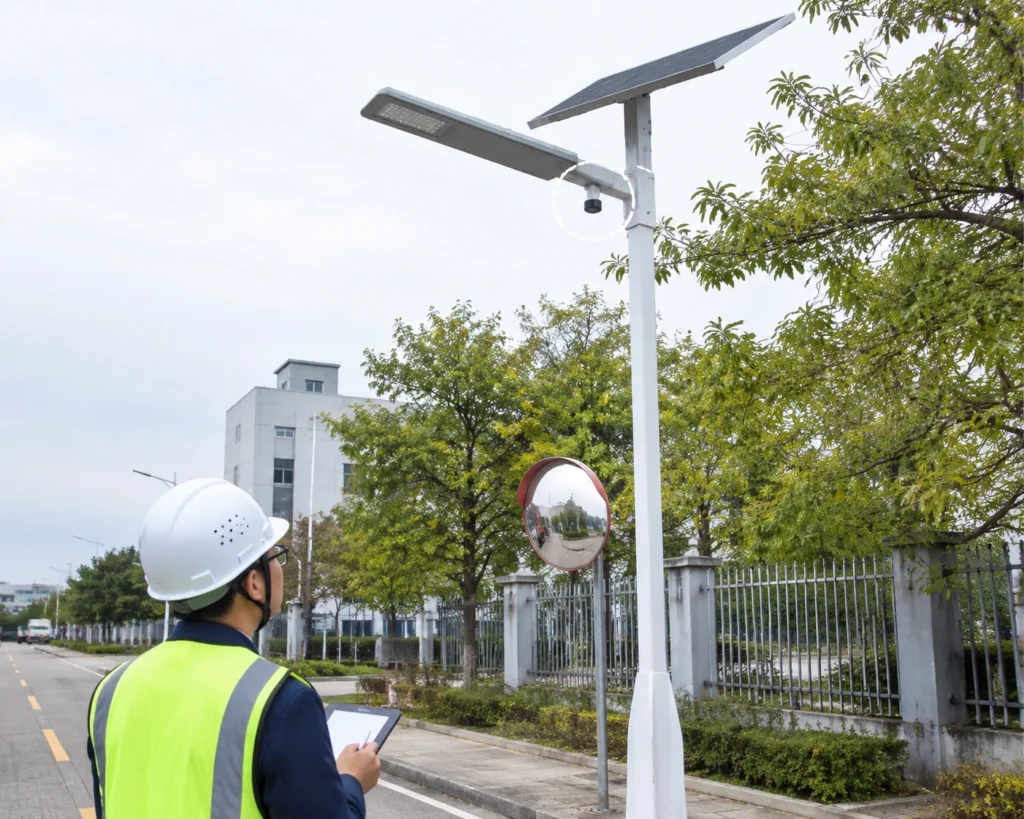
False triggering means the sensor activates boost brightness when useful movement is not present. This can reduce the energy-saving benefit of motion mode.
Common false-trigger sources include:
- Tree movement.
- Animals.
- Passing vehicles outside the target road.
- Nearby building activity.
- Reflective surfaces.
- Moving signs or banners.
- Wind-driven objects.
- Parking lot activity outside the intended area.
- Industrial equipment movement.
- Sensor direction too wide.
- Radar sensitivity set too high.
Radar sensors may require special attention if the site has frequent surrounding movement. PIR sensors may require attention if the movement direction, thermal background, or temperature contrast is not suitable.
If false triggering keeps the light bright for long periods, the solar street light may shut down early during cloudy or rainy periods.
For rainy-season troubleshooting, see Sunlurio’s guide to why solar street lights stop working after cloudy or rainy days.
Motion Sensors Do Not Replace Good System Sizing
Motion sensors can reduce energy consumption, but they cannot fix poor system sizing.
A project may still fail if:
- The battery is too small.
- The solar panel input is insufficient.
- The road is heavily shaded.
- The rainy season is longer than expected.
- Motion boost is triggered too frequently.
- Standby brightness is set too high.
- Delay time is too long.
- The controller profile is too aggressive.
- The system was designed only for ideal weather.
Sensor mode should be reviewed as part of the full system, not as a shortcut to reduce battery and solar panel size without engineering review.
PIR vs Radar in Africa and Middle East Projects
Africa Projects
For many Africa solar street lighting projects, PIR sensors can be practical for village roads, school roads, compounds, farms, pathways, and low-traffic areas where cost control and simple maintenance matter.
Radar sensors may be useful for larger parking areas, industrial access roads, mining areas, municipal sections, logistics yards, or sites with vehicle movement where stronger detection behavior is needed.
Project teams should review:
- Road activity level.
- Whether users are mostly pedestrians or vehicles.
- Local maintenance capability.
- Battery autonomy requirement.
- Dust, rain, or shading conditions.
- Whether false triggering could drain the battery.
- Whether the owner needs simple operation or more advanced control.
For Africa projects, the best sensor is usually the one that matches traffic behavior and maintenance ability, not the most expensive option.
Middle East Projects
For Middle East projects, sensor behavior should be reviewed together with heat, dust, desert exposure, remote maintenance cost, and public infrastructure responsibility.
PIR sensors may still be suitable for pathways, compounds, parks, and lower-speed access areas. Radar sensors may be useful for industrial roads, parking entrances, logistics areas, and projects where vehicle movement detection is more important.
Project teams should review:
- High-temperature working conditions.
- Dust and sand exposure.
- Panel soiling and charging margin.
- Battery protection logic.
- Motion boost frequency.
- False triggering from reflective surfaces or nearby movement.
- Whether smart control is needed for remote profile review.
- Whether local maintenance teams can adjust sensor settings after installation.
For large projects in Saudi Arabia, UAE, Oman, Qatar, or similar markets, sensor behavior may also need to be reviewed together with smart control and long-term O&M requirements.
For connected project review, see Sunlurio’s smart street lighting system design.
What Should Be Tested Before Pole Installation?
Before pole installation, the project team should test motion sensor behavior whenever possible.
A pre-installation test may include:
- Remote response.
- Sensor response.
- Standby brightness.
- Boost brightness.
- Delay time.
- Return-to-standby behavior.
- Controller profile.
- Day/night switching logic.
- Final operating mode.
- Whether the profile is restored after testing.
For radar or PIR review, the test should not only check whether the lamp turns on. It should check whether the sensor response matches the intended project logic.
For local setup procedures, see Sunlurio’s guide to basic remote control setup steps.
What Should Be Recorded During Commissioning?
During commissioning, the project team should record the final sensor configuration.
The record should include:
- Pole number.
- Project zone.
- Sensor type.
- Mounting height.
- Sensor direction.
- Controller profile.
- Standby brightness.
- Boost brightness.
- Delay time.
- Night test result.
- False triggering observation.
- Issue notes.
- Correction status.
Without this record, future troubleshooting becomes difficult. If several lamps behave differently, the team may not know whether the problem is sensor behavior, controller profile, installation angle, or site condition.
For final handover checks, see the solar street light commissioning checklist.
Common Mistakes to Avoid
1. Choosing PIR or Radar Only by Price
A lower-cost sensor may be enough for some projects. A more sensitive sensor may be useful for others. The correct choice depends on road use, pole height, traffic type, battery autonomy, and maintenance expectations.
2. Assuming Radar Is Always Better Than PIR
Radar can be more sensitive, but higher sensitivity can create false triggering if the site is not suitable. Better sensor behavior depends on correct matching, not only sensor type.
3. Assuming PIR Is Always Safer or More Efficient
PIR may be practical and low power, but it can still miss movement if the mounting angle, temperature contrast, or movement direction is not suitable.
4. Setting Standby Brightness Too Low
Low standby brightness saves energy, but it may reduce road safety and user comfort. Public areas may require visible background lighting.
5. Setting Delay Time Too Long
Long delay time keeps the lamp bright longer. This may improve comfort but can reduce battery autonomy, especially when traffic is frequent.
6. Ignoring Pole Height and Sensor Direction
The same sensor may behave differently at different pole heights and luminaire angles. Sensor direction should be checked before handover.
7. Ignoring False Triggering
Trees, animals, nearby movement, reflective surfaces, or industrial activity can keep the light in boost mode and drain the battery.
8. Using Motion Mode on Roads With Constant Traffic
If traffic is constant, the light may remain bright most of the night. In this case, timer mode or hybrid mode may be more predictable.
9. Not Recording the Final Sensor Profile
If sensor settings are changed during installation but not recorded, troubleshooting becomes difficult after handover.
When Timer Mode or Hybrid Mode May Be Better
PIR or radar motion mode is not always the best answer. Some roads need timer mode or hybrid control instead.
Timer mode may be better when:
- Traffic is steady.
- Public visibility is required.
- Sensor false triggering risk is high.
- The owner needs predictable lighting.
- The road has safety or public acceptance requirements.
Hybrid mode may be better when:
- Early evening traffic is busy.
- Late-night traffic is low.
- The project needs both safety and energy saving.
- The owner wants background lighting plus motion boost.
- Battery autonomy must be protected during low-traffic periods.
For a full comparison, see Sunlurio’s guide to motion sensor vs timer mode for solar street lights.
Request a Motion Sensor Review
Sunlurio can help EPC contractors, municipal project teams, and distributors review PIR or radar motion sensor settings for solar street lighting projects.
A project review can include:
- Road type review.
- Traffic pattern review.
- Pole height review.
- Sensor type review.
- Sensor direction review.
- Detection distance review.
- Standby and boost brightness review.
- Delay time review.
- False triggering risk review.
- Battery autonomy review.
- Rainy-season performance review.
- Smart control requirement review.
- Commissioning and handover record review.
To prepare a useful review, the project team can share the project location, road type, pole height, pole spacing, traffic type, operating hours, autonomy requirement, rainy-season condition, sensor requirement, and whether the project needs PIR, radar, timer mode, or hybrid control.
This helps avoid poor detection, false triggering, early shutdown, and inconsistent behavior across project zones.
Related Solar Street Light Setup and Troubleshooting Guides
For EPC teams reviewing PIR and radar motion sensors, these related guides may help connect sensor selection with motion mode, controller settings, pre-installation testing, battery autonomy, multi-pole troubleshooting, and smart control review.
- Basic remote control setup steps
- Motion sensor vs timer mode for solar street lights
- Solar street light motion sensor settings
- How to test solar street lights before pole installation
- Solar street light dimming profile and battery autonomy
- Multiple solar street lights failing in one area
- Remote control vs smart control for solar street lights
FAQ
What is a PIR sensor in solar street lights?
A PIR sensor detects infrared heat changes from moving people, animals, vehicles, or other warm objects. It is commonly used in solar street lights for pathways, parks, campuses, compounds, village roads, and low-traffic areas.
What is a radar sensor in solar street lights?
A radar sensor detects movement using radar or microwave signal reflection. It may be used when the project requires wider movement detection, vehicle response, parking entrance detection, or more sensitive behavior than a basic PIR sensor.
Is radar better than PIR for solar street lights?
Not always. Radar may provide more sensitive detection, but it can also create false triggering if the site has unwanted movement or if the sensitivity is too high. PIR may be enough for pedestrian and low-traffic areas. The best choice depends on project conditions.
Which sensor is better for road projects?
For pedestrian pathways and low-speed areas, PIR may be enough. For parking entrances, industrial roads, logistics areas, or vehicle movement areas, radar may be worth reviewing. For main roads with steady traffic, timer mode or hybrid mode may be more practical.
Can motion sensors save battery power?
Yes, motion sensors can reduce battery consumption if the light spends enough time in standby brightness. If traffic is frequent or false triggering occurs, the energy-saving benefit may be much lower.
Why do motion sensor solar street lights shut down early?
They may shut down early if boost brightness is triggered too often, delay time is too long, standby brightness is too high, battery capacity is insufficient, solar charging is weak, or the dimming profile is too aggressive.
What causes false triggering in solar street light sensors?
False triggering can be caused by trees, animals, nearby movement, passing vehicles outside the target area, reflective surfaces, moving signs, industrial activity, or sensor direction that is too wide or too sensitive.
Should PIR or radar be tested before pole installation?
Yes. Sensor response, standby brightness, boost brightness, delay time, controller profile, and return-to-standby behavior should be checked before pole installation whenever possible.
What should EPC teams record during commissioning?
EPC teams should record pole number, sensor type, mounting height, sensor direction, controller profile, standby brightness, boost brightness, delay time, night test result, false triggering observation, issue notes, and correction status.
Can smart control help with PIR or radar sensor projects?
Yes. In larger projects, smart control may help review motion profiles, adjust dimming settings, monitor abnormal behavior, and support maintenance planning across many poles.