
A solar street light that turns on after installation has passed only one possible check. Before an EPC team submits a commissioning package, it should also establish which equipment and settings were installed, which tests were performed, what the results mean, and whether any defects were retested and reviewed.
For a municipal or infrastructure project, a useful commissioning record follows one traceable path:
Approved project basis → Installed pole / configuration → Site tests → Defect and retest → Evidence revision → Owner or consultant review.
The purpose of this checklist is to help site teams perform and document those checks. It does not create a universal acceptance standard. Test methods, inspection coverage, witness points and pass criteria come from the applicable contract, approved inspection and test plan (ITP), manufacturer instructions and responsible project authorities. Ready for review is not the same as formally accepted.
1. Confirm the Approved Project Baseline Before Commissioning
The first site question is not “Does the lamp work?” It is “Which approved requirement will this test be checked against?”
An early quotation, delivered product datasheet and issued-for-construction drawing may not describe the same project revision. The commissioning team should identify the current applicable documents before recording a pass or failure.
Confirm what applies to this project
| Project basis | What to verify before testing | Reference to record |
|---|---|---|
| Equipment and layout | Approved luminaire/system configuration, pole schedule, mounting arrangement and site geometry | Drawing / schedule ID and revision |
| Operating profile | Required night operation, dimming stages and zone-specific controller settings | Profile ID, revision and approved source |
| Test procedure | Required checks, coverage or sampling, observation conditions and witness points | ITP / procedure ID and revision |
| Performance criteria | Applicable functional and, where required, photometric acceptance basis | Specification / method / approved criterion reference |

The project may have additional requirements for foundations, electrical safety, environmental exposure or documentation. Their inspection and release must be performed by the disciplines and people responsible for them; an EPC luminaire checklist does not certify a pole foundation or electrical installation merely because it looks correct.
Where information is missing or contradictory, record TO CONFIRM and identify the responsible reviewer. Do not invent a universal battery voltage, autonomous operating period, pole tolerance or illuminance threshold to fill the gap.
For teams still resolving the procurement-stage documents, the tender document and BOQ review guide addresses that earlier task.
2. Map Installed Poles to Approved Configurations and Test Records
For a project with several roads or lighting zones, a single statement such as “all lights tested” is difficult to verify. The records should identify the assets covered by each test and the configuration that was present when the test was made.
Use a stable Pole ID / Zone ID or the project’s approved asset identifier. Where a pole supports more than one separately controlled luminaire, the schedule may need a luminaire-level identifier as well.
A practical record connects:
- Approved basis: drawing, equipment schedule and controller profile revision;
- As-installed equipment: offered/installed model, relevant serial or batch reference, and site position;
- Applied settings: operating-profile identifier and actual revision, where this can be established;
- Testing: Test ID and the file containing conditions, observations and results;
- Exceptions: substitution, configuration change or outstanding issue reference.
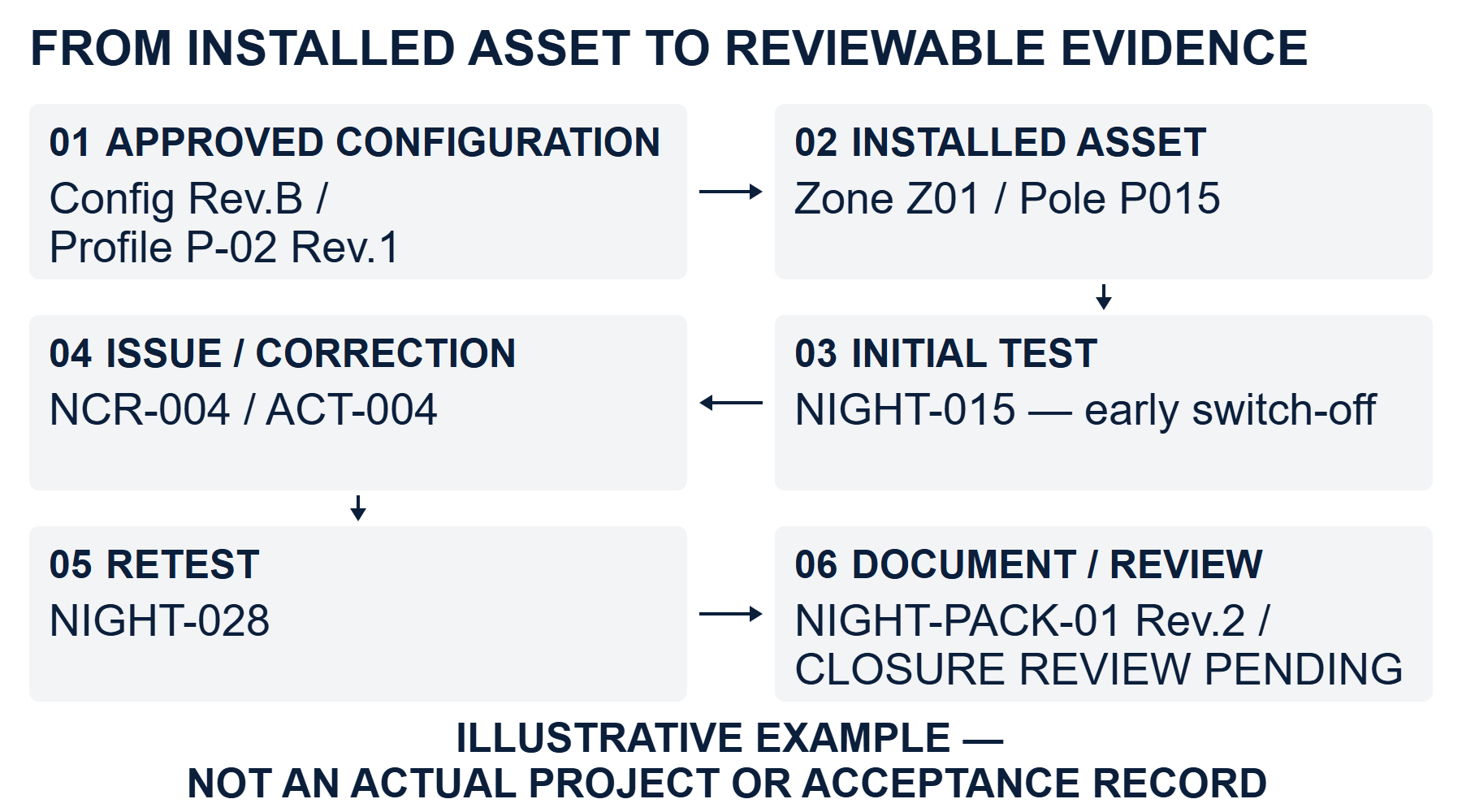
Illustrative example — not an actual Sunlurio project: Zone Z01, Pole P015 is listed against Configuration Rev.B and approved controller profile P-02 Rev.1. The installed record identifies the actual equipment and applied profile; the night observation is filed as NIGHT-015. If its controller settings subsequently change, the team records the previous and new references and checks whether NIGHT-015 still supports the updated configuration.
The same example continues through the defect and retest process below.
A photo of a labelled pole is useful supporting evidence but does not prove that its internal configuration, optic or controller settings match the approved document. Likewise, an inspection sample is valid only for the coverage allowed by the project ITP. Do not mark an entire installation as individually tested based on a representative unit unless the approved method expressly supports that conclusion.
3. Verify Installation Conditions and the Applied Controller Profile
The existing site checks remain important. The improvement is to record the observation, its approved reference, and the related Test ID, rather than creating another sheet of unexplained ticks.
Practical on-site verification points
| Check | Site-team question | Evidence / record to retain |
|---|---|---|
| Ground-level functional test | Was the product checked before lifting, including applicable battery readiness, controller activation and luminaire response? | Pre-installation Test ID, result and any open issue |
| PV module and solar access | Does installation match the approved panel orientation/tilt, and are material shading, cable or connector concerns visible? | Drawing reference, site observation/photo and issue ID if needed |
| Battery and controller | Do installed component references match the released configuration, and is a reported protection or low-charge condition being handled under the OEM procedure? | Model/serial reference, permissible OEM-status reading and test notes |
| Pole, bracket and connections | Is the visible mounting, cable routing, sealing and labelling consistent with the drawings and assigned inspection scope? | Inspection reference; separate civil/electrical release where required |
| Applied operating profile | Which final mode, dimming schedule and sensor logic have actually been left in service? | Approved versus applied Profile ID/revision, record/readback if supported |
| Post-test restoration | Was any temporary manual or test mode returned to the required operating state? | Confirmation date, responsible person and relevant retest ID |
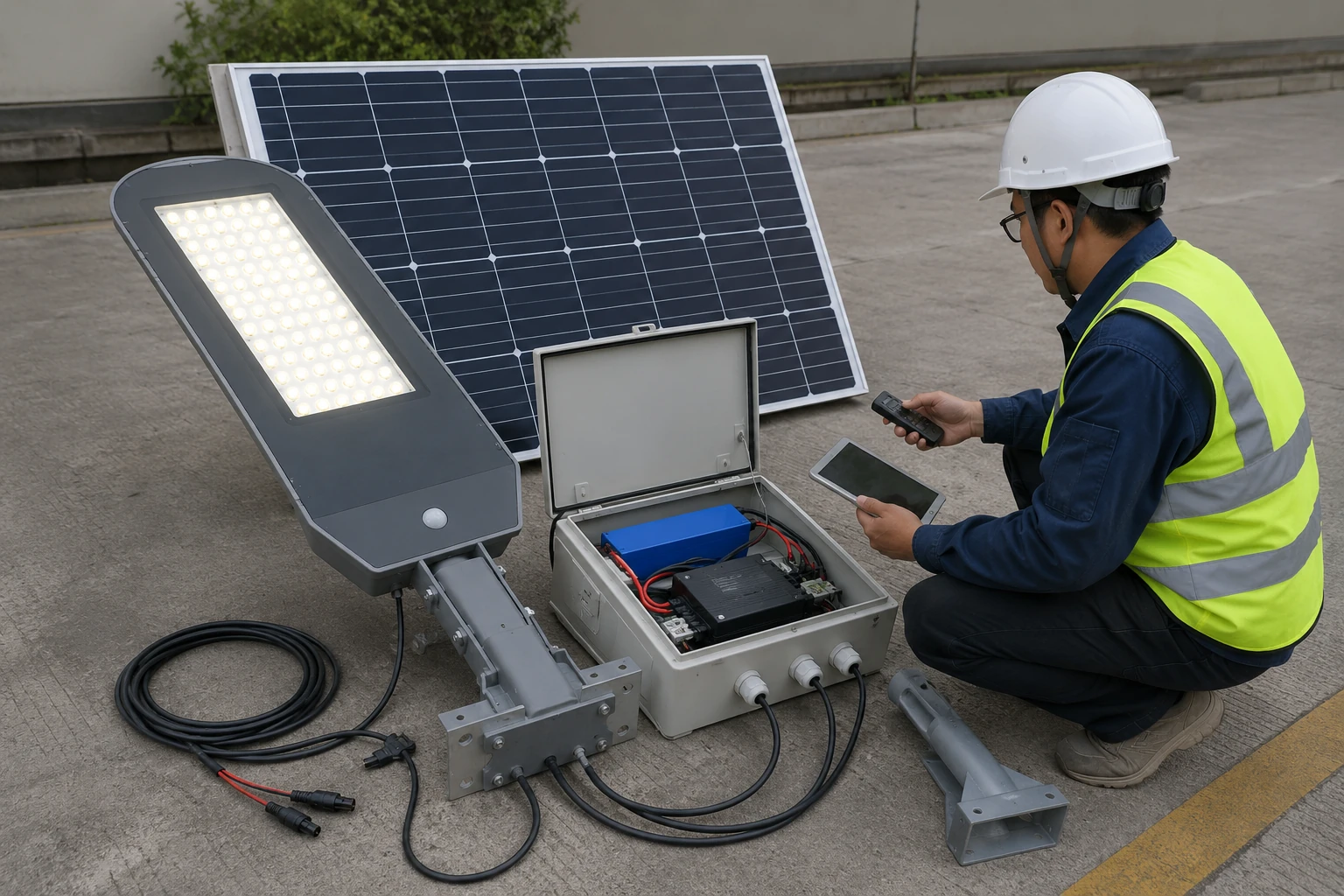
Do not open batteries, improvise live electrical measurements or bypass protection functions based on a generic online checklist. Such work requires the correct OEM procedure, qualified personnel and site safety controls. Some controllers provide a settings export or remote readback; others require a recorded setup sheet. Do not assume every system supports the same method.
The pre-installation solar street light test guide covers the earlier ground-test stage. Here, the commissioning record should reference those results and focus on what changed after mounting.
Controller settings deserve special attention. A temporary ON command or daylight simulation may confirm response, but it is not proof of the approved automatic night sequence. Where different roads or zones use different profiles, retain the correct mapping rather than applying one setting to every pole without review.
If settings are changed on site, note the authorization, the previous and new profile references, and which test results must be repeated. For additional context on specifying profiles before supply, see the solar street light dimming profile tender guide.
4. Distinguish Daytime Functional Tests, Night Tests and Photometric Verification
Different tests answer different questions. A correct observation is useful only within the conditions and duration actually recorded.
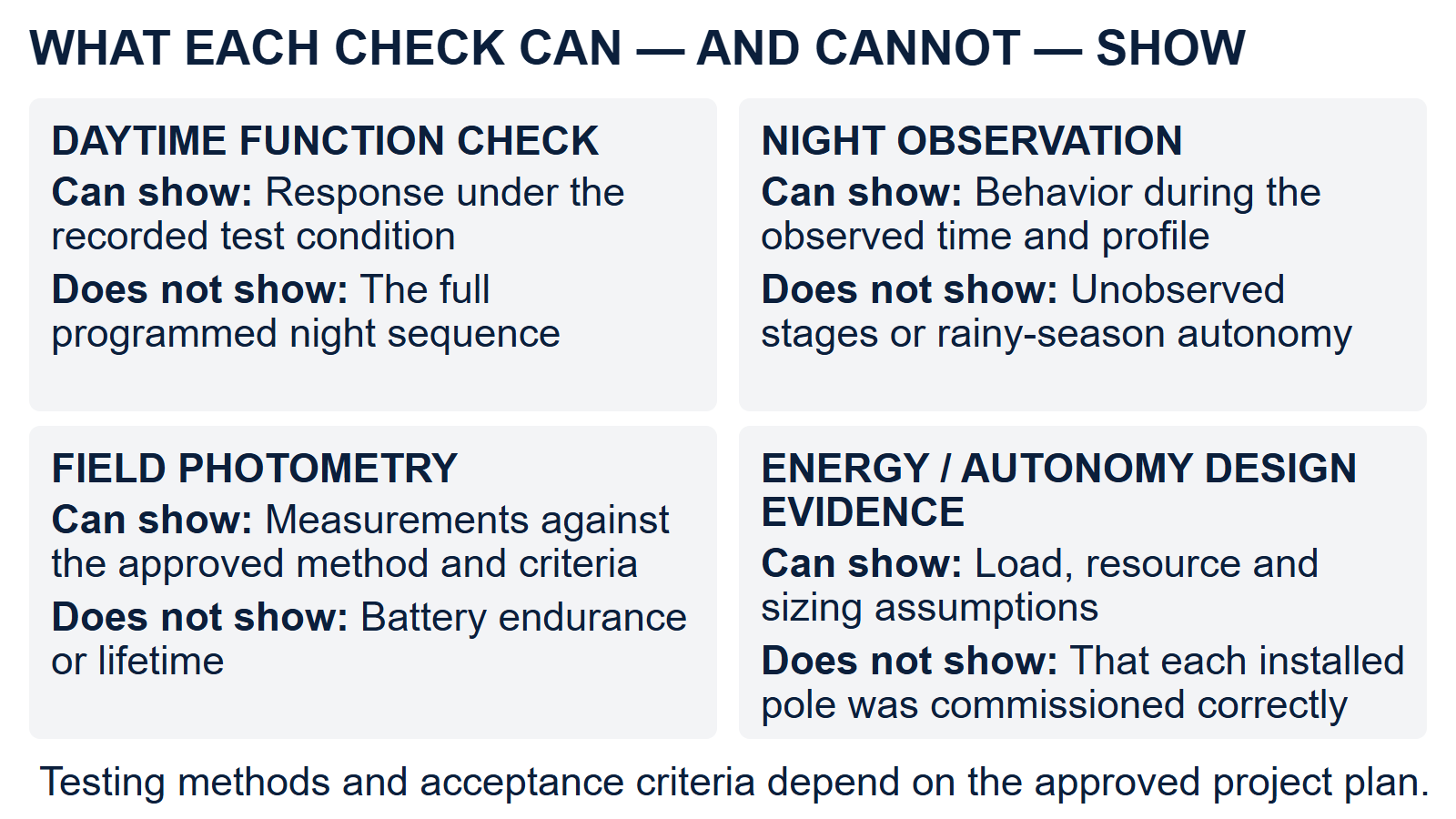
| Evidence type | Can demonstrate | Cannot establish by itself |
|---|---|---|
| Daytime functional response | Equipment response to a documented approved test method or temporary command | Final dusk-to-dawn schedule or every dimming stage |
| Installed night observation | Actual behaviour during the observed time window and applied profile | Operation outside that window or worst-season autonomy |
| Field photometric measurements, if required | Measured lighting performance against the approved method and criteria | Battery endurance or long-term reliability |
| Energy-design / dedicated autonomy evidence | Proposed load, usable energy and seasonal design assumptions within the defined study scope | That every installed pole was correctly commissioned |
Daytime response is a limited functional result
During a daytime check, the luminaire may respond to an OEM-approved local command or simulated darkness. Record the actual mode and test condition. If a temporary mode is used, the team should confirm its restoration before closing the test. Repeatedly pressing remote-control buttons without understanding the controller logic is not a commissioning method.
Observe the real night operating sequence
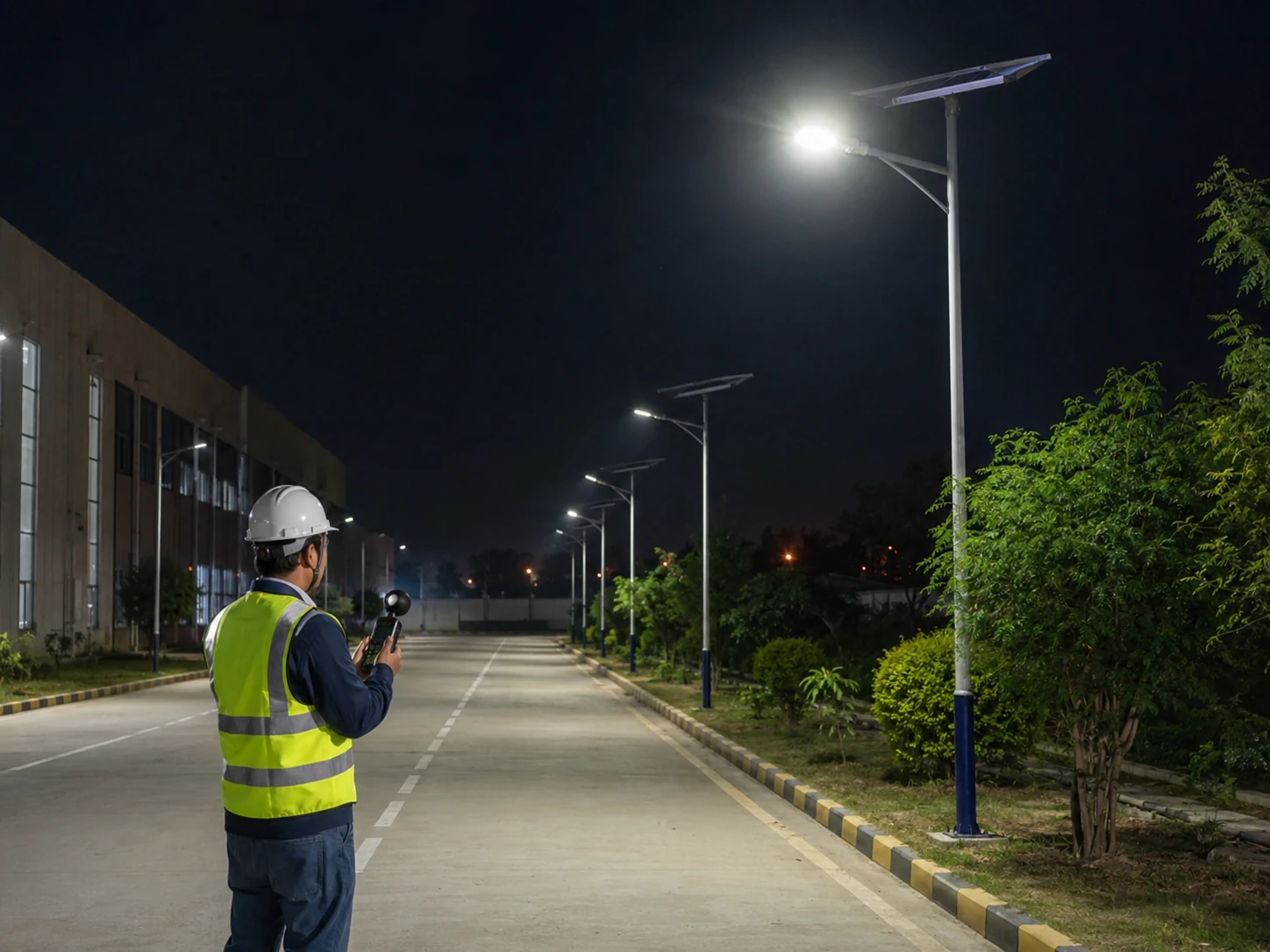
The night record should identify the zone/poles, applied profile, date, start/end time, weather or site conditions relevant to the method, observations and Test ID. Where required, observe dusk activation, staged dimming, motion response, abnormal early switch-off and inconsistent behaviour between poles that should share the same settings.
An observation lasting two hours should be reported as a two-hour observation, not a “full-night pass.” Other scheduled stages need their own observations, controller logs or verification method as required by the project. Photos should be timestamped and tied to the relevant asset/test record where useful.
Do not confuse a visual check with photometric verification
A visible dark area may identify a problem worth investigating, but looking at a road is not a substitute for specified illuminance, luminance or uniformity measurements. When field photometry is required, use the approved measurement method, conditions, positions and calibrated equipment as applicable, and reference the report. Compare the results with the approved target—not an invented universal lux value.
Similarly, a DIALux/Relux design report is a design reference, not proof of actual site measurements. Photometric files should be applicable to the installed luminaire and optic configuration; see IES / LDT photometric-file engineering support.
One successful night test does not prove rainy-season autonomy, worst-month recharge, battery life or long-term controller reliability. Those questions require a suitable energy-design basis and any additional verification specified for the project.
5. Record Defects, Corrective Actions and Retests
When a commissioning check fails, preserve the original record. Replacing the failed entry with “fixed” makes it impossible to tell what was observed, what changed and whether the relevant behaviour was checked again.
Continue the illustrative example from Zone Z01 / Pole P015:
- NIGHT-015: The light switches off earlier than specified by the approved Profile P-02 Rev.1. The time window, conditions and applicable profile requirement are recorded, so this is more than an unexplained visual observation.
- NCR-004: The site team opens a nonconformance/issue under the project procedure for P015 and references NIGHT-015. It assigns responsibility and states the observed difference without guessing its cause.
- ACT-004: The responsible team investigates and documents an authorized correction, component change or profile adjustment, including any change to the configuration revision.
- NIGHT-028: A new test is conducted under the applicable procedure. The result is retained as a separate record, not pasted over NIGHT-015.
- REVIEW-012: The authorized reviewer evaluates the correction, retest evidence and any wider impact before recording whether NCR-004 may close.
Illustrative example — not an actual project or a claim that any issue has passed.
A correction may affect related tests. For instance, changing a dimming profile may require more than repeating a quick ON/OFF command. The project engineer or other authorized reviewer should define the appropriate retest scope.
Keep three states separate:
Corrective action completed → Retest result evaluated → Issue closure authorized.
These are not interchangeable. A failed or deferred item should remain visible until the responsible project procedure determines its treatment. Longer-term service tickets and replacement-part responsibilities belong in the EPC after-sales and maintenance process, not this initial site-commissioning record.
6. Build a Traceable Commissioning Record Index
After field work, the team may have dozens of photographs, setup sheets, night-test reports and defect records. The owner or consultant needs a quick way to find the evidence for a specific pole or test without treating the index itself as a certificate.
The Commissioning Record Index is a short reference table connecting the original records:
Pole / Zone → Approved and applied configuration → Test and result → Issue / Retest → Evidence file and revision → Reviewer status.
Illustrative example — not an actual Sunlurio project
| Pole / Zone | Configuration reference | Test record and result | Issue / retest | Evidence document | Review status |
|---|---|---|---|---|---|
| Z01 / P014 | Config Rev.B; Profile P-02 Rev.1 | NIGHT-014 — observation recorded, criterion review pending | None recorded | NIGHT-PACK-01 Rev.1 | UNDER REVIEW |
| Z01 / P015 | Config Rev.B; Profile P-02 Rev.1 | NIGHT-015 — early switch-off recorded | NCR-004; NIGHT-028 retest | NIGHT-PACK-01 Rev.2 | CLOSURE REVIEW PENDING |
The detailed test file—not the summary row—should contain the conditions, method, observations and applicable criterion. The index does not need to reproduce every measurement or signature.
In the working records, do not collapse file available, test performed, result meets criterion and review approved into one “PASS” value. They describe different stages. A new test must keep its own ID even after a previous one is superseded.
For larger projects, linked asset, test, issue and document tables may be useful behind this summary. That is an internal data-organization concept, not a new mandatory tender requirement or a downloadable Sunlurio workbook currently being offered.
7. Prepare the Commissioning Package for Owner Review
The final commissioning task is to make the evidence reviewable, including unresolved items—not to declare the project accepted on the owner’s behalf.
Before submission, confirm that the transmittal identifies the revision of the asset schedule, applied configuration records, relevant Test IDs, unresolved issues, retests, drawings and other documents required by the project. Where required, include witness records, measurement reports, installer confirmations and O&M information within the party’s agreed scope.

Record who received the package, when, at what revision, and which open issues accompanied it. Do not erase an earlier submission if the owner or consultant later requests corrections.
The EPC may identify a commissioning package as ready for review. Formal owner/consultant acceptance, O&M transfer, payment milestones and warranty commencement are separate contract-defined decisions. For those stages, use the owner acceptance and sign-off guide and the broader acceptance and O&M handover checklist.
Frequently Asked Questions
Can a daytime response test complete solar street light commissioning?
No. It confirms only the response observed under the recorded test condition. The approved night sequence, relevant operating stages and any required lighting measurements need their own verification. Temporary test settings must be restored and recorded as appropriate.
Can one night test prove battery autonomy in the rainy season?
No. A single night demonstrates only the operation observed under that night’s conditions and profile. Rainy-season autonomy and recharge performance depend on project-specific load, solar-resource, usable-battery-energy and control assumptions, with dedicated verification where required.
What should be recorded when a controller profile changes on site?
Record the affected Pole/Zone IDs, approved and previously applied profile references, new setting/revision, reason, authorization, person/date, available readback or setup evidence, and tests requiring review or repetition. Not every controller supports configuration export.
Should every pole be tested, or can commissioning use sampling?
Follow the approved ITP, contract, manufacturer requirements and responsible project authority. Some checks may require unit-by-unit coverage; others may allow defined sampling. No fixed sampling percentage is universally appropriate. Record the sample selection and exactly which assets its results cover.
Does a completed commissioning record mean the project owner has accepted the installation?
No. File availability, test completion, results against criteria, reviewer action and contract acceptance are separate states. Owner acceptance must be issued under the relevant project procedure by an authorized party.
How should an EPC close a defect after repair or reconfiguration?
Keep the original failed Test ID, link an Issue/NCR ID, document the authorized corrective action, and create a separate Retest ID. Record the result against the applicable criterion and obtain the authorized closure decision. A repair note alone is not proof of closure.
Preparing Commissioning Records for an EPC or Municipal Solar Lighting Project?
If your team has commissioning records, a pole schedule or controller-profile documentation but needs to identify missing product/configuration evidence before owner review, Sunlurio can discuss the available information from a supplier-side engineering perspective.
Where available, provide the project country/location, approximate quantity, approved equipment/drawing references, affected zones, applied profile records and the commissioning or document requirements. Share only documents you are authorized to disclose.
Sunlurio can help clarify product/configuration references and the appropriate technical-document support path. Local site supervision, professional certification and owner acceptance remain with the responsible appointed parties.