Quick Answer
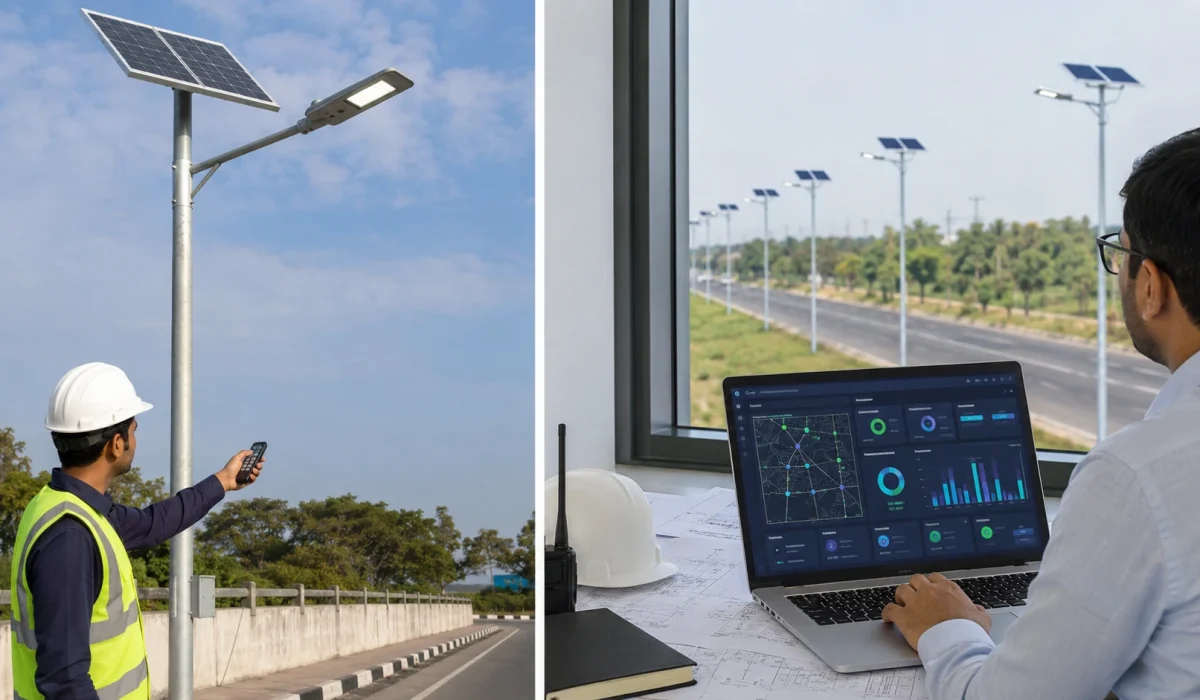
Remote control is usually enough for small solar street light projects where installers only need to set AUTO mode, timer schedules, dimming levels, motion sensor mode, or final operating profiles during installation and commissioning. It is simple, low-cost, and practical when the project does not require remote monitoring.
Smart control is more suitable for larger road, municipal, campus, industrial, or government projects where the owner needs centralized monitoring, fault alerts, remote profile updates, asset management, energy data, zone control, or reduced manual inspection.
The best choice depends on project size, maintenance access, road safety requirements, communication coverage, budget, platform responsibility, data needs, local environment, and handover expectations. Remote control solves local setup. Smart control solves long-term operation and maintenance management.
Project Review Summary
| Item | Project Review Point |
|---|---|
| Main topic | Remote control vs smart control for solar street lights |
| Best-fit buyers | EPC contractors, municipal project teams, project distributors, government project buyers, industrial operators, and maintenance teams |
| Best-fit projects | Rural roads, village roads, municipal roads, campuses, industrial parks, ports, parking areas, highways, smart city roads, and multi-zone solar lighting projects |
| Core search intent | Whether solar street lights need remote control only or smart IoT control |
| Main decision factor | Project scale, maintenance method, monitoring needs, operation responsibility, and communication condition |
| Remote control role | Local setup, timer mode, dimming profile, motion mode, and commissioning confirmation |
| Smart control role | Remote monitoring, fault alerts, group control, asset management, profile updates, and operation records |
| Main risk | Paying for smart control when it is not needed, or using only remote control when the project needs long-term monitoring |
| Africa project focus | Cost control, village roads, small municipal sections, compounds, schools, farms, parking areas, motion sensor, and easy local maintenance |
| Middle East project focus | Heat, dust, desert exposure, IP rating, battery protection, remote maintenance, smart city roads, and government infrastructure |
| Related setup guide | Basic remote control setup steps |
| Related control mode guide | Motion sensor vs timer mode for solar street lights |
| Related smart lighting page | Smart street lighting system design |
What Remote Control Means in Solar Street Lighting
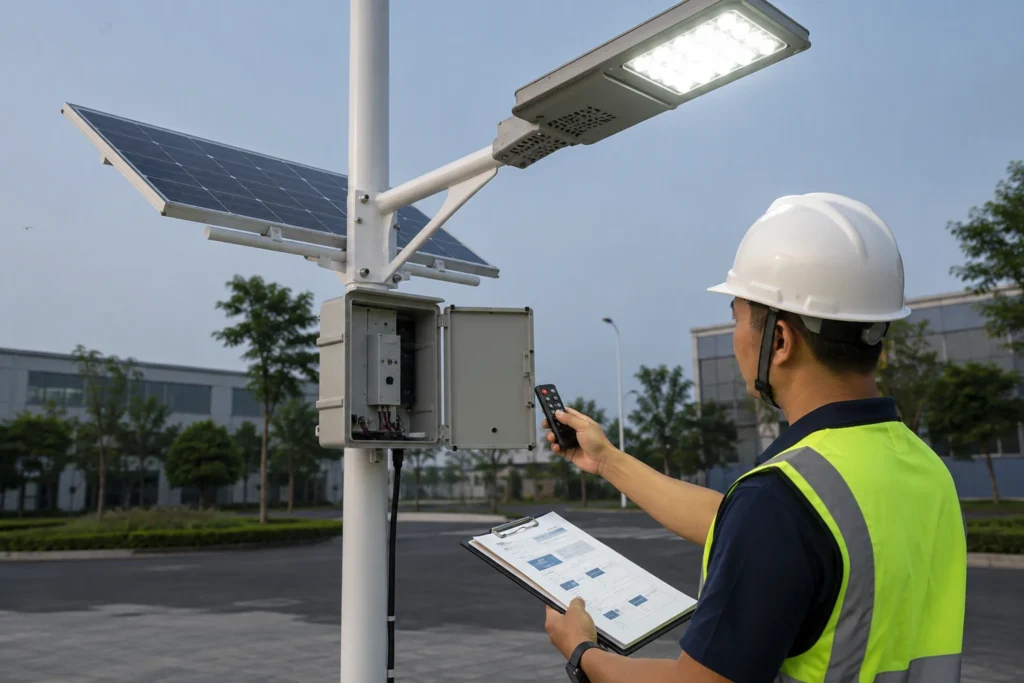
Remote control usually means a handheld IR, RF, or project-specific setting tool used to configure the solar street light controller near the lamp.
It may be used to set or confirm:
- AUTO mode.
- Timer mode.
- Dimming level.
- Motion sensor mode.
- Radar or PIR mode.
- Operating hours.
- Test mode.
- Final controller profile.
- Reset or basic mode switching.
- Commissioning confirmation.
Remote control is mainly a local setup tool. It is useful during installation, pre-installation testing, commissioning, and simple maintenance.
Remote control is suitable when the user only needs simple mode adjustment after installation and does not need to monitor battery health, charging status, lamp faults, or pole locations remotely.
For basic button logic and setup sequence, see Sunlurio’s guide to basic remote control setup steps.
What Smart Control Means in Solar Street Lighting
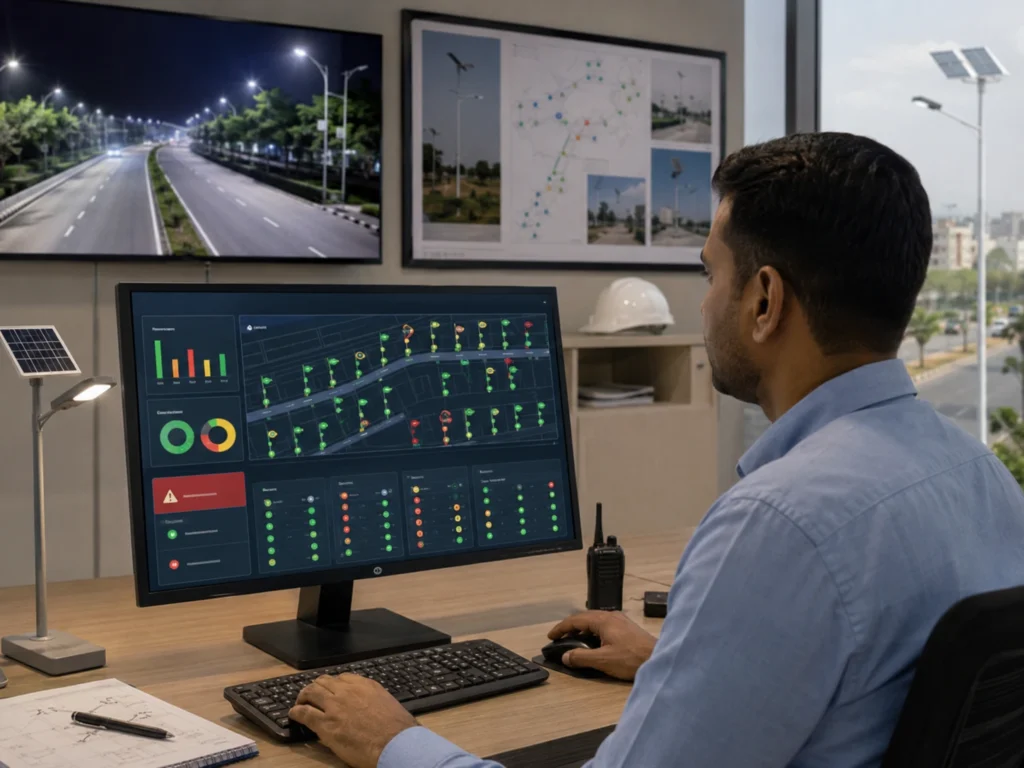
Smart control means the solar street light is connected to a communication system or management platform. Instead of checking each pole manually, the project team can monitor or manage multiple lights through a platform, gateway, SIM-based connection, or networked controller.
Depending on the system design, smart control may support:
- Remote on/off control.
- Remote dimming profile adjustment.
- Group or zone control.
- Fault alerts.
- Battery status monitoring.
- Solar charging status.
- LED load status.
- Controller status.
- Motion sensor data or trigger records.
- Asset management by pole number.
- Maintenance ticket support.
- Energy or operation reports.
- Platform-based handover records.
Smart control is not just a more advanced remote. It changes the maintenance model from manual pole-by-pole checking to centralized operation review.
Smart control is more suitable for city roads, highways, industrial parks, government projects, smart city projects, ports, large campuses, and remote project zones where maintenance visits are costly or slow.
For larger connected projects, see Sunlurio’s smart street lighting system design.
Remote Control vs Smart Control: Key Differences
| Item | Remote Control | Smart Control |
|---|---|---|
| Control method | Handheld remote or local setting tool | App, PC platform, cloud system, gateway, or networked controller |
| Main role | Local setup and testing | Centralized monitoring and management |
| Best-fit project size | Small to medium projects | Medium to large multi-zone projects |
| Best-fit users | Small contractors, local installers, schools, farms, compounds, small road projects | Municipalities, EPC contractors, developers, government projects, industrial operators |
| Setup complexity | Lower | Higher |
| Network needed | No internet usually required | Usually requires 4G/5G, LoRaWAN, Zigbee, gateway, or other communication architecture |
| Main functions | ON/OFF, AUTO, dimming, timer, sensor mode | Monitoring, alarms, group control, reporting, remote profile updates |
| Maintenance | Manual inspection | Remote fault diagnosis and platform-assisted maintenance |
| Profile update | Manual, pole by pole | Remote or group update may be possible |
| Cost level | Lower initial cost | Higher initial cost and possible service cost |
| Handover requirement | Setting record and test result | Platform access, data ownership, communication, and O&M responsibility |
The key difference is not only the control method. It is the level of operation visibility after installation.
When Remote Control Is Enough
Remote control is usually enough when the project is relatively simple, easy to access, and does not require platform-based operation.
1. Small Road or Village Projects
For village roads, rural roads, school roads, compounds, farms, small parking areas, and short access roads, a handheld remote can be practical.
Remote control may be enough when:
- The number of poles is limited.
- The road section is easy to inspect manually.
- The operating profile is simple.
- The customer does not need online monitoring.
- Maintenance teams can visit the site easily.
- Communication coverage is weak or unnecessary.
- The project budget does not support smart control.
- The owner only needs final commissioning records.
2. Projects With Stable Fixed Profiles
If the project uses one approved dimming profile and does not need frequent updates, remote control may be sufficient.
For example:
- Timer mode is fixed.
- Motion mode is simple.
- Standby and boost settings are already approved.
- The project does not need zone-level profile changes.
- The handover record clearly documents the final settings.
For control mode selection, see Sunlurio’s guide to motion sensor vs timer mode for solar street lights.
3. Projects Without Reliable Communication Coverage
Smart control depends on communication conditions. If the project site has weak mobile signal, no gateway location, unstable backhaul, or no maintenance team for communication devices, remote control may be more practical.
Before selecting smart control, project teams should check:
- Mobile signal quality.
- Gateway installation location.
- Power supply for gateway if needed.
- Backhaul connection.
- Network maintenance responsibility.
- Data subscription or platform service cost.
- Local technical support capability.
4. Budget-Sensitive Projects
Smart control adds hardware, communication, platform, commissioning, and maintenance requirements. If the project does not need monitoring, a remote-controlled system may provide better cost control.
However, the cost review should not only compare product price. It should also include maintenance access, fault-finding cost, public lighting responsibility, and future operation workload.
When Smart Control Is Better
Smart control is usually better when the project needs long-term visibility, faster maintenance response, and centralized operation.
1. Large Municipal or Government Projects
For large municipal roads, government tenders, smart city roads, and public infrastructure projects, manual inspection may become expensive and slow.
Smart control can help project owners review:
- Which lights are online.
- Which poles have fault alerts.
- Which batteries are low.
- Which zones need profile adjustment.
- Which areas are operating abnormally.
- Whether maintenance actions were recorded.
This is especially useful when the project has hundreds or thousands of poles.
2. Projects With Difficult Maintenance Access
Smart control can be valuable when the site is difficult or costly to inspect.
Examples include:
- Remote rural roads.
- Long highways.
- Industrial parks.
- Ports.
- Mining areas.
- Oil and gas areas.
- Border roads.
- Large campuses.
- Distributed village lighting projects.
- Roads with limited night inspection access.
If maintenance teams cannot inspect every pole frequently, platform visibility can reduce uncertainty.
3. Projects Requiring Fault Alerts
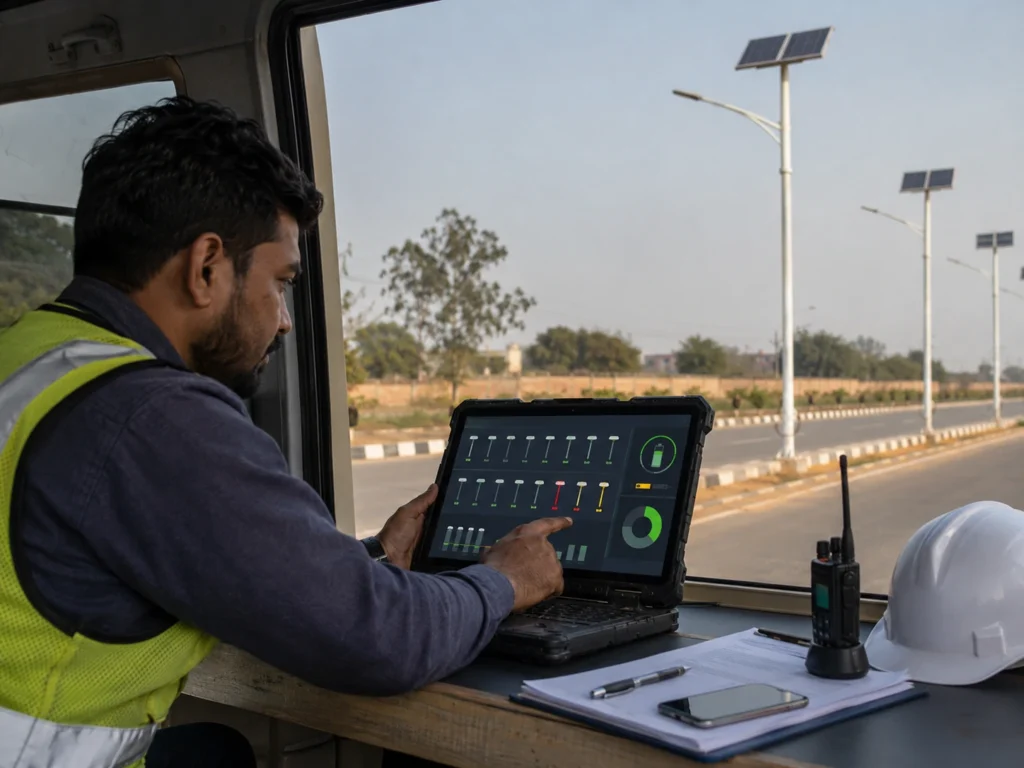
Remote control cannot usually tell the maintenance team which pole has a problem unless someone goes to the site.
Smart control may help identify:
- Lamp offline status.
- Low battery warning.
- Charging abnormality.
- LED load fault.
- Controller abnormality.
- Communication fault.
- Unexpected profile behavior.
- Group-level operation problems.
This does not remove the need for field repair, but it can help locate the problem faster.
4. Projects Needing Remote Profile Updates
Some projects need different profiles by season, zone, road type, or operating period.
Smart control can be useful when the project needs:
- Seasonal dimming adjustment.
- Rainy-season conservative profiles.
- Event-based brightness changes.
- Zone-level control.
- Different settings for main roads and side roads.
- Remote correction after commissioning.
- Avoidance of pole-by-pole manual resetting.
For battery autonomy and dimming logic, see Sunlurio’s guide to solar street light dimming profile and battery autonomy.
5. Projects With Contractual O&M Requirements
Some EPC or municipal projects require operation records, maintenance response, or proof of performance after handover.
Smart control may support:
- Operation logs.
- Fault records.
- Maintenance planning.
- Pole asset management.
- Handover documentation.
- Performance review.
- Warranty communication.
This can be important when the project has strict public lighting responsibility or long-term maintenance obligations.
Which Control Type Is Better for Africa Projects?
For many Africa solar street lighting projects, remote control is still a practical and cost-effective choice for village roads, school roads, farms, compounds, parking areas, and small municipal sections. These projects often need simple setup, basic dimming, dusk-to-dawn operation, motion sensor mode, and easy local maintenance without internet or platform requirements.
Remote control may be enough when:
- The project quantity is limited.
- The site can be inspected manually.
- The owner mainly needs AUTO mode, timer mode, dimming, or motion sensor settings.
- Communication coverage is weak or uncertain.
- The project is budget-sensitive.
- The local maintenance team does not need platform monitoring.
However, smart control becomes more valuable for larger African projects such as municipal roads, highways, mining areas, industrial parks, government lighting programs, and distributed village lighting projects. In these cases, the owner may need to check battery status, fault location, charging behavior, and operation records without sending technicians to every pole.
For Africa projects, the decision is usually not “remote control or smart control is better.” The better question is whether the project needs only local setup or long-term centralized maintenance.
Which Control Type Is Better for Middle East Projects?
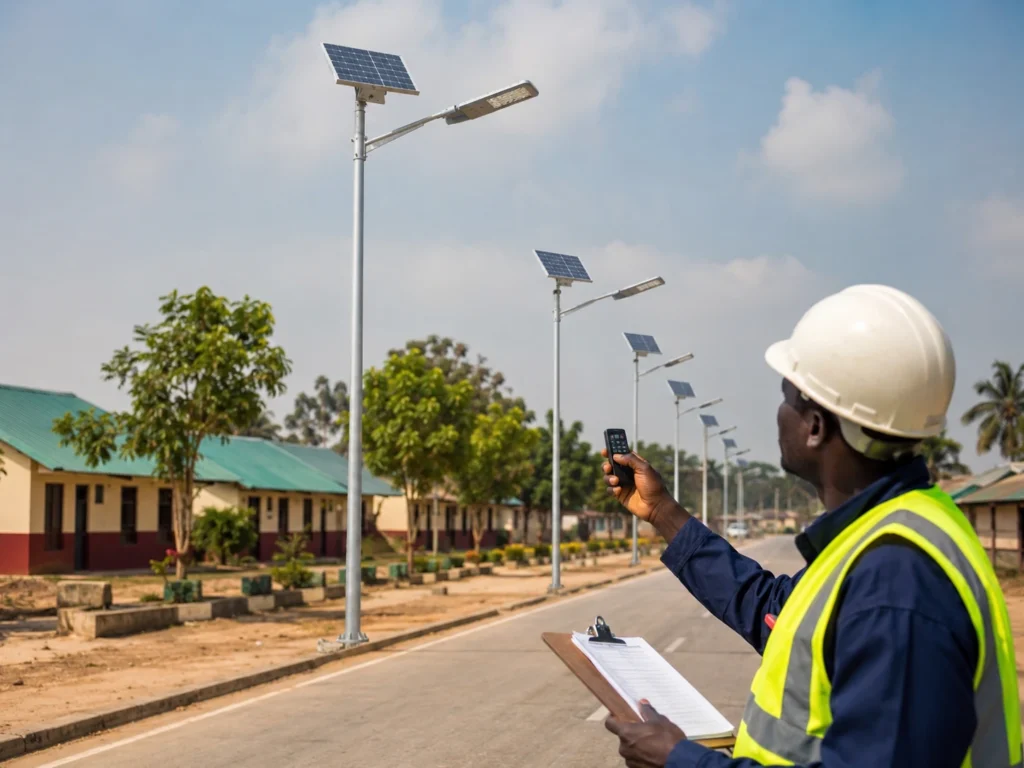
For Middle East solar street light projects, the control choice should be reviewed together with heat, dust, desert exposure, maintenance distance, battery protection, and public infrastructure responsibility.
Remote control can still be suitable for small parking areas, private roads, farms, compounds, and simple off-grid lighting projects where the owner only needs local setup and basic mode adjustment.
Smart control is often more valuable for larger projects in Saudi Arabia, UAE, Oman, Qatar, and similar markets where roads, industrial zones, parks, highways, or government infrastructure may require remote monitoring, fault alerts, group control, and operation records.
Smart control can help project owners:
- Review battery and charging status remotely.
- Reduce manual inspection under high-temperature or dusty conditions.
- Adjust dimming profiles by road section or season.
- Identify abnormal poles faster.
- Manage many lamps across large or remote project areas.
- Support municipal or smart city operation requirements.
However, smart control should not be selected only because it sounds advanced. The project team must also confirm communication coverage, gateway planning, platform responsibility, data access, and local operation capability.
Remote Control Is Not the Same as Smart Control
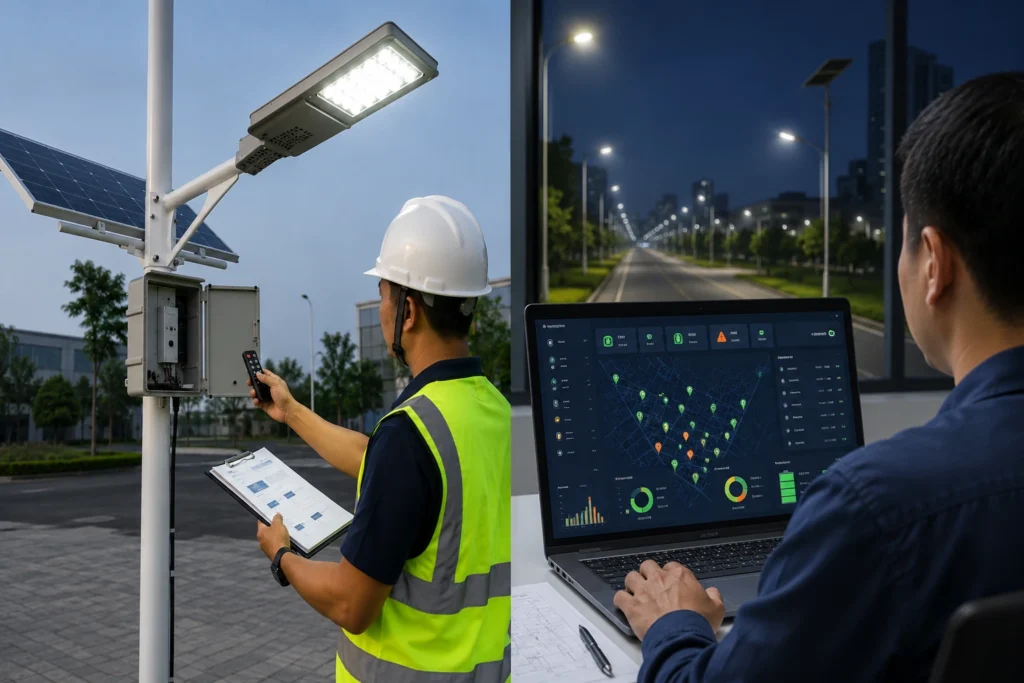
A common mistake is to think that a remote-controlled solar street light is already a smart system.
They are different.
Remote control means the installer can change settings locally. Smart control means the system can be monitored or managed through a connected network or platform.
| Question | Remote Control | Smart Control |
|---|---|---|
| Can the installer set modes on site? | Yes | Yes, depending on system |
| Can the owner see pole status remotely? | Usually no | Usually yes |
| Can faults be reported automatically? | Usually no | Possible |
| Can profiles be updated by zone? | Usually manual | Possible |
| Can maintenance records be linked to pole data? | Usually manual | Possible |
| Can the system support smart city operation? | Limited | More suitable |
Remote control helps installation. Smart control helps operation.
Smart Control Communication Options: What Buyers Should Understand
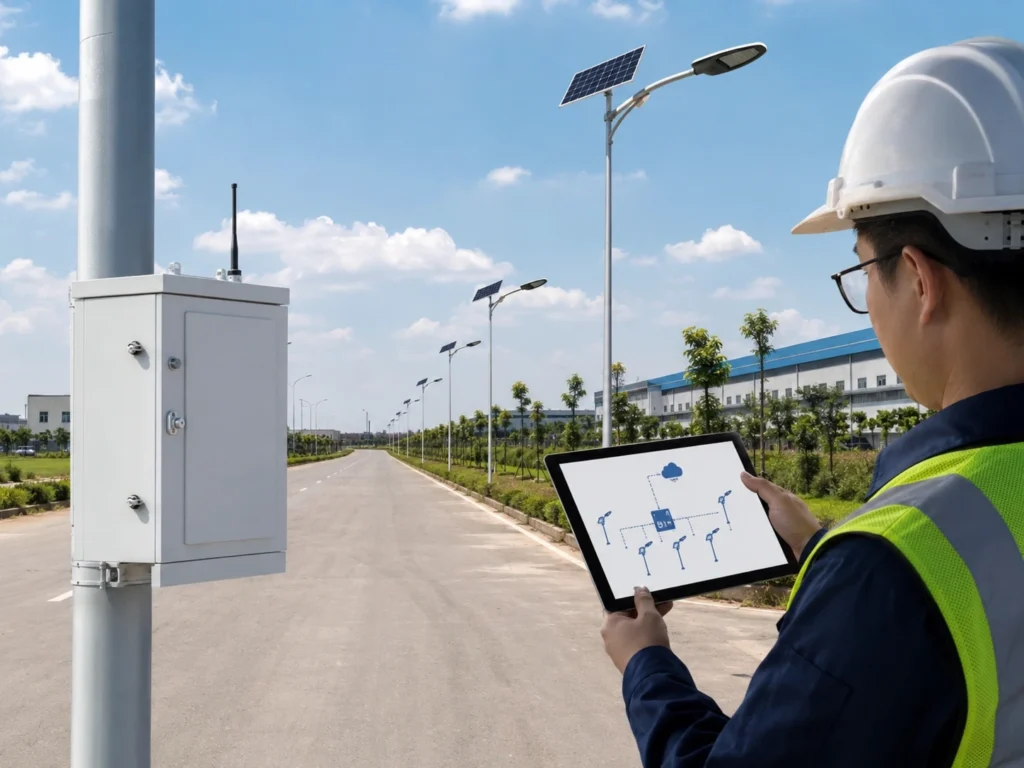
Smart control can use different communication methods depending on project scale, environment, and maintenance logic.
Common project options may include:
- 4G or cellular-based control.
- 5G or LTE-based communication.
- LoRaWAN-based networks.
- Zigbee-based networks.
- Gateway-based local networks.
- Hybrid communication architecture.
- Platform-connected smart controllers.
This article does not need to decide the full communication protocol by itself. The important point is that communication choice affects installation, gateway planning, backhaul, platform cost, signal reliability, and maintenance responsibility.
For a deeper communication design review, see Sunlurio’s smart street lighting system design.
Key Questions Before Upgrading to Smart Control
Before upgrading from remote control to smart control, project buyers should clarify the real operating requirement.
| Question | Why It Matters |
|---|---|
| How many poles are in the project? | Larger projects usually benefit more from centralized monitoring |
| Is the site easy to inspect manually? | Remote or long road projects may need platform visibility |
| Does the owner need fault alerts? | Smart control may reduce fault discovery time |
| Are seasonal profile changes required? | Remote updates may reduce maintenance visits |
| Is communication coverage reliable? | Smart control depends on network conditions |
| Who maintains gateways or SIM cards? | Communication devices create maintenance responsibility |
| Who owns the platform account and data? | Handover and long-term operation must be clear |
| Is the project budget only comparing product price? | Smart control cost includes hardware, platform, data, and support |
| Are operation records required by contract? | Smart control may support documentation and reporting |
| Is the project public, private, or industrial? | Public lighting responsibility may justify higher control visibility |
Smart control should be selected because it solves a real operation problem, not only because it sounds more advanced.
Cost Difference: Remote Control vs Smart Control
Remote control normally has lower initial cost. It requires fewer communication components and less platform setup.
Smart control may add:
- Smart controller cost.
- Communication module cost.
- Gateway cost if required.
- SIM card or data service cost.
- Platform subscription or service cost.
- Commissioning cost.
- Training cost.
- Long-term O&M cost.
- Gateway protection and maintenance cost.
- Cybersecurity or access management requirements.
However, smart control may reduce other costs:
- Fewer manual inspections.
- Faster fault location.
- Easier zone-level profile updates.
- Better asset records.
- Improved maintenance planning.
- Better proof during warranty discussion.
The correct cost comparison is not only product price. It is a life-cycle operation comparison.
Gateway and Platform Responsibility Should Not Be Ignored
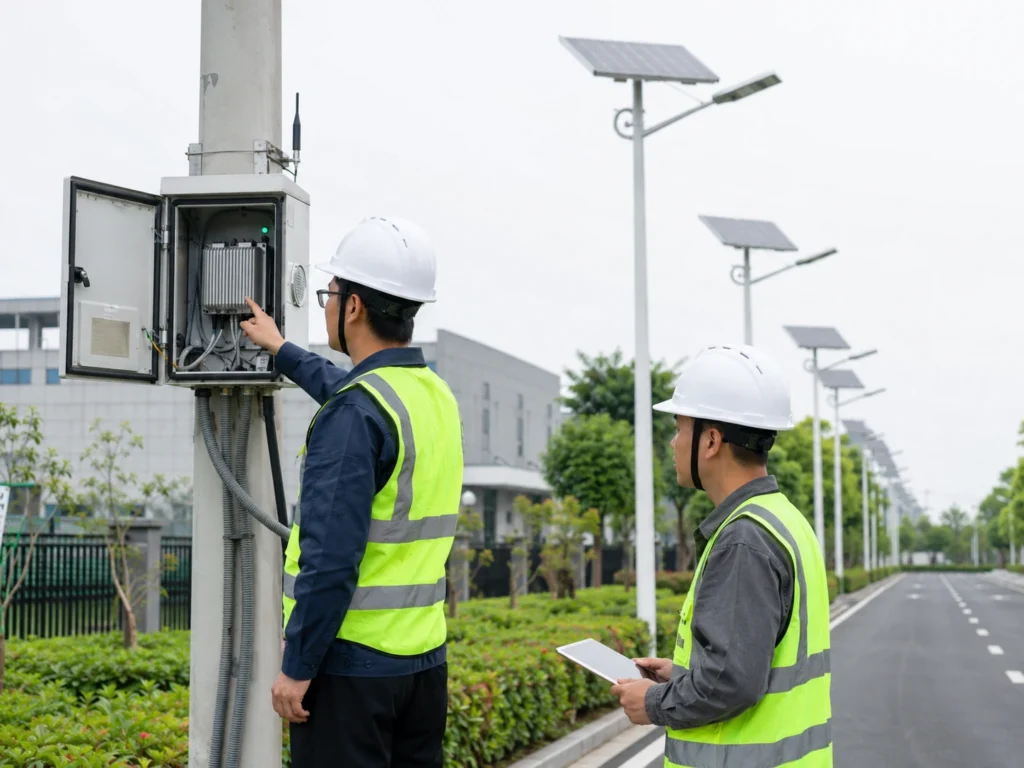
In gateway-based smart lighting systems, the gateway is not just a small accessory. It affects project reliability and maintenance responsibility.
Project teams should clarify:
- Where the gateway will be installed.
- How the gateway will be powered.
- How it connects to the internet or backhaul.
- Whether the location is protected from rain, dust, theft, and surge risk.
- Who maintains the gateway after handover.
- What happens if the gateway loses power or communication.
- Whether the platform can still store or recover data.
- Who has admin access.
- Who can change dimming profiles.
- Who receives fault alerts.
If these points are not clear, the smart system may create new maintenance problems instead of solving old ones.
Remote Control vs Smart Control by Project Type
| Project Type | Recommended Control Direction | Reason |
|---|---|---|
| Small village road | Remote control | Simple setup and easy manual inspection |
| School road or compound | Remote control | Basic dimming and motion mode may be enough |
| Short rural access road | Remote or mixed approach | Depends on maintenance access and project scale |
| Main municipal road | Smart control may be useful | Public responsibility and fault visibility matter |
| Large government tender | Smart control often worth reviewing | Asset management and operation records may be required |
| Industrial park | Smart control or hybrid management | Zone control and maintenance planning are useful |
| Campus road | Remote or smart control | Depends on scale and operator requirements |
| Parking area | Remote control for small sites, smart control for large sites | Scale and maintenance model decide |
| Port or logistics area | Smart control often useful | Large site, operation schedule, and fault visibility matter |
| Highway or long road | Smart control may be valuable | Manual inspection cost is high |
| Remote off-grid project | Case-by-case | Communication coverage and O&M capability decide |
| Desert or high-dust project | Smart control may be useful for large projects | Remote monitoring can reduce site inspection pressure |
The control method should match project responsibility, not only the product configuration.
What Project Buyers Should Confirm Before Ordering
Before choosing remote control or smart control, buyers should confirm:
- Project location.
- Number of poles.
- Road type.
- Pole height and spacing.
- Lighting profile.
- Motion sensor requirement.
- Timer schedule.
- Battery autonomy days.
- Rainy-season condition.
- Local temperature range.
- Dust or sand exposure.
- Coastal salt mist risk.
- IP rating requirement.
- Maintenance access.
- Communication coverage.
- Gateway requirement.
- Platform requirement.
- Fault alert requirement.
- Data ownership.
- Account access permission.
- Local operator capability.
- Whether remote monitoring is needed to reduce field inspection.
- Handover documentation.
- Long-term O&M responsibility.
For tender projects, these points should be reflected in the datasheet, BOQ, controller profile record, communication architecture, and handover document.
Sunlurio can support project teams with datasheets and installation drawings and BOQ and tender document support.
What Should Be Tested Before Installation?
Before pole installation, the project team should confirm whether the selected control method works correctly.
For remote-controlled systems, test:
- Remote response.
- AUTO mode.
- Timer mode.
- Dimming settings.
- Motion sensor mode.
- Final controller profile.
- Night simulation if required.
For smart-controlled systems, test:
- Controller communication.
- Platform connection.
- Pole ID or asset ID.
- Group or zone assignment.
- Dimming command response.
- Fault status reporting.
- Battery and charging data if available.
- Gateway or network connection if required.
- Account access and permission.
For installation-stage testing, see Sunlurio’s guide to ground-level test before pole installation.
What Should Be Recorded During Commissioning?
Commissioning records should match the control method.
For remote-controlled solar street lights, the record should include:
- Pole number.
- Controller profile.
- Timer schedule.
- Motion mode.
- Dimming level.
- Final operating mode.
- Night test result.
- Issue notes.
- Correction status.
For smart-controlled solar street lights, the record should also include:
- Platform account status.
- Pole ID.
- Gateway or communication status.
- Group assignment.
- Alert function.
- Remote command test.
- Data reading result.
- Profile update confirmation.
- Handover access permission.
- Operation responsibility.
For final acceptance, see the solar street light commissioning checklist.
Common Mistakes to Avoid
1. Choosing Smart Control Only Because It Sounds Advanced
Smart control is useful when it solves operation and maintenance problems. For small projects with simple settings, remote control may be more practical.
2. Ignoring Communication Coverage
A smart controller without reliable communication cannot deliver real monitoring value. Signal conditions, gateway position, and backhaul should be reviewed before ordering.
3. Forgetting Gateway Maintenance
Gateway installation, power supply, waterproofing, surge protection, and maintenance responsibility should be clear before handover.
4. Not Defining Platform Ownership
The project owner, EPC contractor, operator, and supplier should clarify who controls the platform account, who can change profiles, and who receives fault alerts.
5. Comparing Only Product Price
Smart control may increase initial cost, but it may reduce inspection and maintenance cost. The correct comparison is life-cycle operation cost.
6. Using Remote Control Without Recording Final Settings
Remote setup can create inconsistent behavior if final profiles are not recorded. This is a common cause of troubleshooting confusion after handover.
7. Using Smart Control Without Training the Operator
If the local team does not understand the platform, alarm logic, or profile settings, the smart system may not be used effectively.
8. Ignoring Rainy-Season Profile Updates
Smart control can help adjust profiles during difficult seasons, but only if the project team defines who can update settings and what profile should be used.
For rainy-season troubleshooting, see Sunlurio’s guide to why solar street lights stop working after cloudy or rainy days.
When Remote Control and Smart Control Can Work Together
Remote control and smart control are not always separate choices. Some projects may use both.
For example:
- Remote control for initial testing.
- Smart control for long-term monitoring.
- Local remote as backup during maintenance.
- Platform control for zone-level profile updates.
- Remote setting tool for site emergency adjustment.
- Smart platform for fault alerts and asset management.
This combination may be useful when the project needs both simple field operation and centralized management.
However, the project team should define which setting has priority. If remote settings and platform settings conflict, final operating logic must be clarified.
Request a Control System Review
Sunlurio can help EPC contractors, municipal project teams, and project distributors review whether a solar street lighting project should use remote control, smart control, or a combined control strategy.
A project review can include:
- Project scale review.
- Road type and traffic review.
- Controller profile review.
- Dimming schedule review.
- Motion sensor mode review.
- Battery autonomy review.
- Communication coverage review.
- Gateway planning review.
- Platform function review.
- Africa or Middle East environment review.
- Commissioning and handover record review.
- Long-term maintenance responsibility review.
To prepare a useful review, the project team can share the project quantity, location, road type, pole height, operating hours, autonomy requirement, maintenance model, communication condition, local temperature, dust or rain condition, and whether the owner needs remote monitoring or only local setup.
This helps avoid over-specification, under-specification, and unclear handover responsibility.
Related Solar Street Light Setup and Troubleshooting Guides
For projects comparing remote control and smart control, these related guides may help review local setup, motion sensor settings, PIR and radar sensors, timer mode, battery autonomy, multi-pole troubleshooting, and smart street lighting system design.
- Basic remote control setup steps
- Solar street light motion sensor settings
- Motion sensor vs timer mode for solar street lights
- PIR vs radar motion sensors for solar street lights
- Solar street light dimming profile and battery autonomy
- Multiple solar street lights failing in one area
- Smart street lighting system design
FAQ
What is the difference between remote control and smart control for solar street lights?
Remote control is mainly used for local setup near the lamp, such as AUTO mode, timer schedule, dimming level, and motion mode. Smart control connects the light to a network or platform for remote monitoring, fault alerts, profile updates, and asset management.
Is remote control enough for solar street lights?
Remote control is enough for many small or simple projects where the owner does not need online monitoring and the site can be inspected manually. It is practical for local setup, testing, and commissioning.
When should a solar street light project use smart control?
Smart control is more suitable for larger projects, municipal roads, government tenders, campuses, industrial parks, ports, highways, and projects where fault alerts, remote profile updates, asset tracking, or operation records are required.
Which is better for Africa solar street light projects?
For small African village roads, school roads, farms, compounds, and parking areas, remote control is often enough. For municipal roads, highways, mining areas, industrial parks, government programs, and distributed projects, smart control may provide more value through remote monitoring and fault location.
Which is better for Middle East solar street light projects?
For small private roads or parking areas, remote control may be enough. For larger Middle East projects exposed to heat, dust, desert conditions, and high maintenance cost, smart control can help with battery status review, fault alerts, dimming profile updates, and remote operation records.
Does smart control reduce maintenance cost?
Smart control may reduce manual inspection and fault-finding time, but it also adds communication hardware, platform setup, gateway maintenance, data service, and training requirements. The cost should be reviewed as life-cycle operation cost, not only product price.
Do all solar street light projects need IoT control?
No. Small village roads, short access roads, and simple projects may not need IoT control. Smart control should be selected when remote monitoring, operation records, or centralized maintenance provides real project value.
What communication methods are used for smart solar street lights?
Smart solar street lights may use cellular communication, 4G/5G, LoRaWAN, Zigbee, gateway-based networks, or other project-specific communication methods. The best choice depends on project scale, coverage, backhaul, gateway location, and maintenance responsibility.
Can remote control and smart control be used together?
Yes. Some projects use remote control for local testing and smart control for long-term monitoring. The project team should define which setting has priority to avoid conflicts between local and platform settings.
What should EPC teams check before choosing smart control?
EPC teams should check project scale, communication coverage, gateway planning, platform requirements, account ownership, data access, fault alert needs, maintenance responsibility, environmental conditions, and whether the owner truly needs centralized monitoring.
Is smart control better than remote control?
Smart control is not automatically better. It is better when the project needs monitoring, remote updates, fault alerts, asset management, and operation records. Remote control may be better for simple projects with limited budget and easy manual maintenance.