1. Introduction
Coastal infrastructure presents a unique engineering paradox: abundant sunlight for solar lighting, yet constant atmospheric corrosion. In tropical ports from Ghana to the Philippines, street light poles can lose up to 120 µm of zinc coating within five years if untreated. Field audits by Sunlurio engineers reveal that premature pole failures rarely originate from mechanical weakness — they start with corrosion at the base plate or internal condensation near cable entry points. This whitepaper examines a systematic approach to corrosion protection design for coastal street lighting systems, combining material science, coating technology, and predictive modeling through Sunlurio CPS™ (Coastal Protection Simulator).
2. Environmental Classification
Corrosion exposure is classified per ISO 9223 and ISO 12944-2 into categories based on chloride deposition and sulfur content:
| Category | Environment | Corrosion Rate (µm Zn/year) | Typical Locations |
|---|
| C3 | Urban/coastal > 1 km from sea | 2–5 | Inner city, light industry |
| C4 | Coastal, salt exposure | 5–15 | Harbors, bridges |
| C5-M | Marine, high salinity & humidity | 15–30 | Sea shore, offshore causeways |
Most Sunlurio coastal projects fall between C4 – C5-M. Under these conditions, unprotected steel can lose 80–150 µm per year, equivalent to structural perforation within 3–5 years.
3. Design Objectives
- Ensure a service life ≥ 25 years with total zinc + paint equivalent thickness ≥ 180 µm.
- Provide resistance to mechanical damage, salt crystallization, and ultraviolet degradation.
- Design for drainage and internal ventilation to prevent condensation corrosion.
- Integrate cathodic or duplex systems verified via CPS™ simulation and ISO salt-spray equivalence.
Each objective is directly linked to cost of ownership: a 20 µm coating loss increases maintenance cost by 18 % over the lifecycle, according to Sunlurio CPS™ data analytics.
4. Corrosion Mechanisms in Coastal Poles
4.1 Electrochemical Reaction
Fe → Fe²⁺ + 2e⁻
O₂ + 2H₂O + 4e⁻ → 4OH⁻
Fe²⁺ + 2OH⁻ → Fe(OH)₂ → Fe₂O₃·H₂O (rust)
The reaction accelerates when the electrolyte (saltwater film) and oxygen coexist. The presence of chloride ions breaks passive oxide films, leading to pitting and under-film corrosion.
4.2 Localized Zones of Attack
- Base plate–anchor interface (crevice corrosion).
- Interior cavity due to trapped condensation.
- Weld heat-affected zones with depleted zinc layer.
5. Protective Design Strategies
Sunlurio applies a “defense-in-depth” concept combining design geometry + coating system + predictive modeling.
- Geometry: Drain holes > 10 mm, sealed top cap, slope > 3° on base plate for runoff.
- Material: S355 JR steel or 6063-T6 aluminum for coastal Class C5-M regions.
- Galvanizing: Hot-dip per ISO 1461, average zinc 85–110 µm; double-dip for poles > 12 m.
- Duplex System: Zinc + Epoxy + Polyurethane topcoat (total > 180 µm) per ISO 12944-5.
- Cathodic Protection: Sacrificial zinc anode at foundation anchor if groundwater salinity > 3 % NaCl.
6. Sunlurio CPS™ — Coastal Protection Simulator
Sunlurio CPS™ is a computational tool developed for environmental durability prediction. It models electrochemical corrosion kinetics based on temperature, humidity, chloride deposition rate, and coating composition. Engineers use it to forecast coating life and schedule maintenance intervals before physical testing.
6.1 Input Parameters
- Atmospheric chloride rate (g Cl⁻/m²/day)
- Average RH (%), annual wet days, surface temperature
- Coating system structure (Zn + primer + topcoat thickness)
6.2 Output Indicators
- Predicted corrosion loss (µm/year)
- Remaining protection time (years)
- Failure probability distribution (Pf %)
- Maintenance alert timeline (year N + x)
Example: For a 100 µm zinc + 80 µm paint system at 5 g Cl⁻/m²/day, CPS™ predicts first maintenance at 18.7 years ± 1.3 years (95 % confidence).
7. Coating System Selection
7.1 Hot-Dip Galvanizing (HDG)
- Thickness: 85–110 µm typical; achievable uniformity via centrifuge drain.
- Bond strength: 3.5–5.0 MPa; intermetallic alloy layers (Γ, δ, ζ, η phase) ensure adhesion.
- Cooling rate < 0.8 °C/s prevents microcracking in long poles.
7.2 Duplex System
Combining galvanizing with paint provides a synergistic effect — life extension ≈ 1.5 × (sum of individual lifetimes).
| Layer | Material | Typical Thickness (µm) | Function |
|---|
| Base | Zinc (HDG) | 100 | Cathodic protection |
| Primer | Epoxy zinc-rich | 60 | Barrier + adhesion |
| Topcoat | Aliphatic polyurethane | 80 | UV & color stability |
8. Structural Integration
Design against corrosion begins at the mechanical level. Sunlurio engineers incorporate corrosion control into pole geometry and foundation design:
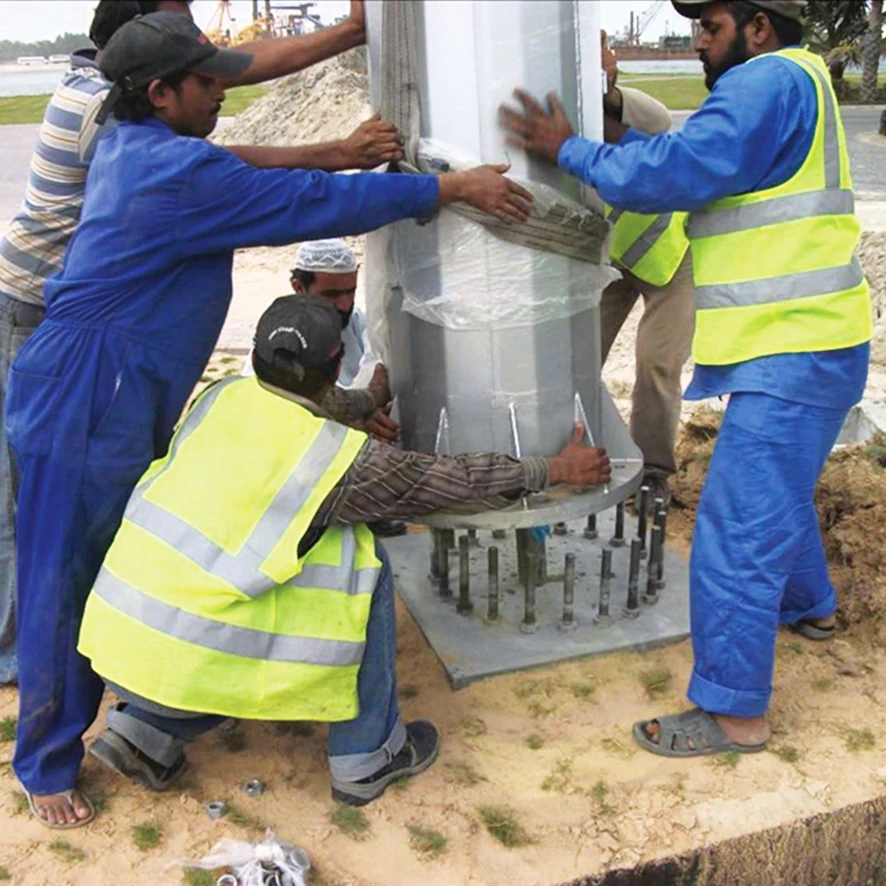
- Anchor bolts: hot-dip galvanized M36–M42, embedded > 600 mm; apply Denso TM tape on exposed threads.
- Base plate gap sealed with breathable silicone; drain holes prevent water stagnation.
- Internal cable route fitted with nylon sleeve and desiccant bag at service entry.
9. Testing and Verification
All coatings are validated via international standard tests before deployment.
- Salt-spray test: ASTM B117 — ≥ 1000 h with no base corrosion.
- Cross-cut adhesion: ISO 2409 — Class 0–1.
- Humidity resistance: ISO 6270-2 — 1000 h no blistering.
- Pencil hardness: ASTM D3363 — ≥ H grade.
Field verification uses ultrasonic coating thickness gauge (± 3 µm). CPS™ reports are compared to real inspection data; deviations usually within ± 5 %.
10. Case Study — Port Access Road, West Africa
Environment: C5-M marine zone, chloride deposition ≈ 6.8 g Cl⁻/m²/day.
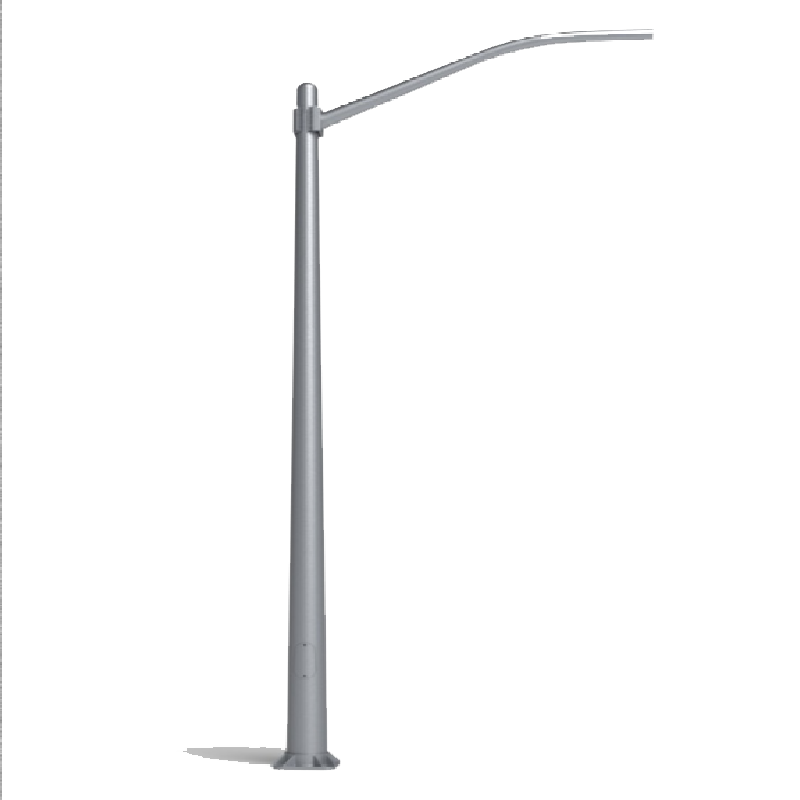
Design: 10 m conical pole, S355 JR, duplex system (Zn 100 µm + Epoxy 60 µm + PU 80 µm).
Simulation: CPS™ predicted service life = 24.2 years ± 1.5.
Measured after 12 months: Zinc loss ≈ 5.3 µm, adhesion Class 0, gloss retention 97 %.
Deviation: < 2.8 % between field and model — confirming durability accuracy.
11. Maintenance and Lifecycle Management
- Routine inspection every 24 months (visual + coating thickness check).
- Touch-up paint when zinc exposure > 5 cm² per m² surface.
- Replace anodes when potential > −0.85 V vs Cu/CuSO₄ reference.
- CPS™ predictive alerts integrated into Sunlurio Cloud dashboard for service scheduling.
12. Environmental Compliance and Sustainability
- All coatings RoHS-compliant (no Cr⁶⁺ pigments).
- Waste zinc and paint sludge recycled > 95 % via closed-loop galvanizing plant.
- Life-cycle CO₂ footprint reduction ≈ 38 % compared to unprotected mild steel pole replacement every 8 years.
13. Deliverables and Documentation
- CPS™ simulation report (.CPR): corrosion rate, service life, maintenance schedule.
- Material certificate (EN 10204 3.1) for each batch of galvanized poles.
- Salt-spray and adhesion test reports per lot.
- Inspection protocol template for client QA teams.
14. Summary
In coastal regions, corrosion control is not a coating problem — it is a design discipline. Geometry, drainage, material, and electrochemistry must work together. Through Sunlurio CPS™, engineers can predict degradation long before the first sign of rust appears, aligning lifecycle cost with structural reliability. The continuing challenge lies in balancing protective thickness with practical manufacturability — ensuring every pole endures salt, sun, and time with equal resilience.
Author Introduction
Prepared by the Sunlurio Materials and Structural Engineering Division. The division specializes in corrosion-resistant pole design, galvanizing technology, and environmental durability simulation using Sunlurio CPS™ for coastal and industrial infrastructure projects across Africa, Southeast Asia, and the Middle East.