Project reference: Treichville District Solar Street Lighting
Location: Treichville, Abidjan, Côte d’Ivoire
Year: 2012
Application: Solar Street Lighting System
Confirmed quantity: 890 units
Company involvement: Participation by our company or core project team; Sunlurio / Hitech
Technical focus: Public-road visibility, solar energy balance, structure, installation and maintenance for solar lighting solutions.
This historical report separates confirmed project facts from engineering checks for comparable procurements. The original equipment schedule, contracting responsibilities and acceptance measurements should be confirmed before detailed claims are used in a tender. The separate 2023 Côte d’Ivoire 890-unit Split Solar project is not the source of the 2012 specifications.
1. Project Background
Our company or core team participated in a solar street-lighting deployment involving 890 units in Treichville, Abidjan, Côte d’Ivoire, in 2012.
For public-road lighting in an urban district, the engineering task extends beyond selecting a lamp. Vehicle routes, pedestrian access, roadside obstacles, construction access and responsibility for ongoing service must be considered together.
The confirmed reference establishes the year, location, quantity and participation. It does not establish the exact road length, a named government programme, the contracting entity or a turnkey installation role. Those details require the historical scope documents.
2. Technical Overview
2.1 Historical Configuration and Equipment Review
The table below is a procurement checklist, not a reconstructed 2012 bill of materials. The historical wattage, pole height, PV module and battery configuration have not been established for publication.
| Component | What to confirm | Supporting evidence |
|---|---|---|
| LED Lighting Module | Model, input power, complete-luminaire flux, optic and colour temperature | Model-matched datasheet, photometric report and IES/LDT |
| Solar Panel | Rated output, orientation, shading and mounting loads | Module data and site-specific energy calculation |
| Battery | Chemistry, usable energy, temperature limits and replacement access | Equipment schedule, capacity tests and operating conditions |
| Controller | Charging method, dimming profile and protective functions | Controller settings and commissioning record |
| Pole and foundation | Height, section, arm, corrosion protection, anchor bolts, soil and wind loads | Structural calculations, foundation and grounding drawings |
Autonomy is an energy-balance question. For a new project, compare the nightly load with worst-month solar resources, charging losses and usable battery energy; include recovery after low-sun periods. Do not infer rainy-day endurance from lamp wattage or nominal battery amp-hours alone.
2.2 Lighting Design and Acceptance Parameters
| Parameter | Review method | Why it matters |
|---|---|---|
| Average illuminance | Agree the applicable road-lighting criteria, calculation area and measurement grid | A centreline reading alone cannot describe the whole road |
| Uniformity and glare | Check road width, spacing, mounting geometry, optics and maintenance assumptions in DIALux | High average illuminance can coexist with dark patches or excessive glare |
| Colour temperature | Match the offered model and project requirements | A change in configuration can affect photometric evidence |
| Operating schedule | Specify full-output and dimmed periods with their actual power demand | The schedule determines nightly energy use |
| Autonomy | State solar conditions, usable storage, losses and allowed dimming | An endurance figure needs explicit test or calculation conditions |
| Service planning | Separate luminaire, battery, controller and structure maintenance needs | A single system-life claim can conceal replacement costs |
3. Project Implementation
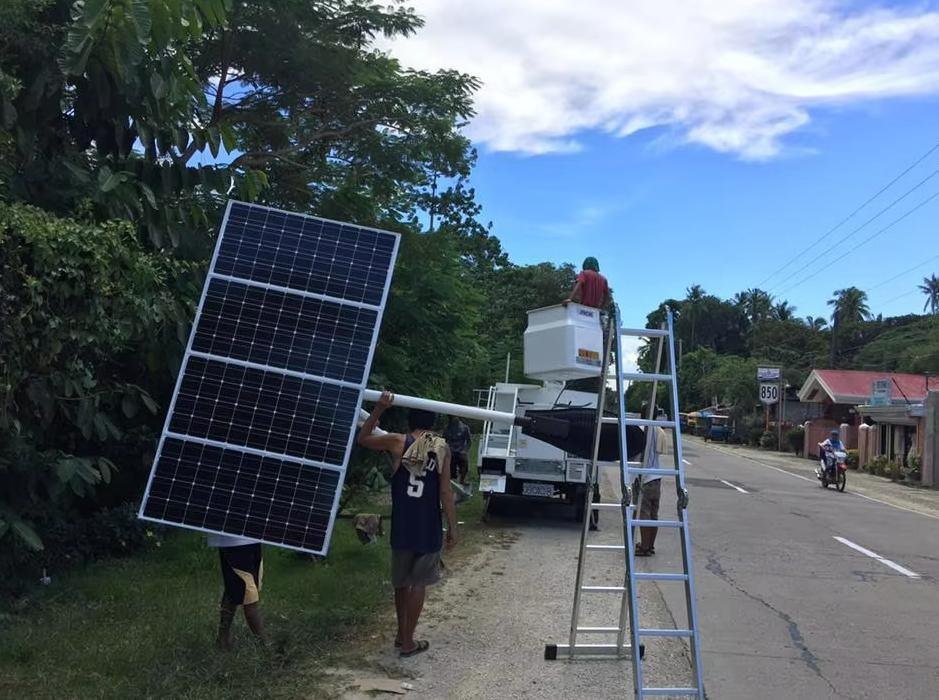
Existing installation illustration retained for the engineering discussion; it is not evidence of the 2012 project location, crew or installation method.
3.1 Site Survey and Planning
For projects of this type, a pre-installation review should address road geometry, soil and foundation conditions, pole positions and site access. Useful inputs include:
- Road layout, carriageway and pedestrian widths, pole spacing and mounting offsets
- Soil information, wind criteria, foundation reactions and anchor-bolt interfaces
- Obstacles, shading, buried utilities, access and lifting constraints
Coordinate the lighting layout with structural and civil drawings. Utility clearance and foundation dimensions should be established by the responsible local designer; a generic depth or clearance is not a construction instruction.
3.2 Material Logistics and Responsibilities
Confirm the supply boundary, packing list, lifting and storage requirements, shipment schedule and inspection responsibilities. The original shipping quantities, port arrangements and team composition are not established by this historical reference.
| Workstream | Responsible party to name | Required interface |
|---|---|---|
| Equipment supply | Contracted supplier | Model schedule, packing list, documents and spares |
| Civil works and erection | Appointed installer / civil contractor | Approved foundations, access, lifting and anchor alignment |
| Electrical checks and commissioning | Qualified site team | Grounding, controller settings, functional tests and records |
This responsibility matrix is for comparable projects; it does not identify the contractual roles of the 2012 participants.
3.3 Installation and Commissioning
- Foundations: use the approved design, concrete specification, curing criteria and inspection process.
- PV mounting: evaluate orientation, tilt, shading and wind exposure for the actual location.
- Mechanical and electrical checks: verify fasteners, battery protection, wiring, grounding and safe maintenance access.
- Lighting verification: use the agreed measurement grid and record operating conditions, instrument details and dimming state.
The precise completion date and final acceptance parties for the historical project require original records; they are not inferred from the year 2012.
4. Confirmed Facts and Procurement Verification

Existing road-lighting illustration retained; it is not a measurement record or photographic proof of the 2012 Treichville installation.
4.1 Confirmed Project Reference
| Item | Confirmed context | Boundary for tender use | Further record |
|---|---|---|---|
| Year | 2012 | Not a precise completion or acceptance date | Dated project record |
| Location | Treichville, Abidjan, Côte d’Ivoire | No verified road length stated | Original layout and scope |
| Quantity | 890 solar street lights | Not the separate 2023 project with the same quantity | Historical equipment schedule |
| Participation | Company or core-team involvement | No assumed turnkey, owner or installation role | Responsibility documents |
Illuminance, uniformity, traffic accidents and crime outcomes require their own source records. No measured improvement or official statistical result is claimed here.
4.2 Energy and Environmental Evaluation
| Review item | Calculation or record needed | Comparison boundary |
|---|---|---|
| Solar resource | Location-specific monthly irradiation and shading assumptions | An annual average alone is not a worst-month design basis |
| Energy use | Actual luminaire power and operating/dimming schedule | Separate generated, stored and delivered energy |
| CO₂ emission comparison | Defined baseline, energy use and applicable emissions factor | No verified annual reduction is stated for this case |
| Operating cost | Tariff assumptions, maintenance and component replacement plan | Compare equivalent lighting service over the same period |
| Reliability | Fleet size, fault definition, downtime and dated service records | No verified historical failure rate is published |
4.3 Community and Social Evaluation
For a comparable project, record road visibility, access, service complaints and stakeholder feedback using agreed methods. Claims about accidents, crime, business income or satisfaction need documented before-and-after evidence and a defined reporting period.
Named testimonials and government endorsements are not used in this report because the supporting records and public-use permissions have not been established.
5. Quality Control and Maintenance Training
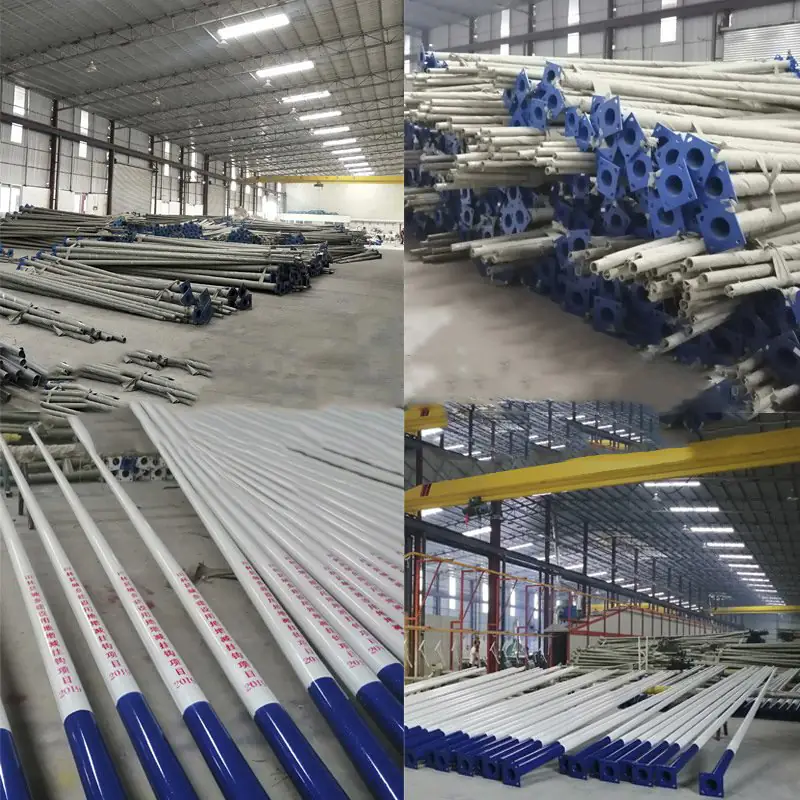
Existing pole-production illustration retained for the quality discussion; it is not a record of 2012 inspection or maintenance training.
5.1 Quality Management Checks for Similar Projects
| Phase | Key review item |
|---|---|
| Design | Model-matched lighting evidence and agreed project criteria; distinguish product test standards from company quality-management certification |
| Procurement | Equipment schedule, supplier documents and inspection/test plan with acceptance criteria |
| Construction | Foundation, anchor alignment, corrosion-protection condition and installation inspections |
| Commissioning | Functional checks, settings, photometric measurements and issue closure |
| Handover | As-built drawings, manuals, spare-parts list, training scope and maintenance records |
The historical inspection duration, test coverage and pass records require original documentation. They are not inferred from general manufacturing practice.
5.2 Maintenance Training Scope
For a new procurement, agree who receives training and how competence and handover will be recorded. Useful topics include:
- Safe luminaire and battery replacement
- Battery condition and charging diagnostics
- Controller settings and fault identification
- Panel cleaning, fastening inspections and service records
This is a recommended training scope, not a statement that a particular number of municipal technicians was trained in 2012.
6. Long-Term Operation and Sustainability
Historical fleet operation should be assessed from verified maintenance logs and inspection records. The age of a project alone does not establish the current number of working lights, original component retention or light-output depreciation.
For similar projects, keep an asset register with location, model, commissioning date, replacements, faults and repair dates. Use that record to plan cleaning, battery replacement, compatible spares and maintenance budgets.
No specific subsequent district procurement or government adoption is attributed to the Treichville reference here.
7. Lessons Learned
- Local design inputs: road geometry, shading and worst-month solar conditions should guide optics and energy storage.
- Structural coordination: poles, arms, anchor bolts, foundations and grounding must be reviewed as connected interfaces.
- Community and site access: discuss access, maintenance and damage-reporting arrangements with the responsible local parties.
- Knowledge transfer: clear manuals, compatible spare parts and practical training help operators maintain the equipment.
- Evidence-based comparison: assess corrosion protection, battery tests and luminaire reports without turning a historical reference into a blanket lifetime guarantee.
8. Conclusion
The 2012 Treichville solar street-lighting project involving 890 units forms part of our company or core team’s project experience in Côte d’Ivoire.
For EPC teams and consultants, its value as a reference is strongest when confirmed participation is separated from technical details that require the original records. A comparable procurement should connect photometric design, solar energy balance, structural interfaces, installation responsibilities and maintenance documentation.
Sunlurio can help review the proposed product family, project inputs and supporting technical documents. Begin with the road location, approximate quantity and any available layout or BOQ; detailed design inputs can be clarified during review.
9. Project Summary Table
| Item | Details |
|---|---|
| Project location | Treichville District, Abidjan, Côte d’Ivoire |
| Year | 2012 |
| Confirmed quantity | 890 solar street lights |
| Company participation | Our company or core project team participated |
| Historical equipment | Confirm original luminaire, pole, PV, battery and controller schedule |
| Performance and acceptance | Use original photometric, commissioning and acceptance records before citing precise results |
| For comparable projects | Review optics, autonomy, structure, site access, documents and maintenance responsibilities together |
The technical review items above are for comparable procurement decisions. They are not presented as a contemporaneous July 2012 report, official acceptance record or verified lifecycle study.