When We First Inspected a Failing Lighting Line in Muscat
Eight years after installation, half the poles at a coastal container terminal had rusted through near the base. Saltwater mist, 80% humidity, and a missing zinc layer—everything combined into slow failure.
That’s when our maintenance crew decided to switch entirely to hot-dip galvanized poles.
Since then, we’ve supplied similar masts for seaports in Mombasa and oil terminals in Sohar. None have shown base corrosion even after 10 years. The reason isn’t luck—it’s chemistry, steel, and standards working together.
What Exactly Are Galvanized Poles—and Why They Last So Long
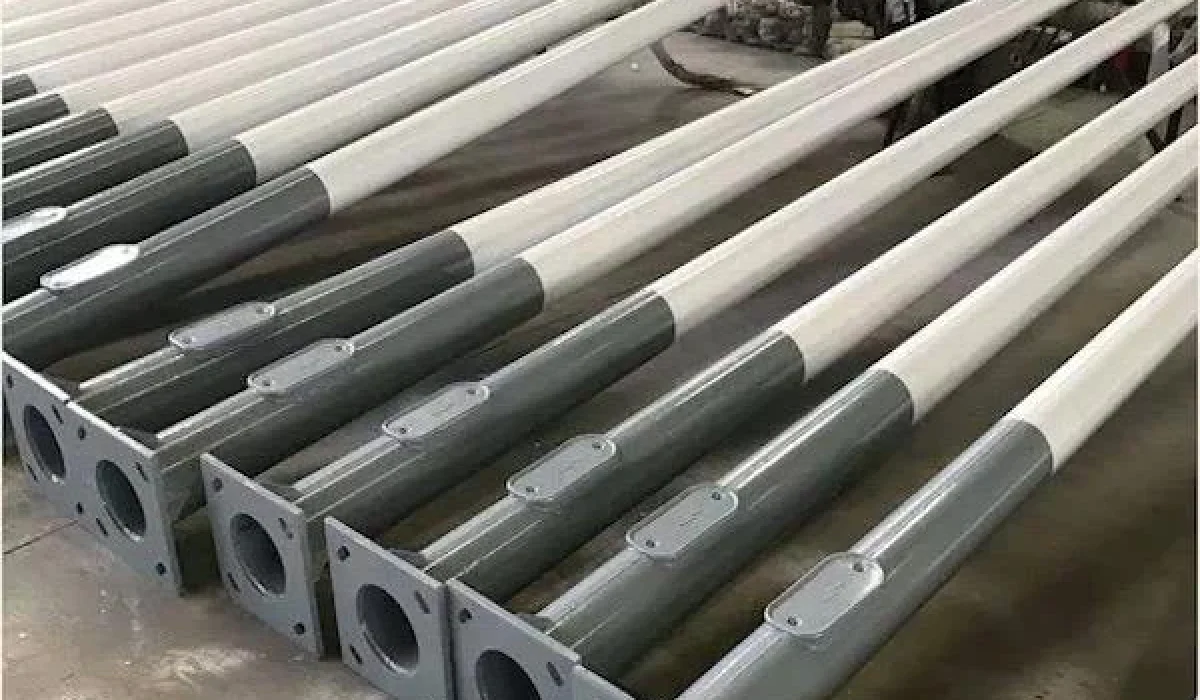
A galvanized pole is simply a steel lighting mast or structure dipped into molten zinc at around 450°C. That zinc doesn’t just sit on top; it bonds metallurgically with the steel, forming alloy layers tougher than paint or powder coating could ever achieve.
They’re common in:
- Highway and solar lighting networks in Kenya and Ghana
- Telecom and CCTV towers in desert regions like Riyadh
- Power distribution poles in coastal cities like Manila
According to ASTM A123 (2021 revision), a properly galvanized pole with a minimum 85 μm zinc layer can withstand marine corrosion for over 25 years—provided it’s inspected and drained correctly.
In short: galvanization transforms vulnerable steel into a self-protecting structure that survives the elements.
How Zinc Actually Stops Rust—A Quiet Chemical Battle
When we explain galvanization to new engineers, we often say: zinc doesn’t just protect; it sacrifices itself elegantly.
Here’s the science:
- Zinc and steel have different electrochemical potentials (E°: Zn = –0.76 V, Fe = –0.44 V).
- When moisture or salt touches both metals, zinc corrodes first, protecting the steel beneath.
- Over time, the corroded zinc reacts with CO₂ to form zinc carbonate (ZnCO₃)—a stable, dull-grey patina that seals out further attack.
So even if a forklift scratches the surface, the surrounding zinc keeps reacting, closing the wound.
This is why maintenance teams along the Tanzanian coast report that galvanized poles “heal” minor damage within months—something no paint system can do.
Inside the Hot-Dip Galvanizing Process
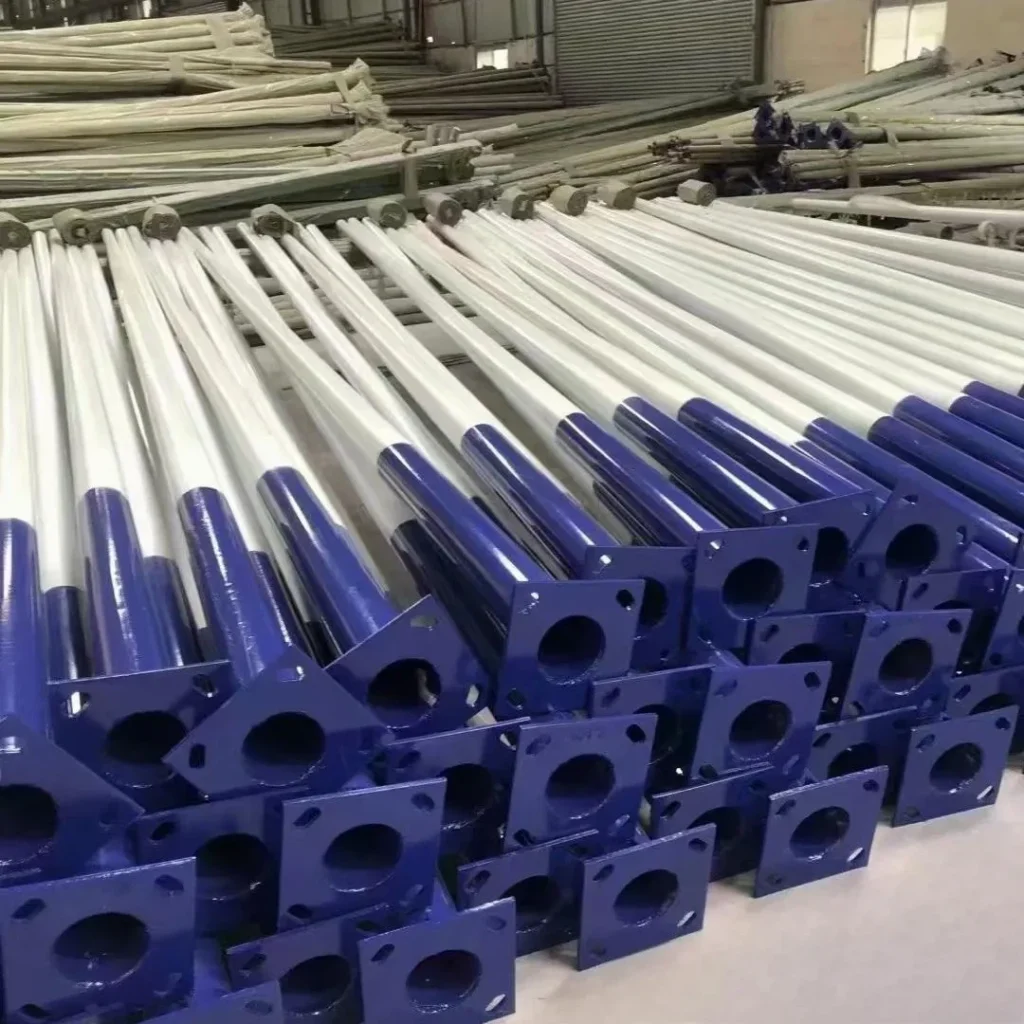
At our Qingdao facility, every pole follows a 4-step sequence before export.
Forget textbook flowcharts—this is what happens on the ground:
| Step | Description | Field Note |
|---|---|---|
| 1. Surface Prep | Poles are degreased, acid-washed, and fluxed. | Even a fingerprint can prevent zinc bonding. |
| 2. Immersion | Steel is dipped in molten zinc at 450 °C. | Each pole stays submerged for 6–8 minutes. |
| 3. Cooling | Zinc solidifies into layered alloys (Γ, δ, ζ, η). | The coating becomes part of the steel itself. |
| 4. Inspection | Coating thickness checked per ASTM A123. | ≥ 85 µm for inland, ≥ 100 µm for coastal. |
Data Source: ASTM A123 / Field QC Logs 2023
The result is a coating so uniform that we’ve cut repainting budgets by nearly 90% in some municipal contracts.
From Salt Fog to Acid Rain: How Galvanized Poles Withstand the Elements
Environmental stress isn’t theoretical—it’s brutal.
| Environment | Main Challenge | Galvanized Performance |
|---|---|---|
| Coastal ports (e.g., Mombasa) | Salt-laden air, chloride ions | No red rust after 1,000 h salt-spray test |
| Industrial zones (e.g., Lagos) | SO₂, acid rain | Zinc patina neutralizes acidic particles |
| Urban roads | Dust, exhaust | Minimal discoloration, easy cleaning |
| Arid deserts | UV and sand abrasion | Zinc layer maintains integrity |
In a 2023 ASTM B117 test, galvanized samples endured 720 hours of continuous salt mist with less than 0.5% white rust. Painted steel failed within 120 hours.
These results mirror what we’ve observed on-site: zinc coatings simply outlast every other protection method.
Why Galvanized Poles Don’t Just Resist Rust—They Resist Bending Too
Many buyers think galvanization is only about corrosion, but it also preserves mechanical integrity.
When steel corrodes, it loses wall thickness—sometimes millimeters per year in humid zones. That’s enough to weaken bending strength dramatically.
Galvanized poles avoid this problem because:
- The coating seals the steel against pitting.
- The heat from dipping relieves residual weld stress.
- The zinc-iron layer distributes surface strain evenly.
We’ve inspected poles after typhoon events in Davao, Philippines where the surrounding fence was torn apart, yet the galvanized lighting masts stayed upright with zero deformation.
Field engineers reported less than 1° tilt deviation even after 120 km/h winds—a performance impossible for uncoated steel.
Material and Geometry Matter
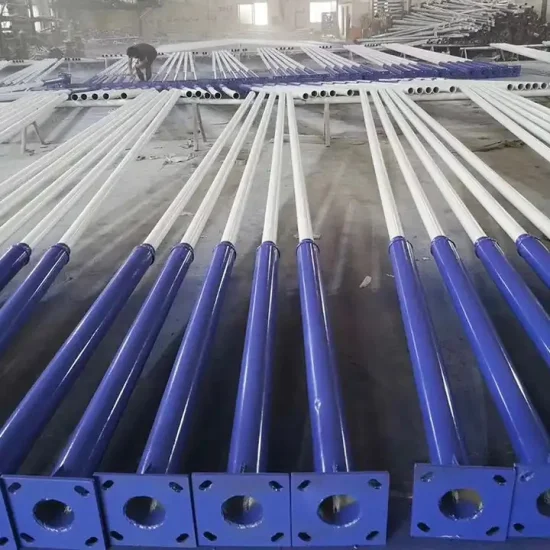
Not all steel poles are equal. The Q345 grade we often specify provides a yield strength of 345 MPa, balancing ductility with toughness.
Pole geometry amplifies that advantage:
- Tapered octagonal shafts reduce moment concentration.
- Wall thickness of 3–6 mm resists buckling.
- Anchor bolts, often galvanized per ASTM A153, complete the corrosion shield.
At one Tanzanian airport apron, galvanization extended pole replacement intervals from 7 years (painted) to over 25 years.
Standards That Keep the Industry Honest
Every export batch we send carries full ASTM and ISO compliance records—not because clients ask, but because good galvanization can’t be faked.
| Standard | Description | Why It Matters |
|---|---|---|
| ASTM A123 | Hot-dip zinc coating on iron and steel products | Defines coating thickness and adhesion criteria |
| ASTM A500 / A595 | Tubular structural steel | Ensures pole strength and weld integrity |
| ASTM A153 | Zinc coating on hardware | Protects nuts, bolts, and anchors |
| ASTM B117 | Salt spray test | Validates corrosion resistance |
Under ASTM A123 Section 6.1, each pole must show continuous coating without uncoated spots larger than 10 mm².
Most failures we see in field audits come from skipped cleaning or uneven immersion—not from zinc quality itself.
Maintenance and Field Longevity
Even the best coating appreciates a little care:
- Annual inspection: Check base plates and anchor bolts for standing water.
- Cleaning: Mild detergent only—never acids or abrasives.
- Touch-up: Use zinc-rich paint ≥ 92% Zn for small chips.
- Drainage: Ensure base foundations allow runoff to prevent trapped moisture.
In equatorial climates, the first zinc carbonate layer often forms within 3–6 months, giving visible matte protection.
Once that patina sets, maintenance becomes almost optional.
Cost, Longevity, and the Real Payback
| Type | Average Lifespan (years) | Maintenance Cycle | Typical Failure Mode |
|---|---|---|---|
| Galvanized Steel | 25–40 | Minimal (inspection only) | Gradual zinc wear |
| Painted Steel | 5–8 | Annual repaint | Coating peel, base rust |
| Stainless Steel | 40–60+ | None | Cost prohibitive |
Data Source: Field Surveys, East African Lighting Projects 2022–2024
Over its life cycle, a galvanized pole costs roughly 40% less than a painted one—even before factoring in downtime and labor.
The Quiet Standard Behind Every Reliable Pole
If there’s one lesson from decades of field work, it’s this: good galvanization isn’t a surface treatment—it’s an investment in time.
From Ghana’s highways to Omani ports, galvanized poles prove that prevention costs far less than replacement.
Every ASTM A123 certificate on your drawing isn’t just paperwork—it’s your insurance against corrosion and bending.
As one Kenyan maintenance engineer told me during a 2024 site visit:
“We used to change poles every seven years. Since we switched to hot-dip galvanized, we mostly just clean them.”
✅ In Summary
- Zinc protects steel chemically and mechanically.
- ASTM standards ensure every coating layer performs as designed.
- Field data confirm 3–5× longer lifespans over painted steel.
- Proper drainage and inspection turn a pole into a 30-year asset.
For engineers and procurement officers seeking ASTM-certified galvanized pole specifications, Sunlurio Engineering provides case studies, QC reports, and real salt-spray data from our partner facilities.
A well-galvanized pole isn’t an expense—it’s decades of structural reliability.