
Coastal Solar Lighting: Why IP66 Is Not Enough (Corrosion & Hardware Checklist)

If you’re specifying IP66 waterproof smart solar lighting for coastal areas, here’s the hard truth: IP66 is about dust + water jets (ingress) — it is not a corrosion guarantee. And if you’ve ever had an “IP66 coastal project” still rusting at screws, glands, or connectors within months… that’s not an IP problem. It’s a […]
Rainy-Season Autonomy Sizing: Why Solar Street Lights Fail After 2–4 Cloudy Days

If your solar street lights run fine in dry season but start dimming early or shutting down during rainy weeks, it’s usually not “bad batteries”. It’s almost always autonomy sizing done with the wrong assumptions. Rainy-season autonomy sizing is the #1 hidden reason solar street lighting projects start failing after 2–4 cloudy days. It’s rarely […]
Rainy Season Autonomy Sizing (Worst-Month PSH) — EPC Review-Safe Method

If your solar street lighting project starts failing after 2–4 cloudy days, it’s usually not “bad luck”. It’s almost always an autonomy sizing error — caused by sizing against annual average sun hours, ignoring derating losses, or hiding energy gaps behind “battery Ah” labels. Engineer’s rule: You don’t buy “autonomy days”. You buy an auditable […]
Owner Acceptance & Handover Checklist for Solar Street Lighting (2026)

If you’re delivering a solar street lighting project for an EPC client or municipality, the fastest way to avoid disputes is simple: Don’t hand over “lights”. Hand over auditable evidence. A site can look bright and still fail acceptance if any of these are missing: Lux/uniformity proof vs the approved criteria Aiming & installation consistency […]
Solar Street Light RFQ Checklist: How to Make Supplier Quotations Comparable
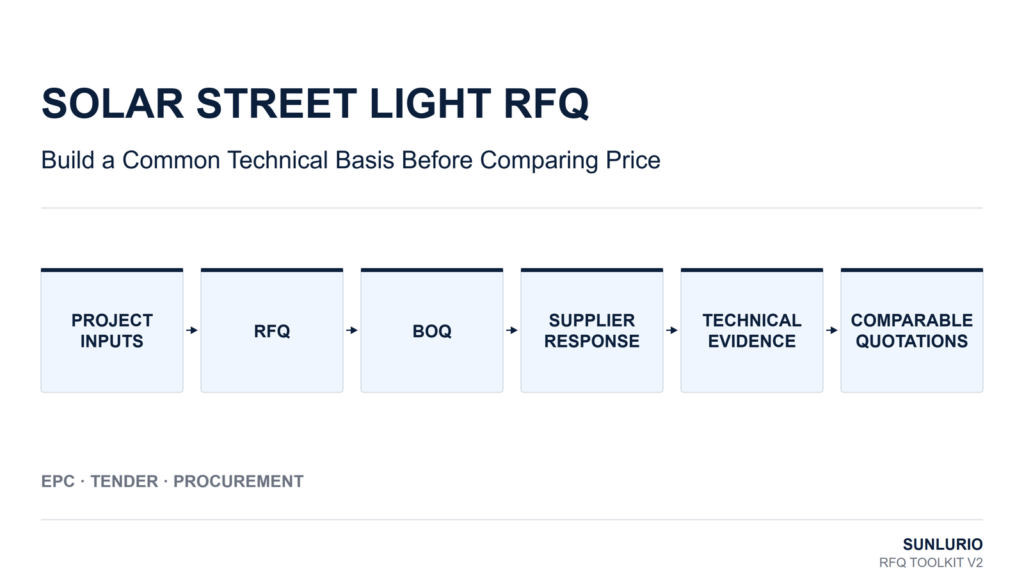
When several suppliers quote the same solar street lighting project, the first question should be: Are they actually quoting on the same technical basis? Two quotations may both say “80 W solar street light” while using different operating profiles, autonomy assumptions, batteries, solar modules, optics, poles, or supply scopes. In that situation, comparing prices alone […]
Solar vs Grid Street Lighting: 5-Year TCO Cost Analysis Template (Tender-Ready)

Most procurement teams compare unit price. Tender reviewers and finance teams compare 5-year total cost of ownership (TCO) — and the decision often changes. This guide gives you a tender-auditable 5-year TCO template for Solar Street Lighting vs Grid Street Lighting, plus the engineering assumptions that decide the numbers (spacing, optics, maintained lighting, O&M, replacements). […]
How to Review a Solar Street Light BOQ Before Comparing Quotations

Prepared and reviewed by Sunlurio Engineering Team Last Reviewed: 2026-08-16 Two quotations can show the same nominal lamp wattage and still describe materially different solar street lighting systems. Battery and solar-module assumptions, operating profile, optics, pole scope, civil works and technical documents can all differ behind the same headline value. A useful BOQ review therefore […]
Type II vs Type III vs Type IV Optics: How to Avoid Wrong IES/LDT in Roadway Tender

If your tender submission includes a DIALux/Relux report, optics choice behind the IES/LDT file is one of the fastest ways to get flagged. Most “wrong optics” problems are not about wattage—they are about: wrong distribution type (Type II vs Type III vs Type IV) wrong mounting height / spacing assumptions missing maintained factor (day-one numbers […]
DIALux Report for Solar Street Lighting Tenders (Reviewer Checklist)

A “tender-ready” DIALux/Relux report is not a pretty screenshot. Reviewers approve (or reject) based on whether your submission is auditable: it must prove the design meets targets + uniformity, uses traceable IES/LDT photometrics, and maps cleanly to the layout + BOQ + deliverables pack. For EPC and government bids, treat your DIALux report as a […]
Solar Street Lighting Tender Checklist (BOQ + IES + DIALux) — EPC/Government Ready

Quick Answer (30 seconds): To avoid technical rejection and redesign loops in EPC & government tenders, submit one consistent Tender Pack (not scattered files) that includes: 1) a clean BOQ (with exact model mapping), 2) correct IES photometric files (matched to optics + mounting), and 3) a complete DIALux/Relux report (lux + uniformity + layout […]