What Is an All-in-One Solar Street Light?
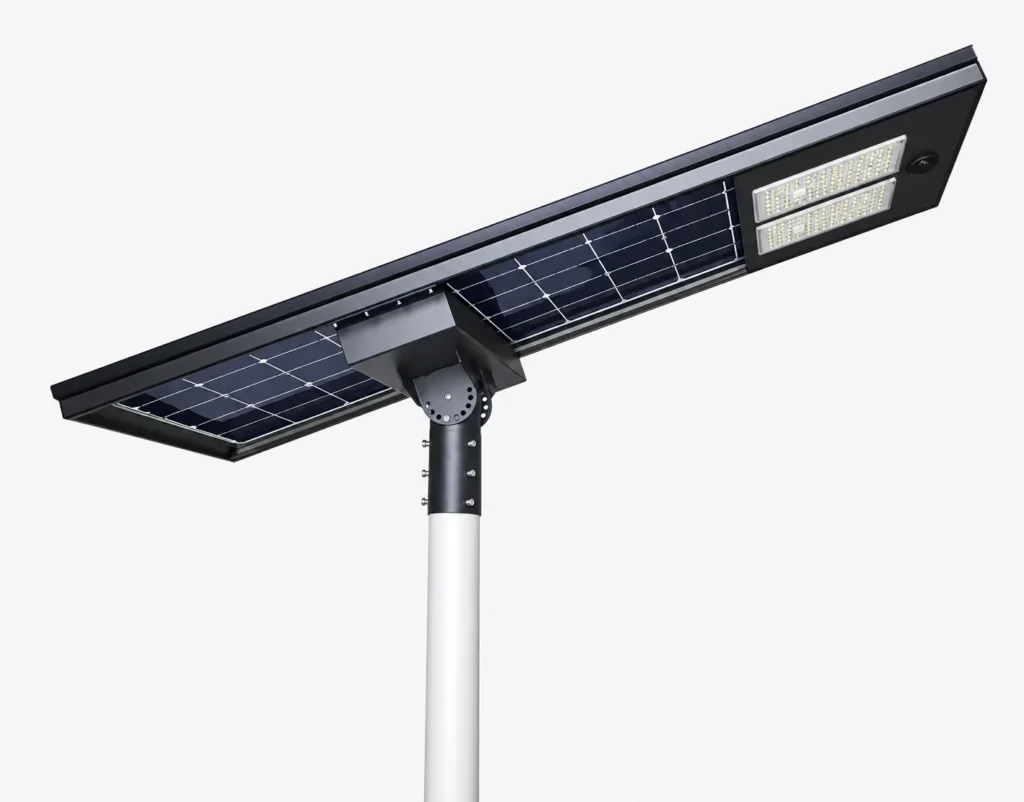
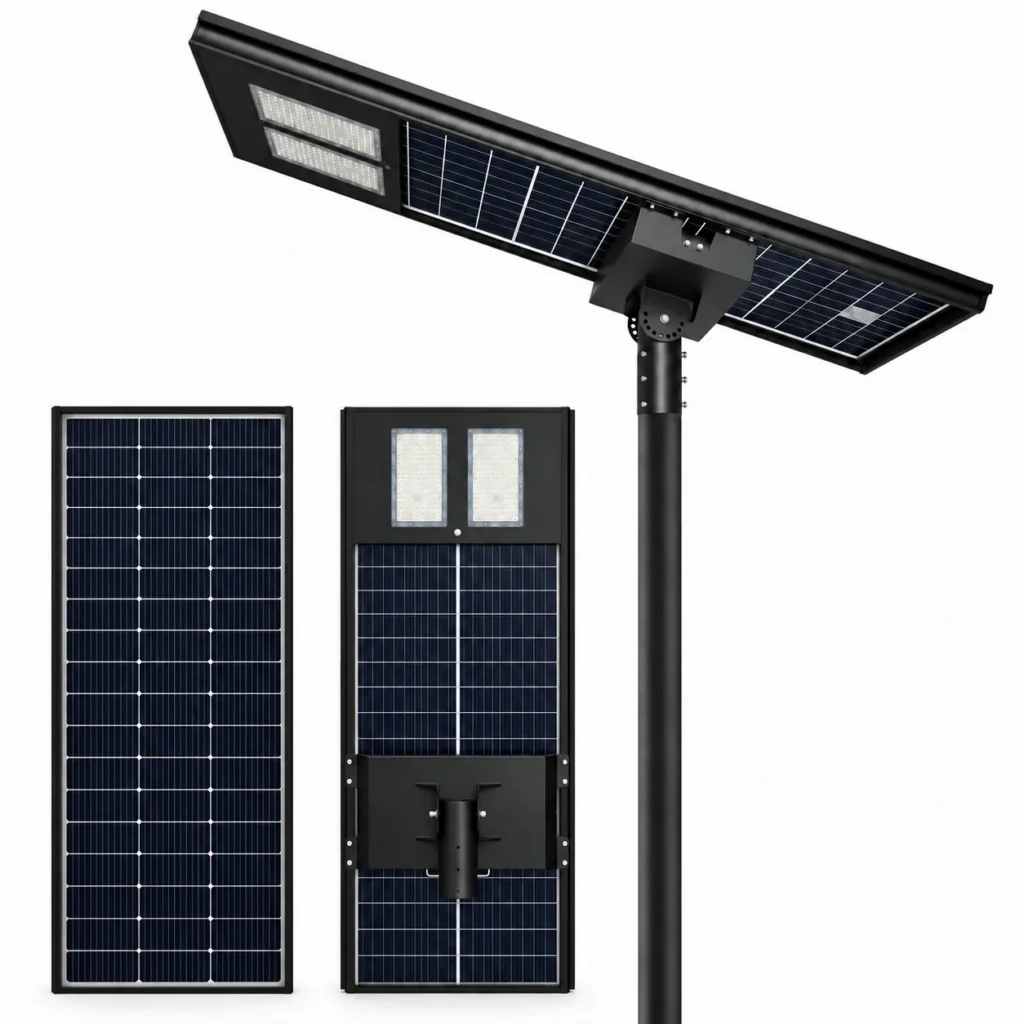
An all-in-one solar street light integrates the main lighting and solar-energy components into a compact fixture architecture. A solar PV module supplies energy, a rechargeable battery stores it, and a controller manages charging and LED operation.
The exact arrangement varies by model and project configuration. Panel and battery capacity, optics, mounting details and control options are not identical across all integrated lights. For model selection and project configuration, see the All-in-One Solar Street Light product range.
How Does an All-in-One Solar Street Light Work?
The energy cycle has four stages. The controller settings determine how the available energy is used through the night.
01 — Generate and charge
During daylight, the PV module converts sunlight into electricity. Charging depends on local solar conditions, panel orientation, shading and system losses.
02 — Store and manage energy
The controller manages charging while the battery stores energy for later use. The charging strategy and battery protection must match the selected battery and controller.
03 — Operate the LED at night
The configured dusk detection or operating schedule activates the luminaire. The optical system directs light onto the road or public area.
04 — Apply the agreed control profile
Timed dimming, motion sensing or remote communication may be available. Confirm these functions for the selected model; a motion sensor is not a universal AIO feature.
Main System Components
Check each component as part of the complete system. A headline wattage does not establish the battery, panel, optics or operating schedule.
Solar PV module
Function: converts sunlight into electrical energy. Confirm: rated output, available mounting angle, shading exposure and the local solar-resource basis.
LED luminaire and optical system
Function: produces and distributes light. Confirm: actual input power, lumen output, optical distribution, CCT and the matching photometric file.
LiFePO₄ battery
Function: stores energy for night operation. Confirm: battery chemistry for the offered model, usable energy in Wh, permitted discharge limits, temperature range and model-specific warranty terms.
Controller
Function: manages charging, discharge and the operating profile. Confirm: charging method, protections, dimming schedule and compatibility with the battery and LED load.
Housing and thermal structure
Function: supports and protects the components while managing heat. Confirm: materials, thermal design, service access and model-matched ingress-protection evidence.
Mounting interface
Function: connects the fixture to the pole or bracket. Confirm: mounting dimensions, adjustment range, fasteners and the project-specific wind and structural basis.
Optional sensing and communication
Function: supports demand-based dimming or monitoring where specified. Confirm: included hardware, control functions, communication requirements and any ongoing service costs.
When All-in-One Is a Good Fit
AIO can be a useful starting point for municipal roads, public-area roads and rural or off-grid routes where an integrated fixture suits the installation and maintenance plan. It can also support batch supply when the same confirmed configuration meets a repeatable set of site conditions.
The decision still depends on the local solar resource, required lighting performance and night-time energy demand. An integrated layout is useful only when the selected fixture can provide the required energy and optical performance within the mounting constraints.
When Another Architecture May Be Better
Consider an all-in-two arrangement when the PV module needs orientation flexibility independent of the luminaire. Consider a split arrangement when separate panel or battery positioning, maintenance access or a more configurable energy system is important.
Component locations vary within each family, so confirm the offered layout rather than relying on the architecture name alone. Compare Solar Street Light Systems for the complete system overview.
Project Inputs Before Selection
Do not select only by wattage. Share these eight inputs so the lighting layout and energy balance can be checked together.
Country / city
Location, local climate, solar conditions and any site shading.
Road width
Carriageway, shoulder, sidewalk and the areas that need illumination.
Pole height
Proposed mounting height, pole arrangement and arm configuration.
Pole spacing
Existing or proposed spacing and any fixed installation constraints.
Working hours
Required operating hours and seasonal changes to night length.
Dimming profile
Output levels and duration at each stage, including any sensing requirement.
Autonomy / backup basis
Required operation during low-solar periods and the agreed service level.
BOQ / drawing / specification
Available road drawings, quantities, lighting targets and tender requirements.
Why Wattage Alone Is Not Enough
Wattage describes electrical power input. Luminous efficacy relates light output to that input, while total lumens describe the amount of light emitted. None of these alone shows how much useful light reaches the road.
Optical distribution, mounting height, pole spacing, road geometry and maintenance assumptions determine the resulting illuminance and uniformity. Compare complete layouts against the project’s target lux and uniformity requirements using a model-matched IES / LDT photometric file and DIALux lighting simulation.
The energy check is separate but connected: LED load, operating hours and dimming determine daily demand; local solar resource, charging losses and usable battery energy determine the PV and battery basis. A battery-life or backup claim should never substitute for that calculation.
AIO vs AIT vs Split — Short Decision Guide
Use this as a starting point, then confirm the actual component layout. Installation complexity and access depend on the selected model and site.
All-in-One (AIO)
PV flexibility: constrained by the fixture arrangement. Installation: fewer separate assemblies, with mounting still checked for the site. Maintenance: confirm access to integrated components. Starting point: projects where compact integration matches the lighting and energy requirement.
All-in-Two (AIT)
PV flexibility: a separate module can offer more orientation options. Installation: adds panel mounting and connections. Maintenance: access depends on where the battery and controller are housed. Starting point: projects needing more independent panel positioning.
Split
PV flexibility: separate component positioning can allow more configuration choices. Installation: more assemblies, wiring and site coordination. Maintenance: placement can be planned around service access. Starting point: projects needing greater energy-system configurability or separated component locations.
For the full architecture comparison, visit the solar street light systems overview.
Engineering Documents for EPC and Tender Review
Request documents matched to the proposed model, configuration and project revision. A document for a different power setting, optic, battery or mounting arrangement may not support the offered system.
Datasheet and dimensional drawing
Confirm the offered configuration, dimensions and mounting interface through datasheets and drawings.
IES / LDT photometric files
Request the model-matched photometric file for the selected LED output and optic. Confirm the test and file basis.
DIALux outputs
Provide road geometry, mounting positions and lighting targets for DIALux simulation support. Review the calculation assumptions with the results.
BOQ and tender review
Submit the available specification, schedule and drawings for BOQ and tender-document review. Document availability and release depend on the model, project and approval status.
Real Project References
These are separate historical supply records from Sunlurio’s approved Project Master. They demonstrate project context, not a guarantee that the same configuration is suitable for another site.
Ghana — 2015–2020
Ghana main-road solar street lighting: 12,000 all-in-one sets, with the approved historical configuration recorded as 80W LED and 9m poles. Sunlurio supported system supply and technical documentation; installation was by the client/EPC/local team.
Sri Lanka — 2019
Sri Lanka 532-set AIO project: 532 sets, 80W LED and 7m poles. This record includes remote installation guidance; installation was by the client/EPC.
Sri Lanka — 2024
Sri Lanka 300-set AIO project: 300 sets, 60W LED and 6m poles. This is a separate project from the 2019 supply; installation was by the client/EPC/local team.
Frequently Asked Questions
What information is needed before choosing an All-in-One solar street light?
Provide the country/city, road width, pole height and spacing, working hours, dimming profile, autonomy requirement and any BOQ, drawing or specification. Include the required lighting criteria when available.
How is battery and solar-panel capacity determined?
Start with the LED load and operating profile to establish daily energy demand. Check usable battery energy, discharge limits, temperature and the agreed autonomy requirement, then size charging capacity against local solar resource and system losses. Confirm the basis for the offered configuration.
How many backup days should a solar street light have?
There is no universal number. The requirement depends on local solar resource, runtime, dimming, load and the project’s autonomy target. Define the expected service level during low-solar periods before selecting the battery and PV module.
Does every All-in-One solar street light include a motion sensor?
No. Sensing and control configuration depend on the model and project requirements. Confirm whether timed dimming, motion sensing or communication hardware is included in the offer.
Can Sunlurio provide IES files and DIALux support?
Sunlurio has engineering-support routes for photometric files and DIALux outputs. Availability depends on the selected model and project inputs. Request matched files and review the calculation assumptions; not every document is an unconditional public download.
What is the difference between All-in-One and All-in-Two?
AIO integrates the main lighting and energy components into a compact fixture architecture. AIT commonly uses a separate PV module, providing more independent panel positioning. Confirm where the battery and controller sit in the actual model.
When should a Split solar street light be considered?
Consider split systems when independent PV or battery positioning, planned maintenance access or a more configurable energy system is required. Compare the complete installation, energy balance and lifecycle service requirements.
Choose the Configuration for Your Project
Use this guide to define the project inputs, then review the available product configurations. Confirm the proposed lighting layout, energy basis and engineering documents before procurement.