Solar street lights can operate through cloudy or rainy periods only when the system is sized for the site’s solar resource and required lighting schedule. Verify usable battery energy, charging losses, dimming settings and backup duration for the offered configuration.
How Do Modern Solar Batteries Store Energy?
Solar street lights can operate through cloud or rain only if the offered PV, controller and battery system meets the required nightly lighting load and autonomy under the site’s worst-month conditions. Battery chemistry alone does not establish backup days.
Solar street lights rely on advanced energy storage systems to maintain consistent performance. During daylight, solar panels convert sunlight into electricity, which is stored in batteries for use during the night. Charging and storage performance depend on the exact cell/pack, BMS, PV module, controller efficiency, temperature and solar irradiance; low-light recharge may be insufficient for the required duty cycle.
Types of Solar Batteries
| Battery Type | Advantages |
|---|---|
| Lithium-ion | Assess exact chemistry, pack usable Wh, charge-rate and temperature limits, tested life and warranty |
| Gel Batteries | Compare the actual gel battery’s usable energy, recharge profile, cycling, weight and maintenance requirements |
| Lead-acid | Compare initial cost against usable energy, installation mass, charging losses, maintenance and replacement |
Battery options, including LiFePO₄ (a lithium-ion chemistry), must be compared at pack level using verified usable Wh, charge/discharge losses, temperature range, BMS protection, cycle/calendar aging, replacement access and written warranty. No chemistry guarantees superior rainy-day performance without system sizing.
How Batteries Extend Operation in Cloudy Conditions
Here’s how modern batteries help solar street lights keep running smoothly, even when the sun isn’t shining:
- Overcharging Prevention: Smart controllers regulate energy intake, preventing battery damage and prolonging lifespan.
- Deep Discharge Protection: Prevents the battery from draining completely, which helps extend its life.
- Energy Management: Verify low-battery dimming and any forecast-based functions against the offered controller documentation. These features are not included in every system.
What Factors Affect Solar Street Light Performance in Bad Weather?
Solar panel efficiency, battery capacity, and smart energy management play key roles in how well solar street lights perform during cloudy or rainy weather.
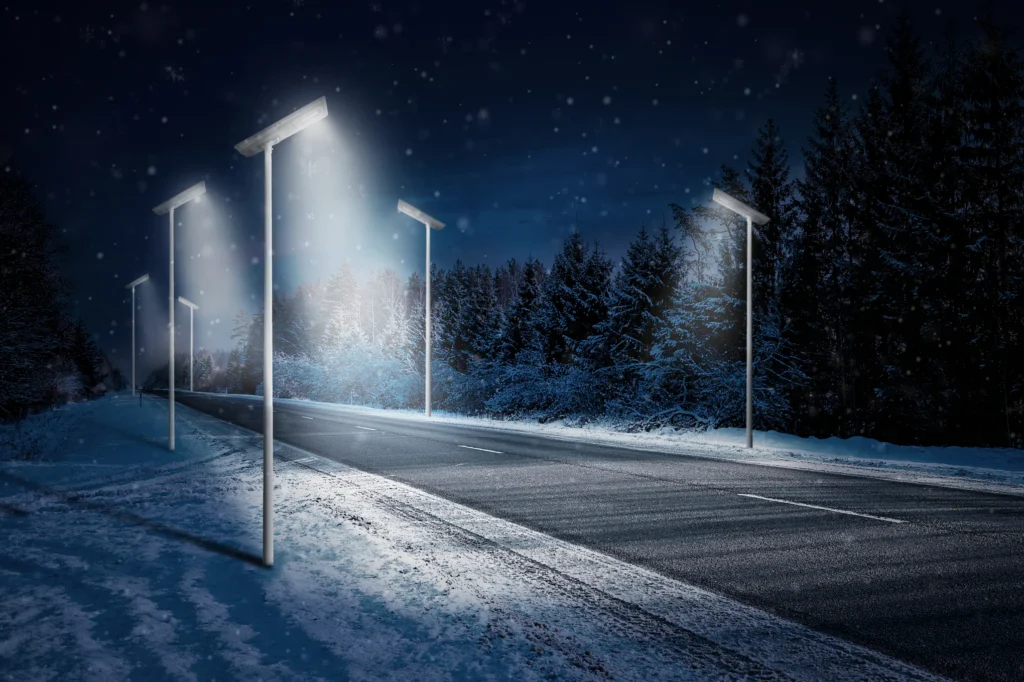
Even on cloudy or rainy days, solar panels can still capture some sunlight. However, certain factors can affect how well the lights perform in these conditions:
Key Factors Influencing Solar Street Light Efficiency
-
Solar Panel Type & Efficiency
- Monocrystalline modules: Compare the offered modules’ tested low-irradiance performance, area, temperature coefficient and shading profile rather than assuming a universal cloudy-weather advantage.
- Alternative PV modules: Evaluate actual STC output, low-irradiance data, footprint, compatibility, cost and sourcing for the same project conditions.
-
Battery Storage Capacity
- Larger batteries can store more energy, providing longer illumination during consecutive cloudy or rainy days.
-
Smart Power Management
- Dimming schedules can reduce the nightly load where the project lighting requirements permit; verify the controller settings and supported functions.
-
Geographical Location
- At rain-prone sites, optimize module orientation and verify site-specific usable battery Wh, shading, controller losses and recovery charge against the defined worst-month duty profile. No design guarantees uptime in all weather.
-
Maintenance & Cleaning
- Dust and debris on solar panels reduce energy absorption. Regular cleaning ensures the panels work efficiently.
How Can Solar Street Lights Be Optimized for Low-Light Environments?
Reliable cloudy-weather operation requires a configuration-matched energy balance, suitable PV/battery sizing, measured LED input power and approved dimming controls. Predictive or AI-based features must be verified on the actual controller model and software version.

To ensure solar street lights continue to operate efficiently even in areas with cloudy weather, manufacturers have integrated several design improvements:
Key Design Improvements
-
High-Efficiency Solar Panels
- Use monocrystalline panels for better efficiency in low-light situations.
- Panels should be installed at an optimized tilt angle to maximize exposure to available sunlight.
-
Larger Battery Capacity
- Lithium-ion batteries offer more storage, making them ideal for storing energy during sunny days to use in low-light conditions.
- Smart charge controllers prevent overcharging and enhance battery life.
-
Smart Energy Management
- Adaptive brightness, where supported, must be configured and checked against the required lighting levels.
- Motion sensors adjust the light intensity based on real-time activity, saving energy when the area is not in use.
-
Hybrid Solar & Grid Systems
- Grid or generator-backed hybrid systems may provide additional resilience only where a compatible backup architecture, grid availability, switching protection and accepted operating schedule are specified and tested.
Verify the complete energy balance and backup requirement before specifying operation through a prolonged cloudy or rainy period.
Conclusion
Cloudy-weather performance is a system-sizing question, not an all-weather guarantee. Review the project location, worst-month solar resource, shading, nightly lighting schedule, usable battery energy and recovery charging with the supplier. Confirm controller features and backup duration for the exact model before procurement.
Project Data to Verify
- Solar resource: Provide the project location, worst-month solar data and expected shading.
- Energy budget: Check usable battery energy against the nightly load, dimming schedule, charging losses and required backup period.
- Controller functions: Verify forecast-based control, sensors and dimming features on the offered model; they are not standard on every smart light.
Ask for a configuration review using these inputs before committing to a cloudy-weather operating requirement. For an EPC tender, submit the BOQ and proposed nightly dimming/load schedule so usable battery energy, worst-month PV yield and controller features can be checked against the required autonomy.