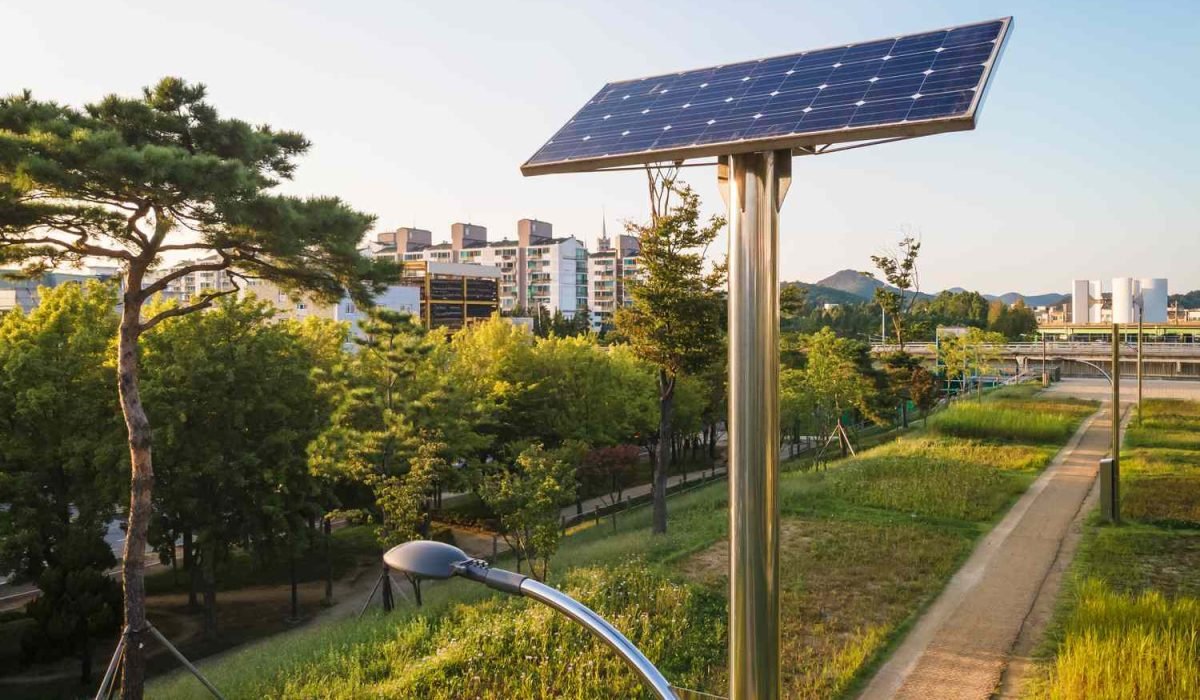
Standalone solar street lighting can avoid utility electricity for its lighting load where grid access is limited, but environmental and financial outcomes depend on the offered PV/battery system, site operation, component life and the grid or diesel alternative being replaced.
In this article, we’ll explore why solar street lights are vital for the environment and how they can help reduce carbon footprints, lower energy consumption, and drive the adoption of renewable energy.
Why Solar Street Lights Are Crucial for the Environment
Solar-powered lighting is one available off-grid energy option for public and private sites. It must meet the same maintained illuminance/luminance, autonomy, installation and safety standards as the selected grid-fed alternative. Here’s why solar street lights are so important for our planet:
1. Reducing Carbon Emissions
For a standalone PV streetlight there is no on-site fuel combustion from the lighting power source, but its full-system emissions are not zero. Assess ISO 14040 life-cycle boundaries, including PV manufacture, lithium battery cells and replacement, driver, pole/foundation steel, transport, maintenance and end-of-life treatment. The grid baseline varies with the utility energy mix and must be stated before claiming a CO₂ reduction.
2. Energy Efficiency
Electrical efficiency must be measured using complete-luminaire input watts, actual LED optics and the PV/controller/battery conversion losses. The off-grid configuration avoids purchased lighting kWh where fully standalone, but it must still be sized for seasonal irradiation, charging recovery and a serviceable battery. It is not automatically more energy-efficient than an equivalent grid-connected LED system.
3. Utilization of Renewable Energy
The sun is one of the most powerful and abundant sources of energy available on Earth. Solar street lights utilize this renewable resource to function, ensuring that they are not only environmentally friendly but also sustainable in the long run. Sunlight is renewable, but the supplied modules, batteries, metals and electronic assemblies require finite materials and have upstream and end-of-life environmental impacts.
Key Environmental Benefits of Solar Street Lights
Solar street lights offer a variety of environmental benefits that contribute to sustainability and reduce negative environmental impacts. Let’s dive deeper into these advantages:
1. Reducing Carbon Footprint
An off-grid PV solution can reduce purchased electricity, but any cradle-to-grave carbon benefit must be calculated for both alternatives under the same lighting service, location, electricity mix, PV/battery lifespan, pole/civil scope and maintenance and replacement schedule. Do not assign a fixed CO₂ saving without a documented inventory.
2. Energy Independence and Savings
A truly standalone solar streetlight does not need purchased grid electricity for its nightly lighting load, but the system still incurs capital cost, PV cleaning, battery/BMS replacement, repairs and possible connectivity fees. Project lifecycle savings must be compared with actual grid connection costs, tariffs, service hours and the required lighting output.
3. Reducing Light Pollution
Solar or grid-fed LED luminaires can reduce unwanted spill and upward light only when their actual optical distribution, pole mounting, aim, CCT and control schedule are properly designed. Verify site lighting calculations, glare, spill and ecological constraints; solar power alone does not establish lower light pollution.
4. Driving Green Technology Forward
Solar street lights are part of a broader movement towards sustainable technologies. As more communities and cities adopt solar-powered solutions, they contribute to the widespread use of renewable energy. This, in turn, encourages innovation and further development of green technologies, supporting a future where renewable energy is the dominant power source for our cities and infrastructure.
5. Long-Term Cost Savings and Efficiency
An off-grid solar lighting project may have lower utility-connection and purchased-electricity costs, but higher PV/battery capital and future replacement costs. Neither a lower full-life cost nor a favourable ROI is assured. Use a priced BOQ with equal lighting service, tariff, worst-month energy budget, replacement schedule, labour, taxes and discount rate.
Why Now Is the Best Time to Switch to Solar Street Lights
Solar lighting may be appropriate for projects where off-grid supply, site solar resources, maintained lighting requirements and local maintenance capacity support the proposed design. The decision should follow an engineering and lifecycle-cost comparison, not a universal policy timetable.
1. Addressing Climate Change with Renewable Energy
For an environmental procurement claim, use a transparent baseline for grid/diesel electricity, component embodied impacts, local transport and maintenance and the required service hours. ISO 14040 supplies a life-cycle assessment framework; it does not itself certify that a particular Sunlurio model has lower impact.
2. Country-Specific Procurement Incentives and Policy Checks
Funding and incentive eligibility are country-, year-, purchaser- and programme-specific. A solar streetlight is not automatically eligible merely because it contains PV. Before pricing an EPC or municipal proposal, obtain the published programme name, competent authority, qualifying equipment and recipient, deadlines, available allocation, permitted procurement structure and any required acceptance documents. Never assume rebates in the tender cost model without evidence.
Conclusion: The Environmental Benefits of Solar Street Lights
Site-matched solar street lighting can provide off-grid road illumination. Confirm lighting compliance, energy autonomy, component service life, environmental inventories and a project-specific TCO before describing the configuration as lower-carbon, lower-cost or otherwise preferable to grid-powered alternatives.
Call to Action
For a government, EPC or NGO lighting project, submit the BOQ for a preliminary lighting and energy review with the intended country, road geometry, lighting standard, annual duty hours, grid/diesel baseline, solar resource, battery replacement and financing assumptions. Any environmental or financial percentage requires a documented comparison.