
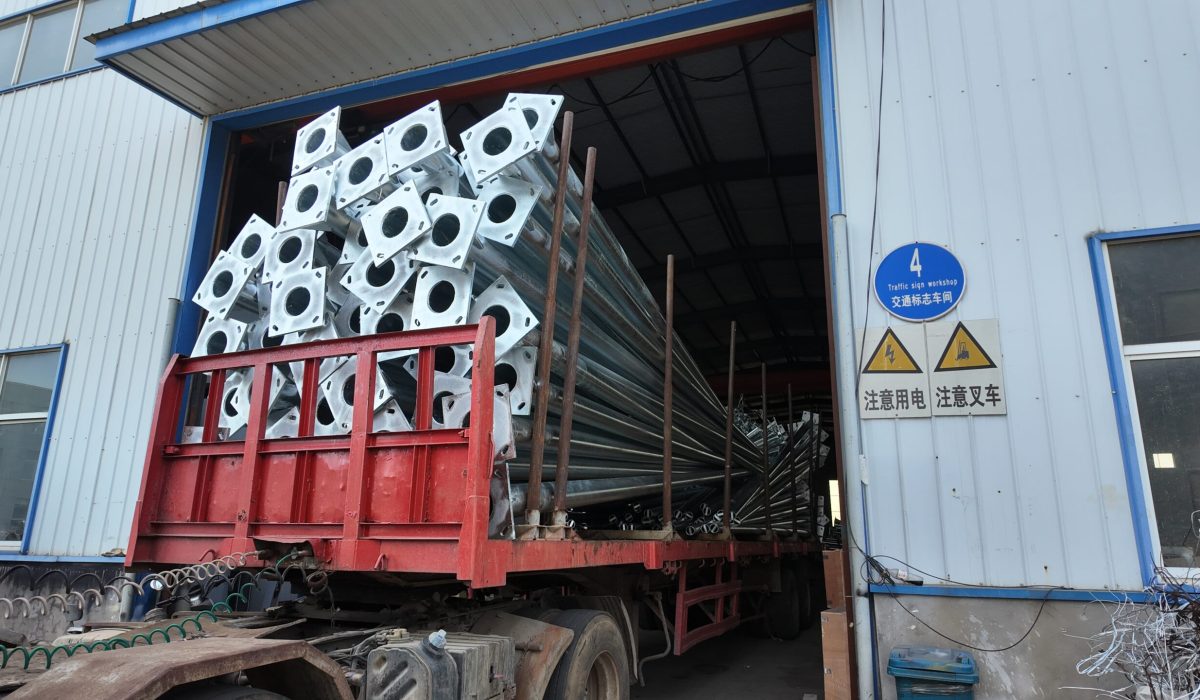
An RFQ that says “300 pcs, 9 m galvanized street light poles” may look clear, but it is still not detailed enough for three manufacturers to quote exactly the same pole.
Pole height is only one part of the specification.
Two 9 m galvanized poles can differ in steel grade, shaft geometry, wall thickness, arm configuration, luminaire loading, wind design basis, base plate, anchor bolts, galvanizing requirements and project documentation.
That is why the lowest quotation is not always a lower price for the same product. In many cases, the suppliers are simply quoting different structural and supply scopes.
For EPC contractors, municipal projects and tender procurement, the objective should therefore be:
Define the same pole first, then compare suppliers.
The practical sequence is:
Lighting requirement → pole geometry → material and structural design → mounted equipment → wind basis → base and anchor interface → galvanizing → approved drawing → comparable quotation.
1. What Information Is Actually Needed to Quote a Street Light Pole?
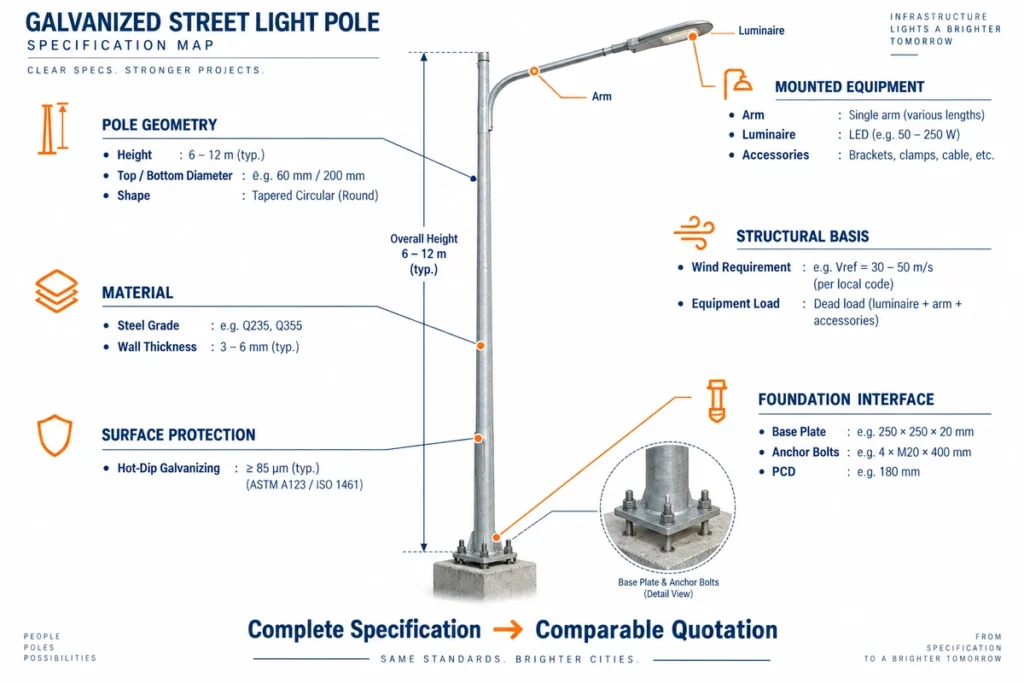
A reliable project quotation starts with a complete enough technical basis.
At minimum, the pole manufacturer needs to understand the lighting application, the basic pole geometry, the equipment installed on the pole, the project wind requirement and the foundation interface.
A useful specification map looks like this:
| Specification Area | What Should Be Confirmed |
|---|---|
| Lighting requirement | Application, mounting height and layout |
| Pole geometry | Height, shape, top diameter, bottom diameter |
| Structural material | Steel grade and wall thickness |
| Mounted equipment | Arm, luminaire and additional accessories |
| Wind basis | Project wind requirement and exposure |
| Foundation interface | Base plate, anchor bolts and PCD |
| Surface protection | Galvanizing requirement |
| Documentation | Drawing, revision and compliance information |
If several of these items are still undefined, the quotation may need to be treated as preliminary rather than final.
That distinction matters.
A preliminary quotation is useful for budgeting.
A project quotation should allow the buyer to understand exactly what pole is being proposed.
2. Start With the Lighting Requirement, Not the Pole Thickness
A street light pole should not be selected only because a buyer is familiar with an 8 m, 9 m or 10 m size.
The pole configuration should first support the lighting requirement.
For a road project, mounting height is normally linked to factors such as:
- road width;
- luminaire distribution;
- pole spacing;
- required lighting level;
- single-side, opposite or staggered arrangement;
- arm configuration.
This does not mean the pole manufacturer needs to redesign the entire lighting scheme before giving any quotation.
It means the proposed pole should be consistent with the actual road-lighting arrangement.
For example, a project may specify a 9 m mounting height, but the final pole configuration can still depend on whether the pole is flange-mounted, embedded, fitted with a short single arm or fitted with a longer double arm.
A useful procurement process therefore starts with:
What lighting arrangement is the pole supporting?
and only then moves into:
What structural pole is required for that arrangement?
Do not select a pole first and force the lighting design to fit it later.
3. Define Pole Height, Shape and Diameter
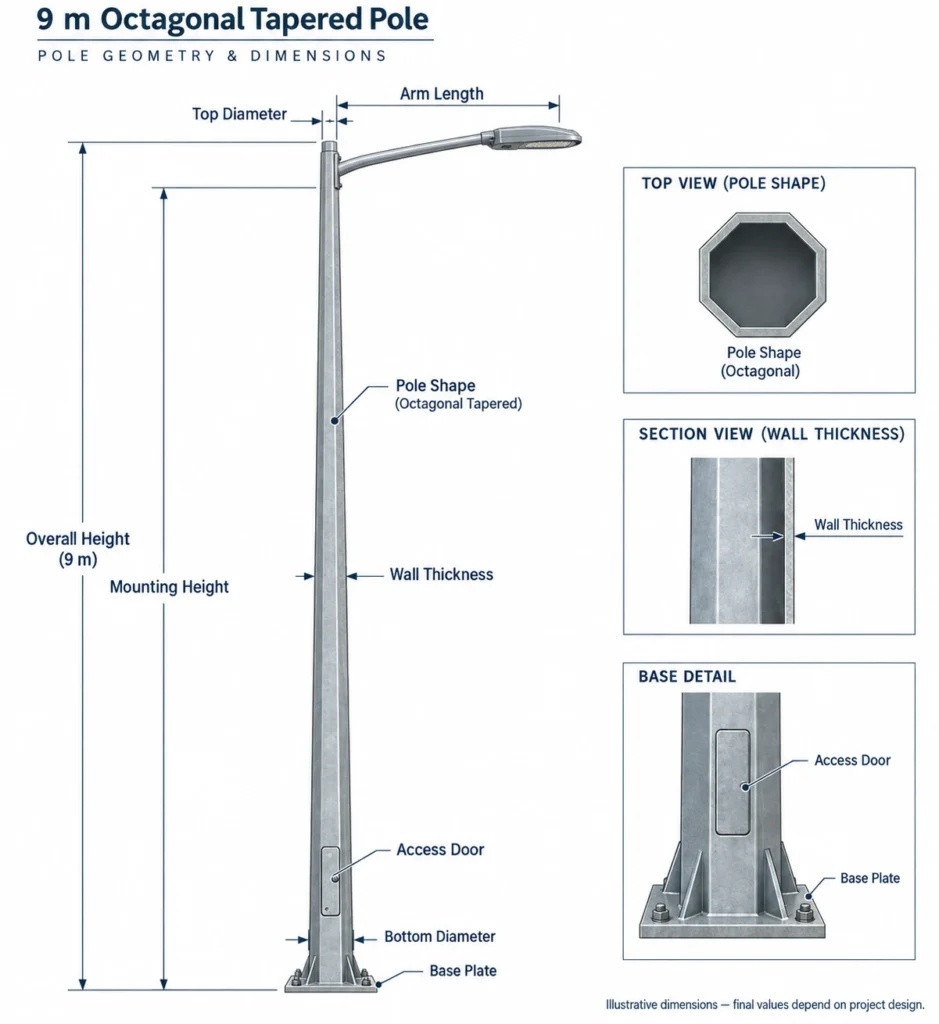
Once the lighting arrangement is understood, the basic shaft geometry can be defined.
Pole height
Common street-lighting projects may use heights such as 6 m, 8 m, 9 m, 10 m or 12 m, but these should not be treated as complete standard products.
The specification should clarify whether the stated dimension refers to:
- overall pole length;
- mounting height above finished ground;
- flange-mounted height;
- embedded-pole length.
This avoids a simple but common misunderstanding: two suppliers may both quote a “9 m pole” while using different dimensional definitions.
Pole shape
Typical project poles may be:
- round tapered;
- octagonal;
- polygonal;
- straight tubular where specifically required.
The purpose of the specification is not to decide that one shape is universally better.
The important point is that the required geometry should be clearly identified before production.
If the tender calls for an octagonal tapered pole, the proposed drawing should show an octagonal tapered pole rather than a manufacturer's generic alternative.
Top diameter
The top diameter affects the interface with:
- the arm;
- tenon;
- bracket;
- luminaire mounting system.
A mismatch at this point can create installation problems even when the shaft itself is structurally acceptable.
Bottom diameter
The lower shaft diameter forms part of the structural geometry and affects the relationship between the shaft, flange and foundation interface.
For this reason, top diameter, bottom diameter, taper and wall thickness should be reviewed together rather than as isolated dimensions.
4. Steel Grade and Wall Thickness Must Be Evaluated Together
One of the most common procurement shortcuts is to compare poles only by wall thickness.
For example:
Supplier A: 9 m pole, 4 mm
Supplier B: 9 m pole, 3.5 mm
It may be tempting to assume that Supplier A automatically offers the stronger or better pole.
That conclusion is too simple.
Street light pole structural performance depends on several variables working together:
Steel grade + pole height + shaft diameter + taper + wall thickness + mounted equipment + wind requirement
Wall thickness is therefore not a standalone quality grade.
Steel grade
The project may specify a particular steel grade or an accepted equivalent.
The manufacturer should confirm the proposed material against the project requirement rather than simply substitute its standard factory material.
Where an equivalent material is proposed, the project team should verify whether that equivalence is acceptable under the tender or consultant requirements.
Wall thickness
Wall thickness contributes to the structural capacity of the shaft, but it needs to be considered together with:
- steel strength;
- section geometry;
- taper;
- pole diameter;
- arm length;
- luminaire loading;
- wind loading.
A thicker wall on a poorly defined geometry is not automatically a better engineering solution.
Likewise, a thinner wall should not be accepted simply because the price is lower.
The correct question is:
Does the proposed pole configuration satisfy the project structural requirement?
Why thickness-only comparisons are misleading
Suppose two suppliers propose:
| Item | Supplier A | Supplier B |
|---|---|---|
| Height | 9 m | 9 m |
| Wall thickness | 4 mm | 3.5 mm |
| Steel grade | Not stated | Confirmed |
| Bottom diameter | Not stated | Confirmed |
| Wind basis | Generic | Project-specific |
| Luminaire load | Not stated | Confirmed |
The first quotation has a thicker wall, but the specification is incomplete.
The second quotation gives more information needed to evaluate whether the proposed pole actually matches the project.
The lesson is not that thinner is better.
It is that thickness alone does not tell the buyer enough.
5. Arm, Luminaire and Additional Equipment Must Be Included in the Pole Load
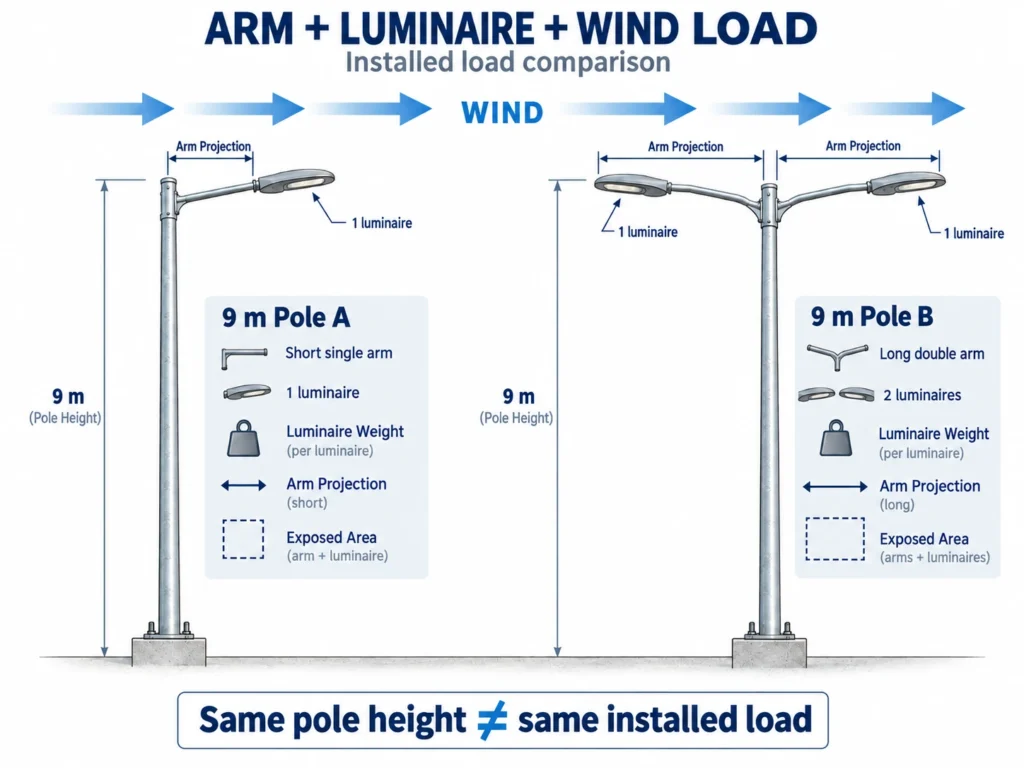
The pole shaft is only one part of the installed system.
The equipment mounted on it changes the loading condition.
Single arm and double arm
A 9 m pole with a short single arm does not have the same configuration as a 9 m pole with a long double arm.
Before structural confirmation, the supplier should know:
- single or double arm;
- arm length;
- arm projection;
- arm angle where relevant;
- number of luminaires.
Luminaire information
Luminaire wattage is useful for electrical design, but wattage alone is not enough for structural review.
The pole manufacturer may also need:
- luminaire weight;
- physical dimensions;
- mounting arrangement;
- wind-exposed area or equivalent project-required data.
For example, two 150 W luminaires can have very different housings and exposed areas.
Structurally, they should not automatically be assumed to create the same load.
Additional equipment
If the pole will also support other equipment, this should be declared before the pole configuration is finalized.
Examples include:
- CCTV cameras;
- signs;
- solar panels;
- communication equipment;
- smart-lighting devices;
- decorative or project-specific attachments.
Anything mounted on the pole should be identified before structural confirmation.
Adding equipment after the pole has already been approved can change the loading basis.
6. Wind Requirement: Why “160 km/h” Is Not a Complete Specification
Another common RFQ line is:
Wind resistance: 160 km/h
This is useful information, but it does not completely define the pole.
Wind loading also depends on what the wind acts on and the design basis used for the project.
Relevant project information can include:
- design wind requirement;
- applicable structural standard;
- site exposure;
- terrain conditions;
- pole geometry;
- arm configuration;
- luminaire quantity;
- luminaire and equipment exposed area.
That means a wind-speed number should be treated as an engineering input, not simply as a marketing rating.
Two suppliers can both write:
160 km/h wind resistant
while proposing different shaft dimensions, materials, arms and base arrangements.
For project procurement, the better question is:
Is the proposed pole structurally evaluated for the actual project configuration and wind basis?
Detailed wind-load calculations belong in the dedicated structural review. For quotation purposes, this section should ensure that the manufacturer receives enough project information to propose the correct pole.
7. Base Plate, Anchor Bolts and PCD Are One Project Interface
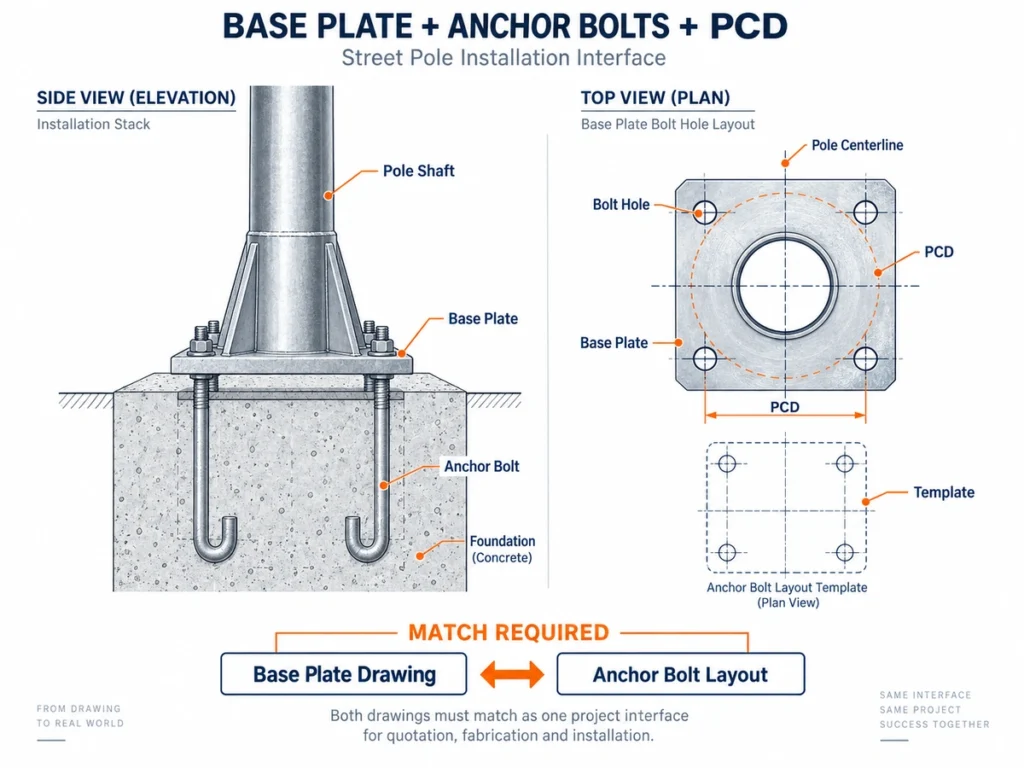
The pole can be correctly manufactured and still fail to install if the base plate and foundation anchors do not match.
For flange-mounted poles, these items should therefore be coordinated as one interface.
Base plate
The project drawing may need to define:
- outside dimensions;
- plate thickness;
- bolt-hole quantity;
- bolt-hole diameter;
- bolt-hole positions;
- orientation.
The final base plate used in production should correspond to the foundation and anchor arrangement used on site.
Anchor bolts
Anchor-bolt information can include:
- quantity;
- diameter;
- length;
- material or grade where specified;
- threaded length;
- projection;
- nuts and washers;
- anchor template or cage configuration.
These details should not be selected independently of the pole base plate.
PCD
PCD, or pitch circle diameter, describes the diameter of the circle passing through the centers of the anchor bolts.
If the pole base plate is manufactured for one PCD while the civil contractor installs another, the pole may not fit the completed foundation.
For example:
Pole base plate: PCD 420 mm
Foundation anchor cage: PCD 460 mm
The problem is no longer a simple dimensional difference.
It can become a site rework issue.
Pole base, anchor cage and foundation should not be approved as three unrelated items.
Before concrete is cast, the final anchor layout should be checked against the final pole base-plate drawing.
8. What Does “Hot-Dip Galvanized” Need to Mean in the Specification?
A project specification should ideally say more than:
Finish: galvanized
because that description leaves several questions open.
For project procurement, the buyer should clarify the required galvanizing basis.
Referenced standard
Depending on the project, the specification may reference a standard such as:
- BS EN ISO 1461;
- ASTM A123;
- another tender, national or local requirement.
Sunlurio should follow the project requirement rather than assume that one galvanizing standard applies to every country and every tender.
Fabrication sequence
Where required by the manufacturing specification, major cutting, forming, drilling and welding operations should be completed before final hot-dip galvanizing.
This helps ensure the completed fabricated pole receives the specified surface treatment.
Any later modification should be handled according to the relevant project requirements.
Acceptance and inspection
For project supply, the specification may also need to clarify:
- coating acceptance basis;
- inspection requirement;
- documentation requirement;
- repair procedure for damaged coating where applicable.
The main procurement point is simple:
“Galvanized” should describe a defined project requirement, not only a general product feature.
Detailed coating thickness, inspection methods and galvanizing-process requirements should be handled in the dedicated galvanizing specification.
9. Coastal and Aggressive Environments Need Additional Protection Decisions
A normal inland municipal road and a coastal road can use the same general pole type but operate in very different corrosion environments.
Projects exposed to:
- sea salt;
- high humidity;
- industrial pollution;
- standing water;
- aggressive soil or splash conditions
may require additional corrosion-protection decisions.
The project team should particularly review:
- pole base zone;
- drainage;
- fasteners;
- coating damage during transport and installation;
- site repair requirements;
- additional coating systems where specified.
Hot-dip galvanizing remains an important protection method, but the word “galvanized” alone does not necessarily describe the complete durability strategy for every coastal or aggressive project.
Where a marine or coastal environment is involved, the corrosion requirement should be reviewed separately rather than copied from a standard inland pole specification.
10. What Should a Street Light Pole Drawing Show?
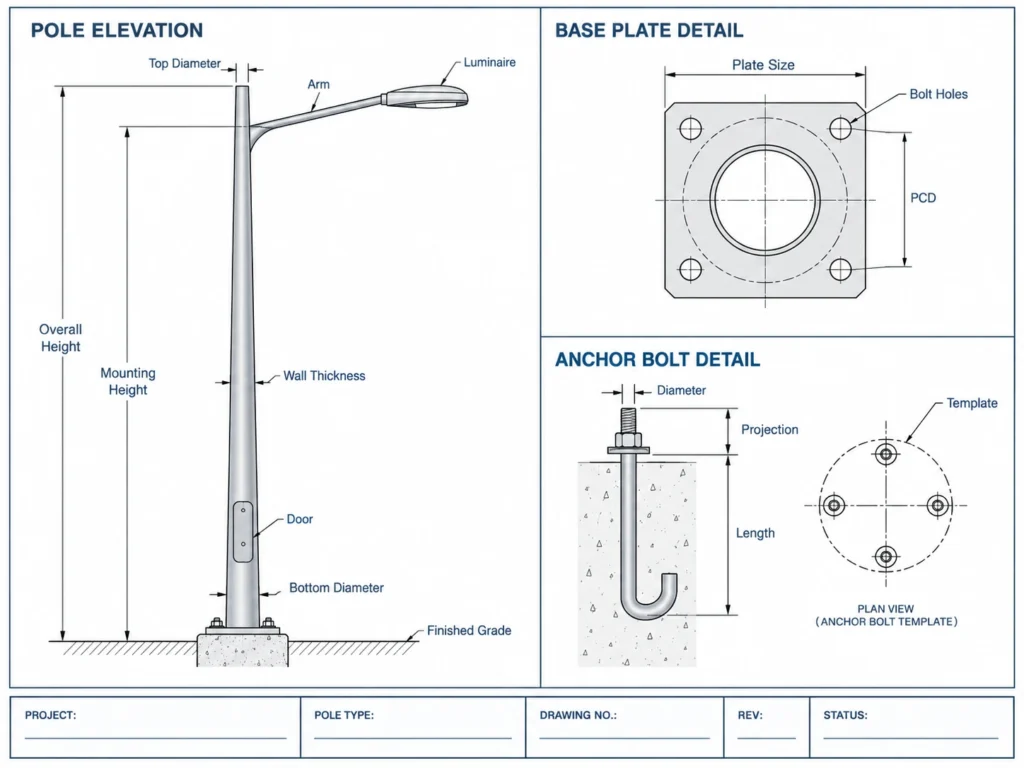
A product datasheet may describe the pole generally.
A project drawing should go further.
Before technical approval or production, the drawing should allow the project team to verify that the proposed pole matches the tender, luminaire and civil interfaces.
Typical information includes:
| Drawing Item | Why It Needs to Be Checked |
|---|---|
| Overall / mounting height | Confirms project geometry |
| Pole shape | Confirms shaft configuration |
| Top diameter | Confirms arm or luminaire interface |
| Bottom diameter | Confirms shaft geometry |
| Wall thickness | Confirms structural specification |
| Arm length / angle | Confirms lighting arrangement |
| Access door | Confirms electrical and maintenance access |
| Base plate | Confirms civil interface |
| Bolt holes | Coordinates anchor bolts |
| PCD | Confirms foundation compatibility |
| Surface treatment | Confirms finish |
| Drawing number | Supports document control |
| Revision | Prevents outdated production |
Reference drawing vs approved production drawing
A drawing issued during quotation should not automatically become the drawing used for manufacturing.
During project development, several items may change:
- luminaire;
- arm;
- wall thickness;
- flange;
- anchor layout;
- project comments.
For that reason, the drawing should have a clear status and revision.
A practical document sequence can look like:
Preliminary / quotation drawing
↓
Technical review drawing
↓
Consultant comments
↓
Revised supplier drawing
↓
Approved production drawing
This is especially important on projects where the civil contractor and pole factory are working in parallel.
11. Why Three Suppliers Can Quote Different Prices for the Same “9 m Pole”
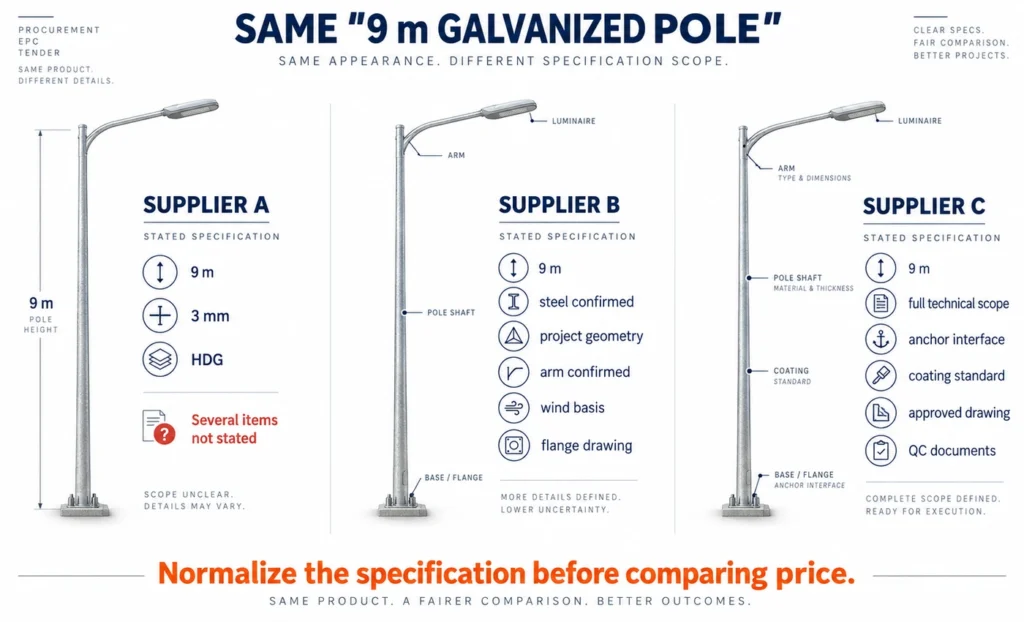
This is where many procurement comparisons become unreliable.
Consider three quotations:
| Specification | Supplier A | Supplier B | Supplier C |
|---|---|---|---|
| Height | 9 m | 9 m | 9 m |
| Steel grade | Not stated | Confirmed | Confirmed |
| Wall thickness | 3 mm | Design-based | Design-based |
| Pole diameter | Not stated | Confirmed | Confirmed |
| Arm | Generic | Project-specific | Project-specific |
| Wind basis | “160 km/h” | Project basis | Project basis |
| Base plate | Generic | Drawing | Drawing |
| PCD | Not stated | Confirmed | Confirmed |
| Anchor bolts | Optional | Matched | Matched |
| Galvanizing | “HDG” | Standard stated | Standard stated |
| Documents | Datasheet | Project drawing | Drawing + QC documents |
All three can appear on a summary sheet as:
9 m galvanized street light pole
but they are not necessarily quoting the same technical scope.
A lower price may come from:
- different steel;
- different shaft dimensions;
- lighter structural configuration;
- excluded anchors;
- simplified arm;
- different galvanizing scope;
- fewer technical documents;
- different testing or QC scope.
This does not mean the most expensive quotation is automatically the best.
It means the quotations must first be normalized.
Do not compare pole prices until you know the suppliers are quoting the same structural and supply scope.
12. Tender Specification vs Supplier Standard: How to Handle Differences
Tender projects create another common problem.
The tender may specify one configuration while the supplier's standard pole uses another.
For example:
| Tender Requirement | Supplier Proposal | Status |
|---|---|---|
| 9 m octagonal pole | 9 m octagonal pole | Comply |
| Specified steel grade | Same grade | Comply |
| 4 mm wall thickness | 3.5 mm proposed | Requires review |
| Required PCD | Same PCD | Comply |
| Specified galvanizing standard | Same standard | Comply |
The correct response is not to hide the differences.
The supplier should identify whether each item:
Complies
or
Deviates
and provide supporting information where required.
The project team can then decide whether the deviation is acceptable.
A useful workflow is:
Tender requirement
↓
Proposed pole
↓
Supporting drawing / datasheet
↓
Compliance or deviation
↓
Consultant / client review where required
This is especially important when an alternative specification is structurally valid but does not exactly match the written tender requirement.
Technical validity and tender compliance are related, but they are not always the same question.
13. Documents Needed at Each Project Stage
Project documentation should become more specific as the project moves from enquiry to production.
| Project Stage | Typical Document Need |
|---|---|
| RFQ / tender | BOQ, basic requirements, preliminary configuration |
| Quotation | Proposed pole specification |
| Technical review | Datasheet and project drawing |
| Consultant approval | Drawing and required compliance documents |
| Civil coordination | Base plate and anchor-bolt layout |
| Production | Approved drawing revision |
| Pre-shipment | QC, galvanizing and batch documentation as required |
Tender stage
At tender stage, the buyer may not yet have every final parameter.
The manufacturer can work from:
- BOQ;
- tender specification;
- project location;
- known luminaire configuration;
- available drawings.
Any assumptions should be identified clearly.
Technical review
Once the supplier is shortlisted, the project normally needs a more detailed proposed configuration.
This is where the pole drawing becomes important.
The drawing should allow the engineer or consultant to verify that the proposed pole matches the project.
Production stage
Production should be based on the approved revision.
If the pole geometry or anchor layout changes after approval, the affected project documents should be reviewed again before manufacturing or civil work continues.
Pre-shipment stage
Depending on the project, the customer may require records relating to:
- dimensions;
- galvanizing;
- visual inspection;
- batch identification;
- packing;
- project-specific QC.
The required evidence should be agreed before shipment rather than requested only after the goods are completed.
14. What to Send a Pole Manufacturer Before Asking for Price
For a project quotation, send as much of the following information as is available:
| Information | Example |
|---|---|
| Project location | Country / city |
| Application | Municipal road / highway / industrial area |
| Quantity | 300 pcs |
| Mounting height | 9 m |
| Pole type | Octagonal / round tapered |
| Arm | Single / double, length |
| Luminaire | Model / weight / relevant dimensions |
| Additional equipment | CCTV / sign / smart equipment |
| Wind requirement | Tender / project specification |
| Steel requirement | If specified |
| Galvanizing requirement | Tender standard |
| Installation | Flange mounted / embedded |
| Existing civil information | Foundation / anchor details if available |
| BOQ | Upload if available |
| Tender specification | Upload if available |
| Existing drawing | Upload if available |
The information does not need to be perfect before contacting the manufacturer.
If the tender documents already exist, it is usually better to send:
BOQ + technical specification + existing drawings
rather than guess missing pole dimensions.
The manufacturer can then identify which items are:
confirmed,
missing,
assumed, or
need clarification.
That creates a much stronger basis for quotation than a one-line enquiry such as:
“Please quote 300 pcs 9 m galvanized poles.”
Before You Compare Pole Quotations
Before selecting a supplier, check one final point:
Are all suppliers actually quoting the same pole?
Confirm that the quotations use the same or clearly comparable:
- height;
- shaft geometry;
- steel requirement;
- wall thickness;
- arm arrangement;
- luminaire loading;
- wind basis;
- base plate;
- anchor scope;
- galvanizing requirement;
- documentation scope.
Only after those items are aligned does a price comparison become meaningful.
For an EPC or municipal lighting project, the objective is not simply to obtain the lowest pole price.
It is to procure a pole that matches the lighting design, civil interface, tender requirement and approved project documentation without creating avoidable changes during production or installation.
FAQ
Is a 9 m galvanized street light pole a standard specification?
No. A 9 m height is a common project dimension, but it does not completely define the pole.
Steel grade, shaft dimensions, wall thickness, arm, luminaire loading, wind requirement, base plate, anchor bolts and galvanizing still need to be confirmed.
What wall thickness should a 9 m street light pole use?
Wall thickness should not be selected from height alone.
The correct thickness depends on the overall structural design, including steel grade, shaft geometry, mounted equipment and project wind requirement.
Is a thicker street light pole always better?
Not necessarily.
A thicker pole may be appropriate for one design, but wall thickness alone does not determine whether a pole is correctly engineered.
The full structural configuration needs to be reviewed.
Does wind speed determine street light pole thickness?
Wind is an important structural input, but it is not the only factor.
Pole geometry, steel grade, mounted equipment, arm configuration, site exposure and the applicable design method also affect the structural requirement.
What should a street light pole drawing include?
A project pole drawing should typically identify the pole geometry, height, shaft dimensions, wall thickness, arm, access door, base plate, bolt-hole arrangement, PCD, surface treatment, drawing number and revision.
The exact drawing content depends on the project scope.
What information should I send for a street light pole quotation?
At minimum, send the project location, quantity, pole height, arm configuration, luminaire information and wind requirement if available.
For tender projects, sending the BOQ, technical specification and existing drawings is usually the most efficient starting point.
Send Your Street Light Pole Project Requirements
For a project quotation, send the available:
BOQ · Pole Quantity · Pole Height · Arm Configuration · Luminaire Information · Wind Requirement · Tender Specification · Existing Drawings
Sunlurio can review the project requirements, identify missing specification items and prepare the proposed pole configuration and supporting documents for technical review.
Send Pole Project Requirements