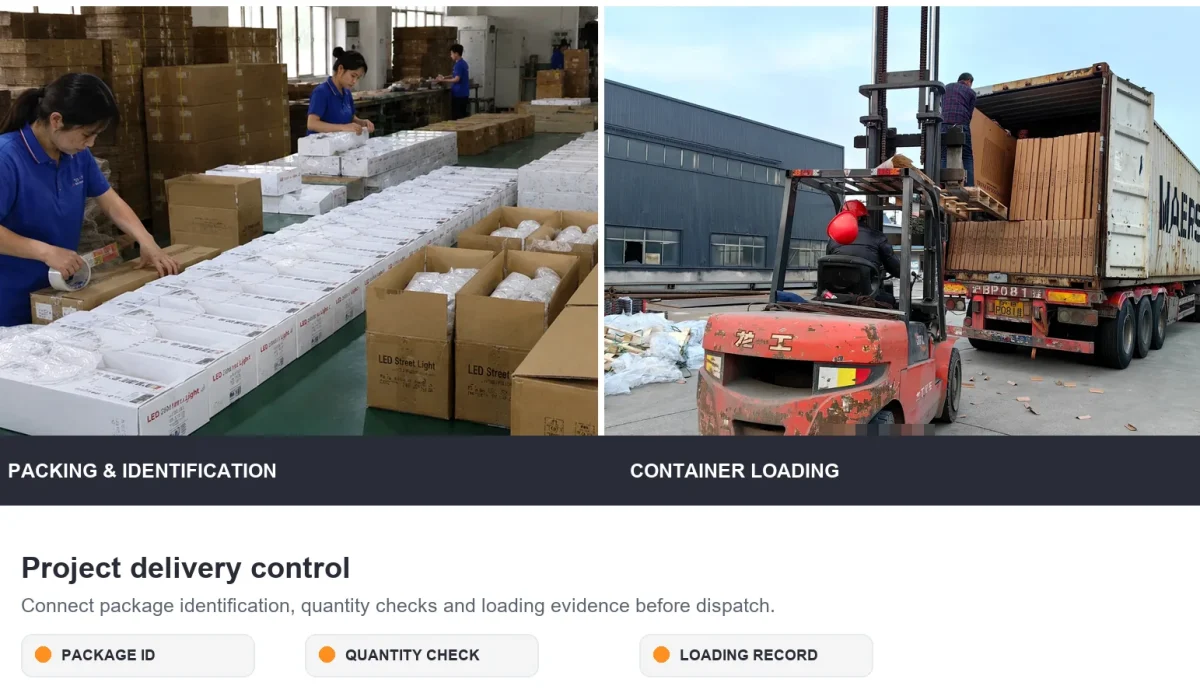
Shipping damage is not the only delivery risk in a street lighting project. A shipment may arrive with intact cartons but still delay installation because brackets are mixed, fasteners are missing, packages cannot be matched to the BOQ, or spare parts are not clearly separated from the ordered quantity.
Reliable delivery depends on traceability as much as physical protection. Every luminaire, pole, solar module, battery, bracket, fastener kit and spare part should be connected from the approved BOQ and final BOM to a Package ID, packing list, container record and receiving check.
For an EPC contractor or municipal project team, the goal is not simply to confirm that the supplier used strong cartons. The goal is to answer five questions:
1. Was the correct configuration packed?
2. Were all components counted?
3. Can each package be identified at the destination?
4. Was the cargo loaded and secured appropriately?
5. Is there enough evidence to resolve a shortage or damage claim?
## Why Do Street Lighting Projects Fail After Products Leave the Factory?
**Street lighting shipments usually fail for one of three reasons: physical damage, missing or mixed components, or insufficient records. Strong packaging helps with the first risk, but only a controlled packing and documentation process can address all three.**
A street lighting system is rarely shipped as one complete assembly. Depending on the project, one installed point may require:
* LED luminaire;
* light pole;
* mounting arm or bracket;
* solar module;
* battery or battery box;
* controller;
* cables and connectors;
* foundation bolts and template;
* fasteners;
* remote control or commissioning accessories;
* installation documents.
This creates a different risk profile from shipping a single finished consumer product.
A carton may arrive without visible damage while the system remains incomplete. For example, 500 luminaires and 500 poles may be present, but installation can still stop if the correct brackets, foundation templates or fastener kits cannot be found.
The delivery process therefore needs to control three separate risks:
| Risk | Typical consequence |
| ——————————- | ——————————————————————————————————————— |
| Physical damage | Broken solar-module glass, scratched galvanized surfaces, dented poles, cracked lenses or deformed brackets |
| Configuration or quantity error | Missing fasteners, mixed system types, incorrect bracket sizes, unmatched controllers or incomplete installation kits |
| Documentation failure | The buyer cannot determine what was shipped, where it was loaded or when the damage occurred |
Packaging should be treated as the final traceability stage of production—not as a separate warehouse activity after manufacturing is complete.
## What Should Be Frozen Before Packing Starts?
**Packing should not begin until the approved project configuration, quantities, drawings, spare-parts scope and document revision have been frozen. Otherwise, the warehouse may pack the correct quantity of the wrong configuration.**
The packing team should work from controlled project documents rather than an informal sales summary.
At minimum, the following inputs should be confirmed:
* final purchase order or contract quantity;
* approved BOQ;
* final product models;
* approved BOM or system composition;
* latest drawing revision;
* pole height and arm arrangement;
* solar-module and battery configuration;
* mounting-interface dimensions;
* cable and connector requirements;
* foundation bolt and template requirements;
* installation-zone grouping, where applicable;
* approved spare-parts list;
* shipping method and destination;
* customer-specific labeling requirements.
A quantity change also needs to flow through all relevant documents. If the order changes from 500 to 520 systems, updating the commercial invoice alone is not enough. The packing list, spare-parts schedule, label range, loading plan and inspection records may also need revision.
A practical document relationship is:
“`text
Approved BOQ
→ Final Product Configuration
→ Final BOM
→ Packing Breakdown
→ Package ID List
→ Container Loading Record
“`
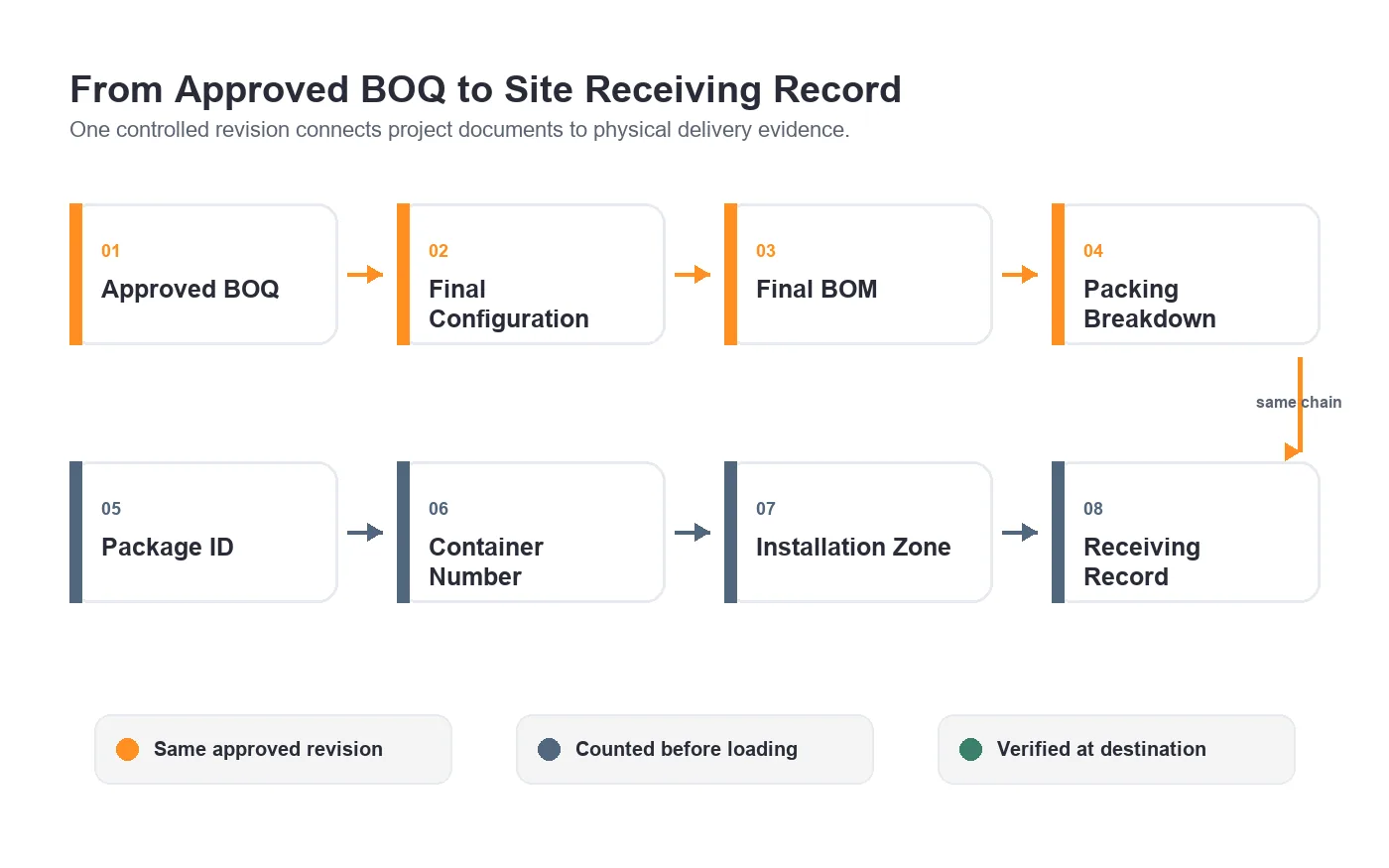
If these records use different revisions, a package count may appear correct while the actual shipment is incomplete.
Before packing begins, the supplier should therefore confirm not only “how many systems” are required, but also exactly what each system contains.
## What Should a Project Packing List Contain?
**A useful project packing list identifies the contents of each package, not only the total number of lighting systems. It should allow the buyer to connect a package to its product, quantity, container and, where required, installation group.**
A description such as the following is not sufficient for a complex project:
“`text
Solar street lights — 500 sets
“`
It does not show how many cartons, bundles, pallets or crates were loaded. It also does not explain how the luminaires, poles, brackets, batteries and installation hardware are distributed.
A project packing list should normally include the applicable fields below:
| Field | Why it matters |
| ———————– | ———————————————————- |
| Project or PO reference | Connects the shipment to the approved order |
| Product model | Distinguishes different configurations |
| Package ID | Gives each package or bundle a traceable identity |
| Package type | Identifies carton, pallet, bundle, crate or another unit |
| Contents | States what is physically inside |
| Quantity per package | Supports receiving and shortage checks |
| Total package quantity | Supports loading reconciliation |
| Net and gross weight | Supports handling and shipping documentation |
| Package dimensions | Supports loading and unloading preparation |
| BOQ or BOM reference | Connects the package to the approved scope |
| Container number | Shows where the package was loaded |
| Installation group | Supports phased site distribution when applicable |
| Handling requirement | Identifies orientation, lifting or stacking restrictions |
| Spare-parts status | Separates spares from the contracted installation quantity |
An illustrative package schedule could look like this:
| Package ID | Contents | Quantity per package | Total packages | Container | Installation group |
| ————- | ————————– | ——————-: | ————-: | ——— | —————— |
| LUM-A-001–050 | LED luminaires | 10 | 50 | CONT-01 | Zone A |
| BRK-A-001–025 | Mounting brackets | 20 | 25 | CONT-01 | Zone A |
| FIX-A-001–010 | Installation fastener kits | 50 kits | 10 | CONT-01 | Zone A |
| SPR-001 | Approved spare parts | As listed | 1 group | CONT-02 | Central store |
These quantities are only examples of document structure. The actual packing breakdown must be developed from the final project BOM, product dimensions, package strength and loading plan.
The packing list should also remain consistent with the commercial invoice, bill of lading and final loading record. If one document shows 80 packages while another shows 82, the difference should be resolved before shipment rather than left for the destination team to interpret.
## How Should Packages Be Labeled and Traced?
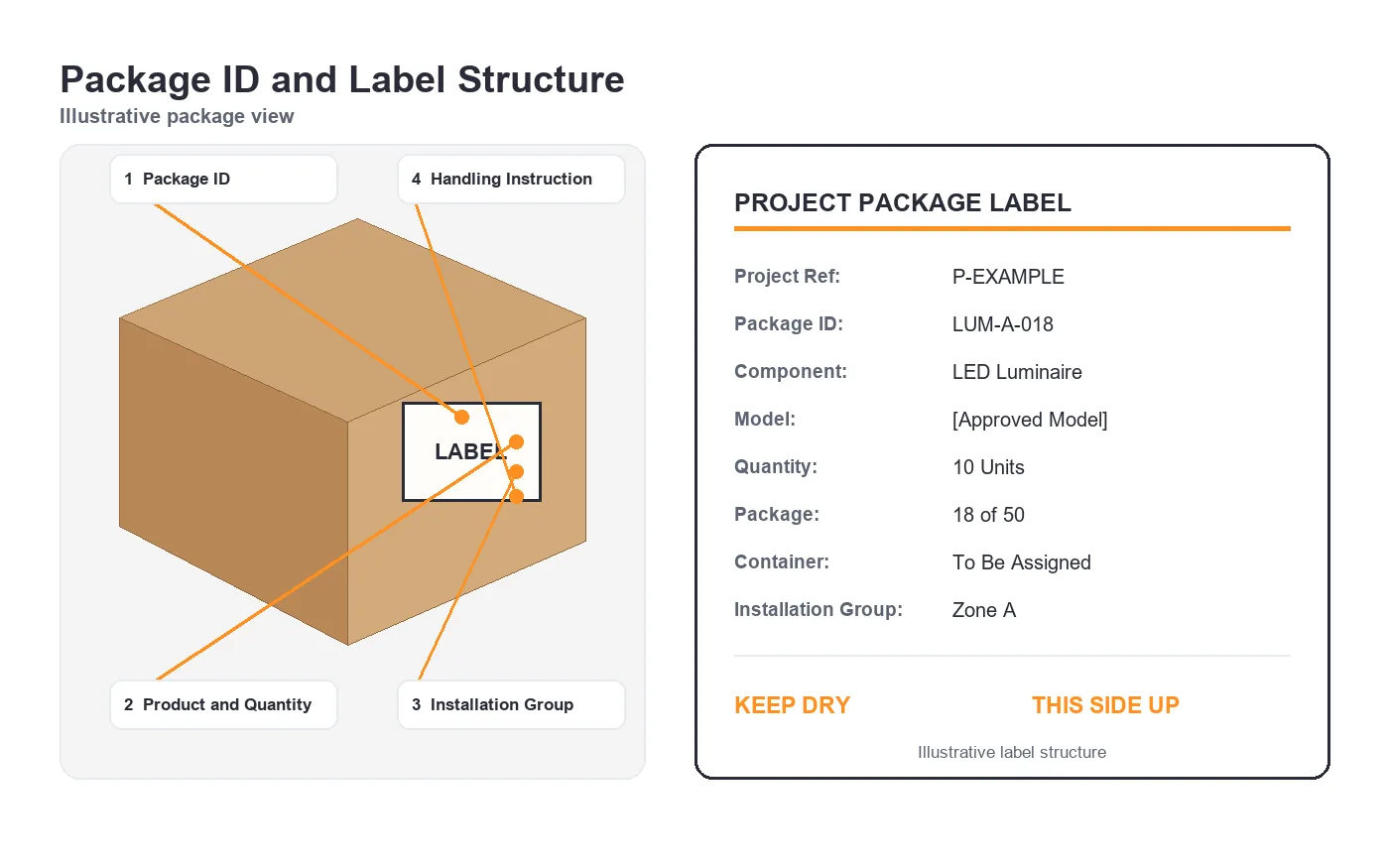
**The package label should connect the physical package to the packing list and project documents. Handling labels such as “Fragile” or “Keep Dry” are useful, but they cannot replace a unique package identity.**
A practical package traceability chain is:
“`text
BOQ Line
→ Product or System ID
→ Component BOM
→ Package ID
→ Container Number
→ Installation Zone
→ Receiving Record
“`
Labels can be divided into four information levels.
### Commercial identification
This may include:
* project or PO number;
* customer or destination;
* Package ID;
* package number, such as 15 of 80;
* net and gross weight;
* external dimensions.
### Product identification
This may include:
* component name;
* product model;
* quantity;
* system type;
* applicable pole or bracket configuration.
### Site identification
For projects divided into roads, zones, lots or installation phases, the label may also show:
* installation zone;
* road or lot reference;
* pole-number range, if already frozen;
* installation kit ID;
* package relationship, such as “Use with BRK-A-015.”
Site identification should only use approved project information. A preliminary pole number should not be printed as a final identifier if the site layout is still changing.
### Handling information
Depending on the package, appropriate symbols or instructions may include:
* Keep Dry;
* Fragile;
* This Side Up;
* Do Not Stack;
* Center of Gravity;
* Lifting Point;
* Sling Here;
* battery or dangerous-goods marks when applicable.
Labels should be visible, legible and resistant to normal transport conditions. Where a package could be approached from more than one direction, repeating the Package ID on more than one side can improve receiving efficiency.
However, a handling label is not a substitute for proper packaging. A “Fragile” sticker cannot prevent solar-module damage if a heavy pole bundle creates a concentrated load against the glass.
## Why Should Small Parts Be Packed as Installation Kits?
**Small parts are inexpensive but operationally critical. Grouping them into identifiable installation kits reduces counting errors and prevents a project from stopping because one type of bolt, washer, connector or bracket is missing.**
Common high-risk small parts include:
* bracket bolts;
* foundation-bolt nuts and washers;
* solar-module clamps;
* controller connectors;
* cable glands;
* fuses;
* terminal components;
* remote controls;
* special keys or tools;
* waterproof connectors;
* short cable assemblies.
Packing every fastener in one large box may simplify factory counting, but it can create problems at the job site. The contractor may need to distribute hardware across several roads or installation teams without knowing which components belong to each configuration.
Where practical, the packing method should follow the installation unit. A project-specific kit may contain:
“`text
Pole-related hardware
+ Luminaire bracket hardware
+ PV mounting hardware
+ Battery-box hardware
+ Approved cables and connectors
+ Required small consumables
“`
The contents must come from the final BOM and installation drawing. There is no universal installation kit suitable for every integrated, all-in-two or split solar street light.
Each kit should have:
* a kit ID;
* a contents list;
* a counted quantity;
* a link to the applicable model or installation group;
* sealed or moisture-protected internal packaging where required.
A sample of completed kits can also be opened and checked during pre-shipment inspection before final sealing.
If multiple system configurations are included in one order, using different label colors may help warehouse and installation teams distinguish them. Color, however, should be a secondary aid. The written model and Package ID must remain the primary identification method.
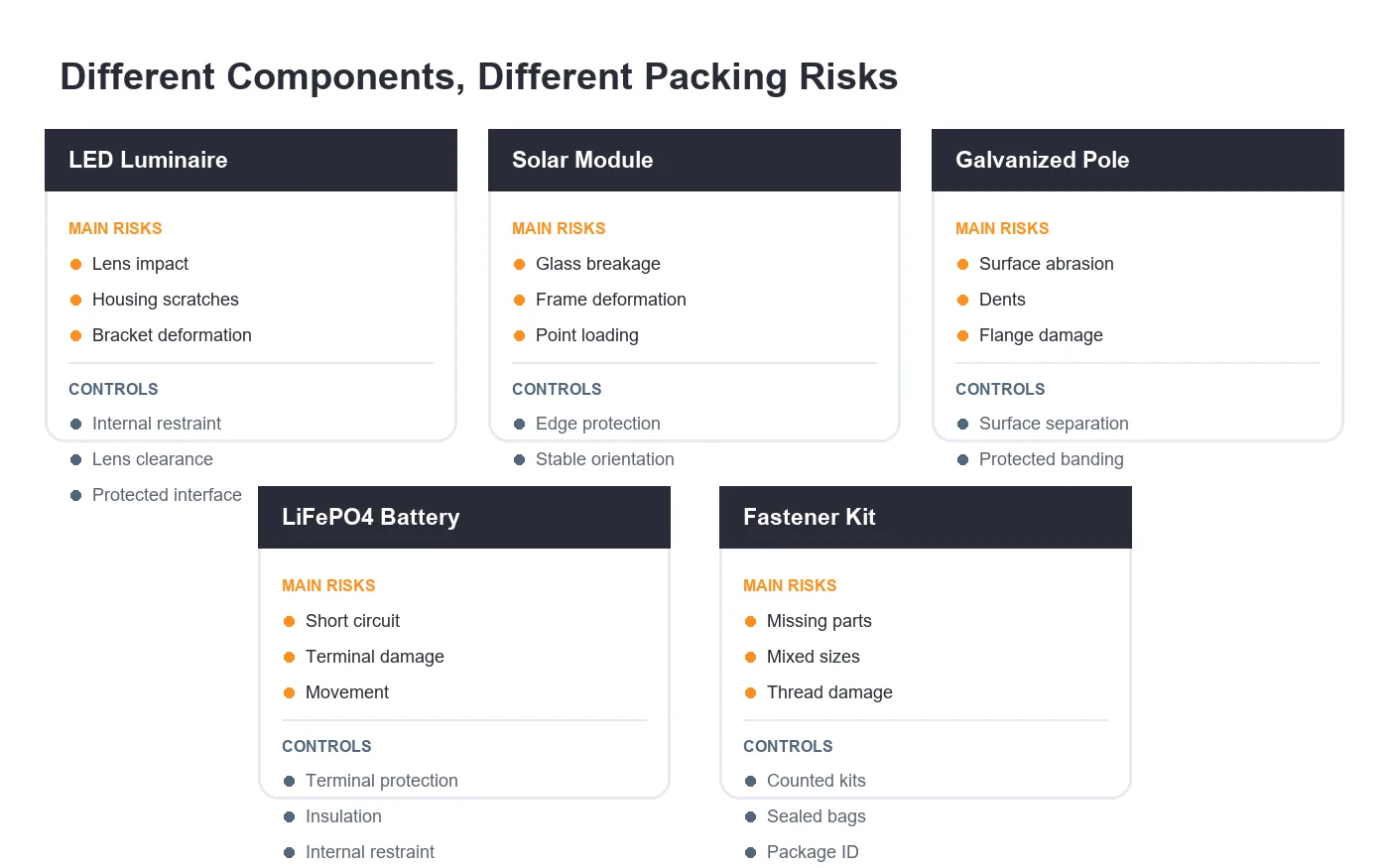
## How Should Different Street Lighting Components Be Packed?
**Different street lighting components fail in different ways during transport. Packaging should therefore be based on the component’s weight, geometry, surface sensitivity, fragility and handling method—not one standard material for the entire shipment.**
| Component | Main transport risks | Packing and inspection focus |
| —————————– | ————————————————————– | ————————————————————————————— |
| LED luminaire | Lens damage, housing scratches, interface deformation | Controlled internal clearance, shaped protection, lens protection and carton strength |
| Solar module | Broken glass, frame deformation, connector pressure | Edge and corner protection, controlled orientation and protection from point loads |
| Galvanized pole | Zinc-coating scratches, dents, flange deformation | Surface separation, protected contact points, suitable bundling and controlled lifting |
| Long or double arm | Bending, impact and configuration mixing | Individual identification, end protection and movement control |
| Foundation bolts and template | Missing parts, mixed sizes and thread damage | Complete sets, thread protection, specification labels and drawing reference |
| LiFePO₄ battery | Short circuit, terminal damage, movement and document mismatch | Terminal protection, insulation, internal restraint and applicable transport compliance |
| Controller and wiring | Lost parts, connector damage and wrong-model mixing | Model labels, sealed kits, moisture protection and quantity verification |
| Fasteners | Shortage, rust and size mixing | Sealed and labeled kits with counted quantities |
| Spare parts | Confusion with normal order quantity | Separate schedule, package identity and commercial line item |
### LED luminaires
A luminaire should not move freely inside its carton. Internal protection should support the product at suitable structural areas without concentrating pressure on the lens, sensor, connector or mounting interface.
The inspection should confirm that:
* the offered model matches the label;
* the lens or glass is protected;
* the housing finish is not in direct contact with hard fasteners;
* loose accessories cannot strike the luminaire;
* the bracket interface is not carrying unintended load;
* the product remains stable when the carton is handled normally.
If a tempered glass component is used, the packaging plan should consider point impact and edge protection rather than assuming that thicker foam alone will prevent breakage.
### Solar modules
Solar modules require protection against both direct impact and concentrated pressure. A large amount of soft wrapping does not automatically make the package safe if the module frame can move or if another cargo unit can press against the glass.
The packing plan should consider:
* panel orientation;
* frame and corner protection;
* connector protection;
* separation between panel surfaces;
* permitted stacking arrangement;
* pallet or crate support;
* interaction with neighboring cargo inside the container.
No universal stacking quantity should be declared without packaging design or test evidence.
### Galvanized light poles
The main concern is not only whether the pole bends. Scratches caused by metal-to-metal contact can damage the galvanized surface and create a dispute even when the pole remains structurally usable.
Pole packing should consider:
* separation between pole surfaces;
* protected banding contact points;
* flange and door protection;
* lifting and sling positions;
* prevention of longitudinal movement;
* protection from sharp edges or fasteners;
* bundle identification.
The wrapping material should not trap water against the surface during a long shipment. The selected method must be reviewed against the actual route, storage period and unloading method.
### Foundation bolts and templates
Foundation hardware should be traceable to the approved foundation drawing. It should not be treated as generic metal accessories.
The receiver should be able to confirm:
* bolt diameter and length;
* template configuration;
* quantity per foundation;
* nut and washer quantity;
* thread condition;
* drawing or system reference;
* total number of complete sets.
A project can have every pole and luminaire on site and still be unable to start installation if the foundation hardware is incomplete or does not match the approved design.
## How Should a Container Loading Plan Be Reviewed?
**A good container-loading plan balances cargo protection, weight distribution, securing, space efficiency and unloading sequence. Maximizing container utilization should not be the only objective.**
The [IMO/ILO/UNECE CTU Code](https://www.imo.org/en/ourwork/safety/pages/ctu-code.aspx) provides broader guidance for packing and securing cargo transport units throughout intermodal transport. The exact securing method for a street lighting shipment still needs to reflect the actual cargo weight, geometry, packaging and route.
### Inspect the empty container
Before loading, the team should check and record whether:
* the container number is correct;
* the interior is clean and dry;
* the floor is suitable for the cargo;
* walls and doors show no relevant damage;
* there are no holes, water marks or contamination;
* there are no protruding nails or sharp objects;
* lashing points are available and suitable;
* the door closes and seals correctly.
Loading into a wet or damaged container can make even well-packed products vulnerable during a long sea journey.
### Review weight distribution
Heavy cargo should not be concentrated at one end of the container. The loading plan should consider:
* gross cargo weight;
* package weight distribution;
* axle and container restrictions;
* location of heavy pole bundles;
* position of delicate solar modules;
* loading and unloading stability.
[Maersk’s container-stuffing guidance](https://www.maersk.com/logistics-explained/transportation-and-freight/2024/07/12/container-stuffing) also emphasizes proper weight distribution and cargo securing to reduce movement and damage during transport.
### Control the loading sequence
The loading sequence should reflect both cargo safety and the destination plan.
Questions to check include:
* Which products will be unloaded first?
* Are the first installation-zone packages accessible?
* Are heavy products placed where they cannot damage lighter cargo?
* Are solar modules protected from pole bundles and concentrated loads?
* Can forklifts or lifting equipment access the packages safely?
* Are related components kept identifiable even when loaded separately?
* Will removing one package destabilize the remaining cargo?
For a phased project, the most space-efficient arrangement may not be the most practical arrangement. Saving a small amount of container space can be a poor trade-off if the receiver must unload and reorganize the entire shipment before installation can begin.
### Prevent movement
Cargo should be protected against:
* forward and backward sliding;
* lateral movement;
* tipping;
* package-to-package collision;
* pressure against the container doors.
The required blocking, bracing, lashing or void-filling method should be determined for the actual shipment. An article or supplier brochure cannot establish a universal number of straps, timber sections or dunnage bags for every load.
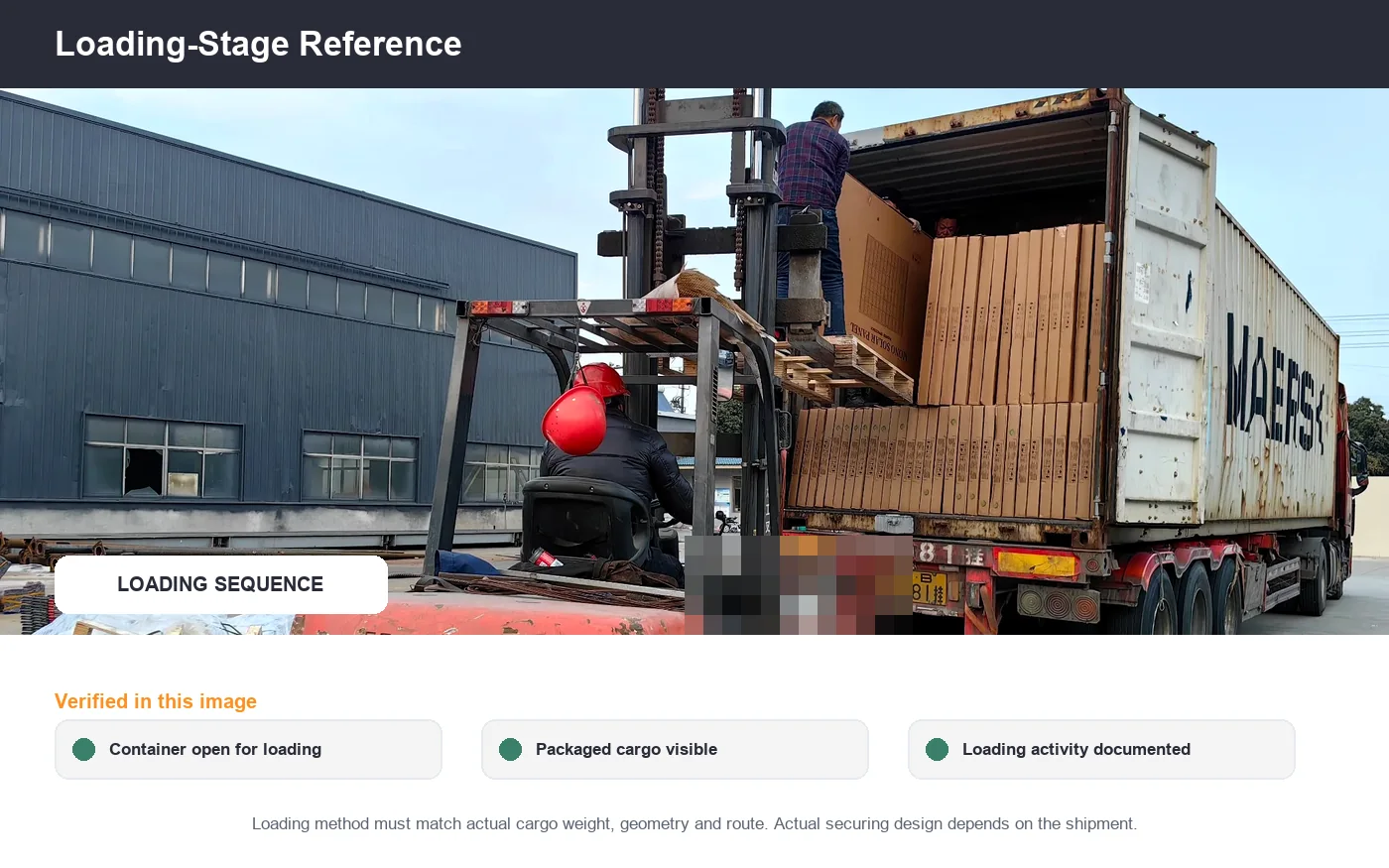
## What Loading Evidence Should the Supplier Provide?
**Loading photos become useful evidence only when they show identifiable packages, loading stages, securing conditions, container details and the final seal. A few wide-angle warehouse photos are not enough to verify quantities or responsibility.**
A controlled loading record should normally include:
1. Empty-container condition.
2. Visible container number.
3. Package labels before loading.
4. Staged package quantities.
5. Loading progress.
6. Cargo separation and protection.
7. Blocking, bracing or securing condition.
8. Final condition before closing the doors.
9. Container number.
10. Seal number.
11. Loading date.
12. Final package count.
13. Responsible checker or inspection record.
A third-party loading-supervision process may also record the loading plan, truck number, container number, packing list and seal. This type of process is described in [Sinovoltaics’ packing and loading supervision guidance](https://sinovoltaics.com/packing-loading-supervision/).
The evidence should make it possible to answer:
* Was Package LUM-A-018 loaded?
* Which container contained the spare controllers?
* Was the solar-module crate intact before the doors were closed?
* Did the final container count match the packing list?
* What was the visible securing condition at dispatch?
Photos should preserve the technical information needed for verification without exposing confidential pricing, unrelated customer information or sensitive documents.
A loading video may supplement the record, but it should not replace identifiable still photographs and a signed or controlled package count.
## What Changes When Lithium Batteries Are Included?
**When lithium batteries are included, packing and shipping must be reviewed against the battery configuration and transport mode. Terminal protection, short-circuit prevention, package restraint, marks and documents cannot be handled as ordinary accessory packing.**
LiFePO₄ chemistry does not remove the need for transport compliance.
The project team should confirm:
* exact battery model and configuration;
* whether batteries are shipped separately, packed with equipment or contained in equipment;
* battery condition and applicable state-of-charge requirements;
* protection against short circuit;
* terminal insulation;
* prevention of movement inside the package;
* applicable marks and labels;
* carrier requirements;
* required transport documents;
* consistency between the shipped battery and its supporting documents.
The applicable requirements may differ between sea, air and road transport and can change over time. The booking party should therefore confirm the current rules with a qualified freight forwarder or dangerous-goods specialist before dispatch.
The project documentation may need to include an applicable UN38.3 test summary and safety data information, but these documents serve different purposes. Neither should be described as a general product-quality certificate.
[IATA’s battery-shipping guidance](https://www.iata.org/en/publications/manuals/battery-shipping-regulations/) warns that mistakes in lithium-battery packaging, marking or labeling can cause delays and may create short-circuit or fire risks. Its battery transport requirements are updated periodically, so shipment-specific confirmation is necessary.
## Does Wood Packaging Need ISPM 15 Treatment and Marking?
**When regulated raw-wood pallets, crates or dunnage are used in international shipping, the destination requirements and applicable ISPM 15 treatment and marking should be confirmed before dispatch. Not every processed wood product is treated in exactly the same way.**
The [International Plant Protection Convention’s ISPM 15 guidance](https://www.ippc.int/publications/regulation-wood-packaging-material-in-international-trade-0) explains that the standard covers wood packaging material made from raw wood, including applicable dunnage, while excluding certain processed materials that present a sufficiently low pest risk, such as some plywood products.
The shipping review should therefore identify:
* what wood material is actually used;
* whether it falls within the regulated scope;
* the importing country’s applicable requirements;
* whether the required treatment and mark are valid;
* whether dunnage added during loading is also compliant where required.
ISPM 15 compliance does not prove that a crate is structurally strong enough for the cargo. Phytosanitary treatment and packaging structural performance are separate issues.
The supplier should also avoid using an ISPM 15 statement as a general marketing claim without checking the actual wood packaging supplied for that shipment.
## How Should Spare Parts Be Planned?
**Spare parts should be selected according to installation risk, failure-recovery needs, replacement lead time and maintenance capability. A fixed spare percentage should not be applied blindly to every project or component.**
A useful spare-parts plan can be divided into three groups.
### Installation consumables and easily lost items
These may include applicable quantities of:
* bolts, nuts and washers;
* cable connectors;
* fuses;
* terminals;
* cable glands;
* small wiring assemblies;
* installation-specific consumables.
These items are inexpensive compared with the cost of stopping an installation team.
### Rapid-recovery spares
These are components that the local maintenance team can replace to restore operation quickly, such as:
* controllers;
* remote controls;
* approved wiring assemblies;
* replaceable driver or control modules;
* applicable sensors or communication modules.
The list must match the final product architecture. A sealed integrated product may have different field-replacement options from a split system.
### Long-lead strategic spares
Depending on the project, these may include:
* complete luminaires;
* matching solar modules;
* battery assemblies;
* custom brackets;
* project-specific optical or control components.
The appropriate quantity depends on:
* project size;
* site remoteness;
* supplier lead time;
* warranty process;
* local maintenance skill;
* component replacement method;
* storage conditions;
* expected service strategy.
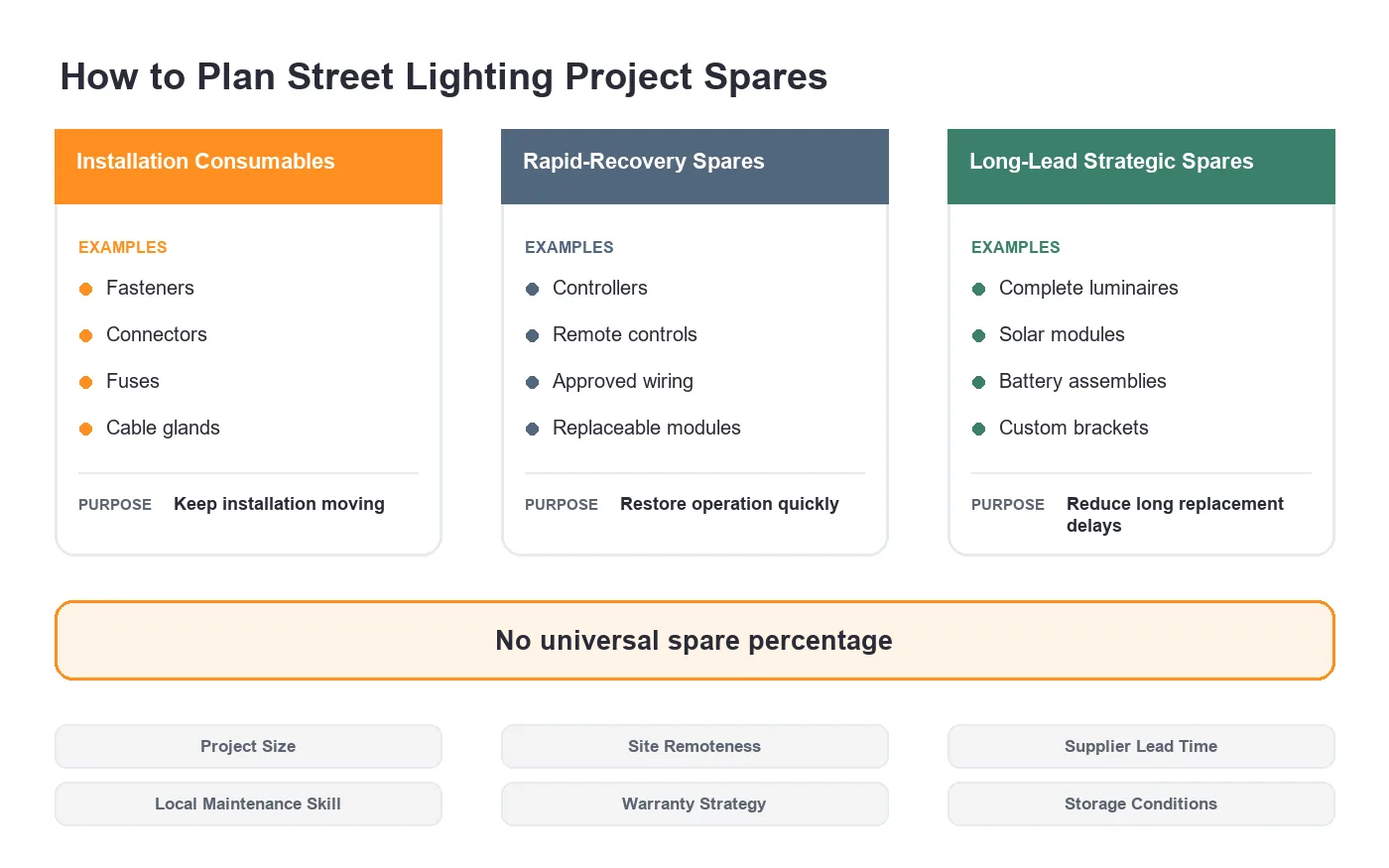
Spare parts should be shown as separate commercial and physical line items. They should not be hidden inside the normal delivery quantity.
For example, the records should distinguish between:
“`text
Contract quantity: 500 systems
Approved spare luminaires: 5 units
Installation fastener allowance: separately listed
“`
This prevents the receiver from treating approved spares as over-delivery—or using them to compensate for an unexplained shortage.
The spare-parts package should also have its own Package ID and contents list. Where different spare parts require different storage conditions, the receiving documents should state those requirements.
## What Should the Buyer Check When the Container Arrives?
**The buyer should document the container, seal, first-door-opening condition and package count before normal unloading begins. Once the cargo and packaging have been dispersed across the site, it becomes much harder to establish what happened during transport.**
### Before opening the container
The receiving team should:
* confirm the container number;
* compare the seal number with the shipping record;
* photograph the closed doors and seal;
* record visible container damage;
* check for signs of water entry or tampering;
* prepare suitable lifting and unloading equipment;
* have the packing list and package schedule available.
### When opening the doors
Open the container with caution. Cargo may have shifted and could be pressing against the doors.
Record:
* the condition immediately after the first door is opened;
* whether packages have moved, fallen or collapsed;
* visible water, condensation or contamination;
* damaged restraints or blocking;
* damaged external packaging;
* Package IDs visible at the door.
### During unloading
The team should check each package against the packing list and classify exceptions accurately.
Do not record every problem as “missing items.” Separate the findings into:
* missing package;
* short quantity inside a received package;
* incorrect model;
* mixed component;
* visible transport damage;
* concealed damage found after opening;
* documentation mismatch;
* site-handling damage.
This classification helps determine the corrective action and prevents production errors, transport damage and unloading damage from being combined into one unclear complaint.
If one package is damaged, the receiver should also inspect nearby packages that may have been subjected to the same movement or pressure.
## How Should Missing Parts or Damage Be Documented?
**A useful claim record connects the affected product to its Package ID, external packaging, internal protection, container and shipping documents. Photographing only the damaged product is usually insufficient to establish when or how the damage occurred.**
For a shortage, record:
* project or PO reference;
* packing-list line;
* Package ID;
* expected quantity;
* received quantity;
* container number;
* seal number;
* unloading date;
* package-opening photos;
* counting record;
* description of the missing component.
For damage, preserve and record:
* full view of the affected package;
* package label;
* external packaging damage;
* internal packaging arrangement;
* close-up of the product damage;
* wider view showing the product and package together;
* container condition;
* affected quantity;
* serial or batch identity where available;
* packing list and commercial documents;
* inspection or carrier report where required.
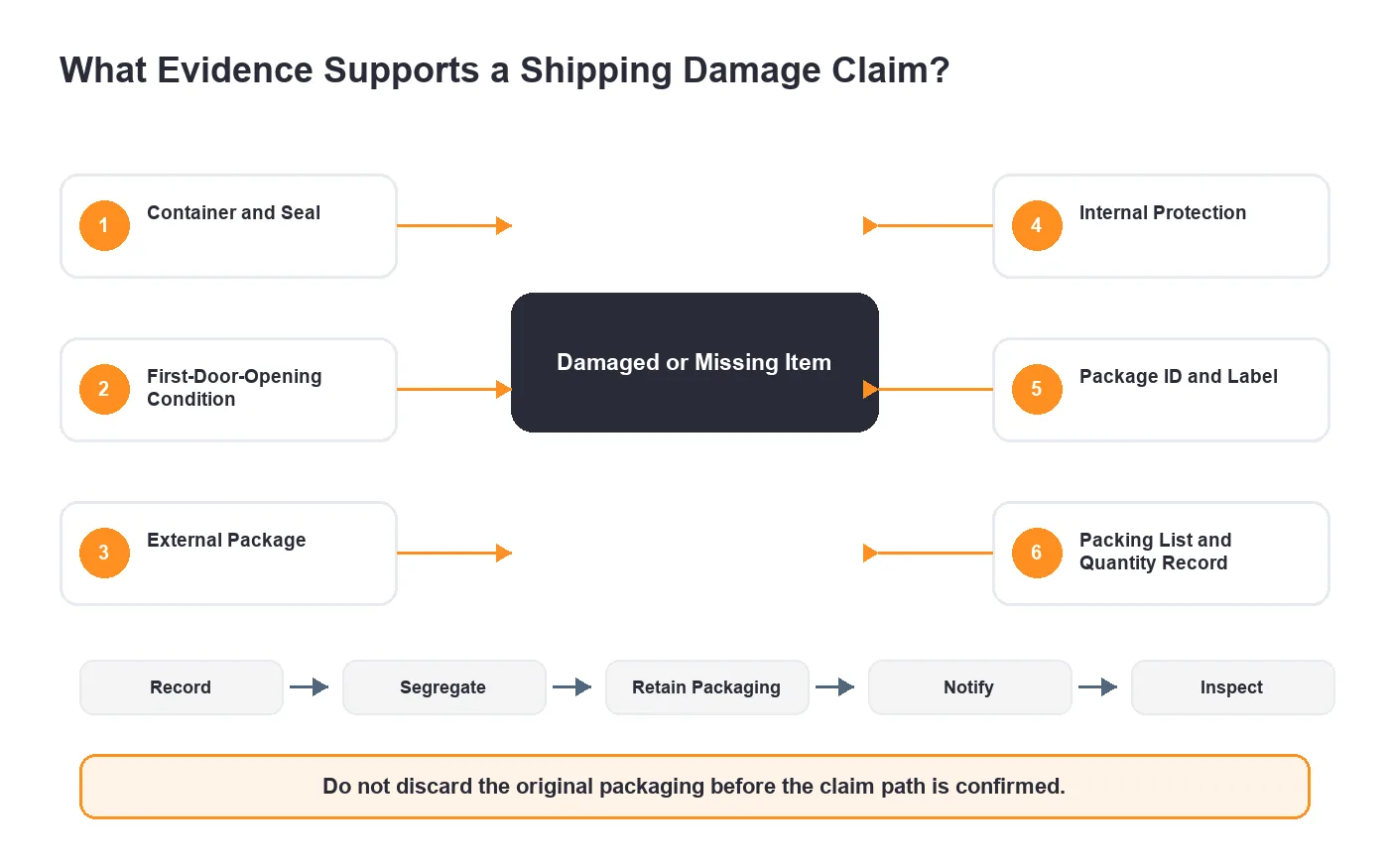
[UPS claim guidance](https://www.ups.com/us/en/support/file-a-claim/supporting-documents), for example, requests photographs showing the damaged item and its internal packaging, the shipping label and the outside of the package. Relevant freight terms may also require commercial documents and preservation of the goods and packaging for inspection.
Do not immediately discard the carton, crate, foam, restraints or damaged product. The carrier, insurer, supplier or inspection company may need to examine the original condition.
The contractual notice period and claims procedure should be checked immediately. Responsibility should not be assumed based only on who arranged the freight; the applicable sales contract, Incoterm, carrier terms and insurance coverage must also be reviewed.
## Hidden Risks That Strong Cartons Cannot Solve
**Strong packaging materials cannot compensate for an uncontrolled project-delivery process. Many serious site delays begin with document or identification errors rather than crushed cartons.**
Watch for these warning signs:
* the packing list shows only total system quantity;
* packages do not have unique IDs;
* the packing breakdown cannot be connected to the final BOM;
* different product configurations use nearly identical labels;
* small accessories are packed as unstructured bulk items;
* spare parts are mixed with the normal order quantity;
* loading photos do not show package labels;
* the container and seal numbers are not recorded;
* packing was completed from an outdated drawing revision;
* solar modules are exposed to pressure from heavy pole bundles;
* loading efficiency is prioritized over weight distribution;
* the unloading sequence is not considered;
* damaged packaging is discarded before inspection;
* production defects, transit damage and site-handling damage are reported as one issue;
* battery documents do not match the final battery model;
* wood-treatment claims are made without identifying the actual packaging material.
These are supplier-audit issues, not cosmetic packaging details.
## Project Shipping and Packing Checklist
Use this checklist before approving shipment.
### Before packing
* [ ] Final BOQ and quantities are approved.
* [ ] Final BOM matches the offered configuration.
* [ ] Latest drawings and revisions are identified.
* [ ] Pole, arm, bracket and foundation configurations are confirmed.
* [ ] Battery and controller models are frozen.
* [ ] Spare-parts scope is separately approved.
* [ ] Installation-zone grouping is confirmed where required.
* [ ] Packing method is reviewed for each component type.
* [ ] Applicable battery transport requirements are confirmed.
* [ ] Applicable wood-packaging requirements are confirmed.
### During packing
* [ ] Each package has a unique ID.
* [ ] Package contents are connected to the BOQ or BOM.
* [ ] Product model and quantity are visible.
* [ ] Small parts are counted and kit-packed.
* [ ] Spare parts are clearly separated.
* [ ] Fragile components have suitable internal protection.
* [ ] Pole surfaces and threads are protected.
* [ ] Package weights and dimensions are recorded.
* [ ] Sample packages are opened and verified where required.
* [ ] Packing photos show identifiable packages.
### During container loading
* [ ] Empty-container condition is documented.
* [ ] The container is clean and dry.
* [ ] Container number is recorded.
* [ ] Loading quantity is reconciled with the packing list.
* [ ] Weight is appropriately distributed.
* [ ] Heavy and fragile cargo are suitably separated.
* [ ] Cargo movement is controlled.
* [ ] Unloading sequence has been considered.
* [ ] Final securing condition is photographed.
* [ ] Seal number is recorded.
* [ ] The final packing list identifies the applicable container.
### At destination
* [ ] Container and seal numbers are verified.
* [ ] Closed-door and first-opening photos are taken.
* [ ] Shifted cargo or damaged packaging is recorded before unloading.
* [ ] Packages are checked by Package ID.
* [ ] Shortage, wrong supply and damage are recorded separately.
* [ ] Original packaging is retained when a claim may be required.
* [ ] Spare parts are transferred to controlled storage.
* [ ] Receiving records are linked to the packing list.
## What Should Be Included in a Project Delivery Pack?
**The final delivery pack should allow the buyer to verify what was approved, what was packed, where it was loaded and what arrived. It should be usable by procurement, logistics, installation and maintenance teams—not only by the freight forwarder.**
Depending on the project scope, the pack may include:
* approved packing list;
* Package ID schedule;
* container allocation list;
* final BOQ and relevant BOM reference;
* product datasheets;
* approved drawings;
* packing inspection records;
* package and loading photos;
* container and seal records;
* applicable battery transport documents;
* spare-parts schedule;
* installation manuals;
* receiving checklist;
* shortage and damage reporting template;
* warranty contact and claim route.
The required contents should be agreed before shipment. Waiting until the container reaches the destination to request a detailed package schedule is too late.
Sunlurio supports project-based lighting deliveries with engineering documents, packing coordination and project verification records. You can review our [manufacturing and quality capabilities](/manufacturing-and-quality/), see [completed lighting projects](/projects/) or check the related [solar street lighting acceptance and handover checklist](/solar-street-lighting-acceptance-handover-checklist/).
## Request a Project Packing and Delivery Pack
If you are preparing a street lighting tender, BOQ or bulk shipment, send us:
* project country;
* destination port;
* required Incoterm;
* product or system type;
* required quantity;
* pole and bracket scope;
* battery configuration;
* BOQ or technical specification;
* installation grouping;
* target delivery date.
Our engineering and project team can review the packing-list structure, package identification, loading records, battery documentation and spare-parts breakdown before shipment.
[Request an Engineering Pack within 24 hours](/engineering-support/#request-now)
## Frequently Asked Questions
### What should be included in a street lighting project packing list?
A project packing list should identify the project, product model, Package ID, package type, contents, quantity, weight, dimensions, BOQ or BOM reference and applicable container number. For phased installations, it may also identify the road, zone, lot or installation group.
### How can an EPC contractor verify that no installation parts are missing?
The contractor should compare the approved BOQ and final BOM with the package schedule, installation-kit list and container-loading record. Small fasteners and connectors should be packed in counted, labeled kits rather than as unidentified bulk accessories.
### Should spare parts be packed separately from the ordered quantity?
Yes. Spare parts should be separately listed, identified and packed so the receiving team can distinguish them from the contracted installation quantity. Their storage and warranty status should also be controlled after arrival.
### What photos should be taken during container loading?
Useful records include the empty container, package labels, staged quantities, loading progress, cargo separation, final securing condition, closed container, container number and seal number. The photos should allow specific packages to be linked to the packing list.
### What should the buyer do before unloading a damaged shipment?
The buyer should record the container and seal, photograph the first-door-opening condition, document shifted cargo or damaged packaging and notify the relevant parties according to the contract and carrier requirements. Original packaging and damaged goods should be retained when an inspection or claim may be required.
### Does every wooden export crate require an ISPM 15 mark?
Not necessarily. ISPM 15 primarily applies to regulated wood packaging material made from raw wood. Some processed wood materials may fall outside the same scope. The actual material and importing-country requirements should be confirmed before shipment.
### Is UN38.3 enough to ship a solar street light battery?
No. A UN38.3 test summary is one part of battery transport documentation. The shipper must also confirm the battery configuration, packaging, short-circuit protection, marks, labels, carrier requirements and rules applicable to the chosen transport mode.
### What is the best spare-parts percentage for a street lighting project?
There is no universal percentage. Spare quantities should be based on project size, installation losses, component failure and replacement risk, supplier lead time, site remoteness, local maintenance ability and the agreed warranty strategy.