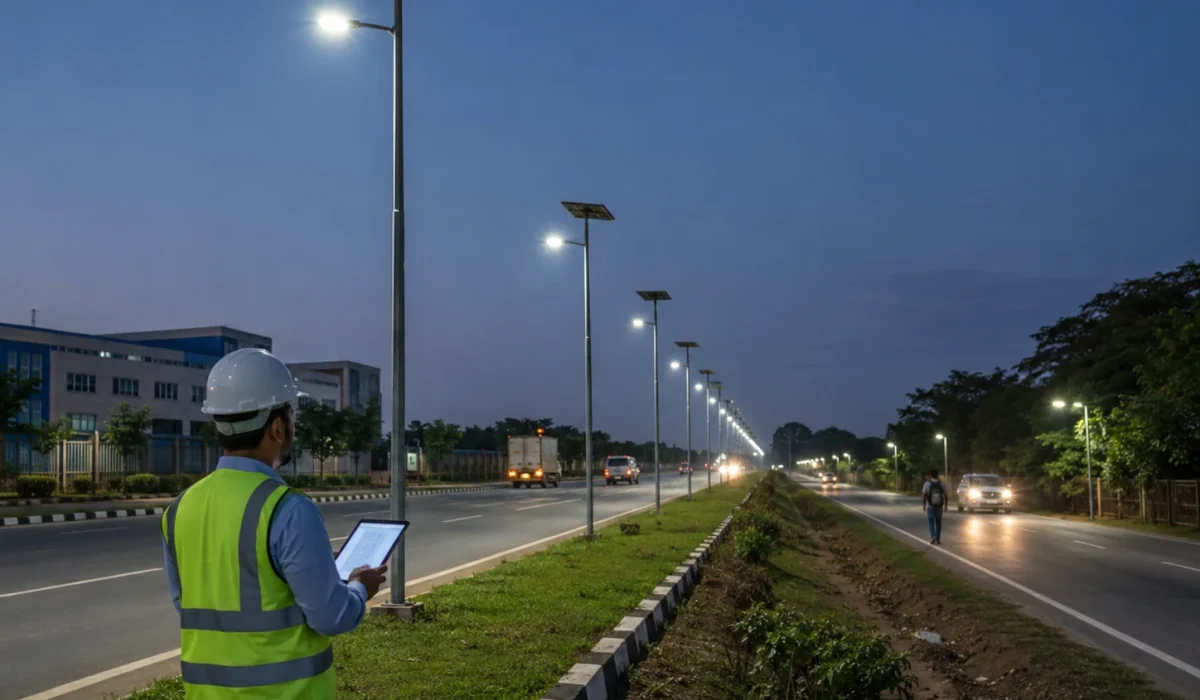
Quick Answer
The best mode depends mainly on traffic pattern and road safety requirement. Timer mode is usually better for high-traffic roads, main municipal roads, public service roads, and security-sensitive areas that need predictable overnight visibility. Motion sensor mode is usually better for low-traffic roads, rural access roads, campus roads, parking areas, park pathways, and secondary zones where the light can stay at lower standby brightness and boost when movement is detected.
For many EPC and municipal projects, the most practical solution is not pure timer mode or pure motion sensor mode. A hybrid timer plus motion profile often works better: the light runs at higher brightness during active evening hours, then switches to lower standby brightness with motion-triggered boost during low-traffic periods.
The final choice should be reviewed together with road type, traffic frequency, pole height, sensor behavior, battery autonomy, rainy-season margin, dimming profile, and commissioning records.
Project Review Summary
| Item | Project Review Point |
|---|---|
| Main topic | Motion sensor vs timer mode for solar street lights |
| Best-fit buyers | EPC contractors, municipal project teams, project distributors, installers, and tender buyers |
| Best-fit projects | Municipal roads, rural roads, campus roads, parking lots, industrial roads, security roads, parks, and pathways |
| Core search intent | Whether solar street lights should use motion sensor mode, timer mode, or a hybrid dimming profile |
| Main decision factor | Traffic pattern and road safety requirement |
| Main technical factors | Standby brightness, boost brightness, delay time, detection range, controller profile, battery autonomy, and rainy-season margin |
| Main risk | Choosing a mode that saves energy but creates poor lighting, or choosing a fixed schedule that drains batteries too quickly |
| Related dimming guide | Solar street light dimming profile and battery autonomy |
| Related setup guide | Basic remote control setup steps |
| Related troubleshooting guide | Multiple solar street lights failing in one area |
What Is Timer Mode in a Solar Street Light?
Timer mode uses a fixed operating schedule. The controller changes brightness according to time after dusk or before dawn.
A typical timer profile may look like this:
| Night Period | Example Brightness Logic | Project Purpose |
|---|---|---|
| First evening period | Higher brightness | Supports evening traffic, pedestrians, shops, and public activity |
| Middle of the night | Lower brightness | Saves battery when activity is lower |
| Pre-dawn period | Medium or higher brightness | Supports early morning traffic or site operation |
| Full night fixed mode | Same output for all night | Used only when stable lighting is required and battery sizing supports it |
Timer mode is predictable. It does not depend on sensor detection. This makes it easier to review during design, commissioning, and handover.
Timer mode is often suitable for:
- Municipal roads.
- Main access roads.
- Active urban roads.
- Public service roads.
- Roads with steady night traffic.
- Security-sensitive areas.
- Roads requiring more consistent lighting.
- Projects where sensor triggering may be unreliable.
- Tender projects requiring clear operating schedules.
However, timer mode may consume more battery energy if the brightness schedule is too aggressive. For battery autonomy review, see Sunlurio’s guide to solar street light dimming profile and battery autonomy.
What Is Motion Sensor Mode in a Solar Street Light?
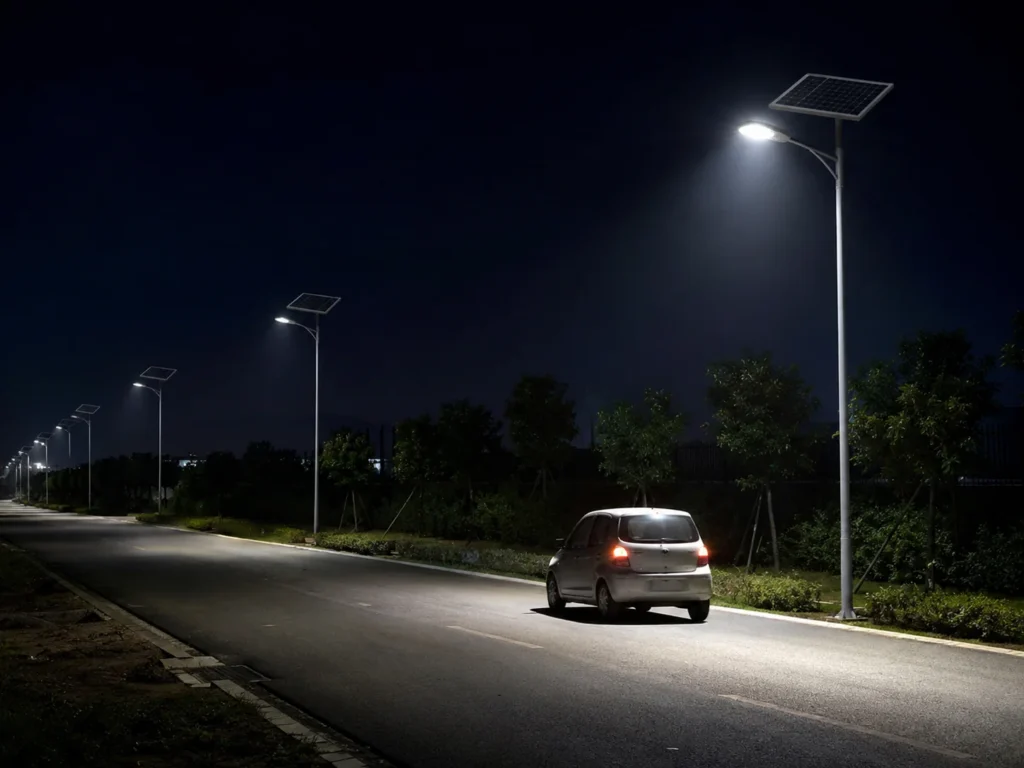
Motion sensor mode changes brightness when movement is detected. The lamp may stay at low standby brightness during quiet periods and increase to higher brightness when pedestrians, vehicles, or other movement enters the detection range.
A basic motion profile may include:
| Mode | Typical Logic | Project Purpose |
|---|---|---|
| Standby brightness | Low output when no movement is detected | Saves battery during low-traffic periods |
| Motion boost | Higher output after detection | Improves visibility when people or vehicles are present |
| Delay time | Brightness remains high for a set period after detection | Prevents immediate dimming after movement |
| Return to standby | Lamp returns to lower brightness | Reduces energy consumption |
Motion sensor mode can reduce energy consumption, but the saving depends on real traffic frequency. If a road has constant movement, the lamp may remain in boost mode for much of the night and consume more energy than expected.
Motion sensor mode is often suitable for:
- Rural roads with low traffic.
- Secondary access roads.
- Campus roads.
- Internal factory roads.
- Parking areas.
- Parks and walkways.
- Residential project roads.
- Environmental-sensitive areas.
- Security zones with intermittent activity.
- Projects requiring longer battery autonomy.
For basic remote buttons such as Radar, Timer, AUTO, and DIM, see Sunlurio’s guide to basic remote control setup steps.
Motion Sensor vs Timer Mode: Main Difference
The main difference is predictability versus adaptive energy saving.
| Item | Timer Mode | Motion Sensor Mode |
|---|---|---|
| Control logic | Fixed brightness schedule by time | Brightness changes when motion is detected |
| Energy saving | Predictable but limited by schedule | Can save more energy if traffic is low |
| Road safety | More consistent lighting | Depends on detection and standby brightness |
| Design review | Easier to calculate | Requires traffic and sensor behavior review |
| Maintenance risk | Lower sensor dependency | Sensor angle, range, delay, and false triggers matter |
| Best-fit sites | Main roads, steady traffic, municipal roads | Low-traffic roads, parking, campus, pathways |
| Autonomy impact | Depends on fixed brightness hours | Depends on trigger frequency and boost duration |
| Handover record | Brightness schedule must be recorded | Sensor type, range, delay time, standby, and boost must be recorded |
Timer mode is not automatically outdated. Motion sensor mode is not automatically better. The correct mode depends on the project environment.
Quick Selection Rule by Road Traffic Pattern
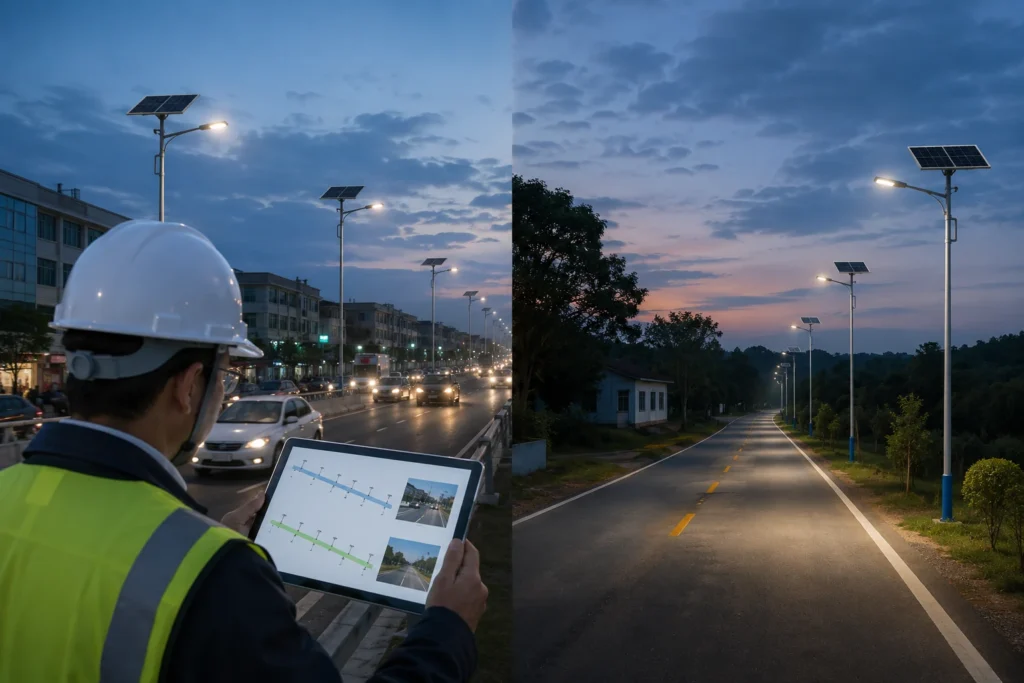
For road projects, traffic pattern is usually the first decision filter.
| Road or Site Condition | Better Control Logic | Reason |
|---|---|---|
| High-traffic municipal road | Timer or hybrid mode | Frequent movement limits motion sensor savings |
| Highway or main road | Timer mode | Predictable continuous visibility is usually required |
| Active urban road | Timer or hybrid mode | Public visibility and driver confidence matter |
| Rural access road | Motion or hybrid mode | Long low-traffic periods allow energy saving |
| Campus road | Motion or hybrid mode | Activity is intermittent and zone-based |
| Parking area | Motion or hybrid mode | Boost lighting is useful when vehicles or pedestrians enter |
| Industrial access road | Hybrid mode | Traffic may vary by shift, gate activity, or operation schedule |
| Security-sensitive area | Timer or hybrid mode | Background visibility should not be too low |
| Park pathway or secondary road | Motion mode with safe standby brightness | Low traffic allows lower overnight consumption |
| Rainy-season project | Conservative timer or hybrid mode | Battery autonomy margin must be protected |
This table should not replace engineering review. Road width, pole height, spacing, target brightness, traffic speed, pedestrian activity, local sunlight, and rainy-season conditions still matter.
Hybrid Timer + Motion Mode: Often the Best Practical Choice
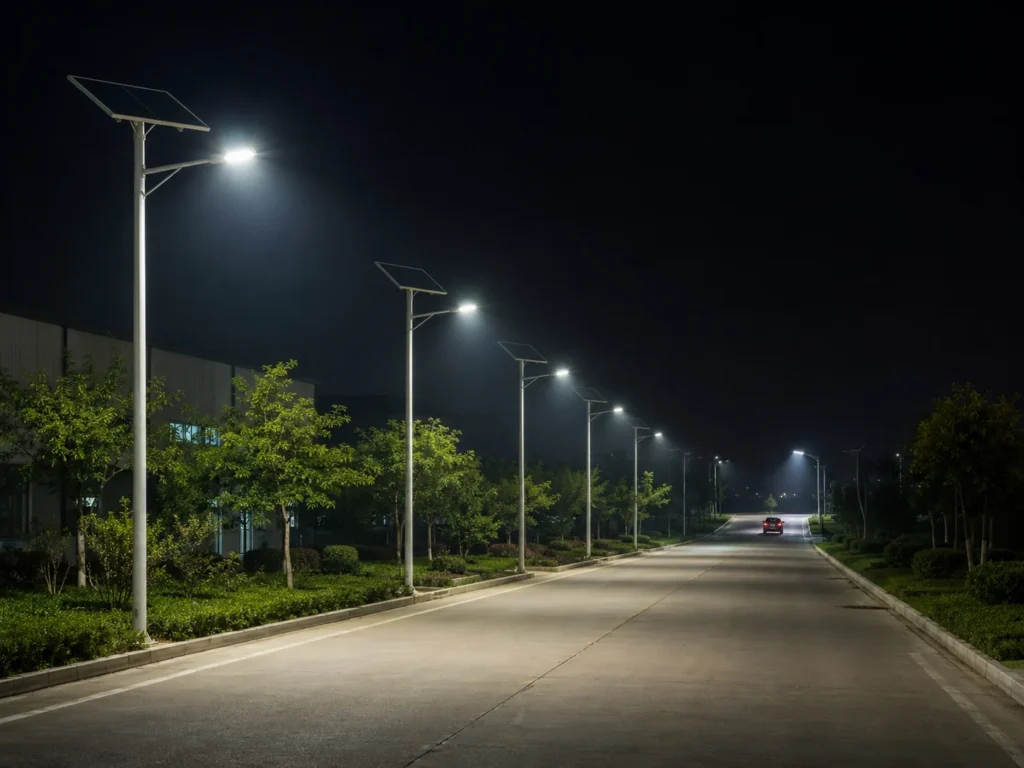
For many long-term road projects, the best choice is not pure timer mode or pure motion sensor mode. A hybrid profile uses timer dimming during predictable high-traffic periods and motion boost during low-traffic periods.
This can provide stable visibility when the road is active while reducing battery consumption during the quietest part of the night.
A typical hybrid logic may use high brightness during the first 3 to 4 hours after dusk, then switch to lower standby brightness with motion-triggered boost for the remaining night period. The exact schedule should be adjusted according to road class, traffic pattern, safety requirement, battery autonomy, and local rainy-season conditions.
| Night Period | Base Timer Logic | Motion Boost Logic |
|---|---|---|
| Early evening | Higher base brightness | Motion boost may not be needed |
| Middle of the night | Lower base brightness | Boost when movement is detected |
| Pre-dawn | Medium base brightness | Boost if required by traffic |
| Low-activity zones | Low standby output | Boost for pedestrians or vehicles |
| Security zones | Moderate background lighting | Boost for detected movement |
Hybrid mode is often useful for:
- Rural roads.
- Campus roads.
- Parking areas.
- Industrial zones.
- Parks and pathways.
- Roads with predictable low-traffic periods.
- Projects requiring both energy saving and visible background lighting.
However, hybrid mode must be documented clearly. Installers should not leave different lamps in random remote settings.
Pros and Limits of Motion Sensor Mode and Timer Mode
| Mode | Main Advantage | Main Limitation |
|---|---|---|
| Motion sensor mode | Can reduce battery consumption on low-traffic roads | Savings disappear if traffic triggers boost frequently |
| Timer mode | Predictable and easy to verify during handover | May consume more energy on empty roads |
| Hybrid mode | Balances visibility and energy saving | Requires clearer controller profile and commissioning record |
In some low-traffic projects, motion-based profiles may allow a more efficient system configuration. However, battery and solar panel sizing should still be confirmed against autonomy days, worst-season operation, road safety requirements, and real traffic patterns.
Lower standby brightness may also help reduce unnecessary light spill and light pollution in some projects, but it should not compromise public safety or project acceptance requirements.
When Timer Mode Is the Better Choice
Timer mode is usually better when the project requires stable, predictable, and easy-to-verify lighting.
1. Public Roads With Steady Night Traffic
On municipal roads, main streets, highways, and access roads with steady traffic, motion sensor savings may be limited. The sensor may trigger frequently, keeping the lamp at high brightness most of the night.
In this case, a well-designed timer profile may be more predictable than motion-only operation.
2. Roads With Safety or Public Acceptance Requirements
Some roads require consistent visibility. If the standby brightness is too low, pedestrians or drivers may feel the road is unsafe before the sensor triggers.
Timer mode may be better for:
- Public roads.
- Intersections.
- Bus stops.
- School access roads.
- Hospital or public service roads.
- Active urban roads.
- Security-sensitive municipal areas.
3. Projects Requiring Simple Handover and Maintenance
Timer mode is easier for contractors and municipal teams to document. The approved schedule can be recorded clearly in the commissioning file.
A handover record may include:
- Dusk start logic.
- First period brightness.
- Middle-night brightness.
- Pre-dawn brightness.
- Total operating hours.
- Final controller profile.
For final acceptance checks, see the solar street light commissioning checklist.
4. Locations With Sensor Interference Risk
Motion sensors and daylight sensors can be affected by installation angle, nearby movement, reflective surfaces, or artificial light exposure.
Timer mode may be more stable when the site has:
- Heavy roadside movement.
- Trees moving in wind.
- Frequent animal movement.
- Nearby flood lights.
- Reflective walls or glass.
- Unstable sensor installation conditions.
- High risk of false triggering.
Sensor interference should be reviewed carefully in multi-pole projects. For related troubleshooting logic, see Sunlurio’s guide to multiple solar street lights failing in one area.
When Motion Sensor Mode Is the Better Choice
Motion sensor mode is usually better when traffic is intermittent and battery autonomy is important.
1. Rural Roads and Low-Traffic Access Roads
On rural roads, many hours of the night may have little movement. Motion mode allows the system to use lower standby brightness and save energy.
This can help projects that need:
- Longer autonomy.
- Lower battery stress.
- Better rainy-season margin.
- Reduced full-power operating hours.
- Lower energy consumption during low-activity periods.
2. Parking Areas and Campus Roads
Parking areas, campus roads, internal factory roads, and park paths often have intermittent movement. Motion boost can provide higher brightness when needed while reducing battery consumption when the area is empty.
This is useful when the project needs both security and energy saving.
3. Secondary Zones and Residential Project Roads
Residential project roads, secondary paths, villa roads, and low-speed access zones may not need high output during the entire night.
Motion sensor mode can provide background lighting during quiet periods and brighter output when users enter the area. However, standby brightness should remain high enough for pedestrian comfort and perceived safety.
4. Security Zones With Intermittent Activity
Motion mode can be useful for perimeter roads, storage yards, logistics areas, and industrial zones where movement should trigger brighter lighting.
However, standby brightness should not be too low if the area requires continuous security visibility.
5. Projects With Limited Solar Charging Margin
In cloudy, rainy, shaded, or high-latitude areas, motion mode may help reduce battery discharge if traffic is low.
But motion mode cannot solve poor system sizing by itself. If the solar panel is too small, the battery is undersized, or the site is heavily shaded, the system may still fail.
For rainy-season operating risks, see Sunlurio’s guide to why solar street lights stop working after cloudy or rainy days.
PIR vs Radar Motion Sensors: What Should Projects Check?
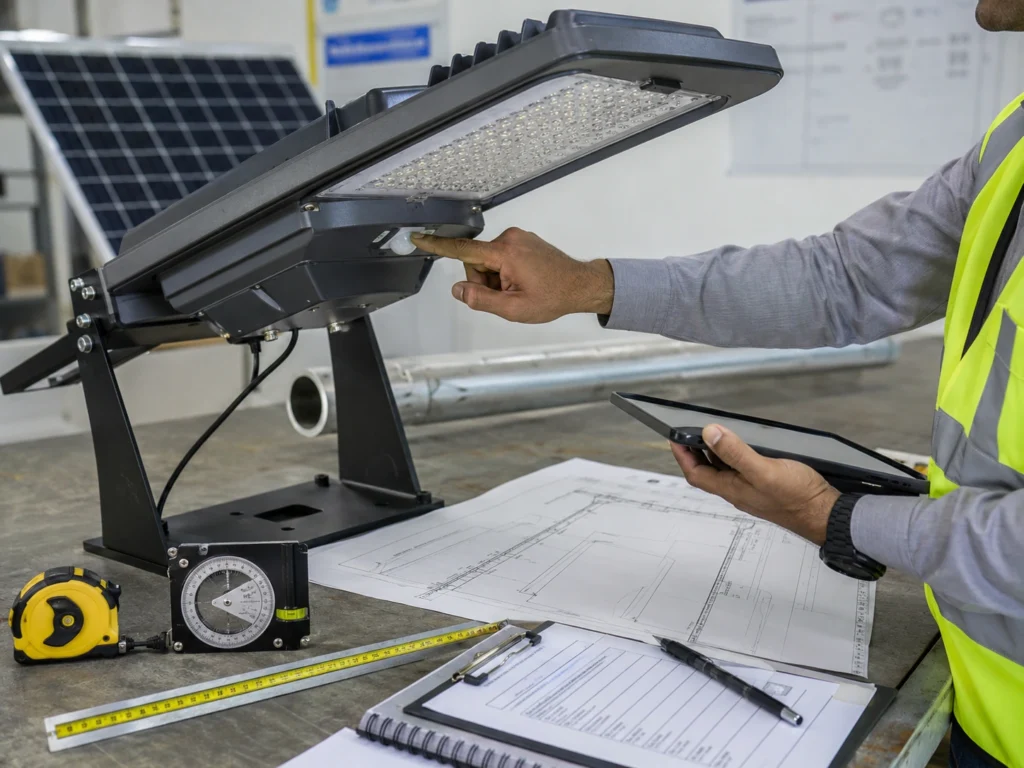
Motion sensor mode may use PIR, radar, microwave, or other detection logic depending on the product design.
For project review, the important point is not only the sensor name. The project team should check whether the sensor behavior matches the road environment.
| Review Item | Why It Matters |
|---|---|
| Detection range | The sensor must detect movement at the required distance |
| Mounting height | Detection behavior changes with pole height and angle |
| Sensor direction | Incorrect orientation may miss movement or trigger too often |
| Delay time | Longer delay time keeps high brightness longer and consumes more energy |
| Standby brightness | Too low may reduce perceived safety |
| Boost brightness | Too high or too frequent may drain the battery faster |
| False triggering | Trees, animals, vehicles, or nearby movement may trigger unnecessary boost |
| Site interference | Nearby lighting or reflective surfaces may affect sensor behavior in some designs |
PIR and radar should not be selected only by price. Detection behavior, mounting height, traffic type, and project safety requirement should be reviewed before confirmation.
Why Motion Mode Does Not Always Save Energy
Motion mode saves energy only when the lamp spends enough time in standby mode.
It may not save much energy when:
- Traffic is frequent.
- Pedestrians pass regularly.
- Vehicles trigger boost all night.
- Delay time is too long.
- Standby brightness is set too high.
- Sensor sensitivity is too high.
- Trees, animals, or nearby movement cause false triggers.
- Multiple poles are triggered repeatedly in the same section.
In these cases, the lamp may stay in high brightness for a large part of the night. Battery consumption may become close to, or even higher than, a conservative timer profile.
For EPC projects, the expected traffic pattern should be reviewed before motion mode is selected.
Why Timer Mode Can Still Cause Battery Problems
Timer mode is predictable, but it can still create battery autonomy problems if the schedule is too aggressive.
High-risk timer profiles include:
- High brightness for most of the night.
- Long full-power operation.
- No middle-night reduction.
- Pre-dawn boost without enough battery reserve.
- Same schedule used for shaded and unshaded roads.
- No adjustment for rainy-season operation.
- No record of final controller profile during handover.
A timer profile should be reviewed together with solar panel input, battery capacity, local sunlight condition, and required autonomy days.
For broader night runtime review, see Sunlurio’s guide to how long solar street lights last at night.
Which Mode Is Better by Application?
| Application | Preferred Control Logic | Reason |
|---|---|---|
| Main municipal road | Timer or hybrid mode | Consistent lighting and public acceptance are important |
| Highway or major access road | Timer mode | Predictable visibility is usually required |
| Rural road | Motion or hybrid mode | Low traffic allows energy saving |
| Campus road | Motion or hybrid mode | Intermittent pedestrian and vehicle activity |
| Parking area | Motion or hybrid mode | Movement-based boost improves security while saving energy |
| Industrial access road | Hybrid mode | Traffic may vary by shift and operation |
| Park pathway | Motion mode with safe standby brightness | Low traffic but pedestrian comfort matters |
| Security perimeter | Hybrid mode | Background visibility plus boost response |
| Bus stop or public service area | Timer or hybrid mode | Predictable brightness is often required |
| Shaded road section | Conservative timer or reviewed hybrid mode | Charging margin must be protected |
| Rainy-season project | Conservative timer or hybrid mode | Autonomy margin must be reviewed carefully |
The application table should not replace engineering review. Road width, pole height, spacing, lumen output, local sunlight, and project safety level still matter.
What Project Buyers Should Confirm Before Choosing a Mode
Before confirming timer mode, motion sensor mode, or hybrid mode, project buyers should clarify:
- Road type.
- Pole height.
- Pole spacing.
- Required lighting hours.
- Required brightness level.
- Traffic frequency.
- Pedestrian activity.
- Security requirement.
- Rainy-season condition.
- Autonomy days.
- Solar panel wattage.
- Battery capacity.
- Controller profile.
- Sensor type.
- Detection range.
- Delay time.
- Standby brightness.
- Boost brightness.
- Final handover record requirement.
For tender projects, these assumptions should be reflected in the datasheet, BOQ, controller setting record, and commissioning checklist.
Sunlurio can support project teams with datasheets and installation drawings and BOQ and tender document support before shipment and installation.
What Should Be Tested Before Pole Installation?
Before the light is lifted onto the pole, the installation team should check whether the selected control mode works correctly.
For timer mode, test:
- Remote response.
- Controller profile.
- Brightness schedule.
- AUTO mode.
- Final operating mode.
For motion sensor mode, test:
- Sensor response.
- Detection direction.
- Standby brightness.
- Motion boost brightness.
- Delay time.
- Return-to-standby behavior.
For hybrid mode, test both the timer schedule and motion boost logic.
For installation-stage procedures, see Sunlurio’s guide to ground-level test before pole installation.
What Should Be Recorded During Commissioning?
During commissioning, the project team should record the final approved control mode.
The record should include:
- Pole number.
- Project zone.
- Controller profile.
- Timer schedule.
- Motion sensor type.
- Standby brightness.
- Boost brightness.
- Delay time.
- Final mode after testing.
- Night test result.
- Issue notes.
- Correction status.
Without this record, future troubleshooting becomes difficult. If several lamps behave differently, the team may not know whether the cause is product issue, site condition, or inconsistent settings.
For multi-pole troubleshooting after handover, see Sunlurio’s guide to multiple solar street lights failing in one area.
Common Mistakes to Avoid
1. Choosing Motion Mode Only Because It Saves Energy
Motion mode can save energy, but only if traffic is low enough. On busy roads, frequent triggering can reduce the expected saving.
2. Setting Standby Brightness Too Low
Very low standby brightness may save battery, but it can reduce perceived safety. Public roads and pedestrian areas may require higher background brightness.
3. Switching the Light Completely Off on Public Roads
Some private or non-critical areas may allow very low standby output, but public roads should not be treated like decorative lighting. Background visibility, pedestrian comfort, and road safety must be reviewed before selecting very low standby brightness.
4. Using the Same Mode for Every Road Section
A main road, rural road, parking area, and shaded road section may need different profiles. One setting may not fit the whole project.
5. Ignoring Rainy-Season Autonomy
Both timer and motion modes must be reviewed against cloudy or rainy periods. A mode that works in sunny weeks may fail during low-sunlight seasons.
6. Leaving Lamps in Random Remote Settings
Remote control is useful during testing, but final project settings must be restored and recorded. Random settings can create inconsistent behavior across poles.
7. Ignoring Sensor Mounting Height and Direction
Motion sensor performance depends on installation. Incorrect pole height, sensor direction, or luminaire angle can cause missed detection or false triggers.
8. Not Testing Before Pole Installation
Testing after installation is harder and more expensive. Sensor response, timer logic, and final mode should be checked before pole lifting whenever possible.
When Smart Control May Be Better Than Remote Mode
For small or simple projects, remote control and controller profiles may be enough. But smart control may be better when the project needs centralized monitoring, fault alerts, remote profile updates, asset management, or zone-level control.
Smart control may be useful when:
- The project has many poles.
- The site is spread across different zones.
- Maintenance access is difficult.
- The customer needs fault status.
- Different road sections need different profiles.
- The project requires remote monitoring.
- Manual inspection cost is high.
- Government or municipal operators need platform records.
For larger projects, Sunlurio can support smart street lighting system design based on project communication requirements and maintenance logic.
Request a Control Mode Review
Sunlurio can help EPC contractors, municipal project teams, and project distributors review whether a solar street lighting project should use timer mode, motion sensor mode, or hybrid control logic.
A project review can include:
- Road type review.
- Traffic frequency review.
- Safety requirement review.
- Battery autonomy review.
- Solar panel input review.
- Dimming profile review.
- PIR or radar sensor behavior review.
- Controller profile review.
- Rainy-season performance review.
- Commissioning and handover record review.
To prepare a useful review, the project team can share the project location, road type, pole height, pole spacing, operating hours, traffic condition, rainy-season requirement, autonomy days, and whether the project needs motion sensor, timer mode, or smart control.
This helps avoid random brightness settings and supports a more reliable project handover.
Related Solar Street Light Setup and Troubleshooting Guides
For project teams comparing motion sensor mode and timer mode, these related guides may help review remote setup, dimming profiles, PIR and radar sensors, motion sensor settings, battery autonomy, multi-pole troubleshooting, and smart control options.
- Basic remote control setup steps
- Solar street light motion sensor settings
- PIR vs radar motion sensors for solar street lights
- Solar street light dimming profile and battery autonomy
- Multiple solar street lights failing in one area
- Remote control vs smart control for solar street lights
- Engineering support for solar street lighting projects
FAQ
What is timer mode in solar street lights?
Timer mode uses a fixed brightness schedule after dusk. The lamp may run at higher brightness during early evening, lower brightness after midnight, and medium or higher brightness before dawn, depending on the controller profile.
What is motion sensor mode in solar street lights?
Motion sensor mode uses PIR, radar, microwave, or similar detection logic to increase brightness when movement is detected. The lamp usually returns to lower standby brightness after a set delay time.
Is motion sensor mode better than timer mode?
Not always. Motion sensor mode can save energy on low-traffic roads, but timer mode may be better for public roads, main roads, and areas requiring consistent lighting. The best choice depends on traffic, safety, battery autonomy, and site conditions.
Does motion sensor mode always save battery power?
No. Motion mode saves battery only if the lamp spends enough time in standby brightness. On busy roads, frequent triggering may keep the lamp at high brightness for long periods and reduce the expected energy saving.
When should timer mode be used?
Timer mode is suitable for roads with steady traffic, public safety requirements, simple maintenance needs, or projects where predictable lighting and clear handover records are important.
When should motion sensor mode be used?
Motion sensor mode is suitable for rural roads, campus roads, parking areas, parks, pathways, and low-traffic zones where activity is intermittent and battery autonomy is important.
What is hybrid mode in solar street lights?
Hybrid mode combines timer dimming and motion boost. The light may use higher brightness during active evening hours, then use lower standby brightness with motion-triggered boost during quieter night periods.
What is the best mode for municipal road projects?
Many municipal road projects use timer mode or hybrid timer plus motion mode. Main roads often need predictable brightness, while low-traffic side roads or pathways may benefit from motion boost.
Should EPC teams use PIR or radar sensors?
PIR or radar selection should depend on detection range, pole height, traffic type, environmental condition, false triggering risk, and project safety requirement. Sensor choice should not be based only on price.
Can motion sensor settings cause solar street lights to fail early?
Yes. If the sensor triggers too often, delay time is too long, or boost brightness is too high, the battery can drain faster than expected, especially during cloudy or rainy periods.
What should be recorded during commissioning?
The commissioning record should include pole number, controller profile, timer schedule, motion sensor type, standby brightness, boost brightness, delay time, final operating mode, night test result, issue notes, and correction status.