
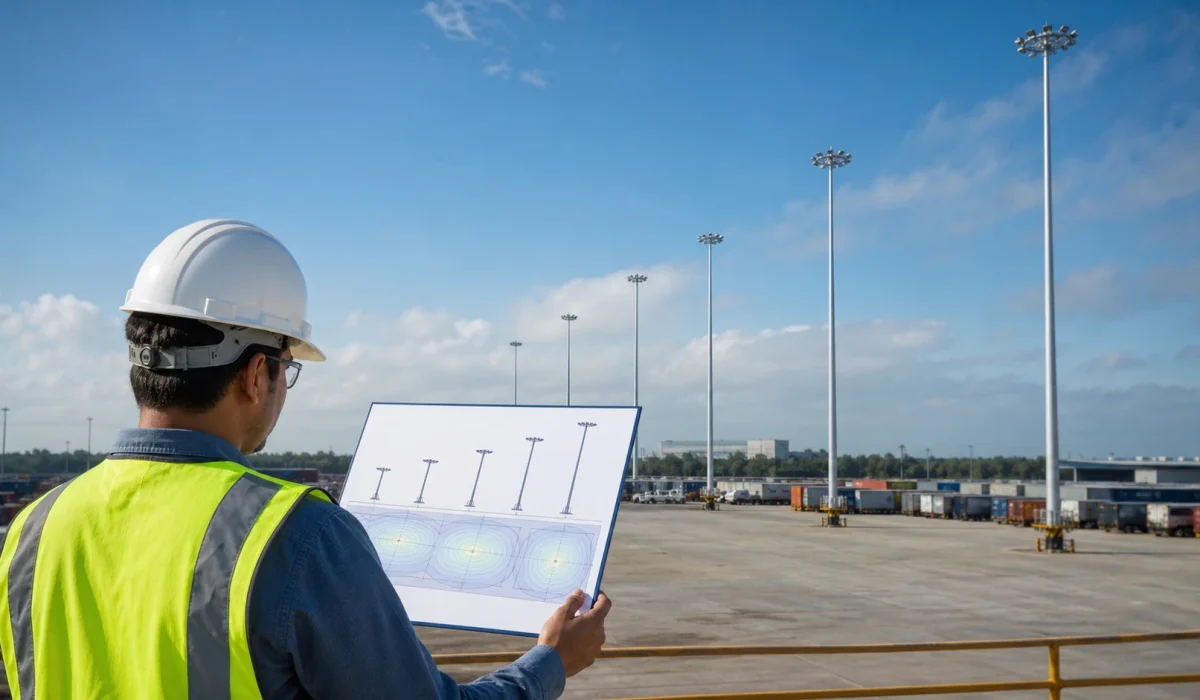
Quick Answer
High mast pole height is selected according to project area, required maintained illuminance, pole spacing, luminaire optics, glare control, wind-load condition, foundation feasibility, maintenance method, and local project requirements.
There is no single global standard height for every high mast lighting project.
In many infrastructure projects, common high mast pole heights include 20m, 25m, 30m, 35m, and 40m or above. In imperial project documents, high mast systems may also be specified using nominal sizes such as 80 ft, 100 ft, 125 ft, 150 ft, or 175 ft.
As a concept starting point:
- 20m / 66 ft may be used for smaller yards, parking areas, industrial access zones, and medium outdoor spaces.
- 25m / 82 ft is often reviewed for logistics yards, industrial yards, and medium infrastructure sites.
- 30m / 98 ft is commonly considered for ports, container yards, large logistics parks, highway interchanges, and wide-area lighting projects.
- 35m / 115 ft is used when wider coverage, fewer mast locations, or higher mounting positions are required.
- 40m+ / 131 ft+ should be treated as project-specific engineering.
A taller pole does not automatically create a better lighting design. Pole height must be reviewed together with spacing, coverage, aiming, beam distribution, maintained illuminance, uniformity, glare, structural design, lowering system, and DIALux or equivalent lighting simulation.
Project Review Summary
| Item | Project Review Point |
|---|---|
| Main Question | How tall should a high mast lighting pole be? |
| Selection Decision | Compare suitable mounting heights for the project |
| Common Metric Heights | 20m, 25m, 30m, 35m, and 40m+ |
| Common Imperial References | 80 ft, 100 ft, 125 ft, 150 ft, and 175 ft |
| Best-Fit Projects | Logistics yards, ports, container terminals, industrial yards, rail yards, highway interchanges, toll plazas, large parking areas, mining yards, stadium perimeter areas, and municipal infrastructure |
| Main Design Factors | Coverage, spacing, optics, aiming, glare, wind load, foundation, maintenance, and lighting simulation |
| Main Procurement Factors | Nominal pole height, actual mounting height, shaft sections, headframe, luminaire quantity, projected area, lowering system, wind-speed requirement, anchor bolts, galvanizing, shipping, and installation method |
| Main Risk | Selecting pole height only by coverage expectation or purchase price |
Pole Height vs Mounting Height
Before selecting a high mast system, the project team should distinguish between pole height and mounting height.
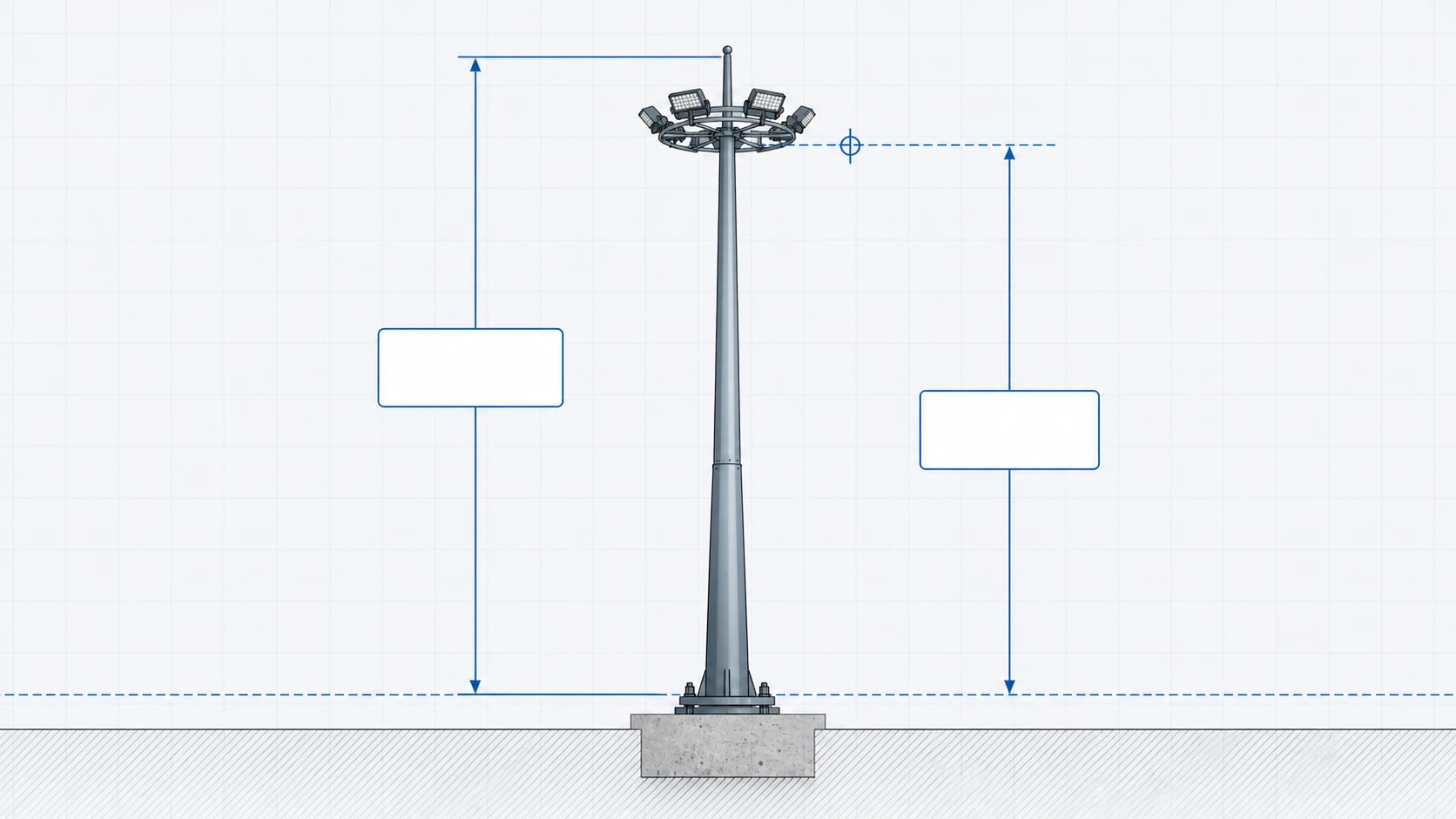
These two terms are related, but they are not always identical.
| Term | Meaning | Why It Matters |
|---|---|---|
| Pole height | The nominal structural height of the mast or pole | Used for procurement, structural design, shipping, foundation, and installation planning |
| Mounting height | The height of the luminaire optical center above the calculation plane or ground surface | Used for photometric calculation, coverage, spacing, glare, and aiming review |
For example, a project may refer to a “30m high mast pole,” but the actual luminaire mounting height may differ because of:
- Base plate or foundation pedestal height.
- Ground level difference.
- Headframe configuration.
- Luminaire bracket position.
- Lowering ring design.
- Calculation plane definition.
- Roadway or yard surface elevation.
Lighting simulation should use the actual luminaire mounting height, not only the nominal product name.
Differences in mounting height should be represented accurately in the lighting model; their practical significance depends on the optics, aiming distance, and calculation geometry.
What Height Range Counts as High Mast Lighting?
There is no single global threshold that applies to every country, standard, and project type.
In common engineering usage, high mast lighting refers to groups of luminaires mounted much higher than conventional street or area-lighting poles. In roadway projects, some references describe high mast lighting as luminaires mounted at around 20m or higher, while other specifications use nominal imperial heights such as 100 ft or above.
In practical B2B project discussions, high mast lighting is often reviewed in these ranges:
| Height Range | Typical Interpretation |
|---|---|
| 15m–20m | Borderline high-mounted area lighting or smaller high mast applications, depending on market and project definition |
| 20m–35m | Common range for many yards, ports, logistics, industrial, highway, and municipal projects |
| 40m–50m+ | Project-specific infrastructure height for large terminals, ports, airports, transport hubs, or special roadway systems |
A 15m pole may be called high mast in some product catalogs, while in other engineering discussions it may still be considered high-mounted area lighting. The classification depends on the local specification, application, luminaire arrangement, and project authority.
For this reason, the project team should confirm the actual mounting height, luminaire arrangement, lowering system, structural design, and lighting calculation requirements instead of relying only on the label “high mast.”
Metric and Imperial Height Reference
International projects may use either meters or feet.
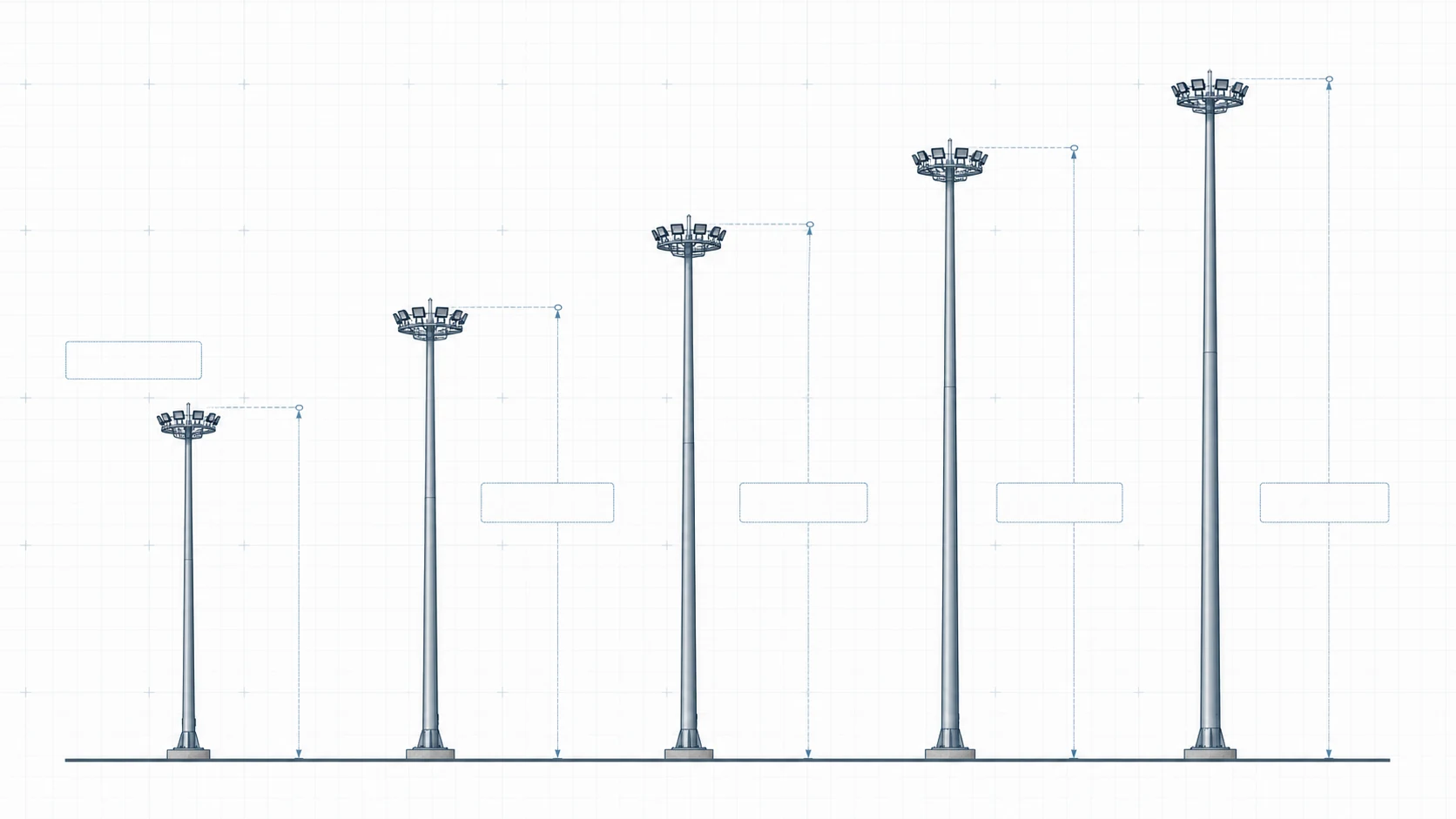
The following conversions are approximate and should be used only for concept communication.
| Metric Height | Approximate Imperial Height |
|---|---|
| 15 m | 49 ft |
| 20 m | 66 ft |
| 25 m | 82 ft |
| 30 m | 98 ft |
| 35 m | 115 ft |
| 40 m | 131 ft |
| 45 m | 148 ft |
| 50 m | 164 ft |
Nominal U.S. heights such as 80 ft, 100 ft, 125 ft, and 150 ft are independent specification sizes. They are not always exact conversions of 25m, 30m, 35m, or 45m systems.
For international RFQs, clearly state both the required unit system and the expected design basis.
Why High Mast Pole Height Is a Design and Procurement Decision
High mast pole height is not only a lighting parameter.
It affects both the lighting design and the physical supply package.
A change from 25m to 30m may influence:
- Number of masts.
- Pole spacing.
- Lighting coverage.
- Luminaire quantity.
- Beam distribution.
- Aiming angle.
- Glare risk.
- Foundation size.
- Wind-load requirement.
- Anchor bolt design.
- Pole shaft sections.
- Headframe or lowering ring.
- Installation equipment.
- Shipping length and container loading.
- Maintenance method.
- Total project cost.
Many buyers assume that a taller mast is always better because it may cover a larger area. This is not always correct.
A taller pole may allow wider coverage, but it can also increase structural and procurement complexity. A lower pole may be easier to manufacture, ship, install, and maintain, but it may require more mast locations.
The best height is usually the height that balances lighting performance, mast quantity, foundation feasibility, glare control, construction cost, maintenance access, and long-term reliability.
If your project is still estimating mast quantity, start with How Many High Mast Lights Do You Need?. If the pole quantity is already estimated, this guide explains how to select a suitable height before final layout and simulation.
Height Selection Matrix
The following matrix is for concept selection only. It is not a guaranteed design recommendation.
| Height | Approx. ft | Typical Starting Application | Layout Effect | Structural Impact |
|---|---|---|---|---|
| 20 m | 66 ft | Small and medium yards, parking areas, industrial access areas | More poles may be needed for wider sites | Lower relative complexity |
| 25 m | 82 ft | Logistics yards, industrial yards, municipal infrastructure | Balanced option for coverage and practicality | Moderate |
| 30 m | 98 ft | Ports, container yards, highway interchanges, large logistics parks | Wider spacing potential, fewer mast locations in some projects | Higher |
| 35 m | 115 ft | Large terminals, heavy industrial yards, major interchanges | Potentially fewer masts, but greater structural and aiming constraints | Significant |
| 40 m+ | 131 ft+ | Special infrastructure, large ports, airports, transport hubs | Project-specific layout and aiming | Full structural review required |
Use this table to narrow the first design discussion. Do not use it as final construction guidance.
The final selection should be checked with project-specific photometric calculation, structural review, foundation feasibility, and installation planning.
Common High Mast Pole Heights
20m High Mast Lighting
A 20m high mast is often used for medium outdoor spaces where wide-area lighting is required but the project does not need very high mounting positions.
Typical applications may include:
- Medium parking areas.
- Small logistics yards.
- Industrial access roads.
- Municipal yards.
- Outdoor storage areas.
- Local service zones.
- Small industrial working areas.
- Small toll or checkpoint areas.
Main advantages may include easier installation planning, lower relative structural complexity, smaller foundation requirements compared with taller masts, easier maintenance access, and reduced visual impact.
Main limitations include shorter effective coverage distance, more required pole locations in wider sites, and higher risk of weak center-zone or edge-zone lighting if spacing is stretched too far.
A 20m high mast should not be selected only because it is easier to install. The design should confirm that the mounting height can still meet the required maintained illuminance and uniformity across the target area.
25m High Mast Lighting
A 25m high mast is a common middle-range option for logistics, industrial, and municipal projects.
Typical applications may include:
- Logistics yards.
- Industrial yards.
- Warehouse outdoor areas.
- Medium parking areas.
- Municipal infrastructure projects.
- Storage yards.
- Truck circulation areas.
- Medium-size terminal areas.
- Rail service yards, depending on clearance and layout requirements.
Main advantages may include wider coverage than 20m, practical use in perimeter or four-corner layouts, manageable foundation requirements, and more accessible maintenance planning than taller systems.
Main limitations include the possibility of more mast locations compared with 30m or 35m systems, weaker performance in very wide sites, and the need for controlled aiming to avoid dark zones.
A 25m high mast is often a practical starting point for concept review, but it should be compared with 30m when the project area becomes wider or when fewer pole locations are preferred.
30m High Mast Lighting
A 30m high mast is one of the most common choices for large outdoor infrastructure lighting.
Typical applications may include:
- Ports.
- Container terminals.
- Large logistics parks.
- Highway interchanges.
- Large industrial yards.
- Large parking areas.
- Toll plazas.
- Mining yards.
- Municipal road junctions.
- Airport service areas, subject to authority requirements.
Main advantages may include wider coverage than 20m or 25m, fewer mast locations in some large sites, better support for perimeter or hybrid layouts, and suitability for multi-luminaire headframes.
Main limitations include larger foundation requirements, higher wind-load impact, more complex installation, greater need for accurate aiming, and higher maintenance planning requirements.
A 30m mast should not be treated as a simple upgrade from 25m. It changes the whole layout and should be reviewed with pole spacing, luminaire quantity, beam distribution, aiming plan, glare control, maintained illuminance, uniformity, and foundation feasibility.
35m High Mast Lighting
A 35m high mast is used when larger coverage, fewer mast locations, or higher mounting position is required.
Typical applications may include:
- Large port yards.
- Wide container terminals.
- Major highway interchanges.
- Large industrial plants.
- Mining or heavy-industry yards.
- Large outdoor storage areas.
- Large municipal infrastructure projects.
- Large toll plaza or transportation infrastructure areas.
Main advantages may include larger coverage potential, better reach across wide open areas, usefulness where internal pole locations are restricted, and suitability for high-output multi-luminaire systems.
Main limitations include higher structural loading, larger foundations, more difficult installation, more complex maintenance, higher wind-load review requirements, and stronger sensitivity to aiming and glare control.
A 35m high mast should be selected only after comparing lighting performance and structural feasibility. It may reduce mast count, but that does not always reduce total project cost.
40m to 50m+ High Mast Lighting
40m to 50m+ high mast lighting should be treated as project-specific engineering.
Typical applications may include:
- Large port terminals.
- Airport-related infrastructure.
- Major transport hubs.
- Large industrial zones.
- Special-purpose yards.
- Very large outdoor project areas.
- Consultant-specified infrastructure projects.
- Some major freeway or interchange systems, depending on agency standards.
A 40m+ mast may provide very wide coverage and reduce pole quantity in specific applications, especially where internal pole locations are restricted or the project scale justifies specialized structural design.
However, 40m+ high mast systems require careful review of structural design, wind load, foundation design, headframe configuration, installation equipment, maintenance method, luminaire aiming, glare control, transport limitation, and authority restrictions where applicable.
40m and above should not be selected from a simple height comparison table.
25m vs 30m High Mast: Decision Framework
One of the most common project questions is whether to use 25m or 30m high mast poles.
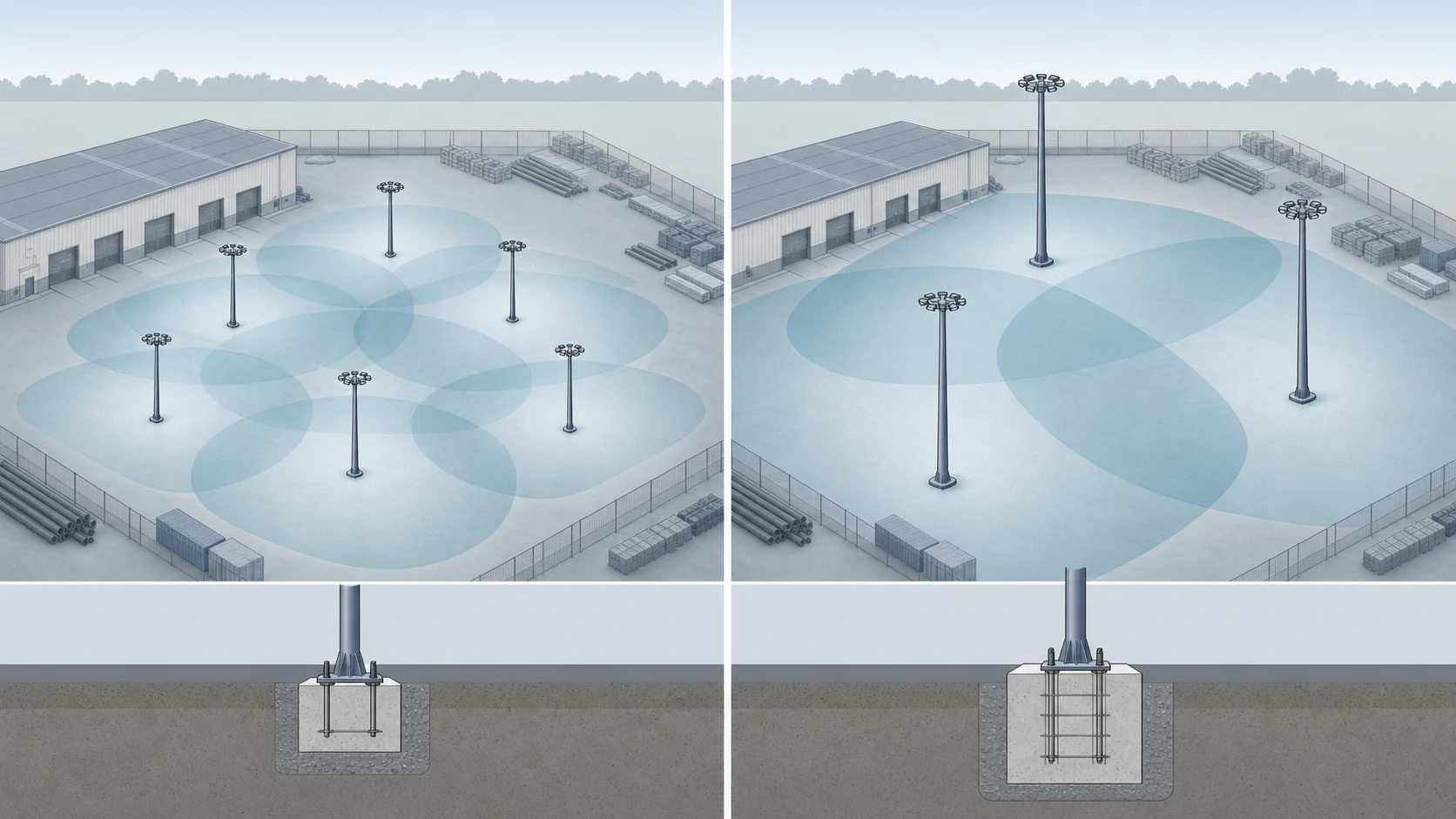
The answer depends on total system performance, not only height.
The following framework is illustrative only. It does not represent final simulation results.
| Review Item | 25m Option | 30m Option |
|---|---|---|
| Typical use | Medium logistics or industrial yards | Larger yards, ports, interchanges, or wide-area sites |
| Pole quantity | May be higher | May be lower in some layouts |
| Foundation complexity | Usually lower | Usually higher |
| Cable routing | May increase if more poles are required | May reduce if mast count decreases |
| Lighting uniformity | Can be strong with closer spacing | Must be checked with aiming and optics |
| Glare control | Depends on optics and aiming | More sensitive to long throw and tilt |
| Maintenance | Usually easier | Requires more planning |
| Installation equipment | Usually less demanding | May require heavier lifting and coordination |
| Total project cost | Not always lower | Not always higher |
A 25m option may require more mast locations but can reduce structural and installation complexity. A 30m option may reduce mast count in some projects but can increase foundation, aiming, glare-control, and maintenance requirements.
The better option should be selected by comparing lighting performance, mast quantity, foundation cost, cable route, installation method, maintenance, and lifecycle value.
How Pole Height Affects Coverage, Spacing, and Glare
Pole height influences coverage, spacing, and glare, but it does not determine them alone.
Coverage
A higher mast can project light over a wider area, but actual coverage depends on:
- Luminaire output.
- Optical distribution.
- Beam angle.
- Tilt angle.
- Number of luminaires.
- Target illuminance.
- Uniformity requirement.
- Calculation plane.
- Maintenance factor.
- Site obstacles.
A taller pole does not automatically provide better useful coverage. For a deeper explanation of coverage boundaries, review High Mast Lighting Coverage Explained.
Spacing
A taller mast may allow wider spacing in some projects, but only if the selected luminaire can maintain the required average illuminance, minimum illuminance, uniformity, glare control, edge coverage, and spill-light limits.
Increasing pole height without changing optics may not solve the spacing problem. For detailed spacing logic, review the High Mast Pole Spacing Guide.
Glare and Aiming
Pole height changes the relationship between the luminaire, target area, and observer.
A higher mast changes viewing angle, tilt requirement, beam projection distance, spill-light direction, and driver or operator visibility. Depending on optics and aiming direction, increasing height may reduce glare in some observer positions but increase it in others.
Each luminaire should have a defined aiming direction, tilt angle, optic type, and target zone. For layout and aiming examples, review High Mast Lighting Layout Patterns.
How Pole Height Affects Foundation and Wind Load
Pole height is also a structural decision.
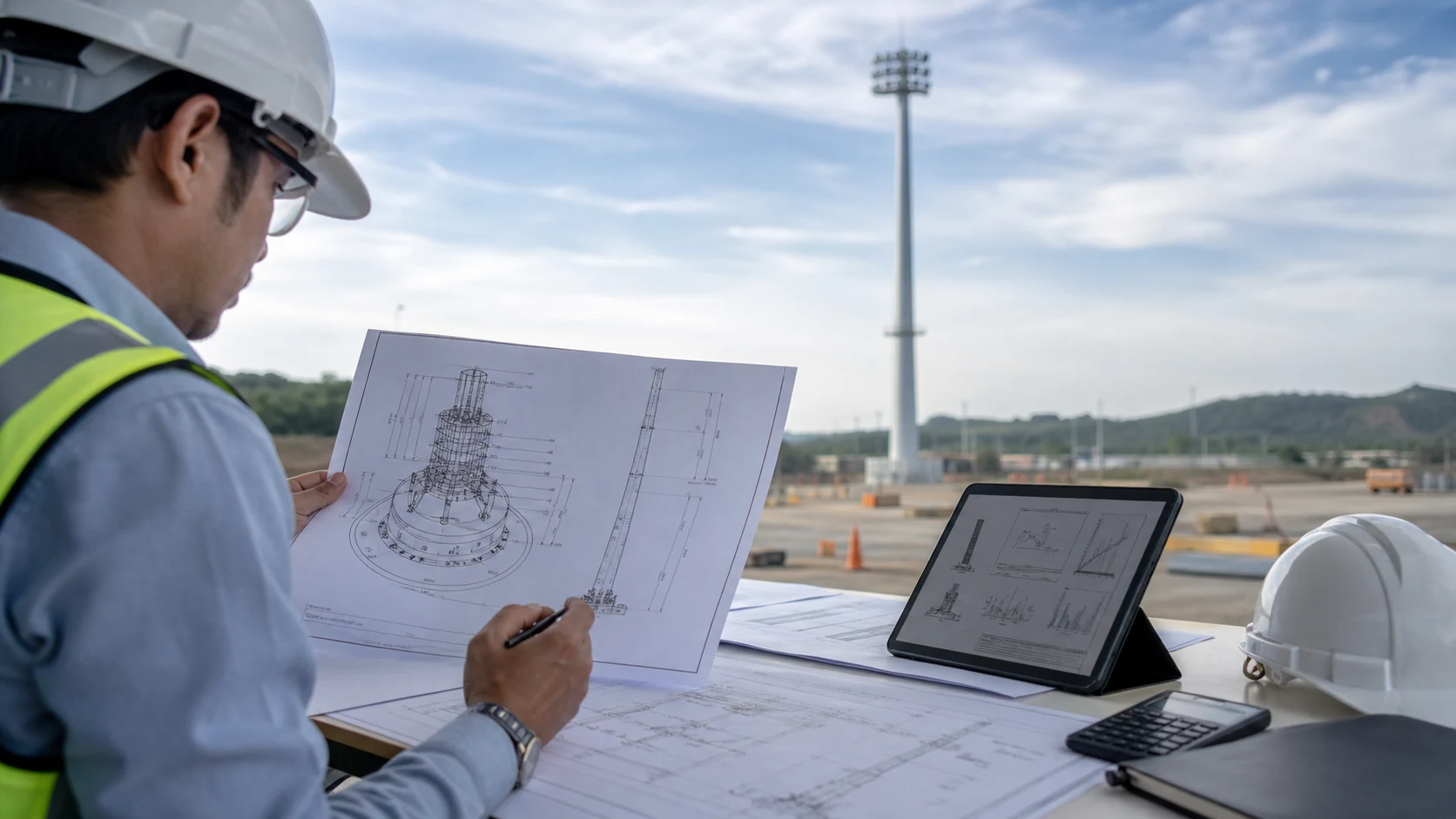
As pole height increases, structural requirements generally become more important, but foundation size and structural design do not change according to one fixed ratio. They depend on multiple variables, including:
- Basic wind speed.
- Terrain category.
- Pole height.
- Pole material and shaft design.
- Luminaire quantity.
- Luminaire projected area.
- Headframe or ring design.
- Foundation soil condition.
- Local structural code or consultant requirement.
- Anchor bolt and base plate design.
A taller mast may require a larger foundation, stronger pole shaft, higher wind-load resistance, larger lifting equipment, or a more detailed maintenance plan, but the final structure must be designed from the actual project conditions.
The lighting team may prefer a taller mast for coverage, but the structural team must confirm feasibility before procurement.
How to Choose Pole Height by Application
The following table provides initial selection guidance only.
| Application | Typical Starting Height Range | Main Review Focus |
|---|---|---|
| Small or medium parking lot | 20m–25m | Coverage, pedestrian visibility, glare, visual impact |
| Large parking area | 25m–30m | Uniformity, pole count, driver visibility, maintenance |
| Logistics yard | 25m–30m | Loading bays, truck routes, warehouse shadows, future expansion |
| Container terminal | 30m–35m+ | Container stacks, crane lanes, truck routes, operator glare |
| Port yard | 30m–40m+ | Wide coverage, wind load, salt environment, maintenance method |
| Highway interchange | 30m–35m+ | Road alignment, driver glare, ramp transitions, safety setbacks |
| Toll plaza | 25m–35m | Lane visibility, canopy conflicts, driver comfort |
| Industrial yard | 20m–35m | Equipment height, restricted zones, pipelines, worker visibility |
| Rail yard | 25m–35m | Track clearance, maintenance access, glare, safety zones |
| Mining yard | 30m–40m+ | Heavy equipment routes, dust, high structural demand |
| Stadium or sports perimeter | 25m–40m+ | Field visibility, glare, spill light, event requirements |
| Airport apron or service area | Project-specific | Authority requirements, glare, aviation restrictions, mast clearance |
These ranges are starting points only. Final selection must follow project-specific lighting and structural requirements.
Procurement Checklist for High Mast Pole Height Selection
When a buyer specifies high mast pole height, the RFQ should include more than the nominal meter value.
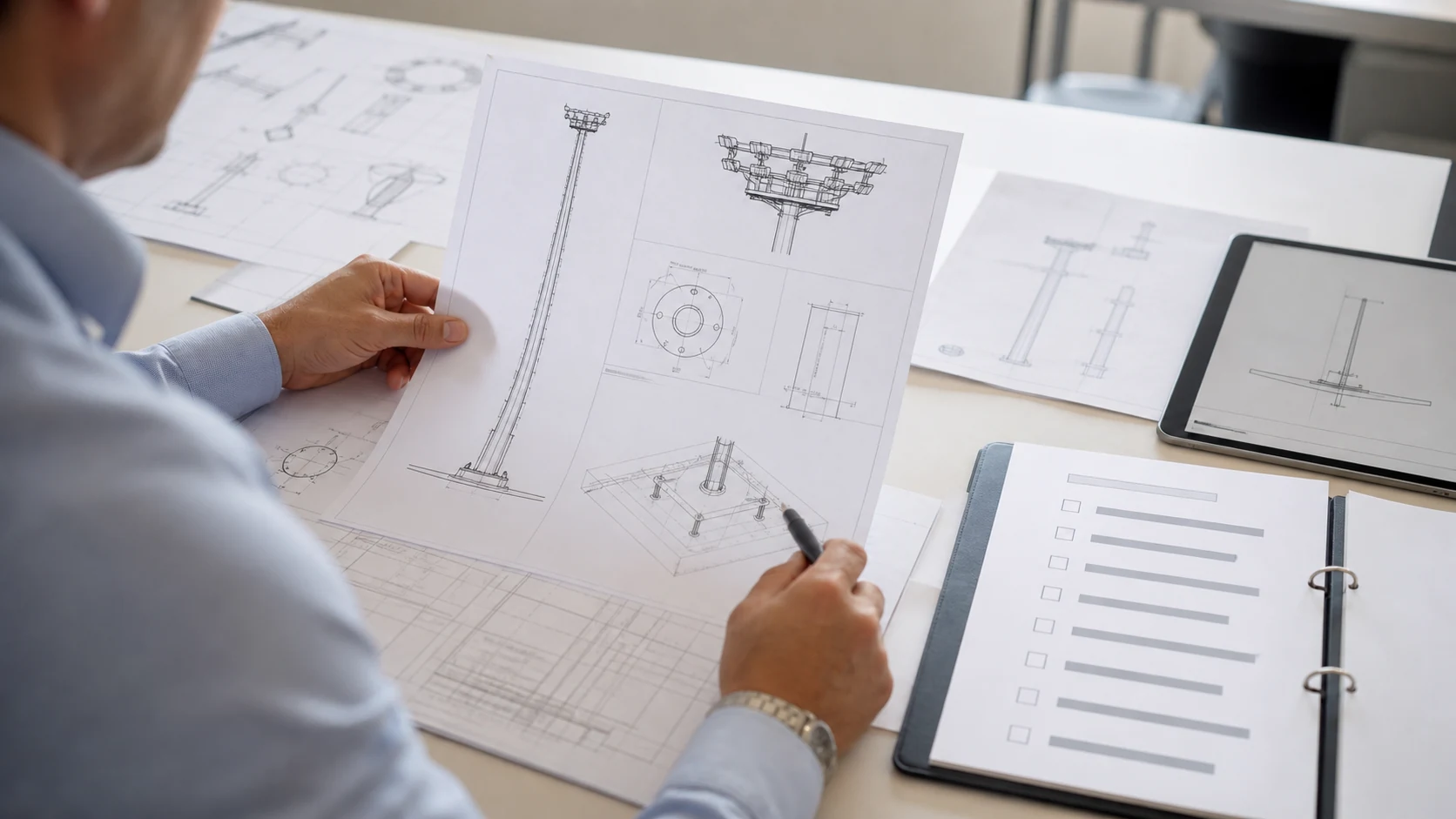
The following checklist helps connect lighting selection with pole supply.
| Procurement Item | Why It Matters |
|---|---|
| Nominal pole height | Defines the product size and structural class |
| Actual luminaire mounting height | Required for lighting calculation |
| Pole shaft sections | Affects fabrication, transport, assembly, and installation |
| Shaft material and grade | Affects structural performance and durability |
| Pole shape and taper | Affects wind load, fabrication, and appearance |
| Base plate and anchor bolts | Required for foundation coordination |
| Headframe or ring type | Defines luminaire arrangement and maintenance method |
| Fixed headframe or lowering system | Affects maintenance strategy and project cost |
| Luminaire quantity per mast | Affects lighting output and projected area |
| Luminaire projected area | Important for wind-load calculation |
| Design wind speed | Required for structural design |
| Applicable standard or code | Defines engineering responsibility and acceptance criteria |
| Foundation design responsibility | Must be clarified between supplier, contractor, and consultant |
| Hot-dip galvanizing | Important for outdoor corrosion protection |
| Finish or coating requirement | May be required for coastal or industrial environments |
| Shipping length and container loading | Affects logistics and cost |
| Installation equipment | Affects site preparation and lifting method |
| Maintenance access | Affects long-term operation and safety |
This information helps avoid a common problem: selecting a pole height for lighting reasons but discovering later that the structural package, foundation, or shipping plan is incomplete.
Files Required for Pole Height Review
To review high mast pole height properly, the engineering team should receive clear project information.
| Required Input | Why It Matters |
|---|---|
| Site layout or CAD drawing | Defines the lighting area and possible pole locations |
| Project application | Determines lighting objectives |
| Site dimensions | Supports coverage and spacing review |
| Target maintained illuminance | Defines required lighting performance |
| Uniformity requirement | Controls dark-zone risk |
| Preferred or restricted pole height | Guides height comparison |
| Allowed pole locations | Prevents impractical layout assumptions |
| Existing obstacles | Helps review shadows and blocked light |
| Luminaire model | Determines output and distribution |
| IES/LDT files | Required for photometric simulation |
| Wind-speed requirement | Supports structural review |
| Foundation constraints | Affects feasibility of taller masts |
| Maintenance method | Influences practical height selection |
| Tender or consultant specification | Defines acceptance requirements |
If these inputs are incomplete, the first height recommendation should be treated as preliminary.
For formal EPC or consultant-reviewed projects, the final height should be supported by DIALux simulation outputs, IES/LDT photometric files, and project-specific engineering documentation.
Engineering References for Pole Height Review
Official and agency documents usually do not provide one universal high mast height for every project.
Instead, they define design logic, standard assemblies, mounting heights, photometric criteria, pole configurations, and structural requirements for their own project types.
Useful references include:
- FHWA Lighting Handbook: roadway lighting guidance covering mounting height, illuminance, uniformity, glare, and roadway lighting applications.
- TxDOT Highway Illumination Manual: highway illumination guidance including high mast assemblies, pole heights, photometric types, wind speed, foundations, and maintenance requirements.
- TxDOT High Mast Lighting Assemblies: summary of TxDOT high mast pole heights, HMIP standards, photometric types, and design wind speeds.
The FHWA handbook describes high-mast lighting as groups of luminaires generally mounted at 20 m or higher in a roadway-lighting context. This should not be treated as a universal international threshold for every industrial, port, airport, or municipal project.
TxDOT defines its standard high mast pole heights as 100 ft, 125 ft, 150 ft, and 175 ft, and specifies high mast systems by pole height and photometric type. This reinforces an important engineering point: height should be reviewed together with optics, luminaire quantity, orientation, site conditions, wind speed, and structural standards.
Common Pole Height Selection Mistakes
| Mistake | Why It Creates Risk | Better Review Method |
|---|---|---|
| Choosing the tallest pole by default | Taller poles increase structural, foundation, and maintenance complexity | Compare lighting and structural impact together |
| Choosing the lowest height to reduce cost | More poles may be required and uniformity may suffer | Compare total system cost, not only pole cost |
| Selecting height without IES/LDT files | Coverage assumptions may be inaccurate | Use actual photometric data |
| Ignoring mounting height difference | Nominal pole height may not equal optical mounting height | Model the actual luminaire mounting height |
| Ignoring glare | Poorly aimed systems may affect drivers or operators | Review observer positions and aiming |
| Ignoring wind load | Structural risk may increase significantly | Coordinate with structural engineering |
| Comparing suppliers only by pole height | Height alone does not prove performance | Compare simulation, optics, BOQ, and documentation |
| Finalizing foundations before simulation | Pole relocation becomes costly | Verify layout before civil work |
| Treating 40m+ as a standard product | Very tall masts need project-specific engineering | Require full design review |
Request a High Mast Pole Height Review
High mast pole height should be reviewed before pole spacing, foundation design, and equipment quantities are finalized.
Send us your CAD layout, project area, target maintained illuminance, required uniformity, preferred height range, allowed pole locations, site restrictions, wind-load requirements, and maintenance preference. Sunlurio can review 20m, 25m, 30m, 35m, or project-specific height options and prepare the lighting documentation required for project discussion.
Request a High Mast Pole Height Review
Related High Mast Lighting Guides
The following guides explain related decisions in high mast lighting design:
- High Mast Lighting Design Guide
- High Mast Pole Spacing Guide
- High Mast Lighting Layout Patterns
- How Many High Mast Lights Do You Need?
- High Mast Lighting Coverage Explained
- High Mast Lighting Systems
- Engineering Support for Lighting Projects
- DIALux Simulation Outputs
- IES/LDT Photometric Files
- Tender Documents and BOQ Support
Frequently Asked Questions
What is the standard height of high mast lighting?
There is no single standard height for all projects. Common high mast lighting heights include 20m, 25m, 30m, 35m, and 40m or above, depending on project scale, lighting requirements, structural conditions, and site constraints.
What height range is usually considered high mast lighting?
Many projects review high mast lighting in the range of approximately 20m to 40m or higher. Some smaller high-mounted area lighting projects may start around 15m, while large infrastructure projects may use 40m to 50m or more.
Is pole height the same as mounting height?
Not always. Pole height usually refers to the nominal structural height of the mast. Mounting height refers to the height of the luminaire optical center above the ground or calculation plane. Lighting simulation should use the actual mounting height.
Is 30m the best height for high mast lighting?
30m is common for many large outdoor infrastructure projects, but it is not always the best height. The correct height depends on site dimensions, target lux, pole spacing, optics, glare control, wind load, and foundation feasibility.
When should 25m or 30m high mast lighting be used?
25m is often suitable for logistics yards, industrial yards, medium outdoor facilities, and municipal infrastructure projects. 30m is commonly reviewed for ports, logistics parks, large industrial yards, highway interchanges, toll plazas, and other wide-area projects. The final choice should compare lighting performance, mast quantity, foundation cost, maintenance, and total project value.
Is 40m high mast lighting suitable for all large projects?
No. 40m and above should be treated as project-specific engineering. It requires detailed lighting simulation, structural review, wind-load coordination, foundation design, transport planning, maintenance review, and authority approval where applicable.
Does a taller pole always provide better lighting?
No. A taller pole may increase coverage potential, but it can also increase glare risk, structural requirements, foundation cost, and maintenance complexity. The final result depends on optics, aiming, and project conditions.
What information is needed to select high mast pole height?
Useful inputs include CAD layout, site dimensions, project application, target maintained illuminance, uniformity requirement, preferred height range, allowed pole locations, obstacles, wind-speed requirement, luminaire model, IES/LDT files, foundation constraints, and maintenance method.