
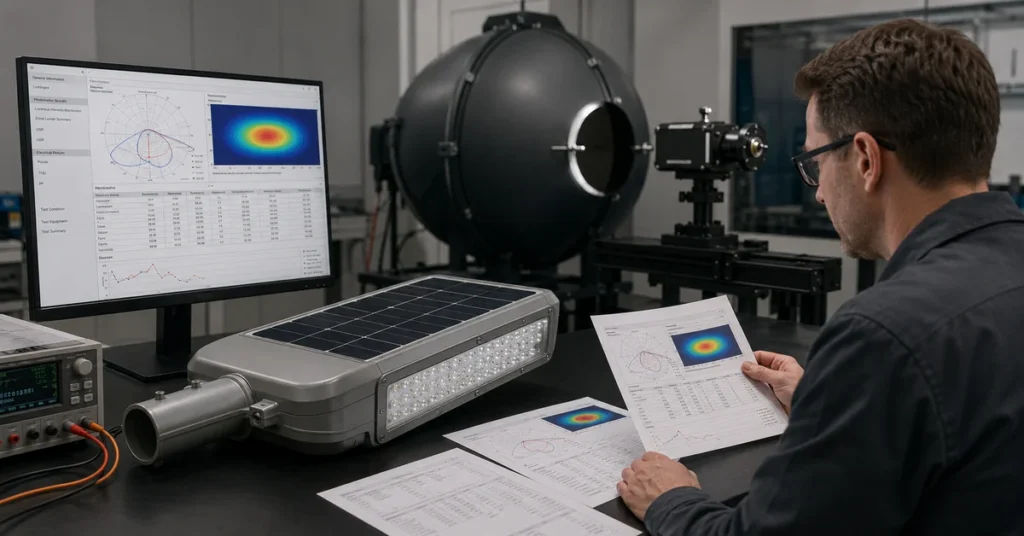
How to Verify 220–230 lm/W Solar Street Light Claims with LM-79
Quick Answer A solar street light rated at 220–230 lm/W may be technically possible, but the number alone does not prove the performance of the
Football field lighting design is more than illumination — it’s performance engineering. At Sunlurio, we approach lighting as a balance between **visual clarity**, **player safety**, and **energy intelligence**. Our engineers have delivered over 50 stadium and training ground projects across Africa, Southeast Asia, and the Middle East, where humidity, salt air, and wind load often redefine design assumptions. The Sunlurio SLS™ (Sports Lighting Simulator) was developed precisely for this complexity — turning FIFA, EN 12193, and CIE 83 standards into actionable simulation outputs for real construction drawings and commissioning workflows.
Field experience showed that a 2° tilt error or 1 m pole setback variation could alter vertical illuminance by up to 6 %. SLS™ allows engineers to visualize these sensitivities before a single floodlight is installed — making it not only a design tool but a decision engine.
All Sunlurio sports lighting designs comply with:
Sunlurio engineers integrate these frameworks directly into simulation templates, reducing compliance review time by over 40 % compared to manual calculation workflows.
The lighting class determines the photometric design targets. Sunlurio SLS™ includes a pre-loaded database aligned with EN 12193 and FIFA guidelines.
| Class | Application | Average Illuminance (Eavg) | Uniformity (U0) | Glare Rating (GR) | CRI (Ra) |
|---|---|---|---|---|---|
| I | FIFA / International broadcast | ≥800–2000 lx | ≥0.7 | ≤40 | ≥80 |
| II | Competition / Club-level | 500–750 lx | ≥0.6 | ≤45 | ≥70 |
| III | Training / Community | 200–300 lx | ≥0.5 | ≤50 | ≥65 |
Unlike theoretical models, Sunlurio designs incorporate real site parameters — pole shadowing, obstructions, and ambient light reflections — validated through SLS™ render analysis.
The field geometry defines the backbone of any football field lighting design. SLS™ imports AutoCAD (.DWG) layouts and allows direct alignment with actual topographic coordinates (WGS84 or local grid). Pole configuration depends on field class and structural feasibility:
Poles are typically set back 4–8 m from the touchline, with heights from 18 m to 35 m depending on beam spread and GR analysis. Increasing pole height by 2 m often improves vertical uniformity by 5–8 %, confirmed by both simulation and field photometer readings.
The Sunlurio SLS™ photometric module uses a structured process that combines precision simulation with field-verifiable outputs. Here’s the typical workflow followed by Sunlurio design teams:
Import the CAD drawing (.DWG/.DXF) into SLS™, defining pitch lines, camera positions, and surrounding structures. The system automatically identifies the playing area (105 × 68 m standard) and safety clearance zones.
Select floodlights from the Sunlurio LED catalog — each with tested IES/ULD photometry. Engineers can preview beam types (narrow 10°, medium 30°, wide 60°) with real candela curves. The software flags combinations likely to exceed GR thresholds before simulation begins.
Each luminaire is assigned a tilt, rotation, and azimuth angle. SLS™ includes an auto-aiming optimizer that iteratively adjusts aiming to achieve target Eavg and uniformity. Engineers can visualize each beam intersection in 3D to check overlap efficiency.
E_avg = Σ[(I_i × cos³θ_i) / h²]
U₀ = E_min / E_avg ≥ target
GR = 24 + 8 log₁₀(L² / ΣI_j)
Each simulation run generates horizontal (Eh) and vertical (Ev) illuminance maps. Field teams later verify these results with calibrated lux meters — typically finding deviations ≤ ±3 %.
SLS™ exports a full design package: isolux map, glare chart, aiming table, and summary report (.SLSR). Each output includes metadata (date, engineer ID, version) for ISO 9001 traceability.
Glare is the most sensitive factor in football field lighting design. Sunlurio engineers balance luminance ratios using asymmetric forward-throw optics and anti-glare shields.
In one Southeast Asian stadium, installing custom anti-glare visors reduced GR by 6 points (from 46 → 40) without reducing Eavg — a field-proven improvement replicated in SLS™ simulation validation.
Floodlight poles are analyzed in HMS™ (High Mast Structural Solver) for wind load and vibration. Each structure is modeled per EN 1991-1-4 with local wind speed inputs.
F = 0.613 × C_d × A × V²
Deflection ≤ H / 400
For 30 m poles at 45 m/s design speed, typical top deflection is 55–65 mm (well within limits). Base plates, anchor bolts, and weld seams are checked against Eurocode 3. Hot-dip galvanizing per ISO 1461 and duplex painting (total ≥ 180 µm) ensure corrosion protection in C4/C5-M marine zones.
Each pole integrates a dedicated feeder circuit with 10 kV surge protection and DALI/1–10V dimmable LED drivers. Sunlurio’s IDS™ control nodes communicate over LoRaWAN, enabling scene-based dimming and remote fault monitoring.
Control panels include astro-timer schedules, manual override, and 24-hour event logs synced to the Sunlurio Cloud Dashboard.
Smart dimming reduces energy consumption without compromising safety or visibility. The IDS™ logic engine supports automatic mode switching:
| Mode | Condition | Output | Energy Saving |
|---|---|---|---|
| Match | Active play | 100 % | — |
| Training | Low occupancy | 70 % | ≈30 % |
| Maintenance | Service time | 30 % | ≈60 % |
| Standby | Idle hours | 10 % | ≈80 % |
Field data from Kenya and Malaysia projects showed average power consumption reduced by 52–57 % annually compared to legacy metal-halide systems.
SLS™ outputs are directly compatible with Sunlurio CDD™ (Construction Design Drafting). A single export synchronizes aiming coordinates, pole foundation loads, and electrical wiring details into the final construction package. This integration eliminates manual transcription errors and guarantees that what’s drawn in design is built in the field — a core principle of Sunlurio’s engineering culture.
After installation, the commissioning team revalidates illuminance and aiming using calibrated lux meters and laser inclinometers. Measured deviations from SLS™ design are typically within ±2.5 %. If GR readings exceed simulation values by >2 points, aiming recalibration is performed using on-site real-time visual simulation via the Sunlurio Mobile Field App.
All test data are uploaded to the Sunlurio Cloud for traceability and warranty documentation.
Configuration: 8-pole, 32 m height, 128 × 1200 W LED floodlights, Class I (broadcast). Simulation: Eavg = 1150 lx, U₀ = 0.73, GR = 39. Field Results: Eavg = 1126 lx (–2.1 %), U₀ = 0.71, GR = 40. Energy Reduction: 54 % vs 2000 W metal-halide baseline. Note: Post-installation camera tests confirmed uniform vertical illuminance — no glare spikes or frame flicker detected under 50 fps broadcast mode.
Professional football field lighting design demands more than bright LEDs — it requires system integration, predictive analysis, and disciplined execution. The Sunlurio SLS™ platform unifies all of these into one engineering process — from design to installation to intelligent operation. As stadium standards evolve toward higher frame rates and adaptive control, Sunlurio continues refining SLS™ with AI-assisted aiming algorithms and real-time glare analytics, ensuring every game unfolds under light engineered to perfection.
For customized football field lighting design and FIFA-compliant simulation reports, contact Sunlurio’s Sports Lighting Division. Our engineers can model your site, generate SLS™-based design documentation, and deliver fully coordinated construction packages ready for tender submission.
Prepared by the Sunlurio Sports Lighting Division — a multidisciplinary team of lighting, structural, and control engineers specializing in large-scale sports facility illumination. Sunlurio combines design simulation, structural verification, and intelligent control through its proprietary SLS™ / HMS™ / IDS™ / CDD™ ecosystem, delivering globally verified lighting systems that meet FIFA and EN standards.
Quick Answer A solar street light rated at 220–230 lm/W may be technically possible, but the number alone does not prove the performance of the
Quick Answer Street light pole spacing can be estimated with S₀ = H × R, where S₀ is the preliminary spacing, H is the luminaire
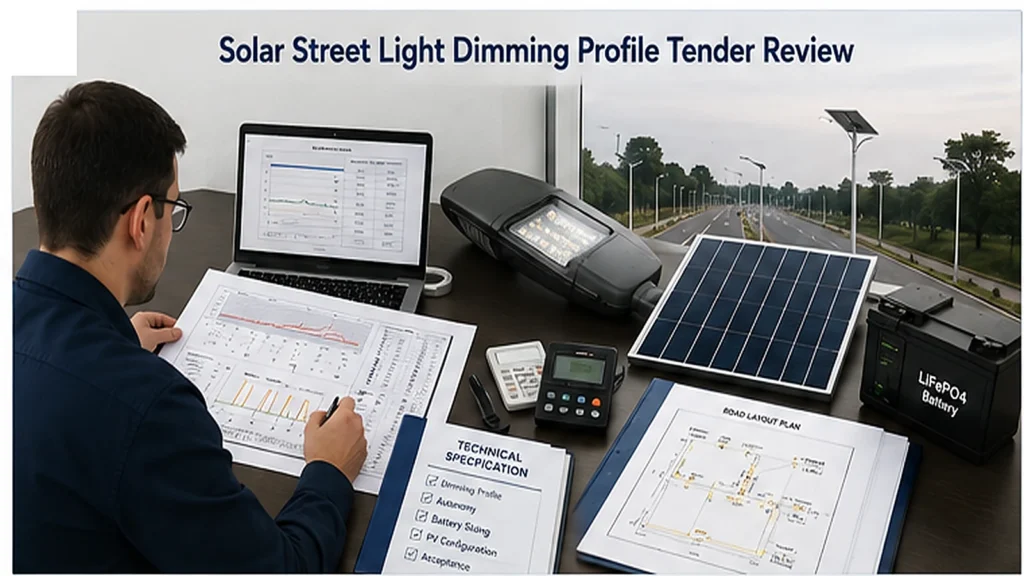
A solar street light dimming profile for a tender should define each operating stage, its duration, output level, time reference, sensor behavior, low-battery override, and
WhatsApp us
Share your project location, road width, pole height, spacing, working hours, backup days, and required documents. Our team can help prepare configuration guidance, datasheets, IES/LDT files, DIALux support when applicable, drawings, and BOQ matching notes.