
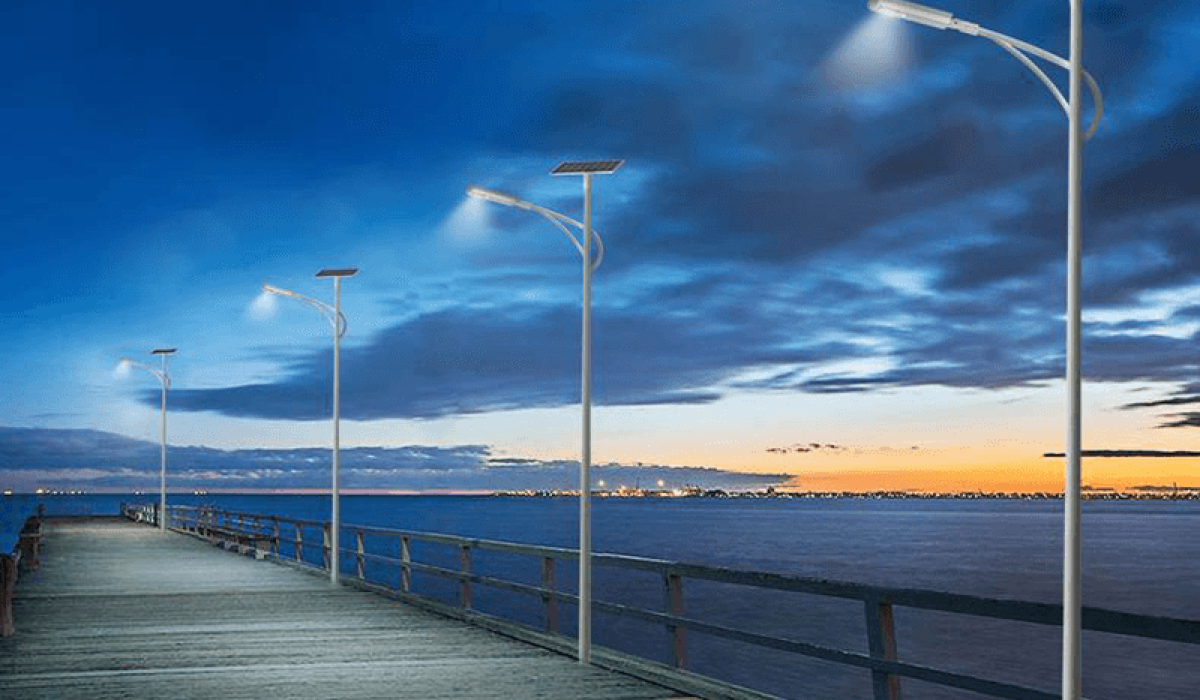
Solar street lighting is no longer just an “alternative” to grid lighting. For governments, EPC contractors, UN/NGO programs, industrial parks, and rural electrification projects, it has become a practical way to deliver visible public-service results without trenching, utility delays, or long-term electricity bills.
But buying solar street lights is not as simple as comparing wattage or looking at a product photo.
A serious buyer has to answer bigger questions:
- Which system type fits the project: all-in-one, split-type, or smart IoT?
- Which specifications actually matter for performance, lifespan, and compliance?
- What causes many public solar lighting projects to fail after one or two rainy seasons?
- What documents should governments, EPC teams, and UN / NGO procurement teams request before award?
- How should buyers compare total cost of ownership, not just quotation price?
This guide is written for:
- Government and municipal buyers
- EPC contractors
- UN / NGO / humanitarian procurement teams
- Industrial park, port, and estate developers
- Consultants preparing RFQs, tenders, or project specifications
It is designed to help buyers make better procurement decisions, reduce tender risk, and choose systems that are technically defensible and commercially realistic.
1. Why Solar Street Lighting Still Matters in 2026
In many markets, stable grid power is still limited, expansion is slow, and road lighting remains uneven. For public buyers, the pressure is not only technical. It is political, social, and operational.
Street lighting affects:
- road safety
- community movement after dark
- local business activity
- security around roads, compounds, schools, clinics, and markets
- public confidence in visible infrastructure delivery
For many municipalities and project owners, solar street lighting remains one of the fastest ways to create visible improvement without:
- cable trenching
- transformer extensions
- monthly electricity bills
- long utility coordination cycles
This is especially relevant in:
- Africa
- the Middle East
- South and Southeast Asia
- remote roads and low-grid regions
- industrial and logistics developments
- humanitarian and settlement lighting projects
For a regional project context, see also Africa Market Guidance.
2. Who This Buyer’s Guide Is For
Not every buyer is solving the same problem. Before comparing products, define what kind of buyer you are.
2.1 Government and Municipal Buyers
Typical priorities:
- public safety
- budget control
- visible delivery
- maintenance practicality
- tender compliance
- long-term reliability
These buyers usually need systems that are easy to justify, easy to inspect, and durable enough to avoid political complaints after installation.
2.2 EPC Contractors
Typical priorities:
- bid competitiveness
- compliance support
- document readiness
- installation efficiency
- technical review pass rate
- low call-back risk
For EPC teams, the supplier is not just selling lights. They are helping the contractor win, deliver, and hand over the project.
See Engineering Support.
2.3 UN / NGO / Humanitarian Procurement Teams
Typical priorities:
- auditability
- consistency across batches
- easy field maintenance
- robust packaging and transport readiness
- remote-site reliability
- realistic performance claims
- low dependence on local grid or specialist labor
In humanitarian and donor-funded projects, buyers are not just purchasing luminaires. They are buying:
- delivery certainty
- field durability
- maintenance simplicity
- document traceability
- accountability
2.4 Industrial Parks, Ports, and Estate Developers
Typical priorities:
- site safety
- road visibility
- vehicle and pedestrian movement
- corrosion resistance
- uptime
- maintenance cost
- visual uniformity
2.5 Rural Electrification and Community Project Buyers
Typical priorities:
- fast deployment
- low maintenance
- autonomy during cloudy weather
- theft resistance
- simple installation
- long battery life
3. Start with the Project Type, Not the Product
A common procurement mistake is starting with product type before defining the application.
The better question is:
What type of project are we buying for?
3.1 Urban Roads and Municipal Streets
Typical needs:
- consistent road visibility
- moderate to high daily usage
- balanced brightness and efficiency
- maintainable pole height and spacing
- clear warranty and spare-parts logic
3.2 Rural Roads and Electrification Programs
Typical needs:
- easy installation
- lower maintenance burden
- reliable autonomy
- practical pole heights
- strong cost discipline
3.3 Highways and Arterial Roads
Typical needs:
- higher poles
- stronger optics
- better autonomy design
- more robust structures
- stronger documentation and design support
In many cases, this application is better suited to split-type systems than compact all-in-one units.
3.4 UN / Refugee Settlement / Humanitarian Compounds
Typical needs:
- reliable night-time operation
- easy maintenance with limited field resources
- standardized components
- safe movement around shelters, roads, clinics, schools, and public compounds
- fast deployment with low civil complexity
For these buyers, maintenance logic matters just as much as first cost.
3.5 Industrial Parks, Ports, and Logistics Roads
Typical needs:
- stronger corrosion control
- high uptime
- larger road widths
- better optics
- stronger pole and foundation design
- potential smart monitoring
3.6 Schools, Clinics, and Public Compounds
Typical needs:
- modest lighting level
- simple deployment
- security and safety benefit
- low operating cost
- long service life
4. Which Solar Street Light Type Fits Your Project?
A buyer’s guide should not ask “Which product looks best?”
It should ask:
Which system architecture fits the project?
4.1 All-in-One Solar Street Light
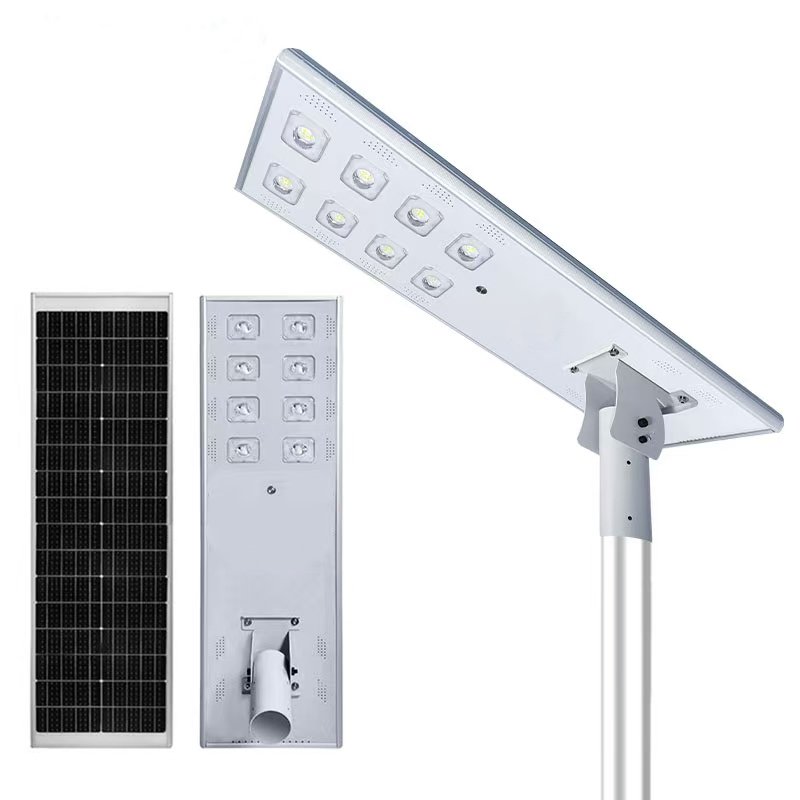
Design: panel, LED, battery, and controller in one integrated body.
Best for:
- village roads
- schools and clinics
- compounds
- community roads
- quick municipal deployment
- lower-height installations
Advantages:
- fast installation
- fewer exposed cables
- cleaner appearance
- easier logistics
- lower field labor complexity
Limitations:
- battery size is physically limited
- less suitable for high-pole, high-load applications
- less ideal for long-autonomy highway projects
- thermal and battery constraints matter more in hot climates
4.2 Split-Type Solar Street Light
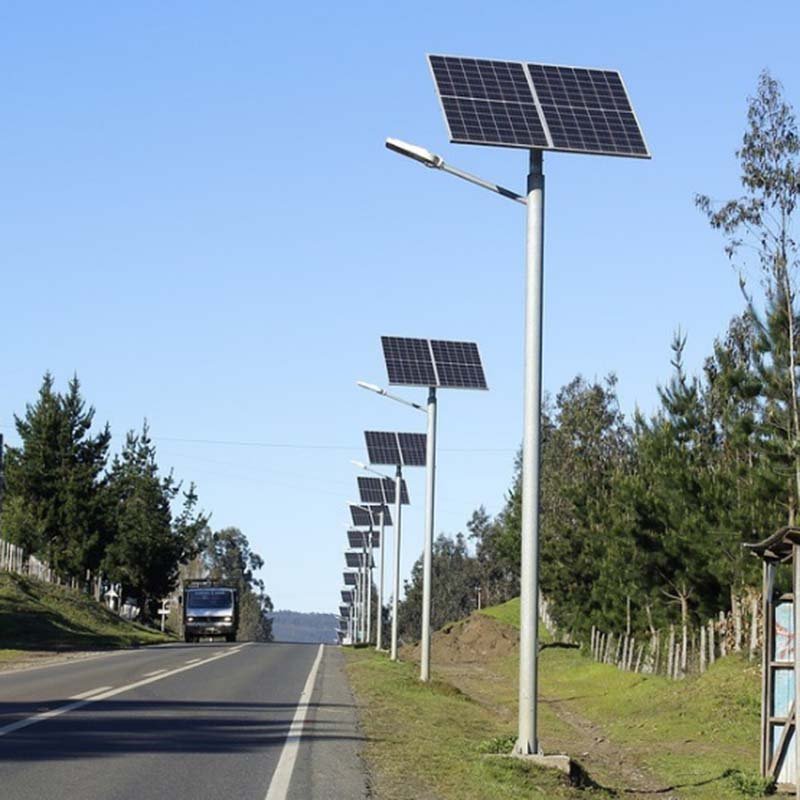
Design: solar panel separated from lamp body, with dedicated battery/control compartment.
Best for:
- highways
- main municipal roads
- industrial roads
- large-area public roads
- demanding autonomy requirements
- projects using 8–12 m poles or above
Advantages:
- larger battery capacity
- more flexible panel orientation
- better for higher wattage and longer runtime
- easier to configure for demanding projects
- more suitable where project geometry varies
Limitations:
- more installation work
- more cable and waterproofing points
- requires better site workmanship
See also Split Solar Street Light.
4.3 Smart / IoT Solar Street Light
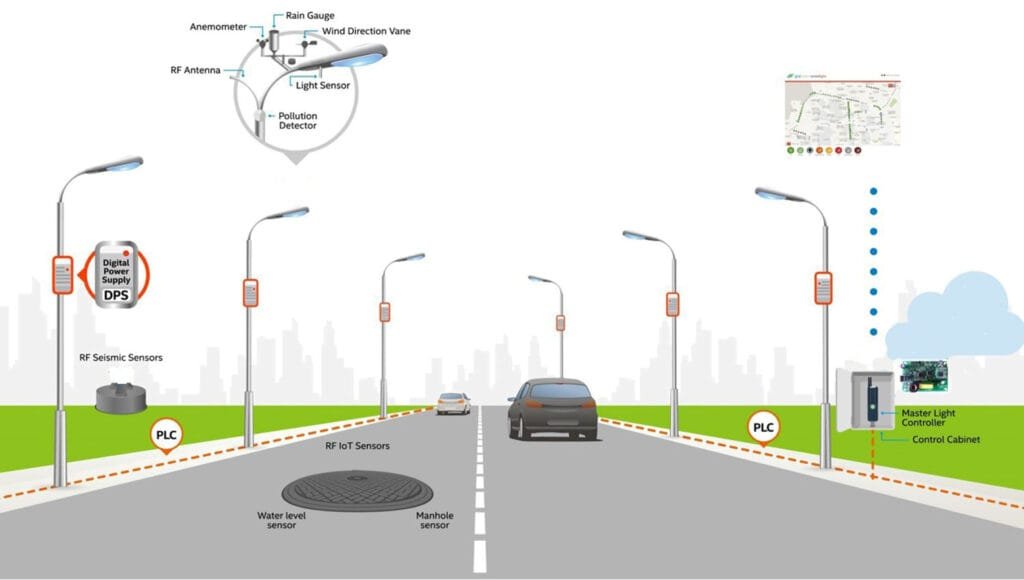
Design: includes remote monitoring, controller communication, and dashboard-level visibility.
Best for:
- smart city pilots
- municipal asset monitoring
- industrial parks
- donor-monitored assets
- larger O&M-sensitive projects
- projects with recurring service and reporting needs
Advantages:
- remote status visibility
- alarm logic
- battery and charging data
- grouped control
- faster fault isolation
- fewer blind site visits
Limitations:
- higher cost
- requires communications strategy
- depends on network/platform compatibility
- requires better commissioning discipline
5. The Specifications That Actually Matter
This is the core of the buyer’s guide.
Most buyers make mistakes because they compare the wrong numbers.
5.1 LED Efficacy: Don’t Buy by Wattage Alone
A “bigger wattage” label does not automatically mean better lighting.
What matters is:
- actual lumen output
- optical distribution
- delivered system efficiency
- road/application fit
For example, a more efficient luminaire can reduce the battery and panel size needed to achieve the same practical result.
See 230 lm/W High-Efficiency Solar Lighting.
5.2 Battery Chemistry and Cycle Life
Battery is one of the most important lifecycle cost drivers.
Older or lower-grade systems may use:
- lead-acid
- GEL / AGM
- lower-grade lithium packs
Better public-project systems often use:
- LiFePO₄
- higher cycle-life cells
- better battery management logic
Why it matters:
- rainy-season reliability
- lifespan expectation
- replacement frequency
- field maintenance burden
- tender credibility
See also 3.2V Low-Voltage Power Architecture.
5.3 Autonomy Days
One of the most common procurement mistakes is underestimating autonomy.
Buyers should define:
- required nightly runtime
- expected worst-season weather
- backup nights required
- whether dimming profile is fixed or adaptive
If a project repeatedly fails after 2–4 cloudy days, the issue is often not a “bad lamp,” but a battery/panel sizing mismatch.
5.4 Controller Quality and Dimming Logic
Controller quality is often underestimated.
The controller determines:
- charging behavior
- discharge protection
- timing logic
- dimming profile
- motion mode logic
- battery protection
- remote monitoring compatibility
Cheap or poorly configured controllers can ruin a good hardware package.
5.5 Pole and Corrosion Protection
A public solar street light project is not just about lamp heads.
Pole and corrosion logic matter just as much, especially in:
- coastal zones
- desert zones
- industrial parks
- ports
- high-humidity locations
Buyers should check:
- hot-dip galvanizing
- coating system
- corrosion class
- salt-spray expectations
- structural suitability
For structural and footing context, see Light Pole Foundation Design Basics.
5.6 IP / IK / Transport Compliance
These are not “nice to have” labels. They are procurement risk filters.
Typical items buyers should verify:
- IP rating
- IK rating
- battery transport compliance
- packaging quality
- shipping suitability
- vibration and handling tolerance
5.7 Documentation Package
For serious tenders, products alone are not enough.
A serious buyer should request:
- datasheets
- battery information
- controller information
- test reports
- IES / LDT files if relevant
- DIALux simulations where relevant
- pole drawings
- warranty terms
- compliance declarations
- packing logic
6. Common Buying Mistakes That Cause Project Failure
This is where many projects go wrong.
Mistake 1: Buying by Wattage Only
A “200W” label tells you very little if efficacy, optics, and battery logic are weak.
Mistake 2: Ignoring Battery Cycle Life
Short-cycle battery platforms often become expensive after 1–3 rainy seasons.
Mistake 3: Using All-in-One Systems for Every Project
Some buyers try to use integrated systems on roads and pole heights better suited to split designs.
Mistake 4: No Rainy-Season Autonomy Check
A system that works in dry season may fail in wet season.
Mistake 5: No Corrosion Spec
Coastal and desert failures often begin at the pole, brackets, fasteners, or cable entries.
Mistake 6: No Tender-Ready Documents
A supplier without usable supporting files can create review delays and procurement risk.
Mistake 7: Trusting Fake Claims
Some offers exaggerate wattage, lumen output, cycle life, or certification.
Mistake 8: Choosing the Lifecycle Cost Review Without Lifecycle Logic
The cheapest quote can become the most expensive project after battery replacements, service calls, and complaints.
7. Government, UN & NGO Procurement: What Buyers Usually Need
This is where many procurement teams separate strong suppliers from weak ones.
7.1 Government / Municipal Focus
Government buyers often need:
- long service life
- stable quality across batches
- practical maintenance logic
- visible public benefit
- defensible tender files
- clear warranty structure
7.2 UN / NGO / Humanitarian Focus
UN, UNHCR, NGO, and donor-funded projects usually place extra weight on:
- consistency
- traceability
- ease of maintenance
- field durability
- packaging and transport logic
- realistic rather than exaggerated performance claims
- simple replacement logic in remote areas
In these projects, reliability and accountability matter as much as headline performance.
7.3 Supporting Documents Buyers Should Ask For
A practical procurement pack often includes:
- product datasheet
- battery pack information
- controller information
- compliance declarations
- UN38.3 / MSDS where relevant
- IES/LDT files where relevant
- DIALux outputs for road or area lighting
- pole drawings and coating logic
- warranty statement
- packing and shipment details
For engineering and tender support, see Engineering Support.
8. Tender-Ready Buyer Checklist
Use this before RFQ, tender evaluation, or final award.
Before RFQ
- Define road type or application
- Define autonomy requirement
- Define expected runtime
- Define pole height range
- Define corrosion exposure
- Define whether monitoring is needed
Before Supplier Shortlisting
- Verify project references
- Review battery chemistry and cycle-life basis
- Review LED efficacy basis
- Confirm whether all-in-one or split is appropriate
- Ask for project-fit rather than generic quotation
Before Award
- Review full compliance file
- Review warranty language
- Review packing and delivery logic
- Confirm spare parts and after-sales path
- Review installation drawings and site assumptions
9. Total Cost of Ownership (TCO): Why Lifecycle Cost Review Often Costs More
A buyer’s guide should compare more than the quotation amount.
TCO should consider:
- initial equipment cost
- trenching avoided
- electricity cost avoided
- maintenance labor
- battery replacement frequency
- field failure risk
- truck rolls / service calls
- downtime and complaint cost
A better-designed solar system can cost more upfront and still win on 8–10 year value.
See How Solar Street Lights Save 20–30% Total Cost of Ownership in 10 Years.
10. How to Evaluate a Solar Street Light Supplier
A serious supplier should help you compare project fit, not just send a catalog.
Buyers should ask:
1. Can they explain project fit clearly?
Do they understand your road type, climate, autonomy, and maintenance environment?
2. Can they support tender review?
Can they provide tender-ready files, compliance logic, and engineering support?
3. Do they have real project references?
Not just factory pictures — real project logic, application fit, and delivery experience.
4. Do they understand lifecycle design?
Can they explain battery, panel, and dimming logic for your climate?
5. Can they support installation and after-sales?
Do they help beyond quotation?
6. Can they support larger project structures?
For some buyers, this includes EPC, PPP, export-credit, or milestone-delivery logic.
11. Case Notes: What Buyers Should Learn from Real Projects
This section should not be treated as brochure boasting.
It should help buyers understand what matters in real-world selection.
Case Note 1: Rural Road and Electrification Projects
Usually prioritize:
- faster deployment
- easier installation
- lower maintenance complexity
- modest but reliable autonomy
Case Note 2: Highway and Main-Road Projects
Usually prioritize:
- stronger structure
- split-type systems
- better optics
- more robust battery logic
- stronger documentation
Case Note 3: Coastal / Desert / Industrial Projects
Usually prioritize:
- corrosion resistance
- sealing quality
- stronger poles
- realistic environmental adaptation
Case Note 4: Government / Donor / Humanitarian Projects
Usually prioritize:
- consistency
- supporting documents
- maintainability
- audit-friendly logic
- realistic, defensible specifications
For broader reference pathways, see Africa Project References and Solar Street Light Projects.
12. Financing and Delivery Models for Large Projects
For larger public projects, the buyer may also need to evaluate the delivery and payment structure.
Common models include:
- EPC delivery
- PPP / service-based models
- export-credit-backed structures
- development bank / donor-compatible delivery paths
The key buyer question is not simply “Can this be financed?”
It is:
Can this project be delivered in a way that matches approval flow, risk profile, and procurement structure?
13. Buyer FAQ
What battery type is best for public solar street lighting projects?
For most serious public projects, LiFePO₄ is the preferred battery chemistry because of its cycle life, safety profile, and maintenance advantages over lead-acid.
How many backup nights should a government project require?
That depends on local solar resource, weather profile, runtime target, and dimming logic. A realistic autonomy requirement should reflect the rainy season, not just dry-season assumptions.
All-in-one or split system for highways?
In many highway and main-road projects, split-type systems are often more suitable because they allow larger battery capacity, more flexible configuration, and better support for higher poles and larger road widths.
What certifications are usually required in tenders?
Requirements vary by market, but buyers commonly ask for ingress protection, impact resistance, battery transport documentation, and other compliance declarations relevant to the project and shipping route.
What should UN / NGO buyers request before award?
They should request a practical evidence pack: technical files, battery and controller information, relevant compliance documents, packaging logic, and project-fit explanations that are realistic for field conditions.
How should buyers compare two solar street light quotations?
Not by wattage or initial price alone. Compare system type, battery chemistry, autonomy logic, LED efficacy, pole protection, documentation, warranty, and expected maintenance burden.
14. Final Step: Request a Tender-Ready Buyer Pack
If you are preparing a government, EPC, UN/NGO, or public-infrastructure project, the next step should not be random quotation comparison.
It should be a tender-ready review based on project type, technical fit, documentation, and lifecycle value.
Useful next steps
Option A — Compare system types first
👉 Compare Solar Street Light System Types
Option B — Review project and tender support
👉 Request Engineering Support
Option C — Review lifecycle cost logic
👉 Review TCO Analysis
Option D — Review project references
👉 See Africa Project References
What you can request
- tender-ready specification pack
- system type comparison
- project-fit recommendation
- engineering document support
- lifecycle / TCO comparison logic
- case notes relevant to your application
A strong solar street lighting project does not start with “Which product looks cheapest?”
It starts with:
Which system is most suitable for this project, this climate, this buyer, and this maintenance reality?