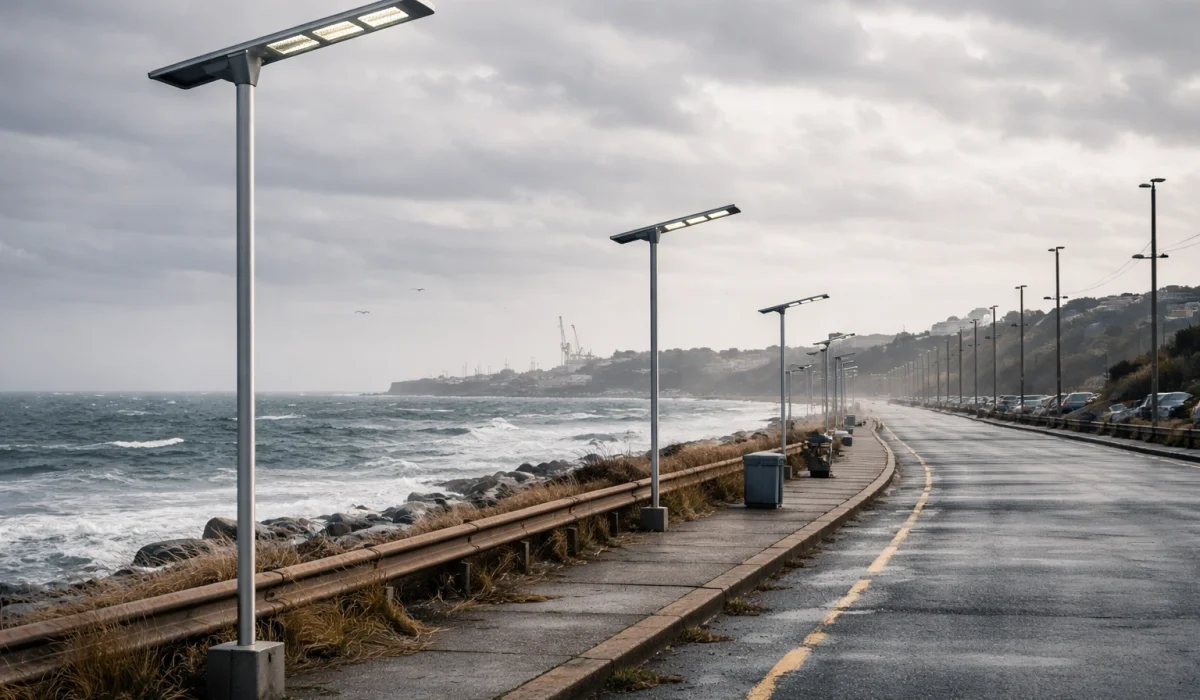
Galvanized poles can be used in coastal lighting projects, but they are usually not the best long-term choice in high-salt or marine splash zones unless additional coatings, sealing, and regular maintenance are included. For EPC contractors, consultants, and municipal buyers, the real decision is not simply whether galvanized steel can work near the ocean, but whether the site exposure, coating system, and maintenance plan can support the intended service life.
If you are reviewing pole materials for coastal roads, waterfront streets, public walkways, or marine-adjacent infrastructure, this guide explains where galvanized poles are acceptable, where they create hidden risk, and what alternatives may be more suitable. If you need technical review support for pole material selection, corrosion protection, or documentation, Sunlurio can support your project through Engineering Support, Lighting Pole solutions, and coastal corrosion protection design.
Quick Answer
Galvanized poles are acceptable in some coastal-adjacent projects, but they are usually not the preferred choice for direct marine exposure, splash zones, or locations with limited maintenance access. Their performance depends heavily on zinc coating quality, additional protective systems, environmental severity, and whether routine inspection and recoating are realistic over the project life.
For practical project review, the better question is not “Is galvanized steel good near the coast?” but “Under what exposure conditions can a galvanized pole achieve an acceptable service life without creating excessive maintenance burden?” In many cases, this judgment should be made together with the project’s engineering support requirements and the intended lighting pole specification path.
What Is a Galvanized Pole?
A galvanized pole is a steel pole protected by a zinc coating, usually applied through hot-dip galvanizing, to improve corrosion resistance in outdoor environments. The zinc layer helps protect the steel in two ways: it creates a physical barrier and also acts sacrificially, meaning the zinc corrodes before the underlying steel.
This is why galvanized poles are widely used in street lighting, highway lighting, and general outdoor infrastructure. In inland or moderately humid locations, they can deliver strong structural performance at a relatively reasonable cost.
However, coastal projects are not ordinary outdoor environments. Salt deposition, humidity, UV exposure, wind-driven spray, and trapped moisture all accelerate coating breakdown. That means a galvanized pole that performs well inland may not perform the same way near the ocean. Where corrosion risk is a major concern, buyers should also review coastal street light pole corrosion protection design rather than relying on galvanizing alone.
Why Coastal Environments Are Much Harder on Light Poles
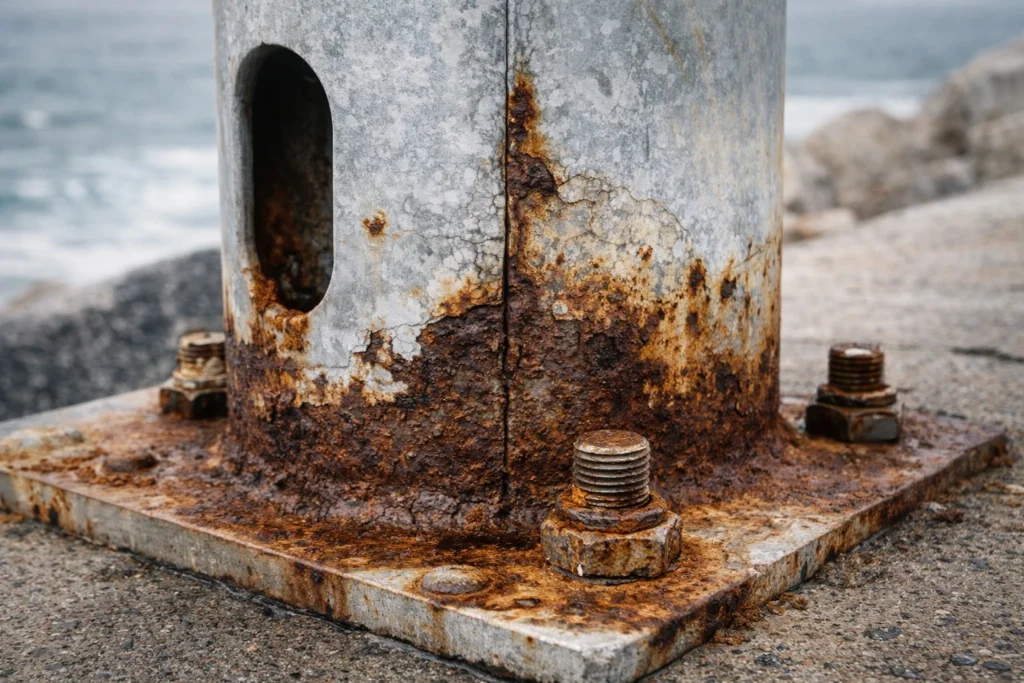
Coastal corrosion risk is not caused by moisture alone, but by the combined effect of salt, humidity, wind, and repeated wet-dry exposure on metal surfaces. In these environments, pole deterioration can accelerate quickly if the material system is not selected for actual exposure conditions.
Salt particles carried by air or spray settle on the pole surface and attract moisture. This creates an aggressive corrosion environment, especially around welds, seams, handholes, base plates, door openings, and coating defects. Repeated wind-driven spray and heat cycles can also weaken protective layers faster than many buyers expect.
Typical coastal pole deterioration includes:
- coating blistering or peeling
- white rust or zinc degradation
- rust bleed at welds and joints
- corrosion around base plates and anchor zones
- trapped moisture damage inside hollow pole sections
For pole selection in these environments, corrosion risk cannot be separated from structural design, installation details, and long-term maintenance planning. Projects that appear acceptable at delivery can still create serious lifecycle problems if corrosion protection is under-specified. This is also why it is useful to review light pole foundation basics together with corrosion risk, especially where base plates, anchor zones, and drainage details affect long-term durability.
How Galvanized Poles Actually Perform in Coastal Projects
Galvanized poles can perform adequately in coastal-adjacent areas, but their long-term suitability drops sharply in direct marine exposure or high-salt zones without additional protection. The zinc layer helps, but salt-rich environments shorten its useful life and increase the risk of exposed steel over time.
This is where many project teams make the wrong assumption. They see galvanizing listed in the specification and assume the corrosion problem is already solved. In reality, galvanizing alone is often only the starting point, not the full protection strategy.
In practice, galvanized poles tend to be more suitable when:
- the site is coastal-adjacent rather than direct waterfront
- salt spray exposure is moderate rather than constant
- routine inspection and recoating are realistic
- lifecycle maintenance is accepted as part of the project plan
They become much less suitable when:
- the pole is exposed to direct marine spray
- the project is close to ports, docks, waterfront promenades, or splash zones
- coating damage is likely and difficult to repair
- maintenance access is poor or irregular
- the owner expects low-intervention long-term service
For this reason, coastal pole review should be treated as a durability and lifecycle decision, not only a material comparison. Where approval decisions involve technical clarifications, Engineering Support and project references can help buyers evaluate whether the proposed pole system matches real project conditions.
A Practical Selection Rule for Coastal Pole Projects
The most useful way to evaluate galvanized poles near the coast is to classify the site by exposure severity, not just by whether it is “near the sea.” Two coastal projects may both be close to the shoreline but still have very different corrosion risk depending on salt deposition, wind exposure, maintenance access, and direct spray conditions.
A practical selection rule is:
| Site Condition | Are Galvanized Poles Suitable? | What Else Is Needed? |
|---|---|---|
| Coastal city, no direct salt spray, maintenance available | Sometimes | Galvanizing plus inspection plan |
| Coastal-adjacent road with moderate salt exposure | Sometimes | Duplex coating system and sealing details |
| Waterfront walkway or open shoreline road | Usually not preferred | Consider aluminum or stainless steel |
| Port, dock, marine frontage, or splash zone | No in most cases | Use marine-grade alternative materials |
| Budget project with short design horizon and replaceable poles | Sometimes | Accept lifecycle maintenance burden |
This kind of site-based decision is often more useful than asking which material is “best” in general. Buyers should focus on exposure class, maintenance reality, and service-life expectations. For broader system planning, this material decision should also align with the project’s lighting pole category and any engineering support documentation path.
What Usually Goes Wrong with Galvanized Poles Near the Ocean?
The main risk is not that galvanized steel fails immediately, but that corrosion starts earlier than expected in local weak points and creates a higher maintenance burden than the original budget assumed. In coastal projects, deterioration often starts at the details, not across the whole pole surface at once.
The most common weak points include:
Welded Areas and Seams
Welds and seams are often more vulnerable than flat surfaces. If coating continuity is reduced or surface preparation is inconsistent, corrosion can begin here earlier than expected.
Base Plates and Anchor Zones
Corrosion often becomes more serious near the base of the pole where water, salt, dirt, and trapped moisture accumulate. This area should never be treated as secondary in coastal design review. In many projects, the pole base should be reviewed together with foundation design basics, because durability problems often involve both corrosion protection and installation detailing.
Handholes, Access Doors, and Openings
Openings can become long-term moisture entry points if sealing and drainage are not handled correctly. Internal corrosion risk is especially relevant in hollow poles.
Coating Damage During Transport or Installation
Even a well-galvanized pole can lose protection value if the coating is damaged before or during installation. In coastal projects, these damaged points can deteriorate much faster than many teams expect.
This is why durable pole performance depends not only on material selection, but also on detailing, transport handling, installation quality, and post-installation inspection. For teams reviewing these issues during project approval, Engineering Support can be more useful than a generic brochure.
Galvanized Steel vs Other Pole Materials for Coastal Projects
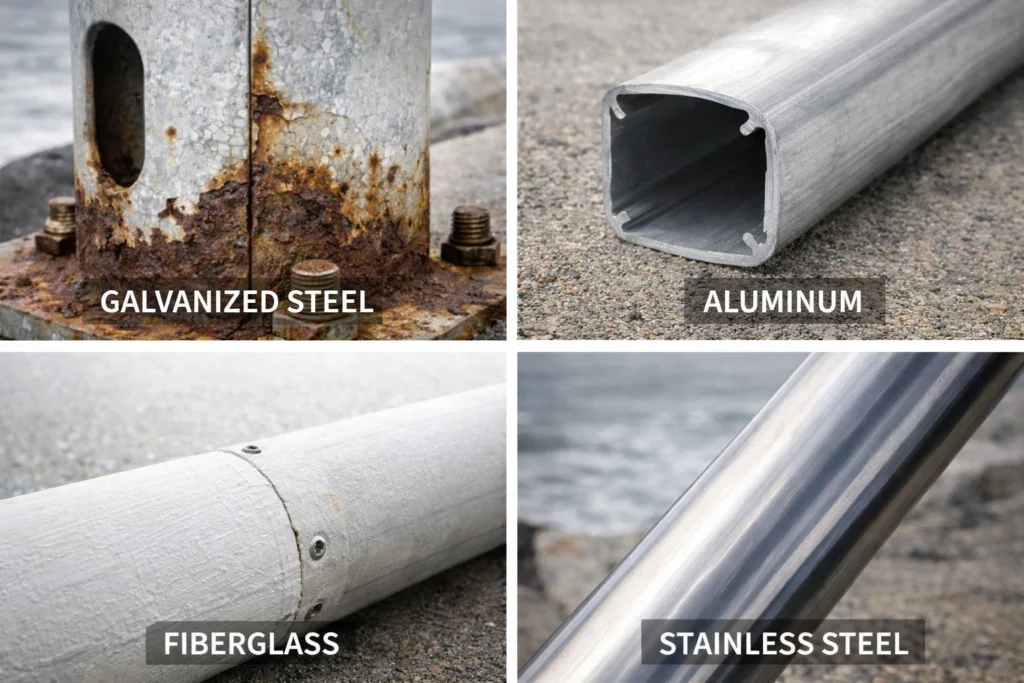
In many coastal environments, aluminum, fiberglass, or stainless steel can outperform galvanized steel because they reduce corrosion risk or lower the maintenance burden over the life of the project. The right choice depends on the site, budget, maintenance model, and expected service interval.
Galvanized Steel vs Stainless Steel
Stainless steel generally offers better corrosion resistance than galvanized steel in marine environments, especially in higher-grade specifications, but it comes at a much higher cost. It is often more suitable for premium waterfront projects, exposed public walkways, or visible landmark installations where long-term durability matters more than initial cost.
Galvanized Steel vs Aluminum
Aluminum is often a stronger candidate than galvanized steel for coastal projects where corrosion resistance and lower maintenance are more important than maximum structural mass. It performs well in salt-rich environments and can be easier to transport and handle.
Galvanized Steel vs Fiberglass
Fiberglass poles are often attractive in corrosive environments because they do not rust like steel and can offer strong durability in low-impact public applications. However, they may not suit every structural or urban design requirement.
A simplified comparison looks like this:
| Material | Coastal Corrosion Resistance | Maintenance Burden | Relative Cost | Typical Suitability |
|---|---|---|---|---|
| Galvanized steel | Moderate | Medium to high | Low to medium | Coastal-adjacent, maintainable projects |
| Stainless steel | Very high | Low | High | Premium waterfront or harsh marine zones |
| Aluminum | High | Low to medium | Medium | Coastal roads and urban marine-adjacent projects |
| Fiberglass | High | Low | Medium | Low-impact or corrosion-sensitive environments |
Where lifecycle performance matters more than lowest upfront cost, galvanized steel is often not the best default option. Buyers comparing alternatives can start from Lighting Pole solutions and then move into project-specific coastal corrosion protection design.
When a Galvanized Pole Is NOT the Right Choice
Galvanized poles are usually not the right choice when the environment is highly aggressive and the project does not support regular maintenance, recoating, or early replacement planning. This is the point many procurement teams underestimate.
Avoid relying on galvanized poles as the default answer in the following situations:
- direct marine splash zones
- port and dock infrastructure
- waterfront promenades with constant salt deposition
- installations with poor access for inspection or recoating
- projects that require low-maintenance, long-service performance
- visible public installations where coating failure would create safety or appearance issues
In these cases, the cheaper upfront material can become the more expensive lifecycle decision. When long-term durability matters more than short-term budget, it is better to review alternative lighting pole options and ask for engineering support clarification before approval.
How to Extend the Life of a Galvanized Pole in Coastal Conditions
If galvanized steel must be used in a coastal project, the best way to improve performance is to treat galvanizing as one layer in a broader protection system rather than as the entire solution. This usually means combining coating protection, detailing, sealing, and maintenance planning.
The most effective measures include:
Use a Duplex Protection System
A duplex system combines galvanizing with an additional protective coating such as epoxy primer and polyurethane or powder coating. This can improve durability significantly compared with galvanizing alone, especially where UV and salt exposure are both strong.
Improve Detailing at Vulnerable Points
Base plates, handholes, seams, welds, and drainage details should be reviewed carefully because these are the most common early-failure points. Good detailing often matters as much as the base material choice.
Seal and Inspect Critical Openings
Water ingress control is essential in hollow poles. Access doors, handholes, base transitions, and cable entry areas should be treated as corrosion-risk zones, not just fabrication details.
Build Maintenance into the Project Plan
A galvanized coastal pole should never be treated as maintenance-free. If inspection, washing, and coating touch-up are unlikely to happen, galvanized steel becomes a much riskier choice.
For projects that need technical clarification on coatings, pole specifications, or engineering documentation, it is often better to combine material review with Engineering Support, Lighting Pole product information, and coastal corrosion protection design guidance.

What Buyers Should Check Before Approving a Galvanized Pole for Coastal Use
Before approving galvanized poles for coastal projects, buyers should confirm the full corrosion protection strategy rather than simply checking whether the pole is galvanized. The approval process should verify whether the material system matches the actual site exposure and service expectations.
A practical review checklist should include:
| What to Check | Why It Matters |
|---|---|
| Exposure severity | “Coastal” can mean very different corrosion conditions |
| Coating system | Galvanizing alone may not be enough |
| Weld and base detailing | Local weak points often fail first |
| Pole interior protection | Hollow sections can corrode internally |
| Sealing and drainage | Moisture control affects long-term durability |
| Maintenance access | Determines whether lifecycle protection is realistic |
| Drawings and specifications | Needed to confirm the real protection approach |
| Project design life | Helps judge whether galvanized steel is truly suitable |
For project review and submission support, buyers should request model-specific drawings, surface treatment details, and corrosion-related technical notes rather than relying only on brochure language. This is also where coastal corrosion protection design guidance, engineering support documentation, and relevant project references become useful.
What to Avoid in Coastal Pole Selection
The most common mistake is assuming that galvanizing automatically makes a pole suitable for all coastal conditions. That assumption leads to under-specified projects, shorter service life, and avoidable maintenance cost.
Avoid these mistakes:
- treating all coastal sites as the same exposure class
- approving galvanized steel without asking about coating system details
- focusing only on upfront material cost
- ignoring splash-zone or direct spray conditions
- overlooking base plate, weld, and handhole corrosion risk
- assuming maintenance will happen later without a real service plan
- accepting generic product claims instead of project-specific technical support
This is especially important for municipal buyers and EPC teams who must justify long-term durability decisions after installation. In practice, buyers should review Engineering Support and the underlying lighting pole selection path before locking in the specification.
Conclusion
Galvanized poles can work in some coastal lighting projects, but they are usually not the best long-term choice for direct marine exposure, splash zones, or sites with weak maintenance access. Their real suitability depends on exposure severity, coating system quality, detailing, and whether the project accepts the lifecycle cost of inspection and protection renewal.
For EPC contractors, consultants, and municipal buyers, the better decision framework is not simply “galvanized or not,” but “Does this site allow galvanized steel to achieve the required service life without creating unacceptable corrosion and maintenance risk?”
If your coastal project requires pole material review, corrosion protection clarification, or technical documents for approval, explore Lighting Pole solutions, review coastal corrosion protection design, check relevant project references, or request support through Engineering Support.
FAQ
Are galvanized poles suitable for coastal projects?
Galvanized poles can be suitable for some coastal-adjacent projects, but they are usually not the preferred long-term choice in direct marine or splash-zone conditions unless additional coatings and regular maintenance are included.
When should galvanized poles be avoided near the ocean?
Galvanized poles should generally be avoided in direct marine frontage, splash zones, ports, waterfront promenades, and locations where regular maintenance or recoating is unlikely.
Is galvanizing alone enough for coastal pole protection?
Usually not. In many coastal conditions, galvanizing should be treated as only one part of the protection system, often supported by additional coatings, sealing, and maintenance planning.
What is the most common mistake in coastal pole selection?
The most common mistake is assuming that all coastal environments create the same level of corrosion risk. Exposure severity, salt deposition, and maintenance access all change whether galvanized steel is a suitable choice.
What documents should buyers request before approving galvanized poles for coastal use?
Buyers should request project-specific drawings, coating details, pole material specifications, and corrosion-related technical notes so they can judge whether the proposed pole system matches the actual site exposure and service expectations.