

When people evaluate an outdoor lighting project, they usually focus first on the luminaire, wattage, or lighting effect. But in real installations, the pole material has a direct impact on structural reliability, corrosion performance, maintenance cost, and long-term service life.
The most common lighting pole types are:
Each option has its place. The right choice depends on the project environment, expected load, maintenance conditions, and budget logic.
Quick Answer
For most municipal roads, highways, industrial areas, and EPC projects, steel lighting poles are still the most common choice because they offer strong structural capacity, broad fabrication flexibility, and good cost control.
But steel is not always the best answer.
- Aluminum lighting poles are often a better fit where corrosion resistance, lower maintenance, and cleaner appearance matter more.
- Composite lighting poles are often considered where the site is coastal, humid, chemically aggressive, or difficult to maintain, and long-term corrosion resistance is a priority.
In practice, the best lighting pole is not simply the strongest or the lightest. It is the one that matches the site conditions, structural demand, and lifecycle cost of the project.
Need help choosing the right lighting pole for your project?
Request Engineering Support (24H) →
What Are the Main Lighting Pole Types?

Lighting poles serve a simple but critical purpose: they support luminaires at the right height and position so the lighting layout can perform as intended. In real projects, however, the pole is not just a support member. It is part of a system that must work under wind, moisture, vibration, transport handling, and years of outdoor exposure.
A pole for a highway interchange faces different design pressures than one in a coastal park or a resort walkway. Wind zone, corrosion exposure, mounting height, outreach arm, soil condition, and maintenance access all influence the right material choice.
Lighting poles generally fall into three major categories:
- Steel poles — strong, versatile, and widely used
- Aluminum poles — corrosion-resistant and lighter to handle
- Composite poles — non-corrosive, lightweight, and used in selected harsh environments
Applications range from municipal streets and industrial zones to ports, parks, and landscape projects.
Steel Lighting Poles
What Are the Characteristics of Steel Lighting Poles?
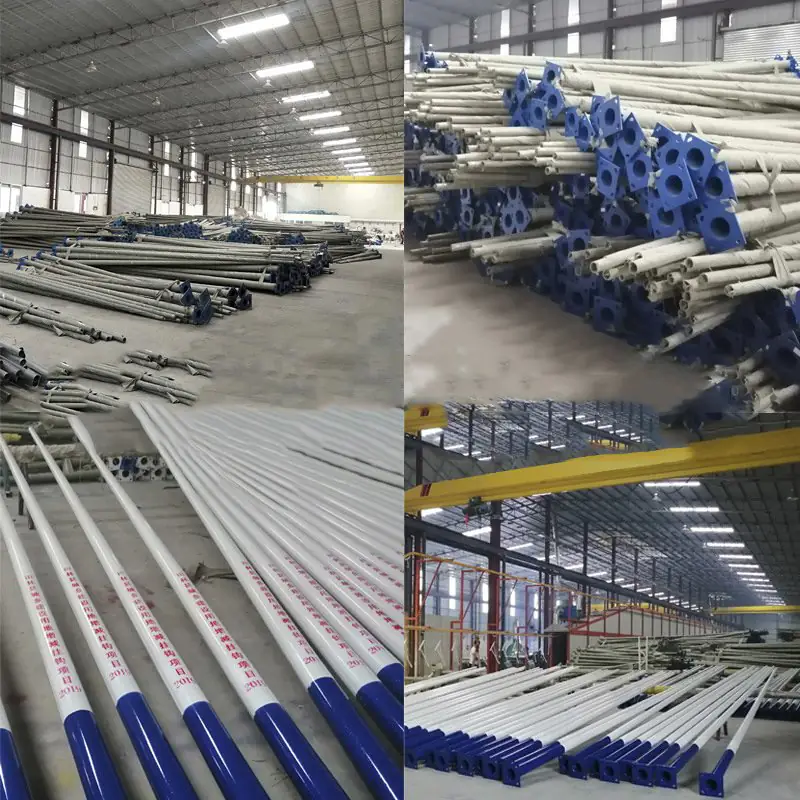
Steel poles remain the standard choice in many outdoor lighting projects because they combine strength, rigidity, and cost efficiency. They are commonly manufactured in forms such as tapered octagonal, round tapered, or conical shapes, depending on the project requirement.
Most steel poles are protected by hot-dip galvanizing, and in some projects they also receive powder-coated finishes for additional appearance control and surface protection.
With correct material selection, proper fabrication, and a suitable protective finish, steel poles can perform reliably for many years in inland and moderate environments.
What Are the Advantages of Steel Lighting Poles?
- High load-bearing capacity for larger luminaires, multiple fixtures, or longer outreach arms
- Good structural rigidity under wind and vibration
- Cost-effective for large public or infrastructure projects
- Flexible fabrication across different heights, brackets, and base-plate arrangements
- Widely accepted in road, industrial, and municipal applications
What Are the Disadvantages of Steel Lighting Poles?
- Heavier weight increases transport and installation effort
- Corrosion risk becomes more serious if galvanizing or coating quality is poor
- Maintenance demand can rise in coastal or aggressive environments
- Damage during transport or erection can expose the surface and reduce durability if not repaired properly
Common Applications for Steel Lighting Poles
- Highways and flyovers
- Industrial compounds and logistics areas
- Ports and infrastructure corridors
- Large parking areas
- Projects with higher pole heights or heavier fixture loads
In most standard outdoor lighting projects, steel is still the first material to evaluate because it balances structural performance and project cost well.
Aluminum Lighting Poles
ALT: aluminum lighting pole used in an outdoor urban or coastal lighting application
What Are the Characteristics of Aluminum Lighting Poles?
Aluminum poles are known for being lightweight, naturally corrosion-resistant, and visually clean. They are usually made from extruded aluminum alloy and can be finished with anodizing or powder coating depending on the project’s visual and protective requirements.
Because aluminum performs well in humid and salty air, it is often selected for urban boulevards, pedestrian areas, waterfronts, and coastal public spaces.
What Are the Advantages of Aluminum Lighting Poles?
- Lower weight makes transport and installation easier
- Strong corrosion resistance in humid and marine environments
- Low maintenance requirement over time
- Clean architectural appearance for public or decorative projects
- Recyclable material for projects with sustainability targets
What Are the Disadvantages of Aluminum Lighting Poles?
- Higher material cost than steel in many markets
- Lower stiffness and load capacity for some heavy-duty applications
- Requires more careful review in high wind zones or where luminaires and brackets are large
- Not always the best choice for budget-sensitive public tenders
Common Applications for Aluminum Lighting Poles
- Urban streets and pedestrian zones
- Coastal towns and waterfronts
- Decorative public lighting
- Landscape and resort projects
Where corrosion resistance and lower maintenance are more important than maximum structural load, aluminum often becomes the more sensible long-term choice.
Composite Lighting Poles

ALT: outdoor lighting pole example for discussing alternative pole material types and project applications
What Are the Characteristics of Composite Lighting Poles?
Composite poles are generally made from materials such as fiberglass-reinforced polymer or resin-based structural composites. Their main advantage is that they are non-corrosive, lightweight, and electrically non-conductive.
They are not as common as steel poles in mainstream municipal projects, but they can be useful in environments where corrosion, moisture, or maintenance difficulty creates long-term risk.
What Are the Advantages of Composite Lighting Poles?
- Strong resistance to rust, salt, and many corrosive conditions
- Very low maintenance demand in difficult environments
- Low weight for transport and installation
- Non-conductive characteristics in selected safety-sensitive applications
- Useful for remote projects where maintenance access is limited
What Are the Disadvantages of Composite Lighting Poles?
- Higher upfront cost in many markets
- Less common supply chain and specification familiarity
- Fewer standard options compared with steel in some regions
- Long-term performance depends heavily on material quality and UV protection design
- Some buyers or consultants may ask for more supporting documentation because the material is less familiar
Common Applications for Composite Lighting Poles
- Coastal and island locations
- Chemically aggressive sites
- Remote installations with limited maintenance access
- Parks, resorts, and special-environment lighting projects
Composite poles are not the default answer for every project, but in the right environment they can reduce long-term maintenance and corrosion problems significantly.
Comparison of Different Lighting Pole Types
| Feature | Steel Pole | Aluminum Pole | Composite Pole |
|---|---|---|---|
| Weight | Heavy | Light | Very Light |
| Corrosion Resistance | Moderate with proper protection | High | Excellent |
| Strength | Excellent | Good | Moderate to application-dependent |
| Maintenance | Medium | Low | Very Low |
| Typical Use | Highways, industrial sites, infrastructure | Urban, coastal, decorative | Remote, corrosive, specialty sites |
This table is useful for early comparison, but final pole selection should still consider:
- pole height
- luminaire weight
- outreach arm length
- local wind condition
- corrosion exposure
- maintenance access
- expected service life
How to Choose the Right Lighting Pole Type

ALT: octagonal galvanized steel lighting poles for road and area lighting projects
Selecting the right pole is not only about catalog specifications. In real projects, it is usually a balance of environment, structural demand, maintenance reality, and budget.
1. Start With the Environment
- Inland urban and road environments → steel is often the practical choice
- Humid or coastal environments → aluminum or composite deserve closer review
- Chemically aggressive or hard-to-maintain environments → composite may offer better long-term value
2. Check Structural Demand
If the project includes:
- higher pole heights
- large luminaires
- longer brackets
- higher wind exposure
then steel often remains the most reliable option because strength and stiffness become more important.
3. Review Installation and Maintenance Conditions
In remote sites or labor-constrained projects, lighter materials can reduce installation difficulty. Where maintenance access is poor, lower-corrosion materials may reduce future service risk.
4. Compare Lifecycle Cost, Not Just Purchase Price
A pole that costs less at the start may cost more later if it requires:
- repainting
- corrosion repair
- early replacement
- more frequent inspection
For some projects, steel wins on initial cost. For others, aluminum or composite wins on maintenance and durability.
5. Match the Pole Type to the Project Logic
Different projects usually have different decision priorities:
- public tender → budget, standardization, structural confidence
- coastal urban project → corrosion resistance and appearance
- industrial site → heavy-duty structural performance
- remote solar lighting project → low maintenance and easier logistics
The right pole is usually the one that fits the site conditions and review expectations, not simply the one with the lowest quoted unit price.
Common Mistakes When Choosing Lighting Pole Types
Many selection problems come from oversimplifying the decision.
Choosing by Material Alone
No material is universally best. The real question is whether the pole matches the environment, load, and maintenance conditions.
Underestimating Corrosion Exposure
In many outdoor projects, long-term problems come from:
- salt spray
- humidity
- standing water
- coating damage
- poor base protection details
Ignoring Wind and Fixture Load
Pole selection should always consider the whole system, including:
- luminaire size
- bracket outreach
- projected area
- wind pressure
- vibration behavior
Looking Only at Initial Cost
A cheaper pole can become a more expensive asset over time if maintenance, corrosion, or replacement risk is high.
Forgetting the Pole Base and Foundation Interface
Even the right pole material can underperform if the base plate, anchor bolts, grout edge, drainage, and protective details are not handled correctly.
For related reading, see:
Light Pole Foundation Design Basics
Conclusion: Choosing the Best Lighting Pole Type for Your Project
Each lighting pole material has a clear role in outdoor lighting design:
- Steel poles are strong, practical, and usually the most economical for mainstream road and infrastructure projects.
- Aluminum poles are often better for coastal, urban, or architecturally sensitive projects where lower maintenance matters.
- Composite poles can be a good solution in remote or highly corrosive environments where long-term durability is more important than lowest upfront cost.
In actual project work, the best pole is not the one that sounds most advanced in a brochure. It is the one that fits the site, structural demand, corrosion exposure, maintenance reality, and project budget.
Before finalizing the pole type, it is worth reviewing the site conditions and lifecycle implications carefully rather than choosing only by material name or initial quotation.
Need Help Choosing the Right Lighting Pole?
If you are comparing steel, aluminum, or composite lighting poles for a road, industrial, coastal, or solar lighting project, we can help review the project conditions and suggest a more suitable direction.
Request Engineering Support (24H) →
View Lighting Pole Options →
See Related Projects →
FAQ
What are the main lighting pole types?
The main lighting pole types are steel poles, aluminum poles, and composite poles. Each suits different project environments and structural requirements.
Which lighting pole type is most common?
For most municipal, highway, and industrial projects, steel lighting poles are still the most common because they offer strong structural performance and competitive cost.
Are aluminum lighting poles better than steel?
Not always. Aluminum lighting poles are often better in coastal or humid environments because of their corrosion resistance, while steel poles are usually better for heavier loads and lower upfront cost.
Are composite lighting poles worth it?
They can be worth it in coastal, remote, or corrosive environments where low maintenance and corrosion resistance justify the higher initial price.
Which lighting pole type is best for coastal areas?
For many coastal applications, aluminum poles or composite poles are often better choices than standard steel because they reduce long-term corrosion risk.
Which lighting pole type is best for highways?
For most highway and heavy-duty infrastructure applications, steel lighting poles remain the most practical and widely used choice.