1. Introduction
Outdoor lighting design integrates the science of photometry with environmental psychology and energy management. Unlike single-purpose street or sports lighting, outdoor illumination must reconcile diverse functions—safety, navigation, architecture, ecology, and perception—within a single controlled luminous environment. This paper defines Sunlurio’s engineering approach to outdoor lighting systems, covering design principles, simulation methodology, optical selection, control logic, and compliance with international standards such as EN 12464-2, CIE 94, and IES RP-33.
The goal is simple but technically rigorous: create outdoor environments that are visually clear, energy-efficient, and environmentally responsible, ensuring that light reaches where it is needed—and nowhere else.
2. Scope and Design Categories
Outdoor lighting encompasses a broad range of applications:
- Road and Path Lighting: vehicular and pedestrian movement zones.
- Façade and Architectural Lighting: highlighting vertical elements and textures.
- Landscape and Garden Lighting: vegetation, water, and hardscape composition.
- Security and Perimeter Lighting: deterrence and visibility around fences, CCTV areas.
- Commercial Plazas and Public Squares: mixed-use circulation with dynamic scenes.
Each category carries its own performance metrics—illuminance, luminance, uniformity, glare, color rendering, and control strategy—requiring coordinated simulation and standard-based evaluation.
3. Design Philosophy
Outdoor lighting operates at the intersection of visibility, aesthetics, and ecology. Its effectiveness depends on both photometric quality and contextual harmony. Sunlurio applies the following guiding principles:
- Purpose before power: Illuminate functions, not surfaces.
- Precision over brightness: Uniformity and contrast define visibility, not lux levels alone.
- Respect the dark: Minimize uplight and spill to protect nocturnal ecosystems.
- Human-centric design: Correlated Color Temperature (CCT) and Color Rendering Index (CRI) chosen for comfort and safety.
- Lifecycle efficiency: Design for maintainability, not just installation cost.
4. Standards and Regulatory Framework
| Standard | Focus Area | Key Criteria |
|---|
| EN 12464-2 | Outdoor work areas | Illuminance, uniformity, glare (UGR), CRI, maintenance factor |
| CIE 94 | Lighting of outdoor workplaces | Average illuminance, E_min/E_avg, luminaire classification |
| CIE 150 | Obtrusive light | Vertical illuminance at property line, sky glow limits |
| IES RP-33 | Exterior lighting design practice | BUG rating, CCT selection, light pollution control |
5. Fundamental Parameters and Equations
5.1 Illuminance Calculation
E(P) = Σ [ (I(θi, φi) · cos(θi)) / r_i² ]
where I(θi, φi) is the luminous intensity (cd) from luminaire i toward point P, θi the incidence angle, and r_i the distance (m).
5.2 Uniformity and Glare Control
U₀ = E_min / E_avg
GR = 10 × log₁₀ [ (ΣL_s²) / (Lb² × N) ]
- U₀ ≥0.25 for general areas, ≥0.4 for pathways and façades.
- Glare rating (GR) ≤45 for outdoor work areas, ≤35 for public plazas.
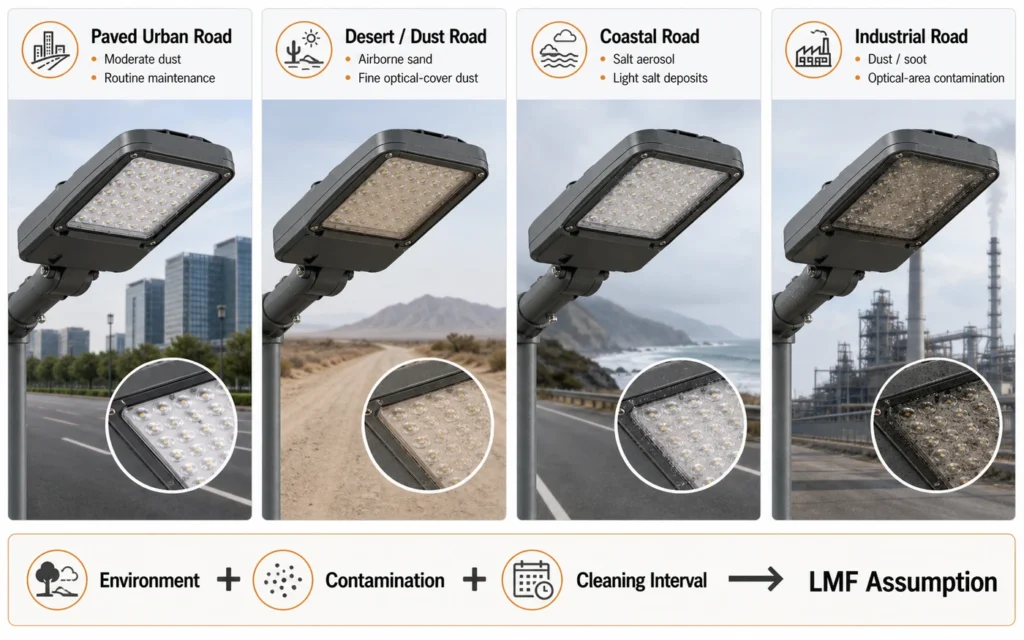
5.3 Maintenance Factor
MF = LLMF × LSF × LMF × RSMF
Recommended MF = 0.80 (urban), 0.75 (industrial), 0.70 (coastal).
6. Photometric and Colorimetric Specifications
- CCT: 2700–3000 K for residential zones; 3000–4000 K for public areas; ≥4000 K for security perimeters.
- CRI: ≥80 for architectural and landscape lighting; ≥70 acceptable for roads and utilities.
- Chromatic stability: Δu′v′ ≤0.002 over 6000 h operation.
- Optical control: full cut-off (U0 rating), beam spill ≤5% above 90°.
7. Simulation and Modeling Methodology
Sunlurio uses DIALux EVO for general outdoor design and AGi32 for precision façade and large-area calculations. The workflow includes:
- Model the site geometry (terrain, walls, vegetation, reflectance factors).
- Assign material reflectance: grass 0.15, concrete 0.35, water 0.05.
- Import IES/LDT files verified through goniophotometric testing.
- Define grid resolution (1 m × 1 m for open areas; 0.25 m × 0.25 m near façades).
- Calculate illuminance and luminance maps, false-color distributions, and glare analysis.
- Iterate aiming, mounting height, and optics until uniformity and spill-light limits are met.
8. Geometric and Mounting Parameters
| Application | Mounting Height (m) | Spacing (m) | Remarks |
|---|
| Pedestrian paths | 3–5 | 3–4 × H | Bollards or short poles, ≤3000 K |
| Parking areas | 6–10 | 3–5 × H | Asymmetric optics, ≤15° tilt |
| Building façades | 4–12 | Varies | Wall-wash or grazing, CRI ≥ 90 |
| Security zones | 6–8 | 2.5–3.5 × H | Cool white, uniform coverage |
9. Optical Distribution and Luminaire Selection
- Use asymmetric cut-off optics to minimize glare and spill.
- Select beam angles (narrow/medium/wide) according to task plane height and spacing.
- Ensure luminaire ingress protection IP65–68, impact resistance IK08–IK10.
- Material: die-cast aluminum, UV-resistant polycarbonate, powder-coated finish.
- Thermal management: junction temperature ≤85 °C at 40 °C ambient.
10. Electrical and Control Systems
- Power supply: 220–240 VAC, 50/60 Hz; driver PF ≥ 0.95, THD ≤ 10%.
- Surge protection: 10–20 kV (IEC 61000-4-5 Class II).
- Dimming control: DALI-2, 1–10 V, or PWM for integrated scenes.
- Smart nodes: LoRa / NB-IoT modules for remote scheduling, fault diagnostics, and runtime tracking.
- Photocell and astro-timer synchronization for adaptive night-time reduction (30–50% energy savings).
11. Energy Efficiency and Sustainability
P_total = Σ (P_fixture × Quantity × Duty_cycle × MF)
η_sys   = (Σ Illuminated Area × Target E_avg) / P_total
Sunlurio designs target system efficacy ≥120 lm/W and annual energy consumption ≤2.5 kWh/m² for public plazas. Lighting scenes are automated to respond to occupancy, weather, and time, achieving up to 55% savings compared with legacy HID systems.
12. Verification and Field Measurement
- Illuminance measurement per EN 13032-1 using calibrated lux meters (accuracy ±5%).
- Measurement grid ≤2 m spacing, 0.85 m plane height for pedestrian areas.
- Verify uniformity (U₀) and glare (GR) values; compare with simulation within ±10% tolerance.
- Record CCT and CRI via portable spectrometer for post-installation validation.
13. Maintenance and Reliability Planning
- Scheduled cleaning: every 12 months (urban), 6 months (coastal/industrial).
- Replace modules when lumen depreciation >20% (L80 ≥ 50 000 h typical).
- Check SPD counter logs; replace surge modules after 300 events or degradation ≥10%.
- Predictive maintenance via Sunlurio Cloud health index monitoring (voltage, temperature, RSSI).
14. Environmental and Ecological Considerations
- Limit upward light ratio (ULR) ≤1%; employ full cut-off optics.
- Use warm CCT ≤ 3000 K near wildlife zones and water bodies.
- Avoid blue-rich spectra in rural ecosystems to protect nocturnal species.
- Ensure compliance with Dark-Sky and LEED v4.1 outdoor lighting credits.
15. Example Project — Urban Waterfront Park
Parameters: Pathway 5 m wide, CCT 3000 K, R3 surface, 4 m poles, 12 m spacing, Type IV optics, 25 W fixtures.
Simulation (DIALux EVO): E_avg = 12 lx, U₀ = 0.41, GR = 28, power density = 0.9 W/m². Verified compliance with EN 12464-2 (E ≥ 10 lx, U₀ ≥ 0.35).
Performance: 47% lower energy use vs 35 W metal-halide; minimal uplight, full Dark-Sky compliance.
16. Deliverables and Documentation
- 3D simulation report (lux plots, isolux diagrams, false-color renderings).
- Photometric data (IES/LDT) and optical summaries.
- Wiring and control schematics with load schedules.
- Maintenance plan and system efficacy report.
- Installation QC checklist and commissioning log.
17. Summary
Outdoor lighting design is both art and engineering. Its success depends on quantitative simulation, optical discipline, and ecological sensitivity. By applying DIALux EVO precision modeling, high-efficacy Sunlurio luminaires, and IoT-enabled control, engineers can deliver spaces that are safe, efficient, and visually coherent. Light becomes an environmental instrument—measured, deliberate, and sustainable.
Author Introduction
Prepared by the Sunlurio Outdoor Lighting Engineering Division, a multidisciplinary team specializing in architectural, landscape, and infrastructure lighting systems. The division integrates optical design, DIALux/AGi32 simulation, and smart control development across global commercial, municipal, and ecological projects.
For calculation review, prepare road width, pole height, spacing, and target lux before requesting DIALux simulation support. Similar installation contexts can be checked through Projects Overview. For early review, submit project conditions through the project RFQ form.