Quick Answer
A solar street light proposal should not read like a brochure. A tender-ready proposal should help the reviewer answer three practical questions:
- Will the road or site be bright between poles, not just under each fixture?
- Will the system operate through the rainy season with a realistic autonomy and dimming profile?
- Can the EPC team hand over the project with clear acceptance criteria and the right documents?
If your proposal cannot show lighting performance, autonomy logic, and handover readiness, the project still carries approval risk, even if the product looks impressive on paper.
A practical guide for EPC contractors, consultants, municipalities, and project teams who need a solar street light proposal that supports approval, smooth installation, and cleaner handover.
Table of Contents
- Quick Answer
- What Makes a Solar Street Light Proposal “Tender-Ready”?
- Stop Guessing, Start Engineering
- Proposal Table of Contents
- Why a Proposal Template Alone Is Not Enough
- Step 0: Collect the 6 Site Inputs That Decide Most of the Design
- 1) Executive Summary
- 2) Project Objectives
- 3) Project Background & Scope
- 4) Scope of Supply
- 5) Lighting Design Approach & Deliverables
- 6) Technical Specifications
- 7) BOQ & Budget
- 8) Implementation Plan
- 9) QA/QC + Acceptance Criteria + Handover Documents
- 10) Why Contractors Trust an Engineering-First Proposal
- 11) Warranty, Maintenance & Spares Strategy
- 12) Risk & Mitigation
- Conclusion
- FAQ
What Makes a Solar Street Light Proposal “Tender-Ready”?
Many suppliers still prepare proposals as if they are product catalogs. But in real tenders, buyers, consultants, and EPC teams usually care less about slogans and more about whether the project can be:
- approved
- installed without rework
- accepted with fewer disputes
- maintained after handover
A tender-ready proposal should reduce uncertainty with measurable engineering outputs, not just product claims.
The Three Core Checks
| Check | Why It Matters |
|---|---|
| Lighting performance | Reviewers need confidence that the road or area will not have dark gaps between poles |
| Rainy-season autonomy | Battery size and dimming logic must be realistic under local climate conditions |
| Acceptance & handover | Clear checklist and document pack help EPC teams close the project more smoothly |
A good proposal should make these points visible early.
Stop Guessing, Start Engineering
If the layout is wrong, the expensive part is usually not the luminaire.
It is the rework, the delayed approval, or the rejected handover.
That is why a serious proposal should be based on project inputs such as:
- road width
- pole height
- pole spacing
- area type
- required autonomy nights
- climate or corrosion condition
Need a first-pass engineering review?
Share your road width, pole height, pole spacing, target lux and available layout. Our engineering team will confirm the suitable review path, required inputs and available outputs for your project.
Request a Lighting Design Review →
Proposal Table of Contents
A strong solar street light proposal often includes the following sections:
- Executive Summary
- Project Background & Scope
- Site Inputs & Design Assumptions
- Lighting Design Approach & Deliverables
- Technical Specifications
- BOQ & Budget Assumptions
- Implementation Plan
- QA/QC, Acceptance Criteria & Handover Documents
- Warranty, Maintenance & Spares Strategy
- Risk & Mitigation
- Appendices
This structure helps the reader move from project need to technical proof to delivery readiness.
Why a Proposal Template Alone Is Not Enough
An editable template is useful, but a template alone does not make a proposal credible.
A proposal becomes stronger when it includes:
- illuminance and uniformity logic, not just wattage
- autonomy with dimming profile, not just battery Ah
- documented deliverables, not just promises
- acceptance logic, not just installation scope
A useful sentence to include in your proposal is:
“Lighting design deliverables are included: IES files and simulation summary based on road width, pole height, and pole spacing.”
That one line already tells the reviewer that you are proposing an engineered solution, not just quoting hardware.
Step 0: Collect the 6 Site Inputs That Decide Most of the Design
This table is one of the fastest ways to make your proposal look engineering-led.
| Required Input | Why It Matters | Example |
|---|---|---|
| Road / area type | Defines lighting class and optics | Local road / highway / parking |
| Road width (m) | Affects beam distribution and uniformity | 7 m |
| Pole height (m) | Affects coverage, glare, and spacing | 6 m / 8 m / 9 m |
| Pole spacing (m) | Affects quantity and layout performance | 25 m / 30 m |
| Autonomy nights | Affects rainy-season reliability | 2–5 nights |
| Climate / environment | Affects panel sizing and corrosion strategy | Coastal / hot & dusty |
Want an engineering review?
Share these six inputs so the appropriate simulation scope, required files and review sequence can be confirmed for your project.
Download the IES / Simulation Input Checklist →
Or email: info@sunlurio.com
1) Executive Summary
Keep this section short and decision-maker friendly.
Executive Summary Example
This proposal presents a solar street lighting solution for [Project Name / Location] covering [X] poles across [Road length / Areas]. The system is designed to meet [target lux / uniformity] with [2–5 nights] autonomy under local climate conditions, using LED luminaires with road optics, MPPT charging, and LiFePO₄ (Lithium Iron Phosphate) energy storage. Deliverables include a BOQ, installation plan, and lighting design files (IES + simulation summary) to support approval, installation, and acceptance, with a focus on preventing dark zones between poles.
If possible, place a simulation vs actual installation photo comparison under this section. It helps convert the proposal from theory into proof.
2) Project Objectives
| Objective | Practical Result |
|---|---|
| Improve public safety | Better night visibility and potentially fewer incidents |
| Reduce energy cost | No grid electricity bills |
| Improve uptime | Operation during grid outages |
| Lower maintenance | Long-life LED + stable LiFePO₄ chemistry |
| Support acceptance | Clear checklist and handover documents |
This section helps non-technical decision-makers quickly understand why the project matters.
3) Project Background & Scope
This section should explain:
- where the project is
- what is being lit
- how many poles or areas are included
- what problems the buyer is trying to solve
- what constraints may affect design
Scope Summary Format
- Project area: [fill in]
- Estimated quantity: [fill in]
- Application: [road / parking / industrial park]
- Design autonomy: [2 / 3 / 5 nights]
- Dimming profile: [fill in]
- Acceptance method: checklist acceptance / lux sampling / consultant witness, as required
This is also the right place to mention project risks such as:
- coastal corrosion
- long rainy season
- theft risk
- no grid access
- high dust environment
4) Scope of Supply
A strong proposal avoids ambiguity about what is included.
Included Example
- LED luminaire with road optics
- Solar panel and bracket
- Battery pack: LiFePO₄ (Lithium Iron Phosphate) recommended for project use
- MPPT controller with protections
- Pole and arm, if included
- Anchor bolt kit and base plate template, if included
- Cables, connectors, and anti-theft fasteners where recommended
- Document pack for submittals and handover
A useful tender note is:
Recommended spares strategy: 2–3% for critical parts to reduce downtime after commissioning.
5) Lighting Design Approach & Deliverables
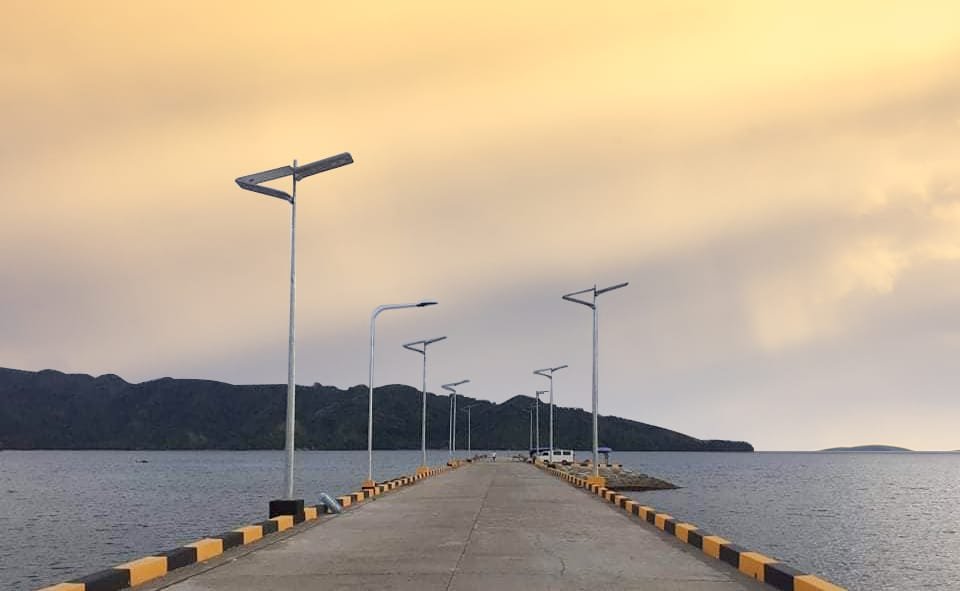
In tenders, deliverables are more convincing than adjectives.
Define what the buyer will actually receive.
| Deliverable | Description | Purpose |
|---|---|---|
| IES files | Luminaire photometric data | Simulation and consultant review |
| Simulation summary | Lux and uniformity results | Prevent dark zones and rework |
| Layout notes | Spacing, height, and arm recommendations | Faster EPC execution |
| Option A / B | Cost-optimized vs rainy-season-optimized | Clear decision-making |
Performance Targets
- Target average illuminance (Eavg): [__] lux
- Minimum uniformity (U0 = Emin / Eavg): [__]
- Battery autonomy: [2 / 3 / 5] nights under [dimming profile]
- Operating temperature: [] °C to [] °C
- Environment notes: coastal / dusty / high humidity, as applicable
Need design proof before submission?
We can help generate a lighting simulation report based on your road width, pole spacing, and mast height.
Download the Input Checklist →
Download the Engineering Guide →
6) Technical Specifications
6.1 System Specification Table
| Component | Example Specification | Notes |
|---|---|---|
| Solar panel | Monocrystalline, sized by location | Avoid fixed watt claim without solar data |
| Battery | LiFePO₄, sized by autonomy nights | Must define dimming profile |
| Controller | MPPT smart controller | Protections and temperature control |
| LED luminaire | Road optics + high efficacy | Optics drive uniformity |
| System efficacy | lm/W (system) | More useful than watt-only comparison |
| CCT | 4000K–5700K | Align with local requirements |
| IP rating | IP66 | Outdoor reliability |
| Surge protection | SPD recommended | Important in lightning regions |
A useful reviewer note:
In modern tenders, system efficacy (lm/W) and verified photometric performance usually matter more than wattage alone.
6.2 Pole & Foundation
| Item | Example | Notes |
|---|---|---|
| Pole height | 6 m / 8 m / 9 m | Must match spacing and road width |
| Material | Hot-dip galvanized steel | Stronger corrosion strategy for coastal use |
| Base plate | As per drawing | Provide bolt-circle dimensions |
| Anchor bolts | M16 / M20 / M24 | Provide casting template |
| Bolt projection length | [__] mm above foundation | Prevent nut engagement issues |
| Wind load | Project-specific | Align with local conditions |
7) BOQ & Budget
Always state assumptions clearly.
7.1 Sample BOQ
| Item | Unit | Qty | Notes |
|---|---|---|---|
| Solar street light system (complete) | set | 50 | Panel + LiFePO₄ battery + controller + luminaire |
| Pole + arm (if included) | set | 50 | 6–9 m |
| Anchor bolt kit (if included) | set | 50 | With template + projection length |
| Installation & commissioning | job | 1 | Includes testing |
| Spares kit (recommended) | lot | 1 | 2–3% critical parts |
7.2 Sample Budget Breakdown
| Cost Item | Quantity | Unit Cost | Total |
|---|---|---|---|
| Solar street light sets | 50 | $___ | $___ |
| Poles & anchor bolts | 50 | $___ | $___ |
| Installation | 50 | $___ | $___ |
| Logistics & clearance | 1 | $___ | $___ |
| Total | $___ |
Budget Assumptions
- Whether foundation civil works are included or excluded
- Dimming profile, for example: 100% for first 5 hours, then 50%
- Autonomy nights and seasonal assumptions
- Warranty scope and exclusions
This section protects both pricing clarity and later expectation management.
8) Implementation Plan

| Phase | Key Tasks | Owner | Duration |
|---|---|---|---|
| Site confirmation | Inputs, layout, approvals | Client / EPC | 1–2 weeks |
| Engineering submittal | IES + simulation + final specs | Supplier | 3–7 days |
| Production | Manufacturing + QA | Supplier | 2–6 weeks |
| Shipping | Packing, documents, delivery | Supplier / Forwarder | 2–6 weeks |
| Installation | Foundation, poles, installation | EPC | 2–4 weeks |
| Commissioning | Testing + handover | EPC + Supplier | 2–5 days |
A good implementation table shows the buyer that your proposal is executable, not just technically attractive.
9) QA/QC + Acceptance Criteria + Handover Documents
Factory QA Examples
- Incoming inspection of panel, controller, and battery
- Functional testing and burn-in
- Waterproof sealing checks
- Packaging inspection and serial tracking
- CCT consistency check for batch uniformity
Site Acceptance Examples
- Mechanical inspection: mounting, torque, cable routing
- Controller configuration: dimming schedule
- Daytime charging verification
- Night operation verification
- CCT consistency check across installed luminaires
- Lux sampling at agreed points, where required
Handover Documents
- Final BOQ and packing list
- Installation manual and wiring diagram
- Warranty certificate
- As-built list with serial numbers and locations
- Maintenance checklist
This section helps the reviewer see that your proposal supports not just delivery, but also acceptance.
10) Why Contractors Trust an Engineering-First Proposal
Many suppliers still sell watts.
A more reliable proposal sells light on the ground and handover confidence.
An engineering-first proposal helps reduce risks such as:
- dark zones between poles
- wrong optics selection
- undersized battery for rainy season
- mismatched foundation details
- avoidable handover disputes
That is why simulation, layout logic, and measurable criteria belong inside the proposal.
11) Warranty, Maintenance & Spares Strategy
- System warranty: [__] years
- Battery warranty: [__] years, under defined conditions
- Recommended spares: 2–3% for critical parts
- Maintenance: quarterly visual checks; annual fastener inspection for dusty or coastal sites
This section is particularly important in donor-funded, municipal, and EPC projects where lifecycle clarity affects approval.
12) Risk & Mitigation
| Risk | Impact | Mitigation |
|---|---|---|
| Prolonged rainy season | Dimming / shorter runtime | Increase autonomy + optimize dimming profile |
| Coastal corrosion | Pole / fastener deterioration | Hot-dip galvanizing + suitable coating |
| Theft / vandalism | Asset loss | Anti-theft screws, elevated battery design |
| Wrong spacing / pole height | Dark zones between poles | Simulation-based layout recommendation |
A proposal that includes risk and mitigation usually appears more credible than one that only describes best-case performance.
Conclusion
A solar street light proposal becomes much stronger when it clearly defines:
- site inputs
- lighting design logic
- autonomy assumptions
- BOQ and budget assumptions
- acceptance criteria
- handover documents
That makes approval faster, installation smoother, and post-installation disputes easier to avoid.
Ready to turn your proposal into a tender-ready submission?
Send your layout drawings and site inputs to info@sunlurio.com and our engineering team can help prepare a lighting design report that is easier to submit and defend.
FAQ
What should a solar street light proposal include?
A strong proposal should include project scope, site inputs, design assumptions, lighting deliverables, technical specifications, BOQ, budget assumptions, implementation plan, QA/QC, acceptance criteria, handover documents, and warranty / maintenance strategy.
What makes a solar street light proposal tender-ready?
A tender-ready proposal shows not only product specifications, but also measurable lighting performance, rainy-season autonomy logic, and acceptance / handover readiness.
What is the difference between a brochure and a tender-ready proposal?
A brochure promotes products. A tender-ready proposal explains how the project will be approved, installed, verified, and handed over with fewer risks.
Why are IES files important in a solar street light proposal?
IES files provide photometric data for simulation and review. They help consultants and EPC teams verify whether the lighting design can achieve the required lux and uniformity.
Why is simulation important for solar street light tenders?
Simulation helps predict lux levels, uniformity, and dark zones before installation. It reduces the risk of spacing mistakes, under-lighting, and later rework.
How do I present rainy-season autonomy in a proposal?
State the autonomy nights, dimming profile, load assumptions, and climate logic clearly. Do not only list battery Ah without explaining how runtime is achieved.
What site inputs should be collected before preparing a proposal?
Useful inputs include road or area type, road width, pole height, pole spacing, autonomy nights, and climate or environment conditions.
What should be included in BOQ assumptions?
You should clarify whether civil works are included, what dimming profile is used, the required autonomy nights, and which warranty or exclusions apply.
What should acceptance criteria look like in a solar street light proposal?
Acceptance criteria may include mechanical inspection, controller configuration checks, daytime charging verification, night operation checks, lux sampling where required, and document handover.
What handover documents should be included?
Typical handover documents include the final BOQ, packing list, installation manual, wiring diagram, warranty certificate, as-built list, and maintenance checklist.
Why is uniformity between poles important?
Because a road that looks bright directly under each pole can still fail in practice if there are dark gaps between poles. Reviewers and users care about the full lit area, not only hotspot brightness.
Why is battery Ah alone not enough in a proposal?
Battery Ah does not explain runtime by itself. A proper proposal should also define load, operating hours, dimming profile, and autonomy nights.
What battery chemistry is commonly recommended for project use?
LiFePO₄ is commonly recommended for project use because it offers good safety, cycling stability, and acceptance in many infrastructure tenders.
How can EPC contractors make solar street light proposals easier to approve?
By using project-specific inputs, providing IES and simulation deliverables, clearly stating assumptions, and including acceptance and handover documents.
Can Sunlurio help review a solar street light proposal?
Yes. Sunlurio can help review site inputs, layout assumptions, BOQ structure, and lighting design logic for suitable project opportunities.