
Choosing the wrong corrosion-protection method for a light pole can create a problem that only becomes visible later: early rusting, coating failure at welds and edges, higher maintenance, and shorter service life in outdoor exposure.
For municipal roads, industrial sites, ports, estates, and public projects, the real question is not simply which option is cheaper at the start.
The more useful question is:
Which protection method is more realistic for the site environment, maintenance cycle, and tender requirements of the project?
In most outdoor lighting projects, that answer is usually hot-dip galvanizing. Zinc-rich coatings, often described in the market as cold galvanizing, can still be useful, but they are generally better understood as a coating or repair approach, not a direct equivalent to after-fabrication hot-dip galvanizing.
Quick Answer
For most outdoor light poles, hot-dip galvanizing is usually the safer choice because it provides a heavier-duty zinc coating that is better suited to long-term corrosion protection in road, municipal, industrial, and coastal environments.
In practical terms:
- Hot-dip galvanizing is usually better for new outdoor poles in public and infrastructure projects.
- Cold galvanizing usually refers to a zinc-rich coating and is more suitable for touch-up, repair, or lighter-duty service conditions.
- If the project expects lower maintenance, longer service life, and better corrosion resistance, hot-dip galvanizing is usually the more defensible option.
- If the environment is coastal, humid, polluted, or hard to maintain, the case for hot-dip galvanizing becomes even stronger.
The key point is simple:
“Galvanized” is not enough as a buying decision. The project should confirm the actual coating method, the applicable standard, the service environment, and the maintenance expectation.
Need help reviewing the right corrosion-protection strategy for a road, municipal, industrial, or coastal lighting project?
Explore Solutions
Request Engineering Support (24H)
Why This Decision Matters in Real Projects
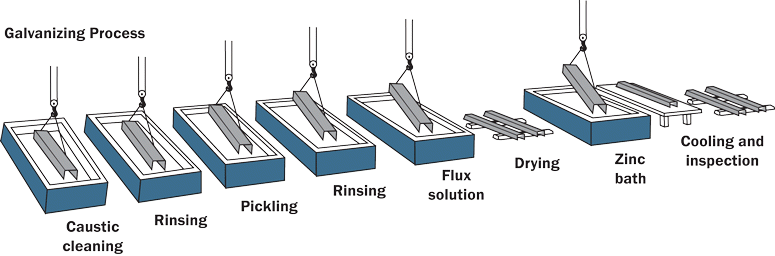
ALT: hot-dip galvanizing process for steel poles showing zinc coating protection
Caption: For light poles in outdoor service, the galvanizing method affects corrosion risk, maintenance frequency, and lifecycle value.
A pole coating is not just a finish detail. It affects:
- corrosion resistance
- weld and edge protection
- maintenance frequency
- touch-up requirements
- lifecycle cost
- suitability for public or coastal use
That matters especially for:
- municipal roads
- highways
- estates and public streets
- industrial compounds
- ports and waterfront areas
- projects where future maintenance access is limited
A coating that looks acceptable in a quotation may still become the weaker option once the pole faces years of humidity, rain, pollution, salt air, or physical handling.
What Is Hot-Dip Galvanizing?
Hot-dip galvanizing is an after-fabrication process in which cleaned steel is immersed in molten zinc. The zinc reacts with the steel and forms zinc-iron alloy layers plus an outer zinc layer.
This matters because the coating is not just sitting on top of the steel like ordinary paint. It becomes part of the corrosion-protection system in a much stronger way.
Why Hot-Dip Galvanizing Performs Better in Outdoor Use
Hot-dip galvanizing is usually preferred in outdoor infrastructure because it provides:
- more durable corrosion protection
- stronger edge and corner coverage
- better performance on welded and fabricated parts
- lower maintenance tendency over time
- more realistic service-life value in exposed environments
Typical Best Applications
Hot-dip galvanizing is usually the more suitable choice for:
- road lighting poles
- highway poles
- municipal and public projects
- industrial lighting poles
- coastal or humid environments
- long-life infrastructure assets
For related pole applications, see:
Lighting Pole
What Is Cold Galvanizing in Practical Terms?
The phrase cold galvanizing is used loosely in the market and often causes confusion.
In many practical cases, it refers to a zinc-rich paint or zinc-rich coating applied by:
- brush
- roller
- spray
This type of coating can still provide useful protection, especially in repair or touch-up situations, but it is not the same as after-fabrication batch hot-dip galvanizing.
Where Zinc-Rich Coatings Can Still Be Useful
Cold galvanizing or zinc-rich coatings can still make sense for:
- repair of damaged galvanized surfaces
- touch-up after transport or installation damage
- maintenance work
- less aggressive service environments
- projects that do not need the same lifecycle performance as fully hot-dip galvanized poles
The problem is not that zinc-rich coatings are useless. The problem is when they are treated as though they are equal to hot-dip galvanizing for harsh outdoor poles.
The Most Common Buyer Misunderstanding
A common mistake in outdoor pole procurement is assuming that:
“cold galvanized” = “galvanized” = “same protection level”
That is usually not a safe assumption.
For light poles in real outdoor service, the more important questions are:
- Is this a true hot-dip galvanized pole?
- Is the coating intended for new structural outdoor use or only for touch-up?
- How will this perform in humidity, coastal air, or industrial exposure?
- What maintenance cycle is realistic for the buyer?
This is where many projects make the wrong choice. They compare only initial finish description and price, but not the actual corrosion-protection logic.
Key Differences Between Hot-Dip and Cold Galvanizing
| Feature | Hot-Dip Galvanizing | Zinc-Rich Coating (“Cold Galvanizing”) |
|---|---|---|
| Process | Steel immersed in molten zinc | Zinc-rich coating applied by brush, roller, or spray |
| Bond to steel | Metallurgical bond | Coating adhesion through binder system |
| Outdoor durability | Stronger for long-term outdoor exposure | More limited and environment-dependent |
| Edge and corner protection | Generally better | More dependent on application quality |
| Typical use | New outdoor poles, roads, infrastructure, coastal projects | Repair, touch-up, lighter-duty use |
| Lifecycle logic | Higher initial cost, lower maintenance tendency | Lower initial cost, more maintenance-sensitive |
This is why the real comparison should usually be:
Which one gives the project a more realistic lifecycle result?
Which Option Fits Which Project?
Municipal Roads
For municipal roads, public streets, and estate roads, hot-dip galvanizing is usually the better choice because poles are expected to stay in service for years with limited maintenance interruptions.
Coastal Roads and Waterfront Areas
For coastal environments, hot-dip galvanizing is usually the safer starting point because corrosion exposure is more severe and maintenance costs rise faster if the coating system is weak.
Industrial Sites and Logistics Areas
For industrial compounds, ports, and logistics yards, hot-dip galvanizing is usually preferred because the pole may face more demanding environmental exposure and longer maintenance intervals.
Decorative or Lower-Duty Urban Elements
For lighter-duty decorative elements or controlled environments, a zinc-rich coating may still be acceptable in some cases, especially where the buyer understands the maintenance implications.
Repair and Touch-Up Work
For repair of damaged galvanized areas, zinc-rich coatings are often useful and practical.
How to Choose the Right Galvanizing Method for Light Poles
1. Start With the Environment
Ask:
- Is the site coastal?
- Is humidity high?
- Is the pole in a polluted or industrial area?
- Is rainfall frequent?
- Will maintenance be difficult?
The harsher the environment, the stronger the case for hot-dip galvanizing.
2. Check Service-Life Expectation
Ask:
- Is this a temporary project or a long-life public asset?
- Does the buyer expect low maintenance?
- Is repainting realistic later?
- Will access for repair be easy or difficult?
If the project expects long-term service with lower maintenance, hot-dip galvanizing usually makes more sense.
3. Review the Actual Coating Process
Ask:
- Is this after-fabrication hot-dip galvanizing?
- Is this only a zinc-rich surface coating?
- Is the supplier describing the finish clearly, or only using marketing terms?
4. Review Standards and Submittals
Ask for:
- galvanizing standard
- coating process description
- inspection or thickness records where applicable
- touch-up method for damaged areas
- packing method to reduce handling damage
For stronger procurement logic, see:
Manufacturing & Quality
What Better Buyers Usually Specify Before Approval
For light pole procurement, better buyers usually do not stop at “galvanized finish” in the BOQ.
They usually clarify at least:
- whether the pole is after-fabrication hot-dip galvanized
- the applicable standard
- coating thickness expectations where relevant
- treatment of welded and fabricated parts
- repair requirements for damaged areas after transport or installation
- whether a duplex system is required for extra durability or appearance
Practical BOQ / Tender Direction
A stronger specification usually avoids vague wording like:
- galvanized finish
- anti-rust treatment
- corrosion-protected surface
A better direction is to define:
- the protection method
- the standard
- the inspection expectation
- the repair method after coating damage
- the project environment if especially corrosive
This helps reduce disputes later.
Common Mistakes Buyers Make
Choosing Only by Initial Cost
A cheaper finish can still become the more expensive choice later if repainting, repair, or replacement happens earlier than expected.
Treating Cold Galvanizing as Equal to Hot-Dip Galvanizing
They are not the same process and should not be treated as interchangeable for harsh outdoor lighting poles.
Ignoring Edges, Welds, and Damage Points
These are often the places where weak coating logic becomes visible first.
Failing to Match the Coating to the Environment
A sheltered decorative environment is not the same as a coastal road or industrial yard.
Judging Only by Appearance
A smoother or shinier surface does not automatically mean better corrosion protection.
Project Review Checklist
Before approving the pole coating strategy, ask:
- What is the actual galvanizing method?
- Is the pole for long-life outdoor use or lighter-duty service?
- What is the site environment: inland, coastal, industrial, humid, or polluted?
- Is future repainting practical?
- Does the supplier clearly describe the coating logic?
- Are repair and touch-up procedures defined?
- Does the coating strategy fit the maintenance reality of the project?
Final Takeaway
For most outdoor light poles, especially in roads, municipal projects, industrial sites, and coastal environments, hot-dip galvanizing is usually the more reliable choice because it is better suited to long-term corrosion protection and lower-maintenance service.
Zinc-rich coatings, often called cold galvanizing, still have a useful role. But they are generally better understood as a coating or repair solution, not a full equivalent to after-fabrication hot-dip galvanizing for harsher outdoor poles.
So the better buying question is not:
Which one is cheaper?
It is:
Which one fits the environment, lifecycle expectation, and maintenance reality of the project?
Need Help Reviewing Pole Corrosion Protection?
If you are selecting light poles for a municipal road, coastal project, industrial area, or public tender, the next step is usually to review the environment, coating logic, and maintenance expectation together before approval.
Next actions:
- Explore Solutions
- View Lighting Pole Options
- See Project References
- Request Corrosion Protection Review (24H)
- Review Manufacturing & Quality
- See Markets We Serve
FAQ
Is hot-dip galvanizing better than cold galvanizing for light poles?
For most outdoor light poles, yes. Hot-dip galvanizing is usually the more durable and corrosion-resistant choice for long-term outdoor exposure.
What is cold galvanizing on a pole?
In many practical cases, cold galvanizing refers to a zinc-rich paint or zinc-rich coating, not true batch hot-dip galvanizing.
Is zinc-rich paint the same as hot-dip galvanizing?
No. Zinc-rich paint is a coating system applied to the surface, while hot-dip galvanizing is created by immersing steel in molten zinc and forming a stronger bonded protective layer.
Which option is better for coastal areas?
Hot-dip galvanizing is usually the safer starting point for coastal light poles because coastal air increases corrosion risk significantly.
Is cold galvanizing ever useful?
Yes. It can still be useful for touch-up, repair, or less demanding service conditions, but it should not automatically be treated as equal to hot-dip galvanizing for harsh outdoor poles.