
Quick Answer
Solar street lighting projects in Ethiopia are not purchased through one single buyer or one standard route. A project may be initiated by a government or municipal authority, funded through a development program, included in a road or infrastructure EPC package, or procured by an industrial park, school, hospital, or private estate. The organization that will operate the lights may not be the same organization that issues the tender, approves technical deviations, pays the contractor, or signs the acceptance certificate.
For this reason, supplier selection should not start with LED wattage or unit price alone. EPC and project teams should first confirm the procurement chain, site conditions, lighting criteria, operating schedule, autonomy requirement, pole and foundation scope, local installation responsibility, required tender documents, spare-parts plan, and acceptance method.
Quick Navigation
- Procurement chain
- Project delivery channels
- Utility-linked projects
- Donor and NGO procurement
- EPC packages
- Project inputs and review sequence
- Tender documents
- Supplier evaluation and risks
- Project review request
Why the Procurement Chain Matters
Ethiopia should not be treated as one uniform solar street light design condition or one simple “price market.” Road class, city or region, altitude, rainy-season conditions, dust exposure, shading, traffic pattern, maintenance access, and the availability of local installation support can differ materially from one project to another.
The commercial route can also change the technical response. A small institutional compound may be evaluated mainly by the owner and installer. A municipal road may involve a public employer, consultant, contractor, and operating authority. A donor-supported project may add a funding agency, implementing agency, formal procurement plan, environmental and social requirements, and defined reporting obligations. A road EPC package may require the lighting supplier to work through the main contractor rather than directly with the final owner.
The first task is therefore to map who controls each decision. This prevents a supplier from preparing a technically attractive offer for the wrong approval process.
For broader regional conditions and specification priorities, see Africa market guidance.
Who Buys, Approves, and Accepts the Project?
The word “buyer” is often too vague for a project tender. The following roles may be held by different organizations.
| Project role | Main responsibility | What the bidder should confirm |
|---|---|---|
| Employer / project owner | Defines the project need and contractual outcome | Who signs the contract and owns the completed assets? |
| Funding agency | Provides or supervises financing | Which procurement, reporting, or eligibility conditions apply? |
| Implementing agency | Manages procurement and implementation | Who issues the tender, answers clarifications, and controls the program? |
| Main EPC contractor | Coordinates the complete works package | Is lighting a nominated package, subcontract, or supplier scope? |
| Local contractor / installer | Performs civil, structural, electrical, and commissioning work | Who handles foundations, poles, lifting, installation, testing, and defects? |
| Consultant / engineer | Reviews design and compliance | Who approves drawings, calculations, samples, and technical deviations? |
| Operating authority | Operates and maintains the installed system | Who receives training, spare parts, warranty support, and maintenance records? |
| Acceptance authority | Witnesses or signs completion | Which tests, records, and performance criteria are required for acceptance? |
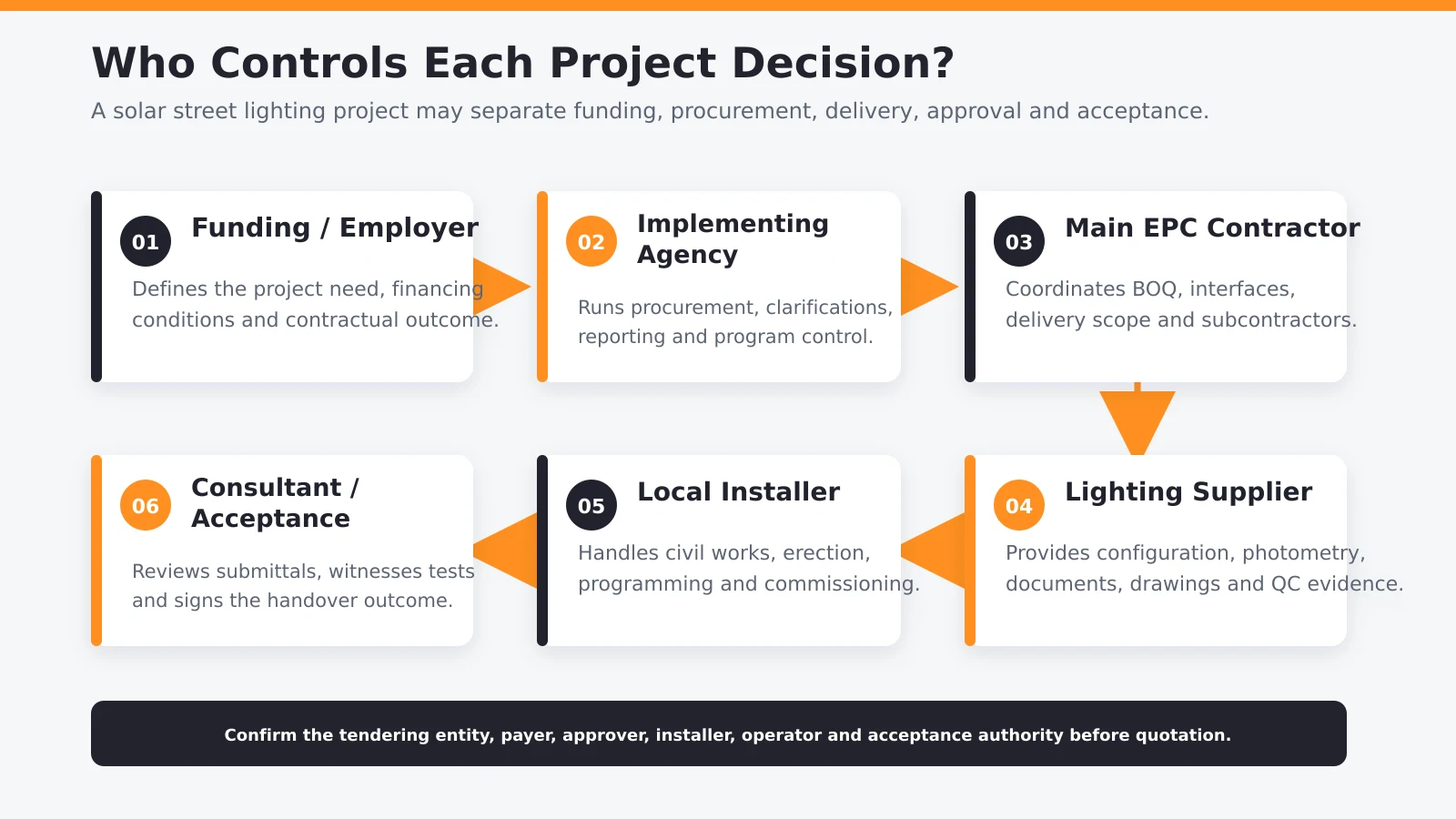
Role map for bid planning. Confirm the actual entities and approval responsibilities for each project before quotation.
Before quoting, confirm the tendering entity, employer, implementing agency, payer, consultant, installer, operator, and acceptance authority. Do not assume these roles from the name of the final beneficiary.
Main Project Delivery Channels
The roles above explain who controls each decision. The channels below explain how the lighting scope enters the project.
| Delivery channel | How lighting may enter the project | Questions that change the offer |
|---|---|---|
| Government or municipal project | Standalone public-lighting tender or part of a local infrastructure program | Who owns the road? Who approves the lighting class, pole position, and civil works? |
| Utility-linked electrification program | Lighting may appear within a defined public-service or electrification package | Does the procurement package explicitly include outdoor area or road lighting? |
| Donor-funded public infrastructure | Goods, works, supply-and-installation, or EPC package under a published program | What does the procurement plan and component description actually include? |
| NGO or humanitarian procurement | RFQ, RFT, local tender, or supply-and-installation package for a defined site | Who is eligible to bid, and are local delivery, civil works, training, and warranty included? |
| Road or infrastructure EPC package | Lighting is one subsystem within a larger road, corridor, or site contract | Who controls BOQ compliance, interfaces, deviations, installation, and acceptance? |
| Industrial park or private estate | Internal roads, gates, yards, perimeter routes, and staff-access areas | What are the safety, uptime, maintenance, security, and operating-hour requirements? |
| School, hospital, or institutional compound | Access roads, walkways, entrances, and public-service areas | Is the need roadway lighting, area lighting, security lighting, or building electrification? |
These channels are not interchangeable. An energy-access program, for example, may finance solar systems for buildings without including street lights. An industrial estate may need road photometrics and pole foundations but follow a private approval process rather than a public tender.
Power-Sector Institutions and Utility-Linked Projects
Ethiopian Electric Power (EEP) and Ethiopian Electric Utility (EEU) have different roles in the power sector. Their institutional scale should not be used as evidence that either organization is the country’s largest solar street light buyer.
EEP’s published materials focus primarily on power generation, transmission infrastructure, substations, bulk electricity supply, and regional power trade. These responsibilities do not by themselves establish EEP as a principal buyer of solar road-lighting systems. See EEP’s official Facts in Brief 2024/25.
EEU is closer to the distribution and customer-service side of the sector. Its establishing regulation includes constructing, maintaining, and administering electricity distribution networks, purchasing bulk power, and selling electricity to customers. See the official EEU establishment regulation.
EEU may also act as an implementing agency for defined grid, mini-grid, or stand-alone solar components, as shown in the World Bank’s ADELE project document. That still does not mean every EEU-related electrification program includes street lighting. EPC teams should check the exact procurement package instead of inferring scope from the institution’s name.
For a utility-linked opportunity, verify:
- the employer, implementing agency, contract type, and explicit inclusion of outdoor lighting;
- whether poles, foundations, cabling, installation, commissioning, and O&M are included;
- who approves drawings and technical deviations;
- who will own, operate, and accept the installed assets.
Donor-Funded Projects: Relevant, but Not Automatically Street-Lighting Tenders
Development-financed electrification programs are relevant to Ethiopia’s broader solar market, but they should not be described as solar street lighting opportunities unless the procurement documents say so.
The World Bank’s Access to Distributed Electricity and Lighting in Ethiopia (ADELE) project is designed to improve reliable electricity access for households, social institutions, and enterprises. Its published components include mini-grids, solar home systems, and stand-alone solar systems for health and education facilities. Those components demonstrate real demand for distributed solar systems, but they do not by themselves prove the existence of a roadway-lighting tender.
The World Bank’s ASCENT Ethiopia program likewise focuses on electricity access, grid connections, utility performance, and institutional capacity. A bidder should not convert that program description into a street-lighting claim without a specific procurement notice or package.
When reviewing a donor-funded opportunity, check the following documents and boundaries:
- the current procurement plan, notice, component, and BOQ;
- the employer, implementing agency, funding conditions, and bidder eligibility;
- the contract type and explicit inclusion or exclusion of outdoor lighting;
- pole, foundation, civil-work, installation, O&M, and local-service scope;
- reporting, inspection, environmental, social, and acceptance obligations.
The correct logic is:
A development program may create a procurement opportunity only when its current package, scope, and tender documents include the relevant lighting system.
NGO and Humanitarian Procurement
NGO procurement is not the same as a large multilateral development program. Opportunities may be issued as an RFQ, RFT, local supplier tender, or supply-and-installation contract for a specific camp, settlement, access route, public facility, or operational site. Bid windows may be short, and eligibility, submission completeness, local delivery, installation capacity, training, and after-sales responsibility can determine whether an overseas manufacturer can participate directly or needs a qualified local bidder, installer, or EPC partner.
Two closed procurement notices show why suppliers must read the complete scope rather than send a product-only quotation:
| Closed procurement example | Publicly shown scope | What suppliers should learn |
|---|---|---|
| Norwegian Refugee Council Ethiopia, 2026 | RFT for procurement of solar street lights | Monitor the contracting portal, confirm bidder eligibility, and follow the stated submission process |
| UNDP Dire Dawa landfill, 2025 | Supply and delivery, site survey, foundations, erection, testing, commissioning, training, as-built documents, warranty, and technical support | A luminaire or system price alone may not cover the required contract scope |
These are closed procurement examples, not active tender recommendations. The Norwegian Refugee Council notice closed on 27 April 2026, and the UNDP notice closed on 2 December 2025. Their value here is evidentiary: they show that Ethiopia-based NGO and UN procurement can require a complete supply–install–commission–handover chain.
Before responding to an NGO or humanitarian tender, confirm:
- bidder registration, nationality, local-presence, and tax requirements;
- the deadline, submission platform, mandatory forms, and clarification procedure;
- whether the contract is supply-only or includes survey, civil works, installation, testing, and training;
- delivery location, site access, security, storage, and local transport responsibility;
- warranty response, spare parts, O&M documents, and handover records.
For this type of delivery planning, see UN and NGO Humanitarian Lighting Projects.
International EPC-Led Infrastructure Packages
Solar street lighting may be delivered as a subsystem within a road, corridor, industrial, or public-infrastructure contract. In this route, the lighting manufacturer may supply the main EPC contractor or a specialist subcontractor rather than contract directly with the final employer.
The delivery chain often looks like this:
Employer or road authority → main EPC contractor → lighting supplier or subcontractor → local installer → consultant and employer acceptance
This structure creates interface risk. A luminaire and solar system can be technically suitable while the package still fails because pole drawings, foundations, anchor bolts, BOQ descriptions, installation responsibilities, or acceptance documents are incomplete.
Before the lighting offer is released, the EPC team should establish:
- who owns the lighting calculation, design criteria, and deviation approval;
- who supplies each system component, pole, anchor cage, and foundation input;
- who performs geotechnical and structural verification and prepares locally approved civil drawings;
- who installs, programs, tests, commissions, submits as-built records, and signs acceptance.
For the structural interface, use the light pole foundation design guide as a starting point, but treat supplier foundation information as design input unless it has been verified for the actual soil, wind, pole, and approval conditions.
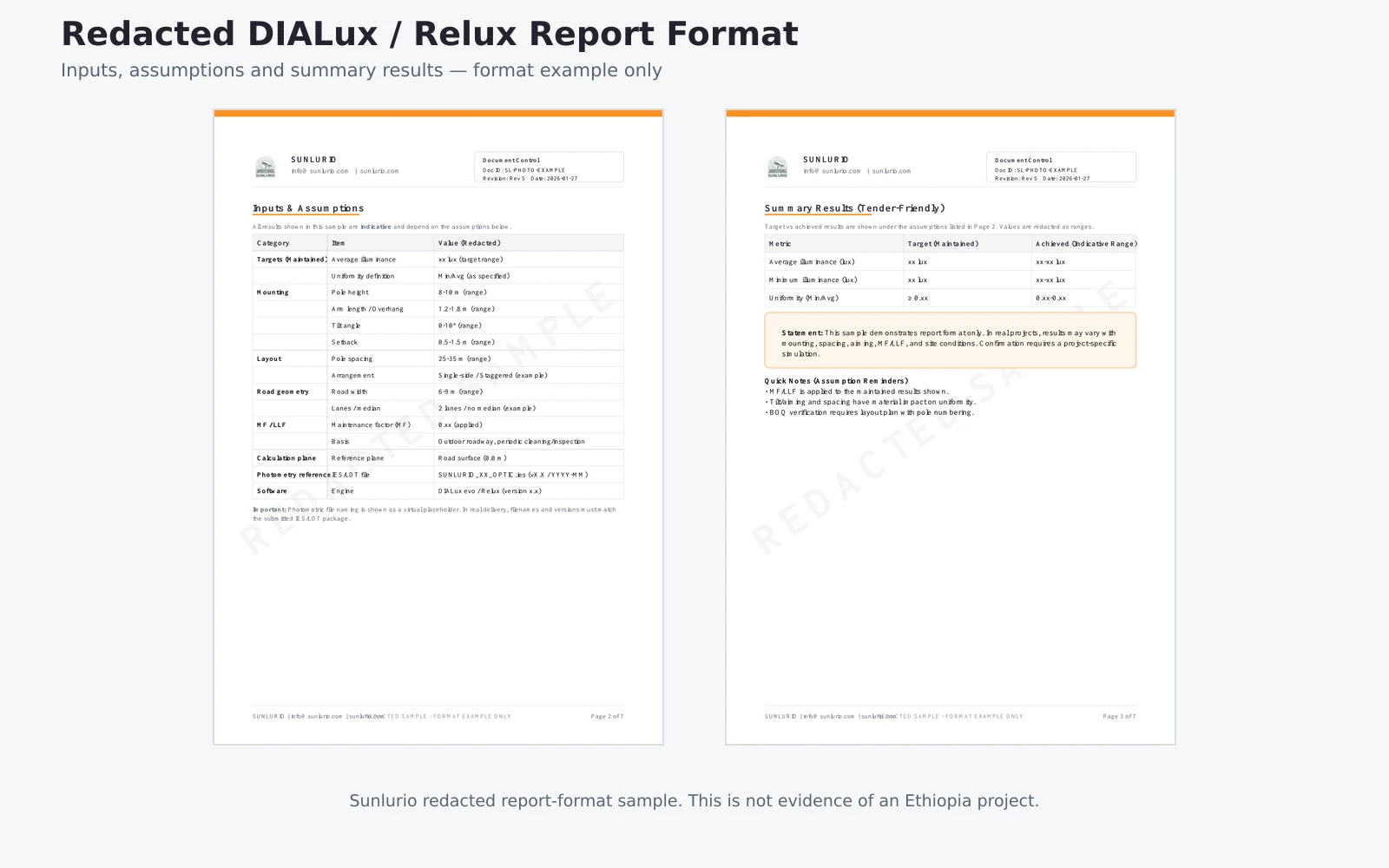
Redacted Sunlurio DIALux / Relux report-format sample, shown only as a document-format example—not as evidence of an Ethiopia project.
Project Inputs That Must Be Confirmed
“Suitable for Ethiopia” is not a complete design basis. The supplier needs project-specific information before it can size the optical, solar, battery, structural, and operating system.
| Input group | Required information | Why it matters |
|---|---|---|
| Location and environment | Coordinates, city or region, altitude, temperature range, dust, rainfall, flood risk, corrosion exposure, and shading | Changes solar yield, thermal behavior, enclosure needs, maintenance planning, and site risk |
| Road and area geometry | Road width, number of lanes, median, sidewalks, setbacks, mounting height, spacing, overhang, tilt, and arrangement | Controls optical layout, pole positions, uniformity, and quantity |
| Lighting criteria | Required standard, lighting class, average illuminance or luminance, uniformity, glare, maintenance factor, and calculation grid | Determines whether the proposal can be verified rather than judged by wattage alone |
| Operating profile | Night length, full-power hours, dimming periods, control logic, and seasonal variation | Determines nightly energy consumption and controller programming |
| Autonomy basis | Required backup days, permitted dimming during low energy, design solar data, and acceptance definition | Determines PV and battery sizing and prevents unsupported autonomy claims |
| Mechanical scope | Pole height, arm geometry, wind basis, luminaire and panel area, pole material, galvanizing, anchor bolts, soil data, and foundation responsibility | Prevents structural and civil-work interface gaps |
| Installation scope | Local crew, lifting equipment, transport to site, storage, foundations, assembly, aiming, programming, and commissioning | Clarifies price, schedule, responsibility, and acceptance readiness |
| Maintenance plan | Battery access, cleaning interval, spare parts, fault diagnosis, warranty route, and local response | Determines whether the system can be supported after handover |
Altitude should not be treated as a single national value. Addis Ababa, lowland areas, industrial zones, and regional road sites can have very different environmental and solar conditions. Use coordinates and project data, not a country-level assumption.
Sunlurio Project Review Sequence for Ethiopia Enquiries
Sunlurio does not treat “100 W solar street light for Ethiopia” as a complete project requirement. The same nominal wattage can produce different results when the optic, mounting height, spacing, dimming schedule, battery energy, solar input, maintenance factor, or acceptance criteria change.
Our project review follows this sequence:
- Confirm the procurement, approval, and acceptance chain.
- Confirm the project location, application, and site constraints.
- Confirm the lighting criteria, road geometry, pole height, spacing, and arrangement.
- Calculate nightly energy consumption from the actual operating and dimming profile.
- Size the PV module and usable battery energy against the agreed solar and autonomy basis.
- Define the pole, anchor-bolt, foundation, civil-work, and installation responsibilities.
- Map the offered configuration to the BOQ and tender clauses, recording clarifications and deviations.
- Confirm the commissioning checks, handover documents, acceptance records, warranty route, and spare-parts plan.
This sequence is intended to expose missing inputs before quotation. It does not replace the tendering authority’s requirements or the consultant’s and local engineer’s approvals.
Tender and Engineering Documents
Repeating that “documentation matters” is not enough. The bid team should define which documents are required, who prepares them, and at which stage they must be approved.
| Document | Decision it supports | Minimum review point |
|---|---|---|
| Product datasheets | Confirms declared component and system specifications | Model numbers and offered configuration must match the BOQ |
| Clause-by-clause compliance matrix | Shows compliance, clarification, and deviation status | No silent deviations or generic “complied” statements |
| BOQ matching sheet | Connects tender descriptions to offered items | Quantity, unit, scope, accessories, and exclusions must align |
| IES or LDT photometric files | Enables independent optical calculation | File must correspond to the offered luminaire and optic |
| DIALux or equivalent calculation | Verifies lighting criteria for the actual geometry | Inputs, maintenance factor, layout, and results must be reviewable |
| Pole and arm drawings | Coordinates dimensions, loads, interfaces, and installation | Offered geometry must match the optical and structural basis |
| Anchor-bolt template | Coordinates the pole base with civil works | Bolt circle, projection, orientation, and tolerances must be clear |
| Foundation design inputs | Supports local structural design and approval | Soil, wind, pole loads, and responsibility boundaries must be stated |
| PV, battery, and nightly Wh calculation | Explains the energy balance and autonomy basis | Use the actual operating and dimming profile, not LED wattage alone |
| Battery and transport documents | Supports transport and safety review | Confirm applicable UN38.3, SDS/MSDS, packing, and shipping documents |
| Installation and commissioning checklist | Defines correct assembly, settings, testing, and records | Acceptance steps and responsible parties must be agreed |
| Warranty and spare-parts plan | Defines post-delivery support | Scope, exclusions, claim process, response route, and critical spares must be explicit |
For submission support, see Tender Documents and BOQ Support.
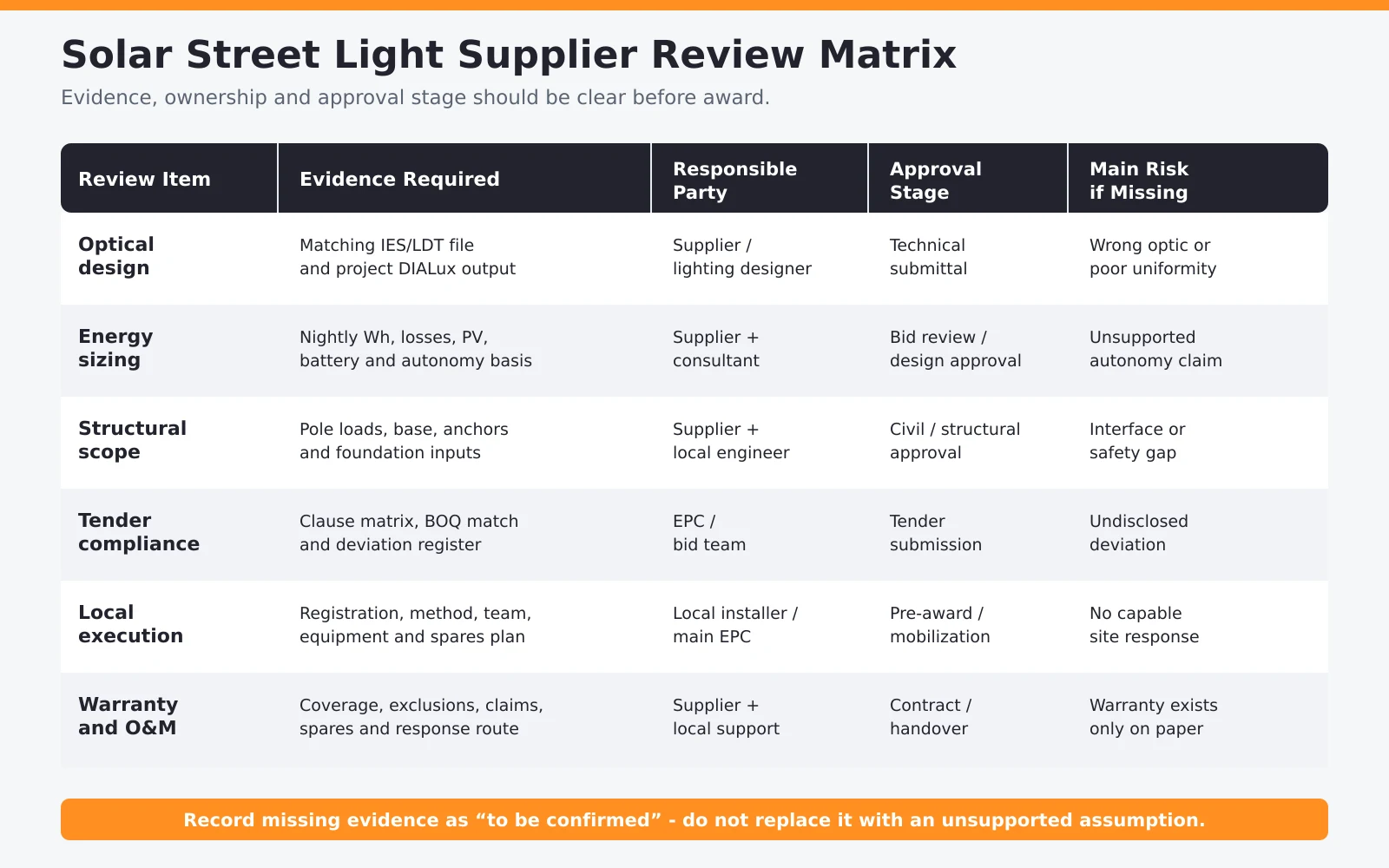
Pre-award review matrix: name the required evidence, responsible party, approval stage, and risk for each workstream.
How to Evaluate Suppliers and Local Partners
A company label such as “manufacturer,” “EPC,” “solar company,” or “local installer” does not prove the capabilities needed for a road-lighting package. Evaluate evidence against the actual scope.
| Evaluation item | Evidence to request | Main risk if missing |
|---|---|---|
| Road-lighting experience | Comparable project references with application, quantity, scope, and year | A general solar supplier is treated as a roadway-lighting specialist |
| System sizing | Nightly Wh, PV, battery, loss, and autonomy calculation | Headline wattage is accepted without an energy-balance basis |
| Optical design | Offered IES/LDT file and project-specific DIALux output | Adequate wattage but poor uniformity, glare, or coverage |
| Structural scope | Pole drawing, load information, base details, and responsibility matrix | Pole, anchor bolt, and foundation interfaces are left unresolved |
| Tender compliance | Clause-by-clause compliance matrix and deviation register | A technical exception appears after award or during approval |
| Local installation capacity | Registration, team scope, equipment, method statement, and similar work | No capable party is responsible for civil works, erection, or commissioning |
| Local after-sales support | Named support route, spare-parts location, response process, and records | The warranty cannot be executed at site |
| Quality control | Inspection plan, component traceability, test records, and pre-shipment checks | Batch or configuration problems cannot be isolated and corrected |
| Warranty terms | Written coverage, exclusions, evidence requirements, and remedy process | A nominal warranty exists without an operational claim process |
For a local installer or contractor, also confirm:
- legal registration, operating location, and comparable outdoor-lighting work;
- civil, erection, commissioning, fault-finding, safety, and handover capability;
- project records, critical spares, warranty response, and defects-liability responsibility;
- understanding of the employer–consultant–EPC approval chain.
Use public company information as a starting point only. If a company does not publicly show road-lighting projects, tender references, installation scope, or O&M capability, record the point as not publicly verified and request evidence rather than assigning a positive or negative rating.
Risks to Resolve Before Award
| Risk | Control before award |
|---|---|
| Treating a solar-home-system or mini-grid supplier as a road-lighting specialist | Request application-specific optical, structural, operating, and acceptance evidence |
| Comparing LED wattage instead of verified performance | Review the IES/LDT file, layout, dimming profile, nightly Wh, PV sizing, and usable battery energy together |
| Assuming every donor electrification program includes street lights | Verify the current notice, component, contract type, and BOQ |
| Leaving the approval chain unclear | Name who answers RFIs, approves deviations, accepts samples, witnesses tests, and signs completion |
| Leaving import and local work outside the responsibility matrix | Allocate Incoterm, inland transport, customs support, storage, civil works, erection, security, and commissioning |
| Accepting an unverified autonomy claim | Define operating hours, dimming, losses, usable battery energy, design solar input, temperature basis, and acceptance method |
| Treating CE as complete tender compliance | Check every project-specific optical, structural, battery, environmental, local, and tender requirement |
| Pricing before resolving poles and foundations | Define pole, arm, panel, anchor-bolt, soil, foundation, and approval interfaces before final pricing |
| Omitting spare parts and maintainability | Agree critical spares, storage, replacement responsibility, warranty evidence, and response route |
Minimum Information to Submit for Project Review
A project review should start with these eight input groups:
- Project location and coordinates.
- Road or site geometry, including width, lanes, medians, walkways, or area dimensions.
- Pole height, spacing, arrangement, arm geometry, and quantity.
- Required lighting criteria or the relevant tender clauses.
- Operating hours, dimming schedule, and control requirements.
- Autonomy or backup-day requirement and its acceptance definition.
- Pole, foundation, civil-work, installation, commissioning, and local-support responsibilities.
- Tender deadline and required calculations, drawings, certificates, and submission format.
If an item is unavailable, mark it to be confirmed. Do not silently replace missing project inputs with country-level assumptions.
FAQ
Who normally purchases solar street lights in Ethiopia?
There is no single buyer type. Procurement may come through a government or municipal authority, implementing agency, NGO, main EPC contractor, industrial park, private estate, school, hospital, or other institution. The operator, payer, tendering entity, and acceptance authority may be different organizations.
Is a higher-wattage solar street light automatically better for a road project?
No. Higher wattage can increase energy demand without correcting poor optics, spacing, glare, or uniformity. Check the offered IES/LDT file, road layout, dimming profile, nightly Wh, PV sizing, and usable battery energy together.
Who should design the pole foundation?
The lighting or pole supplier can provide dimensions and structural inputs. A qualified local engineer should verify the final foundation using the actual pole loads, wind basis, soil conditions, drainage, and approval requirements. The contract should name the responsible party.
Can an overseas manufacturer bid directly?
It depends on the procurement documents. Some tenders permit international bidders; others require local registration, tax documentation, an authorized representative, a joint venture, or a locally eligible bidder. Confirm eligibility before investing in the technical submission.
Does the project need a local installer or local partner?
Not every supply contract requires one, but projects involving survey, foundations, pole erection, commissioning, training, warranty response, or site access usually need clearly assigned local execution capacity. That party may be the main EPC, a subcontractor, a distributor, or another qualified installer, depending on the tender.
What information is needed before requesting a quotation?
Provide the location, site geometry, pole height and spacing, quantity, lighting criteria, operating and dimming profile, autonomy requirement, responsibility split, required documents, and tender deadline. A requested wattage alone is not a sufficient design basis.
Request an Ethiopia Project Configuration Review
Submit the eight input groups above together with the BOQ or relevant tender clauses, if available.
Sunlurio can review the available inputs and identify the system configuration, calculations, drawings, and documentation still needed before quotation. This review does not replace the employer’s, consultant’s, or local engineer’s approval.
Request a Project Configuration Review
Related Resources
Source and verification note: Institutional, program, and closed-procurement descriptions were last checked on 19 July 2026 against the EEP, EEU, World Bank, contracting-portal, and UNGM pages linked in the article. Program-level information is not evidence that a current solar street lighting tender exists. Verify the latest notice, documents, amendments, and award status before making a bid decision.