
A practical guide for EPC contractors, municipal buyers, and consultants who need to judge solar street light performance by delivered results, not just label wattage.
Quick Answer
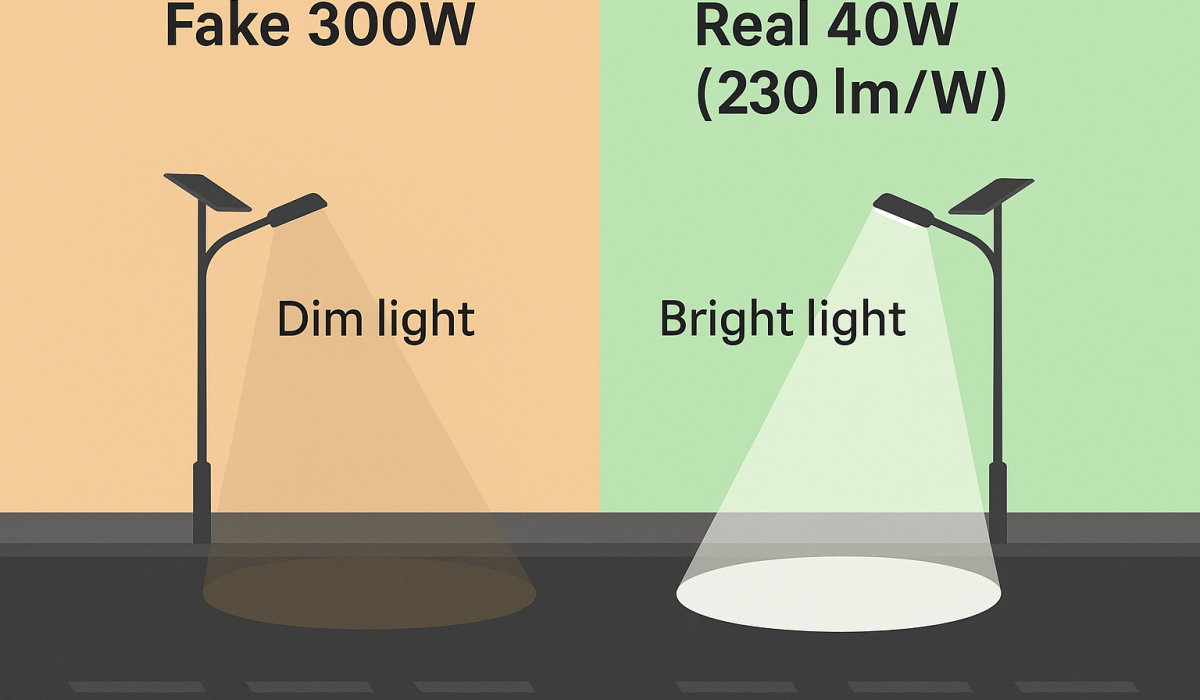
A 60W solar street light can outperform many products marketed as “200W” or “300W” when the complete system is engineered correctly. In solar street lighting, the label wattage alone does not tell you:
- how much usable light reaches the road
- whether the battery and panel can sustain the runtime
- whether the optics create uniform lighting between poles
- whether the system can deliver stable performance in real project conditions
For project review, the safer question is not “How many watts are printed on the product?”
It is:
“What light output, runtime, optics, and battery support can this system sustain in real operation?”
Need help comparing a labeled 200W offer against a real project-ready configuration?
Send us the supplier datasheet, road width, pole height, and spacing for a quick engineering review.
Request Engineering Support →
Why Watt Labels Often Mislead Solar Street Light Buyers
In many markets, especially in price-driven municipal and distributor channels, buyers often see solar street lights labeled 150W, 200W, or 300W and assume the higher number means stronger road performance.
That assumption is risky.
In solar street lighting, the printed wattage may not reflect the real sustainable system output in night operation. A labeled “200W” integrated light may still have:
- limited real LED power
- weak optical performance
- undersized solar panel area
- undersized battery capacity
- short runtime once the battery is partially discharged
This is why project teams should review the complete system design, not just the marketing number.
What Does “Watt” Actually Mean in Solar Street Lighting?
Watt (W) refers to electrical power.
It does not automatically equal road brightness or lighting quality.
For project performance, buyers should look at several related questions:
- How many lumens does the luminaire really deliver?
- What is the system efficacy (lm/W)?
- What optics are used?
- Can the battery and panel support the intended runtime?
- Will the road be evenly lit between poles?
A system with better optical control and higher efficacy can often outperform a system with a larger headline wattage but weaker real design.
Practical Example
If a modern LED luminaire achieves around 230 lm/W, then a 60W system may deliver about 13,800 lumens.
That means a well-designed 60W solar street light can produce road-lighting performance close to what many older-generation, higher-watt systems used to deliver.
So the right comparison is not:
60W vs 200W label
It is:
real delivered lumens + optics + runtime + system match
Why Many So-Called “200W” Solar Lights Underperform in Real Projects
The market problem is usually not that every 200W product is fake.
The problem is that many products marketed as 200W or 300W do not have the panel, battery, thermal design, or optical performance to sustain that claimed output in real use.
Common warning signs include:
- very small solar panel for the claimed wattage
- very small battery for the promised runtime
- low-grade LEDs with lower efficacy
- unrealistic “all night” claims without dimming details
- no clear battery cycle-life data
- no meaningful compliance or transport documentation
In practical terms, buyers may end up with products that:
- look bright for a short period after installation
- lose runtime quickly after cloudy days
- create dark zones between poles
- fail earlier because the battery and system are overstressed
That is why headline wattage can be misleading if it is not supported by a realistic full-system design.
Why a Real 60W Solar Street Light Can Be Enough for City Roads
A properly engineered 60W system can be enough for many municipal and secondary-road projects when the road width, pole height, pole spacing, optics, and runtime assumptions are designed correctly.
1. High LED Efficacy Matters More Than a Big Label
If the luminaire has high efficacy, it can deliver strong light output with lower system power.
A well-engineered 60W luminaire can provide 13,000+ lumens, which may be suitable for many city-road and secondary-road applications when paired with the right optic and layout.
2. Optical Distribution Matters More Than Hotspot Brightness
Road users do not benefit from a bright patch directly under the pole if the space between poles is dark.
That is why optics matter. A proper road-lighting optic can spread light more effectively across the carriageway and improve practical visibility between poles.
3. Sustainable Panel and Battery Matching Is Critical
A 60W solar street light is much easier to support with a realistic pole-top solar system.
A typical engineered configuration may use:
- 150–200W solar panel
- 40–60Ah LiFePO₄ battery
- smart controller with dimming profile
That kind of system can realistically support:
- 12+ hours of lighting
- multi-night backup, depending on location and dimming profile
By contrast, a truly sustainable “real 200W” street light would require a much larger energy system that is often impractical for compact pole-top integrated design.
4. Lower System Stress Usually Improves Long-Term Reliability
A balanced 60W design can also reduce:
- thermal stress
- battery stress
- charging mismatch
- early failure risk
This is one reason why lower, optimized wattage often produces better lifecycle results than oversized marketing claims.
What Buyers Should Compare Instead of Watt Labels
When comparing a real 60W system against a labeled “200W” offer, use this checklist.
| What to Compare | Why It Matters |
|---|---|
| Delivered lumens | Better indicator of usable light than watt label alone |
| System efficacy (lm/W) | Shows whether the luminaire converts power into light efficiently |
| Optics / beam pattern | Determines how well the road is lit between poles |
| Battery chemistry | LiFePO₄ is generally preferred for public projects |
| Battery cycle life | Strongly affects maintenance and replacement cost |
| Panel size | Must support daily recharge under local solar conditions |
| Runtime claim | Must be tied to dimming profile and backup assumptions |
| Compliance documents | Help separate engineered products from weak catalog offers |
Comparison Table: Real 60W vs Labeled “200W”
| Parameter | Real 60W (High-Efficiency System) | Labeled “200W” Market Offer |
|---|---|---|
| LED efficacy | ≥230 lm/W | Often much lower |
| Real brightness | ~13,800 lm | Often unclear or unsupported |
| Battery chemistry | LiFePO₄ | Often unspecified or lower grade |
| Battery cycle life | 5,000–6,000 cycles | Often much lower |
| Backup time | Commonly designed for multi-night backup | Often short in real operation |
| Compliance support | Can include IEC / UN38.3 / IP-rated documentation | Often weak or incomplete |
| Long-term TCO | Usually lower when system is balanced | Often higher due to failures and replacements |
This is not to say every higher-watt product is wrong.
It means buyers should always verify whether the claimed wattage is supported by a credible complete system design.
Case Example: 60W Solar Street Lights for a West Africa Municipal Project
In one West Africa municipal project, the final installed configuration used 500 sets of 60W / 7m solar street lights instead of a higher-watt concept initially expected by the local buyer.
Project-level design logic included:
- high-efficacy LED performance
- road-suitable optics
- LiFePO₄ battery storage
- multi-night backup design
- practical installation and maintenance planning
According to project follow-up records and local feedback, the system achieved:
- stable night lighting on the target roads
- multi-night backup after cloudy periods
- reduced maintenance burden compared with weaker low-cost offers
The local authority had initially asked about 150W–200W class products. After reviewing the actual lighting data and system logic, the lower but better-engineered configuration was accepted.
This is the core lesson:
buyers do not need the biggest label. They need a system that can really perform on the road.
Why This Matters for EPC Contractors and Government Buyers
For EPC contractors, distributors, and municipal buyers, the real risk is not just buying the wrong wattage.
The real risk is approving a product that cannot sustain the promised performance after handover.
That can lead to:
- complaints from road users
- poor public perception
- early battery replacement
- higher O&M cost
- failed confidence in future project phases
A more defensible procurement approach is to ask for:
- minimum system efficacy
- battery cycle-life evidence
- runtime with dimming profile
- autonomy nights
- IES or photometric support where relevant
- clear panel and battery sizing logic
Already comparing supplier offers?
Send us the datasheet or quotation and we can help identify whether the labeled wattage is supported by a realistic system configuration.
Ask for a Datasheet Review →
What Should You Ask Before Approving a “200W” Solar Street Light?
Before accepting a higher-watt solar street light claim, ask these questions:
- What is the real delivered lumen output?
- What is the LED efficacy in lm/W?
- What battery chemistry is used?
- What is the real battery cycle life?
- What panel wattage supports the system?
- How many hours of runtime are guaranteed, and under what dimming profile?
- How many backup nights are assumed?
- Does the supplier provide compliance and transport documentation?
- Has the optic been selected for road lighting, not just visual hotspot brightness?
If the supplier cannot answer these clearly, then the headline wattage alone should not drive the buying decision.
Key Takeaway
When evaluating solar street lights:
- Do not buy watt labels alone
- compare delivered light, optics, runtime, and battery support
- check whether the panel and battery are realistically matched
- verify whether the product can support the project’s operating conditions
A well-engineered 60W solar street light can outperform many products marketed as “200W” or “300W” because it is built around real sustainable performance, not just a bigger number on the housing.
Next Step for Tenders and Project Specifications
If you are preparing a road-lighting tender or reviewing supplier offers, ask for:
- Minimum system efficacy such as ≥210 lm/W
- Battery cycle life such as ≥5,000 cycles with LiFePO₄
- Lighting runtime such as 12 hours
- Defined backup autonomy such as 3 nights, based on a stated dimming profile
- Clear system sizing logic for panel, battery, and light output
Need a project-ready recommendation instead of a marketing quote?
Send us your road width, pole height, spacing, and supplier datasheet and we can help compare real 60W performance against higher labeled offers.
Get a Project Review →
You can also review our related pages for deeper project comparison:
FAQ
Does a higher watt solar street light always mean more brightness?
No. Higher label wattage does not automatically mean better road lighting. Buyers should compare delivered lumens, system efficacy, optics, runtime, and battery support.
Why can a real 60W solar street light outperform a labeled 200W model?
Because a well-engineered 60W system may have higher LED efficacy, better optics, and a more realistic match between luminaire power, battery capacity, and solar panel size.
What is the biggest mistake buyers make when comparing solar street lights?
A common mistake is comparing only the printed wattage. In real projects, performance depends on the full system, not just the label.
What should buyers check besides wattage?
Buyers should check delivered lumens, system efficacy, optics, battery chemistry, battery cycle life, panel size, runtime, backup autonomy, and compliance documents.
Why is LiFePO₄ often recommended for project use?
LiFePO₄ is widely preferred because it offers better safety, strong cycle life, and more stable long-term performance for public and infrastructure projects.
Can a real 200W solar street light exist?
Yes, but a true 200W solar street light would need a much larger energy system to sustain that output properly. Many compact products labeled 200W are not engineered to support that real performance.
Why is runtime more important than label wattage?
Because the buyer ultimately needs lighting that stays on for the required operating hours. If the battery and panel cannot support the load, the label wattage has little practical value.
Why do optics matter in solar street lighting?
Optics determine how the light is distributed across the road. A system with better optics may provide better visibility and fewer dark gaps, even with lower nominal wattage.
What is a better procurement question than “How many watts is it?”
A better question is: what light output, runtime, optics, and battery support can this system sustain in real operation?
Can Sunlurio review a supplier datasheet?
Yes. Sunlurio can help review system configuration, runtime logic, battery support, and whether a labeled wattage looks realistic for the proposed project.