
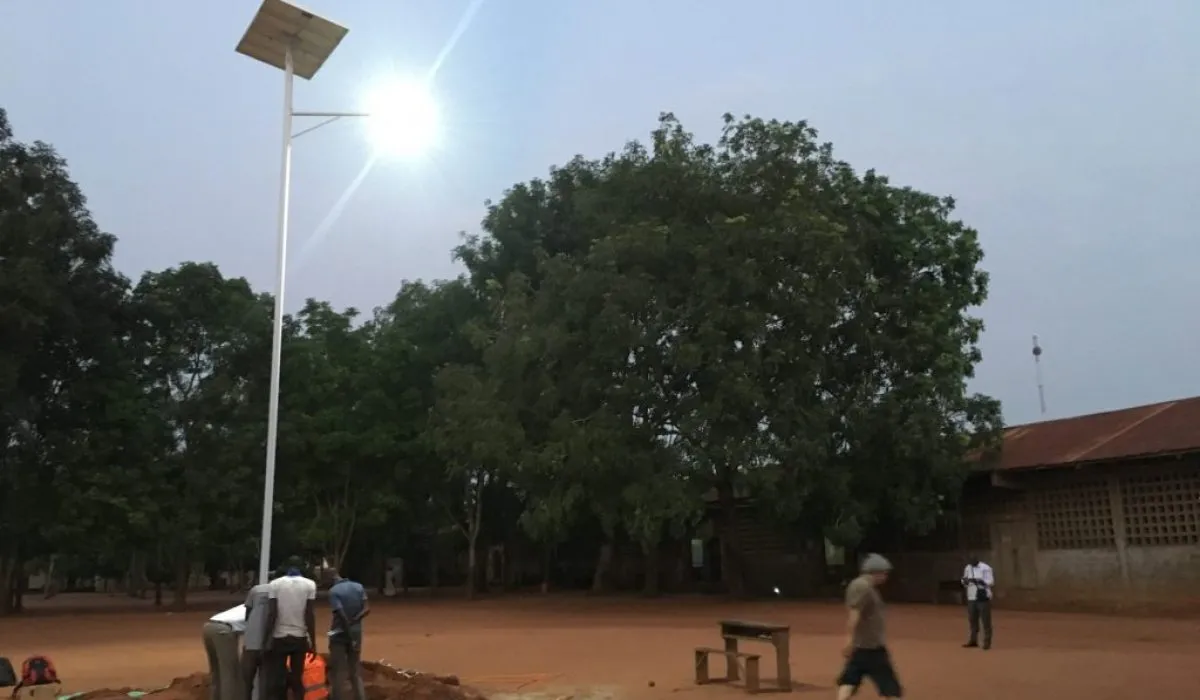
Project Duration: 2010 – 2024
Total Quantity: 13,000 sets
Installation Height: 7 meters
Lamp Power: 60W integrated LED solar light
Project Category: Road & Street Solar Lighting
Prepared by: Mr. Lin, Project Engineer
Date: October 2024
1. Project Overview
In 2010, our engineering team was commissioned by the Ministry of Infrastructure and Transport of Togo to conduct a technical feasibility study for upgrading the lighting system along the Lomé–Kpalimé Road, one of the country’s most important intercity highways.
The road spans approximately 120 kilometers, connecting the coastal capital Lomé with the inland trade center Kpalimé. It handles significant traffic volumes daily, yet for years it remained largely unlit at night. Power shortages and high grid instability made conventional grid-connected lighting unreliable and costly.
The government sought a stand-alone solar lighting solution that could ensure public safety, reduce electricity dependence, and align with Togo’s national renewable energy strategy.
Between 2010 and 2024, we designed, supplied, and installed 13,000 sets of 200W solar street lights along the full corridor, covering both urban and rural sections. The system is now fully operational.
2. Background and Site Conditions
2.1 Client’s Challenges
Before implementation, the following issues were identified:
- Frequent power outages made grid-fed lights impractical.
- High maintenance frequency and cost due to unstable power infrastructure.
- Poor nighttime visibility, resulting in frequent accidents and security incidents.
- Limited local technical capacity for complex electrical systems.
2.2 Environmental and Technical Constraints
Based on data from the Togo Meteorological Bureau, the project area receives an average of 5.3 peak sun hours per day, with an annual solar irradiation of 4.9–5.5 kWh/m²/day — ideal for solar applications.
However, the tropical coastal climate presents challenges:
- Ambient temperature up to 36°C, relative humidity 80–88%;
- Long rainy season with clay-rich soil, causing drainage and foundation issues;
- Corrosive saline air near coastal sections.
These conditions directly guided our material selection, corrosion protection, and structural design.
3. System Design and Technical Configuration
The selected system was a stand-alone, all-in-one solar street lighting solution designed for high durability and minimal maintenance.
| Component | Specification |
|---|---|
| LED Lamp Power | 60W, high-brightness LED chips (≥180 lm/W) |
| Solar Panel | 18V / 120W monocrystalline, 21.5% conversion efficiency |
| Battery | LiFePO₄ 12.8V / 60Ah, 4000+ cycles |
| Pole | 7m hot-dip galvanized steel, 80 μm zinc coating |
| Controller | Light sensor + timer + PIR motion sensor |
| Waterproof Rating | IP66, wind resistance ≥ Grade 12 |
| Operating Hours | ≥12 hours/night, 3–5 days autonomy |
| Design Life | Structure ≥25 years; core components ≥8 years |
Lighting control was configured for smart dimming — 100% brightness in early night hours, reduced to 70% after midnight to extend battery lifespan.
3.1 Lighting Layout and Distribution
According to EN13201 lighting standards, the target average illuminance was ≥15 lux, with uniformity ≥0.35.
Design parameters were determined as follows:
- Pole spacing: 30 meters
- Offset from road edge: 1.5 meters
- Lamp tilt angle: 10°, single-side configuration
The project was divided into 18 lighting zones, with a total of 13,000 light units installed along the 120 km route.
4. Implementation Process
4.1 Construction Organization
To manage schedule and logistics efficiently, construction was executed in three major phases:
| Phase | Period | Coverage | Quantity |
|---|---|---|---|
| Phase I | 2013–2015 | Lomé – Noépé section | 5,000 sets |
| Phase II | 2016–2018 | Tsévié region | 4,000 sets |
| Phase III | 2019–2021 | Kpalimé section | 4,000 sets |
Each phase had a dedicated on-site office, storage yard, and testing area.
Over 420 local workers were employed, with 80 receiving technical training in installation and electrical testing.
4.2 Construction Challenges and Solutions
-
Foundation Stability
Clayey soil with poor drainage required a foundation depth increase from 1.2 m to 1.6 m, with a 20 cm crushed-stone drainage layer added beneath each base. -
Anti-theft and Corrosion Protection
All light modules were fitted with anti-theft mounting brackets and stainless-steel tamper-proof bolts. The pole and fixture surfaces underwent dual-layer galvanization and powder coating, improving corrosion resistance by 38%. -
Safety and Quality Control
Strict work schedules were followed: 06:00–11:00 and 16:00–19:00 to avoid heat exposure.
Each batch of 100 units underwent full electrical and optical testing before acceptance.
4.3 Field Test Results
| Test Item | Design Target | Measured Average |
|---|---|---|
| Illumination uniformity | ≥0.35 | 0.37 |
| Luminous flux per unit | ≥35,000 lm | 36,200 lm |
| Battery efficiency | ≥90% | 94.7% |
| Lighting duration | ≥12 hours | 12.3 hours |
| System failure rate | ≤1% | 0.48% |
All test data were uploaded to the cloud-based monitoring platform for traceability.
5. Commissioning and Performance
After final commissioning in 2021, all systems operated as expected with the following performance indicators:
- Average lighting uptime: 99.5%
- Average maintenance frequency: 0.23 times/unit/year
- Battery replacement cycle: 8 years
- Solar panel degradation: ≤2.1% after 3 years
5.1 Operational and Social Impact
According to the Togo Traffic Authority (2023):
- Nighttime accident rate decreased by 63.4% compared with 2010 levels.
- Nighttime pedestrian activity increased by 42%.
- Small businesses extended operations by 3.5 hours per night.
- Annual CO₂ reduction: 1,870 tons, equivalent to planting ~92,000 trees.
The maintenance cost was reduced to USD 3.1 per unit per year, about 35% lower than conventional grid lighting.
5.2 Local Workforce Development
During implementation, our team trained over 200 local technicians and electricians.
Forty-five of them later joined renewable energy companies in Togo, contributing to local capacity building and long-term project sustainability.
6. Maintenance and Monitoring System
To ensure consistent operation, two regional maintenance centers were established — one in Lomé and one in Kpalimé.
Both centers are equipped with spare parts inventory, remote monitoring software, and trained technicians.
Maintenance protocol includes:
- Quarterly inspections on main sections
- Fault response time: ≤48 hours
- Spare parts coverage: ≥8%
- Real-time monitoring coverage: 96%
Between 2022 and 2024, a total of 367 maintenance cases were recorded — primarily controller replacements and battery updates — all resolved within 48 hours.
7. Engineer’s Reflections and Lessons Learned
Having overseen this project from the early feasibility study in 2010 to final completion in 2024, I can summarize several key lessons:
-
System adaptation to local climate is crucial.
The selection of LiFePO₄ batteries and corrosion-resistant structures ensured stability under extreme humidity and heat. -
Phased implementation improves reliability.
Executing the project in three phases allowed us to test and optimize the system gradually, minimizing risks. -
Local collaboration guarantees sustainability.
By training local workers and establishing a regional service system, we built a foundation for independent long-term maintenance. -
Light brings safety and opportunity.
During nighttime inspections, I often saw residents gathering under the lamps — children studying, vendors trading, people walking safely. That is the true success of engineering.
8. Future Outlook
Building on the success of this project, our next step will focus on integrating smart solar lighting and microgrid connectivity in Togo’s western and northern regions.
We plan to introduce the SLM-II Smart Control System, enabling real-time energy optimization, remote adjustment, and predictive maintenance — moving toward a digitally managed clean lighting network for West Africa.
Prepared by:
Mr. Lin
Senior Project Engineer
Date: October 30, 2024