
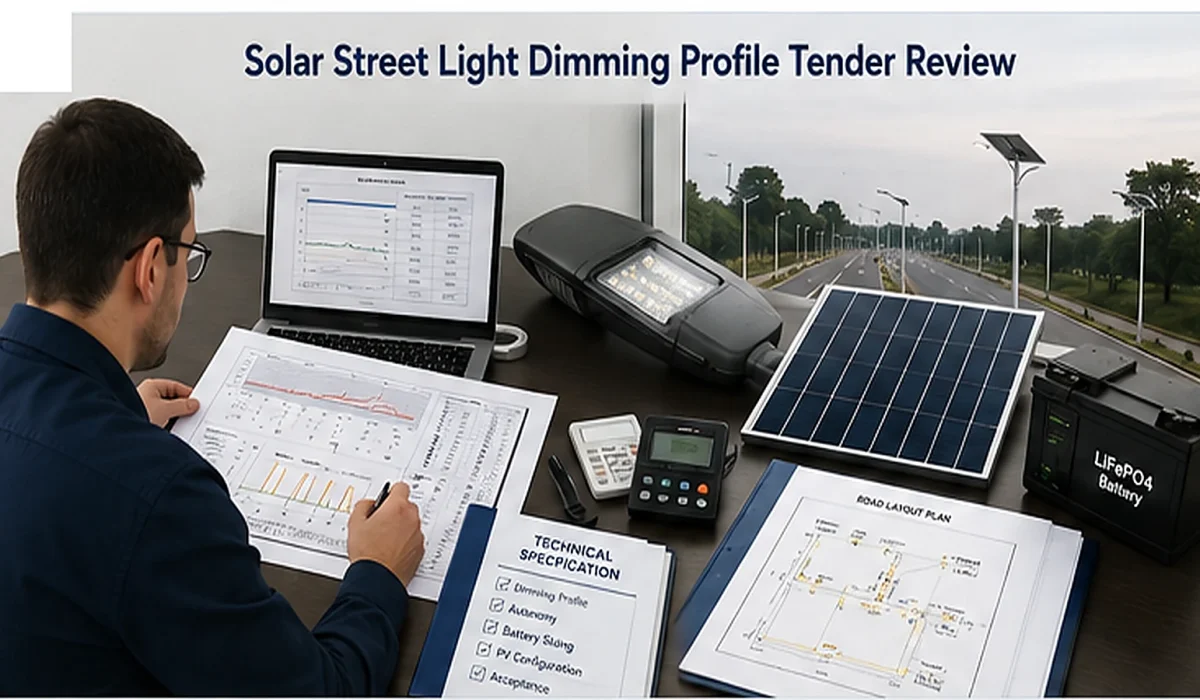
A solar street light dimming profile for a tender should define each operating stage, its duration, output level, time reference, sensor behavior, low-battery override, and acceptance method.
The same approved profile should be used in the supplier’s load calculation, battery and photovoltaic module sizing, factory controller settings, site commissioning, and final handover.
Dimming can reduce system load and help control project cost. However, cost reduction should come from a transparent and approved operating profile—not from undisclosed dimming assumptions, unrealistic motion-sensor activity, or undersized batteries.
For EPC contractors, municipal buyers, government procurement teams, NGOs, and engineering consultants, the main question is therefore not simply:
Can the solar street light be dimmed?
The more important questions are:
- What profile will be used?
- How will it affect daily energy consumption?
- Will every bidder calculate from the same profile?
- Will reduced-output stages still meet the project’s lighting requirements?
- How will the final controller settings be tested and accepted?
Quick Answer: What Must a Tender Define in a Dimming Profile?
A complete solar street light dimming requirement should define five connected areas:
- Operating schedule: The duration and output of every stage.
- Sizing basis: The profile used to calculate daily load, battery capacity, PV capacity, and autonomy.
- Supplier submittal: The profile table, controller settings, calculations, and override logic the bidder must provide.
- Testing and acceptance: How the profile will be checked during factory acceptance testing and site commissioning.
- Ownership and change control: Who can modify the profile after handover and how changes will be recorded.
At minimum, the tender should state:
- Whether timing begins at dusk or follows a fixed clock
- Total design operating hours per night
- Duration of each dimming stage
- Output setting for each stage
- What the output percentage represents
- Standby and boost levels where motion sensing is used
- Sensor hold time and detection logic
- Pre-dawn recovery requirements
- Low-battery or anti-blackout override behavior
- Required equivalent full-power hours
- Factory testing evidence
- Site commissioning checks
- Final profile identification
- Access, password, and configuration ownership
A statement such as programmable dimming required describes a controller capability, but it does not provide a complete design, pricing, or acceptance basis.
Why “Programmable Dimming” Is Not a Complete Tender Requirement
“Programmable dimming” means that the controller can change the luminaire output according to a schedule or sensor input. It does not tell the bidder what schedule must be used.
One supplier may calculate the system based on 12 hours at full output. Another may assume four hours at 100%, four hours at 50%, and four hours at 30%. A third may use a low standby level and assume that motion boost is rarely triggered.
All three suppliers may describe their product as:
- 60 W solar street light
- 12-hour operation
- Programmable dimming
- Three nights of autonomy
However, their calculated nightly energy loads may be substantially different.
Public procurement documents illustrate how widely project requirements can vary. Some tenders define detailed multi-stage schedules with separate output levels for motion and no-motion periods. Other projects require programmable schedules without prescribing one universal curve. Some highway projects prohibit motion sensing but permit approved smart dimming, provided that roadway illumination remains within the project requirement.
This variation is expected. Different projects have different:
- Road classifications
- Traffic volumes
- Pedestrian activity
- Security risks
- Night lengths
- Solar resources
- Battery autonomy targets
- Monitoring capabilities
- Maintenance resources
The tender should therefore define a project-specific profile or require bidders to submit one for approval using a common calculation and evaluation method.
How Dimming Can Reduce Cost—and Create Tender Rejection Risk
Dimming reduces the electrical energy consumed during selected parts of the night. Lower daily energy demand may allow the project team to optimize battery capacity, photovoltaic module capacity, enclosure size, structural loading, and system cost.
But dimming is not a valid cost-saving method when:
- The profile is not disclosed in the bid
- Different bidders use different calculation assumptions
- The lighting level is reduced below the approved requirement
- Motion-trigger frequency is underestimated
- Low-battery protection routinely overrides the tender profile
- The final controller is programmed differently from the technical offer
- The reduced battery or PV configuration cannot recover after adverse weather
The correct principle is:
Dimming can optimize a solar lighting system only when the operating profile is transparent, technically justified, consistently calculated, and verifiable during delivery.
A lower price is not necessarily evidence of better system efficiency. It may result from:
- Fewer equivalent full-power hours
- A shorter assumed night length
- A lower motion-trigger assumption
- Reduced autonomy
- A more aggressive low-battery reserve mode
- A smaller engineering margin
- Undisclosed component derating assumptions
Before accepting the lowest bid, the evaluator should compare the complete load basis—not only the luminaire wattage, battery ampere-hours, panel wattage, and total price.
Common Dimming Profile Types and Their Tender Risks
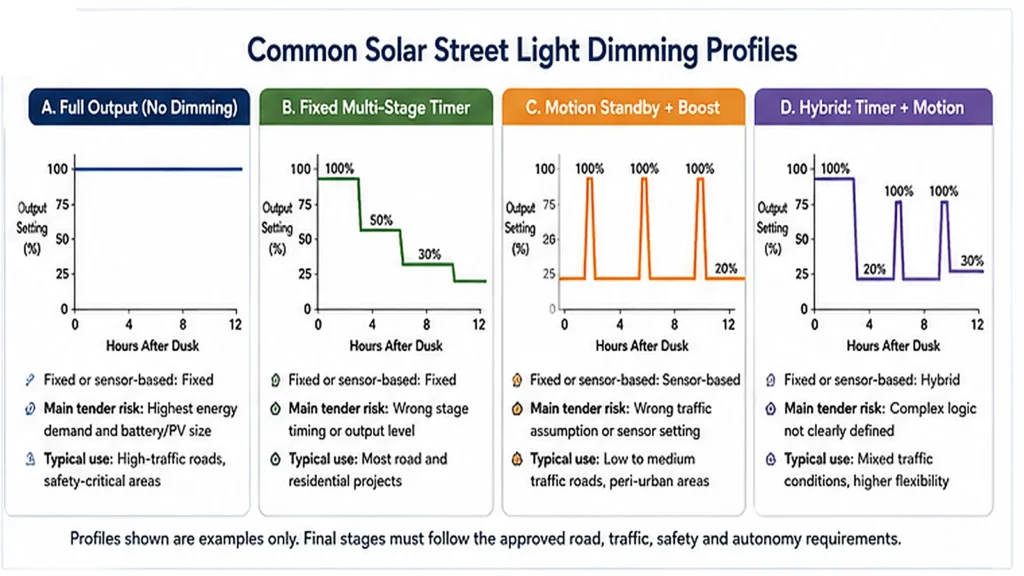
There is no single best solar street light dimming profile for every project.
The selected profile should reflect road use, lighting requirements, traffic patterns, local night length, sensor reliability, autonomy target, and maintenance capability.
Common Dimming Profile Types
| Profile type | Basic operating logic | Possible application | Sizing predictability | Main tender risk |
|---|---|---|---|---|
| Full output all night | Constant declared output from dusk to dawn | Roads or areas requiring stable lighting throughout the night | High | Higher nightly energy demand |
| Fixed multi-stage timer | Predetermined output levels for fixed periods | Roads with predictable nighttime activity | High | Timing basis may be unclear |
| Dusk-relative staged profile | Each stage begins a defined number of hours after dusk | Projects with seasonal sunset variation | High | Pre-dawn timing can change with night length |
| Pre-dawn recovery profile | Output increases before expected morning activity | Roads with early-morning traffic or pedestrian use | High | Recovery time may not follow seasonal dawn |
| Motion standby and boost | Low standby output with temporary higher output after detection | Low-traffic or controlled-access areas | Medium to low | Trigger frequency may be underestimated |
| Hybrid timer and motion | Fixed stages combined with motion response | Areas with different activity levels during the night | Medium | More parameters must be specified and tested |
| Remote or adaptive profile | Profile can be changed through a platform or local control system | Managed municipal, campus, or smart-lighting projects | Depends on control logic | Ownership, communication, and change-control risk |
Manufacturers may offer several factory profiles for the same luminaire, including fixed multi-stage schedules and motion-based standby/boost profiles. This confirms that the product model alone does not identify the actual operating curve. The selected profile and version must be stated separately.
Full-output operation
Full output throughout the night provides the clearest load basis and may be required where stable lighting performance is critical.
However, it creates the highest nightly energy demand and may require:
- A larger battery
- A larger photovoltaic module
- More structural area
- Greater system weight
- Higher initial cost
It should not automatically be rejected as inefficient. For some highways, intersections, security areas, and high-activity roads, a stable output may be the correct project decision.
Fixed multi-stage timer
A fixed multi-stage timer is easier to calculate and verify than an uncertain motion profile.
For example:
| Stage | Duration | Output |
|---|---|---|
| Stage 1 | 4 hours | 100% |
| Stage 2 | 4 hours | 50% |
| Stage 3 | 4 hours | 30% |
The tender still needs to state whether the profile begins:
- At detected dusk
- At a fixed clock time
- At an astronomical sunset time
- After a configurable delay from dusk
Writing 50% after midnight may create ambiguity if one controller follows local clock time and another counts elapsed hours from dusk.
Motion standby and boost
Motion sensing can be suitable for low-traffic roads, campuses, pathways, industrial access areas, parking zones, or controlled sites.
It may be unsuitable where:
- Continuous road-user visibility is required
- Traffic is frequent or unpredictable
- Sensors may be blocked or misaligned
- Detection coverage cannot be verified
- Animals, vegetation, or environmental movement may cause false triggers
- Adjacent luminaires need coordinated response
- The project specification prohibits motion-based operation
A motion sensor should not be treated as a universal energy-saving solution. One recent highway-oriented tender explicitly prohibited motion sensing while allowing programmable dimming only if the required roadway illumination was maintained.
For a detailed mode comparison, see Motion Sensor Mode vs Timer Mode for Solar Street Lights.
Calculate Equivalent Full-Power Hours
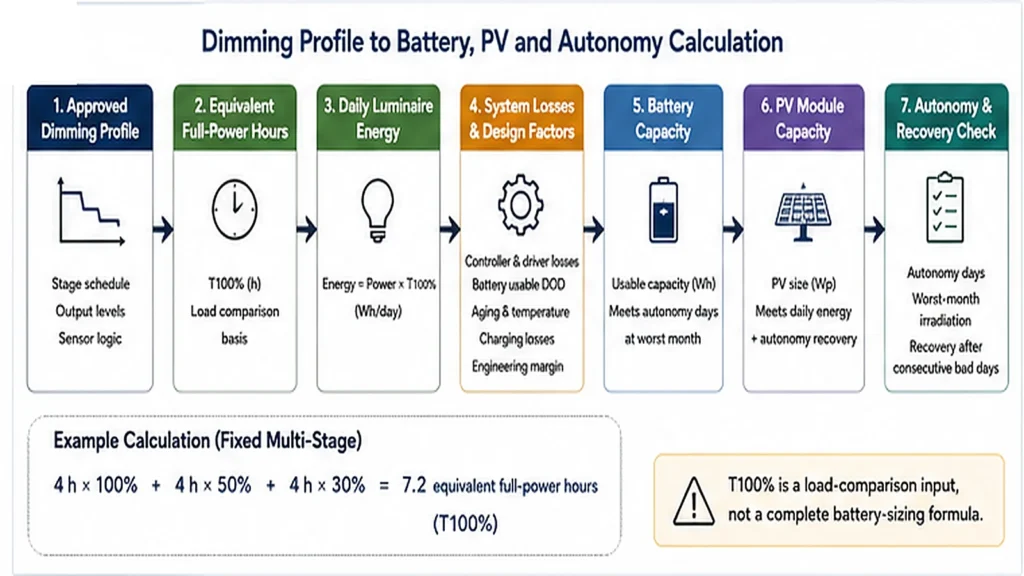
Equivalent full-power hours convert a multi-stage dimming schedule into one comparable nightly load value.
A basic fixed-profile calculation is:
T100% = Σ (stage duration × stage output fraction)Where:
T100%is the equivalent full-power operating time- Stage duration is measured in hours
- Output fraction is expressed as a decimal
Example 1: Full output all night
12 hours × 100%
= 12.0 equivalent full-power hours
Example 2: Fixed multi-stage profile
4 hours × 100%
+ 4 hours × 50%
+ 4 hours × 30%

= 4.0
+ 2.0
+ 1.2

= 7.2 equivalent full-power hours
The light still operates for 12 hours, but its theoretical load is equivalent to operating at the declared full output for 7.2 hours.
Equivalent Full-Power Hours Examples
| Example profile | Calculation | T100% | Main caution |
|---|---|---|---|
| 12 hours at 100% | 12 × 1.00 |
12.0 h | Highest nightly load |
| 4 h at 100%, 4 h at 50%, 4 h at 30% | 4 + 2 + 1.2 |
7.2 h | Reduced stages must remain acceptable for the application |
| 6 h at 70%, 6 h at 30% | 4.2 + 1.8 |
6.0 h | The meaning of output percentage must be defined |
| Motion standby and boost | Standby energy plus triggered boost energy | Variable | Requires a declared trigger assumption |
Public procurement guidance for photovoltaic solar street lighting uses an equivalent rated-power operating time as an input to PV and battery calculations. The exact formula, autonomy requirement, efficiency factors, and margins must still be adapted to the project rather than copied as a universal specification.
Motion-profile estimation
A motion profile does not have one fixed T100% value unless the triggered operating time is defined.
A simplified estimation method is:
Motion-profile T100%
=
Night duration ×
[standby fraction
+ triggered-time ratio × (boost fraction − standby fraction)]
For example:
Night duration: 12 hours
Standby output: 20%
Boost output: 100%
Estimated triggered time: 25%

T100%
= 12 × [0.20 + 0.25 × (1.00 − 0.20)]
= 4.8 hours
If actual traffic causes the light to remain boosted for 60% of the night:
T100%
= 12 × [0.20 + 0.60 × (1.00 − 0.20)]
= 8.16 hours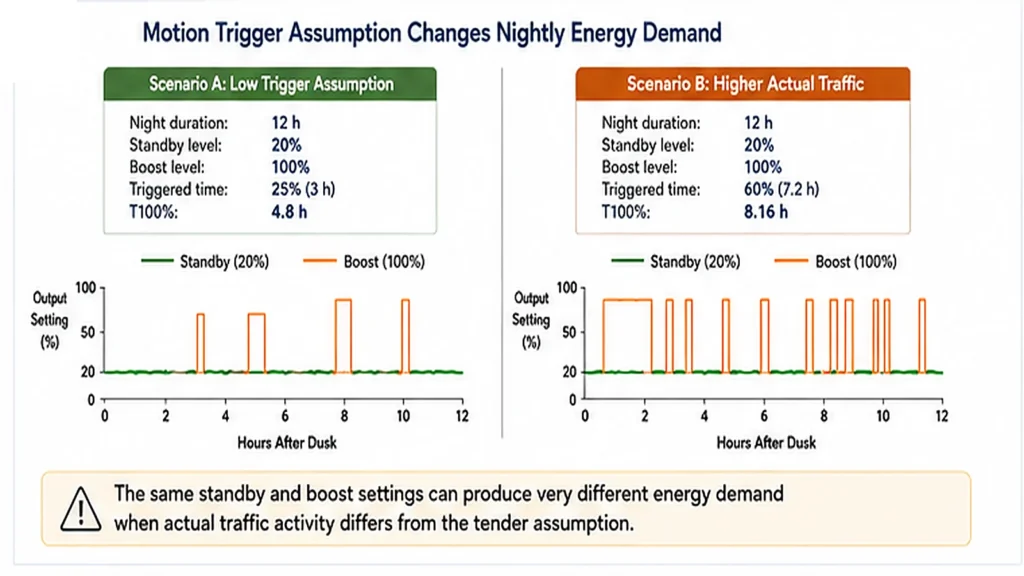
The same hardware can therefore produce very different energy demand depending on the traffic and control assumptions.
This simplified calculation is a comparison tool, not a complete international sizing standard. The tender should require the bidder to explain how the triggered-time ratio was estimated.
The estimate should consider:
- Traffic frequency
- Pedestrian activity
- Sensor range
- Detection overlap
- Hold time
- Repeated triggers
- Adjacent-pole coordination
- False triggering
- Wildlife or vegetation movement
- Site-specific security activity
Link the Profile to Battery, PV, and Autonomy
Equivalent full-power hours are only one input to the complete solar system design.
The theoretical daily luminaire energy can be expressed as:
Daily luminaire energy
=
Declared luminaire power × T100%
However, the final battery and photovoltaic module configuration must also account for:
- LED driver losses
- Controller consumption
- Sensor consumption
- Communication-module consumption
- Cable losses
- Battery usable depth of discharge
- Battery aging
- Temperature derating
- Required autonomy days
- Worst-month solar irradiation
- PV conversion and charging losses
- Dust, shading, and installation-angle losses
- Recovery after consecutive cloudy days
- Engineering safety margin
A bidder should not calculate the battery from one profile and program a more demanding profile after installation.
Normal profile vs reserve profile
The tender should state what happens during low battery state of charge.
Possible behaviors include:
- Continue the normal profile
- Reduce all later stages
- Disable motion boost
- Limit maximum output
- Shorten the operating period
- Enter an anti-blackout reserve profile
- Switch off non-priority zones
A reserve profile may help prevent complete blackout, but it must be disclosed.
The supplier should state:
- Trigger condition
- Reduced output
- Minimum operating period
- Recovery condition
- Whether the event is recorded
- Whether the function can be disabled
- Whether the reserve profile was included in the autonomy calculation
A system that routinely enters emergency reduction during normal seasonal weather may be undersized, even if the controller describes the behavior as intelligent energy management.
Define Output Percentage and Lighting Performance Separately
A tender should not assume that 50% output has only one technical meaning.
Depending on the controller and product documentation, 50% may refer to:
- LED driver current
- Input power
- PWM duty cycle
- Nominal luminous flux
- A manufacturer-defined profile setting
- A software output command
It does not automatically mean that every road-surface measurement will equal exactly 50% of the full-output value.
Actual lighting performance can also be affected by:
- Optical distribution
- Pole spacing
- Mounting height
- Tilt
- Road geometry
- Surface reflectance
- Installation tolerance
- Dirt accumulation
- Product tolerance
The tender should therefore separate:
Controller output setting
Example:
Driver output setting: 50% of the declared rated control output.Required lighting performance
Example:
The lighting performance required during each approved reduced-output stage shall be defined separately by the project lighting design or acceptance criteria.A public preview of CEN/TR 13201-1 states that adaptive changes in average lighting level should not cause other quality criteria to move outside the limits of the selected road-lighting class.
Dimming should therefore be treated as part of the lighting design—not as a separate battery-saving setting applied after the photometric review.
Match the Profile to Road Type, Traffic, and Safety Requirements
The correct profile depends on where and how the road is used.
Highway and arterial roads
Highways and arterial roads may require stable lighting or carefully controlled adaptive stages.
Deep motion-based dimming may be unsuitable because:
- Vehicles move at higher speed
- Detection distance is critical
- Lighting transitions may distract drivers
- Continuous visibility may be required
- Traffic may remain frequent for long periods
The project should define whether adaptive lighting classes or fixed stages are permitted.
Municipal and residential streets
Municipal streets may support fixed multi-stage dimming where traffic declines predictably.
However, the profile should account for:
- Pedestrians
- Intersections
- Shops and public facilities
- Bus stops
- Local security
- Early-morning activity
- Seasonal events
Rural roads
Rural roads may benefit from staged or motion-based operation where traffic is intermittent.
The design still needs to review:
- Detection reliability
- Curves and junctions
- Animal activity
- Isolated pedestrian use
- Emergency access
- Sensor maintenance
Industrial and controlled-access roads
Industrial sites, campuses, ports, warehouses, and controlled compounds may support zone-specific profiles.
For example:
- Main gate: higher continuous output
- Internal access road: staged dimming
- Storage area: motion boost
- Security perimeter: never-dim profile
- Loading area: operational schedule linked to shifts
Areas that may require restricted dimming
The project team should identify zones where deep dimming is not permitted, including:
- Pedestrian crossings
- Road junctions
- Sharp curves
- Gates and entrances
- Security checkpoints
- CCTV areas
- Bus stops
- Accident-prone sections
- Industrial loading areas
- Emergency access routes
Sunlurio’s Intelligent Dimming Design approach reviews zone priority, operating stages, fallback behavior, and acceptance requirements rather than applying one profile to every pole.
What the Tender Should Require from Bidders
A bidder should submit enough information to show that the proposed dimming profile, system sizing, controller configuration, and acceptance method are consistent.
Minimum supplier submittal
The tender may require:
- Dimming profile table
- Controller manufacturer and model
- Time-reference method
- Total operating hours
- Stage durations
- Output settings
- Definition of output percentage
- Equivalent full-power hours
- Daily load calculation
- Battery calculation
- PV module calculation
- Autonomy calculation
- Motion-trigger assumption
- Standby output
- Boost output
- Hold time
- Detection logic
- Low-battery override
- Fallback operation
- Profile name or version
- Factory test method
- Site commissioning method
- Configuration software or tool requirements
- Access and password ownership
- Final handover record
Six-Stage Profile Consistency Check
| Project stage | Profile that should remain consistent |
|---|---|
| Tender requirement | Project-approved required profile |
| Bidder technical offer | Supplier’s formally declared profile |
| Battery and PV calculation | Profile used for sizing |
| Factory programming | Profile written into the controller |
| Site commissioning | Profile verified after installation |
| Final handover | Final approved profile received by the owner |
The technical evaluator should investigate any mismatch.
Examples include:
- The tender requires 8.0 equivalent full-power hours, but the calculation uses 6.0 hours.
- The offer shows a fixed timer profile, but the controller is programmed for motion-based operation.
- Main roads and parking areas require different profiles, but all controllers receive one default setting.
- The profile is changed during commissioning without updating the calculation or record.
- The handover file does not identify the final profile version.
Tender Wording Examples
The following clauses are technical drafting examples.
They should be reviewed against local procurement rules, contract requirements, applicable lighting standards, and the project’s approved engineering design before use. They are not legal advice or universal contractual wording.
Operating-profile requirement
The bidder shall state the proposed operating profile as a time-based schedule from dusk or another clearly defined time reference, including the duration and output level of each stage.Output-definition requirement
The bidder shall define whether each stated output percentage refers to driver power, LED current, duty cycle, nominal luminous flux or another controller parameter.Sizing-consistency requirement
Battery and photovoltaic module sizing calculations shall use the same dimming profile stated in the technical offer. The bidder shall declare the equivalent full-power operating hours used in the calculation.Fixed-profile requirement
Where a fixed multi-stage profile is used, the technical submittal shall identify the start reference, duration and output setting of every operating stage, including any pre-dawn recovery stage.Motion-profile requirement
Where motion sensing is used, the bidder shall state the standby output, boost output, detection logic, hold time, expected trigger assumption, adjacent-luminaire response where applicable and fallback behavior.Autonomy requirement
The bidder shall state whether the required autonomy period is calculated using the normal operating profile, a reduced reserve profile or another defined operating condition.Override-disclosure requirement
Any low-battery, anti-blackout or energy-management function that can override the approved dimming schedule shall be described in the technical submittal, including its trigger and recovery conditions.Profile-identification requirement
The final controller configuration shall be identified by a profile name, code or version and verified during factory testing, site commissioning and project handover.Factory-test requirement
Factory acceptance testing shall verify the sequence, output setting, duration logic, motion response, hold time, override function and fallback behavior of the approved profile.Change-control requirement
Changes to the approved dimming profile shall require authorized change control and an updated configuration, commissioning or handover record.Ownership requirement
All software access, configuration tools, administrator accounts, passwords and profile records required for operation and maintenance shall be handed over according to the agreed project scope.From Tender Requirement to FAT and Site Acceptance
A dimming requirement is only useful when it can be followed from the tender to the installed controller.
Requirement–Calculation–FAT–Acceptance Chain
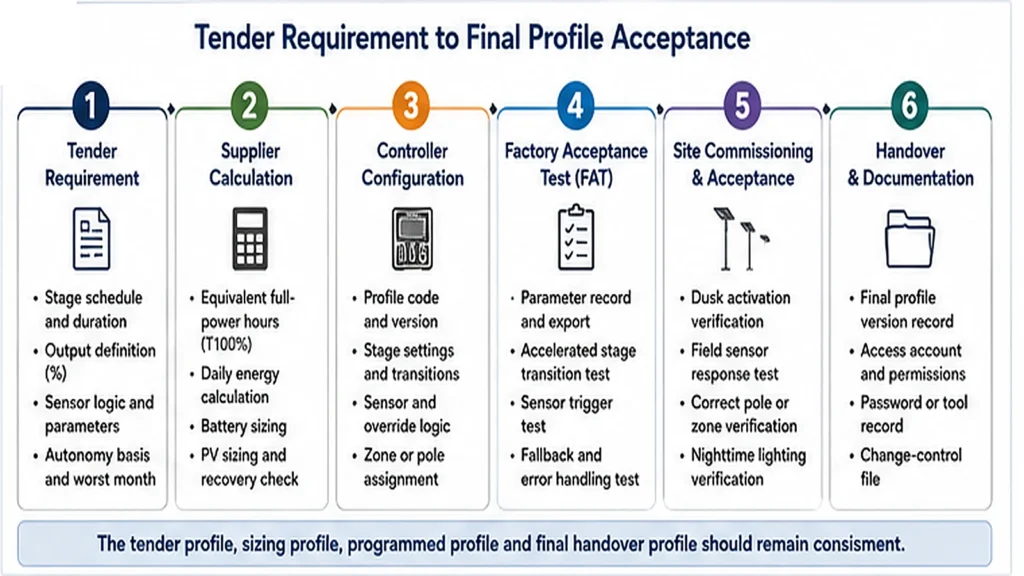
| Tender requirement | Supplier submittal | FAT evidence | Site acceptance |
|---|---|---|---|
| Defined stage schedule | Profile table and timing basis | Controller parameter record | Stage-transition verification |
| Declared equivalent full-power hours | Load calculation | Calculation review | Final programmed profile matches calculation |
| Battery and PV based on approved profile | Battery, PV, and autonomy calculations | Configuration document review | Installed battery and PV configuration check |
| Motion standby and boost | Sensor settings and trigger assumption | Detection and hold-time test | Field detection and response test |
| Low-battery override | Override description | Simulated threshold test where practical | Logged event or controlled verification |
| Controlled profile changes | Profile ID and access method | Configuration export | Final profile and access handover |
| Zone-specific schedules | Pole or zone profile schedule | Sample controller verification | Installed poles match the approved zone list |
This evidence chain is essential because a controller can be programmable without being programmed according to the approved tender requirement.
Factory Acceptance Testing for Dimming Profiles
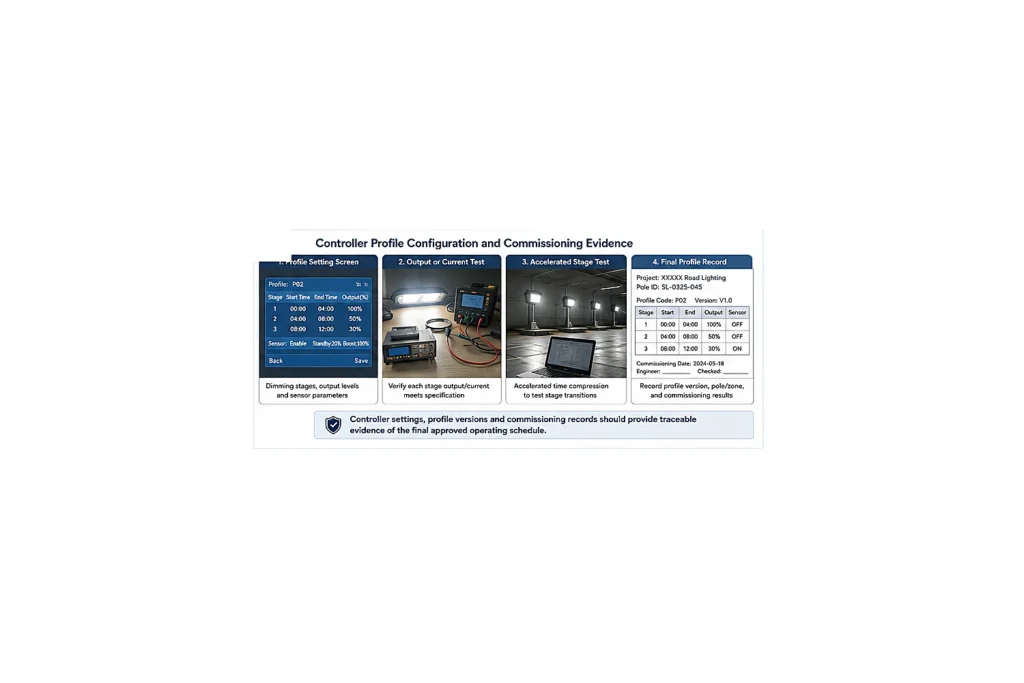
Factory acceptance testing should verify more than whether the luminaire can turn on and reduce brightness.
A suitable FAT may check:
- Controller identity
- Firmware or configuration version where relevant
- Profile code
- Stage sequence
- Stage output
- Timing basis
- Motion detection
- Boost level
- Standby level
- Hold time
- Sensor-disabled periods
- Low-battery override
- Communication failure fallback
- Power-loss recovery
- Configuration access
- Parameter export or setting sheet
Accelerated profile testing
A 12-hour profile does not always need to be observed in real time during FAT.
The supplier may use a controlled accelerated test, for example:
Original Stage 1: 4 hours
Test Stage 1: 4 minutes

Original Stage 2: 3 hours
Test Stage 2: 3 minutes

Original Stage 3: 5 hours
Test Stage 3: 5 minutes
The FAT record should state:
- Original stage durations
- Accelerated test durations
- Scaling method
- Output measured at each stage
- Transition sequence
- Test result
- Confirmation that the formal profile was restored after testing
An accelerated test verifies sequence and control behavior. It does not replace battery-discharge, autonomy, or complete photometric testing where those are required.
Site Commissioning and Acceptance Checks
Factory testing confirms that the controller can execute the required profile. Site commissioning confirms that the correct profile was installed in the correct project location.
Site commissioning should verify
- Controller model
- Correct profile code
- Correct road or zone assignment
- Dusk activation
- Stage timing
- Output changes
- Sensor detection area
- Standby and boost response
- Hold time
- Adjacent-pole behavior
- Never-dim zones
- Low-battery behavior
- Communication status
- Final parameter record
- Owner access
FAT and site commissioning serve different purposes
| FAT | Site commissioning |
|---|---|
| Verifies controller capability | Verifies installed project configuration |
| Checks programmed sequence | Checks correct profile by pole or zone |
| Uses controlled test conditions | Uses actual installation conditions |
| Can use accelerated timing | Confirms real dusk and field behavior |
| Checks sensor function | Checks actual detection coverage |
| Creates factory evidence | Creates final acceptance and handover evidence |
Sunlurio’s Solar Street Light Commissioning Checklist explains the broader testing, night-operation, and handover process.
Lighting measurement during reduced-output stages
Where the tender requires field measurement, the acceptance method should state:
- Which dimming stage will be measured
- Whether the system must be at stable output
- Measurement grid
- Required lux or luminance
- Uniformity requirement
- Road and weather conditions
- Whether measurements apply to full output, reduced output, or both
Actual installations can differ from theoretical calculations because of geometry, surface conditions, installation tolerance, and product variation. Research presented through CIE has therefore emphasized field measurements and commissioning for adaptive road-lighting installations.
Common Tender Mistakes and Hidden Costs
Weak Wording vs Better Tender Wording
| Weak wording | Why it fails | Better approach |
|---|---|---|
| Programmable dimming required | No actual operating schedule | Define each stage, duration, output, and timing reference |
| 50% after midnight | Midnight may not match dusk-relative operation | State whether timing follows a clock or elapsed time after dusk |
| Motion sensor mode required | No standby, boost, hold time, or trigger assumption | Define sensor parameters and calculation assumptions |
| Battery shall support three nights | The operating profile during autonomy is unknown | Define the autonomy profile and reserve behavior |
| Supplier shall test dimming | No test method or evidence | Define FAT items, records, and site checks |
| Profile can be changed remotely | Ownership and authorization are unclear | Define accounts, permissions, logs, and handover |
| 30% light output | The meaning of 30% is unclear | Define the controller parameter and lighting-performance requirement separately |
| Intelligent energy management required | Override behavior is not disclosed | Require trigger, minimum output, recovery, and event-record details |
| Same profile for all poles | Different zones may have different risks | Require zone-specific schedules where needed |
| Profile available by remote control | Final settings may not be recorded | Require a profile ID and final parameter record |
Hidden software and platform costs
Smart or remotely configurable profiles may create ongoing costs, including:
- Platform subscription
- SIM or network fees
- Cloud hosting
- Account renewal
- Software-license renewal
- Proprietary commissioning tools
- Replacement gateways
- Password-recovery support
- Vendor-dependent configuration services
The tender should state whether these are included and for how long.
Hidden maintenance risk
A flexible profile is not useful if the local maintenance team cannot read or restore it.
The project should confirm:
- Whether settings can be exported
- Whether a local tool is required
- Whether the tool is included
- Whether the final profile can be restored without the original supplier
- Whether controllers from different batches use the same software
- Whether spare controllers can receive the approved profile
Hidden autonomy risk
A system may appear to meet autonomy requirements because the calculation assumes deep dimming during cloudy periods.
The evaluator should determine whether:
- The normal profile is maintained during autonomy
- A reserve profile is used
- Motion boost remains active
- The lighting period is shortened
- The system reduces output before the stated autonomy period ends
These conditions should be disclosed before award.
Profile Ownership, Change Control, and Handover
The final dimming profile is part of the delivered engineering configuration.
It should not remain only:
- In a salesperson’s quotation
- Inside an installer’s mobile phone
- In an undocumented remote control
- In a supplier-controlled cloud account
- In a controller with no readable profile identifier
Profile handover should define
- Final profile name or code
- Profile version
- Approval date
- Applicable pole or zone
- Controller model
- Authorized users
- Administrator account ownership
- Password handover
- Configuration tool
- Export or backup file
- Fallback profile
- Change history
- Rollback method
- Spare-controller programming method
Change-control record
A profile-change record may contain:
| Field | Record |
|---|---|
| Project | Project name or contract reference |
| Zone | Road, area, or pole group |
| Profile ID | Current approved profile |
| Previous version | Version before change |
| New version | Revised version |
| Change reason | Technical, operational, or maintenance reason |
| Approved by | Authorized representative |
| Date | Approval and implementation date |
| Changed settings | Old and new stages or sensor parameters |
| Verification | FAT, field test, or commissioning result |
Remote configurability should not mean uncontrolled configurability.
A supplier may need temporary access during commissioning or warranty service, but the project owner should understand:
- Who retains administrator access
- Whether supplier accounts remain active
- Whether changes are logged
- What happens when communication is lost
- Which profile operates offline
- What happens after a controller reset
- How the project can operate after the original service contract ends
What Buyers Should Ask Before Awarding the Contract
Operating profile
- Is the profile based on dusk, fixed time, or astronomical time?
- What is the total design night length?
- What are the duration and output of each stage?
- Is there a pre-dawn recovery stage?
- What does each output percentage represent?
- Are different zones assigned different profiles?
Energy and autonomy
- What equivalent full-power hours were used?
- Is the same profile used in the load, battery, PV, and autonomy calculations?
- What battery losses and aging factors were included?
- Which solar irradiation month was used?
- What profile operates during consecutive cloudy days?
- Does low battery state of charge override the normal profile?
Motion sensing
- What is the standby output?
- What is the boost output?
- What is the hold time?
- What triggered-time ratio was assumed?
- How was traffic activity estimated?
- Do adjacent poles respond together?
- What happens if the sensor fails?
- Can false triggering materially increase consumption?
Testing and acceptance
- How will the profile be tested during FAT?
- Can controller settings be exported?
- Will accelerated profile testing be used?
- How will the correct zone profile be confirmed on site?
- Which dimming stage will be used for photometric acceptance?
- What final records will be handed over?
Ownership
- Who owns the platform account?
- Who can change the profile?
- Are changes logged?
- Are subscriptions required?
- Are passwords and tools included?
- Can replacement controllers be programmed locally?
- What is the offline fallback profile?
- Can the owner restore the approved profile without the supplier?
How Sunlurio Supports Tender-Ready Dimming Profiles
Sunlurio can review a solar street lighting dimming profile as part of a broader engineering and tender-support process.
The review can include:
- Project location and night-length inputs
- Road type and traffic pattern
- Pole height and spacing
- Required lighting hours
- Fixed, motion, or hybrid profile selection
- Equivalent full-power hour calculation
- Battery and PV sizing assumptions
- Autonomy and reserve-profile logic
- Supplier-submittal requirements
- BOQ and technical-compliance notes
- FAT checklist
- Site commissioning settings
- Zone and profile schedule
- Handover and change-control requirements
The final output depends on the project stage, available information, product architecture, road-lighting requirement, and agreed document scope.
To start a review, buyers can share:
- Project country and location
- Road type
- Pole height
- Pole spacing
- Required operating hours
- Required autonomy
- Traffic pattern
- Sensor requirement
- Lighting-performance target
- Existing tender, BOQ, or specification
- Preferred system architecture
For document review, drawings, BOQ alignment, and technical submittals, see Sunlurio’s solar street lighting engineering support and tender document and BOQ support.
Need a Dimming Profile Reviewed Before Tender Submission?
Share the project location, road type, pole height, spacing, required lighting hours, autonomy target, traffic pattern, sensor requirement, and any existing tender or BOQ.
Sunlurio can review the operating profile, equivalent full-power hours, battery and PV sizing assumptions, supplier submittals, FAT requirements, and site acceptance checks.
Frequently Asked Questions
What should a solar street light dimming profile include in a tender?
It should define the time reference, total operating time, stage duration, stage output, output-percentage meaning, motion-sensor behavior, low-battery override, fallback operation, equivalent full-power hours, testing method, and final profile ownership.
The same profile should be used in the technical offer, sizing calculation, controller programming, commissioning, and handover.
What are equivalent full-power hours?
Equivalent full-power hours convert a multi-stage schedule into the number of hours the luminaire would theoretically need to operate at declared full output to consume the same energy.
For example, four hours at 100%, four hours at 50%, and four hours at 30% equal 7.2 equivalent full-power hours.
It is a useful comparison input, but it is not a complete battery-sizing formula.
How does dimming affect battery capacity?
A lower equivalent nightly load can reduce the calculated energy that the battery must supply.
However, final battery capacity also depends on usable depth of discharge, efficiency, aging, temperature, autonomy, controller consumption, safety margin, and the required reserve behavior.
A battery should not be reduced solely because the controller supports dimming.
Can a supplier reduce battery size by using deeper dimming?
Only if the deeper dimming profile is disclosed, approved, used consistently in the design, and acceptable for the road-lighting requirement.
A supplier should not use a low-output profile in its calculation and then present the system as equivalent to a full-output design.
The evaluator should compare equivalent full-power hours and complete sizing assumptions between bidders.
Is motion-sensor dimming suitable for municipal roads?
It may be suitable for some residential, low-traffic, campus, parking, or controlled-access areas.
It may be unsuitable for highways, busy municipal roads, intersections, crossings, or areas requiring continuous visibility.
The decision should be based on traffic, detection reliability, lighting requirements, and the approved project design.
Does 50% controller output mean 50% road illuminance?
Not necessarily.
The setting may refer to driver current, power, duty cycle, nominal flux, or a manufacturer-defined control value. Road illuminance also depends on optics, geometry, road surface, mounting, and installation conditions.
Controller settings and required road-lighting performance should be specified separately.
How should a dimming profile be tested during FAT?
FAT should confirm the profile code, stage sequence, timing basis, output settings, sensor response, hold time, low-battery override, fallback behavior, and configuration access.
An accelerated time sequence can be used to check a long nightly profile, provided that the original durations, test scaling, results, and restored final settings are recorded.
What should be checked during site commissioning?
Site commissioning should verify that the correct profile is installed on the correct pole or zone.
It should also check dusk activation, stage transitions, sensor coverage, standby and boost response, never-dim zones, low-battery behavior, communication status, final parameter records, and owner access.
Can the profile be changed after handover?
Yes, where the controller and project scope permit it.
However, changes should be authorized, recorded, and linked to an updated profile version. The project should assess whether the revised profile affects road-lighting performance, battery sizing, autonomy, or contractual compliance.
What happens when the battery reaches a low state of charge?
The controller may reduce output, disable boost, shorten operation, or switch to a reserve profile.
The exact behavior depends on the controller and approved configuration. The trigger level, minimum output, recovery condition, and effect on the tender profile should be disclosed before award.
Drafting Note
The calculations and tender clauses in this article are general technical guidance.
They must be adapted to the project location, traffic conditions, lighting requirements, solar resource, battery design, procurement rules, contract terms, and applicable standards before use.