
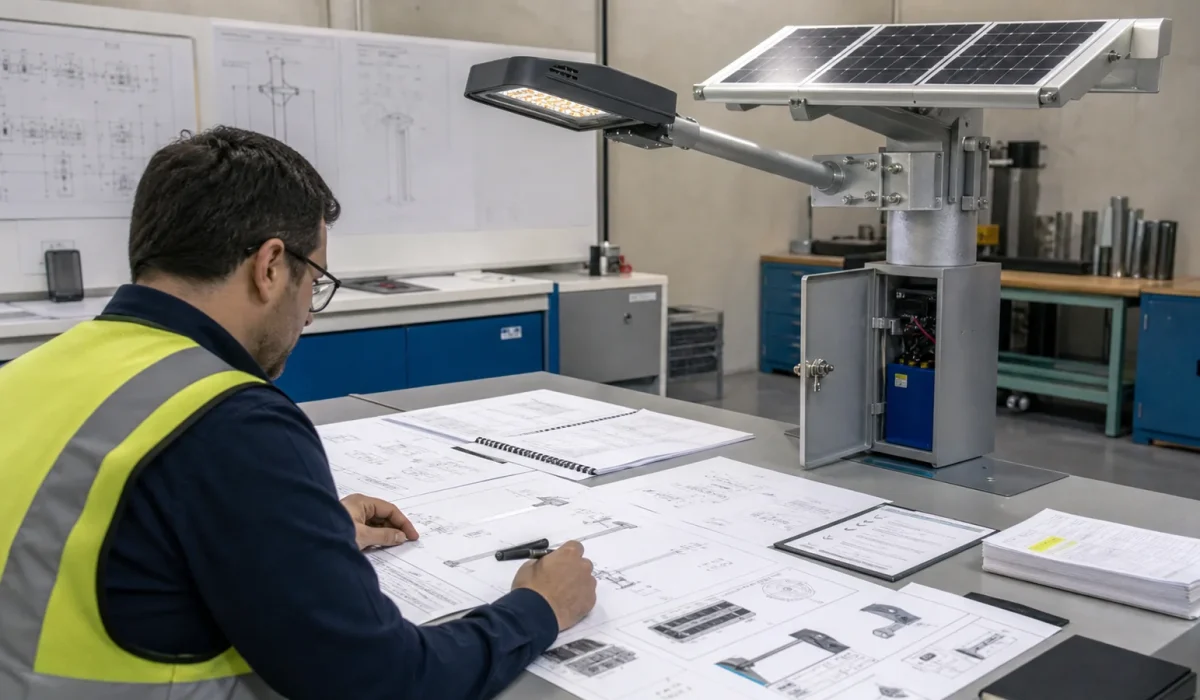
A generic statement such as “anti-theft design required” is not enough. It does not allow an EPC contractor, municipal buyer, NGO project team, or engineering consultant to compare battery placement, PV module fasteners, controller access, cable routing, or maintenance procedures between suppliers.
The objective is not to make every component permanently inaccessible. A complete anti-theft design must reduce unauthorized removal while preserving safe inspection, repair, and replacement throughout the project life.
Quick Answer: What Should an Anti-Theft Tender Requirement Include?
A solar street lighting tender should define anti-theft requirements at three levels:
- Tender requirement: What components must be protected, and what functional result is expected?
- Supplier submittal: What drawings, hardware descriptions, and access procedures must the bidder provide?
- Installation acceptance: What photographs, records, and inspections will prove that the approved design was actually installed?
The specification should normally review:
- Battery location and authorized access
- PV module bracket and fasteners
- Luminaire mounting hardware
- Controller compartment access
- Cable routing and connector exposure
- Pole access door security
- Maintenance keys and special tools
- Installation photographs
- Component serial records where required
- Spare lock, fastener, and tool policy
The correct arrangement depends on the project location, road type, pole height, maintenance capacity, flooding risk, corrosion environment, and local theft pattern. There is no single anti-theft configuration that is best for every off-grid lighting project.
For projects requiring drawings, BOQ support, technical clarification, or tender document review, see Sunlurio’s solar street lighting engineering support.
Why “Anti-Theft Design Required” Is Not a Complete Specification
“Anti-theft design required” describes an objective, but it does not define a measurable scope.
One bidder may interpret it as a small padlock on an external battery box. Another may propose an integrated battery, special panel fasteners, and concealed cable routing. A third may only state that the luminaire is “vandal-proof” without explaining how the luminaire, controller, or solar module is protected from removal.
These offers cannot be compared fairly because the bidders are not pricing the same scope.
Some public solar street lighting procurement documents contain more specific requirements, including protected battery integration, elevated battery placement, corrosion-resistant metal enclosures, and anti-theft locking arrangements. These are examples from individual projects rather than universal requirements for every country or tender.
A complete specification should answer four questions:
- What must be protected?
- How should unauthorized removal be restricted?
- How will authorized maintenance be performed?
- What evidence must be submitted and inspected?
It is also important not to confuse different performance requirements.
An IP rating relates primarily to protection against the ingress of solids and water. An IK rating relates to resistance against mechanical impact. Corrosion protection concerns material durability in the installation environment.
None of these ratings, by itself, proves that a battery, panel, luminaire, or controller cannot be removed.
Anti-theft mounting and access control must therefore be specified separately.
Define the Site Theft Risk Before Selecting the Hardware
Anti-theft hardware should be selected after the project team reviews the actual site risk.
A low external battery box may be practical in a secure industrial compound with controlled access. The same arrangement may be unacceptable on an isolated rural road where batteries can be reached without tools or supervision.
Similarly, an underground enclosure may reduce visibility but create drainage, flooding, corrosion, and maintenance problems. An integrated battery may reduce external access but require careful review of heat dissipation, replacement procedures, and compatible spare parts.
The tender should therefore require a site-based risk review rather than prescribe one configuration without context.
| Project input | Why it matters |
|---|---|
| Site accessibility | Determines how easily the public can approach poles and components |
| Local theft pattern | Helps identify whether batteries, copper cables, PV modules, or metal parts are the main target |
| Road application | Rural roads, municipal streets, campuses, and industrial areas have different access and supervision conditions |
| Pole height | Influences elevated battery access, service equipment, and worker safety |
| Battery resale risk | May justify integrated, elevated, or pole-internal placement |
| Maintenance capability | Determines whether special tools, elevated access, or sealed compartments are practical |
| Flooding and drainage | Affects underground or low-level battery enclosures |
| Coastal or corrosive environment | Affects locks, hinges, bolts, brackets, and metal battery boxes |
| Monitoring availability | Determines whether door alarms, disconnection alerts, or remote fault detection can support physical protection |
| Spare-parts management | Affects long-term availability of locks, keys, fasteners, and maintenance tools |
A useful tender clause should require the bidder to explain why its proposed anti-theft arrangement is suitable for the stated project environment.
The explanation does not need to be long, but it should connect the proposed hardware to actual site conditions.
Common Theft and Vandalism Targets in Solar Street Lighting Systems
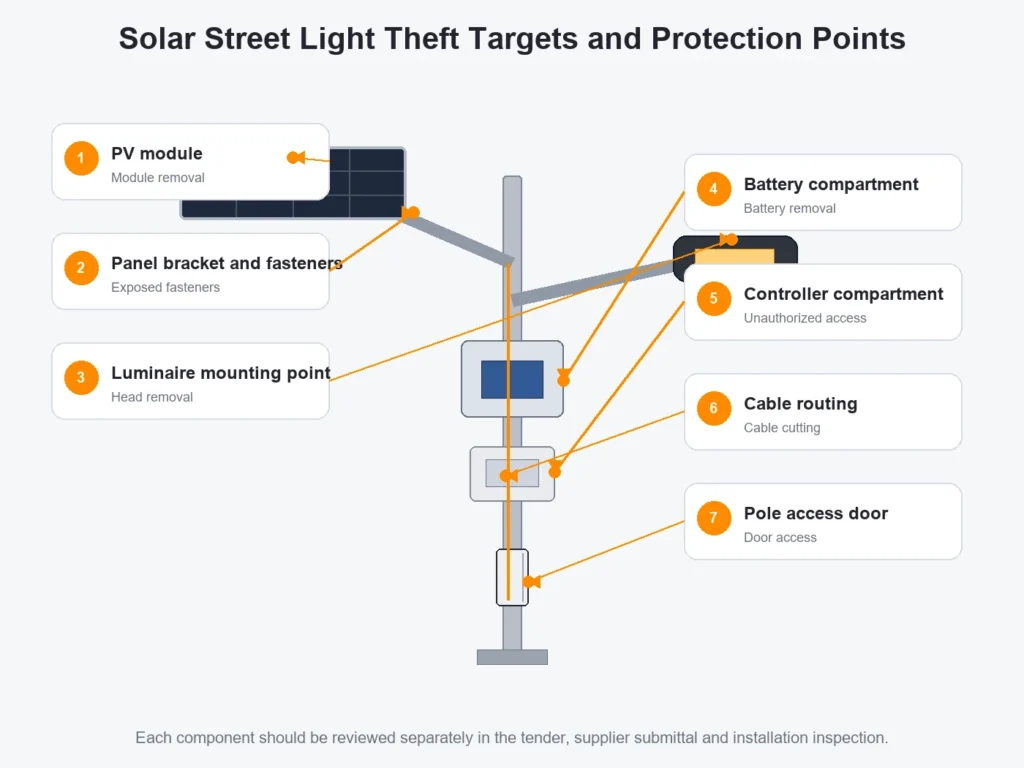 Battery, PV module, controller, cables, luminaire mounting and pole access should be reviewed separately in the tender.[/caption]
The battery and PV module are usually the most obvious high-value components, but they are not the only parts that require review.
Controllers, cables, connectors, luminaires, and pole access doors may also be removed, damaged, or opened without authorization. A tender that protects only the battery may leave the rest of the system exposed.
Component Risk and Protection Matrix
| Component | Theft or vandalism risk | Possible protection approach | Evidence to request |
|---|---|---|---|
| Battery | Removal for resale or unauthorized reuse | Integrated, elevated, pole-internal, or protected compartment | Battery-location drawing, enclosure detail, and access procedure |
| PV module | Module or bracket removal | Protected bracket geometry and tamper-resistant fasteners | Bracket drawing, fastener list, and installed close-up photo |
| Controller | Unauthorized access, removal, or setting changes | Lockable, concealed, or controlled-access compartment | Controller layout and authorized access method |
| Cables | Cutting, stripping, or connector disconnection | Concealed routing, protected entries, and limited exposed length | Cable-routing drawing and installed photographs |
| Luminaire | Luminaire head or mounting-arm removal | Anti-tamper mounting hardware and protected fixing points | Luminaire mounting detail and installation photograph |
| Pole access door | Forced entry to cables, batteries, or controls | Recessed fasteners, controlled lock, or protected door design | Door detail, lock specification, and key or tool procedure |
The purpose of this table is not to force every project to use every measure. It is to prevent important components from being ignored during bidding.
Battery Placement Options: Theft Risk vs Maintenance Access
Battery placement is usually the most important anti-theft decision in an off-grid street lighting system.
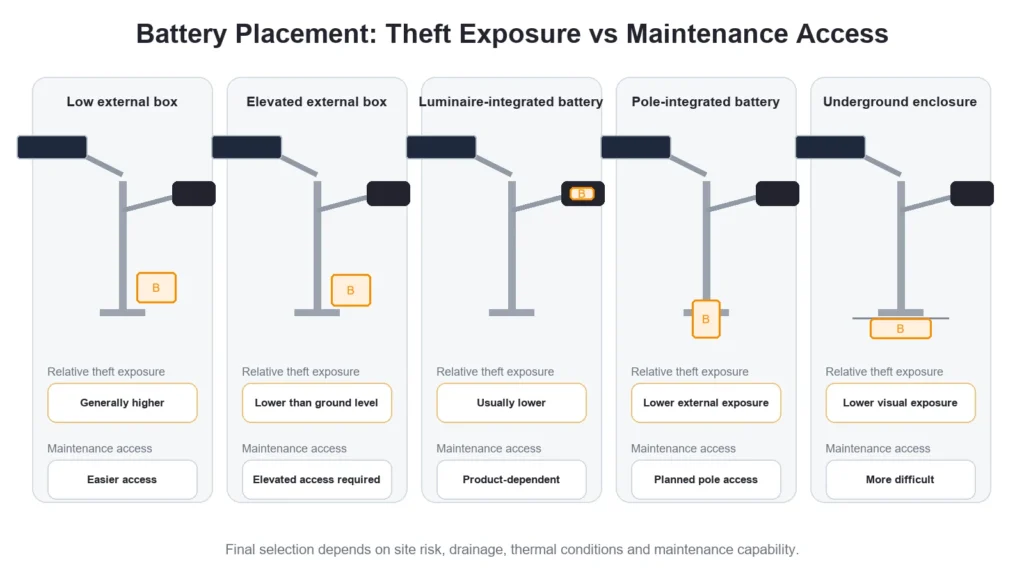
International procurement guidance has identified elevated secured boxes and inside-pole placement as possible theft-reduction approaches. However, these arrangements still need to be reviewed against maintenance access, thermal conditions, pole design, and worker safety.
No battery position is automatically theft-proof.
Battery Placement Comparison
| Battery design | Relative theft exposure | Maintenance access | Tender consideration |
|---|---|---|---|
| Low external battery box | Generally higher | Easy | Avoid where battery theft is a known risk unless the site is access-controlled |
| Elevated external battery box | Lower than ground-level installation | Requires safe elevated access | Define mounting height, locking arrangement, fasteners, and service procedure |
| Luminaire-integrated battery | Usually less accessible | Depends on luminaire design | Confirm heat management, battery replacement, and compatible spare-unit availability |
| Pole-integrated battery | Lower external exposure | Requires planned pole access | Require internal arrangement, ventilation where applicable, and removal procedure |
| Underground enclosure | Lower visual exposure | More difficult | Review drainage, flooding, corrosion, sealing, and safe maintenance access |
Low External Battery Boxes
Low-mounted boxes are easy to inspect and replace, but they may also be easy to attack in unsupervised locations. A lock alone may not be enough if the complete box can be unbolted from the pole or foundation.
Where a low external box is proposed, the tender should review:
- Box attachment to the pole or foundation
- Door, hinge, and lock arrangement
- Exposed bolt protection
- Cable entry
- Corrosion resistance
- Drainage
- Authorized replacement procedure
Elevated Battery Boxes
Raising the battery can reduce casual access, but it transfers part of the problem to maintenance.
The project team should confirm:
- How technicians will reach the box
- Whether a lifting platform or ladder is required
- How the door is prevented from falling open
- Whether the battery can be removed safely at height
- Whether the mounting increases pole wind load
- How keys and special tools are controlled
A box installed high on the pole is not a complete solution if routine battery replacement becomes unsafe or excessively expensive.
Integrated Batteries
An integrated battery can reduce visible external components and exposed cabling. However, the tender should not assume that integration automatically solves every theft and maintenance risk.
The bidder should state:
- Battery chemistry and configuration
- Battery compartment location
- Heat dissipation method
- Replacement method
- Required tools
- Whether the complete luminaire must be removed
- Availability of replacement batteries after the original warranty period
Underground Battery Enclosures
Underground installation can make the battery less visible, but it introduces different risks.
These include:
- Water ingress
- Poor drainage
- Soil corrosion
- Damaged seals
- Difficult inspection
- Cable-entry leakage
- Unsafe or inconvenient maintenance
- Enclosures being covered by soil or pavement after installation
Underground placement should therefore be treated as a project-specific civil and electrical design decision, not as a universal anti-theft recommendation.
Component-Level Tender Requirements
A tender should define anti-theft requirements by component rather than use one sentence for the complete system.
Battery Compartment
The battery requirement should state the permitted or preferred location and require the bidder to describe the enclosure and access method.
The specification should consider:
- Battery location
- Enclosure material
- Outdoor suitability
- Corrosion protection
- Door and hinge arrangement
- Lock or special fastener
- Attachment to the pole or structure
- Cable entry
- Drainage or ventilation where applicable
- Authorized inspection and replacement procedure
The battery must remain serviceable. Welding the battery permanently into a compartment or designing a box that must be destroyed during replacement is not a sustainable maintenance strategy.
PV Module Bracket
PV module protection should cover the complete mounting arrangement, not only the bolt type.
The tender should request:
- Bracket drawing
- Module frame attachment
- Bolt-head exposure
- Nut access
- Tamper-resistant fastener type
- Cable exit and routing
- Bracket material and corrosion protection
- Authorized module-removal procedure
Fasteners should make unauthorized removal more difficult, but authorized technicians must still be able to replace a damaged panel without cutting the bracket apart.
Luminaire Mounting and Controller Access
The luminaire and controller may contain batteries, drivers, communication modules, or programmable settings. Unauthorized access can therefore affect both component security and lighting performance.
The bidder should identify:
- Luminaire mounting bolts
- Bracket or spigot arrangement
- Controller location
- Access cover
- Locking or special fasteners
- Required tools
- Seal replacement requirements
- Procedure for authorized controller inspection
For smart systems, software permissions and remote alarms may support physical security, but they do not replace secure mechanical mounting.
Cable Routing and Connectors
Exposed cables may be cut for copper recovery or disconnected to disable the system.
The tender should define:
- Maximum permitted exposed cable length
- Internal pole routing where practical
- Protected cable entry
- Connector location
- Strain relief
- UV and weather protection
- Access to fuses or isolators
- Repair method
The phrase “all cables concealed” should not be used without checking whether the proposed product architecture can actually comply.
A more workable specification defines which routes must be internal and how unavoidable exposed sections must be protected.
Pole Access Door
The pole access door may provide access to terminal blocks, cables, controllers, or pole-integrated batteries.
The tender should state whether the door requires:
- Recessed fasteners
- Tamper-resistant screws
- A controlled key
- A protected lock
- A retained internal safety chain
- A replaceable gasket
- A documented access procedure
The design must also preserve grounding continuity, cable clearance, and safe electrical isolation.
Tender Wording Examples
The following clauses are drafting examples.
They should be reviewed and adapted by the project owner, EPC contractor, consultant, procurement team, or legal adviser before being included in a contract.
They are not universal legal wording and do not replace applicable national standards, procurement rules, or project-specific engineering review.
General Anti-Theft Scope
The solar street lighting system shall include component-level anti-theft measures covering the battery compartment, photovoltaic module mounting arrangement, luminaire mounting point, controller access and exposed cable routes where applicable.Bidder Disclosure Requirement
The bidder shall identify all anti-theft fasteners, locks, brackets, access points and special maintenance tools included in the offer. Generic statements such as “anti-theft design” without component-level details shall not be considered sufficient.Battery Installation Requirement
The battery shall be installed in an integrated, elevated, pole-mounted, underground or otherwise protected compartment appropriate to the project environment. The arrangement shall restrict unauthorized removal while allowing authorized inspection and replacement without destructive disassembly.PV Module Bracket Requirement
The photovoltaic module mounting arrangement shall use protected or tamper-resistant fastening methods. The bidder shall submit the proposed bracket detail, fastener type and authorized maintenance removal procedure for technical review.Cable-Routing Requirement
Power and control cables shall be routed within the pole, bracket or protected enclosure where practical. Any exposed cable section shall be identified in the technical submittal and provided with suitable mechanical, environmental and connector protection.Supplier-Submittal Requirement
The bidder shall submit drawings or technical details showing battery location, photovoltaic bracket fastening, luminaire mounting, controller access, cable routing and the tools or keys required for authorized maintenance.Installation-Evidence Requirement
The contractor shall provide installation evidence for each pole or for an approved inspection sample, including photographs of the battery compartment, photovoltaic bracket, luminaire mounting hardware, cable routing and pole access arrangement, together with serial-to-location records where required by the project.Handover Requirement
All special keys, removal tools, spare anti-tamper fasteners and access procedures required for routine maintenance shall be listed and handed over to the employer or nominated maintenance authority before final acceptance.The tender team should decide whether evidence is required for every pole, for a defined sample, or for each installation team and configuration.
Requiring unnecessary records for every unit can create administrative cost without improving project control.
From Tender Requirement to Acceptance Evidence
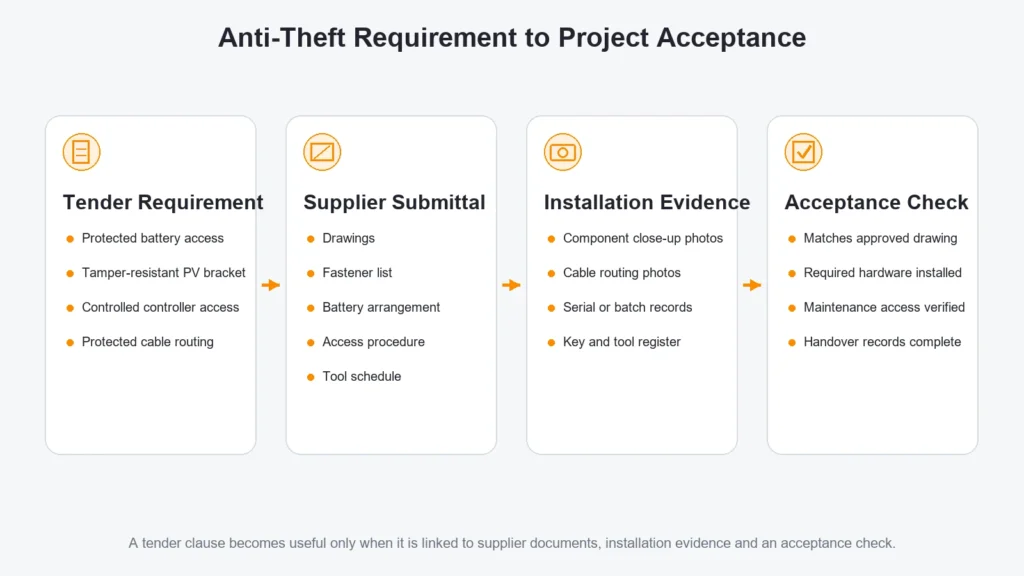
A technical clause is only useful if the project team can verify it.
The anti-theft requirement should therefore be connected to a supplier submittal, an installation record, and an acceptance check.
Requirement–Evidence–Acceptance Chain
| Tender requirement | Supplier submittal | Installation evidence | Acceptance check |
|---|---|---|---|
| Protected battery access | Battery-location drawing and access description | Compartment and mounting photographs | Installed location and access method match the approved design |
| Protected PV bracket | Bracket drawing and fastener list | Close-up photograph of installed fasteners | Specified fasteners and bracket arrangement are present |
| Controlled controller access | Controller-compartment detail | Open and closed compartment photographs | Authorized access is possible without exposing the compartment publicly |
| Concealed or protected cable routing | Cable-routing drawing | Pole, bracket, and connector photographs | No unapproved exposed route or unsupported connector |
| Secure luminaire mounting | Mounting detail and bolt specification | Luminaire-arm connection photograph | Approved mounting hardware is installed |
| Controlled maintenance access | Key and tool schedule | Handover register | Required keys, tools, and spares have been transferred |
| Component traceability | Proposed serial-record format | Serial-to-pole or batch-to-location record | Installed components correspond with project records |
This chain prevents a common procurement failure: the tender includes a technical requirement, but the project never asks the supplier to show its proposed design and never checks whether the approved arrangement was installed.
Some public tenders require component identification and serial information. Extending this into a location record can support warranty administration, replacement tracking, and investigation after theft.
However, serial-to-location mapping should only be required where the project has a practical process for creating, checking, storing, and maintaining the records.
What Installation Photographs Should Show
A useful photograph should prove a specific requirement. It should not only show that a pole exists.
Depending on the approved design, the evidence package may include:
- Battery enclosure closed
- Battery enclosure open under authorized access
- Battery-box attachment point
- PV module bracket fasteners
- Protected cable entry
- Luminaire mounting bolts
- Controller compartment
- Pole access door
- Serial label
- Completed pole-location reference
The tender should state which photographs are mandatory.
Otherwise, contractors may submit distant road photographs that provide no evidence of the anti-theft hardware.
Maintenance Access, Spare Tools and Hidden Costs
A secure design that cannot be maintained safely is not a complete project solution.
Anti-theft hardware can create long-term cost and downtime when maintenance requirements are not considered during procurement.
Special Fasteners Without Tools
A bidder may propose proprietary or uncommon fasteners but fail to include the required removal tools.
When the first battery or panel needs replacement, the maintenance team may have to:
- Drill out the fastener
- Cut the bracket
- Damage the enclosure
- Wait for a special tool
- Replace undamaged components unnecessarily
The tender should therefore require a tool schedule and an agreed quantity of spare tools.
Uncontrolled Keys
Locks do not provide effective access control when:
- Every pole uses a different key
- Keys are not labelled
- No duplicate set is provided
- The handover register is incomplete
- The lock supplier cannot provide replacements
- Keys are held only by the installation subcontractor
The project should define who receives the keys, how duplicates are controlled, and whether a master-key arrangement is acceptable.
Excessive Welding
Welding can make removal more difficult, but it may also prevent normal maintenance.
Permanent welding should not block:
- Battery replacement
- Luminaire replacement
- PV module replacement
- Cable inspection
- Controller access
- Corrosion repair
Where welding is used, the bidder should identify which joints are permanent and which components remain replaceable.
Elevated Access Costs
Installing batteries or controllers high on the pole may reduce theft exposure but increase maintenance cost.
The project team should consider:
- Required vehicle or lifting equipment
- Road closure needs
- Working-at-height procedures
- Technician availability
- Replacement frequency
- Emergency repair time
A design that requires a lifting truck for every minor intervention may be unsuitable for a remote project with limited maintenance resources.
Underground Enclosure Risks
An underground box can create hidden lifecycle costs if drainage and sealing are not maintained.
The acceptance procedure may need to check:
- Enclosure elevation
- Drainage route
- Cable seals
- Cover security
- Water accumulation
- Soil settlement
- Access clearance
- Corrosion condition
Spare Locks and Fasteners
Anti-theft components should be included in the spare-parts discussion.
The tender may need to request:
- Spare locks
- Spare keys
- Spare tamper-resistant bolts
- Replacement gaskets
- Special sockets or bits
- Compatible cable glands
- Replacement access-door hardware
The required quantity should be based on project size, hardware standardization, and maintenance strategy rather than an arbitrary percentage.
Common Tender Specification Mistakes
Weak anti-theft wording often creates either an incomplete scope or an unnecessarily restrictive design.
Weak Wording vs Better Tender Wording
| Weak wording | Why it fails | Better approach |
|---|---|---|
| Anti-theft design required | No component scope, bidder evidence, or acceptance method | Define the protected components, submittals, and inspection evidence |
| Battery box with lock | Does not define box attachment, lock arrangement, or maintenance access | Specify enclosure, fixing, access, corrosion protection, and replacement method |
| Vandal-proof luminaire | Confuses impact resistance with protection against removal | State IK rating separately from mounting and access-control requirements |
| All cables shall be concealed | May be impossible for some system architectures | Define internal routes and protection for unavoidable exposed sections |
| Battery shall be installed underground | Ignores flooding, drainage, corrosion, and servicing conditions | Allow reviewed placement options based on site risk |
| Integrated battery required | May restrict suitable systems without proving better lifecycle performance | Define the required security and maintenance outcome |
| Supplier shall submit photos | Does not specify what the photographs must prove | List required views, close-up details, and location references |
| Special anti-theft bolts required | Does not address tool supply or future replacement | Require fastener details, tools, and spare quantities |
| Monitoring system shall prevent theft | Remote monitoring cannot physically stop removal | Use monitoring as a supporting detection measure |
| High IP and IK ratings required for anti-theft | Environmental and impact ratings do not prove removal resistance | Specify ingress, impact, and anti-theft requirements separately |
Another common mistake is copying a clause from an unrelated tender without checking the project environment.
Government and institutional specifications may prescribe particular battery positions, enclosure materials, heights, or protection ratings. Those values apply to the issuing project and should not automatically be reused elsewhere.
The same principle applies to broader solar PV procurement guidance. Concepts such as tamper-resistant array fasteners, locked electrical equipment, and cable anti-theft devices can be useful, but they must be adapted before being applied to standalone street lighting systems.
What Buyers Should Ask Before Awarding the Contract
Before selecting a supplier, the technical evaluation team should ask questions that reveal the actual design rather than accept a “yes” response to an anti-theft requirement.
Battery
- Where is the battery installed?
- Can it be reached from ground level?
- How is the enclosure attached?
- What type of authorized access is provided?
- Can the battery be replaced without damaging the box, pole, or luminaire?
- How is heat managed?
- How are water and corrosion risks controlled?
PV Module
- How is the module fixed to the bracket?
- Which bolt heads and nuts remain exposed?
- Are special fasteners used?
- Are removal tools included?
- How is the PV cable protected?
- Can the module be replaced without cutting the bracket?
Luminaire and Controller
- What prevents removal of the luminaire head?
- Where is the controller located?
- Can operating settings be changed without authorization?
- How is the controller inspected?
- Are communication modules or antennas separately protected?
Cables and Pole Access
- Which cables are routed internally?
- Where are connectors located?
- How is the pole door secured?
- Can cables be reached after opening the door?
- How is electrical isolation performed during maintenance?
Documents and Handover
- What drawings will be submitted before manufacture?
- What fastener, lock, and tool schedules will be provided?
- What installation photographs are required?
- Is serial-to-location mapping included or optional?
- Who receives keys and special tools?
- Are spare locks and fasteners included?
- How are deviations from the approved design recorded?
- What maintenance instructions are provided?
The evaluation team should also verify that the anti-theft design does not weaken the underlying solar lighting system.
Battery capacity, autonomy, PV sizing, thermal conditions, and charging performance remain separate technical requirements.
Anti-theft protection should not be used to justify an undersized battery, poor heat dissipation, or inaccessible electrical design.
How Sunlurio Supports Tender-Ready Anti-Theft Design
Sunlurio can support anti-theft requirement development as part of a broader solar street lighting engineering review.
The review can include:
- Project location and site-access assessment
- Road application and pole-height review
- Comparison of integrated, elevated, pole-mounted, and protected battery arrangements
- Component-level anti-theft scope
- Battery-compartment and bracket details
- Cable-routing review
- Maintenance-access method
- Key, tool, and spare-hardware schedule
- Supplier-submittal requirements
- Installation-photograph checklist
- Serial or batch record format where applicable
- BOQ and technical clarification support
The final document scope depends on the project stage, product configuration, available inputs, and agreed support scope.
Anti-theft requirements should be coordinated with the selected solar street light configuration, site environment, maintenance plan, and tender format.
For projects that also require technical drawings, data sheets, BOQ support, or document review, see Sunlurio’s solar street lighting engineering support and tender document and BOQ support.
Project owners can also review solar street lighting project references and application-based lighting solutions before finalizing the tender scope.
Need Anti-Theft Requirements Added to Your Solar Street Lighting Tender?
Send the project location, road application, pole height, preferred system configuration, site-security concerns, and tender format.
Sunlurio can help review component-level anti-theft requirements, supplier submittals, maintenance access, and installation evidence for a tender-ready engineering pack.
Frequently Asked Questions
What Should an Anti-Theft Solar Street Light Tender Specification Include?
It should identify the components requiring protection, the expected protection outcome, the documents bidders must submit, and the installation evidence required for acceptance.
At minimum, the tender should review the battery, PV module bracket, luminaire mounting, controller access, cables, and pole access door.
It should also define authorized maintenance access, required tools, and the handover procedure.
Is an Integrated Battery Always Safer Than an External Battery Box?
No. An integrated battery is normally less visible and less accessible than a low external box, but the complete design still needs to be reviewed.
Important questions include heat dissipation, battery replacement, luminaire removal, spare-battery compatibility, and access to the battery compartment.
Integration should not be treated as proof of adequate security or maintainability.
Is an Underground Battery Box Suitable for Every Project?
No. Underground installation may reduce visual exposure, but it can create flooding, drainage, corrosion, and maintenance risks.
It is more suitable where civil works, enclosure sealing, cable entry, and long-term drainage can be controlled.
It may be unsuitable in flood-prone areas or projects without reliable inspection and maintenance capacity.
Does an IK Rating Prove That a Solar Street Light Is Theft-Resistant?
No. An IK rating indicates resistance to defined mechanical impacts. It does not prove that a luminaire, battery, controller, or solar panel cannot be unbolted or removed.
The tender should specify IK performance and anti-theft mounting as separate requirements.
Should Tamper-Resistant Fasteners Be Specified by Brand?
Usually not. A performance-based description is generally more flexible unless the project has an approved standardized hardware system.
The tender can require a defined fastener function, tool supply, corrosion suitability, spare quantity, and controlled removal method.
Naming one brand may unnecessarily restrict competition or create replacement problems.
What Installation Photographs Should Be Required at Handover?
The required views should correspond to the approved anti-theft design.
Typical photographs include the battery compartment, box attachment, PV bracket fasteners, luminaire mounting bolts, controller access, cable routing, pole access door, and serial label.
The tender should state whether photographs are required for every pole or for an approved sample.
How Should Special Keys and Maintenance Tools Be Managed?
The supplier should provide a schedule showing each key and tool type, the equipment it operates, and the quantity supplied.
Keys and tools should be transferred through a handover register.
The project should also define who controls duplicates and whether spare locks, fasteners, or special sockets are included.
Can Smart Monitoring Prevent Solar Street Light Theft?
Smart monitoring can detect equipment disconnection, unexpected outages, access events, or abnormal operating conditions when the required sensors and communication functions are included.
It cannot physically prevent a battery, panel, or luminaire from being removed.
Monitoring should support—not replace—secure mounting, controlled access, and installation inspection.
Drafting Note
The tender clauses in this article are general drafting examples.
They must be adapted to the project location, procurement rules, technical design, maintenance capability, contractual requirements, and applicable national standards before use.