
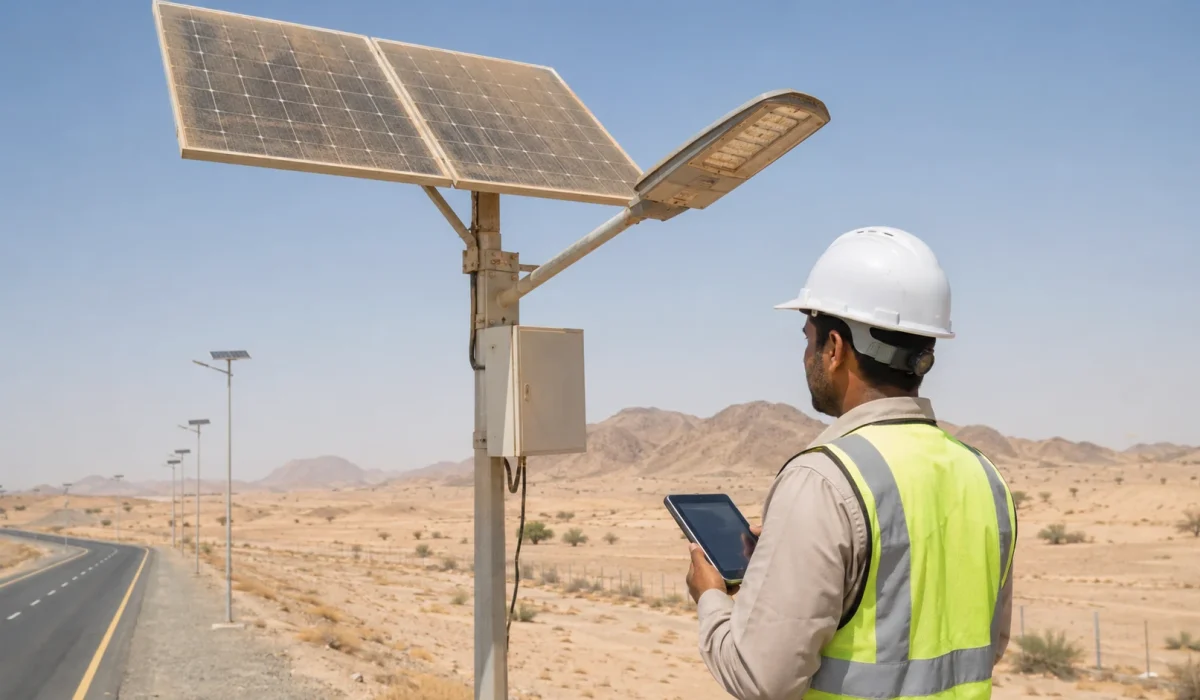
Quick Answer
Solar street lights in desert climates require more active maintenance than systems installed in mild urban environments. The main maintenance tasks include solar panel cleaning, battery and controller inspection, heat dissipation checks, cable and seal review, pole fastener tightening, and surface coating inspection.
In many desert and semi-desert projects, solar panels should be inspected every 1–3 months, with extra review after sandstorms or visible dust accumulation. The final cleaning schedule should still be adjusted according to dust level, rainfall, road type, panel tilt angle, and actual charging performance.
For EPC contractors and municipal buyers, desert maintenance should not be treated as an after-sales detail. It should be planned before installation through proper product selection, spare parts planning, handover documents, and a clear inspection schedule.
Why Desert Solar Street Lights Need a Different Maintenance Plan
Desert solar street lights face a different maintenance environment because dust, heat, wind, UV exposure, and remote-site access all affect long-term performance. A system that works well in a normal city road may require a different inspection and cleaning plan when installed in a hot, dry, dusty, or sandstorm-prone area.
The biggest issue is not only whether the lamp can turn on after installation. The real project question is whether the system can keep stable charging, runtime, and structural condition after months or years of dust exposure and high-temperature operation.
For desert road lighting, highway lighting, industrial areas, mining access roads, and remote municipal projects, maintenance planning should cover:
- solar panel dust accumulation
- reduced charging performance after sandstorms
- battery aging under high temperature
- controller and wiring heat stress
- gasket and sealing degradation
- pole coating abrasion from wind-blown sand
- anchor bolt and fastener loosening
- higher labor cost for remote inspection
- spare parts planning for off-grid solar lighting maintenance
This is why desert solar street lighting projects should be reviewed as a complete system, not only as a lamp, panel, and battery combination.
Desert vs. Mild Urban Maintenance Requirements
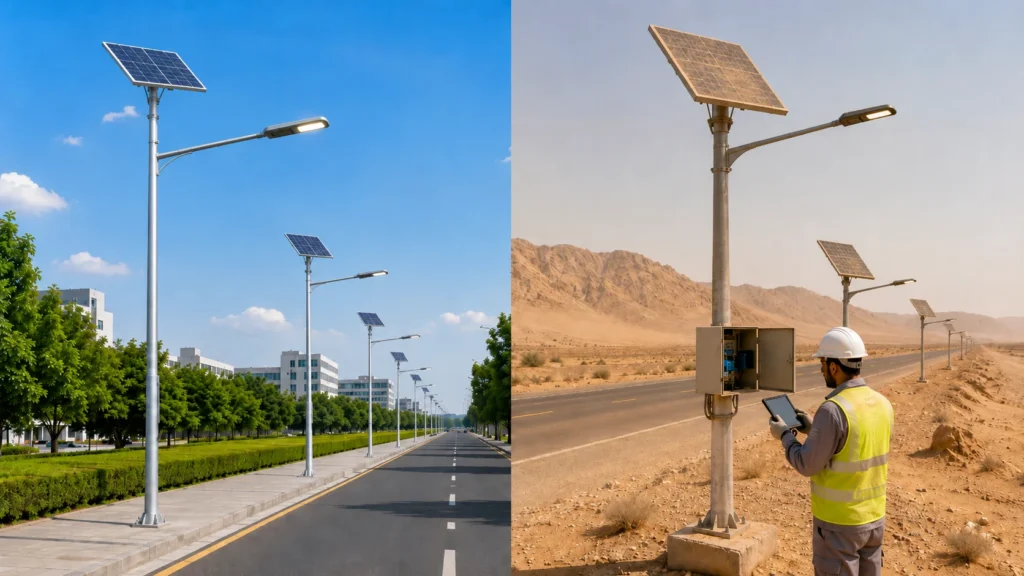
Solar street lights in desert climates require a more active maintenance plan than systems installed in mild urban environments. The difference is not only cleaning frequency. It also affects battery life, sealing materials, fastener inspection, fault diagnosis cost, and long-term maintenance responsibility.
| Maintenance Dimension | Mild Urban Climate | Desert or Semi-Desert Climate |
|---|---|---|
| Solar Panel Cleaning | Panels may only need periodic cleaning every 6–12 months in some locations, especially where seasonal rain helps remove light dust. | Panels often need inspection every 1–3 months, with additional cleaning after sandstorms or visible dust accumulation. |
| Battery Environment | Battery temperature stress is usually lower, although seasonal temperature changes still need to be considered. | High daytime temperature can accelerate battery aging, reduce usable capacity, and increase stress on the controller and wiring. |
| Fasteners and Structural Parts | Pole fasteners, brackets, and mounting parts are usually checked during regular annual inspection. | Wind, vibration, sand abrasion, and day-night temperature differences can loosen fasteners or damage coatings. |
| Gaskets, Seals, and IP Protection | Gaskets and seals usually age more slowly if the system is not exposed to extreme heat, dust, or strong UV radiation. | Rubber gaskets, cable glands, lens seals, and battery box seals can become brittle or cracked faster. Buyers should check the dust-proof IP rating and sealing material suitability. |
| Fault Diagnosis Cost | Maintenance access is usually easier in city roads, communities, and commercial areas. | Many projects are located on remote roads, mining access routes, or industrial sites, where each inspection may involve transport, labor, spare parts, and longer downtime. |
Main Maintenance Requirements in Desert Climates
Desert maintenance should focus on the parts that directly affect charging, runtime, safety, and long-term reliability. The most important areas are solar panels, batteries, controllers, LED housing, seals, cables, pole structure, and surface protection.
1. Solar Panel Cleaning and Dust Control
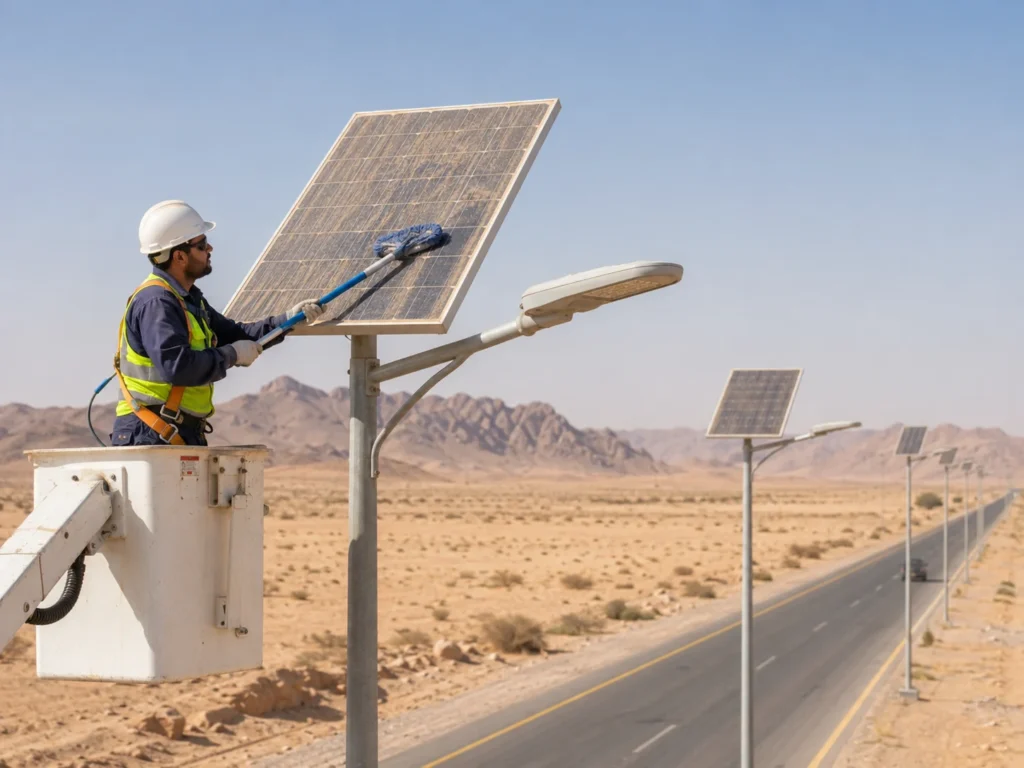
Solar panel cleaning is the most visible and frequent maintenance task in desert climates because dust and sand can block sunlight from reaching the panel surface. This is not only an appearance issue. Heavy dust accumulation can reduce daily charging, which may shorten nighttime runtime before any component is actually damaged.
In many desert projects, panels should be inspected every 1–3 months. The cleaning frequency should be shortened after sandstorms or during long dry seasons with heavy dust. However, the exact schedule should depend on actual site conditions, not a fixed rule.
Important factors include:
- local dust level
- road type and traffic conditions
- nearby construction activity
- mining or industrial dust exposure
- rainfall frequency
- panel tilt angle
- actual battery charging data
- visible runtime reduction at night
For cleaning, use a soft non-abrasive brush, microfiber cloth, and clean water. In many cases, demineralized or low-mineral water is preferred to avoid mineral marks on the glass. Avoid hard scrapers, harsh chemical solvents, and rough cleaning tools because sand particles can already create abrasion risk on the panel glass.
Panel tilt angle also matters. A steeper and project-appropriate tilt can help loose dust slide or blow away more easily. However, tilt angle should not be changed randomly after installation because it may affect solar charging performance, wind load, and structural assumptions. Any major adjustment should be reviewed against the original design.
2. Battery Inspection and Heat Management
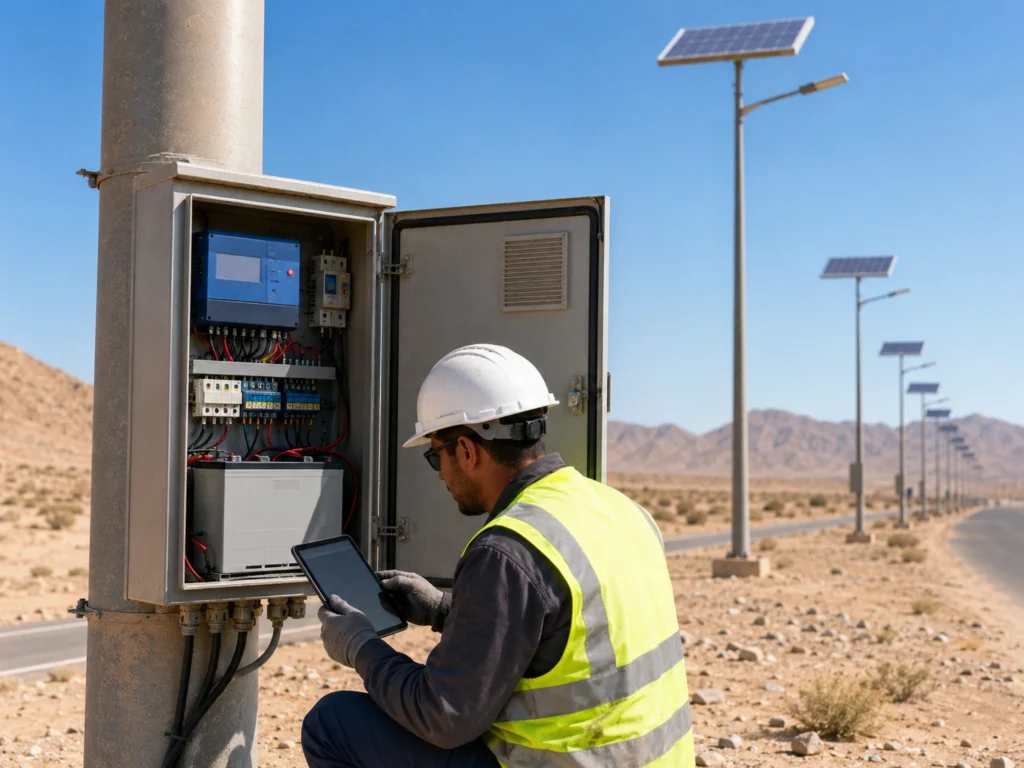
Battery inspection is critical in desert solar street lighting because high ambient temperature can accelerate battery aging and reduce long-term capacity. A solar street light may pass the first acceptance test but still develop runtime problems later if the battery is undersized, poorly protected, or exposed to excessive heat.
Maintenance teams should check:
- battery compartment temperature condition
- visible swelling or deformation
- loose terminals or cable connections
- reduced runtime at night
- abnormal charging or discharging behavior
- controller fault indications
- corrosion or dust inside the battery box
- ventilation or heat dissipation blockage
Battery life is not the same in all desert projects. A general planning range is often 3–7 years, depending on battery chemistry, depth of discharge, thermal protection, sizing margin, charging control, and real site temperature.
LiFePO4 batteries are often preferred for project-grade solar street lighting because they usually provide better cycle life and thermal stability than many conventional lithium-ion battery options when properly designed. However, even LiFePO4 batteries still require correct sizing, temperature protection, and maintenance review in hot environments.
For EPC and municipal projects, battery replacement planning should be included in the maintenance plan from the beginning. The project team should know what battery type is used, where it is installed, how it can be accessed, and what spare parts may be needed during the service period.
3. Controller, Wiring, and Ventilation Checks
The controller and wiring system should be inspected because desert heat and dust can affect electrical reliability over time. A solar street light failure is not always caused by the battery or LED module. Loose wiring, poor cable sealing, dust inside the control compartment, or overheating around the controller can also cause unstable operation.
Maintenance should include:
- checking cable glands and waterproof connectors
- confirming that wiring terminals are tight
- removing dust from controller compartments
- checking for insects, sand, or moisture entry
- reviewing controller fault logs if available
- confirming charging and discharging status
- checking whether ventilation openings are blocked
For desert projects, buyers should not only ask whether the product is waterproof. They should also check whether the dust-proof IP rating, cable entry protection, battery box sealing, and controller compartment design are suitable for long-term exposure to sand, heat, and UV radiation.
If the system uses smart control, remote monitoring, or project-level operation data, the maintenance team should review abnormal runtime, low battery alerts, communication failures, and repeated undercharging events. These signals can help identify maintenance needs before many lights fail at the same time.
For larger projects, this is where documentation becomes important. Datasheets, wiring diagrams, controller settings, and handover records should be kept available for the maintenance team. Sunlurio supports project buyers with datasheets and drawings to make technical review and maintenance easier after installation.
4. LED Housing, Lens, and Sealing Protection
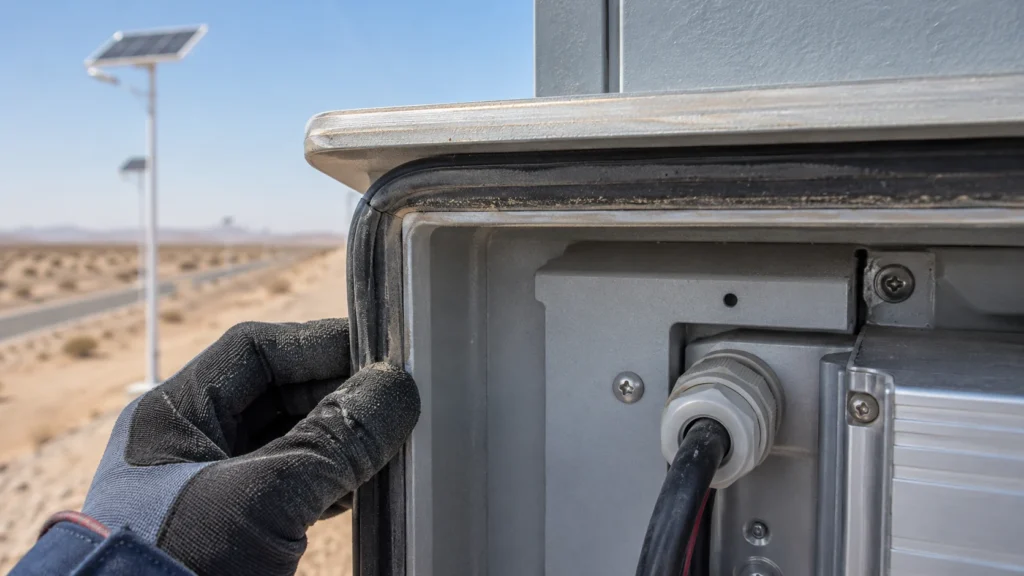
LED housing and sealing protection should be checked regularly because wind-blown sand can damage outer surfaces, lenses, gaskets, and cable entry points. In desert environments, dust protection is not only about keeping the lamp clean. It is also about preventing fine particles from entering sensitive areas over time.
Maintenance teams should inspect:
- lens surface condition
- dust buildup on the light output area
- rubber gasket aging
- cracks or gaps around the housing
- cable entry sealing
- signs of water or dust ingress
- damaged screws or cover plates
- heat sink dust blockage
If seals become brittle or cracked, dust and moisture may enter the luminaire housing. This can reduce optical performance, affect heat dissipation, and shorten the service life of internal components.
Heat sinks should also be kept free from heavy dust buildup. Before wet cleaning, dry dust should be removed carefully with a soft brush or controlled air cleaning method to reduce the risk of scratching or pushing abrasive particles into sensitive areas.
5. Pole, Fastener, and Surface Coating Inspection
Pole and hardware inspection is necessary because desert projects often experience wind, vibration, sand abrasion, and large temperature differences between day and night. These conditions can loosen fasteners and damage protective coatings over time.
The maintenance team should check:
- pole vertical alignment
- anchor bolts and base plate condition
- nuts, washers, and fasteners
- bracket and arm connections
- solar panel mounting frame
- paint damage or coating abrasion
- early corrosion around scratches
- foundation edge or grout condition
Even in dry desert environments, corrosion can still occur if protective coating is damaged, especially in coastal desert areas, industrial zones, or locations with salty dust. If paint or coating is scratched by sand abrasion, the damaged area should be repaired before corrosion spreads.
For projects in coastal desert regions, corrosion protection should be reviewed more carefully. Pole material, galvanizing, powder coating, fastener material, and cable entry protection should be matched to the real environment rather than selected only by standard appearance.
How Often Should Solar Street Lights Be Cleaned in Desert Areas?
Solar street lights in desert areas are commonly inspected every 1–3 months, but cleaning frequency should be adjusted according to dust level, rainfall, sandstorm frequency, panel angle, and actual charging performance. After severe sandstorms, panels should be checked as soon as site access is safe and practical.
A practical cleaning plan can be organized like this:
- Light dust, occasional wind, some seasonal rain: inspect every 2–3 months.
- Dry road, frequent dust, limited rain: inspect every 1–2 months.
- Mining area, construction road, desert highway: inspect monthly or after visible dust accumulation.
- After sandstorms: inspect and clean as soon as site access allows.
- Runtime becomes shorter: check panel dust, battery health, controller status, and shading together.
The key point is that cleaning should be linked to performance. If the battery is not fully charging or the runtime is becoming shorter, the team should not only replace parts immediately. They should first check whether dust, panel angle, shade, wiring, or controller settings are causing the charging loss.
Battery Replacement Planning in Hot and Dusty Environments
Battery replacement planning should be part of the project maintenance strategy because batteries are one of the most important lifetime cost items in solar street lighting. In desert climates, heat exposure, deep discharge, poor sizing, and weak thermal protection can all shorten battery life.
A simple project question is:
If the battery needs replacement after several years, can the project team access it safely, identify the right model, and replace it without redesigning the whole system?
Before project handover, EPC contractors and municipal teams should confirm:
- battery chemistry and model
- battery capacity and voltage
- expected replacement cycle
- access method for replacement
- spare battery availability
- controller compatibility
- protection against overheating
- warranty terms and maintenance responsibility
For remote desert projects, battery replacement cost is not only the cost of the battery itself. It also includes transport, labor, site access, inspection time, and possible downtime. This is why a lower initial price may not always mean a lower project cost.
Maintenance Checklist for EPC and Municipal Project Handover
A desert solar street lighting project should include a clear maintenance checklist before handover. This helps the owner, EPC contractor, installer, and maintenance team understand what needs to be inspected and who is responsible for each task.
A practical handover checklist should include:
- solar panel cleaning interval
- post-sandstorm inspection procedure
- battery inspection schedule
- controller and wiring inspection method
- LED housing and lens cleaning method
- gasket and seal inspection points
- pole fastener tightening schedule
- coating and corrosion inspection method
- spare parts list
- fault reporting process
- maintenance responsibility by party
- inspection record template
For tender and municipal projects, this checklist can also support clearer acceptance and after-sales communication. Instead of only saying “the system needs maintenance,” the project file should show what needs to be checked, how often, and which parts may require future replacement.
Sunlurio’s engineering support can help project teams prepare technical documents, drawings, specifications, and project review materials for solar street lighting systems in harsh environments.
Hidden Maintenance Costs Buyers Should Consider
The hidden maintenance costs of desert solar street lights often come from cleaning labor, battery replacement, spare parts, remote site access, seal aging, coating repair, and repeated inspection after sandstorms. These costs should be reviewed before finalizing the project configuration.
Common hidden costs include:
- more frequent panel cleaning
- post-sandstorm site visits
- battery replacement logistics
- controller or cable fault diagnosis
- gasket and seal replacement
- pole repainting or coating repair
- difficult access to remote road sections
- downtime caused by delayed spare parts
- labor cost for large project areas
For EPC contractors, these costs can affect project margin and client satisfaction. For municipal buyers, they can affect long-term budget planning. For distributors, they can affect after-sales pressure and replacement claims.
A well-designed desert solar street lighting system should reduce unnecessary maintenance through better sizing, better sealing, stronger thermal design, suitable battery selection, and clear documentation.
Common Mistakes to Avoid
Desert solar street light maintenance often fails when the project team treats hot and dusty conditions as a normal outdoor environment. The most common mistakes are usually simple, but they can create serious long-term performance problems.
Avoid these mistakes:
- using hard scrapers to clean solar panels
- cleaning dusty panels with abrasive methods
- using harsh chemical solvents on glass or seals
- ignoring battery compartment heat buildup
- assuming the same cleaning schedule works for every desert site
- checking only whether the light turns on, without checking charging performance
- ignoring cable glands, seals, and gaskets
- failing to inspect pole fasteners after wind exposure
- selecting low-cost batteries without replacement planning
- handing over the project without maintenance documents
For B2B projects, the biggest mistake is treating maintenance as a later problem. In desert climates, maintenance difficulty is partly decided during product selection, system design, installation method, and project documentation.
What Buyers Should Check Before Ordering Solar Street Lights for Desert Projects
Before ordering solar street lights for desert climates, buyers should check whether the system is designed for heat, dust, cleaning access, battery replacement, and long-term maintenance. A specification that looks acceptable on paper may still create problems if it does not match the actual project environment.
Key questions include:
- What is the local temperature range?
- How frequent are dust storms or sandstorms?
- Is the road close to mining, construction, or industrial dust?
- How often can the owner clean the panels?
- Is the battery protected from direct heat?
- Is the battery easy to replace later?
- Are the controller and wiring compartments well sealed?
- Is the dust-proof IP rating suitable for the project environment?
- Is the pole coating suitable for sand abrasion?
- Are spare parts available for future maintenance?
- Will the supplier provide datasheets, drawings, and handover documents?
For off-grid solar lighting maintenance, the buyer should confirm not only the lamp specification, but also cleaning access, battery replacement method, spare parts availability, and fault diagnosis process.
For road lighting and municipal projects, buyers should also ask for suitable technical support before installation. This may include product drawings, datasheets, lighting layout review, battery configuration review, and BOQ mapping.
You can review Sunlurio’s solar street light solutions for project-grade configurations, or request tender-ready documents through Engineering Support.
How Sunlurio Supports Desert and Harsh-Climate Solar Street Lighting Projects
Sunlurio supports desert and harsh-climate solar street lighting projects by helping buyers review the system from product selection to project documentation. For EPC contractors, municipal buyers, and project distributors, the goal is not only to supply lights but also to reduce long-term maintenance risk.
Sunlurio can support project teams with:
- solar street light configuration review
- battery and controller specification support
- project datasheets and technical drawings
- BOQ and tender document support
- lighting layout and engineering review
- harsh-environment project discussion
- spare parts and maintenance planning
- project handover documentation support
For desert climates, we recommend reviewing dust exposure, temperature range, panel cleaning access, battery replacement logic, pole coating, and sealing design before confirming the final model.
Need a Desert Solar Street Lighting Maintenance Review?
For EPC contractors, municipal buyers, and project distributors, Sunlurio can help review solar street light configuration, battery placement, sealing design, spare parts planning, and handover documents for desert and harsh-climate projects.
Request Engineering Pack (24H):
Request project drawings, datasheets, BOQ support, and maintenance review
Related Engineering Support
For project buyers, EPC contractors, and municipal teams, the following resources may help with technical review and tender preparation:
- Engineering Support
- Datasheets and Drawings
- Tender Documents and BOQ Support
- Solar Street Light Products
- Africa Project References
- Middle East Project References
FAQ
How often should solar street lights be cleaned in desert climates?
Most desert projects require inspection every 1–3 months, but the final schedule depends on dust level, rainfall, sandstorm frequency, panel angle, and charging performance. After severe sandstorms, panels should be checked as soon as site access is safe and practical.
Does desert dust reduce solar street light performance?
Yes. Heavy dust accumulation can reduce solar charging performance because less sunlight reaches the panel surface. If the panel stays dirty for too long, the battery may not charge fully during the day, which can shorten nighttime runtime.
What is the best way to clean solar panels in desert areas?
Use a soft non-abrasive brush, microfiber cloth, and clean water. Avoid hard scrapers, rough tools, and harsh chemical solvents. Because sand particles can scratch the glass surface, dry dust should be removed carefully before wet cleaning.
How does high temperature affect solar street light batteries?
High temperature can accelerate battery aging, reduce usable capacity, and increase stress on electrical components. Battery compartments should be protected from excessive heat, dust blockage, and poor ventilation. Battery condition should be checked regularly in hot desert environments.
How long do solar street light batteries last in desert climates?
A common planning range is 3–7 years, depending on battery chemistry, sizing, temperature protection, depth of discharge, controller settings, and real site conditions. LiFePO4 batteries usually provide better cycle life and thermal stability when properly designed, but they still require correct sizing and inspection.
What IP rating should solar street lights use in desert climates?
The required IP rating depends on the project environment, product structure, and exposure level. For desert projects, buyers should check dust-proof protection, cable entry sealing, battery box protection, controller compartment design, and long-term gasket durability rather than only looking at a single IP number.
What parts should be inspected after a sandstorm?
After a sandstorm, inspect the solar panel surface, LED lens, heat sink, cable glands, controller compartment, battery box, gaskets, pole fasteners, and mounting brackets. If the system shows reduced runtime afterward, check panel dust, battery charging status, wiring, and controller operation together.
Should maintenance planning be included in solar street light tender documents?
Yes. For EPC and municipal projects, maintenance planning should be included in the tender or handover documents. The project file should define cleaning intervals, inspection items, spare parts, battery replacement planning, and maintenance responsibility. This helps reduce disputes and long-term operating risk.