
Quick Answer
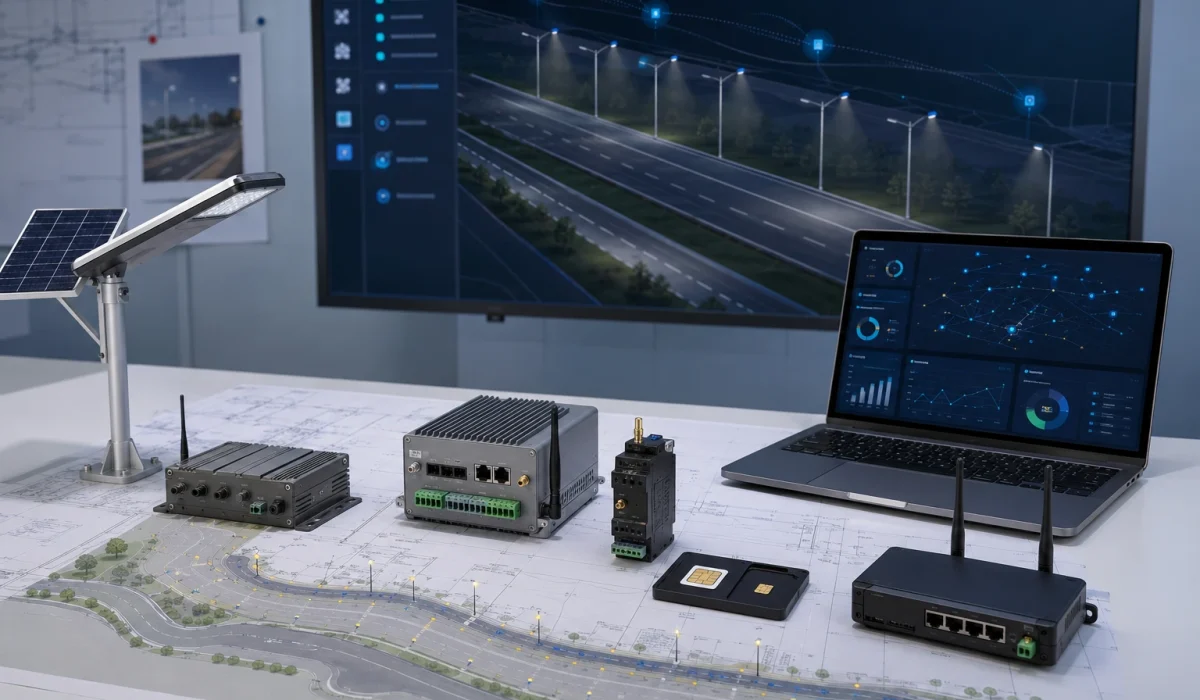
Smart street lighting control can use 4G/5G, LoRaWAN, Zigbee, NB-IoT, or other communication methods. There is no single best option for every government, municipal, or EPC project.
For dispersed roads, highways, rural roads, and remote solar street lighting projects, 4G/5G or other cellular IoT options are often easier because each controller can connect directly through the cellular network without local gateways. For planned smart city districts, industrial parks, campuses, or municipal networks, LoRaWAN can be a strong option when gateway locations can be designed and maintained. For small, dense, local-area projects such as parks, compounds, campuses, or demonstration zones, Zigbee may also be suitable.
For project buyers, the better question is not “Which protocol is the most advanced?” The better question is: which communication method is easier to deploy, maintain, approve, and operate under the real project conditions?
Key Selection Points for Smart Street Lighting Projects
- Main topic: smart street lighting control communication selection
- Compared options: 4G/5G, LoRaWAN, Zigbee, NB-IoT, and related IoT control options
- Best-fit readers: government buyers, municipal project teams, EPC contractors, smart city planners, lighting consultants, and infrastructure distributors
- Best-fit projects: smart city street lighting, municipal roads, highways, industrial parks, campuses, public areas, and distributed solar street lighting projects
- Key decision factors: gateway requirement, maintenance workload, node density, road distance, cellular coverage, platform function, and total lifecycle cost
- Required documents: control architecture, controller datasheet, gateway plan, luminaire schedule, wiring diagram, platform function list, BOQ mapping, and commissioning checklist
- Common mistake: choosing the communication method only by module price instead of total project operation cost
What Smart Street Lighting Control Really Means
Smart street lighting control is not only remote switching. A smart street lighting system normally combines lighting hardware, control hardware, communication hardware, software platform, installation method, and long-term maintenance responsibility.
A smart street lighting system may include:
- remote on/off control
- scheduled dimming
- group control by road, area, or project zone
- fault alarm
- energy monitoring
- device status reporting
- lighting asset management
- maintenance notification
- optional sensor or smart city platform integration
This means communication is only one part of the system.
A complete smart street lighting project usually includes LED street lights or solar street lights, smart lighting controllers, dimmable LED drivers, communication modules, gateways or cellular connections, cloud or local management platform, wiring, installation accessories, commissioning process, BOQ, and tender documentation.
For government and municipal projects, the communication method should be reviewed together with the full lighting system. A protocol that looks attractive on paper may still create problems if gateway locations, network coverage, platform functions, or maintenance capacity are not clear.
What Is Inside a Smart Street Light Control System?
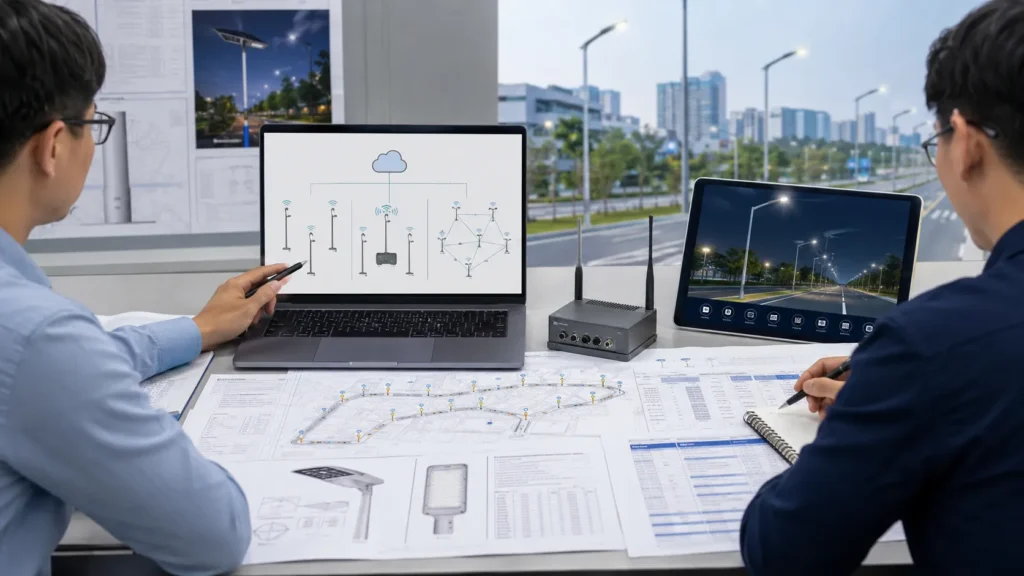
A smart street light is not only a lamp with an app. It normally includes the luminaire, controller, communication module, power or driver interface, platform, wiring, and commissioning tools.
| System Part | Main Function | Why It Matters |
|---|---|---|
| LED street light or solar street light | Provides lighting performance | The luminaire must still meet road lighting requirements |
| Smart controller | Controls on/off, dimming, and device status | This is the control point of each light |
| Communication module | Connects the controller to the network | It may use 4G/5G, LoRaWAN, Zigbee, NB-IoT, or another protocol |
| Gateway | Collects data from multiple nodes in some systems | Usually needed for LoRaWAN or Zigbee architecture |
| Cloud or local platform | Allows users to monitor and manage lights | Used for control, alarms, reports, and asset management |
| SIM card or data service | Connects cellular controllers to the operator network | Usually required for 4G/5G or cellular IoT systems |
| Dimmable driver | Allows the luminaire to adjust output | Required if the project needs dimming control |
| Wiring and accessories | Connects controller, driver, luminaire, and power system | Affects installation and maintenance quality |
| Commissioning tools | Used to bind, test, and accept devices | Important for handover and long-term operation |
This is why a smart street lighting system should not be reviewed only by the controller brand or communication protocol.
For a real government project, the buyer should check whether the luminaire, controller, communication network, platform, wiring, commissioning method, and maintenance plan can work together.
Quick Comparison: 4G/5G vs LoRaWAN vs Zigbee
The key difference is simple: 4G/5G usually connects each light directly through the cellular network, LoRaWAN connects many lights through planned gateways, and Zigbee connects nearby nodes through a local mesh network.
| Communication Method | Best-Fit Project Type | Main Advantage | Main Limitation |
|---|---|---|---|
| 4G/5G or cellular IoT | Dispersed roads, highways, rural roads, remote solar street lighting, multi-area projects | No local gateway required; each controller can connect directly through cellular network | SIM/data cost, cellular signal dependency, operator management |
| LoRaWAN | Large smart city zones, municipal districts, industrial parks, campuses, planned infrastructure areas | Long-range, low-data, scalable for many lighting nodes | Requires gateway planning, coverage review, and gateway maintenance |
| Zigbee | Parks, campuses, compounds, small municipal zones, dense local lighting networks | Mesh networking and local-area control for dense sites | Shorter practical range; depends on node density and site conditions |
The best option depends on project layout, signal condition, gateway availability, maintenance ability, and long-term cost model.
How 4G/5G Street Lighting Control Works
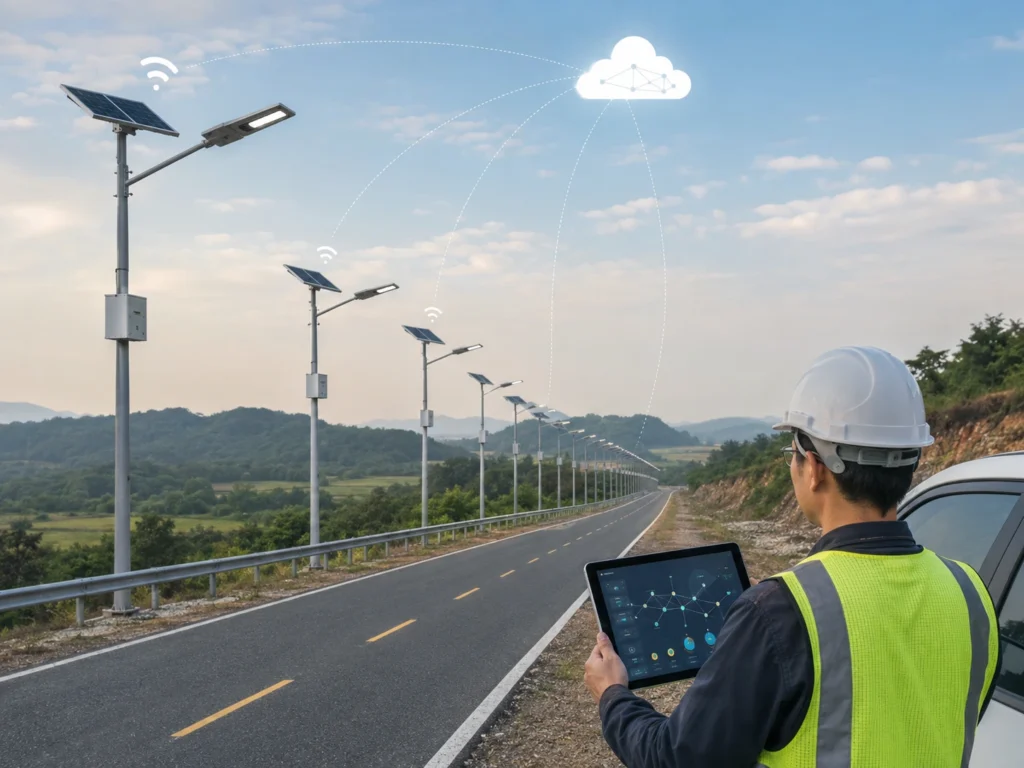
In a 4G/5G smart street lighting system, each lighting controller usually connects to the cloud platform through a cellular network.
The simplified structure is:
Street light controller with 4G/5G module → cellular operator network → cloud platform or management app
This means the system can often work without local gateways.
For many government road lighting projects, this is a major advantage. Long roads, rural roads, highways, coastal roads, village roads, and solar street lighting projects are often spread across large areas. Installing and maintaining gateways along every route may not be practical.
4G/5G control can be useful when:
- lighting points are widely dispersed
- the road network is long or linear
- local gateway installation is difficult
- the project needs faster deployment
- the maintenance team does not want to manage gateway infrastructure
- cellular signal is stable in the project area
- the buyer can accept SIM or data service management
However, 4G/5G is not a free or risk-free solution.
Before choosing 4G/5G, buyers should confirm:
- cellular signal strength along the project route
- SIM card management method
- data fee model
- platform compatibility
- operator availability
- long-term communication service responsibility
- what happens if a controller goes offline
- whether the project area has coverage from one or multiple operators
For most smart street lighting control functions, such as on/off control, dimming schedules, fault alarms, and status reporting, the system usually does not require high-bandwidth 5G data. In many projects, 4G, LTE-M, NB-IoT, or other cellular IoT options may already be enough, depending on the available local network and platform compatibility.
For dispersed projects, cellular control may reduce gateway work. But long-term communication cost and operational responsibility must be reviewed carefully.
How LoRaWAN Street Lighting Control Works
LoRaWAN smart street lighting usually depends on lighting nodes communicating with LoRaWAN gateways. The gateway then connects the lighting network to the server or platform.
The simplified structure is:
Lighting controller with LoRaWAN module → LoRaWAN gateway → network server / cloud platform
LoRaWAN is often attractive for large-scale smart city projects because street lighting control usually needs low-data communication. Many functions, such as on/off commands, dimming schedules, fault status, and energy data, can work with low data volume.
LoRaWAN can be suitable when:
- the project has many lighting points
- the project area is relatively planned or concentrated
- gateway locations can be secured
- the city or district already has LoRaWAN infrastructure
- the maintenance team can manage gateway equipment
- the buyer wants to avoid SIM cards for every lighting point
- the system mainly needs control and monitoring data, not high-bandwidth applications
The main issue with LoRaWAN is not the lighting node. The main issue is gateway planning.
Government buyers should confirm:
- how many gateways are needed
- where gateways will be installed
- whether each gateway location has power supply
- how the gateway connects back to the network
- whether buildings, trees, terrain, or metal structures may block coverage
- how many lights may be affected if one gateway fails
- who maintains the gateways
- what spare parts are required
- whether coverage testing is included before final acceptance
LoRaWAN can be a strong option for planned smart city lighting networks, but it should not be selected only because the node communication cost looks attractive. Gateway coverage and maintenance responsibility must be clear.
How Zigbee Street Lighting Control Works
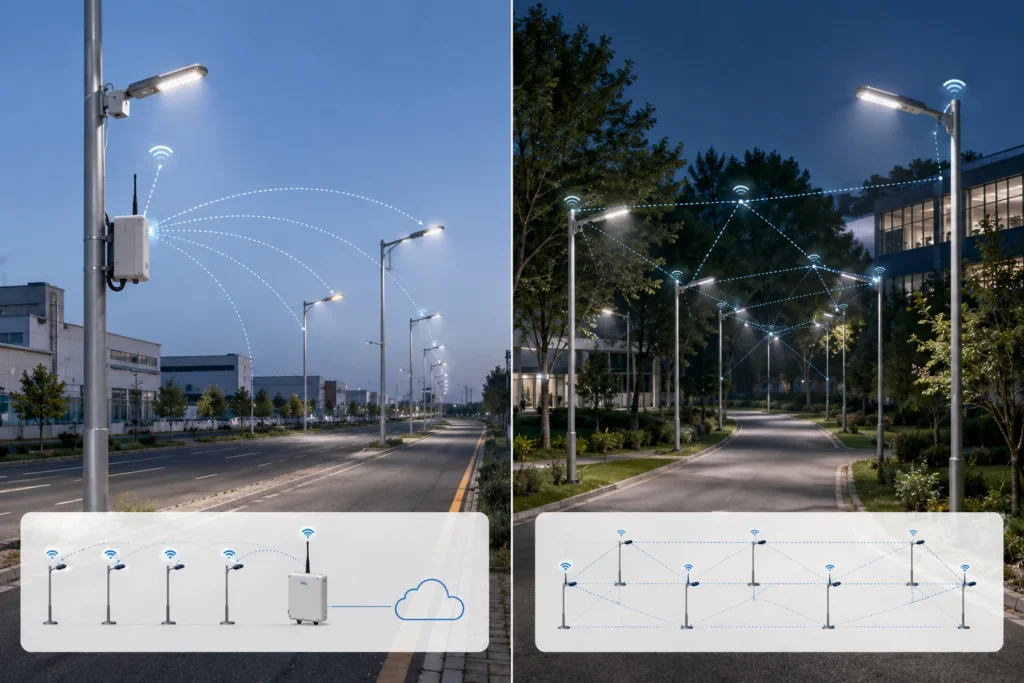
The simplified structure is:
Lighting node ↔ nearby lighting node ↔ coordinator / gateway → platform
Zigbee can work well in compact and dense environments because nearby nodes help the network remain connected.
Zigbee may be suitable for:
- parks
- campuses
- compounds
- closed industrial areas
- small municipal zones
- local smart lighting demonstration projects
- short-distance road lighting sections
- projects with dense lighting nodes
However, Zigbee is usually not the first choice for long, dispersed road lighting projects.
Government buyers should be careful when:
- pole spacing is large
- the project is spread across a long road
- the lighting network is divided into disconnected areas
- buildings, trees, or terrain may block communication
- the project requires city-scale control
- the maintenance team cannot troubleshoot mesh network issues
Zigbee should be reviewed as a local-area control option rather than a default solution for every municipal road lighting project.
Simple Decision Path by Project Type
The practical selection should start from the project condition, not from the protocol name.
Use this decision path as an early review tool:
- If the lights are widely dispersed, start by reviewing 4G/5G or other cellular IoT options.
- If the road network is long and linear, 4G/5G is often simpler than dense gateway or mesh planning.
- If the project area is large but planned, LoRaWAN can be reviewed.
- If the city or district already has LoRaWAN infrastructure, LoRaWAN may reduce duplicated network investment.
- If the project is small and dense, Zigbee may be suitable.
- If gateway locations are difficult to secure, 4G/5G may reduce site coordination.
- If cellular signal is weak or unstable, do not rely only on 4G/5G.
- If the maintenance team is limited, avoid overly complex gateway or mesh infrastructure.
- If long-term SIM cost is sensitive, compare LoRaWAN or another gateway-based option.
- If quick deployment is required, 4G/5G may reduce infrastructure preparation.
- If city-scale management is required, review 4G/5G and LoRaWAN together with platform requirements.
A simplified starting point is shown below.
| Project Type | Usually Better Starting Point | Why |
|---|---|---|
| Long municipal road | 4G/5G or LoRaWAN | Depends on cellular signal and gateway planning ability |
| Rural solar street lighting | 4G/5G or cellular IoT | Dispersed locations often make gateway maintenance difficult |
| Smart city district | LoRaWAN or 4G/5G | Large-scale platform management is needed |
| Park road with 20–50 lights | Zigbee, LoRaWAN, or 4G/5G | Depends on distance, density, and maintenance capacity |
| Campus or industrial park | LoRaWAN or Zigbee | More concentrated area makes local network planning easier |
| Highway or remote road | 4G/5G or cellular IoT | Gateway installation may be difficult along long routes |
| Small demonstration project | Zigbee or LoRaWAN | Local testing and controlled environment may be enough |
| Multi-town municipal project | 4G/5G or mixed architecture | Distributed locations may need flexible communication planning |
This table is not a final specification. It is a practical starting point for early project review.
Sunlurio Project Review Note: What We Check Before Recommending a Communication Method
When a buyer says “we need smart solar street lights” or “we want 5G street lighting,” Sunlurio does not recommend a communication method only by the protocol name. We first review the project layout, operating environment, maintenance responsibility, and tender requirements.
For government, municipal, EPC, and smart city lighting projects, the first review usually includes:
- whether the project is a long road, city district, park, campus, compound, or multi-town project
- how many lighting points are included in the current phase
- whether future expansion is expected
- pole spacing and distance between lighting nodes
- whether the lights are solar, AC, or hybrid
- whether cellular signal is stable across the full route
- whether gateway locations can be powered, protected, and maintained
- who will manage SIM cards, data plans, platform accounts, and offline alarms
- whether the local maintenance team can operate the platform after handover
- whether the tender requires local hosting, user permission control, reports, or API integration
For many projects in Africa, the Middle East, and Southeast Asia, the technical decision is also affected by practical site conditions. A gateway may need power supply, waterproof protection, lightning protection, anti-theft consideration, and maintenance access. A 4G/5G controller may simplify deployment, but SIM management and operator coverage still need to be confirmed. A Zigbee mesh may work well in a compact park or campus, but it can become unstable if pole spacing is too large or the site is divided by buildings, trees, walls, or terrain.
This is why Sunlurio normally reviews smart control together with the lighting product, solar power system, pole layout, dimming profile, platform function, BOQ, wiring diagram, and commissioning checklist.
Example: 20 Smart Solar Street Lights for a Park Road
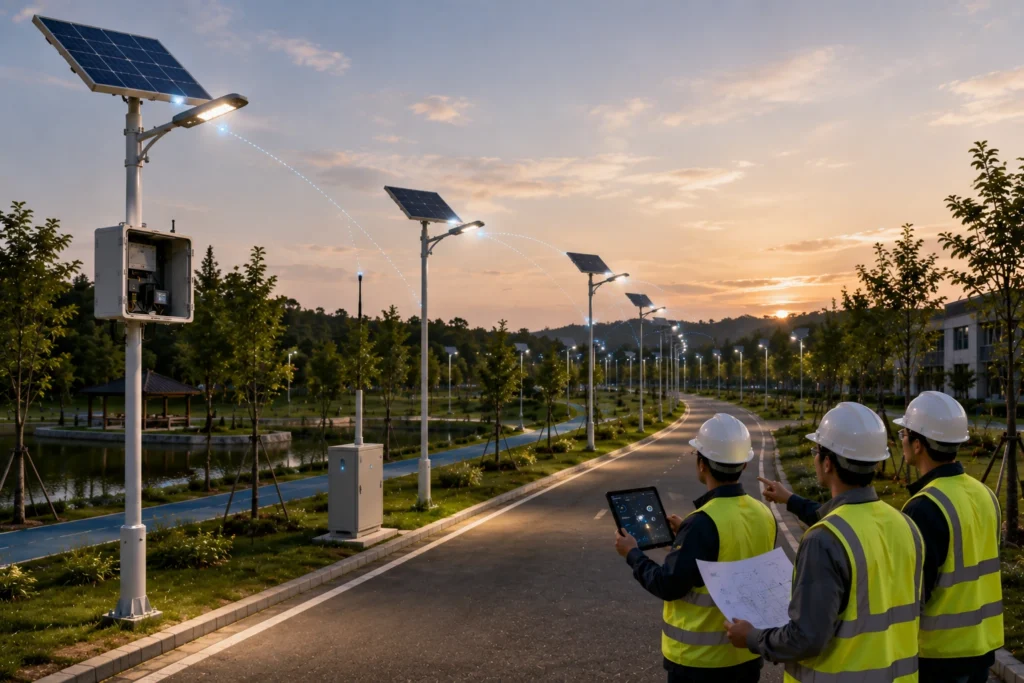
A simple example can make the system structure easier to understand.
Suppose a government authority, park owner, or EPC contractor wants to install 20 smart solar street lights along a park road. The project needs remote monitoring, dimming schedule, and fault alarm.
The project team should first confirm:
- approximate road length
- pole spacing
- whether all 20 lights are in one connected area
- whether there is a guard room, service room, or high point suitable for gateway installation
- cellular signal condition inside the park
- whether the buyer wants device-level control or group control
- whether the project may later expand to 50–100 lights
- who will operate the platform after handover
There are three possible communication directions.
Option A: 4G/5G Control Structure
Each solar street light → smart controller with 4G/5G module → operator cellular network → cloud platform / app
In this structure, each solar street light has its own smart controller with a cellular module. Each controller connects directly to the platform through the operator network.
This option may be suitable when:
- the 20 lights are spread along a long road
- there is reliable cellular signal in the park area
- the buyer wants to avoid local gateway installation
- the maintenance team prefers device-level management
- SIM or data service cost is acceptable
The main advantage is simple deployment.
The main point to check is long-term SIM, data, and platform service cost.
Option B: LoRaWAN Control Structure
Solar street lights with LoRaWAN controllers → LoRaWAN gateway in or near the park → internet backhaul → cloud platform
In this structure, the 20 solar street lights communicate with one or more LoRaWAN gateways. The gateway then connects the system to the platform.
This option may be suitable when:
- the park road is relatively concentrated
- a gateway can be installed in a good location
- the gateway has power and network connection
- the project may expand to more lights later
- the buyer wants to avoid SIM cards for every light
The main advantage is that multiple lights can be managed through planned gateway infrastructure.
The main point to check is gateway coverage and maintenance responsibility.
Option C: Zigbee Control Structure
Solar street light node ↔ nearby solar street light node ↔ coordinator / gateway → platform
In this structure, nearby lights form a local mesh network. The system connects to a platform through a coordinator or gateway.
This option may be suitable when:
- the park road is short
- pole spacing is not too large
- the nodes are close enough to support stable mesh communication
- the project is small and local
- the buyer wants local-area control
The main advantage is local mesh networking for dense environments.
The main point to check is distance, obstruction, and mesh stability.
For a 20-light park project, all three options may be possible. The best choice depends on site distance, pole spacing, cellular signal, gateway installation conditions, maintenance capacity, and long-term cost model.
Gateway Review Checklist: The Hidden Cost Many Buyers Miss
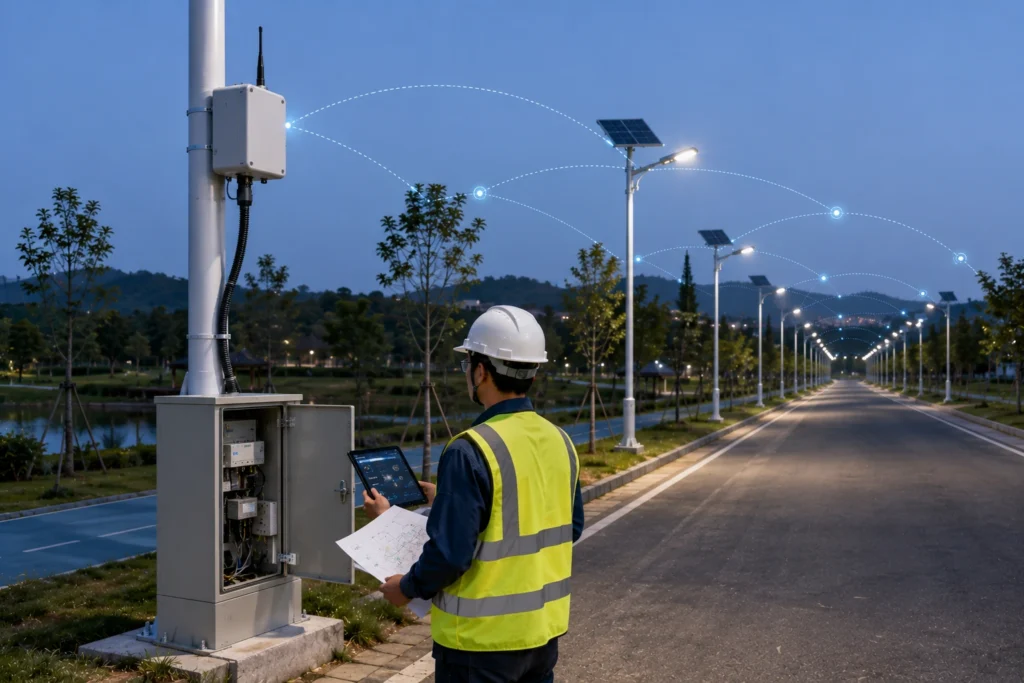
Gateway requirement is one of the most important differences between 4G/5G, LoRaWAN, and Zigbee.
4G/5G systems usually do not need a local gateway for each project area. Each controller can connect directly through the cellular network. This can simplify installation for dispersed roads and remote solar street lighting projects.
LoRaWAN and Zigbee systems usually depend on gateways, coordinators, or local network infrastructure. These devices are not a problem by themselves, but they must be included in the project design.
For gateway-based systems, buyers should review:
- gateway quantity
- gateway installation location
- power supply for gateway
- backhaul connection method
- waterproof and dustproof protection
- lightning protection
- anti-theft protection
- signal coverage review
- maintenance access
- spare gateway requirement
- troubleshooting responsibility
- number of lights affected by one gateway failure
A gateway may look like a small part of the system, but in real projects it can become a major operation point.
If the gateway is poorly located, many lighting nodes may become unstable. If nobody is responsible for gateway maintenance, the smart lighting system may lose its value after installation.
SIM Cost, Data Fee, Platform Fee, and Lifecycle Cost
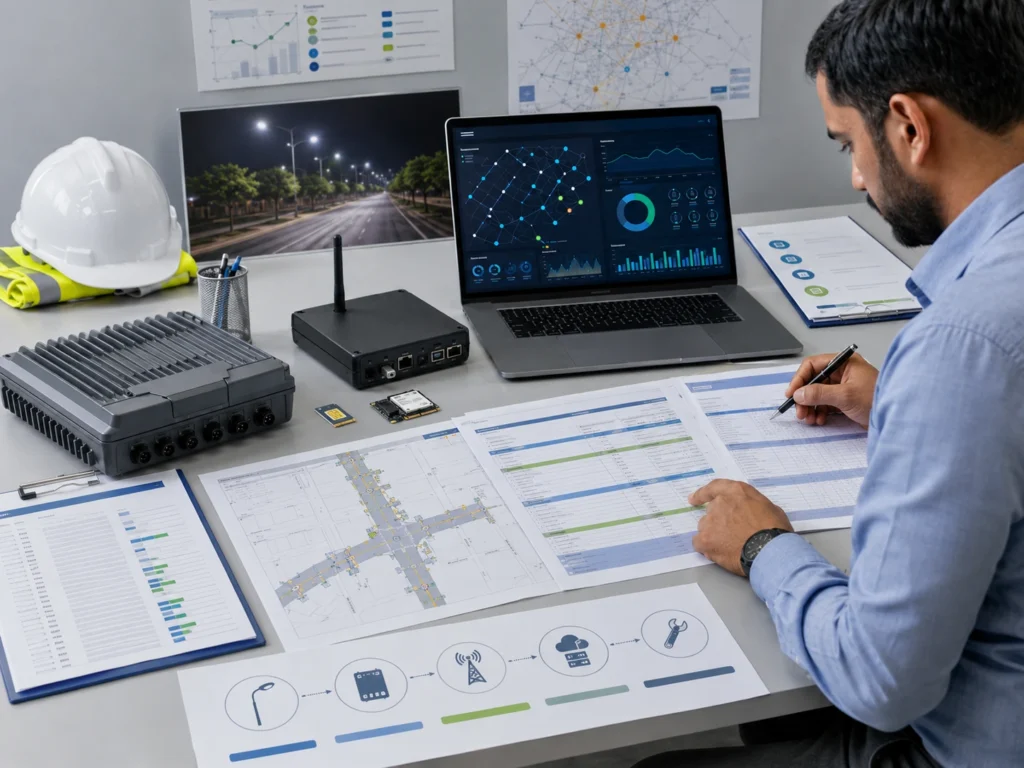
A smart street lighting project should not only compare controller price. It should compare the full cost of ownership, including CAPEX and OPEX.
| Cost Item | 4G/5G | LoRaWAN | Zigbee |
|---|---|---|---|
| Controller cost | Usually higher than basic non-smart control | Node cost can be efficient at scale | Often suitable for local dense networks |
| Gateway cost | Usually low or not required locally | Required and must be planned | Required depending on architecture |
| SIM / data fee | Usually required | Usually not required per lighting node | Usually not required per lighting node |
| Platform service fee | Depends on provider and hosting model | Depends on provider and hosting model | Depends on provider and hosting model |
| Deployment complexity | Lower for dispersed sites | Requires gateway and coverage planning | Requires local mesh planning |
| Maintenance workload | SIM, signal, and platform management | Gateway, coverage, and network maintenance | Mesh stability and local troubleshooting |
| Best cost scenario | Dispersed or remote projects | Large planned low-data networks | Small dense local projects |
| Main cost risk | Long-term data and operator dependency | Gateway maintenance and coverage blind spots | Range and network stability in dispersed areas |
A smart lighting tender should not only ask for the controller price.
It should also ask:
- Who pays for the platform?
- Who pays for communication service?
- Who maintains gateways?
- Who replaces failed controllers?
- Who manages SIM cards?
- Who handles offline devices?
- Who trains the municipal maintenance team?
- Who provides commissioning support?
- What documents are included for acceptance?
These questions are important because government street lighting projects are usually expected to operate for many years.
Smart Street Lighting Control Is Not Only Communication
A communication protocol alone cannot make a street lighting system smart. The system becomes useful only when the luminaire, controller, communication network, platform, installation method, and maintenance process work together.
Before approval, buyers should confirm:
- whether the LED driver supports dimming
- whether the controller interface matches the luminaire
- whether the controller is suitable for AC, solar, or hybrid street lighting
- whether surge protection is included
- whether the pole wiring supports the control architecture
- whether the platform functions match the tender requirements
- whether the system supports group control or individual control
- whether manual override is required
- whether commissioning instructions are provided
- whether maintenance staff can operate the platform
A communication module alone does not guarantee a working smart street lighting project.
For project-based lighting review, buyers can also review Sunlurio’s smart lighting control products, smart street lighting system design, and engineering support for project review.
What Buyers Should Confirm Before Tender Approval
Before selecting 4G/5G, LoRaWAN, or Zigbee, government and EPC buyers should confirm the project inputs.
A practical tender review should include:
- project area and road type
- number of lighting points
- pole spacing and road length
- whether the project is concentrated or dispersed
- power source: solar, AC, or hybrid
- required smart control functions
- cellular signal condition
- gateway installation condition
- platform language and user access
- maintenance team capability
- data hosting or cybersecurity requirement
- budget model: one-time cost, subscription cost, or mixed model
- required tender documents and acceptance records
If these inputs are unclear, the supplier can only provide a generic smart lighting proposal. For government projects, that is usually not enough.
Required Documents for Smart Street Lighting Projects
A reviewable smart street lighting proposal should include more than a product datasheet.
| Document | Why It Matters |
|---|---|
| Smart control architecture | Shows how lighting nodes, gateways, network, and platform connect |
| Controller datasheet | Confirms protocol, interface, protection level, voltage, and control functions |
| Luminaire schedule | Connects each light model with controller type and pole location |
| Gateway plan | Required for LoRaWAN or Zigbee projects |
| Network coverage plan | Reduces blind zone and offline device risk |
| Wiring diagram | Supports installation and troubleshooting |
| Platform function list | Confirms remote control, dimming, alarm, reporting, and user access |
| BOQ mapping | Defines models, quantities, gateways, accessories, and scope clearly |
| Commissioning checklist | Helps acceptance and handover |
| Maintenance guide | Helps the government team operate the system after installation |
These documents make the project easier to approve, compare, install, commission, and maintain.
For tender-based projects, buyers can review Sunlurio’s BOQ and tender document support, datasheets and wiring drawings, and engineering support pack.
Common Mistakes to Avoid
Mistake 1: Choosing Only by Module Price
A cheaper controller module may create higher long-term operation cost if it requires difficult gateway maintenance, unstable communication, or extra troubleshooting.
Government buyers should compare total lifecycle cost, not only product unit price.
Mistake 2: Ignoring Gateway Maintenance
For LoRaWAN or Zigbee projects, gateways must be installed, powered, protected, connected, and maintained.
If gateway responsibility is not defined, the smart lighting system may become difficult to operate after handover.
Mistake 3: Assuming 4G/5G Always Has Stable Signal
4G/5G can simplify deployment, but only when cellular signal is reliable.
Before using 4G/5G for remote roads, ports, industrial zones, or rural solar street lights, the project team should verify local signal coverage.
Mistake 4: Using Zigbee for Overly Dispersed Road Projects
Zigbee can work well in dense local networks, but it may not be suitable for long, linear, widely spaced municipal road projects.
Pole spacing and node density should be checked before choosing Zigbee.
Mistake 5: Not Defining Platform Functions Clearly
Different buyers may expect different functions from “smart control.”
The tender should define whether the project needs remote on/off, dimming, group control, fault alarm, energy monitoring, GIS map, user permissions, maintenance reports, or API integration.
Mistake 6: Separating Lighting Design from Control Design
The smart control system must match the luminaire, driver, pole wiring, power system, and installation method.
A communication module alone does not guarantee a working smart street lighting project.
When Each Option May Not Be Suitable
A good smart lighting supplier should help the buyer understand limitations instead of recommending one option for every project.
4G/5G May Not Be Suitable When
- cellular coverage is poor
- long-term SIM or data cost is unacceptable
- SIM management is difficult
- the project requires local network independence
- the platform cannot support the required operators or regions
- data hosting or cybersecurity rules restrict cellular cloud connection
LoRaWAN May Not Be Suitable When
- gateway locations are difficult to secure
- the project is too small to justify gateway planning
- the maintenance team cannot manage gateway infrastructure
- many physical obstructions affect wireless coverage
- there is no clear responsibility for gateway power, network, and protection
Zigbee May Not Be Suitable When
- pole spacing is too large
- the project is spread across a long city road or highway
- the lighting network is not dense enough
- site obstructions reduce mesh stability
- the project requires large-scale citywide operation
- local maintenance teams cannot troubleshoot mesh network issues
How Sunlurio Supports Smart Street Lighting Projects
Sunlurio supports smart street lighting projects by helping buyers match lighting products, communication options, control architecture, and engineering documents with real project conditions.
For government, municipal, EPC, and smart city lighting projects, Sunlurio can support:
- smart street lighting system configuration
- 4G/5G, LoRaWAN, or Zigbee control option discussion
- controller and luminaire matching
- solar, AC, or hybrid power coordination
- dimming schedule and control function review
- platform function clarification
- wiring and installation notes
- smart control architecture diagram
- BOQ mapping by model and accessory
- datasheets and drawings
- manufacturing and quality control support
- commissioning and handover checklist
This helps buyers evaluate not only the communication protocol, but also whether the full lighting system can be reviewed, installed, accepted, and maintained.
For government and EPC projects, that is often more important than choosing the lowest-price control module.
Related Solutions and Engineering Support
For broader project planning, review:
- Smart lighting control products
- Smart street lighting system design
- 5G solar street light system
- Smart 5G solar systems
- 4G/5G smart light project references
- Engineering support for project review
- BOQ and tender document support
- Datasheets and wiring drawings
- Manufacturing and quality control
These pages help buyers understand how lighting configuration, smart control architecture, project documents, manufacturing control, and engineering support work together for tender-based street lighting projects.
FAQ
What is smart street lighting control?
Smart street lighting control means using controllers, communication networks, and a management platform to monitor and control street lights remotely. It may include remote switching, dimming schedules, group control, fault alarms, energy monitoring, asset management, and maintenance reporting.
Which communication method is best for smart street lighting?
There is no single best communication method for every smart street lighting project. 4G/5G is often easier for dispersed roads, LoRaWAN is suitable for large planned low-data networks, and Zigbee is more suitable for small dense local-area projects.
Is 4G/5G better than LoRaWAN for street lighting control?
4G/5G is not always better than LoRaWAN. It is usually easier when the project is dispersed and gateway installation is difficult. LoRaWAN may be better for large planned networks where gateways can be installed and maintained properly.
Does LoRaWAN street lighting need a gateway?
Yes, LoRaWAN street lighting normally requires gateways. Lighting nodes communicate with the gateway, and the gateway connects the system to the network server or platform. Gateway quantity, location, power, protection, and maintenance should be planned before approval.
What is a gateway in smart street lighting?
A gateway is a communication bridge between lighting controllers and the cloud platform. It collects data from nearby lighting nodes and sends that data to the platform through Ethernet, cellular network, WiFi, or another backhaul connection.
Is Zigbee suitable for municipal street lighting?
Zigbee can be suitable for small and dense municipal zones, parks, campuses, compounds, or local demonstration projects. It is usually less suitable for long, dispersed roads with large pole spacing.
Do 4G/5G smart street lights need SIM cards?
In many 4G/5G smart street lighting systems, each controller needs a SIM card or cellular service identity to connect to the operator network. Buyers should confirm SIM management, data fee, operator coverage, and long-term service responsibility before approval.
What is the main cost difference between 4G/5G, LoRaWAN, and Zigbee?
4G/5G may reduce gateway infrastructure but usually needs SIM or data service management. LoRaWAN may reduce per-node communication cost but needs gateway planning and maintenance. Zigbee may work well in dense local networks but can become difficult in dispersed projects.
Can solar street lights use smart control?
Yes, solar street lights can use smart control. The controller and communication method must match the solar power system, battery logic, dimming schedule, and project maintenance requirements.
What documents are needed for a smart street lighting tender?
Useful documents include smart control architecture, controller datasheet, gateway plan, luminaire schedule, wiring diagram, platform function list, BOQ mapping, commissioning checklist, and maintenance guide.
Request Engineering Pack
If you are planning a government, municipal, EPC, or smart city street lighting project, Sunlurio can help review the smart control direction before final tender or procurement.
To support faster review, please prepare:
- project area and road type
- number of lighting points
- pole spacing
- power source: solar, AC, or hybrid
- required smart control functions
- preferred communication method, if any
- cellular signal condition
- gateway installation conditions
- platform and maintenance requirements
- tender document or technical specification
Sunlurio can support your team with smart street lighting configuration, communication option discussion, controller and luminaire matching, BOQ mapping, datasheets, drawings, and commissioning-ready project documents.